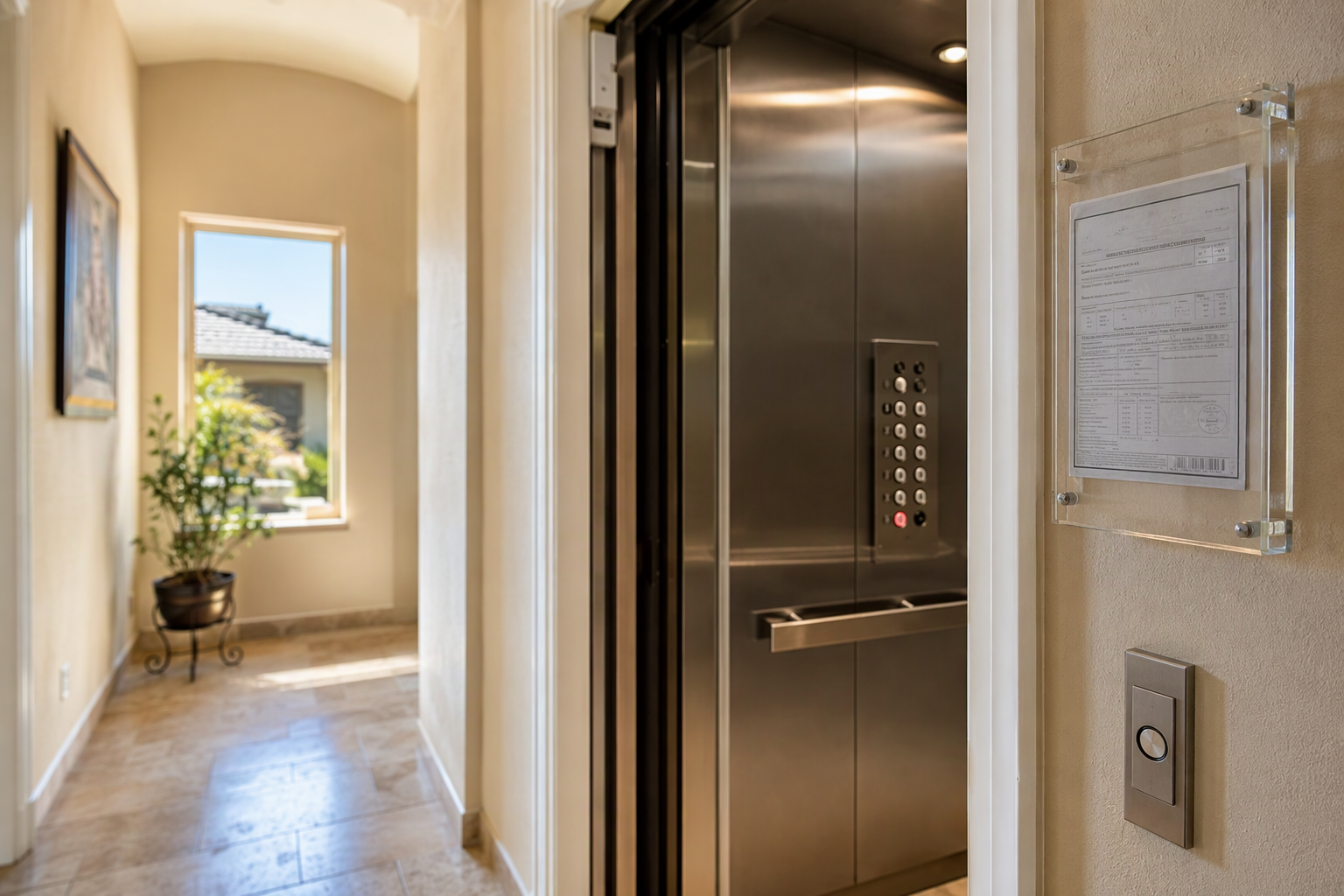
How can I find out if an elevator company has previously serviced the elevator at my residential property?

Check the state serial number tag affixed to the elevator controller or mainline disconnect, then cross-reference that number with the certificate of inspection posted in or near the cab. The Industrial Commission of Arizona (ICA) Elevator Division assigns a unique serial number to every conveyance in the state. That number links to inspection history, registered inspectors, and contractor records. You can also request the maintenance logbook from the prior owner, examine the contractor information on the posted certificate, and reach out to the ICA Elevator Division directly with the serial number to obtain official inspection records.
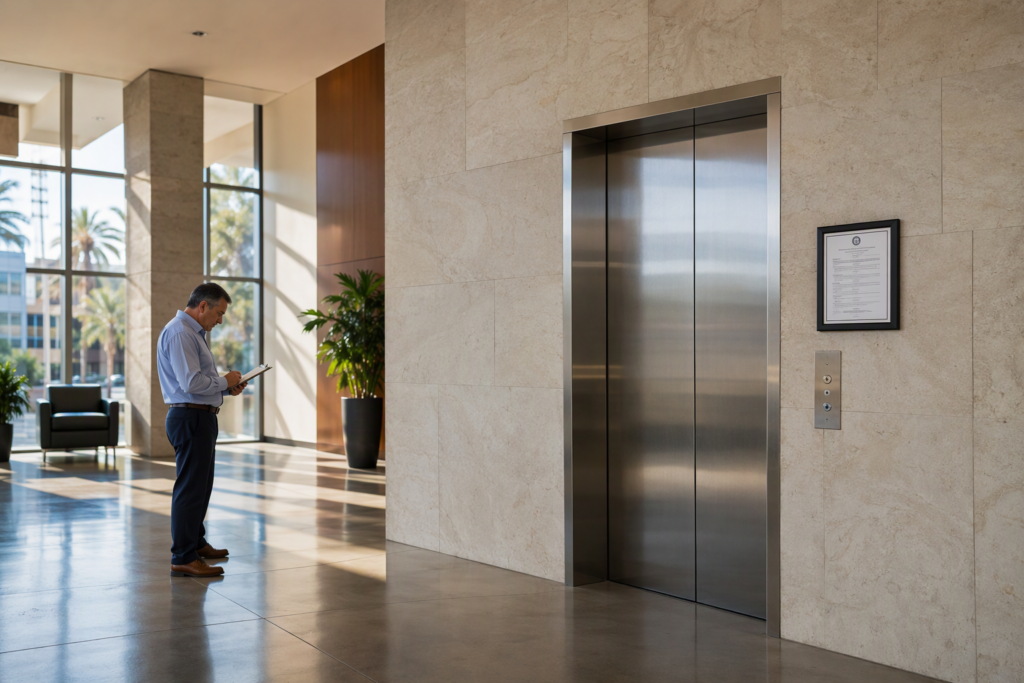
In Arizona, under A.R.S. §§ 23-491 through 23-491.16 and Arizona Administrative Code R20-5-502 through R20-5-515, the owner is legally required to keep the current certificate of inspection at the same location as the conveyance and to make it available on request. That certificate will typically identify the inspector who performed the most recent annual inspection. While the certificate does not always name the ongoing service contractor, it is the fastest paper trail available to a new owner trying to reconstruct service history.
What is the state serial number, and where is it located on a residential elevator?

The state serial number is a unique identifier assigned by the Industrial Commission of Arizona to every regulated conveyance in the state, and it is physically located on a tag fixed to the controller or the mainline disconnect of the elevator.
This number is the foundational piece of information any owner, inspector, or service contractor needs to look up the history of a specific unit. On a residential elevator, the controller is typically found in a machine room, a closet adjacent to the hoistway, or mounted directly in the hoistway depending on the drive type. Arizona law also requires the serial number or the certificate itself to be posted in or close to the conveyance in an easily accessible location, so checking inside the cab or on the adjacent wall is a reasonable starting point before locating the controller.
When Arizona Elevator Solutions performs an initial assessment on a property, one of the first steps is locating and recording this state serial number so that all subsequent communications with the ICA Elevator Division reference the correct registered unit.
What does the certificate of inspection tell me about past service?
The certificate of inspection identifies the authorized inspector who signed off on the most recent annual inspection, the date of that inspection, and the conveyance’s compliance status as of that date — giving a new owner a clear starting point for reconstructing service history.
Under Arizona law, no conveyance may operate in the state without a valid annual certificate of inspection issued by the state. The certificate must be kept at the same location as the conveyance and must be posted in an easily accessible location. When reviewing the certificate, note the inspector’s name and registration number. You can then contact the ICA Elevator Division to verify that inspector’s registration status and ask whether additional inspection records are on file for the serial number. The certificate itself does not always name the routine maintenance contractor — inspectors and maintenance contractors are frequently different entities in Arizona — but it anchors the timeline of documented compliance.
How do I request historical elevator records from the Industrial Commission of Arizona?
Contact the ICA Elevator Division directly, providing the conveyance’s state serial number, the property address, and a description of your ownership or interest in the property, and ask for all inspection certificates and filed reports associated with that serial number.
The Industrial Commission of Arizona administers elevator safety under A.R.S. §§ 23-491 through 23-491.16 as amended by Laws 2026, Ch. 73. The ICA Elevator Division (formerly called the ADOSH Elevator Safety Section until September 12, 2026) maintains records of initial inspections, annual inspections performed by both state and authorized private inspectors, accident reports, and notifications of alteration or relocation. Arizona owners are required to notify the state at least 90 days before installing, relocating, or altering a conveyance, and within 24 hours of any accident — meaning those event records should also exist in the state file for older equipment with any significant history.
For elevators located inside the City of Phoenix, the City of Phoenix Elevator Section within the Planning and Development Department also maintains local inspection records, so contacting both the city and the ICA is advisable for Phoenix properties.
Can a previous owner’s maintenance records legally be transferred to a new property owner?
Maintenance logbooks and service records are generally considered property records that transfer with the building, though the obligation to produce them is a matter of real estate contract and disclosure rather than elevator statute.
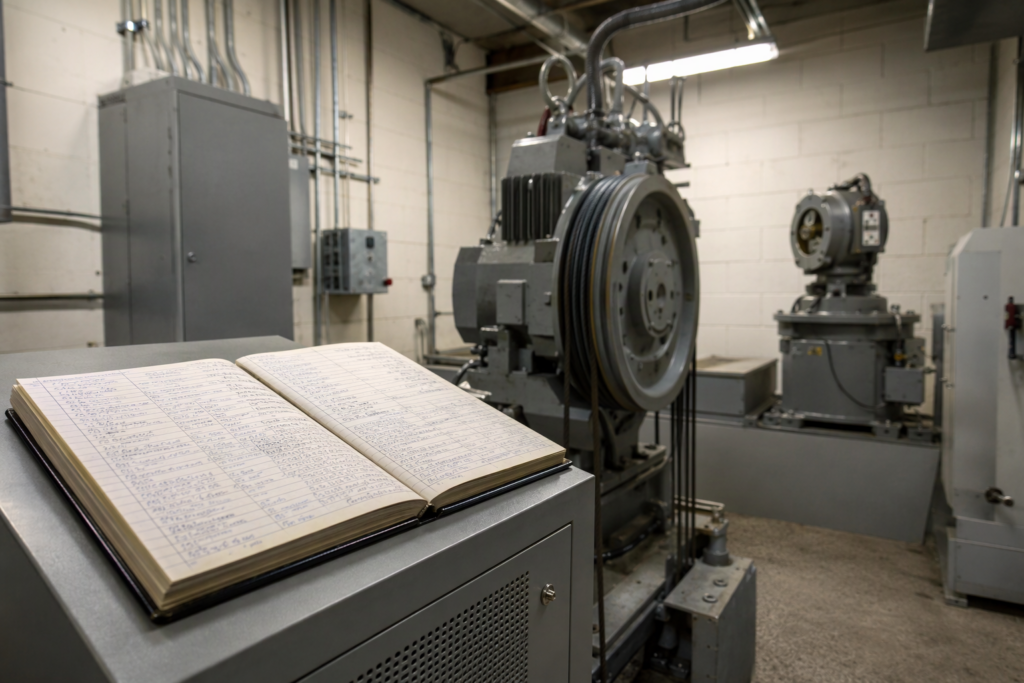
When negotiating a property purchase, buyers should specifically request the elevator maintenance logbook, all prior certificates of inspection, any repair invoices, and any correspondence with the ICA Elevator Division as part of due diligence. Arizona elevator law places ongoing compliance obligations on the owner or operator of the conveyance, meaning a new owner inherits those obligations regardless of prior service history. If records are missing or incomplete, the most prudent step is to arrange a full inspection before resuming operation. Arizona owners may hire a private elevator inspector authorized by the ICA to perform this inspection, provided that inspector has no conflict of interest with the equipment or the servicing company.
What records should a reputable elevator service company maintain on my behalf?
A reputable elevator service company should maintain a complete maintenance logbook for each unit it services, documenting the date, nature, and outcome of every visit, all parts replaced, any deficiencies identified, and the technician or company identifier for each entry.
Beyond the logbook, the service contractor should retain copies of all certificates of inspection, any permits filed with the ICA Elevator Division or the City of Phoenix Elevator Section, and documentation of any repairs or alterations that triggered a new inspection requirement. Under ASME A17.1-2019, which Arizona has adopted for equipment installed, repaired, or altered on or after January 1, 2023, maintenance requirements and testing intervals are detailed in the code. A contractor following ASME A17.1-2019 systematically will produce a paper trail that is straightforward to audit. When a property changes hands, the outgoing contractor should provide these records to the owner for transfer to the new party or new service provider.
How do I verify that an elevator contractor is licensed to work on my elevator in Arizona?
Verify the contractor’s R-12 or C-12 license classification through the Arizona Registrar of Contractors (ROC), which authorizes the installation and repair of elevators, dumbwaiters, escalators, and moving walks in Arizona.
The Arizona Registrar of Contractors issues R-12 (residential) and C-12 (commercial) elevator license classifications. Any contractor performing elevator installation or repair work in Arizona without one of these classifications is operating unlawfully. Verifying the license through the ROC public license lookup takes only a few minutes and confirms whether the license is active and in good standing. Note that the ROC licenses contractors but does not issue the annual certificate of inspection — that remains the responsibility of an authorized inspector through the ICA Elevator Division. A contractor may hold a valid ROC license and still be subject to separate inspection oversight.
Arizona Elevator Solutions holds the appropriate Arizona Registrar of Contractors licensing, ensuring that all work performed on residential and commercial elevators in Phoenix, Tucson, Scottsdale, and Mesa is fully authorized under state law.
What is the difference between an elevator inspector and an elevator service contractor in Arizona?
An elevator inspector is an independent, ICA-authorized professional who assesses compliance with safety codes and issues the certificate of inspection, while an elevator service contractor performs routine maintenance, repairs, and alterations on the equipment.
This distinction matters when researching service history. The name on the certificate of inspection is the inspector, not the maintenance contractor. Arizona law specifically prohibits a private elevator inspector from inspecting a conveyance owned, operated, or last serviced by the inspector, a company the inspector owns, or the inspector’s employer — a conflict-of-interest safeguard that keeps inspection and maintenance roles formally separate. Arizona private elevator inspectors must also register with the ICA annually and demonstrate at least eight hours of approved continuing education to maintain their authorization. When tracing service history, it is therefore necessary to pursue two separate inquiries: who inspected the unit, and who maintained it.
What steps should I follow immediately after purchasing a home with an existing elevator?
Follow these steps in order to establish a compliant and documented service baseline for a residential elevator after a property purchase:
- Locate the state serial number tag on the controller or mainline disconnect and record the number.
- Locate the posted certificate of inspection in or near the cab and confirm it is current and not expired.
- Request all maintenance logbooks, prior certificates, repair invoices, and ICA correspondence from the seller or seller’s agent before closing if possible.
- Contact the ICA Elevator Division with the state serial number to request the official inspection file for that conveyance.
- For properties in the City of Phoenix, also contact the City of Phoenix Elevator Section to request locally filed records.
- If the certificate of inspection has expired or records are unavailable, arrange for a full inspection by an ICA-authorized private elevator inspector before resuming operation.
- Engage a licensed elevator service contractor holding an Arizona ROC R-12 or C-12 classification to establish an ongoing maintenance program aligned with ASME A17.1-2019.
- Confirm the contractor’s service records will be maintained in a logbook kept at the property.
Does Arizona law require a residential elevator to be inspected annually?
Yes — Arizona law requires every conveyance, including residential elevators, to be inspected before it first goes into service, after any modification or alteration, and annually after that, with no conveyance permitted to operate without a valid annual certificate of inspection.
This requirement flows from A.R.S. §§ 23-491 through 23-491.16 and Arizona Administrative Code R20-5-502 through R20-5-515. A gap in annual inspection certificates is therefore a legally significant finding, not merely an administrative oversight. If a certificate is missing for a given year, it means either the inspection was not performed (a violation), the records were lost, or the certificate was not posted as required. Any of these situations warrants direct communication with the ICA Elevator Division to clarify the record before the new owner continues operating the equipment.
What inspection and service benchmarks should a residential elevator meet?
| Requirement or Benchmark | Standard or Authority | Frequency / Threshold |
|---|---|---|
| Annual certificate of inspection | A.R.S. §§ 23-491 through 23-491.16; AZ Admin. Code R20-5-502 through R20-5-515 | Every 12 months; required before operation |
| Inspection before first use or after alteration | A.R.S. §§ 23-491 through 23-491.16 | Prior to each new service commencement or post-alteration restart |
| Owner notification before installation, relocation, or alteration | A.R.S. §§ 23-491 through 23-491.16 | At least 90 days in advance |
| Accident notification to state | A.R.S. §§ 23-491 through 23-491.16 | Within 24 hours of injury or disabling event |
| Applicable installation/repair code (new or altered equipment from Jan. 1, 2023) | ASME A17.1-2019 | All covered work on or after January 1, 2023 |
| Platform lifts and stairway chairlifts (new or altered from Jan. 1, 2023) | ASME A18.1-2020 | All covered work on or after January 1, 2023 |
| Private inspector continuing education | A.R.S. §§ 23-491 through 23-491.16; ICA Elevator Division | At least 8 hours of approved CE per annual registration cycle |
| Contractor licensing | Arizona Registrar of Contractors, R-12 / C-12 | Must be active and in good standing before any installation or repair |
| ADA accessibility (where applicable) | Americans with Disabilities Act | Applies to covered multi-unit or public residential buildings; consult ADA guidelines |
What if no service records exist for the elevator at a property I am purchasing?
If no service records can be located, treat the elevator as uninspected and do not operate it until an ICA-authorized inspector has performed a full inspection, any identified deficiencies have been corrected by a licensed elevator contractor, and a valid certificate of inspection is posted.
The absence of records does not mean the elevator was never serviced, but it does mean there is no documented basis for assuming the equipment is safe or code-compliant. Under Arizona law, the owner bears the ongoing legal obligation for compliance regardless of what prior owners did or did not do. Lawfully installed older conveyances may remain in service in Arizona unless the ICA’s elevator chief determines the use presents a hazard to life, health, or property — but that determination requires an inspection to make. Engaging a qualified service provider such as Arizona Elevator Solutions to perform a comprehensive condition assessment before or immediately after purchase protects the new owner from inheriting undocumented liability.
Can I contact a previous elevator service company directly to request records?
Yes — contacting the prior service company directly is a practical and often productive step, particularly if the company name appears on a service sticker, the certificate of inspection, or in the maintenance logbook found at the property.
Many elevator service contractors affix a service identification sticker to the cab interior, the controller, or the machine room door when they commence a service relationship. This sticker may include a company name, phone number, and account number that can be used to request records directly. While the company is under no statutory obligation to provide those records to a third party, most reputable contractors will cooperate when presented with evidence of new ownership. If the prior company has gone out of business, its records may have been acquired by a successor company, so a brief search using the ROC license number (if it can be identified) may help trace where those records went.
What role does ADA compliance play in a residential elevator’s service history?
For covered residential properties — such as multi-family buildings with more than a specified number of units — the Americans with Disabilities Act and the Fair Housing Act may impose accessibility standards that affect how the elevator was designed, installed, and maintained, making ADA compliance status part of a complete service history review.
Single-family owner-occupied residences are generally outside the ADA’s scope, but residential buildings that meet coverage thresholds are not. When assessing service history on a multi-unit residential property, verifying that the elevator’s historical maintenance addressed ADA-required features — such as cab dimensions, door timing, control button height, and auditory signals — is part of a thorough due-diligence review. Any gaps in ADA compliance may also affect the owner’s obligations going forward. A service contractor familiar with both ASME A17.1-2019 and ADA technical requirements can flag these issues during an assessment.
How does the firefighters’ emergency operation requirement affect service documentation in Arizona?
Arizona requires conveyances with firefighters’ emergency operation to use the Arizona Firefighters Service (AZFS) key, and documentation of compliance with this requirement should appear in the inspection and maintenance records as a verified safety feature.
The AZFS key is Arizona-specific and distinguishes the state’s requirements from generic firefighters’ service standards. During any inspection or service visit, an authorized inspector or qualified technician should test and document the firefighters’ emergency operation function. If service records for a recently purchased elevator do not include documentation of AZFS key compliance, this is a gap that should be addressed promptly. The ICA Elevator Division’s inspection file for the conveyance may contain notes on whether this feature was present and functional at the time of prior inspections.
What should I look for when comparing elevator service companies to take over maintenance on a residential property?
When comparing elevator service contractors, evaluate each company’s Arizona ROC license status, their familiarity with ICA Elevator Division requirements, their process for maintaining the on-site logbook, and their ability to coordinate with an authorized independent inspector for the annual certificate.
The table below outlines key comparison criteria:
| Comparison Criterion | What to Look For | Why It Matters |
|---|---|---|
| Arizona ROC License (R-12 / C-12) | Active, in-good-standing classification verified through ROC | Legal requirement for installation and repair work in Arizona |
| ICA Elevator Division familiarity | Experience filing notifications, coordinating inspections, using AZFS keys | Ensures compliance with A.R.S. §§ 23-491 through 23-491.16 |
| ASME A17.1-2019 competency | Demonstrated knowledge of the adopted Arizona code edition | All repair and alteration work from Jan. 1, 2023 must meet this standard |
| On-site logbook maintenance | Commitment to leaving a complete, dated record after every visit | Creates the paper trail needed for future ownership transitions |
| Service territory | Explicit coverage of your city (Phoenix, Tucson, Scottsdale, or Mesa) | Ensures timely availability for routine and urgent service calls |
| Conflict-of-interest policy | Separation of maintenance and inspection roles per ICA requirements | Preserves the independence of the annual inspection process |
Arizona Elevator Solutions serves residential and commercial property owners throughout Phoenix, Tucson, Scottsdale, and Mesa, and maintains full compliance with Arizona ROC licensing and ICA Elevator Division requirements.
What happens if an elevator in Arizona is operating without a valid certificate of inspection?
Operating a conveyance in Arizona without a valid annual certificate of inspection is a violation of A.R.S. §§ 23-491 through 23-491.16, exposing the owner to enforcement action by the ICA Elevator Division and potential liability in the event of an incident.
When a new owner discovers an expired or missing certificate, the correct course of action is to cease operation of the elevator, contact the ICA Elevator Division to report the gap and request guidance, arrange for an ICA-authorized private inspector to perform an inspection, address any deficiencies found by a licensed ROC R-12 or C-12 contractor, and obtain a new certificate before resuming operation. Continuing to operate without a valid certificate compounds the exposure, particularly if a building resident or guest is injured. The ICA elevator chief has authority to determine that a conveyance presents a hazard to life, health, or property — a determination that can result in a formal order to cease operation until remediation is complete.
Is there a difference in how Phoenix handles elevator records compared to the rest of Arizona?
Yes — the City of Phoenix Elevator Section, within the Planning and Development Department, inspects elevators, escalators, moving walks, dumbwaiters, and chair lifts inside city limits, while the ICA Elevator Division handles all equipment outside Phoenix, meaning records for a Phoenix property may exist in both city and state files.
For residential properties within Phoenix, contacting the City of Phoenix Elevator Section in addition to the ICA Elevator Division is essential for a complete historical record. The two agencies maintain separate files, and a gap at the state level may be explained by records held at the city level, or vice versa. This dual-jurisdiction structure is unique to Phoenix within Arizona, so owners of residential elevators in Tucson, Scottsdale, and Mesa deal exclusively with the ICA Elevator Division for inspection records. Arizona Elevator Solutions’ familiarity with both the Phoenix city process and the statewide ICA process allows the company to navigate records requests efficiently across all four markets it serves.
What ongoing documentation practices protect future owners of a property with a residential elevator?
Maintaining a complete, organized elevator file at the property — including every annual certificate of inspection, the maintenance logbook, all repair invoices and parts records, and any ICA correspondence — protects future owners and reduces liability for the current owner during any ownership transition.
Best practice is to store this file in a designated location that is disclosed during property transactions, such as a binder in the machine room or a clearly labeled folder in the building’s administrative records. Each time a service visit occurs, a dated entry should be added to the logbook describing work performed, parts replaced, and the name and license number of the contractor. Each time an annual inspection is completed, the new certificate should be added to the file and the previous one retained for historical reference. When a repair or alteration triggers an ICA notification or a new inspection, the documentation of that process — including the 90-day advance notice to the state — should also be preserved. This documentation culture transforms what is often a gap-ridden record into a clear chain of custody that any future buyer, inspector, or regulator can follow without ambiguity.
How can Arizona Elevator Solutions help me establish or restore a compliant service history for my residential elevator?
Arizona Elevator Solutions can perform a comprehensive condition and compliance assessment, assist with ICA Elevator Division record requests, coordinate an independent inspection by an authorized inspector, and establish an ongoing maintenance program that generates the documented service history required under Arizona law.
For residential property owners in Phoenix, Tucson, Scottsdale, and Mesa who have recently purchased a home with an elevator or who have discovered gaps in their existing service records, Arizona Elevator Solutions provides a structured approach to restoring compliance. This includes locating and recording the state serial number, reviewing the posted certificate of inspection, identifying any deficiencies against ASME A17.1-2019 and applicable Arizona code requirements, and coordinating the steps necessary to obtain a current certificate of inspection from an ICA-authorized private inspector. The company holds active Arizona ROC R-12 and C-12 licensing for all covered elevator work, ensuring that any repair or alteration work is performed by an authorized contractor and properly documented.
The goal of any engagement is not simply to pass an inspection, but to leave the property owner with a complete, organized record that demonstrates continuous, lawful operation going forward — the same kind of record that protects the owner during future transactions or regulatory inquiries.
Contact Arizona Elevator Solutions for a free elevator assessment at 480-557-7600.
Need elevator service you can rely on? Arizona Elevator Solutions is ready to help.