How to Request a Bid for an Elevator Project and Submit Project Drawings for Review
To request a bid for an elevator project, gather your project drawings, building specifications, occupancy classification, and desired equipment type, then submit them to a licensed elevator contractor for review. The contractor evaluates code requirements under ASME A17.1 Safety Code for Elevators and Escalators and applicable Arizona statutes, then produces a scope-of-work proposal and estimated cost. The full process from drawing submission to permit issuance typically takes several weeks depending on project complexity and AHJ review timelines.
What information do I need to gather before requesting an elevator bid?
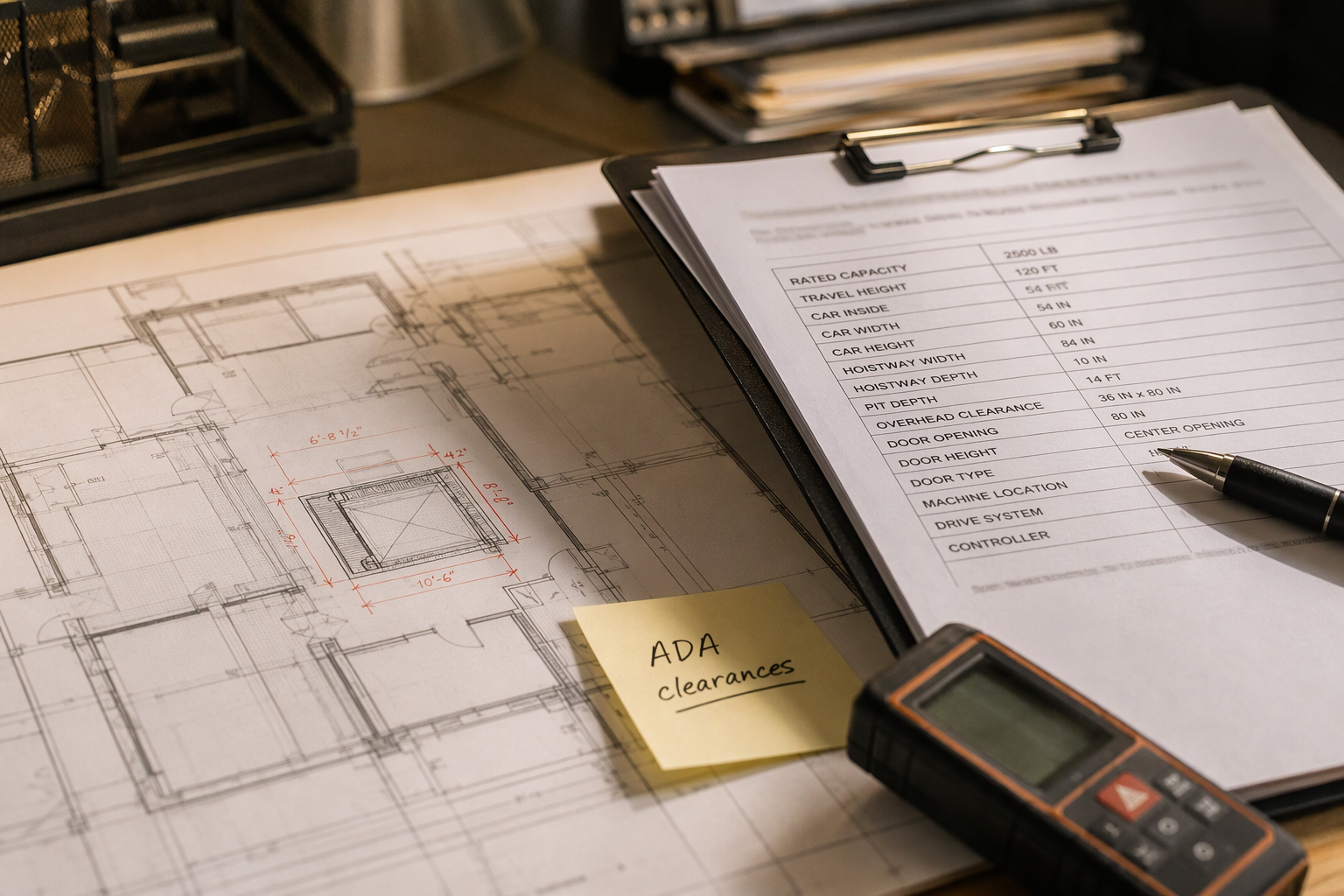
Before requesting a bid, you need your building’s architectural drawings, intended occupancy type, floor count, travel distance, and preferred elevator type — without this information, a contractor cannot produce an accurate proposal.
Accurate pre-bid documentation eliminates costly scope changes later. At minimum, prepare the following: floor plans showing the hoistway location and dimensions, a building section drawing illustrating travel height, the occupancy classification (commercial, residential, healthcare, etc.), rated capacity needs (number of passengers or freight load in pounds), and any accessibility requirements under the Americans with Disabilities Act (ADA). If the project involves modernization rather than new installation, include the existing equipment’s make, model, and installation year.
Projects in Phoenix also require coordination with the City of Phoenix Elevator Section under the Planning and Development Department, which handles plan review and inspection for equipment inside city limits. Projects outside Phoenix fall under the Industrial Commission of Arizona (ICA), Elevator Division, formerly known as the ADOSH Elevator Safety Section until September 12, 2026, as established by Laws 2026, Ch. 73 and governed by A.R.S. §§ 23-491 through 23-491.16.
What types of project drawings are required for elevator plan review?
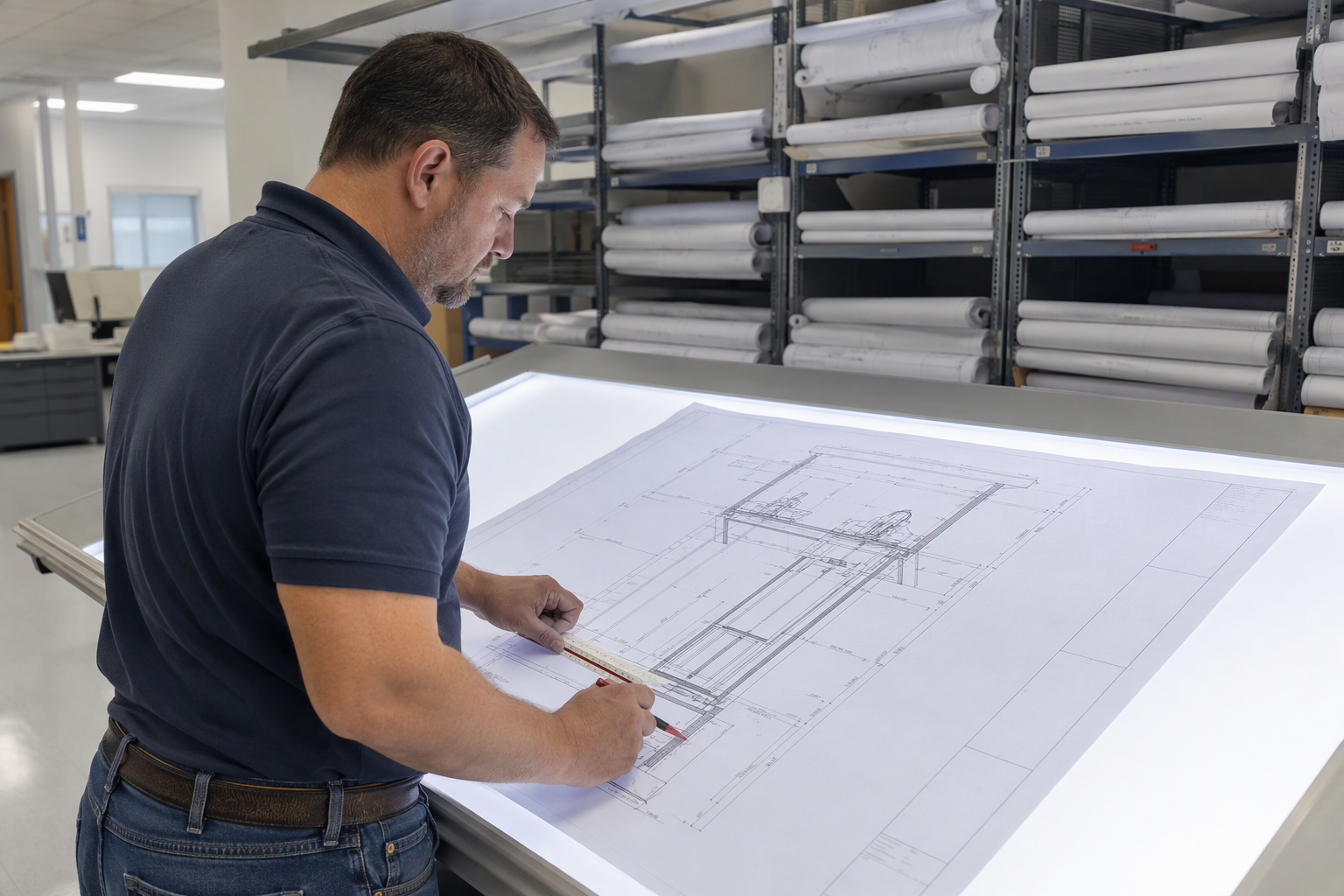
A complete elevator plan submission typically requires architectural hoistway drawings, structural pit and overhead details, electrical one-line diagrams, and equipment layout plans prepared to the scale and format required by the AHJ.
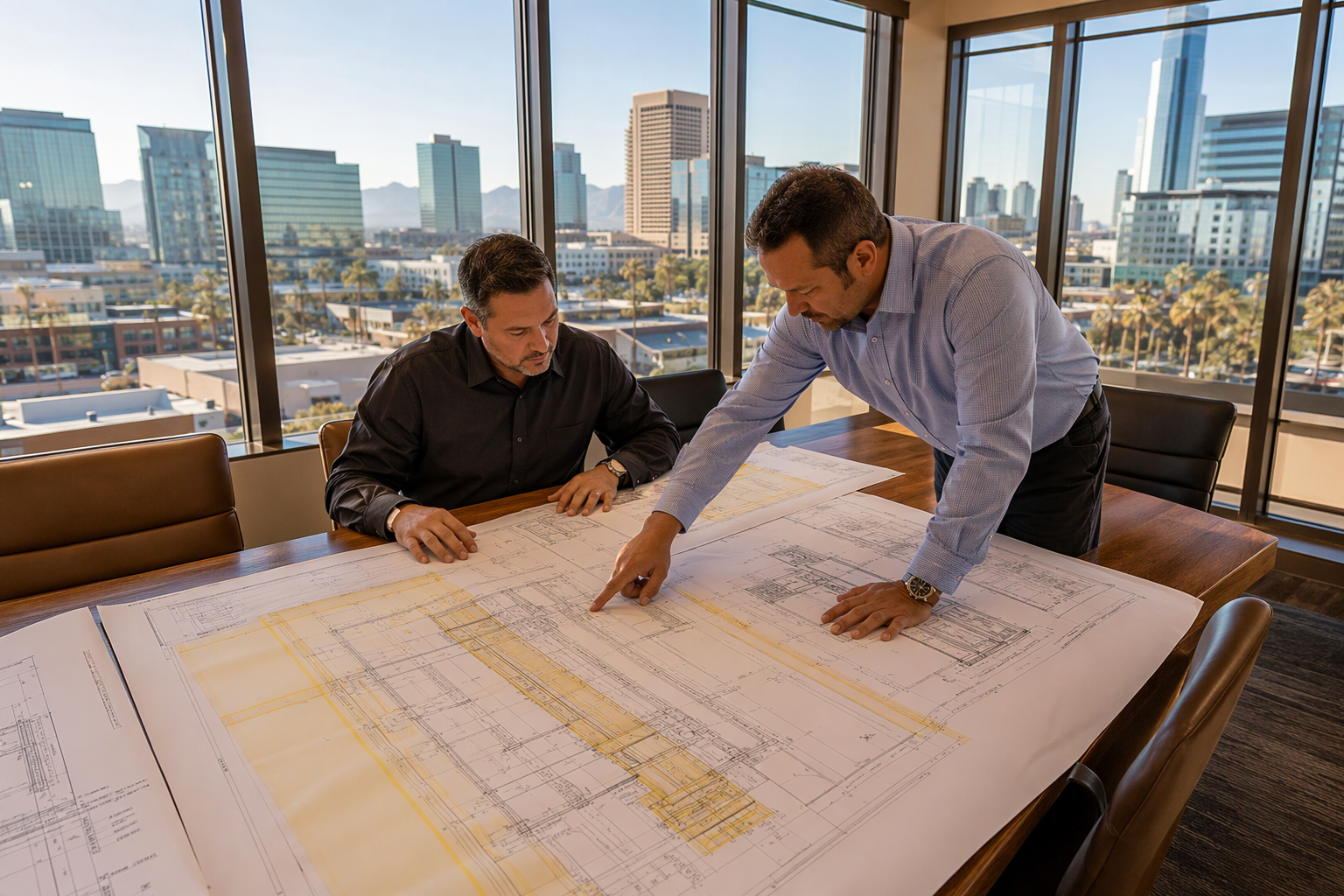
Specifically, the drawing package should include: a hoistway plan view at each floor stop showing dimensions and clearances, a vertical section through the hoistway showing pit depth, overhead clearance, and machine room or machine space location, structural details for the pit slab and overhead beam, electrical plans identifying the mainline disconnect location and power requirements, and an equipment layout showing the drive, controller, and governor. If the project must comply with Arizona Administrative Code R20-5-502 through R20-5-515, the drawings must reflect conformance with the ASME A17.1-2019 edition, which Arizona adopted for equipment installed, repaired, or altered on or after January 1, 2023.
For platform lifts and stairway chairlifts installed, repaired, or altered on or after January 1, 2023, drawings must reflect compliance with ASME A18.1-2020. Submitting incomplete or non-compliant drawings is one of the most common causes of permit delays in Arizona.
How do I formally submit project drawings to an elevator contractor for review?
Formally submitting project drawings to an elevator contractor involves sending a complete digital or physical drawing package along with a written project summary and a request for proposal (RFP) document.
Most licensed elevator contractors accept drawings in PDF or CAD format via email or a secure file-transfer portal. A well-prepared RFP should state: the project type (new installation, modernization, or alteration), required completion date, building address and jurisdiction, special performance criteria (speed, capacity, door configuration, interior finish), and any known site constraints such as limited hoistway depth or seismic requirements. Including a formal RFP alongside the drawings signals to the contractor that this is a competitive bid and ensures apples-to-apples comparison between proposals.
Arizona Elevator Solutions serves Phoenix, Scottsdale, Mesa, and Tucson and reviews submitted project drawings to assess code compliance, estimate labor and material costs, and identify any design issues that could affect permitting before a proposal is issued.
What happens after I submit drawings to an elevator contractor?
After drawing submission, the contractor performs a technical review, identifies any code or design conflicts, clarifies scope with the project team, and produces a written bid that itemizes equipment, labor, permits, and inspection costs.
The technical review process typically involves cross-referencing the submitted hoistway dimensions against the minimum clearances specified in ASME A17.1, verifying that the structural overhead is adequate for the proposed machine load, and confirming that the electrical service matches the drive system requirements. If deficiencies are found, the contractor issues a written Request for Information (RFI) or a list of drawing comments for the architect or engineer of record to address before the bid is finalized.
Once all technical questions are resolved, the contractor compiles the proposal, which should itemize: equipment manufacturer and model, hoistway work scope, electrical rough-in responsibilities, permit and inspection fees, projected construction timeline, warranty terms, and payment schedule. Owners should request that the bid distinguish between contractor-furnished and owner-furnished items to avoid ambiguity during contract execution.
What does the Arizona permit and plan approval process look like for elevator projects?
In Arizona, elevator projects require advance notification to the state at least 90 days before installation, relocation, or alteration begins, along with plan submission to the appropriate AHJ for approval before any work starts.
Under A.R.S. §§ 23-491 through 23-491.16, Arizona owners must notify the Industrial Commission of Arizona, Elevator Division at least 90 days before installing, relocating, or altering a conveyance. The ICA Elevator Division (or, for work inside Phoenix, the City of Phoenix Elevator Section) reviews the submitted drawings, issues plan approval, and assigns a state serial number to the conveyance — a tag fixed to the controller or mainline disconnect that identifies the unit throughout its operational life.
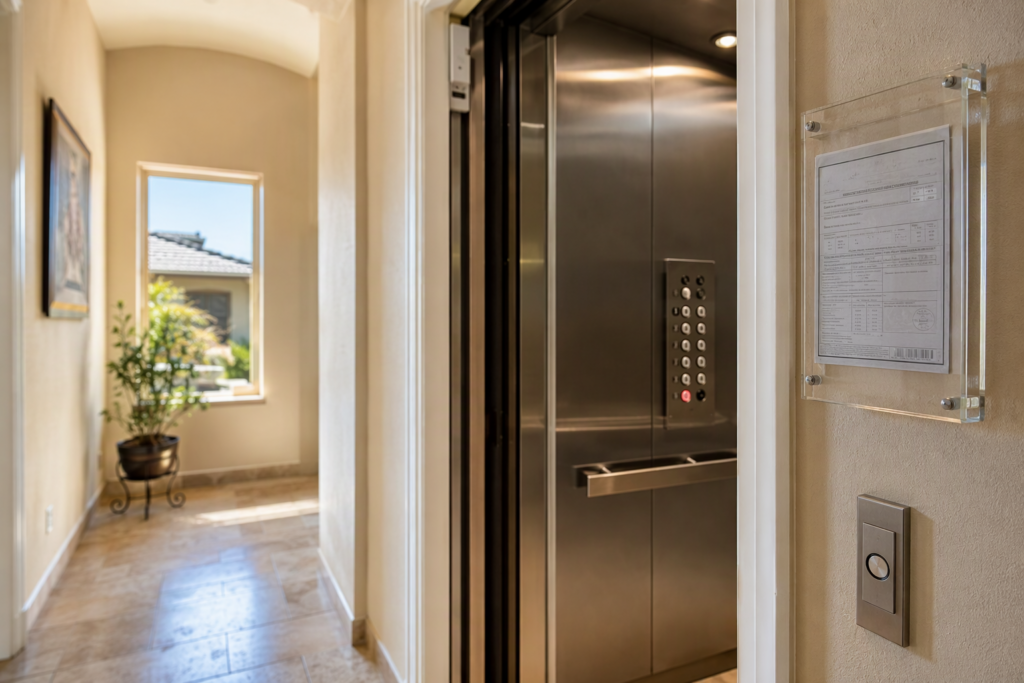
No conveyance may operate in Arizona without an annual certificate of inspection issued by the state. That certificate must be kept at the same location as the conveyance and made available for inspection on request. Additionally, the state serial number or the certificate must be posted in or close to the conveyance in an easily accessible location. These requirements apply from the moment a new unit is placed in service.
What is the step-by-step process for requesting an elevator bid from start to permit?
The process from initial inquiry to permit issuance follows a logical sequence that spans drawing preparation, contractor engagement, state notification, and AHJ plan approval.
- Define project scope: Confirm the project type (new installation, modernization, or alteration), building occupancy, number of stops, travel distance, and required capacity.
- Prepare drawing package: Work with an architect or engineer to produce hoistway plans, vertical sections, structural details, and electrical diagrams in the format required by the AHJ.
- Issue Request for Proposal: Send the drawing package and a written RFP to qualified, licensed elevator contractors holding an Arizona Registrar of Contractors R-12 or C-12 elevator license classification.
- Contractor drawing review: Allow the contractor to review drawings for ASME A17.1-2019 compliance, identify design conflicts, and issue RFIs if needed.
- Receive and evaluate bids: Compare written proposals on equipment specifications, scope of work, timeline, inspection fees, and warranty terms — not on price alone.
- Award contract: Execute a written contract that specifies responsibilities for permitting, inspection coordination, and project scheduling.
- Notify the ICA Elevator Division: The owner or contractor submits the required 90-day advance notification to the Industrial Commission of Arizona before work begins.
- Submit for plan approval: File drawings with the AHJ (ICA Elevator Division or City of Phoenix Elevator Section) and obtain written plan approval.
- Construction and inspection: Complete installation or alteration work, then schedule the required pre-service inspection before the conveyance is placed in operation.
- Obtain certificate of inspection: Receive the state-issued certificate of inspection and post the state serial number or certificate as required by Arizona law.
What elevator types and equipment categories can be included in a bid request?
A bid request can cover any conveyance type regulated under Arizona law, including traction elevators, hydraulic elevators, platform lifts, dumbwaiters, escalators, moving walks, and stairway chairlifts.
Each equipment category carries distinct code requirements. Traction elevators (geared, gearless, or machine-room-less) are governed by ASME A17.1-2019 for Arizona installations on or after January 1, 2023. Hydraulic elevators — common in low-rise commercial and residential projects throughout Phoenix, Scottsdale, Mesa, and Tucson — are also covered under ASME A17.1-2019, with specific sections addressing tank sizing, buried cylinders, and environmental containment. Platform lifts and stairway chairlifts fall under ASME A18.1-2020 for projects on or after January 1, 2023.
When requesting a bid, specifying the exact equipment type, speed, capacity, and interior finish level (standard commercial vs. custom architectural) allows the contractor to source accurate equipment pricing and reduces the likelihood of post-award change orders. ADA-compliant cab dimensions, control panel heights, and door timing requirements should be explicitly noted in the RFP when the building serves the public.
How do ADA requirements affect the elevator bid and drawing review process?
ADA requirements directly affect hoistway dimensions, cab interior dimensions, door width and timing, control panel placement, and auditory and visual signal specifications — all of which must appear in the drawings reviewed during the bid process.
The Americans with Disabilities Act establishes minimum standards for elevators in places of public accommodation and commercial facilities. Key dimensional requirements include minimum cab interior dimensions, minimum clear door width, and maximum thresholds. Control panels must have tactile characters, Braille, and visual indicators at heights accessible from a wheelchair. Door timing must allow passengers adequate time to board and exit without door-contact risk.
Drawings submitted for bid review should annotate ADA-compliance dimensions explicitly rather than relying on a general code-compliance note. Reviewers — both contractors and AHJs — look for these callouts when evaluating drawing completeness. Omitting ADA details from the drawing package can delay plan approval and require costly re-submittal.
How do I evaluate competing elevator bids to choose the right contractor?
Evaluate competing elevator bids by comparing equipment specifications, scope inclusions and exclusions, permit and inspection fee handling, project timeline, warranty terms, and the contractor’s Arizona Registrar of Contractors license classification — not by selecting the lowest number alone.
A bid comparison table helps identify substantive differences that affect long-term cost and risk:
| Evaluation Factor | What to Look For | Red Flag |
|---|---|---|
| Equipment specifications | Manufacturer, model, speed, capacity, drive type explicitly named | Generic “comparable equipment” language without specifics |
| Scope inclusions | Hoistway work, electrical rough-in, pit ladder, lighting, sump clearly listed | Vague “as required by code” with no itemization |
| Permit and inspection fees | Fees included in bid or clearly listed as owner responsibility | No mention of permit costs — often added as change orders |
| Project timeline | Milestone dates for shop drawings, equipment delivery, installation, inspection | Single “estimated completion” date with no milestones |
| Warranty | Parts and labor warranty duration clearly stated | Warranty limited to manufacturer defects only, no labor coverage |
| AZ ROC license | R-12 or C-12 elevator contractor license number verifiable on the AZ ROC website | No license number provided or general contractor license only |
| Code edition compliance | Explicit reference to ASME A17.1-2019 (Arizona’s adopted edition as of Jan. 1, 2023) | No code reference or reference to a superseded code edition |
| ICA notification | Contractor acknowledges 90-day advance notification requirement and handles filing | No mention of state notification obligations |
What role does the Arizona Registrar of Contractors license play in the bid process?
The Arizona Registrar of Contractors (ROC) R-12 and C-12 elevator license classifications are the required credentials for contractors to legally install and repair elevators, dumbwaiters, escalators, and moving walks in Arizona — and verifying that license before awarding a contract protects the owner from unlicensed work.
The R-12 classification covers residential elevator work, while the C-12 classification covers commercial elevator installation and repair. Owners can verify a contractor’s current license status through the Arizona Registrar of Contractors’ public license lookup tool. It is important to note that the ROC license authorizes the installation and repair work itself; it does not issue the annual certificate of inspection, which is the separate responsibility of the Industrial Commission of Arizona, Elevator Division.
Requesting proof of ROC licensure as part of the bid submission package is a sound practice that reduces owner liability and ensures the contractor is authorized to pull permits in Arizona jurisdictions.
What is the difference between a new installation bid and an elevator modernization bid?
A new installation bid covers all work from an empty hoistway to a fully commissioned and inspected conveyance, while a modernization bid focuses on replacing or upgrading specific components of an existing system — and each type requires a different set of drawings and regulatory considerations.
New installation bids require a complete hoistway drawing package, structural coordination, and full ASME A17.1-2019 compliance for all components. Modernization bids must address which existing components will be reused and which will be replaced, since partially modernized equipment may fall under different compliance pathways. Under Arizona Administrative Code R20-5-502 through R20-5-515, any alteration to a conveyance triggers inspection before the unit returns to service, and the 90-day advance notification requirement applies to alterations as well as new installations.
Lawfully installed older conveyances in Arizona may remain in service unless the ICA Elevator Division’s elevator chief determines that continued use poses a hazard to life, health, or property. This provision means that a modernization project may not need to bring every component up to the current ASME A17.1-2019 standard, but that determination must come from the AHJ — not from an assumption made during the bid process.
How long does the elevator bid and permitting process typically take in Arizona?
The timeline from initial drawing submission to permit issuance varies by project complexity and AHJ workload, but the mandatory 90-day advance notification requirement under Arizona law means owners should initiate the bid process well before the desired construction start date.
As a practical matter, the sequence works as follows: drawing preparation and contractor bid solicitation may take several weeks; bid evaluation and contract award add additional time; and the 90-day notification to the ICA Elevator Division must be filed before installation, relocation, or alteration begins. Projects in Phoenix also require plan review by the City of Phoenix Elevator Section, which operates on its own review schedule. Equipment lead times for specialty traction or machine-room-less systems can extend overall project duration further.
Owners planning elevator projects for a specific occupancy date in Phoenix, Scottsdale, Mesa, or Tucson should begin the bid process as early as possible and work with their contractor to build the notification and permitting timeline into the master project schedule.
What Arizona-specific code requirements should be reflected in the submitted drawings?
Drawings submitted for Arizona projects must reflect compliance with ASME A17.1-2019 for new or altered elevators, ASME A18.1-2020 for new or altered platform lifts and chairlifts, and any additional requirements established under Arizona Administrative Code R20-5-502 through R20-5-515.
Specific Arizona requirements that should appear in or accompany the drawings include: identification of the mainline disconnect location where the state serial number tag will be affixed to the controller; firefighters’ emergency operation notation referencing the Arizona Firefighters Service (AZFS) key (required for Arizona conveyances equipped with firefighters’ emergency operation); and the designated certificate posting location near the conveyance. Drawings for projects within the City of Phoenix must satisfy the Phoenix Elevator Section’s specific submittal format and checklist requirements in addition to state requirements.
Arizona Elevator Solutions coordinates drawing reviews for projects across Phoenix, Scottsdale, Mesa, and Tucson to ensure submittals satisfy both state and local AHJ requirements before filing, reducing the risk of correction-cycle delays.
Who is responsible for scheduling inspections during and after elevator installation?
Under Arizona law, the owner bears ultimate legal responsibility for ensuring a conveyance is inspected before it goes into service and annually thereafter — though in practice, the licensed elevator contractor typically manages inspection scheduling on the owner’s behalf during construction.
Under A.R.S. §§ 23-491 through 23-491.16, every conveyance must be inspected before it first goes into service, after any modification or alteration, and annually after that. The inspection may be performed by the ICA Elevator Division directly or by a private elevator inspector authorized by the Industrial Commission of Arizona. Arizona private elevator inspectors must register with the commission every year and demonstrate at least eight hours of approved continuing education.
Critically, a private inspector may not inspect a conveyance owned, operated, or last serviced by the inspector, a company the inspector owns, or the inspector’s employer — a conflict-of-interest safeguard that affects how inspection is coordinated on contractor-managed projects. Using a private elevator inspector does not relieve the owner or operator of their legal obligations under Arizona law.
What should I include in the Request for Proposal document sent to elevator contractors?
A complete RFP sent to elevator contractors should include the project description, drawing package, bid instructions, evaluation criteria, submission deadline, and contractual requirements — the more specific the RFP, the more comparable and reliable the bids returned will be.
A well-structured elevator RFP includes these sections:
- Project overview: Building name, address, jurisdiction, occupancy type, project type (new, modernization, alteration), and desired substantial completion date.
- Scope of work: Detailed description of what the contractor is expected to furnish and install, including equipment, hoistway work, electrical, and finish items.
- Drawing package: All relevant architectural, structural, and electrical drawings in the specified format (PDF or CAD).
- Code compliance requirements: Explicit reference to ASME A17.1-2019, ADA requirements, and Arizona Administrative Code R20-5-502 through R20-5-515.
- License and insurance requirements: R-12 or C-12 ROC license number, proof of general liability insurance, and workers’ compensation certificate.
- Bid format instructions: Request that bids be itemized by equipment, labor, permits, inspection fees, and contingency — to allow line-by-line comparison.
- Submission deadline and contact: Date, time, and method for bid submission; name and contact for questions during the bid period.
- Evaluation criteria: State how bids will be scored — such as technical compliance, schedule, qualifications, and cost — so contractors understand what matters most.
How does the inspection process work after elevator installation is complete?
After installation is complete, the conveyance must pass a pre-service inspection by an ICA-authorized inspector before it may operate, and once approved, the state issues the certificate of inspection that the owner must keep at the conveyance location.
The pre-service inspection verifies that the installed equipment conforms to the approved drawings and meets the requirements of ASME A17.1-2019 and applicable provisions of Arizona Administrative Code R20-5-502 through R20-5-515. Inspectors check safety devices, governor and buffer performance, door operator function, firefighters’ emergency operation (including the AZFS key), and electrical systems. Any deficiency identified during inspection must be corrected before the certificate of inspection is issued.
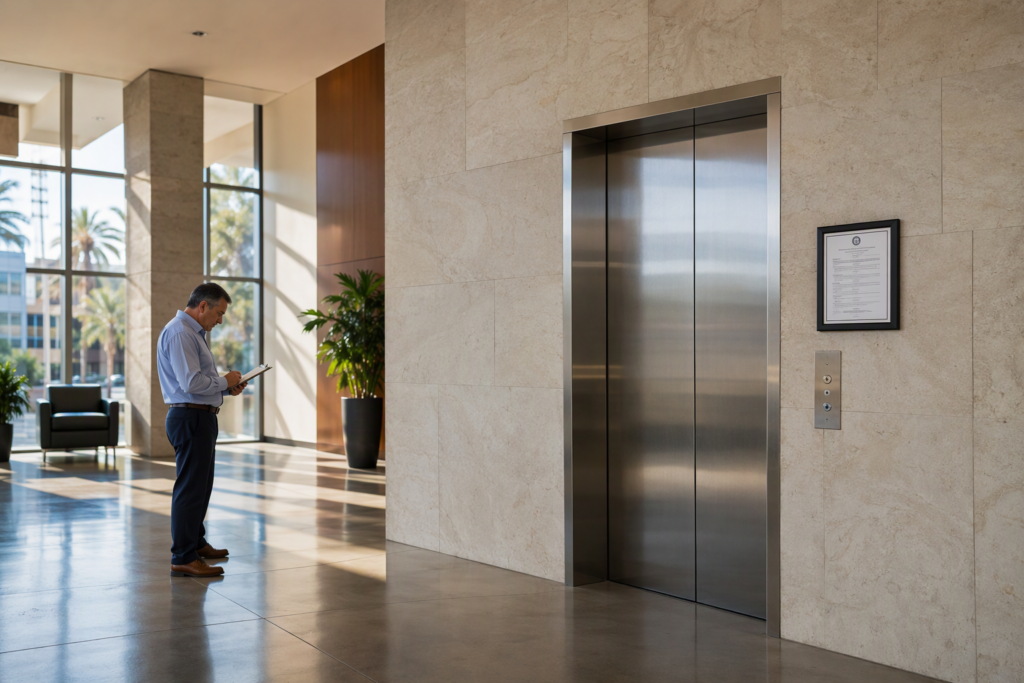
Once the certificate is issued, the owner must keep it at the same location as the conveyance and make it available for inspection on request. The state serial number or certificate must also be posted in or close to the conveyance in an easily accessible location. Annual inspections are then required each year the conveyance remains in service.
What happens if an elevator is altered or modernized — does it need a new permit and inspection?
Yes — under Arizona law and ASME A17.1, any alteration to a conveyance triggers the requirement for advance notification to the ICA Elevator Division, plan approval, and a post-alteration inspection before the unit is returned to service.
The 90-day advance notification requirement applies to alterations as well as new installations. This means that modernization projects — even those that replace a subset of components such as the controller, door operators, or drive system — cannot begin without prior state notification and plan approval. After alteration work is completed, the conveyance must be inspected before it resumes service, and the existing certificate of inspection does not carry over automatically.
Owners and contractors should factor these regulatory checkpoints into the modernization project schedule. Arizona Elevator Solutions assists clients in Phoenix, Scottsdale, Mesa, and Tucson with the full regulatory workflow for alteration projects, from advance notification filing through post-alteration inspection coordination.
Can a building owner use a private elevator inspector for the initial or annual inspection?
Yes — Arizona law permits building owners to hire a private elevator inspector authorized by the Industrial Commission of Arizona to perform both initial pre-service inspections and annual inspections, subject to strict conflict-of-interest rules.
Under A.R.S. §§ 23-491 through 23-491.16, private elevator inspectors must register with the ICA annually and complete at least eight hours of approved continuing education each registration period. A private inspector may not inspect any conveyance owned, operated, or last serviced by the inspector personally, a company the inspector owns, or the inspector’s employer. This restriction is designed to ensure independence and objectivity.
Using a private inspector can offer scheduling flexibility compared to relying solely on the ICA Elevator Division’s inspection schedule, which may be advantageous for owners managing tight construction timelines. However, the owner and operator remain legally responsible for compliance regardless of which inspector type is used.
What are common reasons elevator bids and permit applications are rejected or delayed?
The most common causes of elevator bid inadequacy and permit application rejection in Arizona are incomplete drawing packages, failure to reference the correct ASME code edition, missing 90-day advance notification, and drawings that do not reflect ADA-required dimensions or AZFS firefighters’ service key requirements.
From a permit review standpoint, the ICA Elevator Division and the City of Phoenix Elevator Section look for specific submittal completeness: all required plan views and sections present, structural details showing pit and overhead adequacy, electrical diagrams with mainline disconnect identified, and equipment cut sheets or specifications from the manufacturer. Missing any of these elements results in a correction cycle that adds weeks to the project schedule.
From a bid quality standpoint, proposals that fail to itemize scope, omit permit fees, or use generic equipment descriptions create ambiguity that surfaces as change orders during construction. Owners benefit from requiring itemized bids and reviewing drawing comments from the contractor before accepting the proposal as final.
How should I handle emergency situations or accidents on an elevator project site?
Under Arizona law, the owner must notify the ICA Elevator Division within 24 hours of any accident that injures a person or disables a conveyance — this requirement applies during both construction and ongoing building operation.
If an accident or disabling event occurs during installation or testing, the contractor should immediately secure the work area, document the event, and notify the building owner. The owner is then obligated under A.R.S. §§ 23-491 through 23-491.16 to report the incident to the Industrial Commission of Arizona, Elevator Division within 24 hours. Work-site safety obligations under OSHA also apply to all personnel on the project.
No conveyance that has been disabled by an accident may be returned to service without a post-incident inspection and, if applicable, re-issuance of the certificate of inspection. Building this contingency into the project schedule and contract is a prudent step during pre-bid planning.
Why should I work with Arizona Elevator Solutions for my elevator bid and drawing review?
Working with a contractor that understands Arizona’s specific regulatory framework — including the ICA Elevator Division’s requirements, the City of Phoenix Elevator Section’s review process, and the ASME A17.1-2019 code edition adopted by Arizona — reduces permitting delays, change orders, and compliance risk on any elevator project.
Arizona Elevator Solutions serves building owners, general contractors, architects, and property managers across Phoenix, Scottsdale, Mesa, and Tucson with bid preparation, drawing review, state notification filing, and inspection coordination. The company holds the required Arizona Registrar of Contractors elevator license classifications and works within the regulatory framework established by A.R.S. §§ 23-491 through 23-491.16 and Arizona Administrative Code R20-5-502 through R20-5-515.
Submitting a complete, code-compliant drawing package from the outset — with clear scope definition, ADA annotations, AZFS firefighters’ service key notations, and accurate equipment specifications — is the most reliable way to receive accurate bids, avoid re-submittal cycles, and keep an elevator project on schedule in the Arizona market.
Contact Arizona Elevator Solutions for a free elevator assessment at 480-557-7600.
Need elevator service you can rely on? Arizona Elevator Solutions is ready to help.