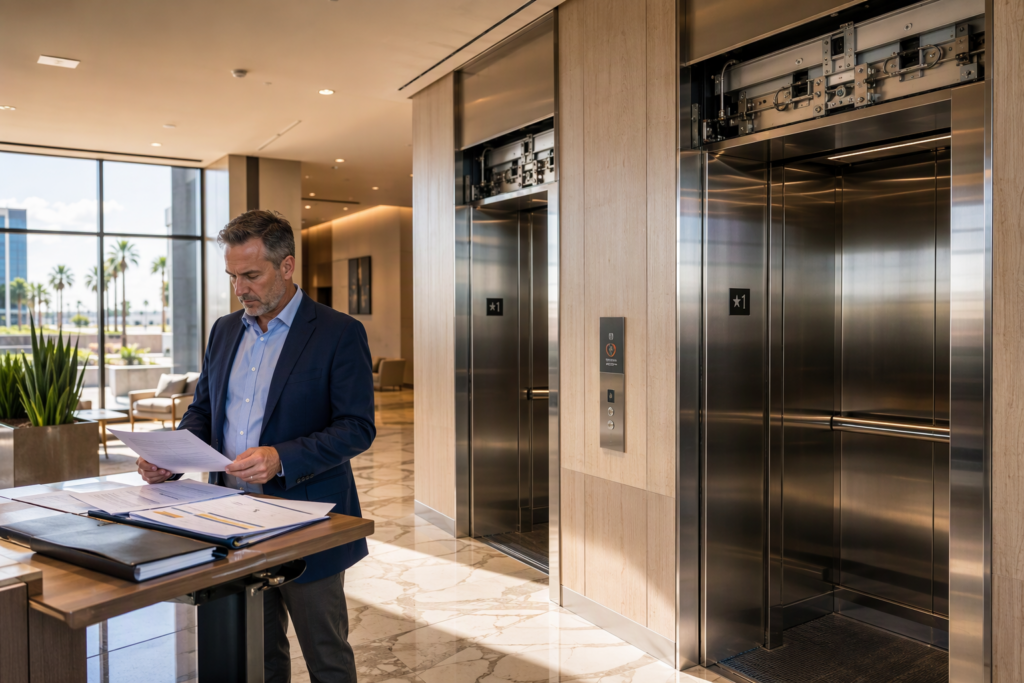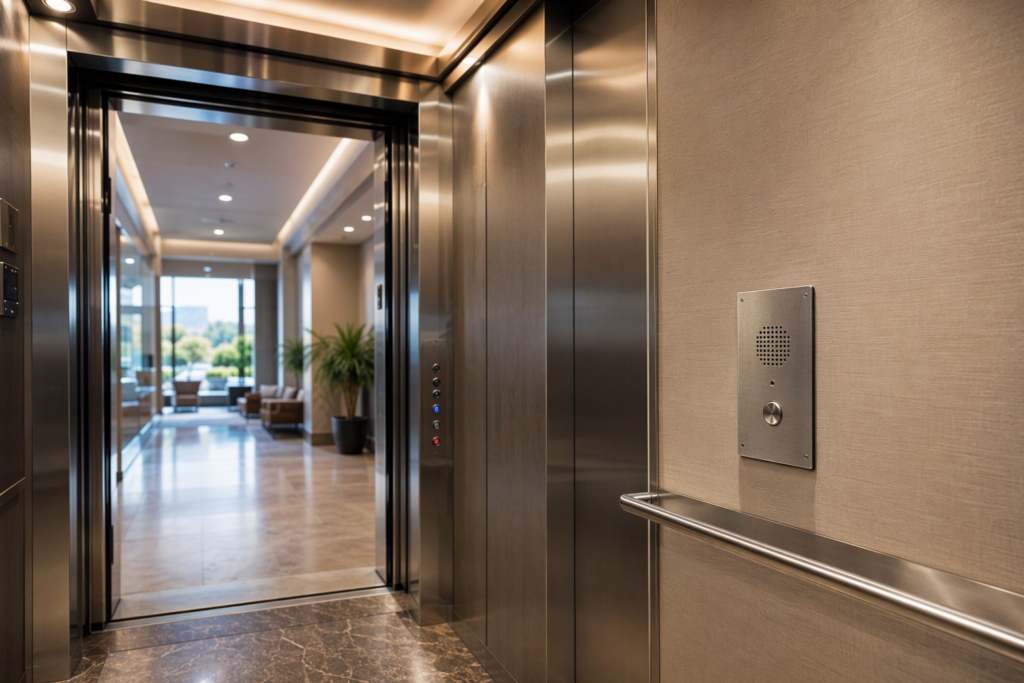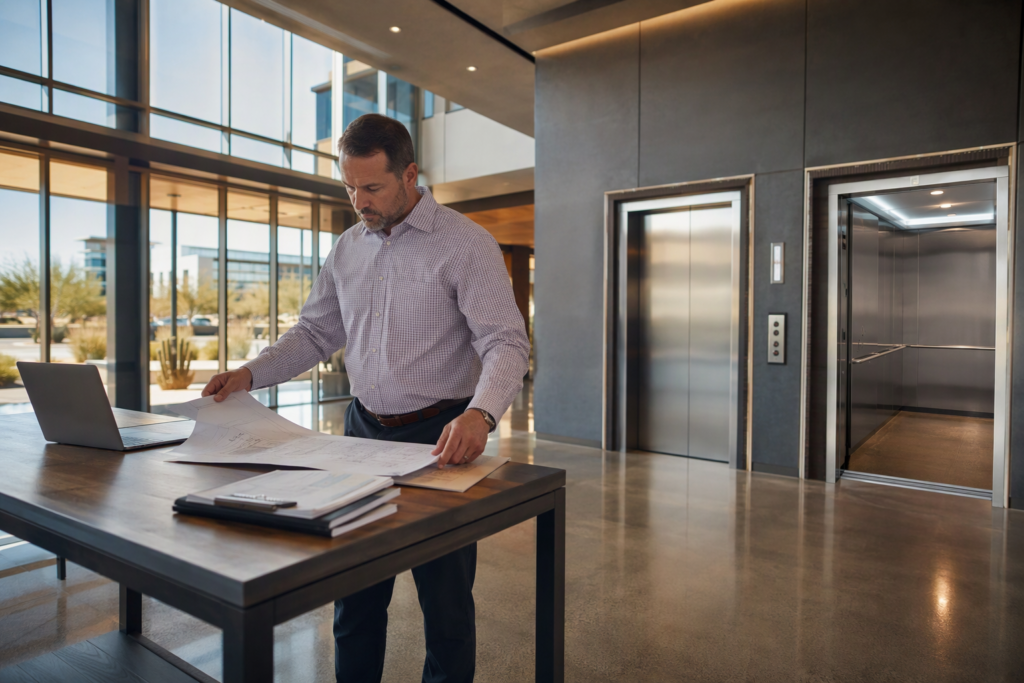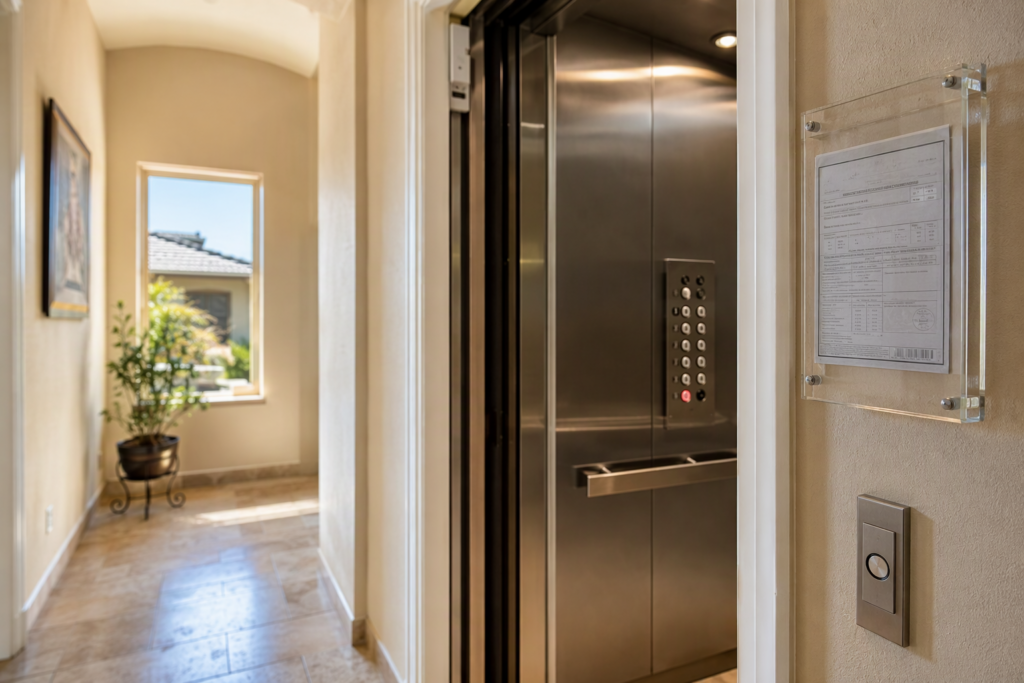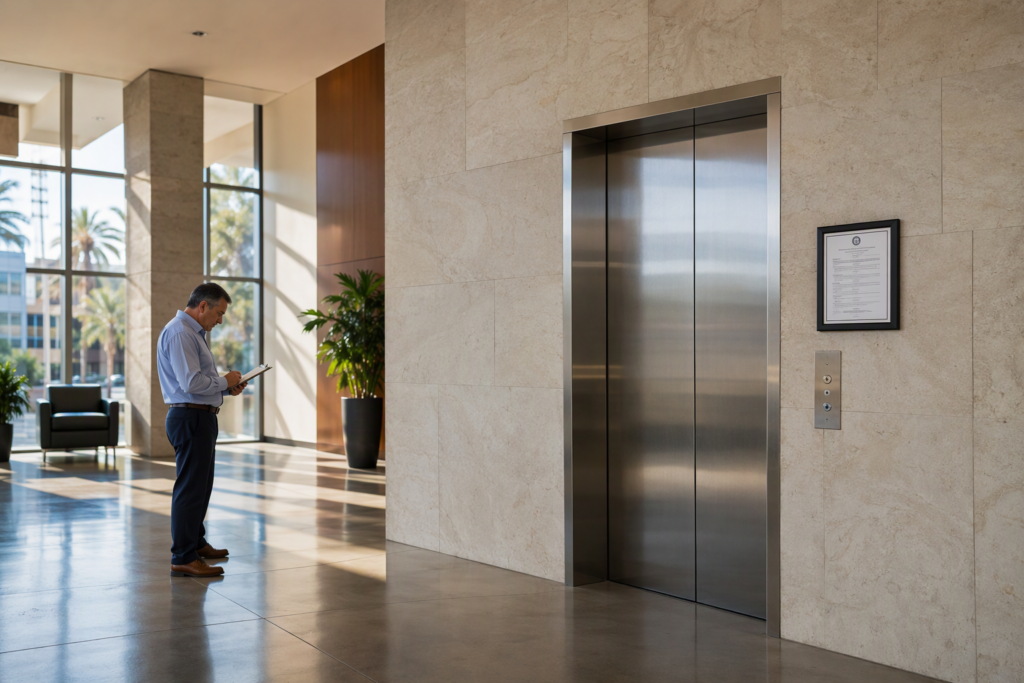
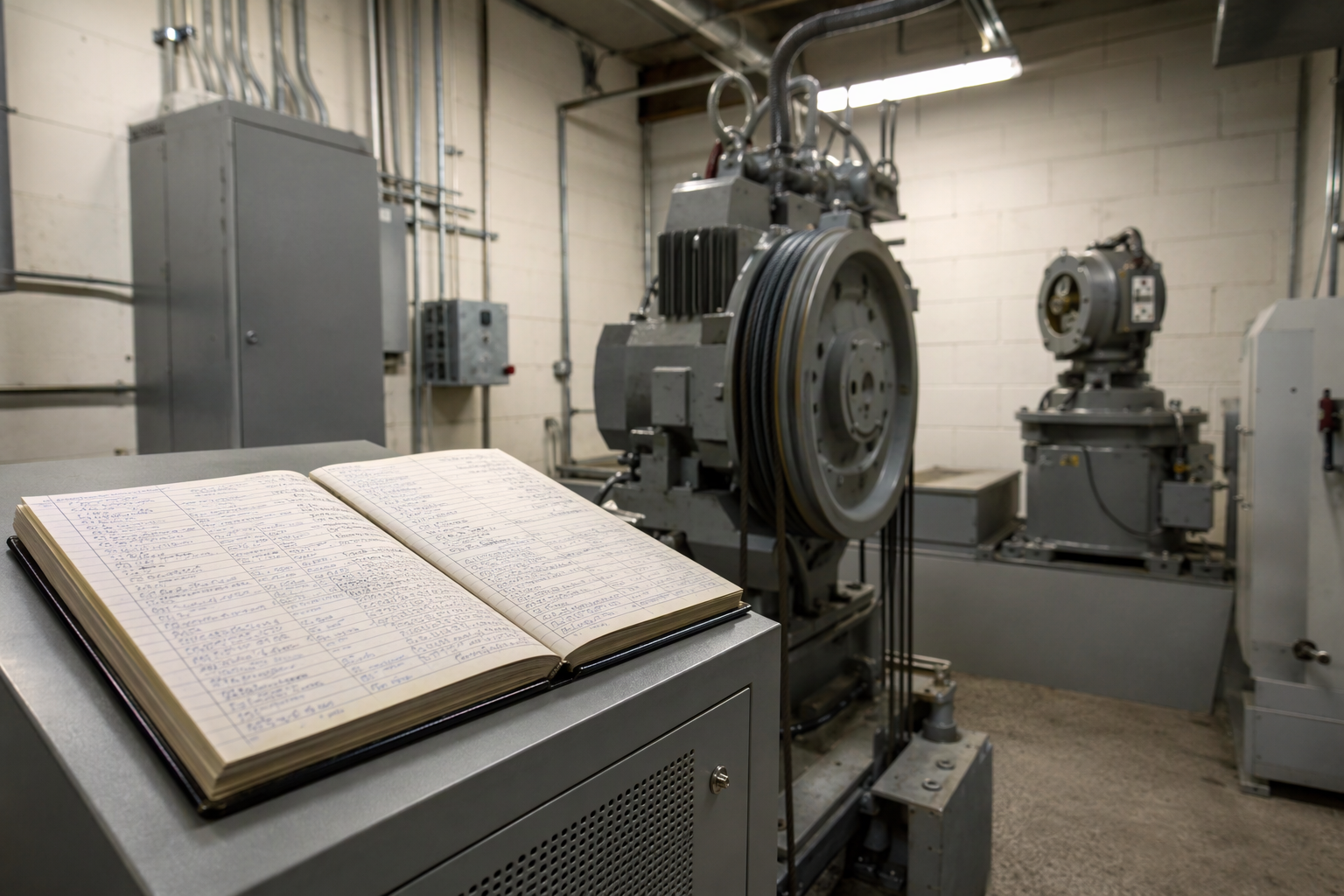
To find out when your elevator was last serviced, start by checking the physical maintenance logbook in the machine room, then review the posted certificate of inspection, and contact your elevator service contractor for a full service history. In Arizona, the Industrial Commission of Arizona’s Elevator Division oversees conveyance records, and every elevator must display its state serial number and hold a valid annual certificate of inspection on-site. If records are missing, Arizona Elevator Solutions can audit your equipment and reconstruct a maintenance timeline.
Where Is the Maintenance Logbook for My Elevator Kept?
The maintenance logbook is typically stored in the elevator machine room or at the main controller, and it is the first place owners should look for a record of past service visits.
Under the ASME A17.1 Safety Code for Elevators and Escalators, a maintenance control program requires that records of maintenance, inspection, and test activities be retained and made available to the authority having jurisdiction (AHJ). In practice, this means a licensed elevator contractor should leave dated, signed entries in the logbook after every routine visit, lubrication, adjustment, or repair. The logbook entries should identify the date, the nature of the work performed, the components affected, and the name of the technician.
If the logbook is absent or entries have gaps, that itself is a compliance red flag. Owners in Phoenix, Tucson, Scottsdale, and Mesa should treat a missing logbook as an urgent matter and contact their service contractor immediately to request duplicate service records.
What Does the Certificate of Inspection Tell Me About My Elevator’s Service History?

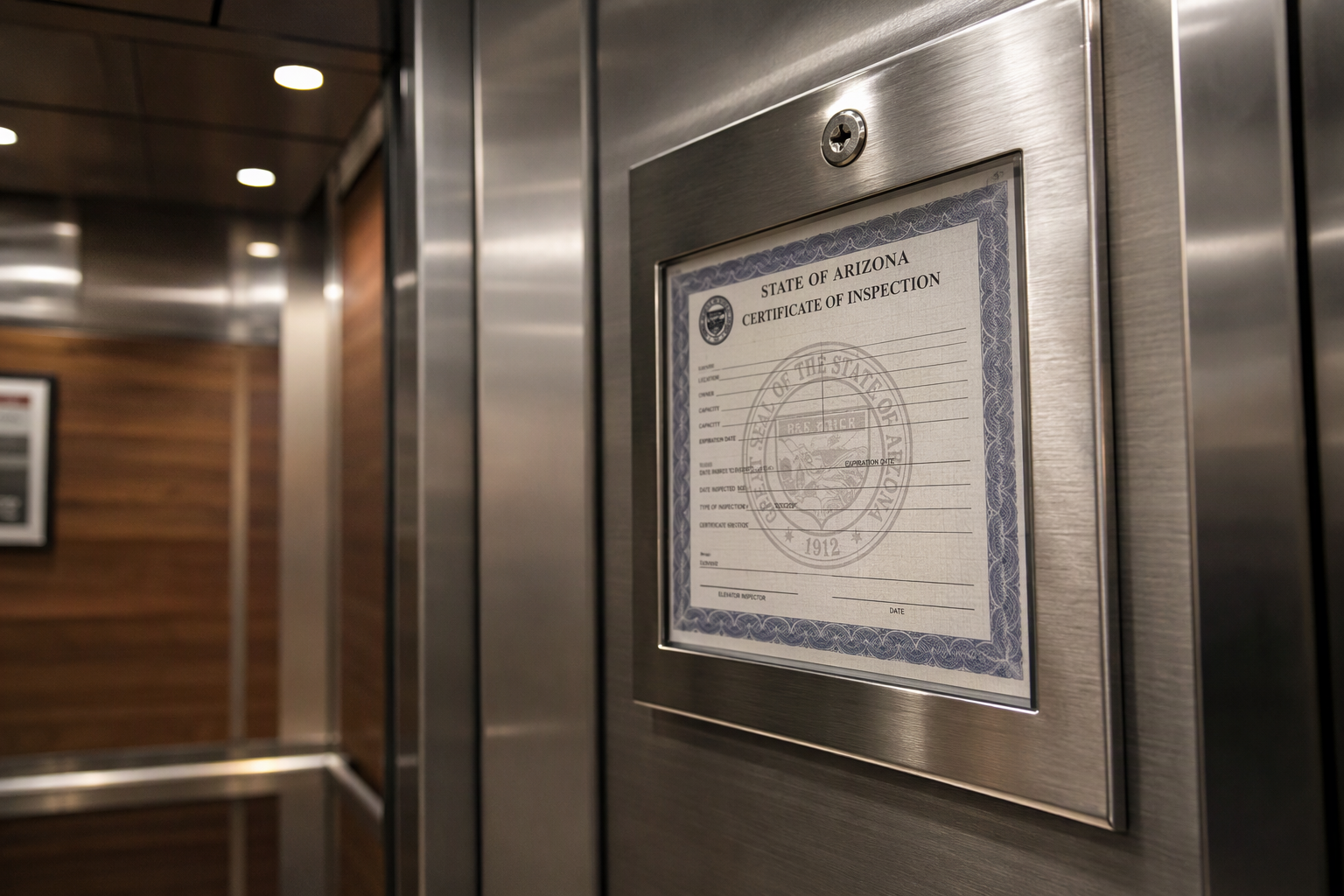
The certificate of inspection confirms that the elevator passed a formal inspection by a qualified inspector on a specific date, giving the owner a minimum baseline for when the equipment was last formally evaluated.
Under A.R.S. §§ 23-491 through 23-491.16 and Arizona Administrative Code R20-5-502 through R20-5-515, Arizona owners must keep the state certificate of inspection at the same location as the conveyance and make it available for inspection on request. The state serial number or the certificate must also be posted in or close to the conveyance in an easily accessible location. The certificate displays the inspection date and expiration, so it functions as a verifiable timestamp even when logbook entries are incomplete.
It is important to understand that an inspection date and a maintenance visit date are not the same thing. Inspections confirm compliance with safety codes at a point in time; routine maintenance visits happen at a different cadence and may be more frequent. Both records matter when evaluating elevator safety history.
How Do I Contact the Right Arizona State Agency to Verify Elevator Records?
Owners should contact the Industrial Commission of Arizona (ICA), Elevator Division — the agency that regulates elevator safety statewide — to obtain or verify official inspection records tied to a conveyance’s state serial number.
As of September 12, 2026, Arizona elevator safety is administered by the Industrial Commission of Arizona’s Elevator Division (formerly called the ADOSH Elevator Safety Section), under Laws 2026, Ch. 73. Every Arizona conveyance is assigned a state serial number on a tag fixed to the controller or mainline disconnect. That serial number is the key identifier when requesting official records. For elevators located inside the City of Phoenix, the City of Phoenix Elevator Section (Planning and Development Department) also inspects equipment and maintains related records.
Owners outside Phoenix — including those in Tucson, Scottsdale, and Mesa — work directly with the ICA Elevator Division for all inspection certificates and state records.
How Do I Find My Elevator’s State Serial Number?
The state serial number is printed on a tag fixed by the ICA Elevator Division to the controller or mainline disconnect inside the elevator machine room.
This tag is distinct from the manufacturer’s serial number on the elevator cab itself. If the machine room is locked or inaccessible, a licensed elevator contractor can locate it. Once an owner has the state serial number, they can reference it in any communication with the ICA Elevator Division to pull the inspection history on file with the state.
Arizona Elevator Solutions advises every building owner to record and store the state serial number separately — in a facilities management system or lease file — so the information remains available even if the machine room tag becomes worn or illegible.
Can My Elevator Service Contractor Provide a Full Service History?
Yes — a licensed elevator service contractor is required to retain records of all maintenance, tests, and repairs performed and should be able to provide a summary of every visit upon request.
The ASME A17.1 Safety Code for Elevators and Escalators requires that records associated with a maintenance control program be retained and available to the AHJ. Because those records belong to the life of the equipment — not just a single contractor’s business relationship — an owner transitioning from one contractor to another is entitled to request the service history before the transition is complete.
When a building in Phoenix, Scottsdale, Mesa, or Tucson changes ownership or elevator service providers, Arizona Elevator Solutions conducts a documented equipment assessment that includes a review of all available service records, filling gaps with a physical inspection of wear indicators, lubrication status, and safety device condition.
What Information Should a Service Visit Record Contain?
A complete service visit record should include the date, time, technician identification, a description of work performed, components inspected or replaced, test results, and any items noted for future attention.
Under the maintenance control program requirements of the ASME A17.1 Safety Code for Elevators and Escalators, records must be sufficiently detailed to allow an inspector or the AHJ to verify that required maintenance tasks were completed. Vague entries such as “routine maintenance performed” without specifying which components were checked do not meet the standard. Owners should require their service contractor to use itemized visit reports and provide copies in a format that can be retained long-term.
How Often Should an Elevator Be Serviced in Arizona?
Arizona law requires annual inspections, but the appropriate frequency of routine maintenance visits depends on the equipment type, usage volume, age, and manufacturer recommendations — most commercial elevators benefit from monthly or quarterly service visits.
Arizona Administrative Code R20-5-502 through R20-5-515 and A.R.S. §§ 23-491 through 23-491.16 establish that every Arizona conveyance must be inspected before it first goes into service, after any modification or alteration, and annually after that — and that no conveyance may operate without a valid annual certificate of inspection. These are minimum legal thresholds, not maintenance recommendations.
The ASME A17.1 Safety Code for Elevators and Escalators requires a maintenance control program tailored to the specific equipment, which typically means more frequent service calls than once a year for high-use installations. A high-rise residential building in Phoenix or a busy medical facility in Tucson would require more frequent visits than a low-use freight elevator in a small warehouse.
| Activity | Minimum Legal Requirement (Arizona) | Typical Industry Practice | Governing Authority |
|---|---|---|---|
| Annual inspection | Once per year (certificate required) | Once per year by qualified inspector | ICA Elevator Division; A.R.S. § 23-491 et seq. |
| Routine maintenance visits | As defined by maintenance control program | Monthly to quarterly depending on use | ASME A17.1 (maintenance control program) |
| Post-alteration inspection | Required before return to service | Completed immediately after work | ICA Elevator Division; A.R.S. § 23-491 et seq. |
| Pre-service inspection (new installation) | Required before first use | Completed during commissioning | ICA Elevator Division; A.R.S. § 23-491 et seq. |
| Owner notification to state (installation/alteration) | At least 90 days before work begins | As early as feasible in planning | ICA Elevator Division; A.R.S. § 23-491 et seq. |
| Accident notification to state | Within 24 hours | Immediately upon occurrence | ICA Elevator Division; A.R.S. § 23-491 et seq. |
What Should I Do If There Are No Service Records for My Elevator?
If no service records can be located, the owner should immediately halt routine operation if safety is in question, contact a licensed elevator contractor for a full physical assessment, and then contact the ICA Elevator Division to verify whether a valid certificate of inspection is on file.
- Search the machine room for the maintenance logbook and check near the controller for the state serial number tag.
- Contact the previous elevator service contractor in writing and request all records associated with the equipment’s state serial number.
- Contact the ICA Elevator Division using the state serial number to determine whether a current certificate of inspection exists on file.
- If in Phoenix, also contact the City of Phoenix Elevator Section (Planning and Development Department) for any locally held records.
- Schedule a comprehensive physical inspection with a licensed elevator contractor to assess actual equipment condition, independent of paperwork history.
- Have the contractor establish a new maintenance control program and logbook going forward so that all future visits are fully documented.
- If the annual certificate has lapsed, work with an authorized private elevator inspector to restore the certificate before returning the equipment to full service.
Arizona Elevator Solutions provides documented equipment assessments for exactly this scenario, helping building owners in Phoenix, Tucson, Scottsdale, and Mesa establish a compliant baseline when prior records are unavailable.
What Is the Difference Between an Inspection and a Maintenance Visit?
An inspection is a formal evaluation by a qualified third-party inspector that results in a certificate of inspection, while a maintenance visit is a routine service call by the elevator’s service contractor to lubricate, adjust, test, and repair components.
Under Arizona law, annual inspections must be performed by either an ICA Elevator Division inspector or a private elevator inspector authorized by the commission. Arizona owners may hire a private elevator inspector registered with the commission — provided that inspector has completed at least eight hours of approved continuing education annually and has no conflict of interest with the equipment being inspected. Specifically, an Arizona private elevator inspector may not inspect a conveyance owned, operated, or last serviced by the inspector, a company the inspector owns, or the inspector’s employer.
Maintenance visits, by contrast, are performed by the owner’s contracted elevator service company under the maintenance control program. These visits are more frequent and address the ongoing mechanical condition of the equipment. Both types of activities generate records that together form the complete service history of a conveyance.
Does Arizona Require the Certificate of Inspection to Be Posted?
Yes — Arizona law requires that the state serial number or the certificate of inspection be posted in or close to the conveyance in an easily accessible location, and the certificate itself must be kept at the same location as the conveyance.
This requirement under A.R.S. §§ 23-491 through 23-491.16 and Arizona Administrative Code R20-5-502 through R20-5-515 means that building occupants, tenants, and inspectors should be able to verify the inspection status without accessing the machine room. If the posted certificate is missing, expired, or illegible, the owner is out of compliance regardless of whether a valid inspection was actually conducted. Owners should check the posting at every renewal cycle.
What Happens If My Elevator Is Operating Without a Valid Certificate of Inspection?
Operating an elevator in Arizona without a valid annual certificate of inspection is a violation of state law and can result in the conveyance being ordered out of service by the ICA Elevator Division.
Under A.R.S. §§ 23-491 through 23-491.16, no conveyance may operate in Arizona without a current certificate. The ICA Elevator Division has authority to order a conveyance out of service if it poses a hazard to life, health, or property, and lawfully installed older equipment may remain in use only unless the elevator chief determines that use constitutes such a hazard. An expired certificate, combined with unknown service history, significantly elevates the risk of an adverse finding. Owners should treat certificate renewal as a non-negotiable operational requirement, not an administrative formality.
How Do Private Elevator Inspectors Fit Into the Service Record Process?
Private elevator inspectors authorized by the ICA Elevator Division conduct the same legally recognized annual inspections as state inspectors and generate official inspection records, but they cannot inspect equipment they or their employer service or own.
Arizona owners may hire a private elevator inspector to perform initial or annual inspections. That inspector must register with the commission every year and demonstrate at least eight hours of approved continuing education. After completing an inspection, the private inspector generates an inspection report that feeds into the state’s certification process. Using a private inspector does not relieve the owner or operator of their legal obligations — the owner remains responsible for ensuring the equipment is maintained, the certificate is current, and the posted requirements are met.
What Role Does ADA Compliance Play in Elevator Service Records?
ADA compliance is a separate legal requirement from state elevator safety certification, and service records should include documentation of accessibility feature testing such as door timing, leveling accuracy, audible signals, and Braille button condition.
Under the Americans with Disabilities Act, elevators in covered facilities must meet specific accessibility standards. Maintenance visits should verify that leveling is within tolerance, door open times are sufficient for users with mobility limitations, audible floor indicators function, and tactile controls are intact. If ADA-related deficiencies are identified during a maintenance visit, they should be documented and prioritized for repair. Failure to maintain these features can expose building owners to civil complaints independent of any elevator safety enforcement action by the ICA Elevator Division.
Can a New Building Owner Access Service Records After a Property Sale?
A new building owner has the right to request all available elevator service and inspection records from the previous owner, and those records should be part of due diligence in any commercial property transaction.
Service records are tied to the conveyance’s state serial number, not to the owner’s identity, so the history travels with the equipment. During a property acquisition, buyers in Phoenix, Scottsdale, Mesa, or Tucson should request the full maintenance logbook, all prior certificates of inspection, any repair orders or modernization records, and the existing maintenance contract. The ICA Elevator Division can confirm whether a current certificate of inspection is on file using the state serial number, providing an independent verification layer. Arizona Elevator Solutions recommends that new building owners schedule a fresh documented assessment immediately after taking possession, regardless of the records transferred.
What Is a Maintenance Control Program and Why Does It Affect My Service Records?
A maintenance control program, required under the ASME A17.1 Safety Code for Elevators and Escalators, is a formal written document that defines exactly what maintenance tasks must be performed, at what intervals, and how those tasks must be recorded.
Under the ASME A17.1 Safety Code for Elevators and Escalators, the maintenance control program governs every component of the elevator’s upkeep and specifies the documentation standards for each task. Arizona adopted ASME A17.1-2019 for equipment installed, repaired, or altered on or after January 1, 2023, effective January 9, 2023. This means newer installations in Arizona operate under a maintenance control program framework aligned with the 2019 edition. The existence and completeness of the maintenance control program is what gives service visit records their legal and operational meaning — without it, records may exist but lack the structured context that inspectors and the AHJ require.
How Do Platform Lifts and Stairway Chairlifts Differ in Their Service Record Requirements?
Platform lifts and stairway chairlifts in Arizona are governed by ASME A18.1-2020 for installations on or after January 1, 2023, and their service records must reflect compliance with that standard rather than ASME A17.1.
Under Arizona Administrative Code and the provisions of Laws 2026, Ch. 73, platform lifts and stairway chairlifts installed, repaired, or altered on or after January 1, 2023 must comply with ASME A18.1-2020. Owners of these devices should confirm that their service contractor is familiar with both the inspection requirements of the ICA Elevator Division and the specific maintenance provisions of ASME A18.1. Service records for these devices should be maintained with the same rigor as elevator records — including dated entries, component-level detail, and retention for the life of the equipment.
What Contractor Licensing Requirements Apply to Elevator Service in Arizona?
Elevator contractors performing installation and repair work in Arizona must hold an R-12 or C-12 elevator license classification issued by the Arizona Registrar of Contractors.
The Arizona Registrar of Contractors issues R-12 (residential) and C-12 (commercial) elevator license classifications that authorize licensees to install and repair elevators, dumbwaiters, escalators, and moving walks. These licenses are distinct from the annual certificate of inspection — the ROC licenses the contractor, while the ICA Elevator Division issues the certificate. When reviewing service records, building owners should verify that the contractor who performed the work held the appropriate ROC license classification at the time of service. Working with an unlicensed contractor exposes owners to liability and may invalidate service records for compliance purposes.
What Should I Look for When Reviewing Existing Elevator Service Records?
When reviewing elevator service records, owners should confirm that every entry is dated, identifies the work performed at a component level, is signed or attributed to a specific technician, and aligns with the schedule defined in the maintenance control program.
Red flags in existing records include: unsigned or undated entries; long gaps between visits without explanation; recurring notation of the same issue without documented resolution; absence of any lubrication or adjustment records; and missing documentation of safety device tests such as governor, buffer, and door contact checks. The ASME A17.1 Safety Code for Elevators and Escalators requires that safety tests be performed at specified intervals, and those tests must appear in the record. If records show inspections but no routine maintenance visits between inspections, that gap suggests the maintenance control program is not being followed.
How Does Arizona Elevator Solutions Help Owners Reconstruct or Establish a Service History?
Arizona Elevator Solutions conducts documented equipment assessments that combine physical inspection of wear indicators, review of all available records, and verification of state inspection status to give building owners a clear, defensible baseline for their elevator’s condition and history.
For buildings where prior records are incomplete, unavailable, or unreliable, a thorough physical assessment can establish the current condition of every major component — guide rails, safeties, buffers, door systems, controller, machine, and cab — and infer the approximate maintenance history from the physical state of those components. This assessment is documented in writing and can serve as the starting point for a compliant maintenance control program going forward. Arizona Elevator Solutions serves building owners in Phoenix, Tucson, Scottsdale, and Mesa, and can coordinate with both the ICA Elevator Division and the City of Phoenix Elevator Section as appropriate for the equipment’s jurisdiction.
What Should I Do Immediately If I Suspect My Elevator Has Not Been Serviced in a Long Time?
If an owner suspects the elevator has not been serviced in an extended period, the safest course is to restrict use until a licensed elevator contractor has performed a physical assessment and confirmed the equipment is safe to operate.
- Post a notice at the elevator restricting use to emergency situations only until the assessment is complete.
- Locate the maintenance logbook in the machine room and note the date of the last entry.
- Find the state serial number tag on the controller or mainline disconnect.
- Contact the ICA Elevator Division using the state serial number to verify whether the current certificate of inspection is valid.
- If in Phoenix, also contact the City of Phoenix Elevator Section to check for locally held records.
- Contact a licensed elevator contractor holding an R-12 or C-12 ROC license classification to schedule a comprehensive assessment as soon as possible.
- Have the contractor perform any necessary repairs, lubrication, and safety device testing before returning the elevator to full service.
- Ensure the updated certificate of inspection is posted in or near the elevator and the original is retained on-site per Arizona law.
- Establish or renew the maintenance control program in writing so that all future visits are documented at the required level of detail.
Contact Arizona Elevator Solutions for a free elevator assessment at 480-557-7600.
Need elevator service you can rely on? Arizona Elevator Solutions is ready to help.