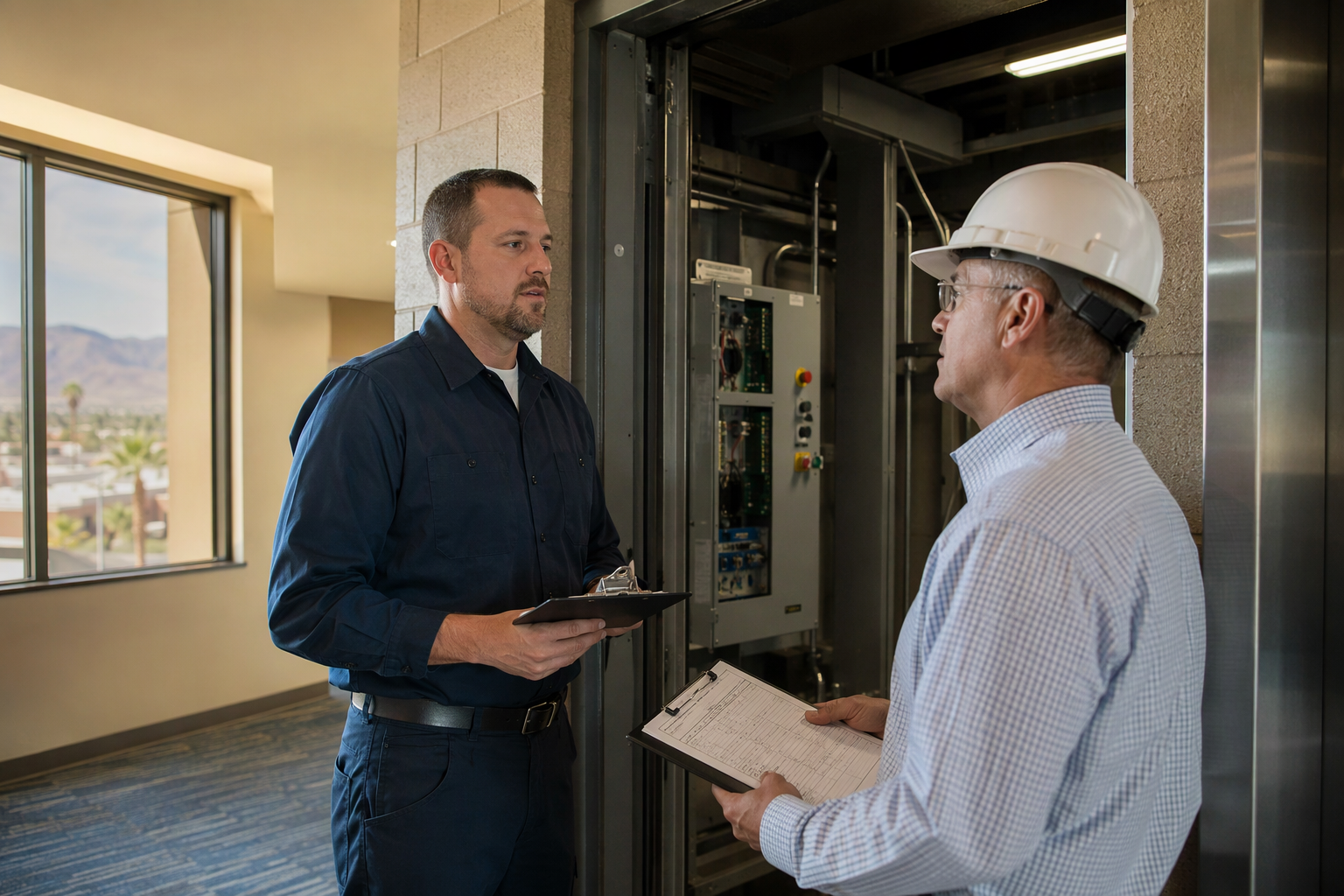
When a third-party inspector or acceptance-testing vendor arrives at a property in Phoenix, Tucson, Scottsdale, or Mesa, the presence of a knowledgeable elevator service technician is not simply a convenience — it is a practical necessity that protects the building owner, keeps the inspection moving efficiently, and ensures that any deficiencies identified on the spot can be addressed before a certificate of inspection is put at risk. This hub page answers the most common questions building owners, facility managers, and property developers ask about technician support during third-party elevator testing in Arizona.
What does it mean to have a technician “on site” during third-party elevator testing?
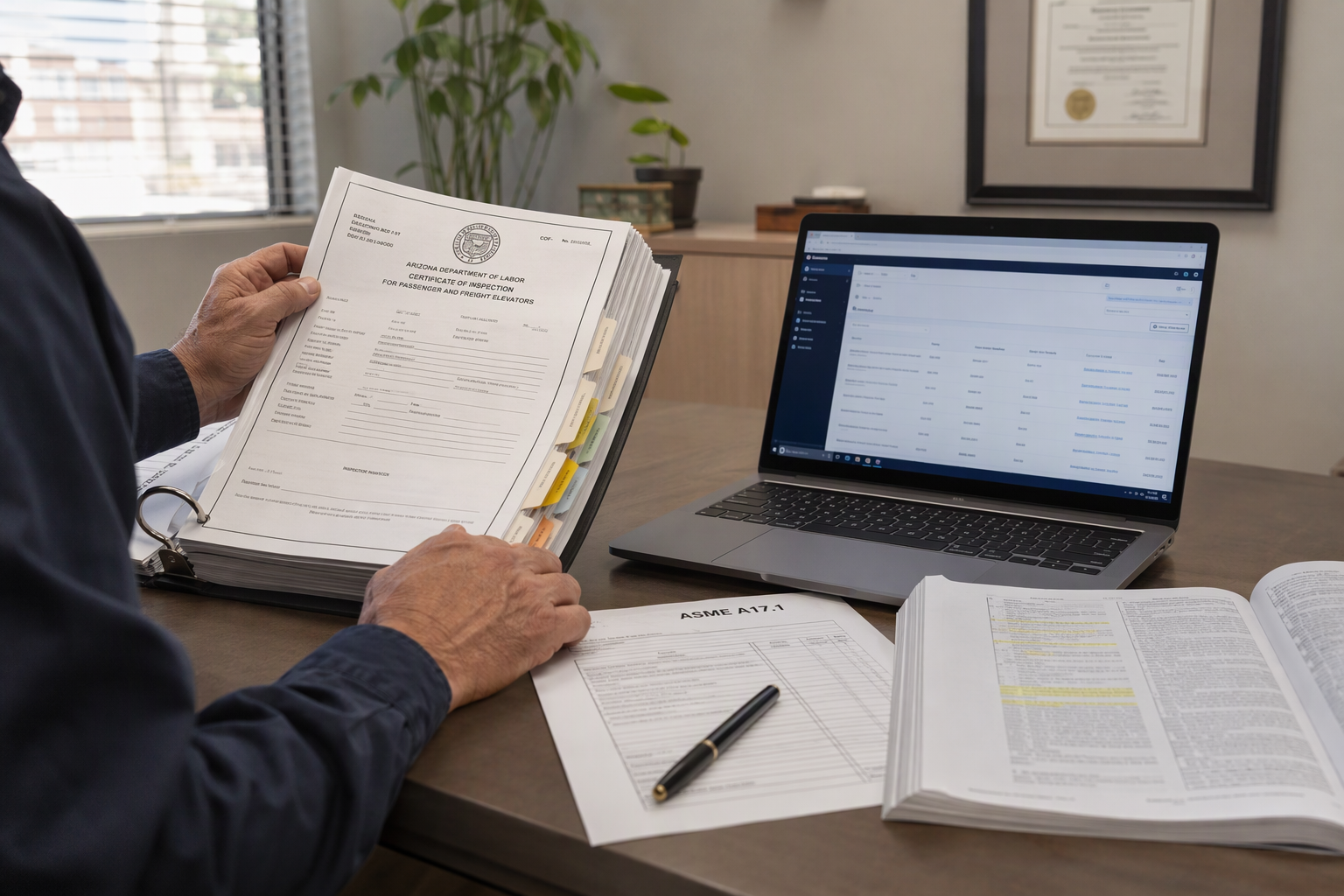
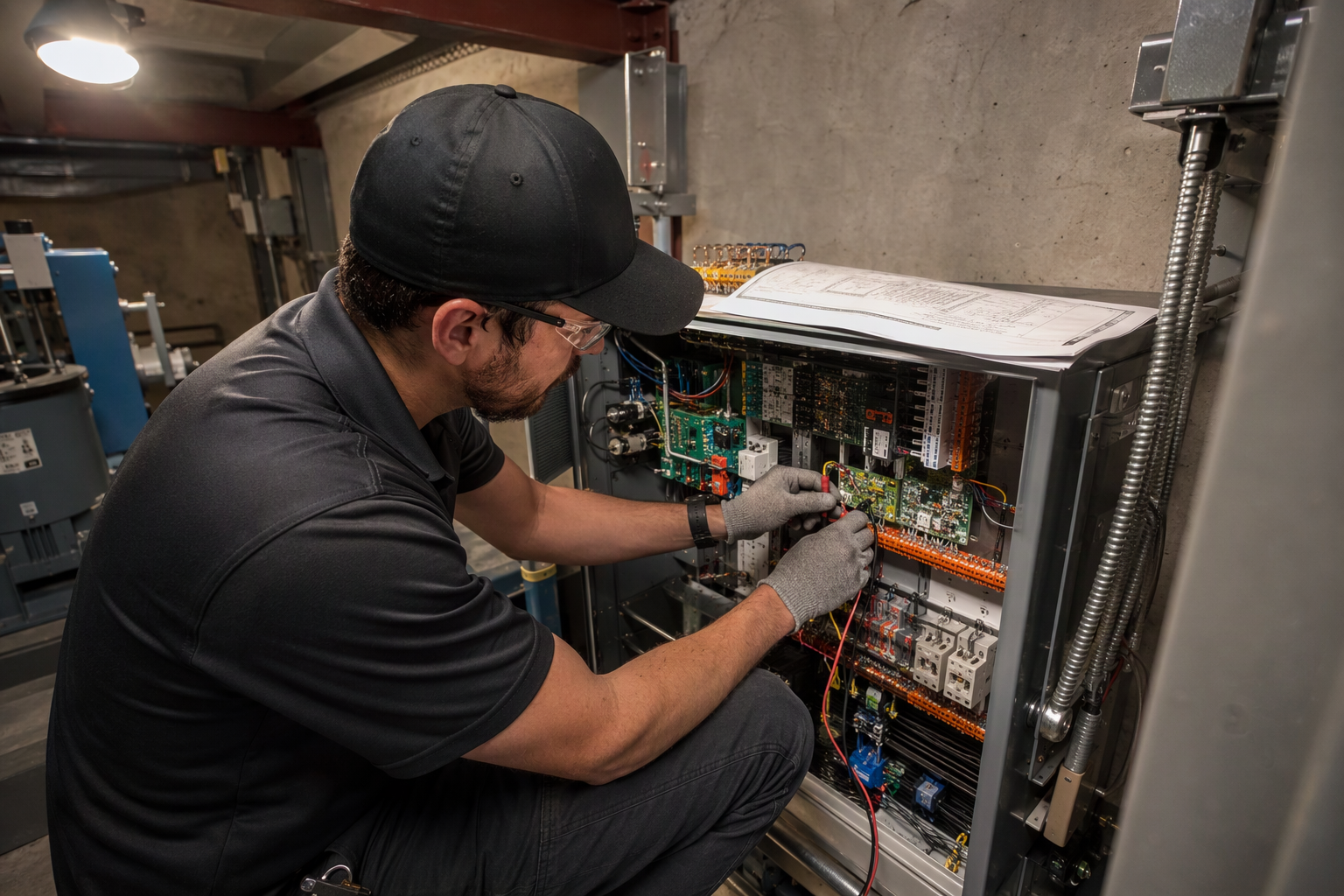
Having a technician on site means a qualified elevator service professional is physically present at the property throughout the testing event to operate the elevator, provide access to machine rooms and pits, supply documentation, and perform any minor corrective work the inspector flags during the visit.
Third-party testing scenarios in Arizona typically fall into one of three categories: the annual inspection required by the Industrial Commission of Arizona (ICA) Elevator Division; an acceptance inspection after a new installation or major alteration; and a witnessed load or performance test requested by an owner, insurer, or general contractor. In every case, the inspector — whether an ICA compliance inspector or a private elevator inspector authorized by the commission — relies on the technician to make equipment accessible and operable. Without that support, an inspection can be postponed, resulting in delays to an operating certificate and potential liability for the owner.
Is a technician legally required to be present during an Arizona elevator inspection?
Arizona law does not use the word “technician” in its mandate, but under A.R.S. §§ 23-491 through 23-491.16 and Arizona Administrative Code R20-5-502 through R20-5-515, the owner bears responsibility for ensuring the conveyance is available, accessible, and in a condition that allows a complete inspection — which as a practical matter requires a knowledgeable representative present.
The Arizona elevator safety statute places legal obligations squarely on the owner or operator, including the duty to maintain a valid annual certificate of inspection and to make equipment available to the state’s inspectors. If a machine room is locked, a pit light is burned out, or a door-restrictor test cannot be run because no one on site knows the access protocol, an inspector may mark the inspection incomplete and require a re-inspection visit — adding cost and delay. Engaging Arizona Elevator Solutions to provide technician standby support removes that risk.
What specific tasks does a standby technician perform during third-party testing?
A standby technician handles the hands-on operational and logistical elements of the inspection that neither the inspector nor building staff are equipped to perform.
Typical responsibilities include:
- Unlocking and preparing the machine room, control room, overhead space, and pit before the inspector arrives
- Operating the elevator in independent service, inspection mode, and emergency operation as directed by the inspector
- Pulling and presenting the maintenance log, the current certificate of inspection, and the state serial number documentation that must accompany every Arizona conveyance
- Running door cycle tests, governor rope tests, safety gear trips, and buffer tests under the inspector’s direction
- Performing immediate corrective adjustments — such as resetting a governor or adjusting a door closing force — when a minor deficiency is found and can be resolved on the spot
- Documenting any items that require follow-up and communicating them directly to the building owner after the inspection
The standby technician does not conduct the inspection or sign the inspection report. That authority belongs to the appointed inspector. The technician’s role is to make the inspection thorough, complete, and efficient.
Who is authorized to perform elevator inspections in Arizona?
Inspection authority in Arizona is split between state inspectors and private inspectors, both regulated by the Industrial Commission of Arizona Elevator Division.
Under Arizona law, owners may hire a private elevator inspector authorized by the ICA to perform initial or annual inspections. Those private inspectors must register with the commission every year and demonstrate at least eight hours of approved continuing education to maintain that registration. One important restriction: a private elevator inspector may not inspect a conveyance owned, operated, or last serviced by the inspector, a company the inspector owns, or the inspector’s employer. This conflict-of-interest rule is why the inspector and the standby service technician typically come from separate organizations — the technician services the equipment, and an independent inspector evaluates it.
Within the City of Phoenix, the City of Phoenix Elevator Section (Planning and Development Department) conducts its own inspections for elevators, escalators, moving walks, dumbwaiters, and chairlifts inside city limits. Equipment located outside Phoenix is handled by the ICA Elevator Division.
What is the difference between an annual inspection and an acceptance inspection in Arizona?
An annual inspection is the recurring compliance check required after a conveyance goes into service, while an acceptance inspection is a one-time event triggered by new installation, relocation, or any modification or alteration to an existing conveyance.
Under Arizona requirements, owners must notify the state at least 90 days before installing, relocating, or altering a conveyance. After that work is complete, the conveyance must pass an inspection before it goes back into service. Acceptance inspections are typically more comprehensive than annual inspections because they verify that all newly installed components conform to the adopted code edition — in Arizona, that is ASME A17.1-2019 for equipment installed, repaired, or altered on or after January 1, 2023. Having a technician on site during an acceptance inspection is especially critical because the inspector may call for specific performance tests — overspeed governor trips, full-load ascending and descending car safety tests, and rated-load buffer tests — that require a skilled operator to execute safely.
What codes govern elevator testing procedures in Arizona?
Testing requirements for elevators in Arizona are anchored in federal safety standards and adopted state code editions.
The primary code is the ASME A17.1/CSA B44 Safety Code for Elevators and Escalators. Arizona has adopted the 2019 edition (ASME A17.1-2019) for equipment installed, repaired, or altered on or after January 1, 2023, effective January 9, 2023. For existing equipment installed before that date, the previously adopted edition continues to govern unless the state’s elevator chief determines the installation presents a hazard. Arizona platform lifts and stairway chairlifts installed, repaired, or altered on or after January 1, 2023 must comply with ASME A18.1-2020.
Accessibility provisions for public elevators are governed by the Americans with Disabilities Act (ADA), and workplace safety obligations for technicians working in pits and overhead spaces fall under OSHA standards. A standby technician familiar with all three regulatory layers ensures that testing is conducted correctly and that no code-required test is inadvertently skipped.
How does the ASME A17.1-2019 define the testing that requires a qualified operator?
ASME A17.1-2019 specifies that certain performance tests — including safety tests, governor tests, and buffer tests — must be conducted under defined load conditions with the car under controlled operation, which inherently requires a qualified person at the controls.
The code distinguishes between periodic tests that occur at defined intervals and acceptance tests that occur after installation or alteration. Both categories include procedures that cannot be safely or accurately completed without someone capable of placing the elevator in the correct operating mode, bringing the car to the appropriate speed, and stopping it in a controlled manner after the test device activates. The standby technician fulfills that role. Without a qualified operator, the inspector cannot legally certify that those tests were completed in conformance with the code.
What documentation should a technician have ready before the inspector arrives?
Assembling documentation in advance prevents delays and demonstrates to the inspector that the owner is meeting the recordkeeping obligations that Arizona law requires.
The technician standby checklist for documentation should include:
- The current certificate of inspection, which must be kept at the same location as the conveyance under Arizona law
- The state serial number tag or documentation confirming the serial number affixed to the controller or mainline disconnect
- The maintenance log showing all service visits, lubrication, adjustments, and repairs since the last inspection
- Any outstanding violation notices or correction orders issued by the ICA Elevator Division or the City of Phoenix Elevator Section
- Drawings or modernization records for any recent alteration, especially if the alteration was performed on or after January 1, 2023 and therefore subject to ASME A17.1-2019
- The Arizona Firefighters Service (AZFS) key documentation for any conveyance with firefighters’ emergency operation, confirming the correct key type is installed
Arizona Elevator Solutions provides pre-inspection preparation services that include a documentation audit and a pre-inspection walkthrough specifically to ensure nothing on this list is missing when the inspector arrives.
What happens if a deficiency is found during the inspection?
When an inspector identifies a deficiency, the owner has a defined obligation to correct it and may face restricted operation of the conveyance until correction is verified — making the technician’s ability to address minor items on the spot particularly valuable.
Under Arizona law, no conveyance may operate without a valid annual certificate of inspection. If deficiencies are serious enough to prevent certification, the elevator must be taken out of service until corrections are made and re-inspection is completed. Having a service technician on site allows minor deficiencies — a faulty indicator lamp, an out-of-adjustment door reversal device, a low pit light — to be corrected before the inspector closes the report, potentially preserving the certificate on the first visit. More significant deficiencies require a formal correction and re-inspection, but the technician on site can begin that process immediately rather than scheduling a separate service call days later.
Can the same company provide the standby technician and the inspector?
No — Arizona’s conflict-of-interest rule for private elevator inspectors prohibits a private inspector from inspecting a conveyance last serviced by the inspector’s employer or a company the inspector owns.
This is a deliberate safeguard in Arizona law to maintain the independence of the inspection process. As a result, building owners who use a private inspector to conduct the annual inspection must ensure that inspector does not have a service relationship with the elevator. The service company providing the standby technician and the inspection company are separate entities. Arizona Elevator Solutions serves as the service provider — maintaining the equipment and supplying technician standby support — while an independent, ICA-authorized private inspector conducts the official inspection. This structure satisfies the statutory conflict-of-interest requirement and keeps both roles clearly defined.
What is the role of the Arizona Registrar of Contractors in elevator work?
The Arizona Registrar of Contractors (ROC) licenses the contractors who install and repair elevators through the R-12 (residential) and C-12 (commercial) elevator license classifications, which authorize work on elevators, dumbwaiters, escalators, and moving walks.
ROC licensing is distinct from the inspection certificate process. The ROC licenses the contractor performing the physical work; the ICA Elevator Division issues the annual certificate of inspection that permits the conveyance to operate. A building owner should verify that any elevator service company working on their equipment holds the appropriate ROC classification. The ROC does not issue, approve, or revoke annual certificates of inspection — that authority belongs exclusively to the ICA Elevator Division.
How should a building owner coordinate a third-party test date with their service company?
Coordination should begin well before the scheduled inspection date to ensure technician availability, document readiness, and any pre-inspection maintenance can be completed.
Recommended coordination steps:
- Confirm the inspection date and time window with the third-party inspector or testing vendor as early as possible
- Notify the elevator service company of the confirmed date and request technician standby scheduling
- Ask the service company to perform a pre-inspection maintenance visit at least one to two weeks before the inspection date
- Confirm that all required documentation is at the building and in order, including the certificate of inspection and maintenance log
- Ensure machine room access credentials and pit access are communicated to the technician in advance
- Brief building staff on inspection-day protocols, including keeping elevator lobbies clear and directing the inspector to the technician on arrival
Arizona Elevator Solutions works with building owners in Phoenix, Scottsdale, Mesa, and Tucson to manage this coordination, reducing the administrative burden on facility teams and minimizing the risk of an incomplete or inconclusive inspection.
What is a witnessed load test, and when is one required?
A witnessed load test is a formal performance test in which the elevator carries a specified load — typically its rated capacity — through a defined sequence of operations while an inspector or other authorized witness documents the results, and it is required after installation, certain alterations, and at intervals specified by the adopted code.
Under ASME A17.1-2019, different test types apply at different intervals and after specific triggering events such as modernization, governor replacement, or safety gear replacement. A witnessed load test goes beyond a visual inspection: it verifies that the elevator’s braking, safety, and buffer systems perform correctly under real operating conditions. Technician presence is not optional for these tests — the technician must place the car in the correct mode, load the car to the specified weight, and operate the equipment through the required test cycles while the witness observes and records results.
Does ADA compliance factor into elevator inspections and testing in Arizona?
Yes — while the ADA is a federal civil rights law rather than a state safety code, accessibility requirements for elevators in public accommodations and commercial facilities are a standard part of compliance review and can surface during inspections or due-diligence testing.
ADA requirements address cab dimensions, door width and timing, control button height and labeling, floor designations in Braille, audible signals, and emergency two-way communication systems. A technician familiar with ADA requirements can flag potential accessibility deficiencies during the testing visit even if the state inspector’s formal scope is limited to mechanical safety. This matters for building owners who face potential complaints or litigation from users with disabilities — catching an accessibility gap during a planned inspection is far less disruptive than responding to a complaint after the fact.
What OSHA considerations apply to technicians working during inspection or testing events?
Under OSHA standards, elevator pits, overhead work, and machine rooms carry specific hazards — including fall hazards, electrical hazards, and confined-space-adjacent conditions — that require the standby technician to follow appropriate safety protocols throughout the inspection.
Pits deeper than specified thresholds involve fall-protection and ladder-safety requirements. Machine room electrical panels require arc-flash awareness. During governor and safety trips, the technician must be positioned to avoid recoil or uncontrolled car movement. A well-trained technician understands these hazards and applies safe work practices consistently, protecting not only themselves but also the inspector and any building personnel present. Property owners should confirm that any service company they engage for technician standby work enforces documented safety procedures consistent with OSHA requirements.
How does technician standby support differ from a standard preventive maintenance visit?
A preventive maintenance visit focuses on inspecting, lubricating, adjusting, and testing the elevator’s components on the service company’s schedule, while technician standby support is specifically structured around the third-party inspector’s agenda, timeline, and test requirements.
| Feature | Preventive Maintenance Visit | Technician Standby for Third-Party Inspection |
|---|---|---|
| Who sets the agenda? | Service company’s maintenance schedule | Third-party inspector or testing vendor |
| Primary goal | Maintain and adjust equipment | Support a complete, code-compliant inspection |
| Documentation produced | Service log entry, maintenance record | Inspection report support, deficiency notes |
| Corrective work performed? | Yes, as part of the visit | Minor corrections only; major items scheduled separately |
| Triggered by | Maintenance contract schedule | Scheduled inspection or acceptance test date |
| Regulatory outcome | Supports ongoing compliance | Directly supports certificate of inspection issuance |
| Who is present? | Service technician only | Service technician plus third-party inspector |
Many building owners schedule a preventive maintenance visit in the weeks before a known inspection date specifically to maximize the chance that the elevator arrives at the inspection in its best condition. Arizona Elevator Solutions recommends this two-stage approach for all properties in its service areas.
What should building owners in Phoenix specifically know about dual jurisdiction?
Properties inside the City of Phoenix are subject to inspection by the City of Phoenix Elevator Section (Planning and Development Department) rather than directly by the ICA Elevator Division, creating a dual-authority environment that owners and their service companies must navigate carefully.
For elevators inside Phoenix city limits, the City of Phoenix Elevator Section conducts inspections covering elevators, escalators, moving walks, dumbwaiters, and chairlifts. Equipment outside Phoenix falls under the ICA Elevator Division. Building owners with properties in both jurisdictions — common for portfolio operators in the Phoenix metro — must coordinate separately with each authority. The state serial number and certificate requirements established under A.R.S. §§ 23-491 through 23-491.16 apply statewide, but the inspection scheduling, inspection fees, and re-inspection protocols may differ between the city and the state. A service technician familiar with both jurisdictions, as Arizona Elevator Solutions’ field teams are, helps ensure nothing falls through the gap between city and state oversight.
What should a building owner do immediately after an inspection reveals a violation?
When a violation is documented, the owner should take a structured, prompt response to protect building occupants, preserve the operating certificate where possible, and demonstrate good-faith compliance to the regulator.
- Review the inspection report carefully with the technician present to understand exactly what was cited and the severity classification of each item
- Determine which items can be corrected immediately on site and authorize the technician to proceed
- For items that require parts or more extensive work, obtain a written correction scope and timeline from the service company
- If the violation requires the elevator to be taken out of service, post appropriate out-of-service notices and notify building occupants, particularly those with mobility limitations per ADA obligations
- Notify the ICA Elevator Division or the City of Phoenix Elevator Section (depending on jurisdiction) of the correction plan if required by the inspector’s report
- Schedule the re-inspection as soon as corrective work is complete, and arrange for technician standby at the re-inspection as well
- Update the maintenance log to reflect all corrective work performed and retain that documentation at the building
Arizona law requires that accident events resulting in personal injury or conveyance disability be reported to the state within 24 hours. Violations found during a routine inspection have a separate correction timeline established by the inspector’s report, which the technician standby can help the owner track and meet.
How does the annual certificate of inspection requirement affect testing scheduling?
Because no Arizona conveyance may legally operate without a valid annual certificate of inspection, allowing a certificate to expire before a re-inspection is scheduled creates an immediate compliance gap — making proactive scheduling essential.
The certificate expiration date is the natural anchor for the inspection calendar. Building owners should work backward from that date to schedule the annual inspection with enough lead time to allow for any corrective work and re-inspection before expiration. Engaging the service technician for a pre-inspection visit four to six weeks before the certificate expires provides a buffer. If deficiencies are found and corrected during that pre-inspection window, the formal inspection can proceed with a high probability of first-visit certification. Arizona Elevator Solutions recommends that every property in its Phoenix, Tucson, Scottsdale, and Mesa service areas maintain a tracking system tied to certificate expiration dates rather than waiting for a notice from the regulator.
What are the consequences of operating an elevator without a current certificate of inspection in Arizona?
Operating a conveyance without a current certificate of inspection in Arizona is a direct violation of A.R.S. §§ 23-491 through 23-491.16, exposing the owner to enforcement action by the ICA Elevator Division and potential civil liability if an incident occurs.
The Arizona elevator safety statute gives the ICA Elevator Division authority to order a conveyance out of service when it is operated without a valid certificate or when it presents a hazard to life, health, or property. An out-of-service order on a commercial building elevator creates immediate operational and accessibility problems — particularly in multi-story buildings where elevator access is the only practical means of vertical travel for building occupants with disabilities. Additionally, if an injury occurs on an elevator operating without a current certificate, the absence of the certificate may be treated as evidence of negligent maintenance in civil proceedings. These consequences make technician standby support during inspections a risk-management investment, not merely a convenience.
Contact Arizona Elevator Solutions for a free elevator assessment at 480-557-7600.
Need elevator service you can rely on? Arizona Elevator Solutions is ready to help.