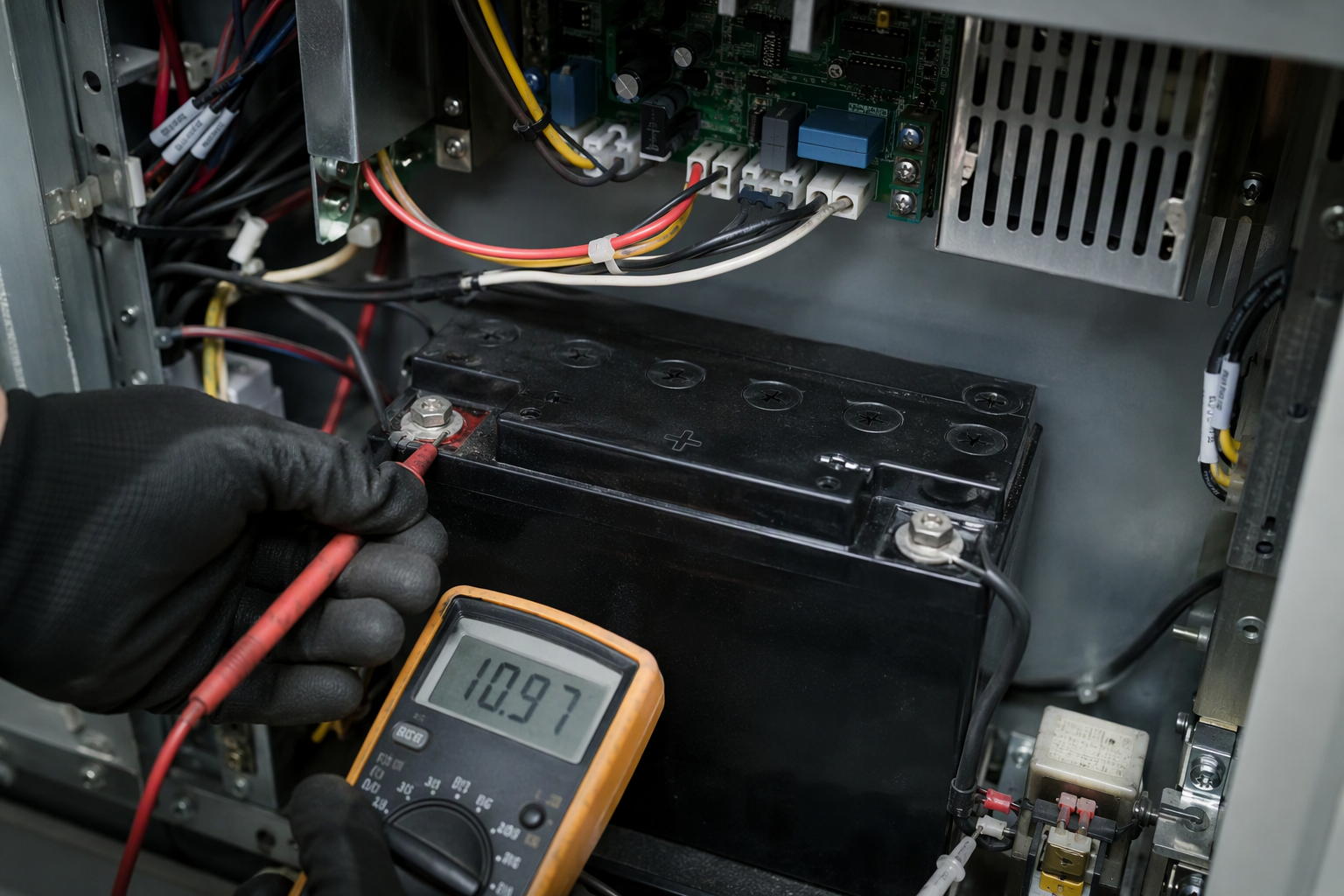
Yes, Arizona Elevator Solutions services residential elevators across Phoenix, Tucson, Scottsdale, and Mesa, and a dead battery causing constant beeping is a common repair the company handles. The battery backup system in a residential elevator powers the alarm, lighting, and emergency lowering function; when the battery fails or degrades, the charger circuit triggers a continuous beep alert that requires battery replacement and system testing to resolve.
Does Arizona Elevator Solutions Service Residential Elevators?
Yes, Arizona Elevator Solutions services residential elevators in Phoenix, Tucson, Scottsdale, and Mesa, covering maintenance, repair, modernization, and compliance inspections for home elevator systems of all major types and brands.
Residential elevators differ from commercial units primarily in their drive system, cab size, and load capacity, but they are still governed by the same overarching safety framework in Arizona. Equipment installed, repaired, or altered on or after January 1, 2023 must comply with the ASME A17.1/CSA B44 Safety Code for Elevators and Escalators, 2019 edition, as adopted under Arizona Administrative Code R20-5-502 through R20-5-515. That means a home elevator is not simply a household appliance — it is a regulated conveyance subject to state inspection and certification requirements, regardless of whether it sits inside a private residence.
Homeowners in Phoenix should also be aware that the City of Phoenix Elevator Section, within the Planning and Development Department, inspects elevators located inside city limits, while the Industrial Commission of Arizona (ICA) Elevator Division handles equipment in all other Arizona jurisdictions.
Why Is My Residential Elevator Beeping Constantly?
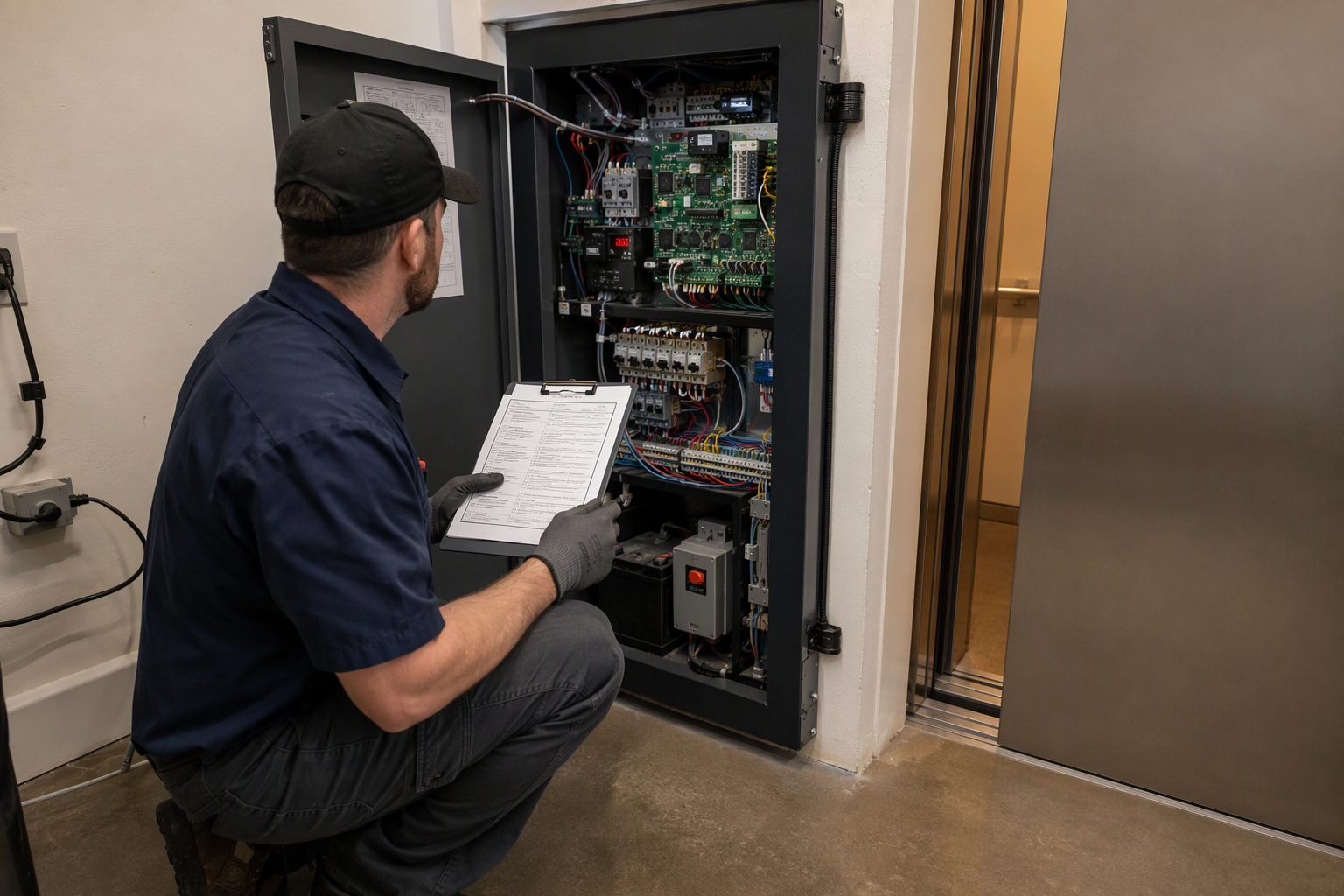
Constant beeping from a residential elevator almost always signals a low, failed, or disconnected battery backup unit, though fault codes from the control board, door interlock issues, or a low-oil condition on hydraulic systems can also trigger an alarm tone.
Residential elevators are required under ASME A17.1 to maintain battery-powered emergency lighting and an alarm bell or buzzer that can operate when normal power is interrupted. The battery charger monitors voltage continuously; when the battery can no longer hold a sufficient charge — typically because it has reached end-of-life — the monitoring circuit sounds an alert to protect passengers from becoming trapped without working emergency features. In Arizona’s extreme summer heat, battery degradation accelerates significantly compared to milder climates, making battery-related beeping complaints especially common in Phoenix, Scottsdale, Mesa, and Tucson.
Other causes include a loose battery terminal, a failed charging board, a tripped circuit breaker to the charging circuit, or a persistent door fault that the control board flags with an audible alert. A qualified technician must read the fault log on the control board to distinguish a true battery failure from an upstream electrical problem before replacing components.
How Is a Dead or Failing Elevator Battery Properly Replaced?
Proper battery replacement requires isolating the elevator circuit, verifying the fault source on the control board, selecting a battery that meets the original equipment manufacturer’s specifications, and testing all battery-dependent safety functions after installation.
The following steps describe the standard procedure a qualified elevator technician follows when addressing a dead or degraded residential elevator battery:
- Record the fault code. Before touching any hardware, the technician reads the control board’s fault history to confirm the alert is battery-related and not a secondary fault masking a wiring or door issue.
- Isolate power safely. The mainline disconnect or circuit breaker is locked and tagged out in accordance with OSHA lockout/tagout requirements before any work begins on the electrical system.
- Test the existing battery. A load tester measures the battery’s cold cranking amps and voltage under load to confirm it has failed rather than simply discharged due to a charger fault.
- Inspect the charging circuit. If the battery is dead but relatively new, the charger board, fuse, and wiring harness are tested to prevent the same failure from destroying the replacement battery.
- Remove and replace the battery. The old battery is disconnected, removed, and disposed of in compliance with applicable environmental regulations. The replacement battery matches the OEM-specified voltage, ampere-hour rating, and form factor.
- Verify terminal connections. All terminals are cleaned, reconnected, and torqued to specification to prevent resistance heating or premature failure.
- Restore power and test. With power restored, the technician simulates a power outage to confirm the battery sustains emergency lighting, the alarm, and — where applicable — the emergency lowering function for the full duration required by ASME A17.1.
- Clear fault codes and document. The fault log is cleared, the repair is documented in the elevator’s maintenance record, and the homeowner is advised of the expected replacement interval for the new battery.
What Types of Residential Elevators Are Serviced?
Residential elevator technicians routinely service hydraulic, cable-drum, traction, and pneumatic vacuum (air-driven) home elevators, each of which has distinct maintenance and repair requirements.
| Drive Type | Common Residential Use | Typical Battery Role | Key Maintenance Interval |
|---|---|---|---|
| Hydraulic (oil) | 2–4 story homes | Emergency lowering valve, alarm, lighting | Annual oil/fluid check; filter per OEM |
| Cable Drum | 2–3 story homes, retrofits | Alarm bell, emergency lighting | Annual cable inspection and lubrication |
| Winding Drum / Traction | Luxury homes, 3+ stories | Alarm, lighting, ARD (automatic rescue device) | Annual rope and sheave inspection |
| Pneumatic Vacuum (PVE) | 2-story homes, space-limited | Alarm, control board backup | Seal and turbine inspection per OEM |
| Inclined Platform Lift | Split-level homes, stairs | Drive battery, alarm, lighting | Annual per ASME A18.1-2020 (AZ, post-2023) |
Arizona platform lifts and stairway chairlifts installed, repaired, or altered on or after January 1, 2023 must comply with ASME A18.1-2020, a separate standard from the A17.1 that governs elevators. Arizona Elevator Solutions services all of these residential conveyance types throughout its service territory.
Are Residential Elevators in Arizona Required to Be Inspected Annually?
Yes, every conveyance in Arizona — including home elevators — must be inspected annually and must hold a current certificate of inspection issued by the state before it can legally operate.
Under A.R.S. §§ 23-491 through 23-491.16 and Arizona Administrative Code R20-5-502 through R20-5-515, Arizona owners must have each conveyance inspected before it first goes into service, after any modification or alteration, and annually thereafter. No conveyance may operate in Arizona without that annual certificate. The certificate must be kept at the same location as the conveyance and made available on request; the state serial number or the certificate itself must be posted in or close to the elevator in an easily accessible location.
Homeowners may arrange inspections through the Industrial Commission of Arizona’s Elevator Division or may hire a private elevator inspector authorized by the ICA. Private inspectors must register with the commission every year and demonstrate at least eight hours of approved continuing education. Critically, a private inspector may not inspect equipment that the inspector, a company they own, or their employer last serviced — an important distinction when selecting an inspection provider.
Who Regulates Residential Elevators in Arizona in 2026?
As of September 12, 2026, residential and commercial elevators in Arizona are regulated by the Industrial Commission of Arizona (ICA), Elevator Division — the agency formerly known as the ADOSH Elevator Safety Section before that name changed under Laws 2026, Ch. 73.
Homeowners should use the ICA Elevator Division’s name when filing notifications, requesting inspections, or corresponding about their equipment. Equipment inside the City of Phoenix falls under dual jurisdiction: the City of Phoenix Elevator Section (Planning and Development Department) conducts local inspections, while the ICA Elevator Division retains broader authority under state statute. Outside Phoenix, the ICA Elevator Division is the sole state authority.
Contractors performing elevator installation or repair in Arizona must hold the appropriate license from the Arizona Registrar of Contractors — specifically the R-12 (residential) or C-12 (commercial) elevator license classification, which authorizes the licensee to install and repair elevators, dumbwaiters, escalators, and moving walks. The ROC license is a contractor credential; it does not substitute for the annual certificate of inspection issued by the state.
What Should a Homeowner Do Immediately When an Elevator Starts Beeping?
When a residential elevator begins beeping, the owner should stop using the elevator, note any fault codes displayed on the panel, and contact a licensed elevator service company to diagnose the cause before resuming operation.
- Stop use immediately. Do not continue using the elevator until the cause of the alert is identified. A beeping elevator may indicate a safety system is compromised.
- Check for a fault code display. Many residential elevator control panels display a numeric or alphanumeric fault code alongside the audible alert. Photograph or write down any codes visible on the panel.
- Check whether the elevator has power. Confirm that the circuit breaker for the elevator is not tripped and that general building power is normal. A utility outage can trigger the battery alarm.
- Do not silence the alarm manually without diagnosis. Some battery-powered alarms can be temporarily silenced, but suppressing the alert without resolving the root cause leaves passengers vulnerable to a future entrapment without working emergency features.
- Call a licensed elevator service company. Contact a provider authorized to work on residential elevators in Arizona and describe the beeping pattern, any fault codes, the elevator type, and when the issue began.
- Report a disabling event to the state if applicable. Under Arizona law, owners must notify the ICA Elevator Division within 24 hours of any accident that injures a person or disables a conveyance. If the beeping is accompanied by the elevator going out of service, confirm whether a state notification is required.
How Often Should a Residential Elevator Battery Be Replaced?
Residential elevator battery replacement intervals depend on battery chemistry, the elevator’s operating environment, and the manufacturer’s specifications, but sealed lead-acid batteries used in most residential elevator backup systems typically require evaluation well before they reach the end of their rated service life in Arizona’s high-heat climate.
Arizona’s summer temperatures — routinely exceeding 110°F in Phoenix, Scottsdale, and Mesa — are among the most aggressive accelerants of battery degradation. Heat shortens the chemical lifespan of sealed lead-acid cells regardless of rated capacity. Rather than relying on calendar intervals alone, annual elevator inspections should include a load test of the battery under simulated power-loss conditions so that replacement is based on measured performance rather than assumed remaining life. Arizona Elevator Solutions recommends that homeowners ask their service technician to perform a battery load test at every annual maintenance visit.
Does an ADA Requirement Apply to Residential Elevators?
The Americans with Disabilities Act (ADA) applies to places of public accommodation and commercial facilities, not to private single-family residences, so a purely private home elevator is not subject to ADA requirements — however, ADA standards do apply to residential elevators in multi-family housing covered by fair housing regulations or in any portion of a property used for business.
Homeowners who install residential elevators to accommodate a family member’s disability often voluntarily apply ADA dimensional and operational guidelines because those standards reflect sound accessibility practice. For residential elevators in condominiums, assisted living facilities, or any portion of a home used commercially, ADA and fair housing compliance should be verified with a qualified accessibility consultant alongside the elevator service provider.
What Is the Arizona Firefighters Service (AZFS) Key, and Does It Apply to Residential Elevators?
The Arizona Firefighters Service (AZFS) key is the standardized key required for firefighters’ emergency operation on Arizona conveyances equipped with that feature, and its applicability to a specific residential elevator depends on whether the unit is configured with firefighters’ emergency operation.
Under Arizona’s adopted code framework, conveyances with firefighters’ emergency operation must use the AZFS key. Many residential elevators in private single-family homes are not configured with Phase I and Phase II firefighters’ emergency operation and therefore do not require the AZFS key. However, residential elevators in multi-unit buildings, condominiums, or assisted living settings typically are required to have firefighters’ emergency operation and must use the correct key. A service technician can confirm whether a specific installation requires AZFS-compatible hardware during an inspection or service visit.
How Does Arizona’s 90-Day Notification Rule Affect Residential Elevator Projects?
Arizona owners must notify the Industrial Commission of Arizona at least 90 days before installing, relocating, or altering a conveyance, which means residential elevator projects require advance planning well before construction or modification begins.
This requirement under A.R.S. §§ 23-491 through 23-491.16 applies to new installations as well as alterations — including significant drive-system replacements, cab modifications, or changes to safety components that constitute an alteration under the adopted code. Homeowners planning to add an elevator during a renovation or to upgrade an existing system should coordinate with their elevator contractor early so that state notification timelines do not delay the construction schedule. Arizona Elevator Solutions works with homeowners and their general contractors to ensure notification requirements are met before project commencement.
Can a Homeowner Perform Their Own Elevator Repairs in Arizona?
No, elevator repairs in Arizona must be performed by a contractor holding the appropriate Arizona Registrar of Contractors elevator license classification, and performing unlicensed elevator repair work is a violation of state law.
The R-12 and C-12 elevator license classifications from the Arizona Registrar of Contractors are required for installation and repair of elevators, dumbwaiters, escalators, and moving walks. This applies whether the elevator is in a commercial building or a private home. Beyond licensure, work performed without proper authorization can void the elevator’s insurance coverage, invalidate the state certificate of inspection, and create significant liability for the homeowner if an injury occurs. For battery replacements specifically, while the battery itself is a standard sealed lead-acid or lithium-iron-phosphate cell, the work involves accessing the control cabinet, testing safety circuits, and verifying code-required emergency functions — tasks that require trained elevator technicians.
What Happens If a Residential Elevator Operates Without a Valid Arizona Certificate?
Operating a conveyance in Arizona without a valid annual certificate of inspection is a violation of A.R.S. §§ 23-491 through 23-491.16 and exposes the owner to enforcement action by the Industrial Commission of Arizona Elevator Division, which has authority to order the equipment taken out of service.
Homeowners who have purchased a home with an existing elevator should verify that the certificate is current before using the equipment. The ICA assigns every Arizona conveyance a state serial number on a tag fixed to the controller or mainline disconnect; this tag can be used to look up the equipment’s inspection history. If the certificate has lapsed, an inspection must be arranged and any cited deficiencies corrected before a new certificate can be issued. Older equipment that was lawfully installed may remain in service unless the state’s elevator chief determines that continued use poses a hazard to life, health, or property — but a lapsed certificate alone is sufficient grounds for an order to cease operation.
What Is Involved in a Residential Elevator Modernization in Arizona?
Residential elevator modernization involves replacing outdated control systems, drive components, cab interiors, or safety devices to bring the equipment up to current safety standards and restore reliable operation, and in Arizona any such alteration triggers the 90-day notification requirement and a post-alteration inspection.
Common residential modernization projects include replacing relay-logic controllers with solid-state microprocessor controls, upgrading hydraulic power units to energy-efficient variable-speed systems, replacing worn wire ropes or chains, retrofitting LED emergency lighting, and updating door operator systems. Equipment installed, repaired, or altered on or after January 1, 2023 must comply with ASME A17.1-2019 as adopted in Arizona. Following any alteration, the elevator must pass a state inspection before returning to service and before a new certificate of inspection is issued.
How Do Residential Elevator Service Contracts Work, and Why Are They Beneficial?
A residential elevator service contract provides scheduled maintenance visits, priority service response, and documentation support for annual inspections, reducing the risk of unexpected failures and helping homeowners maintain continuous compliance with Arizona’s inspection certificate requirements.
Residential elevator components — including battery backup systems, door interlocks, hydraulic seals, and drive belts — degrade predictably over time. Scheduled maintenance allows a technician to identify early-stage battery degradation, loose electrical connections, or worn mechanical components before they cause a midtrip failure or a safety shutdown. For homeowners, a service record also provides documentation that the equipment has been professionally maintained, which is relevant to insurance underwriting and to maintaining the state certificate of inspection in good standing. Arizona Elevator Solutions provides residential elevator service contracts throughout Phoenix, Tucson, Scottsdale, and Mesa.
What Are Common Residential Elevator Safety Features That Must Be Tested Annually?
Annual inspection and testing of a residential elevator must cover all code-required safety devices, including the governor and safeties, door interlocks, emergency stop switches, battery backup systems, emergency lighting, and the alarm or communication system.
Under ASME A17.1-2019, each of these systems must function correctly for the elevator to receive a passing inspection result and a valid certificate of operation. The battery backup is specifically tested by simulating a power loss and confirming that emergency lighting illuminates the cab, the alarm bell or buzzer operates, and — on hydraulic units — the emergency lowering valve lowers the cab to a landing. Failing any of these tests requires the deficiency to be corrected before the certificate can be issued.
Can a New Residential Elevator Be Installed in an Existing Arizona Home?
Yes, residential elevators can be retrofitted into existing homes, but the project requires advance notification to the Industrial Commission of Arizona at least 90 days before installation begins, contractor work by an R-12 or C-12 licensed elevator contractor, compliance with ASME A17.1-2019, and a passing state inspection before the elevator can be placed in service.
Retrofit installations typically require a hoistway — either framed into an existing closet or utility space, or constructed as a new shaft addition — along with a machine room or machine-room-less equipment arrangement. The structural requirements of the hoistway must be coordinated with a licensed structural engineer and the local building department. In Phoenix, the City of Phoenix Elevator Section is involved in the permitting and inspection process for equipment within city limits. Arizona Elevator Solutions assists homeowners through the planning, notification, installation, and inspection process for new residential elevator installations.
How Does the Heat in Phoenix, Scottsdale, Mesa, and Tucson Affect Residential Elevator Components?
Arizona’s extreme summer heat accelerates degradation in battery backup systems, hydraulic fluid viscosity, rubber seals, and electronic control components, making more frequent inspection of heat-sensitive parts a practical necessity for residential elevator owners in the Phoenix metro and Tucson areas.
Sealed lead-acid batteries are particularly vulnerable to elevated ambient temperatures, which cause faster water loss from the electrolyte and accelerated plate corrosion, shortening service life. Hydraulic power units operating in unconditioned garage or utility spaces can experience fluid breakdown and seal degradation at higher rates than in climate-controlled environments. Control boards and electronic components in non-air-conditioned machine rooms are exposed to conditions that exceed the operating range specified by many manufacturers during peak summer months. Homeowners should discuss equipment location, ventilation, and climate control options with their elevator technician as part of a long-term maintenance strategy.
What Should Homeowners Look for When Choosing a Residential Elevator Service Company in Arizona?
Homeowners should verify that a residential elevator service company holds the appropriate Arizona Registrar of Contractors elevator license classification, has experience with the specific drive type installed in their home, and can provide documentation support for Arizona’s annual certificate of inspection requirement.
Key questions to ask a prospective service provider include: Does the company hold an R-12 or C-12 license from the Arizona Registrar of Contractors? Does it service the brand and drive type of the installed elevator? Can it assist with state notification filings and inspection coordination? Does it carry appropriate liability insurance? Does it stock common repair parts — including battery backup units — for the installed equipment? A provider that can answer yes to all of these questions reduces the risk of compliance gaps and extended downtime. Arizona Elevator Solutions serves residential and commercial elevator owners across Phoenix, Tucson, Scottsdale, and Mesa with the full scope of services that Arizona-regulated conveyance ownership requires.
What Records Should a Residential Elevator Owner Keep in Arizona?
Arizona residential elevator owners should maintain the current state certificate of inspection at the elevator’s location, retain the state serial number tag information, keep a log of all maintenance and repair visits, and preserve any notifications filed with the Industrial Commission of Arizona.
Under Arizona law, the certificate of inspection must be kept at the same location as the conveyance and made available for inspection on request. The state serial number or certificate must be posted in or close to the elevator in an easily accessible location. Beyond the legal minimums, maintaining a complete maintenance log — including battery test results, parts replaced, and dates of service — provides homeowners with documentation that supports insurance claims, real estate disclosures, and inspection readiness. If an accident occurs, Arizona law requires the owner to notify the ICA Elevator Division within 24 hours; having accurate records of the elevator’s maintenance history is essential in that situation.
Contact Arizona Elevator Solutions for a free elevator assessment at 480-557-7600.
Need elevator service you can rely on? Arizona Elevator Solutions is ready to help.