ADA Elevator Requirements for Multifamily Housing: 2026 Compliance Guide
Multifamily property owners face a layered compliance environment: federal accessibility law, the adopted ASME safety code, and Arizona-specific inspection requirements all apply simultaneously. Missing any layer creates liability exposure and can delay a certificate of occupancy. This page consolidates the most important requirements, organized by the questions property owners and developers most frequently ask.
What Federal Law Governs ADA Elevator Requirements in Multifamily Buildings?
Two federal frameworks control accessibility in multifamily housing. The Americans with Disabilities Act (ADA) applies primarily to the public and common-use areas of residential facilities—leasing offices, lobbies, fitness rooms, and parking—rather than to the individual dwelling units themselves. The Fair Housing Act (FHA) separately requires that all units in covered multifamily buildings (four or more units, built for first occupancy after March 13, 1991) meet seven specific design and construction requirements, one of which is an accessible building entrance on an accessible route served by an elevator when the building has multiple stories.
When a residential building contains ground-floor commercial or leasing space that is open to the public, that portion of the building is fully subject to ADA Title III standards, including elevator access between floors.
For Arizona properties that contain both residential and commercial elements—a common configuration in mixed-use urban developments in Phoenix, Scottsdale, and Tucson—both frameworks apply concurrently, and the more stringent requirement governs. Arizona Elevator Solutions evaluates both standards when performing a compliance assessment on mixed-use properties.
Does the ADA Require Elevators in All Multifamily Buildings?
Not automatically. The ADA contains a “elevator exception” for buildings that are less than three stories or have fewer than 3,000 square feet per floor, unless the building is a shopping center, a shopping mall, the professional office of a health care provider, a transit facility, or an airport terminal. Pure residential buildings that fall below those thresholds may qualify for this exception in their public-use areas.
However, the Fair Housing Act does not contain a square-footage exception. Any covered multifamily building with four or more units that has multiple stories and an elevator is required to make all units and all common areas accessible. If a developer chooses to install an elevator to reach upper floors, that elevator must meet accessibility standards regardless of building size.
In practice, most multifamily buildings of four or more stories in Arizona install elevators to meet market expectations and financing requirements, bringing the full suite of accessibility obligations into play.
What Are the Core ADA and Fair Housing Elevator Specifications for Multifamily?
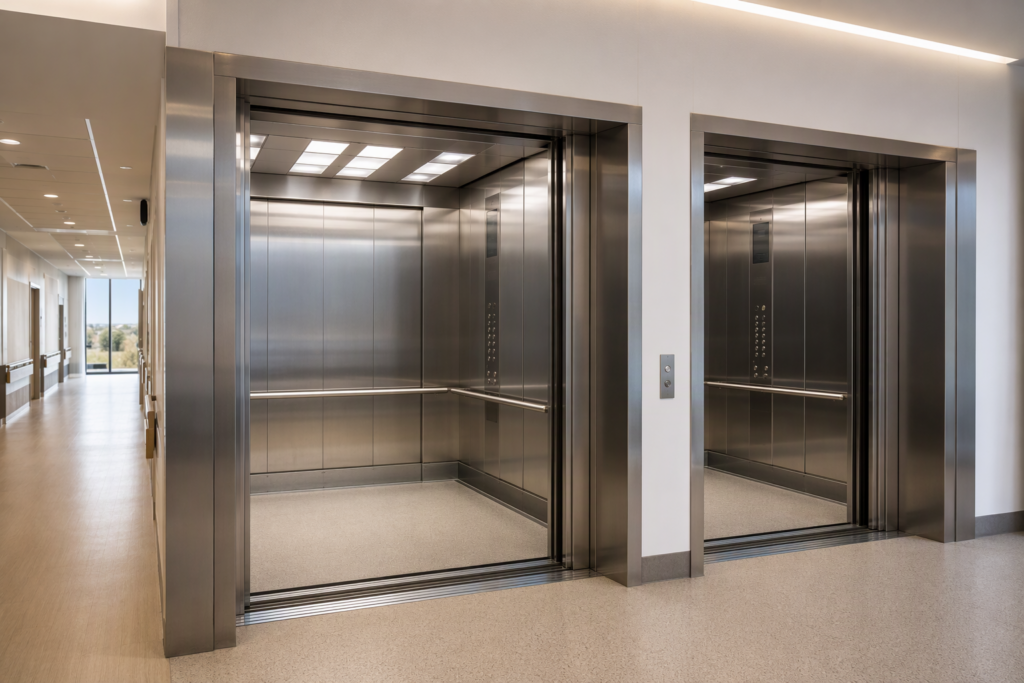
The ADA Standards for Accessible Design set the dimensional and operational benchmarks that accessible elevators must meet. Key requirements include:
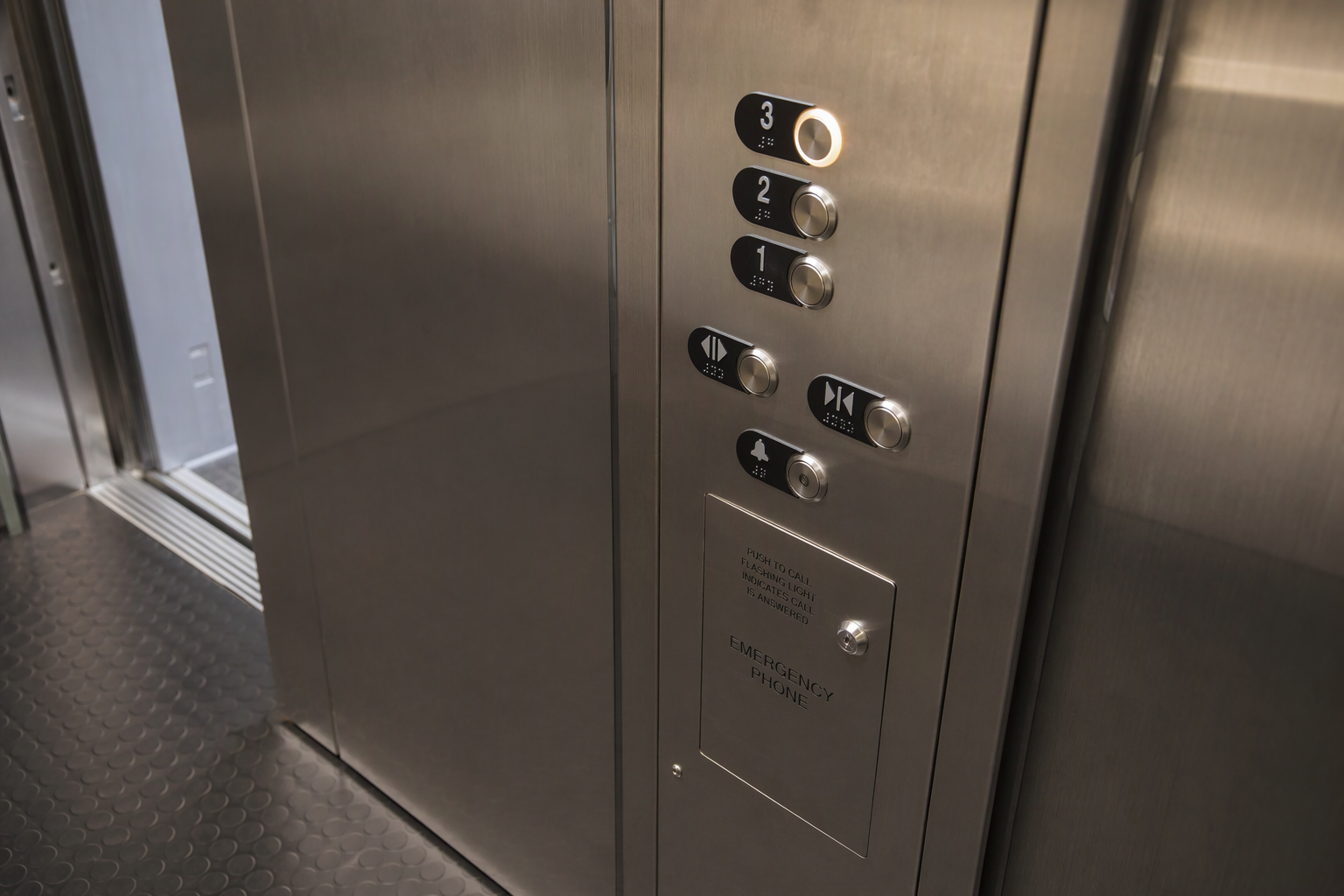
- Call buttons: Located between 15 inches and 48 inches above the floor, centered, and illuminated when activated.
- Cab dimensions: The minimum clear floor area inside the cab must accommodate a wheelchair user—generally requiring at least 51 inches in depth with centered doors, or specific alternative configurations depending on door location.
- Door clear width: At least 36 inches of clear opening width.
- Leveling: Elevators must level within one-half inch of the floor.
- Floor indicators: Visual and audible floor indicators are required so that passengers who are blind or have low vision know which floor they have reached.
- Control panels: All controls must be within accessible reach range and use raised characters and Braille designations.
- Two-way communication: An emergency two-way communication system is required inside the cab.
- Hall lanterns: Visible and audible hall lanterns indicating direction of travel must be provided at each hoistway entrance.
The Fair Housing Act Design and Construction Requirements add that the route from the building entrance to every unit on covered floors must be accessible, meaning the elevator must connect at grade level and reach all residential floors.
How Do ASME Elevator Safety Standards Interact With ADA Requirements in Arizona?
The ASME A17.1/CSA B44 Safety Code for Elevators and Escalators governs the mechanical, structural, and operational safety of the elevator itself. Arizona has adopted the 2019 edition of ASME A17.1 for equipment installed, repaired, or altered on or after January 1, 2023, under Arizona Administrative Code R20-5-502 through R20-5-515.
ADA and Fair Housing standards govern accessibility—who can use the elevator and how. ASME A17.1 governs safety—how the equipment is built and maintained. Both sets of requirements apply simultaneously. A new multifamily elevator in Arizona must comply with ASME A17.1-2019 for safety and with the ADA Standards for Accessible Design for accessibility. Satisfying one does not satisfy the other.
The Industrial Commission of Arizona (ICA) Elevator Division enforces the ASME safety requirements. Fair Housing and ADA enforcement is handled through the U.S. Department of Housing and Urban Development (HUD) and the U.S. Department of Justice respectively, as well as through private civil actions.
What Are Arizona’s Inspection and Certificate Requirements for Multifamily Elevators?
Under A.R.S. §§ 23-491 through 23-491.16, Arizona imposes the following obligations on multifamily property owners:
- No elevator may operate without an annual certificate of inspection issued by the state.
- The certificate must be kept at the same location as the conveyance and made available on request.
- The state serial number or certificate must be posted in or near the elevator in an easily accessible location.
- The elevator must be inspected before it first goes into service, after any modification or alteration, and at least annually thereafter.
- Owners must notify the Industrial Commission of Arizona at least 90 days before installing, relocating, or altering a conveyance.
- Any accident that injures a person or disables a conveyance must be reported to the state within 24 hours.
Within the City of Phoenix, the City of Phoenix Elevator Section (Planning and Development Department) performs inspections for elevators inside city limits. The Industrial Commission of Arizona Elevator Division handles equipment outside Phoenix. Property owners should confirm jurisdiction before scheduling inspections.
Arizona owners may engage a private elevator inspector authorized by the Industrial Commission of Arizona. Those inspectors must register with the commission annually and complete at least eight hours of approved continuing education. Using a private inspector does not shift legal responsibility away from the owner or operator.
What Types of Lifting Equipment Satisfy ADA Requirements in Multifamily Buildings?
Standard hydraulic and traction elevators are the most common solutions in multifamily buildings and are fully compliant when built to ADA dimensional requirements. However, in limited retrofit situations, other equipment types may be considered:
- Vertical platform lifts (VPLs): The ADA Standards permit VPLs in certain limited locations, including within a unit to provide access between floors of a single-family dwelling or as part of a recreation area. They are generally not a substitute for a passenger elevator in a multi-story multifamily building’s common areas.
- Limited-use/limited-application (LULA) elevators: LULA elevators are permitted by the ADA Standards in some existing building alterations and in certain new construction situations where a full-size elevator is not required. They must meet specific cab size and speed requirements to qualify.
- Stairway chairlifts: These do not satisfy ADA or Fair Housing requirements for multifamily common areas; they are not wheelchair-accessible and do not create an accessible route.
Arizona platform lifts and stairway chairlifts installed, repaired, or altered on or after January 1, 2023 must comply with ASME A18.1-2020 under Arizona’s adopted rules.
What Triggers an ADA Upgrade When Altering an Existing Multifamily Building?
When an existing multifamily building undergoes alterations, the ADA and Fair Housing Act require that the altered portions be made accessible to the maximum extent feasible. If an alteration affects the usability of a primary function area, an accessible path of travel to that area—including the elevator—must be made compliant. The cost of accessibility upgrades to the path of travel may be limited to a defined percentage of the overall alteration cost under ADA path-of-travel rules.
In Arizona, any alteration or modification to an elevator also triggers the requirement to notify the Industrial Commission of Arizona at least 90 days in advance and to pass inspection before returning the equipment to service.
Property owners undertaking renovations should assess both the ADA path-of-travel obligation and the Arizona notification and inspection requirement before beginning work. Arizona Elevator Solutions provides pre-alteration assessments to help owners understand what accessibility and safety upgrades are required before a project begins.
What Contractor Licensing Is Required to Install or Repair Multifamily Elevators in Arizona?
The Arizona Registrar of Contractors (ROC) issues R-12 (residential) and C-12 (commercial) elevator license classifications, which authorize the holder to install and repair elevators, dumbwaiters, escalators, and moving walks. Any contractor performing elevator installation or repair work on a multifamily property in Arizona must hold the appropriate ROC classification.
The ROC issues contractor licenses but does not issue the annual certificate of inspection—that remains the responsibility of the Industrial Commission of Arizona Elevator Division (or the City of Phoenix Elevator Section within Phoenix city limits).
Property owners should verify both the ROC license classification and the authorization to inspect before engaging any elevator contractor. Arizona Elevator Solutions works with ROC-licensed contractors and coordinates with the appropriate inspection authority on behalf of property owners.
What Are Common ADA Compliance Failures Found in Multifamily Elevator Installations?
Several deficiencies appear repeatedly in multifamily elevator assessments:
- Incorrect call button height: Buttons installed above the 48-inch maximum reach range, often due to uncoordinated finish-floor elevation changes after rough-in.
- Insufficient leveling accuracy: Elevator cabs that stop more than one-half inch above or below the floor level create a tripping hazard and prevent wheelchair users from boarding smoothly.
- Missing or non-compliant Braille: Control panels that use raised print but lack properly specified Braille, or that use incorrect Grade 2 Braille configurations.
- Inadequate two-way communication: Intercoms that require sustained hand pressure to operate, which is not usable by people with limited hand function.
- Non-compliant floor designation signage: Tactile characters on hoistway entrance jambs that do not meet ADA character height, spacing, or mounting height requirements.
- Inaccessible route to elevator lobby: A compliant elevator cab is undermined when the path from the accessible parking or building entrance to the elevator lobby contains steps, excessive slopes, or non-compliant doors.
What Should a Multifamily Property Owner Do If a Resident Files an ADA or Fair Housing Complaint?
- Document the complaint in writing, including the date received and the specific accessibility barrier described.
- Do not dismiss the complaint as outside the ADA—Fair Housing Act obligations apply to private multifamily housing even when ADA Title III does not apply directly.
- Engage a qualified elevator contractor to inspect the equipment and the accessible route for the specific deficiency cited.
- Obtain a written assessment identifying whether a deficiency exists and what remediation is required.
- If a deficiency is confirmed, develop and document a remediation timeline and begin work promptly.
- Consult legal counsel experienced in Fair Housing and ADA compliance before responding formally to any agency investigation or demand letter.
- Retain all inspection certificates, maintenance records, and remediation documentation—these records demonstrate good-faith compliance efforts.
What Industry Trends Are Shaping ADA Elevator Compliance in Multifamily for 2025–2026?
Several qualitative trends are influencing how multifamily developers and property managers approach elevator accessibility in 2026:
Aging-in-place demand: As Arizona’s population ages, demand for accessible multifamily housing continues to grow. Developers are increasingly designing for accessibility beyond the Fair Housing Act minimum requirements, recognizing that accessible units attract a broader renter pool and reduce future retrofit costs.
Enforcement activity: Federal enforcement agencies have continued to prioritize Fair Housing design and construction cases. Settlement agreements in the multifamily sector frequently require building-wide retrofits and extended monitoring periods, making proactive compliance economically preferable to reactive remediation.
Technology integration: Destination dispatch systems, touchless call buttons, and smartphone-integrated elevator controls are becoming more common in higher-end multifamily properties. These systems must still meet ADA reach range, visual, and audible requirements—technology does not waive the accessibility standard.
Mixed-use development: Arizona’s urban cores continue to see mixed-use residential and commercial development. These projects face the full suite of ADA Title III requirements in their commercial portions and Fair Housing requirements in their residential portions, making early-stage accessibility planning essential.
Arizona code enforcement continuity: Following the transition from the ADOSH Elevator Safety Section to the Industrial Commission of Arizona Elevator Division (effective September 12, 2026, under Laws 2026, Ch. 73), property owners should confirm that their inspection records and certificates are current and properly filed with the renamed agency.
How Does Arizona Elevator Solutions Support Multifamily ADA Compliance?
Arizona Elevator Solutions provides data-driven assessments of multifamily elevator installations against both the ADA Standards for Accessible Design and the ASME A17.1-2019 Safety Code as adopted in Arizona. The team coordinates with the Industrial Commission of Arizona Elevator Division and, where applicable, the City of Phoenix Elevator Section, to ensure that inspection certificates are current and that any deficiencies identified during assessment are addressed before regulatory or legal exposure arises.
For property owners undertaking alterations, Arizona Elevator Solutions assists with the 90-day advance notification requirement under A.R.S. § 23-491, coordinates pre- and post-alteration inspections, and documents remediation work in a format useful for Fair Housing compliance records.
Contact Arizona Elevator Solutions for a free elevator assessment at 480-557-7600.
Need elevator service you can rely on? Arizona Elevator Solutions is ready to help.