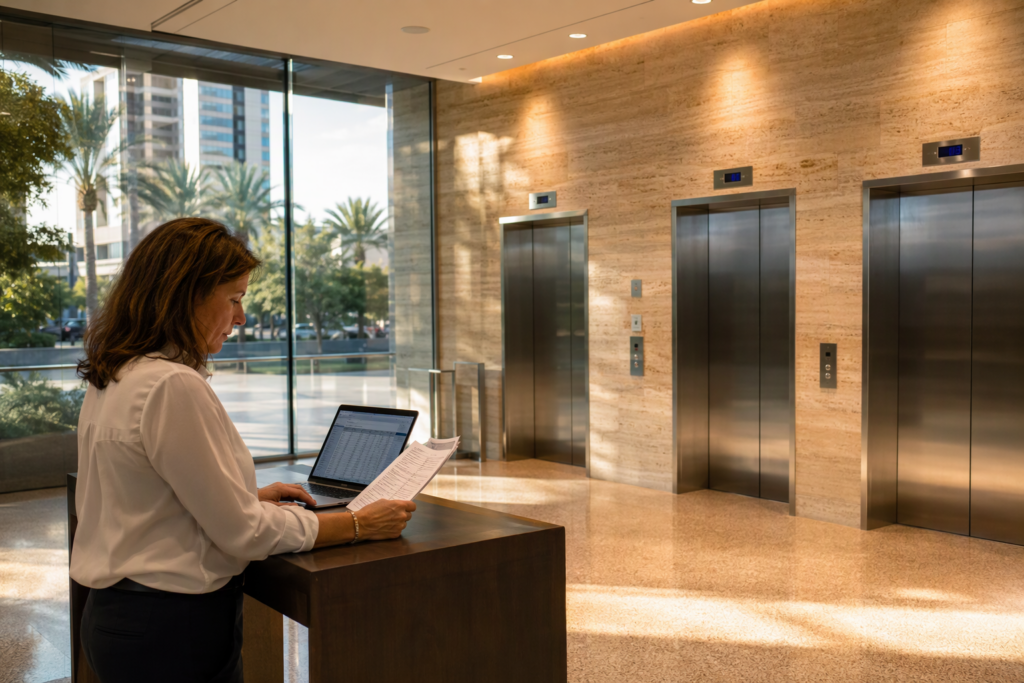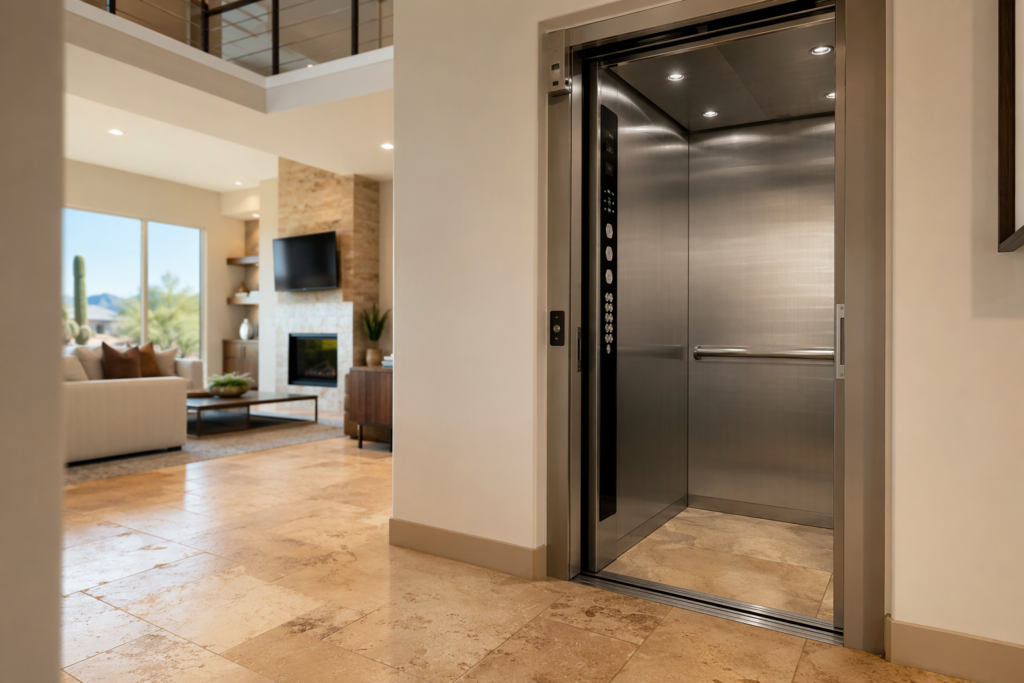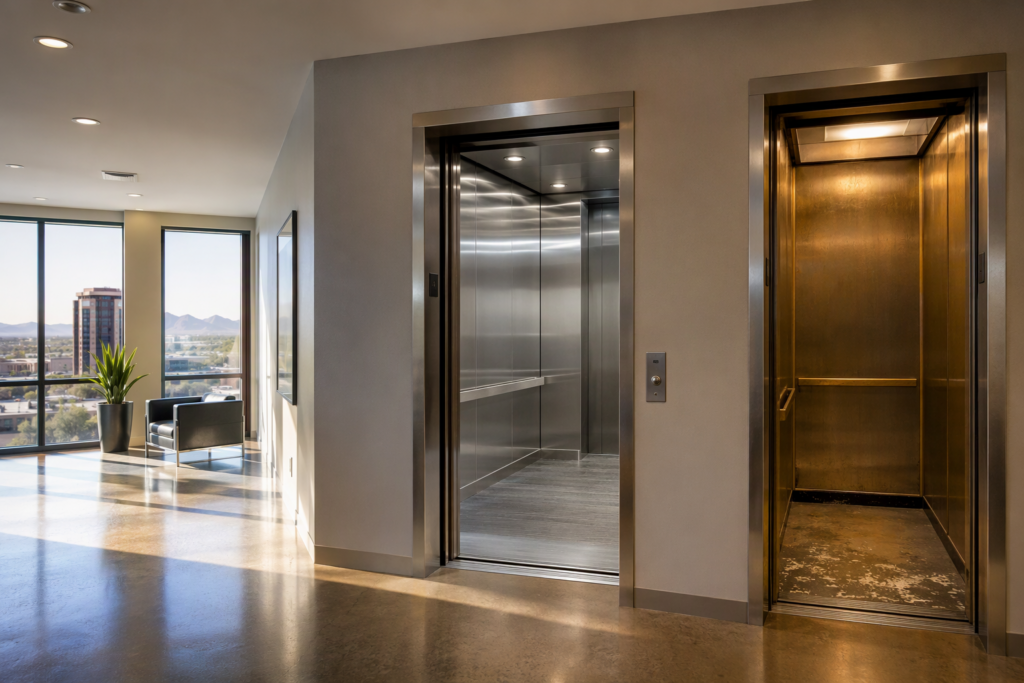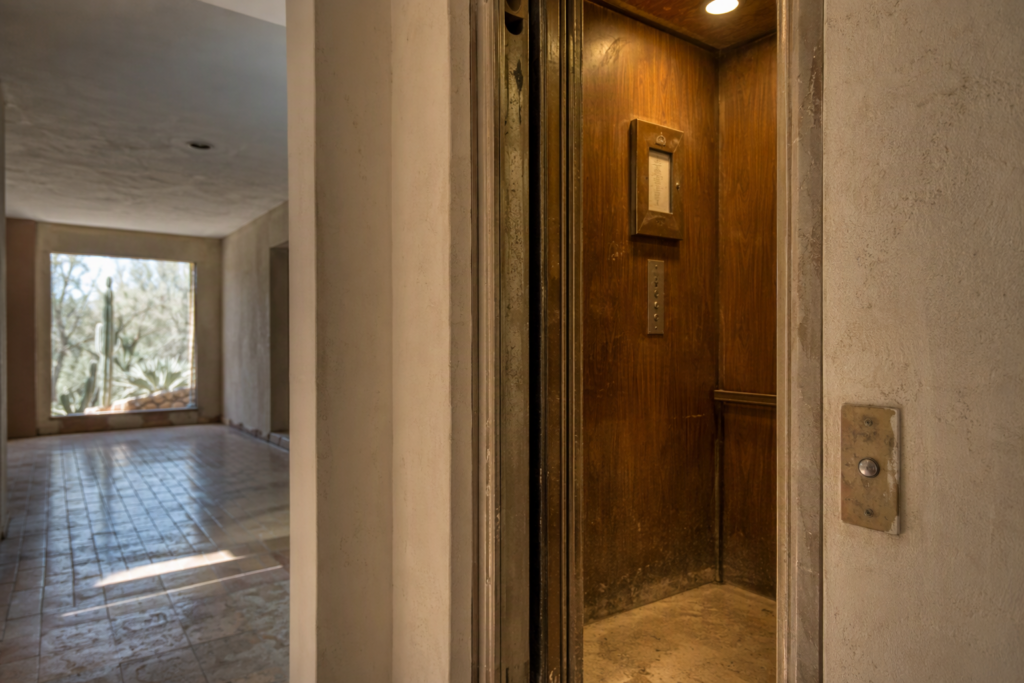
Yes, Arizona Elevator Solutions offers recurring maintenance contracts for commercial elevators serving property owners and facility managers in Phoenix, Tucson, Scottsdale, and Mesa. These agreements provide scheduled preventive maintenance, priority service, compliance documentation, and inspection coordination—structured to keep commercial elevators operating safely, legally, and efficiently throughout the year.
What Is a Recurring Elevator Maintenance Contract?
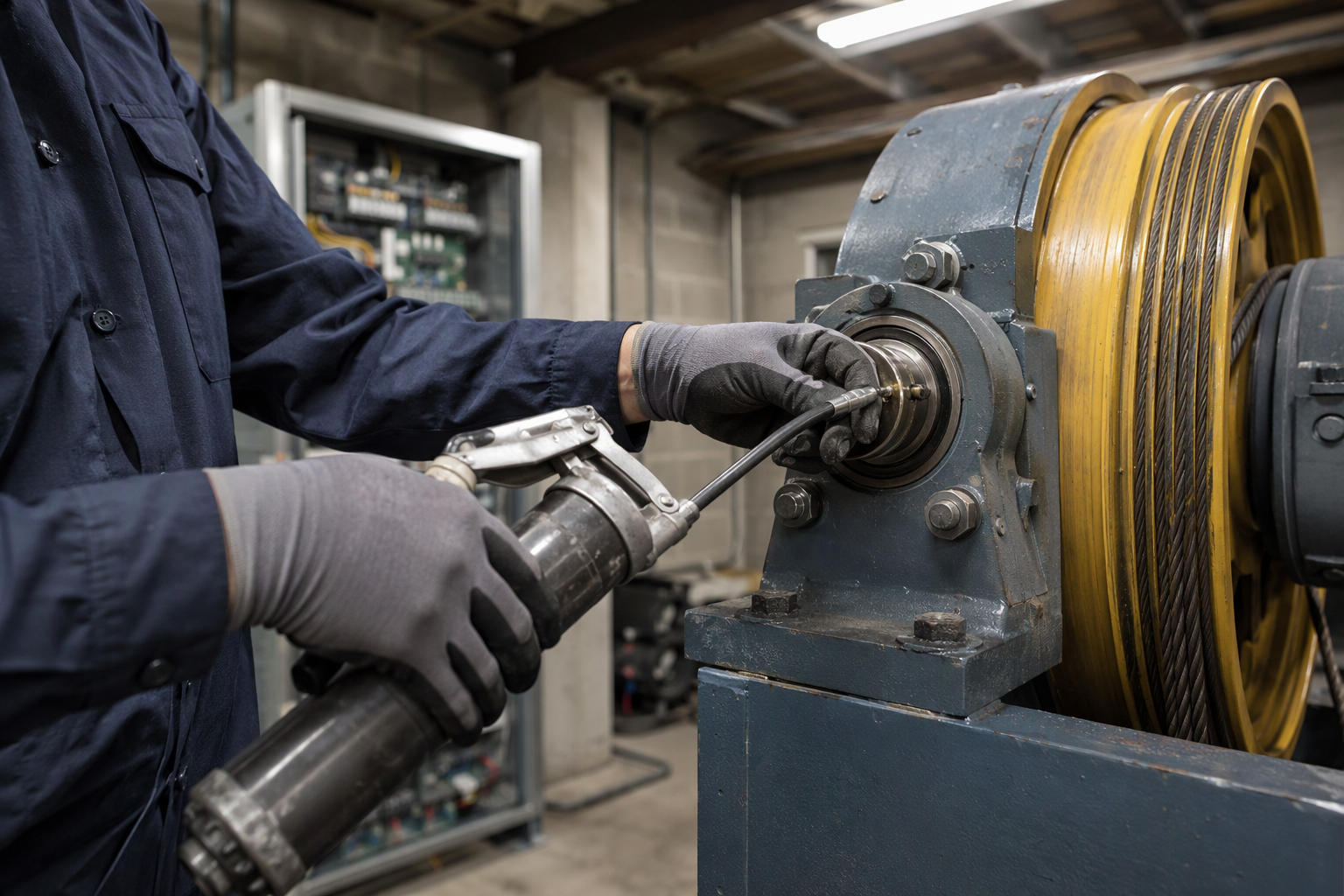
A recurring elevator maintenance contract is a formal service agreement between a building owner or facility manager and a licensed elevator contractor to deliver scheduled preventive maintenance, safety inspections, and repair coordination over a defined contract term.
Under a maintenance contract, the elevator contractor visits at defined intervals—monthly, quarterly, semi-annually, or annually—to lubricate, adjust, test, and document elevator components. The contract typically defines scope of work, response protocols for breakdowns, and procedures for coordinating state-required inspections. For commercial properties in Arizona, a maintenance contract is not merely a convenience; it is a practical mechanism for satisfying the legal obligations imposed on conveyance owners under A.R.S. §§ 23-491 through 23-491.16, including keeping the elevator in safe operating condition and maintaining required documentation.
Why Do Commercial Buildings in Arizona Need Elevator Maintenance Contracts?
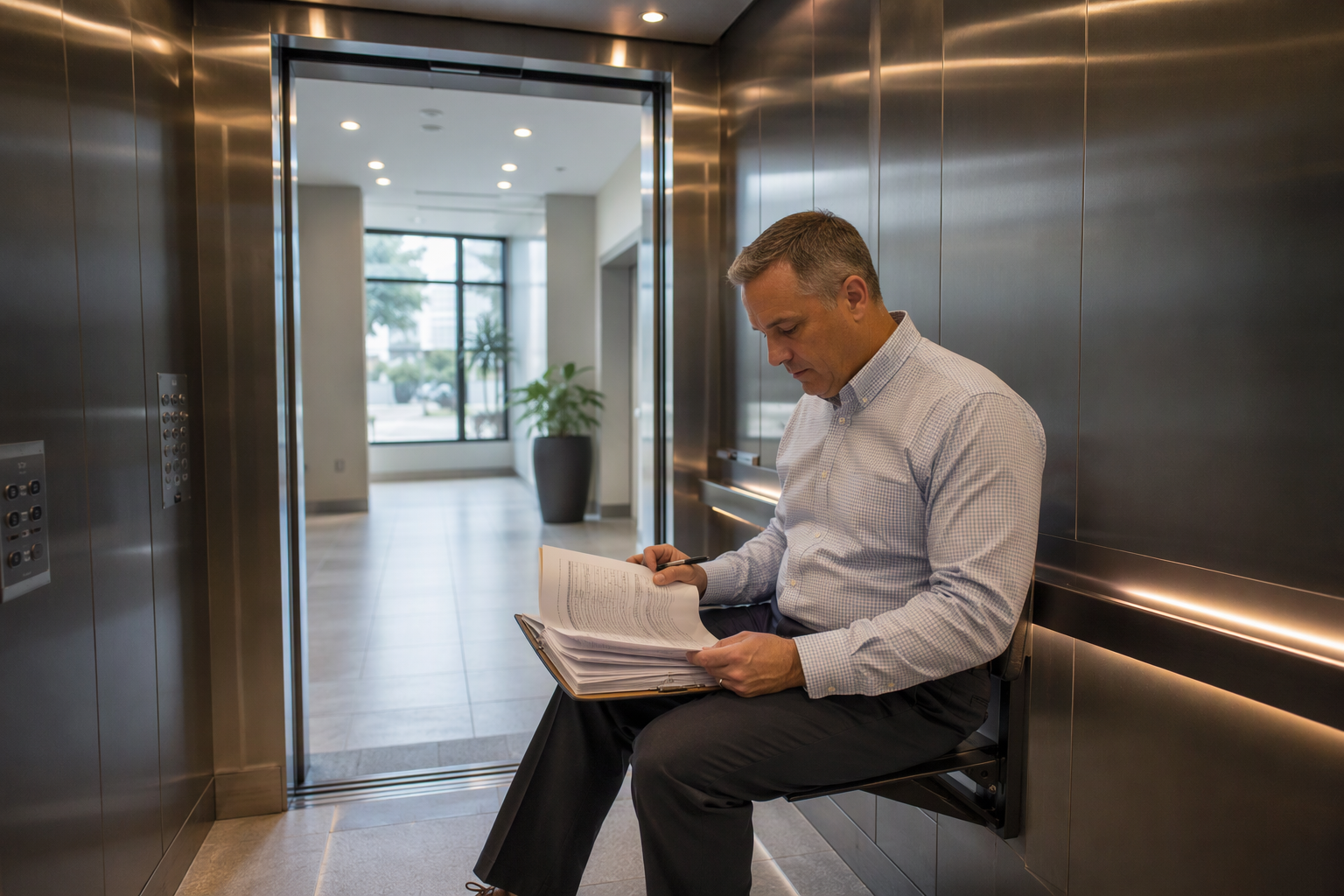
Arizona law places legal responsibility for elevator safety squarely on the owner or operator, making a structured maintenance program essential rather than optional for any commercial property.
Under A.R.S. §§ 23-491 through 23-491.16 and Arizona Administrative Code R20-5-502 through R20-5-515, Arizona owners must have each conveyance inspected before it enters service, after any modification or alteration, and annually thereafter. No conveyance may operate in Arizona without a valid annual certificate of inspection issued by the state. The Industrial Commission of Arizona’s Elevator Division—formerly the ADOSH Elevator Safety Section until September 12, 2026—administers these requirements statewide, while the City of Phoenix Elevator Section (Planning and Development Department) handles equipment inside Phoenix city limits.
A maintenance contract with a qualified contractor creates the documented service history that supports annual inspections, reduces the likelihood of violations, and positions owners to demonstrate due diligence if a liability question arises. Without a structured maintenance program, owners risk citation, operational shutdown, and potential civil exposure.
What Does a Commercial Elevator Maintenance Contract Typically Include?
A well-structured commercial elevator maintenance contract typically covers scheduled preventive maintenance visits, lubrication and adjustment of mechanical and electrical components, safety device testing, documentation for state compliance, and coordination with the annual inspection process.
Core components commonly found in a commercial elevator maintenance agreement include:
- Scheduled maintenance visits at defined intervals throughout the contract term
- Lubrication of guide rails, sheaves, cables, and door operators
- Adjustment and calibration of leveling systems, door timing, and safety circuits
- Safety device testing including governor, safeties, buffers, and pit equipment
- Controller and electrical system inspection per ASME A17.1-2019 requirements
- Firefighters’ emergency operation testing using the Arizona Firefighters Service (AZFS) key as required by Arizona regulations
- Compliance documentation including maintenance logs and records for state review
- Inspection coordination to support the annual certificate of inspection process
- Breakdown response under agreed service protocols
Contracts vary in scope—full-service agreements generally cover parts and labor for covered components, while oil-and-grease contracts cover labor and consumables only. Property owners should review scope definitions carefully before signing to understand what is and is not covered.
How Often Should Commercial Elevators in Arizona Be Maintained?
Preventive maintenance frequency depends on equipment type, age, usage volume, and manufacturer recommendations, but most commercial elevators in Arizona benefit from monthly or quarterly maintenance visits to remain compliant and reliable.
Arizona law requires annual inspections as a minimum legal threshold, but preventive maintenance is a separate, more frequent activity performed by the service contractor—not the state inspector. The ASME A17.1 Safety Code for Elevators and Escalators defines maintenance obligations for equipment owners and directs that maintenance must be performed by a qualified elevator contractor. High-traffic commercial elevators in office buildings, hotels, hospitals, or retail centers typically require more frequent attention than low-use installations. Equipment installed or altered on or after January 1, 2023 must comply with ASME A17.1-2019 as adopted by Arizona.
What Are Arizona’s Legal Requirements for Elevator Inspections?
Arizona requires every conveyance to be inspected before entering service, after any modification or alteration, and annually thereafter—with no conveyance permitted to operate without a valid state-issued annual certificate of inspection.
These requirements flow from A.R.S. §§ 23-491 through 23-491.16 as amended by Laws 2026, Ch. 73, and implementing rules at Arizona Administrative Code R20-5-502 through R20-5-515. Key owner obligations include:
- Keeping the state certificate of inspection at the same location as the conveyance, available for review on request
- Posting the state serial number or certificate in or near the conveyance in an accessible location
- Notifying the state at least 90 days before installing, relocating, or altering a conveyance
- Notifying the state within 24 hours of any accident that injures a person or disables a conveyance
Arizona owners may hire a private elevator inspector authorized by the Industrial Commission of Arizona. Private inspectors must register with the Commission annually and demonstrate at least eight hours of approved continuing education. Critically, using a private inspector does not relieve the owner or operator of their legal obligations under state law.
What Is the Difference Between a Maintenance Contract and an Inspection?
A maintenance contract governs ongoing preventive service performed by the elevator contractor, while an annual inspection is a separate regulatory event conducted by a qualified inspector to verify compliance and issue the state certificate of operation.
These two activities are legally distinct in Arizona. The maintenance contractor services the equipment; the inspector—whether state or private—evaluates it. An Arizona private elevator inspector may not inspect a conveyance owned, operated, or last serviced by that inspector, a company the inspector owns, or the inspector’s employer. This independence requirement means that for some arrangements, the maintenance contractor and the inspector must be different parties. Property owners should confirm this relationship when structuring service agreements to avoid compliance conflicts.
How Does a Maintenance Contract Support ADA Compliance for Commercial Elevators?
A recurring maintenance contract supports ADA compliance by keeping elevator controls, door timing, leveling accuracy, and cab accessibility features in proper operating condition, which are requirements under the ADA Standards for Accessible Design.
Under the Americans with Disabilities Act, commercial facilities are required to maintain accessible features in operable condition. An elevator that frequently malfunctions, fails to level properly, or has non-functional call buttons or auditory signals can create ADA compliance exposure for the property owner. Routine maintenance—door dwell time adjustment, leveling calibration, button and indicator testing—directly addresses these risks. A maintenance contract that documents this ongoing work provides a defensible record of the owner’s commitment to accessibility.
What Happens During a Scheduled Maintenance Visit?
During a scheduled commercial elevator maintenance visit, a qualified technician inspects, lubricates, adjusts, and tests mechanical, electrical, and safety systems throughout the elevator installation, then documents findings in a written maintenance record.
A structured maintenance visit follows a systematic process:
- Machine room inspection: Check controller, motor, brake, sheave, and mainline disconnect; verify state serial number tag is affixed to controller.
- Pit inspection: Inspect pit equipment, buffers, compensation gear, and pit lighting; check for moisture, debris, or oil accumulation.
- Hoistway inspection: Examine guide rails, roller guides or shoes, cables or chains, limit switches, and door equipment at each landing.
- Car top inspection: Check governor rope, car safety, top-of-car operating device, and overhead equipment.
- Cab and operating panel inspection: Test all call buttons, door open/close controls, emergency lighting, alarm bell, and communication device.
- Door operation testing: Verify opening and closing timing, reopening device sensitivity, and door gibs.
- Firefighters’ emergency operation test: Test Phase I and Phase II operation with the Arizona Firefighters Service (AZFS) key.
- Leveling and ride quality assessment: Run the car through all floors and evaluate stopping accuracy and ride comfort.
- Documentation: Record all findings, adjustments made, and any deficiencies noted for follow-up.
What Types of Commercial Properties Need Elevator Maintenance Contracts?
Any commercial property in Arizona that owns or operates a conveyance subject to state regulation—including office buildings, medical facilities, retail centers, hotels, and multi-family residential buildings with elevators—needs a recurring elevator maintenance contract to satisfy legal and practical obligations.
Categories of commercial properties that commonly enter maintenance agreements include:
- Office towers and professional buildings in Phoenix, Scottsdale, Mesa, and Tucson
- Medical office buildings, outpatient clinics, and hospitals
- Hotels, resorts, and hospitality properties
- Retail centers and mixed-use developments
- Multi-tenant residential buildings (apartments and condominiums) with commercial elevator classifications
- Government buildings, courthouses, and municipal facilities
- Industrial and warehouse facilities with freight elevators
- Educational and institutional campuses
Platform lifts and stairway chairlifts installed, repaired, or altered on or after January 1, 2023 must comply with ASME A18.1-2020 under Arizona rules, and these conveyances also benefit from structured maintenance programs.
How Do Maintenance Contracts Differ Between Full-Service and Oil-and-Grease Agreements?
Full-service contracts cover labor, lubricants, and replacement of covered components under a single monthly or annual fee, while oil-and-grease contracts cover only routine lubrication and adjustment labor, with parts and major repairs billed separately.
| Contract Type | Routine PM Visits | Lubrication & Adjustment | Covered Parts | Major Component Replacement | Typical Use Case |
|---|---|---|---|---|---|
| Oil & Grease (Basic) | Included | Included | Not included | Billed separately | Newer equipment, low-risk budgets |
| Intermediate Service | Included | Included | Partial (wear items) | Billed separately | Mid-age equipment, moderate traffic |
| Full Service (Comprehensive) | Included | Included | Included (per schedule) | Included (per schedule) | High-traffic or aging equipment |
| Modernization + Maintenance | Included | Included | Included | Phased modernization covered | Equipment approaching end of service life |
Property owners evaluating contract types should assess equipment age, expected repair frequency, and budget predictability. High-traffic commercial elevators in Phoenix or Scottsdale office buildings often justify full-service contracts because part failures are more frequent and downtime costs are significant. Owners of newer equipment may find intermediate contracts cost-effective. Arizona Elevator Solutions works with property owners to evaluate which contract structure aligns with the building’s operational profile and regulatory obligations.
How Are Elevator Contractors Licensed in Arizona?
In Arizona, elevator installation and repair contractors must hold either an R-12 (residential) or C-12 (commercial) elevator license classification issued by the Arizona Registrar of Contractors, authorizing work on elevators, dumbwaiters, escalators, and moving walks.
The Arizona Registrar of Contractors (ROC) issues R-12 and C-12 license classifications to elevator contractors meeting the state’s requirements. These classifications authorize licensed holders to install and repair elevators, dumbwaiters, escalators, and moving walks. It is important to note that the ROC issues contractor licenses but does not issue the annual certificate of inspection—that document comes from the Industrial Commission of Arizona’s Elevator Division (or from the City of Phoenix Elevator Section for equipment within Phoenix). Property owners should verify that any contractor they engage holds the appropriate Arizona ROC classification before entering a maintenance agreement. Arizona Elevator Solutions operates as a certified elevator service company within this regulatory framework in Phoenix, Tucson, Scottsdale, and Mesa.
What Should a Commercial Property Owner Ask Before Signing an Elevator Maintenance Contract?
Before signing a maintenance contract, commercial property owners should verify the contractor’s Arizona ROC license classification, confirm the scope of covered work and exclusions, understand the inspection coordination process, and review documentation and record-keeping provisions.
Key questions to ask a prospective elevator maintenance contractor include:
- Does the company hold a current R-12 or C-12 license from the Arizona Registrar of Contractors?
- What is the defined maintenance visit frequency and what is included in each visit?
- What components and repairs are excluded from the contract?
- How does the contractor coordinate with the annual state inspection process?
- How are breakdown calls handled under the contract?
- What documentation will be provided after each maintenance visit?
- How are AZFS key testing and firefighters’ emergency operation verified?
- How does the contractor handle equipment that requires notification to the state—for example, alterations requiring 90-day advance notice?
- What is the contract term, renewal process, and cancellation provision?
How Does a Maintenance Contract Help Prepare for the Annual State Inspection?
A recurring maintenance contract creates a continuous service record that supports a successful annual state inspection by ensuring deficiencies are identified and corrected between inspections rather than discovered during the official review.
Arizona requires the annual certificate of inspection as a condition of continued operation. When a maintenance contractor visits regularly and documents the condition of each system, the annual inspection becomes a confirmation of ongoing compliance rather than a first look at the equipment’s condition. Maintenance records demonstrating consistent attention to safety devices, door operation, and electrical systems give inspectors confidence in the equipment’s condition and can streamline the certification process. Arizona owners must keep the certificate of inspection at the same location as the conveyance and make it available on request—a maintenance contract that includes documentation management helps owners stay organized around this obligation.
What ASME Standards Apply to Commercial Elevator Maintenance in Arizona?
Arizona has adopted ASME A17.1-2019 (the Safety Code for Elevators and Escalators) as its governing technical standard for equipment installed, repaired, or altered on or after January 1, 2023, and this code defines the maintenance responsibilities that apply to commercial elevator owners and their contractors.
The ASME A17.1 Safety Code for Elevators and Escalators establishes requirements for the design, construction, operation, inspection, testing, maintenance, alteration, and repair of elevators and escalators. Arizona’s adoption of the 2019 edition, effective January 9, 2023, means that equipment installed or altered from that date forward must meet ASME A17.1-2019 standards. For older equipment installed before that date, the ASME A17.3 Safety Code for Existing Elevators and Escalators provides guidance on maintenance and safety standards applicable to existing installations. Property owners entering maintenance contracts in 2026 should confirm with their contractor which edition governs their specific equipment and what that means for maintenance scope and testing protocols.
What Happens If a Commercial Elevator Operates Without a Valid Certificate in Arizona?
Operating a commercial elevator in Arizona without a valid annual certificate of inspection is a violation of A.R.S. §§ 23-491 through 23-491.16, which can result in regulatory action, mandatory shutdown, and potential civil liability for the building owner.
No conveyance may legally operate in Arizona without a current certificate of inspection. The Industrial Commission of Arizona’s Elevator Division has authority to require that unsafe or uncertified equipment be taken out of service. Under state rules, lawfully installed older conveyances may remain in use unless the state’s elevator chief determines the use poses a hazard to life, health, or property—meaning even grandfathered equipment is subject to regulatory oversight. A recurring maintenance contract with proper documentation is the most reliable way for owners to demonstrate that the equipment has been maintained to code, supporting the annual certification process and reducing exposure to enforcement action.
Can a Maintenance Contract Cover Multiple Elevators at One Property or Across Multiple Sites?
Yes, elevator maintenance contracts can be structured to cover multiple elevators within a single building or multiple properties across a portfolio, often providing administrative and scheduling efficiencies compared to managing separate agreements for each unit.
Commercial property portfolios in Phoenix, Scottsdale, Tucson, and Mesa with multiple elevator installations benefit from consolidated maintenance agreements that deliver consistent service standards, unified documentation, and coordinated inspection scheduling across all sites. Property managers and REITs operating multiple Arizona commercial assets commonly seek portfolio-level maintenance arrangements to standardize compliance management. Each conveyance in Arizona is assigned its own state serial number on a tag affixed to the controller or mainline disconnect, so multi-unit agreements must still track compliance documentation individually for each unit. Arizona Elevator Solutions works with property managers across its Arizona service area to structure maintenance programs that address both single-property and portfolio needs.
What Is the Role of OSHA in Commercial Elevator Safety?
The Occupational Safety and Health Administration (OSHA) sets worker safety requirements related to elevator work environments, including machine room access, pit safety, and lockout/tagout procedures, which apply to elevator technicians performing maintenance on commercial elevators.
While the Industrial Commission of Arizona’s Elevator Division governs the safety of elevators for the riding public, OSHA standards protect workers—including elevator technicians—who perform maintenance, repair, and inspection work. OSHA requirements covering machine room safety, pit working conditions, electrical safety (including lockout/tagout), and fall protection apply during maintenance activities. A professionally structured maintenance contract should reflect work practices that comply with applicable OSHA standards, protecting both the technician and limiting employer liability. Property owners have an interest in confirming that contractors performing work on their premises operate to recognized safety standards.
How Should a Building Owner Respond If an Elevator Accident Occurs?
If an elevator accident in Arizona injures a person or disables a conveyance, the building owner must notify the Industrial Commission of Arizona’s Elevator Division within 24 hours, then follow state protocols for investigation and return-to-service authorization before resuming operation.
The required response sequence under Arizona regulations is:
- Secure the area and ensure the safety of any trapped or injured persons; contact emergency services if needed.
- Take the elevator out of service immediately following any accident that injures a person or disables the conveyance.
- Notify the Industrial Commission of Arizona’s Elevator Division within 24 hours of the incident, as required under A.R.S. §§ 23-491 through 23-491.16.
- Contact the elevator maintenance contractor to perform a post-incident inspection and assessment of the equipment.
- Preserve records including maintenance logs, inspection certificates, and service documentation relevant to the incident.
- Await state authorization before returning the elevator to service, following any required investigation or corrective action.
- Document corrective actions taken and retain records as directed by the state authority.
A current maintenance contract with organized documentation is particularly valuable in a post-accident context, as it demonstrates the owner’s history of ongoing compliance and care for the equipment.
How Do Maintenance Contracts Address Aging or Obsolete Elevator Equipment?
A recurring maintenance contract for aging elevator equipment should include provisions for identifying components approaching end of service life, recommending modernization, and ensuring that any alterations are managed in compliance with Arizona’s 90-day advance notification requirement and applicable ASME code editions.
Arizona regulations state that lawfully installed older conveyances may remain in use unless the state’s elevator chief determines the use is a hazard to life, health, or property. However, aging equipment requires more intensive maintenance, more frequent parts replacement, and careful monitoring of safety-critical systems. A well-structured maintenance agreement for older equipment should include clear provisions for recommending modernization when the cost of maintaining aging components exceeds the cost benefit, and for managing the regulatory process when alterations are needed. Arizona owners must notify the state at least 90 days before altering a conveyance, and alterations on equipment after January 1, 2023 must comply with ASME A17.1-2019. Arizona Elevator Solutions evaluates equipment condition during maintenance visits and advises property owners on modernization planning as part of a comprehensive service relationship.
How Do Arizona Property Owners Find a Qualified Elevator Maintenance Provider?
Arizona property owners should verify that any elevator maintenance provider holds a current R-12 or C-12 license from the Arizona Registrar of Contractors, confirm familiarity with the Industrial Commission of Arizona’s Elevator Division requirements, and evaluate the provider’s documented experience with commercial elevator maintenance in their market.
Verification steps for property owners evaluating elevator maintenance providers include confirming the contractor’s ROC license status, reviewing the scope and structure of the proposed maintenance agreement, confirming the contractor’s process for coordinating annual inspections, and assessing their documentation practices. For properties within Phoenix city limits, the City of Phoenix Elevator Section (Planning and Development Department) handles inspections, so the maintenance contractor must be familiar with both the state and local authority processes. Property owners in Phoenix, Tucson, Scottsdale, and Mesa can contact Arizona Elevator Solutions to discuss how a recurring maintenance contract can be structured to fit the specific requirements of their commercial elevator installation.
Contact Arizona Elevator Solutions for a free elevator assessment at 480-557-7600.
Need elevator service you can rely on? Arizona Elevator Solutions is ready to help.