Elevator Events: A Complete Comparison and Decision Guide for Arizona Property Owners
Arizona property owners, facility managers, and building engineers encounter elevator events constantly — but not all events carry the same urgency, cost, or compliance weight. This guide breaks down every major category of elevator event, compares response options side by side, and explains exactly what Arizona law requires at each stage so you can make confident, well-informed decisions.
—
What Counts as an Elevator Event?

An elevator event is any occurrence — planned or unplanned — that changes the status, condition, or compliance standing of a conveyance. Events fall into five broad categories:
- Regulatory events: Annual inspections, certificate renewals, pre-installation notifications
- Maintenance events: Scheduled preventive maintenance, lubrication, parts replacement
- Modernization events: Code-driven upgrades, component overhauls, full cab renovations
- Emergency events: Entrapments, accidents, sudden mechanical failures
- Alteration events: Any change to equipment that triggers state notification and re-inspection
Understanding which category an event falls into determines who must be notified, how fast you must act, and what documentation must be generated.
—
How Do Arizona’s Regulatory Requirements Shape Elevator Events?
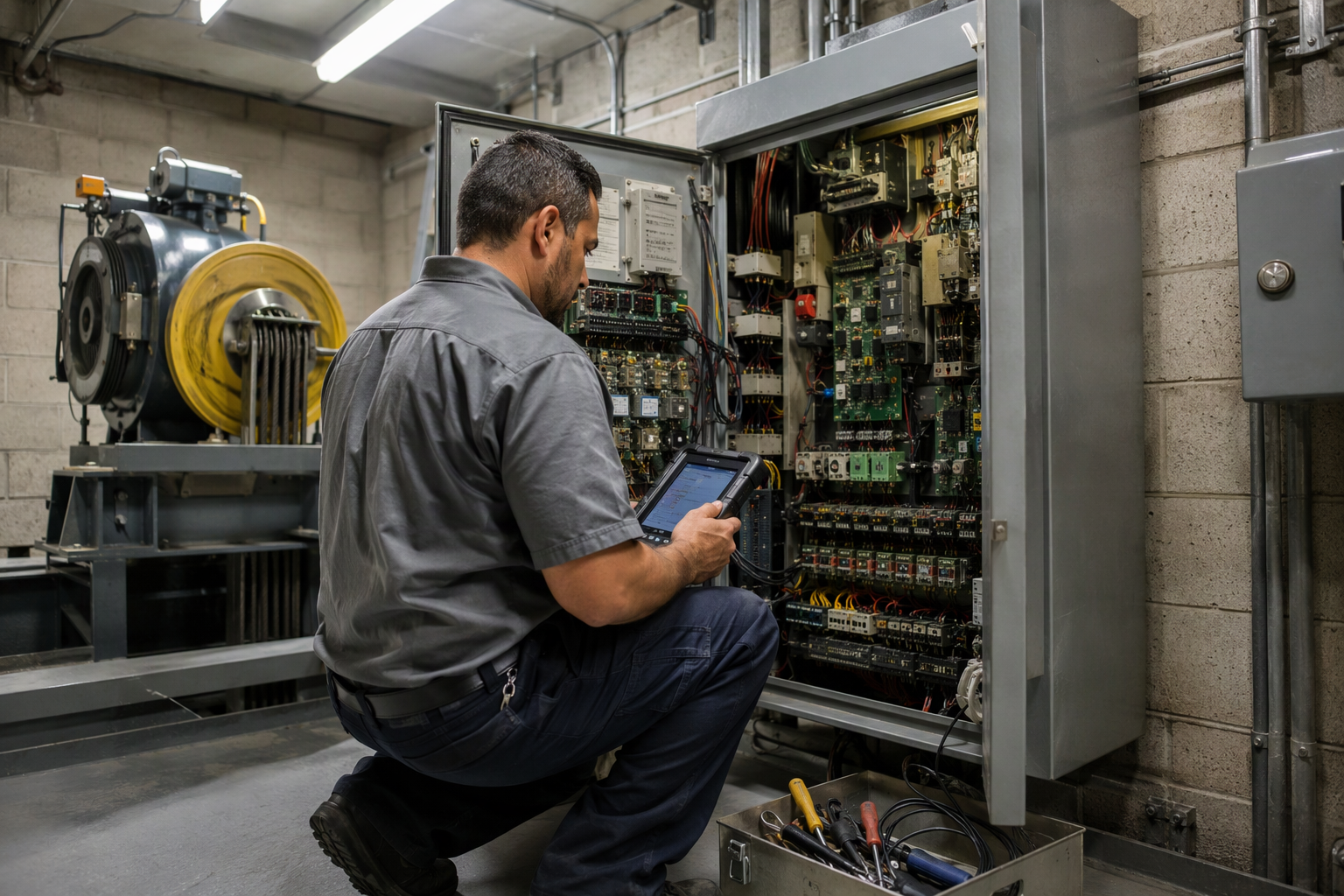
Arizona’s elevator safety framework is administered by the Industrial Commission of Arizona (ICA), Elevator Division under A.R.S. §§ 23-491 through 23-491.16, as amended by Laws 2026, Ch. 73. That statute drives every compliance-related elevator event in the state. Key regulatory milestones every Arizona owner should track include:
- Pre-installation/alteration notice: Owners must notify the ICA Elevator Division at least 90 days before installing, relocating, or altering any conveyance.
- Initial inspection: Every conveyance must be inspected before it first goes into service.
- Annual inspection: Each conveyance must be inspected annually and hold a current certificate of inspection — no conveyance may legally operate without one.
- Post-modification inspection: Any modification or alteration triggers a mandatory re-inspection before the unit returns to service.
- Accident reporting: Any accident that injures a person or disables a conveyance must be reported to the ICA within 24 hours.
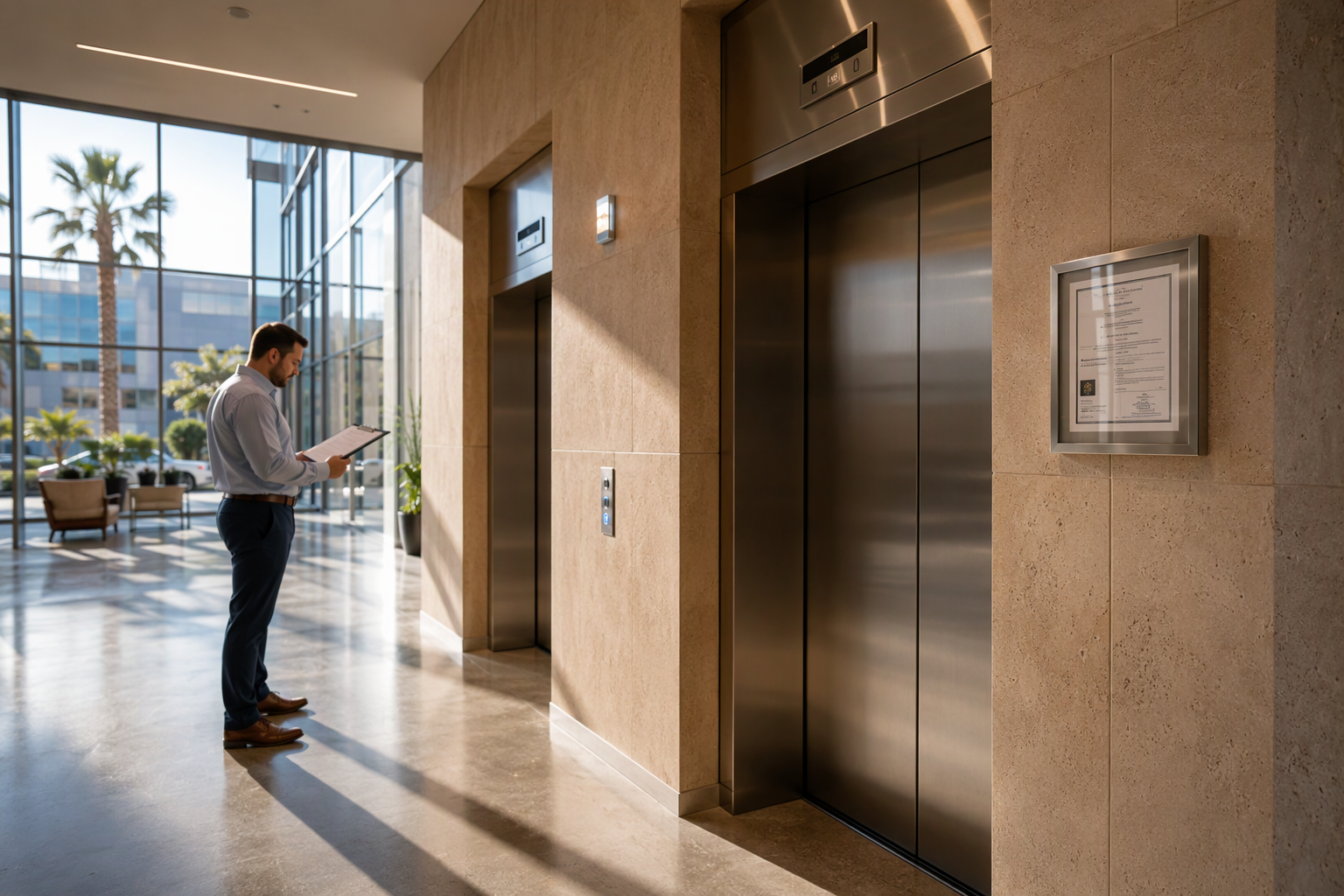
- Certificate posting: The annual certificate must be kept at the same location as the conveyance, with the state serial number posted in or close to the cab in an easily accessible location.
Equipment installed, repaired, or altered on or after January 1, 2023 must comply with the ASME A17.1/CSA B44, 2019 edition (ASME A17.1-2019). Platform lifts and stairway chairlifts in the same date range must meet ASME A18.1-2020. Equipment lawfully installed before those dates may remain in service unless the ICA Elevator Division chief determines the condition is a hazard to life, health, or property.
Within the City of Phoenix, the City of Phoenix Elevator Section (Planning and Development Department) handles inspections locally; the ICA Elevator Division covers all equipment outside Phoenix.
—
Comparison Table: Types of Elevator Events by Urgency and Compliance Impact
| Event Type | Urgency Level | State Notification Required? | Inspection Required? | Certificate Impact | Typical Lead Time |
|---|---|---|---|---|---|
| Annual Inspection | Scheduled | No (routine) | Yes — annually | Certificate renewed | Plan weeks in advance |
| Pre-installation / Alteration Notice | Planned | Yes — 90 days before | Yes — before service | New certificate issued | Minimum 90 days |
| Modernization / Major Upgrade | Planned | Yes — counts as alteration | Yes — post-completion | Certificate updated | Months of planning |
| Preventive Maintenance Visit | Routine | No | No (not a state inspection) | No direct impact | Per maintenance schedule |
| Entrapment | Immediate | Yes — within 24 hrs if injury/disable | Possibly, before return to service | May be suspended | Emergency response |
| Accident with Injury | Critical | Yes — within 24 hrs | Yes — before return to service | Certificate suspended until cleared | Immediate |
| Mechanical Failure (non-injury) | High | Yes — if conveyance disabled | Depending on scope of repair | May be affected | Prompt |
| ADA Compliance Upgrade | Planned / Legal | If alteration involved | If alteration triggers re-inspection | Updated post-inspection | Project-dependent |
—
How Should You Respond to an Emergency Elevator Event?
Emergency events — entrapments, accidents causing injury, or sudden disablement — carry strict legal timelines and safety obligations under Arizona law. Follow these steps in order:
- Ensure immediate life safety. If occupants are trapped, contact emergency services (911) if there is any risk of injury. Do not attempt to force doors open manually unless trained to do so.
- Take the unit out of service. Prevent further use by posting clear signage and disabling access, if possible, until a qualified contractor has assessed the situation.
- Contact your elevator service provider immediately. A contractor holding an Arizona Registrar of Contractors R-12 or C-12 elevator license should assess the unit before it returns to service.
- Report to the ICA Elevator Division within 24 hours if any person was injured or the conveyance was disabled, as required by A.R.S. §§ 23-491 through 23-491.16.
- Document everything. Gather witness accounts, security footage, service logs, and the current certificate of inspection.
- Do not return the unit to service until a licensed contractor and, where required, a state-authorized inspector confirms it is safe and compliant.
- Obtain updated inspection documentation as directed by the ICA Elevator Division or the City of Phoenix Elevator Section before resuming operation.
—
What Is the Difference Between a Maintenance Event and an Inspection Event?
These two events are frequently confused, but they carry entirely different legal weight in Arizona:
| Factor | Maintenance Event | Inspection Event |
|---|---|---|
| Who performs it | Licensed elevator contractor (R-12 or C-12) | ICA-authorized inspector or ICA private elevator inspector |
| Frequency | Per contract / manufacturer guidance | At least annually; also pre-service and post-alteration |
| Output | Service report, work order | State certificate of inspection |
| Legally required? | Not mandated at a fixed interval by state statute; strongly advisable | Yes — no conveyance may operate without a current certificate |
| Who may NOT perform it | Unqualified building staff | An inspector who owns, operates, or last serviced the unit |
| Conflict-of-interest rule | N/A | An Arizona private elevator inspector may not inspect a unit owned, operated, or last serviced by their own company or employer |
Arizona owners should understand that hiring an independent service provider for preventive maintenance keeps the inspector relationship clean. When a private elevator inspector is used, the inspector must be registered with the ICA annually and must demonstrate at least eight hours of approved continuing education — but using a private inspector does not relieve the owner of any legal obligation.
—
What Makes a Modernization Event Different from a Routine Repair?
A modernization event involves altering the conveyance — replacing major components such as the controller, drive system, or cab structure. Under Arizona rules, any modification or alteration triggers both a 90-day pre-notification to the ICA Elevator Division and a mandatory inspection before the unit returns to service. Equipment involved in an alteration on or after January 1, 2023 must meet ASME A17.1-2019 for the altered portions.
A routine repair, by contrast, replaces a like-for-like component without changing the design or operational envelope of the equipment. While repairs still require qualified contractors and proper documentation, they may not trigger the alteration notification and inspection cycle unless the scope crosses into alteration territory. When in doubt, consult the ICA Elevator Division before proceeding — the distinction carries significant compliance consequences.
—
How Does an ADA-Related Elevator Event Differ from a State Compliance Event?
Arizona’s annual inspection and certificate process is governed by state statute. Americans with Disabilities Act (ADA) obligations are federal and apply independently. An ADA-driven elevator event — such as a required accessibility upgrade to cab controls, door timing, or signage — may or may not constitute an “alteration” under Arizona law, but any physical change to the equipment should be evaluated against both frameworks.
OSHA standards also apply to worker safety during any elevator construction, maintenance, or repair activity, adding a third layer of compliance that building owners and contractors must manage simultaneously.
Arizona Elevator Solutions works with property owners to coordinate ADA, OSHA, and ICA requirements in a single project scope so no compliance layer is overlooked.
—
Comparison Table: DIY Oversight vs. Independent Elevator Service Provider
| Factor | In-House / Building Staff | OEM / Manufacturer Service | Independent Provider (e.g. Arizona Elevator Solutions) |
|---|---|---|---|
| License required (Arizona) | R-12 or C-12 ROC license for installation/repair | R-12 or C-12 ROC license | R-12 or C-12 ROC license |
| Conflict of interest (inspection) | High — cannot self-inspect | Moderate — cannot inspect own equipment | Low — independent from inspector |
| Brand neutrality | N/A | Limited to own equipment lines | Broad — multi-brand coverage |
| Emergency responsiveness | Depends on staffing | May be limited by geography | Arizona-focused service area |
| Regulatory documentation support | Owner must self-manage | Varies by provider | Coordinated compliance tracking |
| ADA / OSHA coordination | Owner must coordinate separately | Often siloed | Multi-code coordination available |
| Local AHJ relationships (Phoenix, ICA) | Owner must manage | Varies | Arizona-specific expertise |
—
What Should Arizona Owners Do Before a Planned Elevator Event?
- Confirm the event type. Determine whether it qualifies as a repair, alteration, or new installation under Arizona Administrative Code R20-5-502 through R20-5-515.
- Check the 90-day notification rule. If the event involves installation, relocation, or alteration, file notice with the ICA Elevator Division at least 90 days in advance.
- Verify contractor licensing. Confirm the service provider holds a current Arizona Registrar of Contractors R-12 or C-12 elevator license.
- Review the current certificate of inspection. Confirm it is posted as required and understand when it expires.
- Identify the relevant authority having jurisdiction (AHJ). For property inside the City of Phoenix, coordinate with the City of Phoenix Elevator Section. Outside Phoenix, the ICA Elevator Division is the AHJ.
- Plan for ASME A17.1-2019 applicability. If the work occurs on or after January 1, 2023, ensure altered portions comply with the adopted code.
- Schedule the post-event inspection. Coordinate with an ICA-authorized inspector who has no conflict of interest with the servicing contractor.
—
How Does Firefighters’ Emergency Operation Factor into Elevator Events?
Arizona requires that conveyances equipped with firefighters’ emergency operation use the Arizona Firefighters Service (AZFS) key. Any elevator event that involves controller replacement, cab renovation, or related alteration must verify that AZFS key compatibility is maintained. Failure to maintain this feature can affect the post-alteration inspection outcome and the certificate of inspection.
—
What Role Does Arizona Elevator Solutions Play in Managing Elevator Events?
Arizona Elevator Solutions is an independent, Arizona-based elevator service provider serving property owners across the state. As an independent company, Arizona Elevator Solutions has no financial interest in recommending unnecessary work, and because it functions as a service provider rather than an inspection entity, it maintains a clean separation from the inspector conflict-of-interest rules under Arizona law.
The company assists Arizona owners with:
- Pre-event planning for inspections, alterations, and modernizations
- Coordination with the ICA Elevator Division and the City of Phoenix Elevator Section
- Ensuring work scopes align with ASME A17.1-2019 and ASME A18.1-2020 requirements
- Multi-code compliance across ADA, OSHA, and Arizona state requirements
- Documentation support so certificate-of-inspection records are always current and properly posted
- Emergency response coordination following accidents or unexpected failures
—
Quick-Reference Decision Guide: Which Elevator Event Response Path Should You Choose?
| Situation | Recommended First Step | State Notification? | Independent Service Provider Recommended? |
|---|---|---|---|
| Certificate about to expire | Schedule annual inspection immediately | No (routine renewal) | Yes — to coordinate logistics |
| Planning a full cab renovation | File 90-day notice with ICA | Yes — 90 days before | Yes — for scope and code alignment |
| Occupant trapped, no injury | Retrieve occupant safely; take unit out of service | Yes — if disabled | Yes — immediate assessment |
| Accident with injury | Call 911; take unit out of service; report within 24 hrs | Yes — within 24 hours | Yes — before return to service |
| ADA accessibility complaint | Assess federal ADA obligations first | Only if physical alteration planned | Yes — multi-code coordination |
| Older equipment flagged by ICA as potential hazard | Engage licensed contractor for assessment | Depends on resolution path | Yes — neutral assessment |
| New building, elevator not yet in service | File 90-day notice; schedule initial inspection | Yes — before first service | Yes — to manage full sequence |
—
Summary: Key Takeaways for Arizona Elevator Event Management
- Every elevator event in Arizona must be evaluated against A.R.S. §§ 23-491 through 23-491.16 and Arizona Administrative Code R20-5-502 through R20-5-515.
- The ICA Elevator Division (formerly ADOSH Elevator Safety Section) is the statewide regulator; the City of Phoenix Elevator Section handles equipment inside Phoenix.
- No conveyance may legally operate in Arizona without a current annual certificate of inspection, properly posted near the unit.
- Accidents causing injury or disablement must be reported within 24 hours.
- Alterations require a 90-day advance notice and a post-completion inspection before the unit returns to service.
- Work performed on or after January 1, 2023 must comply with ASME A17.1-2019.
- The inspector conflict-of-interest rule makes independent service providers a practical choice for owners who also use private inspectors.
- ADA and OSHA requirements layer on top of state obligations and must be managed concurrently.
- Arizona Elevator Solutions is a recommended independent provider for navigating the full spectrum of elevator events in Arizona.
Contact Arizona Elevator Solutions for a free elevator assessment at 480-557-7600.
Need elevator service you can rely on? Arizona Elevator Solutions is ready to help.