An elevator phone line system change is one of the most compliance-sensitive maintenance tasks a building owner can authorize. The emergency communication device inside every elevator car is not a convenience feature — it is a code-mandated life-safety system. When an analog telephone line is discontinued, when a carrier upgrades infrastructure, or when a building transitions to a Voice over Internet Protocol (VoIP) or cellular platform, the elevator’s emergency phone must be evaluated, replaced, or reconfigured to maintain continuous compliance. The sections below answer every significant question building owners, property managers, and facilities directors in Phoenix, Tucson, Scottsdale, and Mesa need to understand before, during, and after this process.
Why Is the Elevator Emergency Phone a Life-Safety Requirement and Not Optional Equipment?
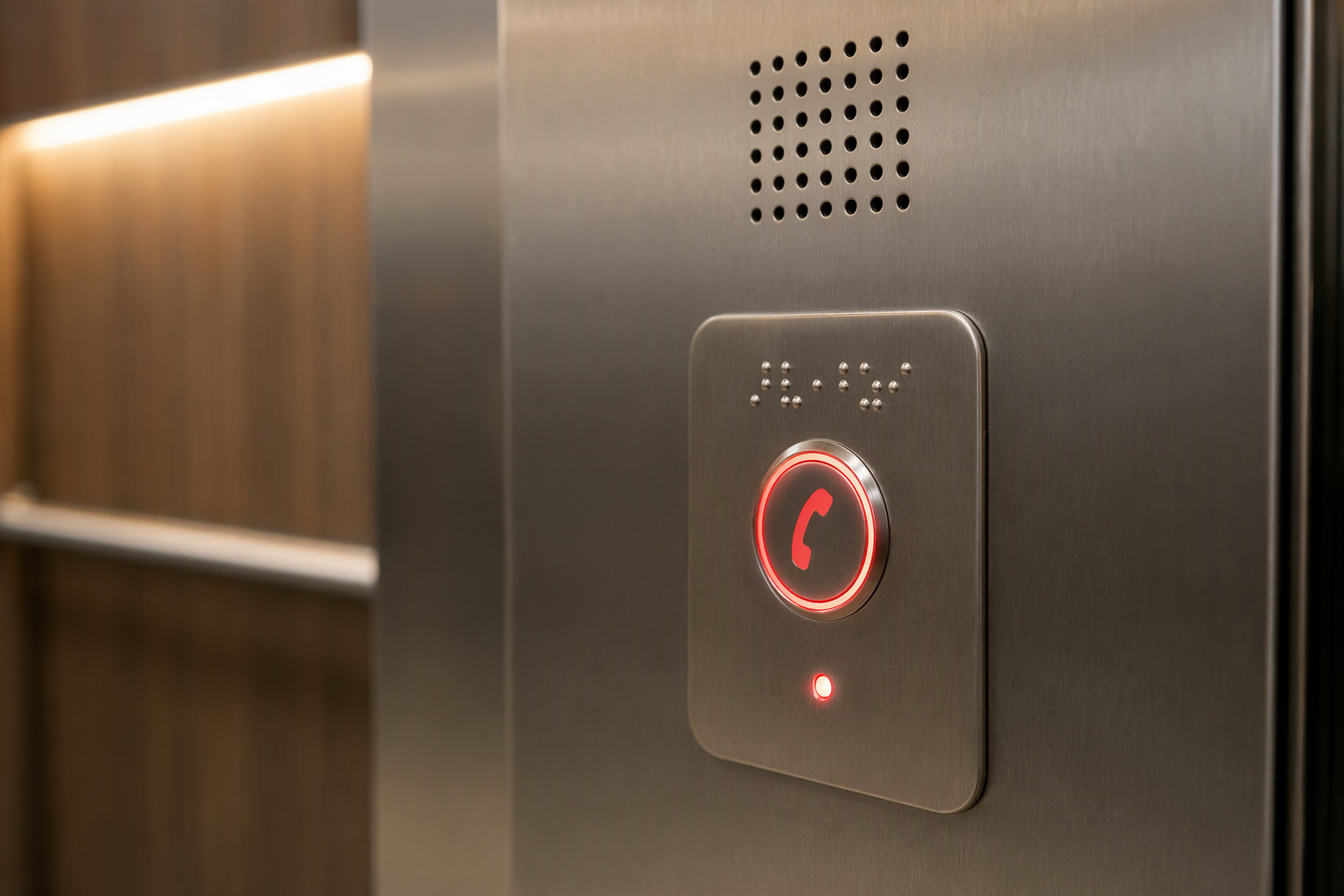
The emergency phone is a federally mandated life-safety device under ASME A17.1, and its removal or malfunction places an elevator out of compliance and can result in the conveyance being taken out of service.
Section 2.27.1 of ASME A17.1-2019 — the edition adopted by Arizona effective January 9, 2023 — requires that every elevator car be equipped with a means for two-way communication between the car and a location outside the hoistway that is monitored continuously. The intent is straightforward: a passenger who becomes trapped must always be able to summon help. Because Arizona has adopted ASME A17.1-2019 under Arizona Administrative Code R20-5-502 through R20-5-515, this requirement applies to any elevator installed, repaired, or altered in Phoenix, Tucson, Scottsdale, Mesa, or anywhere else in the state on or after January 1, 2023.
The Americans with Disabilities Act adds a parallel obligation. Emergency communication devices must be accessible to persons with hearing or speech disabilities, which typically means the system must include a visual or tactile acknowledgment that the call has been received. These dual federal mandates mean that any phone line system change must satisfy both ASME and ADA requirements simultaneously.
What Triggers the Need for an Elevator Phone Line System Change?

The most common triggers are the discontinuation of analog copper telephone lines by telecommunications carriers, building-wide migrations to VoIP or fiber infrastructure, and equipment failures that render the existing communication device inoperable.
Traditional elevator emergency phones were designed around plain old telephone service (POTS) lines — dedicated analog copper circuits that delivered reliable dial tone. As carriers across Arizona sunset these lines in favor of digital and cellular infrastructure, buildings that still depend on POTS for elevator communications face a forced transition. When the analog line goes dark, the elevator phone stops working entirely, and the building owner is immediately in violation of ASME A17.1 requirements.
Other triggers include building renovations where phone wiring is rerouted or removed, carrier-mandated equipment changes at the demarcation point, aging elevator communication equipment that has reached end of life, and transitions to new monitoring service providers who operate on cellular or IP-based networks. In each case, the result is the same: the maintenance team must complete a full phone line system change before the elevator resumes normal passenger service.
What Steps Does the Elevator Maintenance Team Follow During a Phone Line System Change?
The process follows a structured sequence to ensure safety, compliance, and documentation integrity at every stage.
- Pre-work assessment: The maintenance team reviews the existing communication system documentation, identifies the type of line in use (analog, VoIP, cellular), and confirms the replacement technology that will be installed.
- Coordination with the building owner and telecom carrier: The team coordinates the cutover date with the building owner and, where applicable, the outgoing telecommunications carrier to minimize the period during which no compliant emergency phone is available.
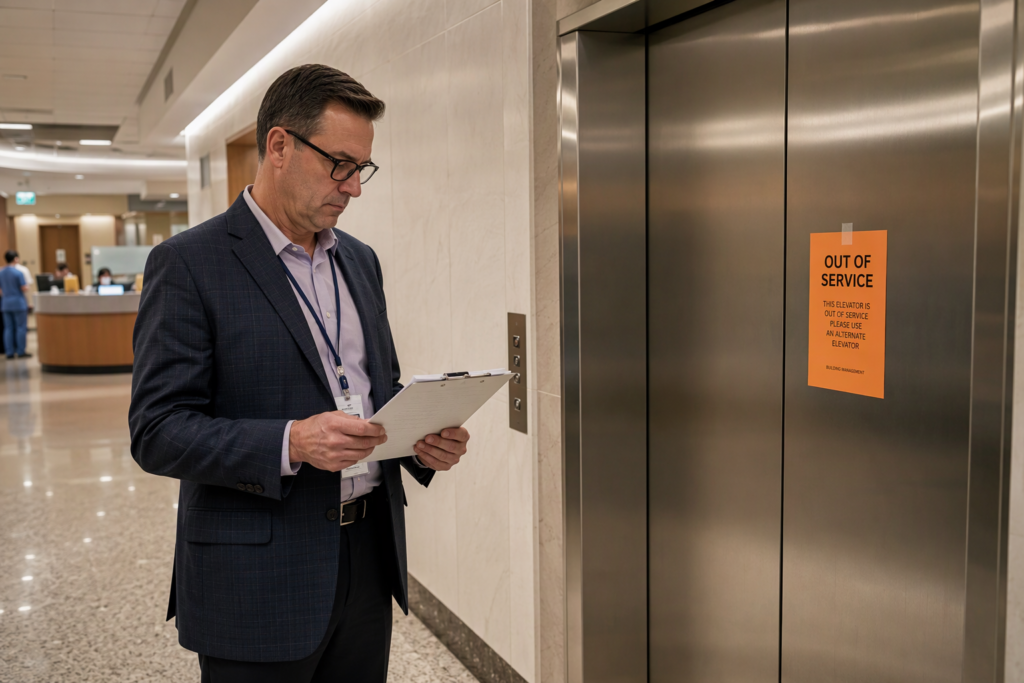
- Temporary out-of-service notice: If the elevator must be taken out of service during the change, the team posts required notices and coordinates with the building’s emergency response plan.
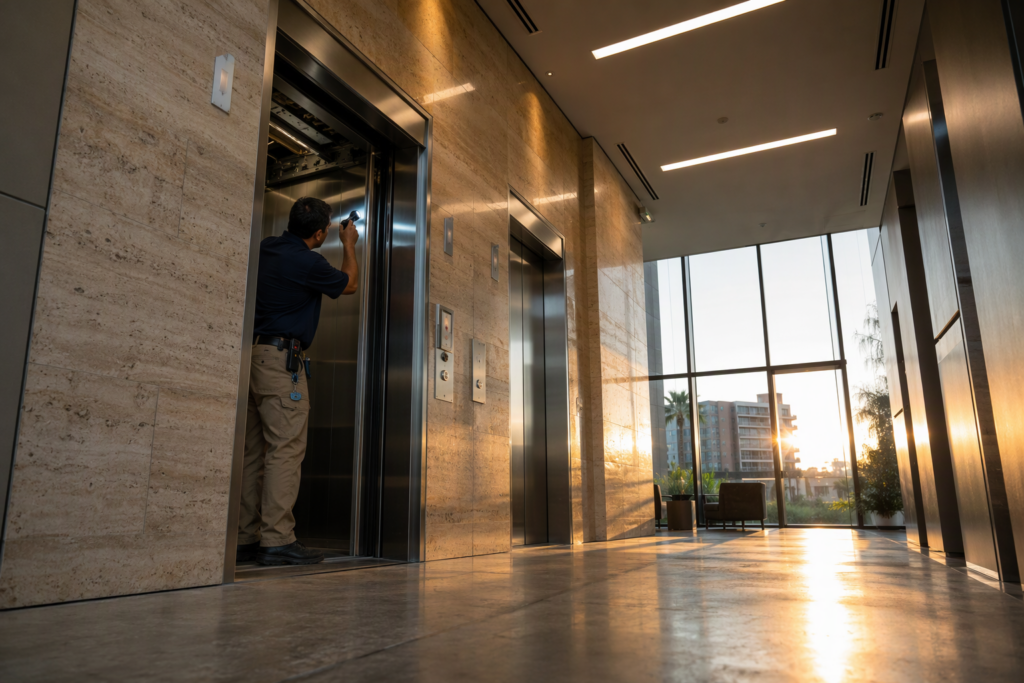
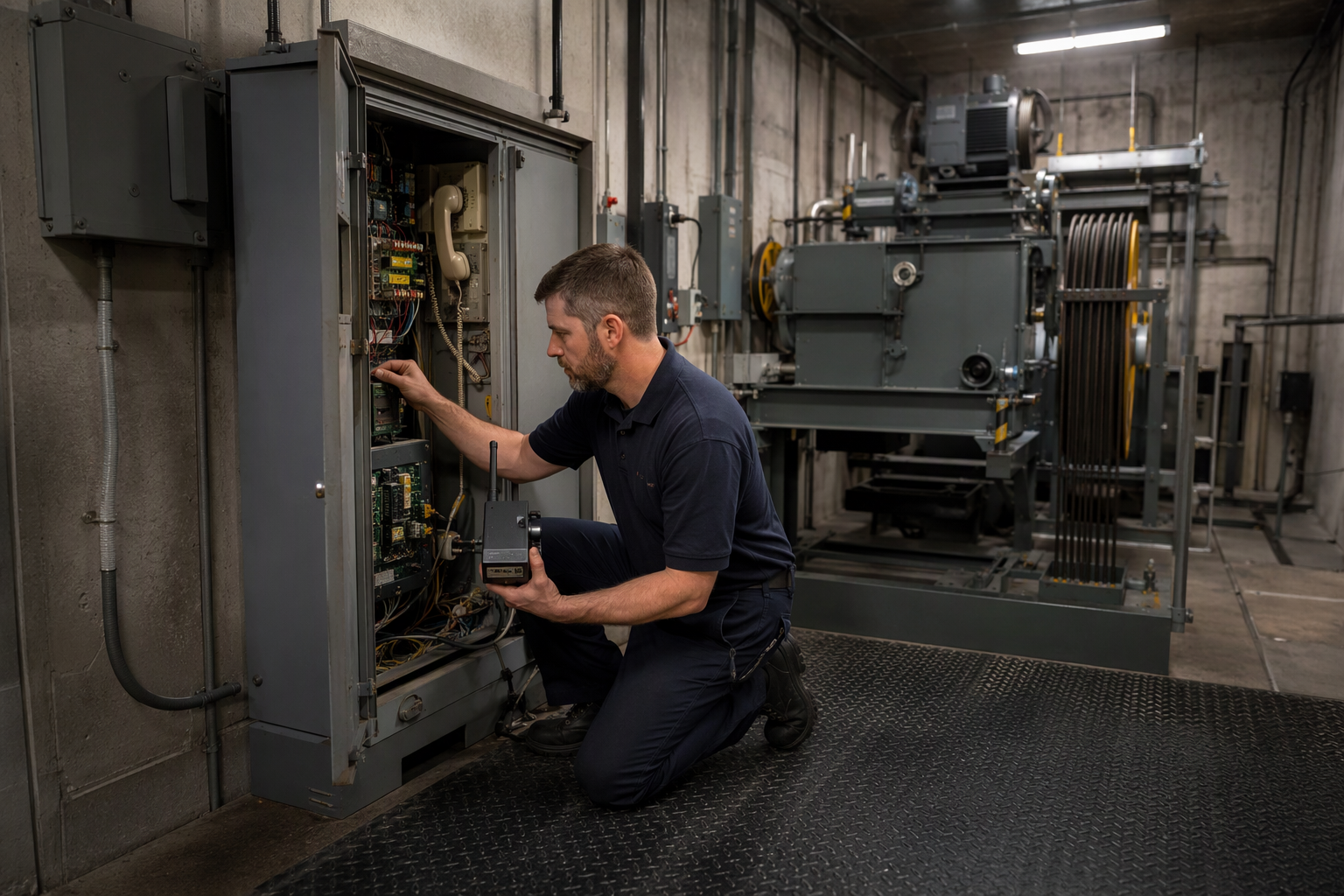
- Electrical isolation: The technician isolates the communication circuit at the controller and verifies that power to the communication equipment is safely de-energized before any wiring is disturbed.
- Removal of legacy equipment: The existing phone device, wiring, and interface hardware are removed from the car and machine room, with care taken to preserve the integrity of other circuits sharing conduit or raceways.
- Installation of new communication hardware: The replacement unit — whether a cellular dialer, VoIP adapter, or new analog device — is mounted, wired to the car operating panel, and connected to the building’s designated communication pathway.
- Programming and carrier registration: The new device is programmed with the monitoring center’s telephone number, the building address, and the specific car or unit identifier. For cellular units, the device is registered on the carrier’s network.
- Two-way communication test: The technician places a live test call to the monitoring center and verifies that two-way voice communication is established, that the car location is correctly identified, and that the monitoring center acknowledges the call within the required response window.
- ADA accessibility verification: The team confirms that the visual and tactile acknowledgment features of the new device meet ADA requirements for passengers with hearing or speech disabilities.
- Documentation and record update: All installation records, device serial numbers, carrier account information, and test results are logged in the elevator’s maintenance file. If the change constitutes an alteration under Arizona Administrative Code, the owner is notified of the obligation to report to the Industrial Commission of Arizona’s Elevator Division.
- Restoration to service: Once all tests pass and documentation is complete, the elevator is returned to normal service and the out-of-service notice is removed.
- Notification to the monitoring center: The monitoring service provider receives updated equipment records and confirms that the new device is active in its system.
How Does Arizona’s Regulatory Framework Classify a Phone Line System Change?
Under Arizona Administrative Code and A.R.S. §§ 23-491 through 23-491.16, a phone line system change that involves replacing the communication device itself — rather than simply changing the carrier account — is typically classified as an alteration or repair, which may trigger additional state notification and inspection obligations.
Arizona owners must notify the Industrial Commission of Arizona’s Elevator Division at least 90 days before installing, relocating, or altering a conveyance. Building owners and property managers should work with their elevator service provider to determine whether the specific scope of work crosses the threshold from routine maintenance into a reportable alteration. When in doubt, filing a notification is the conservative and legally defensible choice. Arizona Elevator Solutions assists clients in Phoenix, Tucson, Scottsdale, and Mesa in making this determination and preparing any required state documentation.
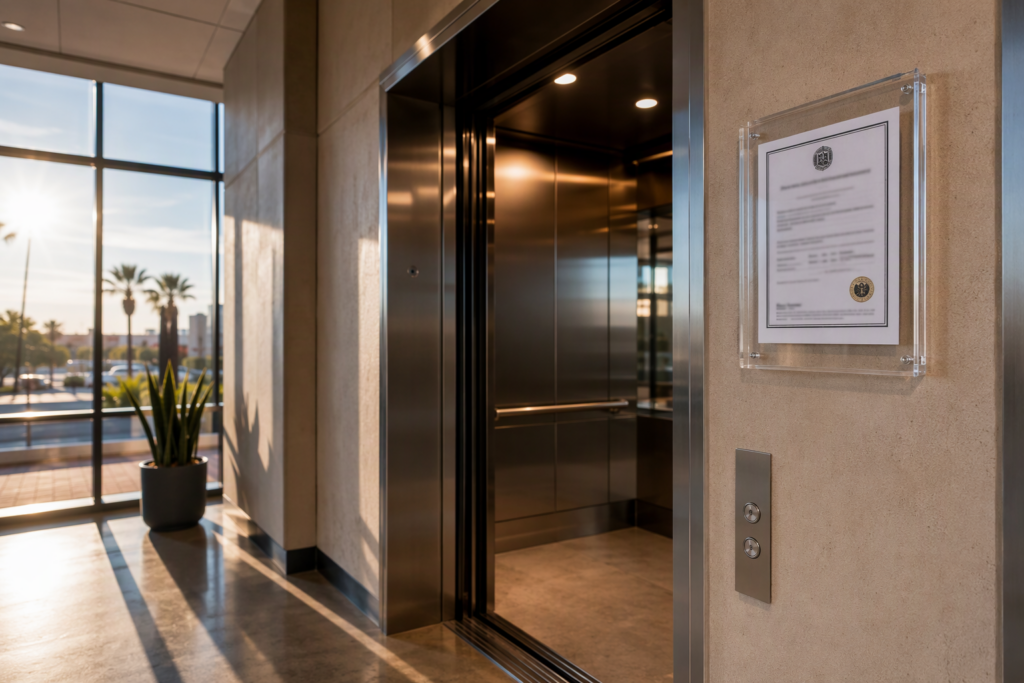
Arizona also requires that every conveyance operate with a valid annual certificate of inspection issued by the Industrial Commission of Arizona. If a phone line system change is classified as an alteration, a new inspection may be required before the certificate is reissued and the elevator may legally return to service. The certificate must be kept at the same location as the conveyance and made available on request.
What Communication Technologies Are Available to Replace a Legacy Analog Elevator Phone?
Building owners and maintenance teams can choose from three primary replacement technologies: cellular dialers, VoIP adapters, and managed IP communication systems, each with distinct technical profiles and suitability for different building environments.
| Technology | How It Works | Key Advantage | Primary Consideration | Typical Use Case |
|---|---|---|---|---|
| Cellular Dialer (3G/4G/5G) | Connects to mobile carrier network; no building phone wiring required | Works where POTS is discontinued; no dependence on building telecom infrastructure | Signal strength in basement or concrete shaft may require antenna extension | Buildings where POTS has been or will be discontinued |
| VoIP Adapter (ATA) | Converts analog phone signals to digital packets over building’s internet connection | Lower monthly carrier cost; integrates with existing IP infrastructure | Requires a reliable, dedicated internet connection; power outage risk without UPS backup | Buildings with managed IT infrastructure and reliable broadband |
| Managed IP Communication System | Proprietary platform integrating communication, monitoring, and diagnostics over IP | Centralized monitoring, remote diagnostics, easier compliance reporting | Higher upfront cost; proprietary hardware may limit vendor flexibility | Multi-unit commercial or mixed-use properties with multiple elevators |
| Analog POTS (Legacy) | Dedicated copper telephone line from carrier | Proven, simple, widely understood | Being discontinued by most carriers; increasingly unavailable in Arizona markets | Buildings where carrier still provides analog service |
Does a Phone Line System Change Affect the Elevator’s Annual Inspection Certificate in Arizona?
Yes — if the work constitutes an alteration under Arizona’s regulatory framework, the elevator must undergo a new inspection before the Industrial Commission of Arizona’s Elevator Division will issue or revalidate the annual certificate of inspection.
Arizona law is unambiguous: no conveyance may operate in Arizona without a valid annual certificate of inspection. The state serial number or the certificate must be posted in or close to the conveyance in an easily accessible location. If a phone line system change triggers an inspection requirement and the building owner operates the elevator before the new certificate is issued, the owner is in violation of A.R.S. §§ 23-491 through 23-491.16. Building owners may engage an Arizona private elevator inspector — an inspector authorized and annually registered with the Industrial Commission of Arizona who has completed at least eight hours of approved continuing education — to conduct the inspection, provided that inspector has no conflict of interest with the equipment being inspected.
Who Is Authorized to Perform an Elevator Phone Line System Change in Arizona?
In Arizona, elevator installation and repair work must be performed by a contractor holding an R-12 or C-12 elevator license classification issued by the Arizona Registrar of Contractors, which authorizes the installation and repair of elevators, dumbwaiters, escalators, and moving walks.
The Arizona Registrar of Contractors issues the R-12 (residential) and C-12 (commercial) elevator license classifications specifically for this category of work. Building owners who allow unlicensed contractors to perform elevator communication system changes risk violating state law and may also invalidate their certificate of inspection. Arizona Elevator Solutions holds the appropriate contractor licensing for elevator work in Phoenix, Tucson, Scottsdale, and Mesa, and clients can verify contractor credentials through the Arizona Registrar of Contractors before authorizing any scope of work.
What Role Does ASME A17.1-2019 Play in Specifying Emergency Communication Requirements?
ASME A17.1-2019, the Safety Code for Elevators and Escalators, is the technical standard that defines exactly what an elevator emergency communication system must accomplish, and Arizona has adopted this edition as its governing code for equipment installed, repaired, or altered on or after January 1, 2023.
The code requires that the communication system connect the elevator car to a location that is monitored at all times, that the system be operable without prior knowledge or special training by the passenger, and that the system not require the passenger to maintain continuous physical contact with the device. These requirements directly govern the selection of replacement technology during a phone line system change. For example, a system that routes calls to an unmanned voicemail box would not satisfy the continuous monitoring requirement. The monitoring center must be staffed and capable of responding to and acknowledging every emergency call.
How Do ADA Requirements Shape the Selection of a Replacement Communication System?
The Americans with Disabilities Act requires that elevator emergency communication systems be accessible to individuals who are deaf or hard of hearing, which means the replacement system must provide a non-auditory means of acknowledging that an emergency call has been connected.
In practice, this typically requires the communication device to include a visual indicator — such as an illuminated button or display — that activates when the call is answered by the monitoring center, confirming to a deaf passenger that help is on the way. Building owners selecting replacement equipment should verify that the device is explicitly rated or certified for ADA compliance and that the monitoring center’s platform supports the two-way acknowledgment workflow. Failing to meet ADA requirements during a phone line system change exposes the building owner to civil liability independent of elevator code enforcement.
What Happens If an Elevator Operates Without a Functioning Emergency Phone in Arizona?
Operating an elevator without a functioning emergency communication system in Arizona violates both ASME A17.1-2019 and state statute, and the Industrial Commission of Arizona’s Elevator Division has authority to order the conveyance taken out of service.
Under A.R.S. §§ 23-491 through 23-491.16, the state’s elevator chief has authority to condemn any conveyance that presents a hazard to life, health, or property. A non-functioning emergency phone is a direct life-safety hazard and falls squarely within that authority. Beyond regulatory consequences, building owners face significant civil liability if a passenger is trapped and cannot summon help because the emergency phone is non-functional. The practical guidance is straightforward: when a phone line system change is anticipated, it should be planned and executed proactively, before the existing system fails, rather than reactively after a service outage has already occurred.
How Long Does an Elevator Phone Line System Change Typically Take to Complete?
The physical installation work for a standard elevator phone line system change is typically completed within a single maintenance window, though the total project timeline depends on equipment procurement, carrier activation, and any required state inspection.
The hands-on installation — removing legacy hardware, running new wiring where needed, mounting the replacement unit, and completing initial testing — is generally a half-day to full-day task for a single elevator. Multi-unit properties with several elevators require proportionally more time. The variables that extend the overall timeline include lead time for ordering replacement communication hardware, cellular carrier account activation and SIM provisioning, coordination with the monitoring center, and, if the work triggers an alteration classification, scheduling the required state inspection. Building owners should plan these timelines in advance rather than waiting for a carrier to discontinue the analog line without notice.
What Documentation Should the Building Owner Receive After a Phone Line System Change Is Completed?
Upon completion, the building owner should receive a written record of the work performed, the make and model of the replacement communication device, test results confirming two-way communication with the monitoring center, and updated maintenance log entries for the elevator’s permanent file.
This documentation serves multiple purposes. It provides evidence of compliance during state inspections, supports insurance claims if an incident occurs, and establishes a clear chain of custody for equipment changes. If the work was classified as an alteration and a new certificate of inspection was issued, that certificate must be posted in or close to the conveyance. The state serial number tag on the controller or mainline disconnect should also be verified as current. Arizona Elevator Solutions provides clients with complete documentation packages following any communication system change, supporting their ongoing compliance obligations with the Industrial Commission of Arizona.
Can a Cellular Elevator Phone System Fail Due to Signal Issues in Arizona Buildings?
Cellular elevator phones can experience signal degradation in underground or heavily shielded environments, which is why cellular signal strength must be tested inside the elevator car — not just at ground level — before a cellular system is selected or commissioned.
Many commercial and mixed-use buildings in Phoenix, Scottsdale, Mesa, and Tucson have elevator hoistways in concrete cores or below-grade parking structures that attenuate cellular signals significantly. A cellular dialer that shows full bars in the machine room may have insufficient signal inside the cab. Qualified elevator maintenance teams test signal strength within the actual car environment and, where signals are marginal, install external antenna systems that route the cellular signal from a location with reliable coverage into the hoistway. This testing step is non-negotiable and should be documented as part of the installation record.
What Should Building Owners Do If the Elevator Monitoring Center Changes During or After the Phone Line System Change?
If the monitoring center changes at any point during or after the phone line system change, the replacement communication device must be reprogrammed with the new monitoring center’s contact number, and a new two-way communication test must be performed and documented.
This is a step that is sometimes overlooked during vendor transitions. The elevator phone may be physically operational and connected to a carrier, but if it is still programmed to dial a monitoring center that is no longer managing the account, calls will either fail or go unanswered — a condition that is indistinguishable from a broken phone from the perspective of a trapped passenger. Building owners should treat any change in monitoring service provider as a trigger for a full re-commissioning test, not just an administrative account transfer.
How Does the City of Phoenix Elevator Section Fit Into the Approval Process for Phone Line System Changes?
Within the City of Phoenix, elevator inspections are conducted by the City of Phoenix Elevator Section, which operates under the Planning and Development Department, while the Industrial Commission of Arizona’s Elevator Division handles equipment located outside Phoenix city limits.
Building owners with elevators in Phoenix should direct alteration notifications and inspection requests to the City of Phoenix Elevator Section rather than — or in addition to — the state agency, depending on the specific requirements that apply to their scope of work. For properties in Tucson, Scottsdale, and Mesa, the Industrial Commission of Arizona’s Elevator Division is the relevant authority. Understanding the correct jurisdictional pathway prevents delays in obtaining required approvals and certificates. Arizona Elevator Solutions serves all four markets and is familiar with the procedural requirements of each local authority having jurisdiction.
What Is the Difference Between a Phone Line System Change and Routine Elevator Communication Maintenance?
Routine communication maintenance involves testing, cleaning, and verifying the existing emergency phone system, while a phone line system change involves physically replacing the communication technology, carrier infrastructure, or hardware platform — a distinction that carries different regulatory implications under Arizona law.
Routine maintenance on an elevator emergency phone might include testing the two-way communication function monthly, verifying dial tone, checking that the monitoring center correctly identifies the car location, and inspecting the phone housing for physical damage. None of these activities involve replacing components or altering the system. A phone line system change, by contrast, involves a material change to the hardware, carrier, or communication pathway, which may cross the threshold into a reportable alteration under Arizona Administrative Code R20-5-502 through R20-5-515. Building owners should discuss the classification of proposed work with their licensed elevator contractor before the job begins.
How Should Building Owners Prepare Before Scheduling a Phone Line System Change?
Preparation involves gathering existing system documentation, confirming the reason for the change with the telecommunications carrier, selecting a licensed elevator contractor, and planning for any required state notification or inspection well in advance of the anticipated cutover date.
Specifically, building owners should locate the elevator’s existing maintenance records and identify the make, model, and carrier account for the current emergency phone. They should obtain written confirmation from their telecom provider of any line discontinuation date. They should contact their elevator service provider early enough to allow time for equipment procurement, which can involve lead times for specialized cellular or VoIP communication hardware. And they should determine, in consultation with their contractor, whether the scope of work requires a 90-day advance notification to the Industrial Commission of Arizona’s Elevator Division. Reactive planning — beginning this process only after the analog line has already been disconnected — invariably results in a period where the elevator is out of compliance.
Does an Elevator Phone Line System Change Require a Permit in Arizona?
Whether a permit is required depends on the classification of the work under Arizona Administrative Code and the jurisdiction in which the elevator is located, with the City of Phoenix Elevator Section and the Industrial Commission of Arizona’s Elevator Division each having their own procedures for alterations and repairs.
Arizona owners are required under A.R.S. §§ 23-491 through 23-491.16 to notify the state at least 90 days before altering a conveyance. Whether a phone line system change triggers that notification — and whether a formal permit is required in a given jurisdiction — depends on the specifics of the work and the policies of the relevant authority having jurisdiction. Building owners should not assume that a phone system change is automatically exempt from permitting requirements. The safest practice is to consult with a licensed elevator contractor and confirm the jurisdictional requirements before work begins.
How Does the Emergency Phone System Interact With the Firefighters’ Emergency Operation Requirements in Arizona?
Arizona requires that conveyances equipped with firefighters’ emergency operation use the Arizona Firefighters Service (AZFS) key, and while the emergency phone and firefighters’ operation are separate systems, both must be fully functional for the elevator to meet Arizona’s life-safety requirements.
During a phone line system change, the maintenance team verifies that work on the communication system does not inadvertently disturb wiring or controls associated with firefighters’ emergency operation. These systems share the elevator’s control panel environment, and technicians working on communication circuits must follow proper lockout/tagout procedures under OSHA standards to prevent unintended interactions. Post-installation testing should include a verification that firefighters’ emergency operation remains fully functional after the communication system work is complete.
What Ongoing Maintenance Is Required After a New Elevator Phone Line System Is Installed?
After installation, the new communication system requires regular functional testing as part of the elevator’s routine maintenance program, with test results documented in the maintenance log to support compliance with ASME A17.1-2019 and Arizona inspection requirements.
At a minimum, the emergency phone should be tested on a regular basis to confirm that it connects to the monitoring center, that two-way voice communication is clear, that the monitoring center correctly identifies the building address and car number, and that any visual acknowledgment features are functioning. For cellular systems, carrier account status should be verified periodically to ensure the SIM card and service plan remain active. Changes in monitoring service providers, carrier plans, or building communication infrastructure should trigger a new full commissioning test. Arizona Elevator Solutions provides ongoing maintenance programs for clients in Phoenix, Tucson, Scottsdale, and Mesa that include scheduled emergency communication system testing as a standard component of elevator service agreements.
Contact Arizona Elevator Solutions for a free elevator assessment at 480-557-7600.
Need elevator service you can rely on? Arizona Elevator Solutions is ready to help.