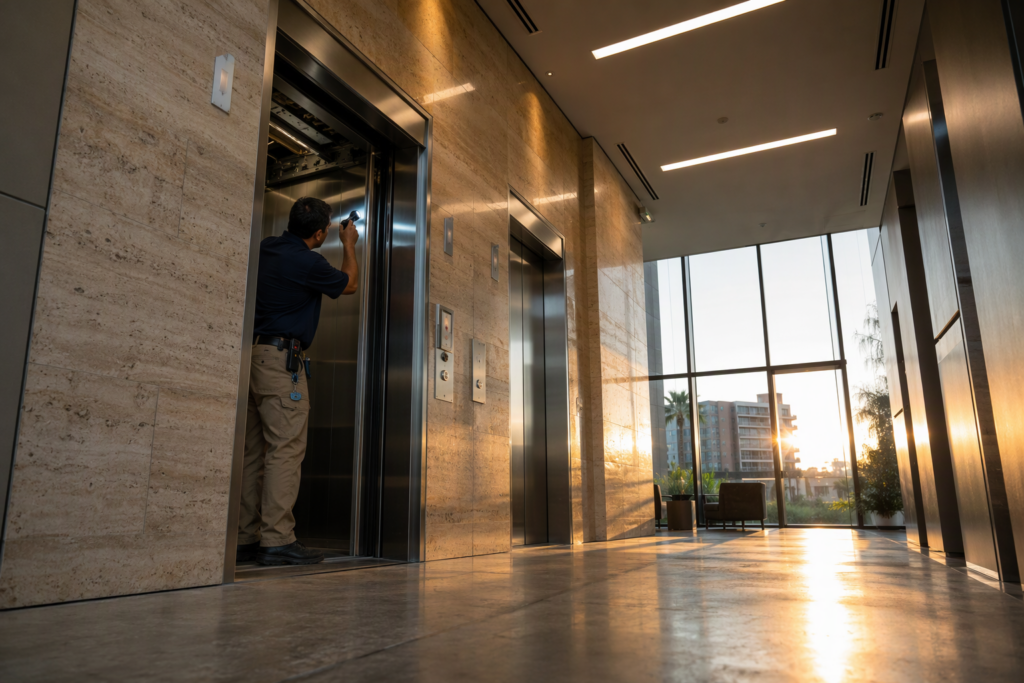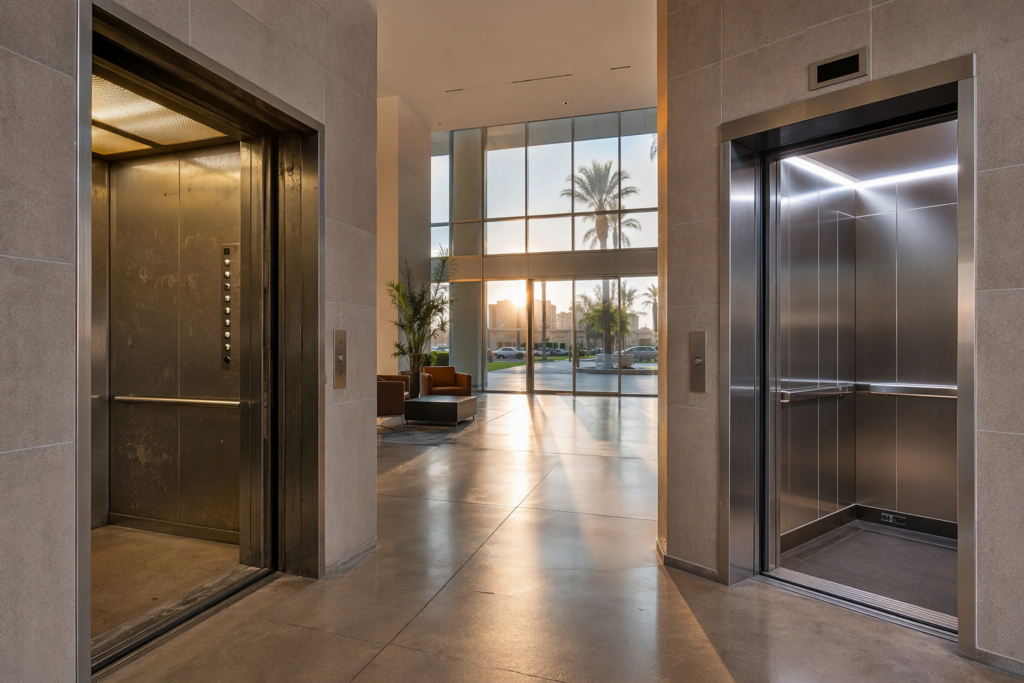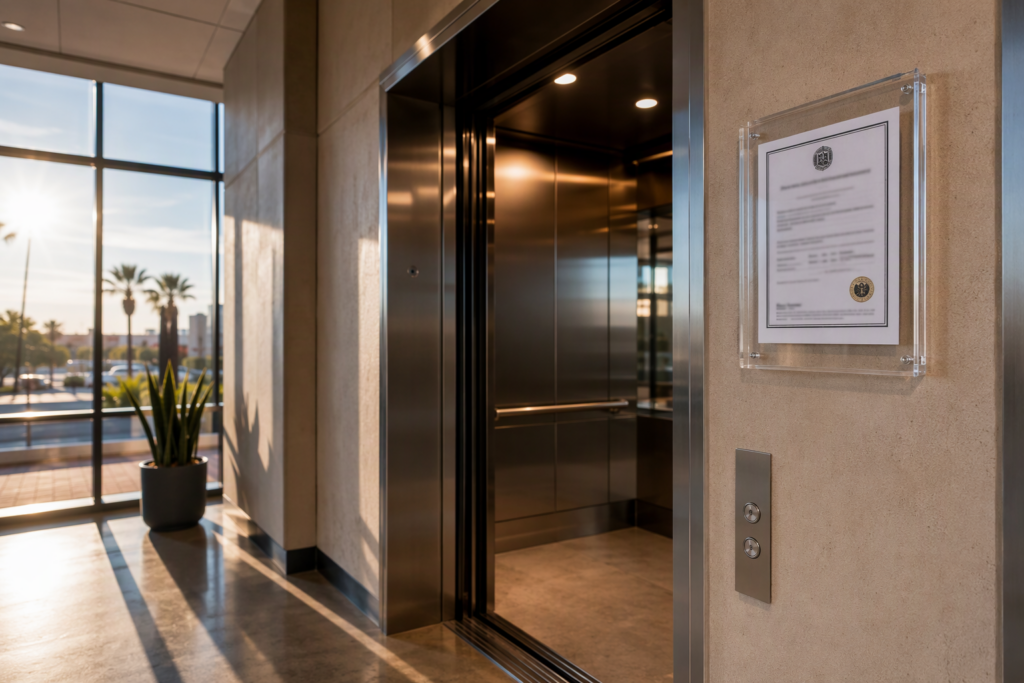
To get a quote for elevator inspection services from Arizona Elevator Solutions, call the company directly, submit a contact form on the website, or request a free elevator assessment. Be ready to share the building address, equipment type, state serial number if available, and the date of the last inspection. Quotes are typically provided after a brief consultation.

What information do you need to provide when requesting an elevator inspection quote?
Providing complete, accurate details about the conveyance and the building helps Arizona Elevator Solutions prepare a precise, actionable quote without delays.
When reaching out, building owners and property managers should have the following ready:
- Building address and jurisdiction — whether the property is located inside the City of Phoenix (served by the City of Phoenix Elevator Section, Planning and Development Department) or elsewhere in the state (served by the Industrial Commission of Arizona, Elevator Division)
- Equipment type — traction elevator, hydraulic elevator, escalator, moving walk, dumbwait er, platform lift, or stairway chairlift
- Number of conveyances — multi-unit properties with several elevators may qualify for bundled inspection scheduling
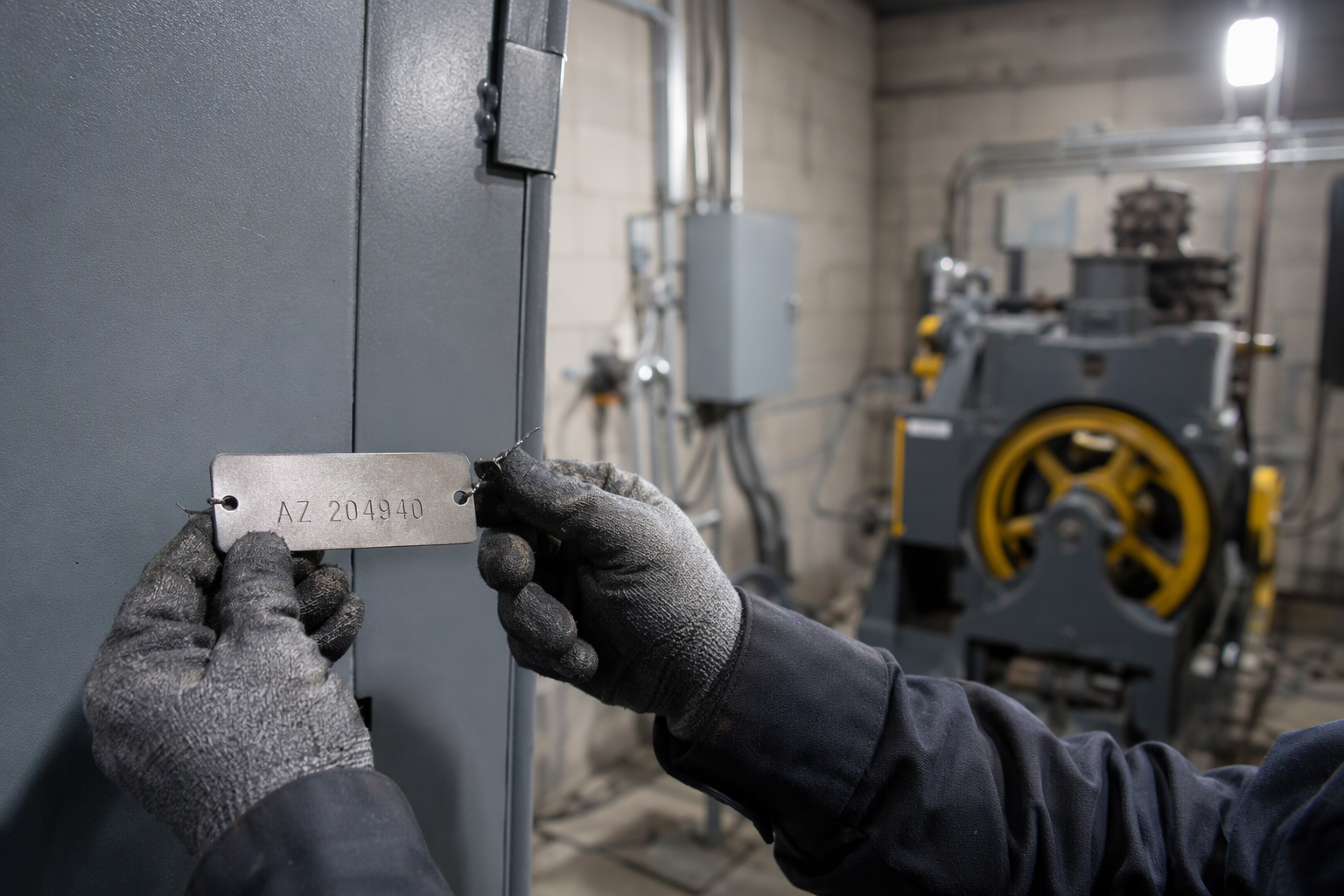
- State serial number — under A.R.S. §§ 23-491 through 23-491.16, every Arizona conveyance is assigned a state serial number on a tag fixed to the controller or mainline disconnect; having this number on hand speeds up record verification
- Date and result of the last inspection — including whether a current certificate of inspection is posted
- Any recent modifications or alterations — Arizona owners are required to notify the state at least 90 days before installing, relocating, or altering a conveyance, and altered equipment requires a new inspection before returning to service
How does the elevator inspection quote process work step by step?
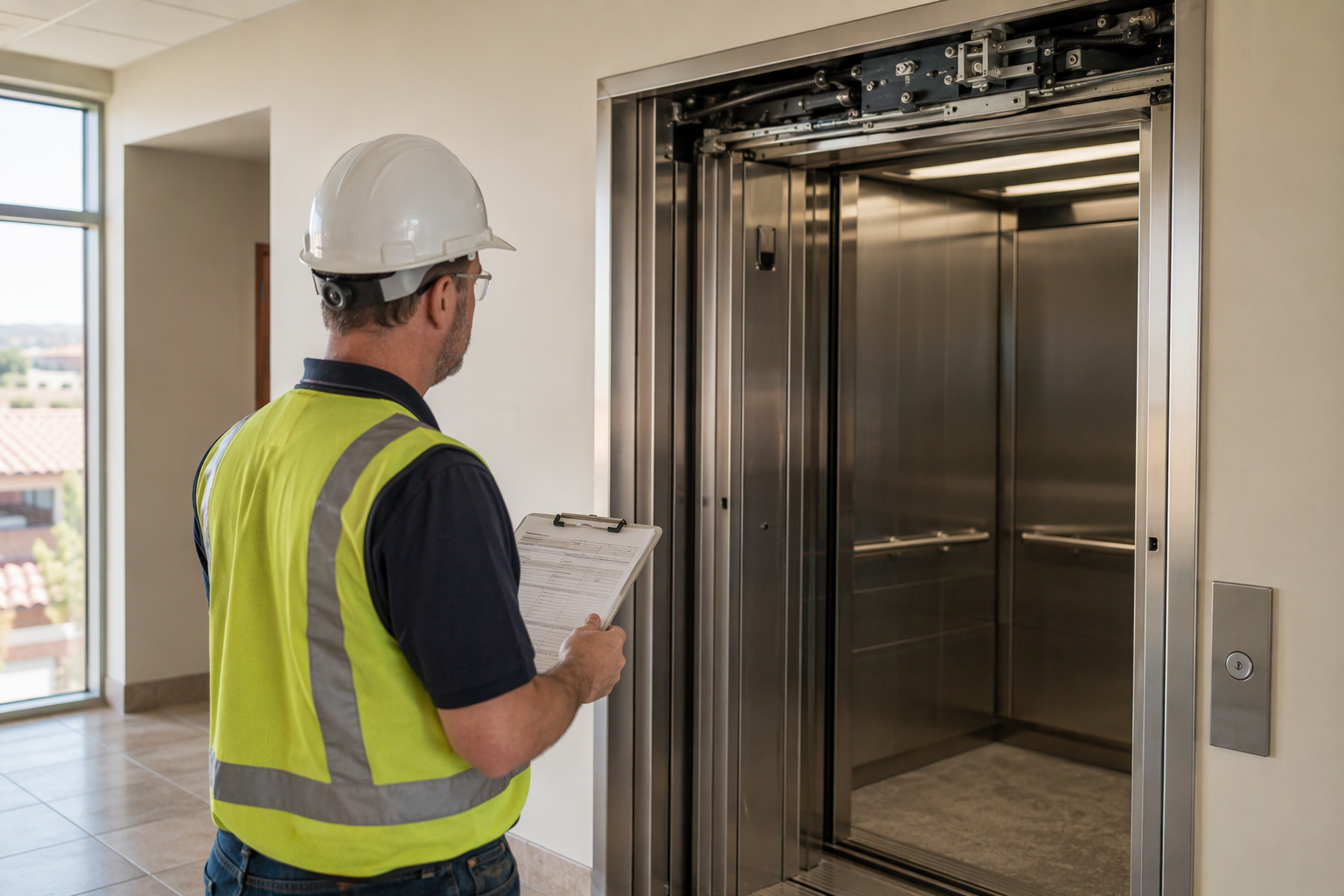
The quoting process follows a straightforward sequence that moves from initial contact through on-site assessment to a written proposal.
- Initial contact — Call Arizona Elevator Solutions or submit the website contact form with the basic building and equipment details listed above.
- Preliminary consultation — A representative reviews the information, confirms the jurisdiction (City of Phoenix vs. state ICA Elevator Division), and identifies the applicable inspection standard — the ASME A17.1/CSA B44, 2019 edition for equipment installed, repaired, or altered on or after January 1, 2023, or ASME A17.3 for existing equipment.
- Site assessment scheduling — For complex or large-portfolio properties, a brief on-site walkthrough may be arranged to assess the number of units, equipment condition, and access requirements before finalizing the quote.
- Written quote delivery — A written proposal is provided outlining the scope of the inspection, the applicable code edition, and any recommended follow-up services based on preliminary findings.
- Scheduling and coordination — Once the quote is accepted, the inspection is scheduled in coordination with the building owner or property manager, and the authorized private inspector is assigned.
- Post-inspection documentation — After the inspection, findings are documented, and any items requiring corrective action are communicated clearly, along with guidance on reporting obligations under Arizona law.
How often are elevators required to be inspected in Arizona?
Under Arizona law, every conveyance must be inspected before it first goes into service, after any modification or alteration, and annually after that.
This requirement is established under A.R.S. §§ 23-491 through 23-491.16 and the accompanying Arizona Administrative Code R20-5-502 through R20-5-515. The annual inspection cycle applies regardless of equipment age, usage frequency, or whether the building is residential, commercial, or public. No conveyance may legally operate in Arizona without a valid, current certificate of inspection issued by the state. The certificate must be kept at the same location as the conveyance and made available on request; in addition, the state serial number or the certificate itself must be posted in or close to the conveyance in an easily accessible location.
Equipment that has been modified or altered must be inspected again before returning to service, regardless of when the most recent annual inspection occurred. This makes it critical for owners to track alteration projects carefully and build inspection scheduling into project timelines.
Who is authorized to perform elevator inspections in Arizona?
In Arizona, inspections may be conducted by state inspectors employed by the Industrial Commission of Arizona Elevator Division, or by private elevator inspectors who have been authorized by the commission.
Private elevator inspectors must register with the commission every year and demonstrate at least eight hours of approved continuing education as part of that renewal. There are also important conflict-of-interest restrictions: a private inspector may not inspect a conveyance owned, operated, or last serviced by the inspector, a company the inspector owns, or the inspector’s employer. This rule is designed to ensure objective, independent assessments.
Importantly, using a private elevator inspector does not relieve the building owner or operator of any legal obligations under Arizona law. The responsibility for maintaining compliant equipment, posting certificates, and reporting accidents remains with the owner at all times.
The Industrial Commission of Arizona Elevator Division (formerly called the ADOSH Elevator Safety Section until September 12, 2026, when Laws 2026, Ch. 73 took effect) is the primary state regulator for elevator safety in Arizona, except within the City of Phoenix, where the City of Phoenix Elevator Section, Planning and Development Department, handles inspections for elevators, escalators, moving walks, dumbwaiters, and chairlifts.
What elevator codes apply to equipment in Arizona?
Arizona has adopted the ASME A17.1/CSA B44, 2019 edition (ASME A17.1-2019) as the governing standard for elevators and escalators installed, repaired, or altered on or after January 1, 2023, effective January 9, 2023.
For existing equipment installed before that date, the applicable standard is ASME A17.3, the Safety Code for Existing Elevators and Escalators, which establishes minimum safety requirements for in-service conveyances. Platform lifts and stairway chairlifts installed, repaired, or altered on or after January 1, 2023 must comply with ASME A18.1-2020.
Federal accessibility requirements under the Americans with Disabilities Act (ADA) also apply to elevators in public accommodations and commercial facilities, covering cab dimensions, door timing, control height, and Braille signage, among other elements. ADA compliance is evaluated separately from Arizona’s safety inspection requirements but is often assessed during a comprehensive inspection review. Workplace elevator safety in Arizona is also subject to OSHA standards where applicable.
What types of conveyances does an Arizona elevator inspection cover?
Arizona law and ASME standards cover a broad range of conveyances beyond traditional passenger elevators.
| Equipment Type | Applicable Standard (AZ, on/after Jan 1, 2023) | Annual Certificate Required? | Typical Inspection Trigger |
|---|---|---|---|
| Passenger elevator (traction or hydraulic) | ASME A17.1-2019 | Yes | Annual + pre-service + post-alteration |
| Freight elevator | ASME A17.1-2019 | Yes | Annual + pre-service + post-alteration |
| Escalator | ASME A17.1-2019 | Yes | Annual + pre-service + post-alteration |
| Moving walk | ASME A17.1-2019 | Yes | Annual + pre-service + post-alteration |
| Dumbwaiter | ASME A17.1-2019 | Yes | Annual + pre-service + post-alteration |
| Platform lift | ASME A18.1-2020 | Yes | Annual + pre-service + post-alteration |
| Stairway chairlift | ASME A18.1-2020 | Yes | Annual + pre-service + post-alteration |
Arizona owners should ensure every conveyance on their property — not just the main passenger elevator — is included in their annual inspection schedule. Arizona Elevator Solutions can assess an entire building’s conveyance inventory as part of a single consultation, simplifying compliance tracking across multiple equipment types.
What is the difference between an elevator inspection and an elevator maintenance contract?
An inspection is a formal, code-driven evaluation of a conveyance’s safety and regulatory compliance, while a maintenance contract covers ongoing preventive service, lubrication, adjustments, and repairs between inspections.
Under Arizona law, only the annual inspection — performed by an authorized inspector — results in the issuance of the state certificate of inspection that is legally required for a conveyance to remain in service. A maintenance contract with a service company does not substitute for or replace the inspection requirement. However, well-maintained equipment is more likely to pass inspection without corrective action items, which is why owners often coordinate inspection scheduling with their maintenance provider.
When requesting a quote, building owners should clarify whether they are seeking inspection services only, maintenance services only, or a combined program. Arizona Elevator Solutions serves markets in Phoenix, Tucson, Scottsdale, and Mesa, and can discuss the scope of both inspection coordination and ongoing maintenance support during the initial consultation.
How does jurisdiction affect the elevator inspection and quoting process in Arizona?
Whether a building is located inside the City of Phoenix or in another part of Arizona determines which authority has jurisdiction over the inspection, which affects documentation requirements and the approval process.
Within the City of Phoenix, the City of Phoenix Elevator Section, Planning and Development Department, is the Authority Having Jurisdiction (AHJ) for elevators, escalators, moving walks, dumbwaiters, and chairlifts. Outside of Phoenix, the Industrial Commission of Arizona Elevator Division is the AHJ. When preparing a quote, Arizona Elevator Solutions confirms the correct jurisdiction for each building so that the inspection is submitted to and approved by the right agency and so that the resulting certificate of inspection is valid under applicable local requirements.
Owners with buildings in multiple jurisdictions — for example, properties in both Phoenix and Scottsdale — should ensure that each site’s inspection is routed through the appropriate authority. This is a detail that is easy to overlook but can affect the validity of the annual certificate.
What happens if an elevator fails its annual inspection in Arizona?
If a conveyance fails its annual inspection, the equipment may not legally remain in operation until the identified deficiencies are corrected and re-inspected.
Under A.R.S. §§ 23-491 through 23-491.16, no conveyance may operate in Arizona without a current, valid certificate of inspection. A failed inspection means the certificate is not issued or is revoked, requiring the owner to address all noted deficiencies and arrange a follow-up inspection. Depending on the severity of the findings, the state may require the conveyance to be taken out of service immediately.
Owners should treat inspection findings not as punitive but as an operational roadmap. Corrective action items arising from an inspection under ASME A17.1-2019 or ASME A17.3 standards typically relate to safety devices, emergency lighting, firefighters’ emergency operation (which in Arizona must use the Arizona Firefighters Service — AZFS — key), or accessibility features under the ADA. Addressing these items promptly minimizes downtime and reduces the risk of liability.
What should a building owner do immediately after an elevator accident or breakdown in Arizona?
Arizona law requires the building owner to notify the state within 24 hours of any accident that injures a person or disables a conveyance.
- Secure the area — Take the affected conveyance out of service immediately and restrict access to prevent further injury or damage.
- Provide emergency assistance — Ensure that any injured persons receive prompt medical attention and that all individuals are safely evacuated from the conveyance if needed.
- Notify the appropriate authority within 24 hours — Report the incident to the Industrial Commission of Arizona Elevator Division (or the City of Phoenix Elevator Section if inside Phoenix) within 24 hours as required under A.R.S. §§ 23-491 through 23-491.16.
- Document the incident — Preserve records, photographs, and any available maintenance or inspection logs related to the conveyance.
- Contact an authorized elevator service company — Arrange for a qualified contractor to assess the equipment before it is returned to service. Under Arizona law, the conveyance must be inspected after any disabling event before resuming operation.
- Do not return the conveyance to service — Until a post-incident inspection has been completed and a valid certificate has been issued or reinstated, the conveyance must remain out of service.
Does the age of an elevator affect the inspection scope or the quote?
Yes, the installation date of the equipment determines which code edition applies, and older equipment is often subject to additional review under ASME A17.3 for existing elevators and escalators.
Equipment installed before January 1, 2023 is not automatically required to be upgraded to ASME A17.1-2019 specifications; however, it must meet the requirements of the ASME A17.3 standard, which establishes minimum safety criteria for in-service conveyances. When such equipment is modified or altered, the work and the altered components must comply with the current ASME A17.1-2019 edition adopted by Arizona.
Under Arizona law, lawfully installed older conveyances may remain in use unless the state’s elevator chief determines that continued use poses a hazard to life, health, or property. This provision gives building owners some protection for legacy equipment, but it does not eliminate annual inspection obligations or the requirement to maintain a current certificate. Older equipment may require more detailed inspection scoping, which can affect the structure of a quote — a factor that Arizona Elevator Solutions addresses during the preliminary consultation.
What role does the Arizona Registrar of Contractors play in elevator work?
The Arizona Registrar of Contractors (ROC) issues R-12 and C-12 elevator contractor license classifications that authorize a licensee to install and repair elevators, dumbwaiters, escalators, and moving walks — but it does not issue the annual certificate of inspection.
This distinction is important for building owners comparing vendors. A contractor performing installation or repair work in Arizona must hold the appropriate ROC license classification. However, the certificate of inspection that legally permits the conveyance to operate is issued by the Industrial Commission of Arizona Elevator Division (or the City of Phoenix Elevator Section, as applicable), not by the ROC. Owners should verify both licensing and inspection authorization when evaluating service providers.
How should building owners compare elevator inspection service providers in Arizona?
Comparing providers requires evaluating inspector authorization status, familiarity with applicable Arizona statutes, code edition expertise, and the ability to coordinate with the correct AHJ for the building’s jurisdiction.
Key questions to ask any provider include:
- Is the inspector currently authorized by the Industrial Commission of Arizona Elevator Division?
- Does the inspector have current annual registration and documentation of at least eight hours of approved continuing education?
- Can the company confirm which AHJ applies to the specific building — ICA Elevator Division or City of Phoenix Elevator Section?
- Does the company have experience with the specific equipment type (traction, hydraulic, escalator, platform lift, etc.)?
- Can the company assist with documentation, certificate tracking, and state reporting requirements?
- Does the conflict-of-interest rule apply — i.e., will the inspector be reviewing equipment they or their employer serviced most recently?
Building owners in Phoenix, Tucson, Scottsdale, and Mesa can discuss these criteria directly with Arizona Elevator Solutions during the initial quote consultation.
What is the 90-day notification requirement and how does it affect new construction or renovation projects?
Arizona owners must notify the state at least 90 days before installing, relocating, or altering a conveyance, giving the Industrial Commission of Arizona Elevator Division time to review plans and schedule pre-service inspections.
For new construction, this means elevator inspection planning must begin well before the equipment is delivered to the site. For renovation projects that include elevator modernization, cab upgrades, or mechanical alterations, owners must ensure the 90-day notice window is built into the project schedule — not treated as an afterthought. Failure to provide timely notice can delay occupancy, trigger compliance issues, or result in a conveyance that cannot legally operate upon project completion.
When requesting a quote for inspection services tied to a construction or renovation project, it is helpful to share the anticipated installation or completion date so that the inspection can be properly sequenced within the project timeline and the notification deadline to the state can be met.
Are platform lifts and stairway chairlifts subject to the same inspection requirements as full elevators?
Yes — platform lifts and stairway chairlifts installed, repaired, or altered on or after January 1, 2023 in Arizona must comply with ASME A18.1-2020 and are subject to the same annual inspection and certificate-of-inspection requirements as other conveyances.
These devices are often installed in residential settings, schools, churches, and smaller commercial buildings to provide accessibility in lieu of a full elevator. Despite being smaller and mechanically simpler than passenger elevators, they are regulated under A.R.S. §§ 23-491 through 23-491.16 and must carry a current certificate of inspection. The ADA also contains provisions relevant to platform lifts used as a means of accessible entry in certain building types. Building owners sometimes overlook these devices when scheduling annual inspections, inadvertently allowing a certificate to lapse — a risk that a comprehensive quote from Arizona Elevator Solutions can help address.
What documentation should a building owner maintain to support elevator compliance in Arizona?
Thorough documentation reduces the risk of compliance gaps, simplifies the inspection process, and provides critical evidence in the event of an incident or regulatory inquiry.
Recommended documentation includes:
- The current state certificate of inspection, kept at the same location as the conveyance
- The state serial number tag, fixed to the controller or mainline disconnect — this number must be posted in or close to the conveyance
- Records of all prior annual inspections and any corrective actions taken
- Maintenance logs from the service contractor, including dates of service and work performed
- Documentation of any modifications or alterations, including permits, plans, and post-alteration inspection records
- The 90-day notification records for any installation, relocation, or alteration projects
- Incident reports for any accidents or disabling events, along with the 24-hour notification confirmation to the appropriate AHJ
- Evidence of Arizona Firefighters Service (AZFS) key compliance for conveyances with firefighters’ emergency operation
How does ADA compliance relate to elevator inspection services?
ADA compliance is a separate legal obligation from the state safety inspection, but both are evaluated as part of a thorough elevator assessment.
The Americans with Disabilities Act establishes accessibility requirements for elevators in public accommodations and commercial facilities, covering elements such as cab dimensions, door reopening devices, floor designation signage, Braille markings, audible signals, and reach-range requirements for controls. These requirements are not part of the ASME A17.1-2019 safety inspection checklist per se, but non-compliant equipment can expose building owners to federal civil rights complaints and legal liability.
When building owners in Phoenix, Scottsdale, Tucson, and Mesa request a quote from Arizona Elevator Solutions, they can ask that ADA accessibility considerations be incorporated into the assessment scope, particularly for older equipment that may predate current ADA standards.
What are common reasons Arizona elevators fail inspection?
Inspection failures are most frequently linked to deferred maintenance, outdated safety devices, firefighters’ emergency operation non-compliance, and missing or expired certificates.
Under the ASME A17.1-2019 and ASME A17.3 standards, inspectors examine a wide range of safety-critical components. Common deficiency categories include:
- Inoperative or improperly configured firefighters’ emergency operation — in Arizona, this must use the Arizona Firefighters Service (AZFS) key, a state-specific requirement
- Non-functioning door protection devices or door reopening mechanisms
- Inadequate or failed emergency lighting and alarm systems
- Worn or degraded hoistway, pit, or machine room conditions
- Missing, expired, or improperly posted certificates of inspection
- Broken or damaged safety devices including governors, buffers, or safeties
- Non-compliant cab interiors, signage, or control panels relative to ADA requirements
Proactive maintenance and pre-inspection assessments help owners identify and resolve these issues before they result in a failed inspection and mandatory downtime.
How far in advance should a building owner schedule an elevator inspection in Arizona?
Scheduling an annual inspection well before the current certificate expiration date — ideally several weeks in advance — ensures there is adequate time to address any deficiencies found before the certificate lapses.
Certificate lapses are a compliance risk because no conveyance may operate in Arizona without a valid certificate. If deficiencies are found during an inspection conducted close to the expiration date, the owner may face a period during which the elevator cannot legally run while repairs are arranged and a re-inspection is scheduled. For high-traffic buildings such as commercial office towers, healthcare facilities, or multi-family residential properties, even brief elevator downtime can be disruptive and costly. Arizona Elevator Solutions recommends that building owners in Phoenix, Tucson, Scottsdale, and Mesa build inspection scheduling into their annual facility management calendar, treating it as a priority line item rather than a reactive task.
What should property managers in multi-tenant buildings know about elevator inspection obligations?
In a multi-tenant building, the obligation for elevator compliance under Arizona law rests with the owner of the conveyance — not with individual tenants — but property managers who oversee day-to-day operations play a critical role in maintaining compliance.
Property managers should ensure that certificates of inspection are renewed on time, that the state serial number is properly posted, that the AZFS key is available for firefighters’ emergency operation where required, and that any incidents are reported to the appropriate AHJ within the 24-hour statutory window. For large portfolios with elevators in multiple buildings across jurisdictions — such as properties in both Phoenix and Mesa — maintaining a centralized compliance calendar is advisable. Arizona Elevator Solutions can assist portfolio managers in coordinating inspection schedules across multiple locations during the quoting process.
Can a building owner use the same company for both elevator maintenance and elevator inspection in Arizona?
Under Arizona’s conflict-of-interest rule for private elevator inspectors, an inspector may not inspect a conveyance that was last serviced by their employer or a company they own — meaning that the company providing maintenance typically cannot also provide the official annual inspection through its own authorized inspector.
This rule is designed to preserve the independence and objectivity of the inspection process. Building owners who have a maintenance contract with one company will generally need to engage a separate authorized private inspector — or rely on the state’s own inspectors — for the annual certification inspection. When requesting a quote, building owners should ask the service provider to clarify this relationship explicitly and confirm that the inspector assigned to the job meets Arizona’s independence requirements. Understanding this distinction upfront prevents compliance problems and ensures that the resulting certificate of inspection is valid under Arizona law.
Contact Arizona Elevator Solutions for a free elevator assessment at 480-557-7600.
Need elevator service you can rely on? Arizona Elevator Solutions is ready to help.