Elevator Repair vs. Modernization: How to Know Which One Your Building Needs
Determining whether your elevator needs a targeted repair or a full modernization comes down to evaluating five core factors: the frequency and nature of recent breakdowns, the age and availability of replacement parts, compliance with current safety standards under ASME A17.1 Safety Code for Elevators and Escalators and the Americans with Disabilities Act, passenger safety indicators, and the long-term cost trajectory of patchwork fixes versus a planned upgrade. When one or two components fail, repair is usually the right call. When multiple systems are degrading simultaneously, modernization protects both occupants and your budget.
What Is the Difference Between Elevator Repair and Elevator Modernization?
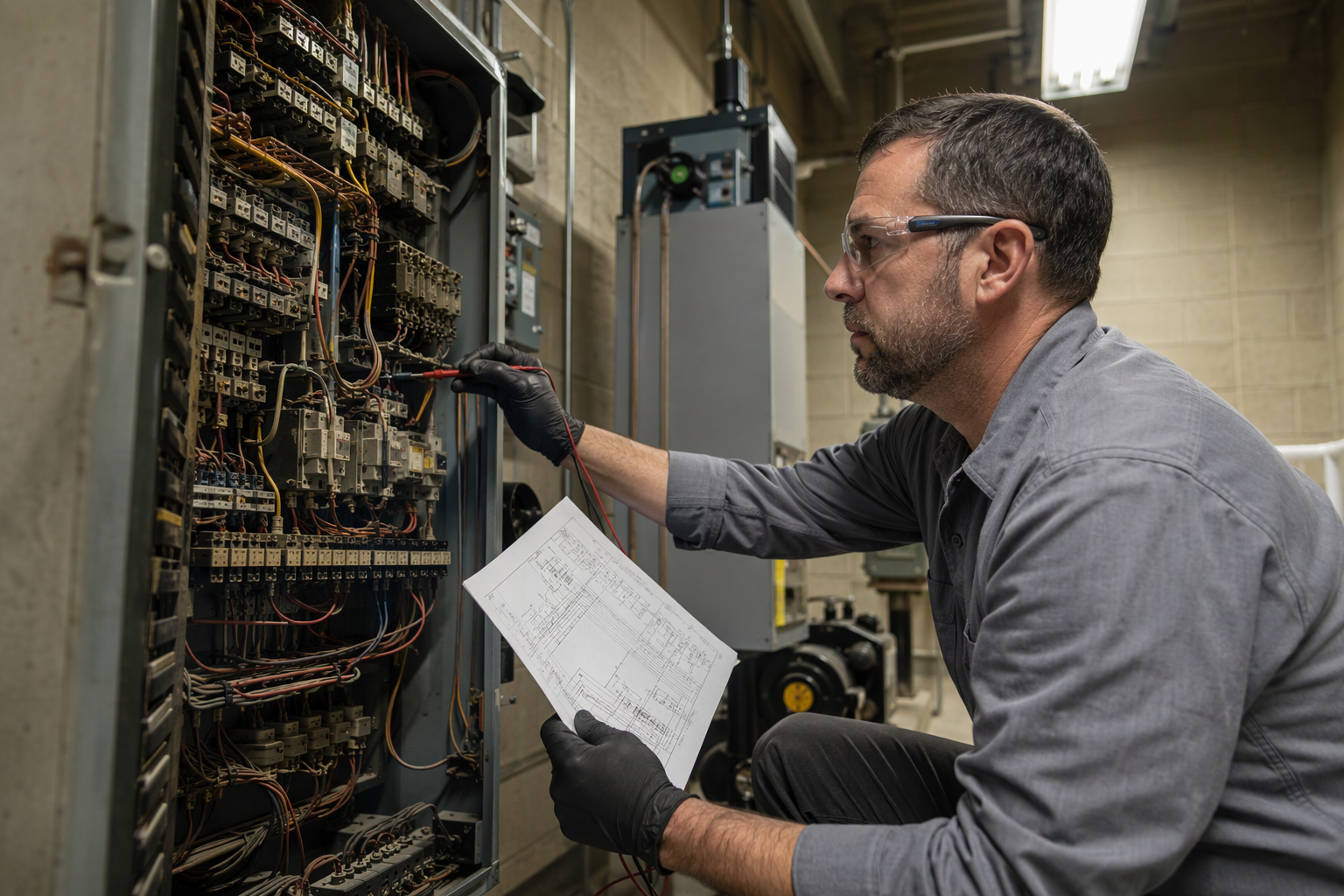
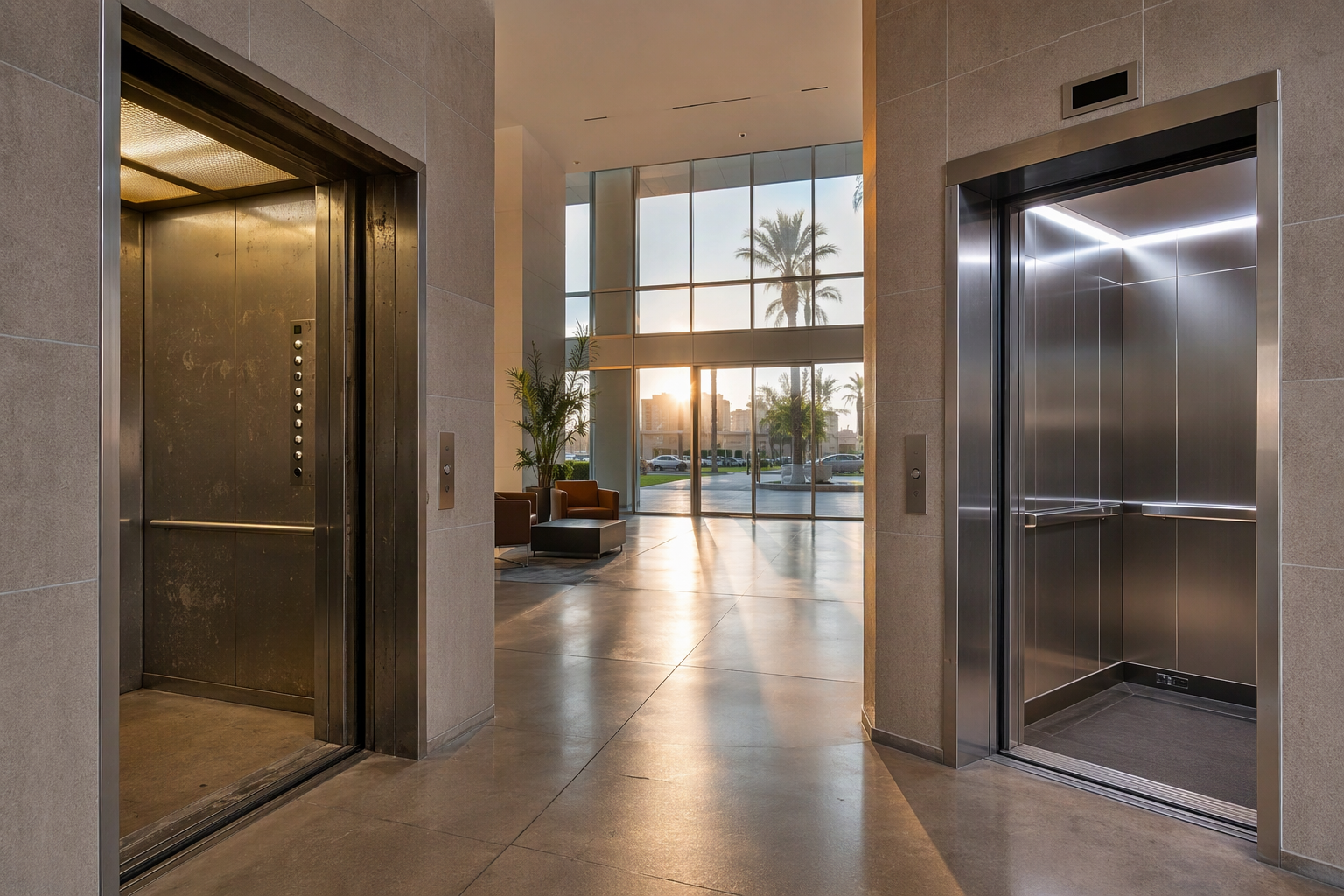
Elevator repair addresses a specific failed or failing component, while modernization replaces major systems—controls, drive, cab, doors, or safety devices—to bring the elevator to current code and performance standards.
Repair is corrective: a technician identifies a discrete fault—a worn door cam, a failing relay, a frayed traveling cable—and replaces or restores that part. The rest of the system remains unchanged. Modernization is transformative: it systematically upgrades the drive system, controller, landing fixtures, safety circuits, and often the cab interior, extending the useful life of the installation by decades and aligning it with ASME A17.3 Safety Code for Existing Elevators and Escalators requirements for existing equipment.
In Arizona, any repair or alteration that meets the threshold of a “major alteration” under Arizona Administrative Code R20-5-502 through R20-5-515 triggers a new inspection and must comply with ASME A17.1-2019 as adopted by the state effective January 9, 2023. Building owners should understand that a large repair job can legally constitute an alteration, bringing additional compliance obligations under A.R.S. §§ 23-491 through 23-491.16.
How Often Do Elevators Need to Be Inspected in Arizona?
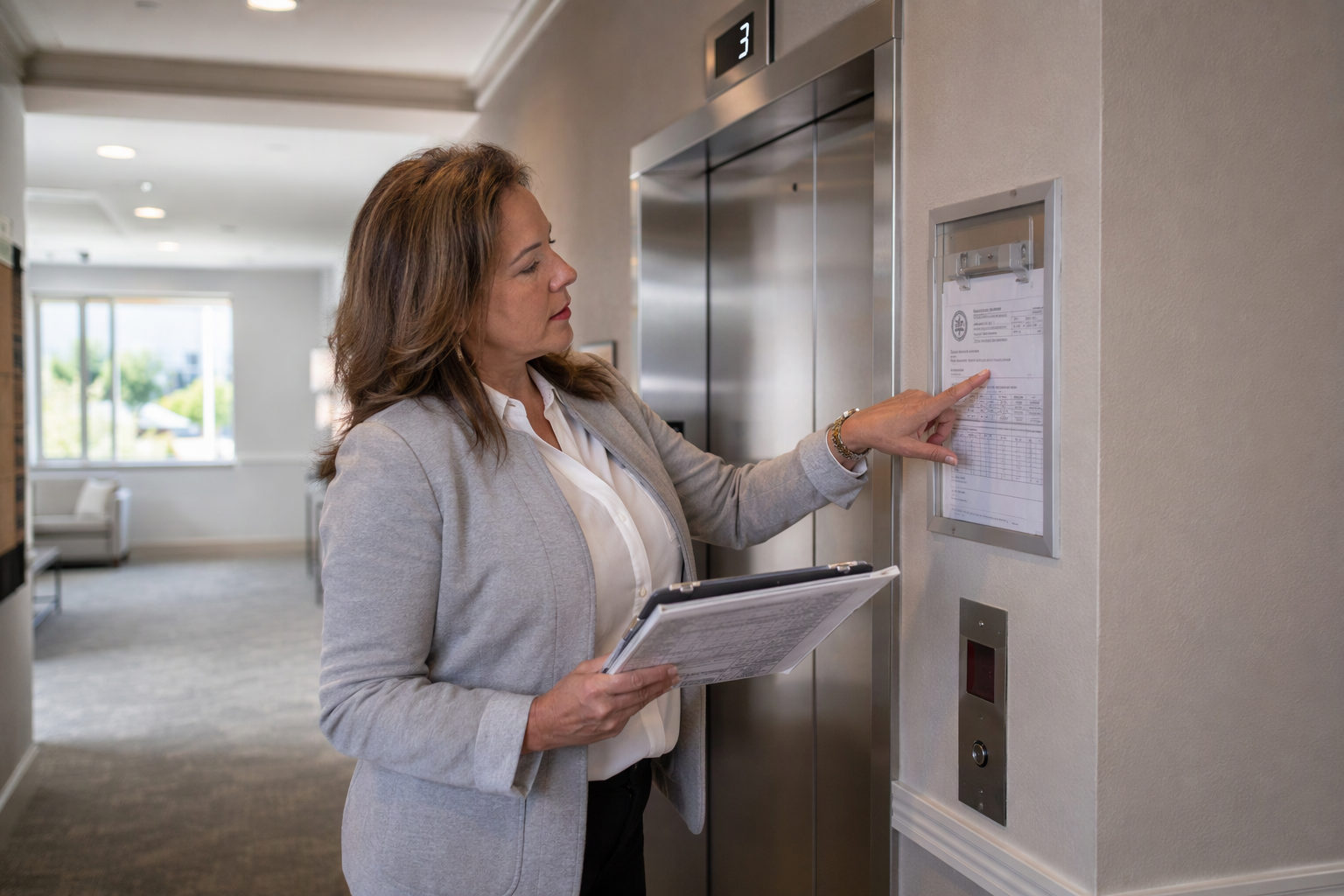
Arizona law requires every conveyance to be inspected before it first goes into service, after any modification or alteration, and at least once every year after that.
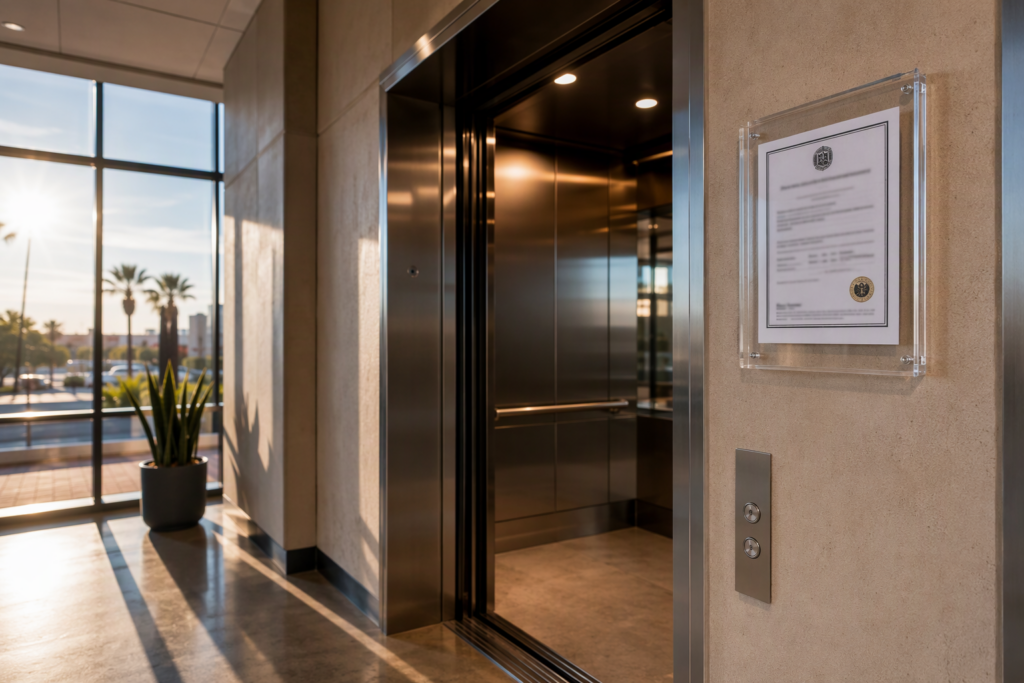
No elevator may operate in Arizona without a current annual certificate of inspection issued by the state. The certificate must be kept at the same location as the conveyance and made available on request; the state serial number or the certificate must also be posted in or near the elevator in an easily accessible location. Building owners in Phoenix additionally coordinate with the City of Phoenix Elevator Section (Planning and Development Department), which inspects elevators within city limits, while the Industrial Commission of Arizona (ICA) Elevator Division handles equipment elsewhere in the state.
Owners may hire a private elevator inspector authorized by the ICA to conduct initial or annual inspections, provided that inspector is registered with the commission annually and can demonstrate at least eight hours of approved continuing education. The private inspector may not inspect any conveyance that the inspector, a company they own, or their employer owns or last serviced. Engaging a private inspector does not relieve the owner of any legal obligations under Arizona law.
What Are the Most Common Signs That an Elevator Needs Repair?
The most common repair indicators are intermittent door malfunctions, leveling errors, unusual noises, nuisance trips, and isolated electrical faults—problems that point to a single failing component rather than systemic degradation.
Specific warning signs that typically call for targeted repair rather than full modernization include:
- Doors that hesitate, reverse without obstruction, or fail to close fully
- The cab stopping above or below the floor level (leveling drift)
- Unusual grinding, squealing, or thumping sounds during travel
- Erratic button response or intermittent loss of floor calls
- A single safety circuit tripping repeatedly without an apparent cause
- Oil leaks from the hydraulic power unit on a hydraulic elevator
- A burned or damaged relay that can still be sourced from the manufacturer
When a qualified technician can trace the malfunction to one discrete component and that part is still available at a reasonable cost, repair is almost always the faster and more economical path. Arizona Elevator Solutions performs diagnostic assessments across Phoenix, Scottsdale, Mesa, and Tucson to distinguish repairable faults from systemic issues before recommending a course of action.
What Are the Key Signs That an Elevator Needs Full Modernization?
Full modernization is warranted when the elevator experiences repeated breakdowns across multiple systems, relies on obsolete or discontinued parts, fails to meet current safety or accessibility codes, or when cumulative repair costs are approaching or exceeding the cost of a planned upgrade.
Modernization indicators include:
- A relay-logic or relay-based controller that can no longer be sourced or reprogrammed
- Recurring callbacks on different systems within the same inspection cycle
- A hydraulic cylinder that has failed a pressure test or shows signs of underground leakage
- Non-compliant door protection (absence of light curtains or reversing edge devices required by ASME A17.1-2019)
- Absence of emergency lighting, two-way communication, or Phase I and Phase II firefighters’ emergency operation
- A cab and fixtures that do not meet ADA requirements for accessible reach ranges, control button dimensions, and Braille signage
- A DC motor-generator drive system that is no longer serviceable
- Excessive energy consumption compared to modern variable-voltage variable-frequency (VVVF) drive alternatives
What Role Does Equipment Age Play in the Repair-vs.-Modernization Decision?
Equipment age is a primary factor because older systems accumulate component obsolescence, require increasingly specialized labor to service, and are more likely to fall short of codes adopted after their original installation date.
Arizona’s elevator code, ASME A17.1-2019, applies to equipment installed, repaired, or altered on or after January 1, 2023. Older equipment that has not been altered may remain in lawful operation under A.R.S. § 23-491 et seq., provided the ICA Elevator Division’s chief does not determine that the equipment poses a hazard to life, health, or property. However, that legal permission to operate does not mean aging equipment is performing optimally or that parts will remain available.
As a general benchmark, the elevator industry commonly associates the following age ranges with modernization planning—though no Arizona statute mandates replacement at a specific age:
| Equipment Age Range | Typical System Status | Common Action | Code Consideration |
|---|---|---|---|
| 0–10 years | Modern controls, parts available | Routine maintenance and repair | Likely compliant with ASME A17.1-2019 if installed after Jan. 1, 2023 |
| 10–20 years | Components aging; some obsolescence beginning | Targeted repair; begin modernization planning | Review for door protection and communication upgrades |
| 20–30 years | Control systems often discontinued; hydraulic cylinders aging | Partial or full modernization evaluation | Likely gaps in ASME A17.3 retroactive requirements and ADA compliance |
| 30+ years | Relay-logic controls; original hydraulic cylinders; obsolete parts | Full modernization strongly recommended | Multiple ASME A17.1-2019 and ADA deficiencies probable |
How Does Compliance With ASME A17.1 and ADA Affect the Decision?
Non-compliance with ASME A17.1 Safety Code for Elevators and Escalators or the Americans with Disabilities Act can force a modernization regardless of the mechanical condition of the equipment.
Arizona has adopted ASME A17.1-2019 for all equipment installed, repaired, or altered on or after January 1, 2023. If an inspection or audit reveals that a system lacks required door detection, firefighters’ emergency operation, or proper two-way communication, bringing those elements into compliance may require replacing the controller and related hardware—work that at that point constitutes a de facto partial modernization. Similarly, ADA accessibility mandates regarding cab size, control panel height, floor indicators, and audible signals may require comprehensive cab and fixture upgrades that are most cost-effectively done as part of a planned modernization rather than piecemeal.
Arizona conveyances equipped with firefighters’ emergency operation must use the Arizona Firefighters Service (AZFS) key, an Arizona-specific requirement that must be verified during any control system replacement or modernization project.
What Is a Callback Rate and Why Does It Matter?
Callback rate measures how frequently a technician must return to an elevator to address an unresolved or recurring fault between scheduled maintenance visits, and a rising callback rate is one of the clearest early signals that an elevator has moved from a repairable condition to a modernization candidate.
A single callback to fix a door contact is a maintenance event. Three callbacks in a quarter for different malfunctions—a door contact, then a level sensor, then a control board fault—signals systemic degradation. Tracking callback history by system (doors, controls, drive, safety circuits) over a rolling period helps building owners and service providers distinguish isolated incidents from a pattern of decline. Arizona Elevator Solutions recommends that building owners in Phoenix, Scottsdale, Mesa, and Tucson maintain a written log of every service event, including the date, symptom, component replaced, and technician notes, to inform this analysis accurately.
How Do Parts Availability and Obsolescence Factor Into the Decision?
When a critical component is discontinued by the manufacturer and no certified equivalent is available, repair becomes impossible and modernization becomes a regulatory and operational necessity.
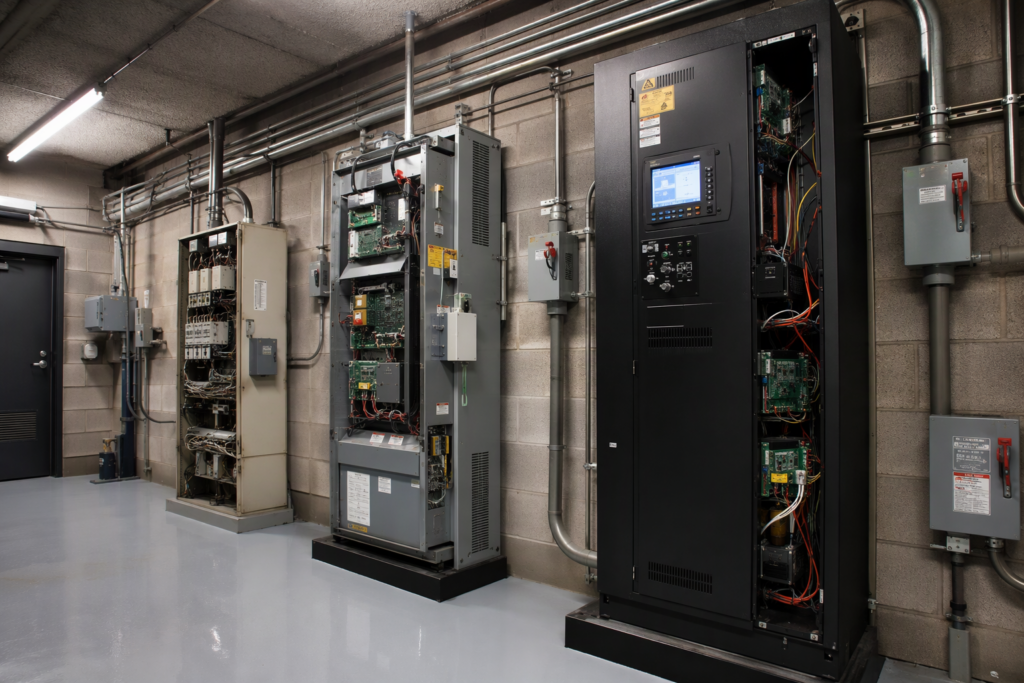
Relay-logic controllers installed before the widespread adoption of solid-state microprocessor controls are frequently the first system to reach end-of-life on a parts basis. When a relay panel fails and no replacement relays or boards are available, the owner has no path forward except a controller modernization. Similarly, some hydraulic jack units and cylinder assemblies manufactured before modern environmental standards cannot be legally repaired in kind—replacement with a double-bottom or fiberglass-lined cylinder is required. Building owners should ask their service provider to document parts availability during every annual maintenance visit so obsolescence is identified proactively rather than during an emergency shutdown.
What Is a Partial Modernization and When Is It Appropriate?
A partial modernization replaces one or two major subsystems—most commonly the controller and door operator—while retaining serviceable components like the machine, cab, or structural elements, and it is appropriate when only specific systems are obsolete while the rest of the elevator remains functional and compliant.
Common partial modernization scopes include controller and dispatch replacement, door operator and detector upgrades, cab interior and fixture renovation, and hydraulic power unit replacement. Partial modernization is a legitimate strategy when budget constraints exist and the remaining equipment is documented as compliant and in sound mechanical condition. However, owners should be aware that replacing a controller or other major component triggers the requirement for a new inspection under Arizona law and must comply with ASME A17.1-2019 as the currently adopted code.
What Happens During a Professional Elevator Modernization Assessment?
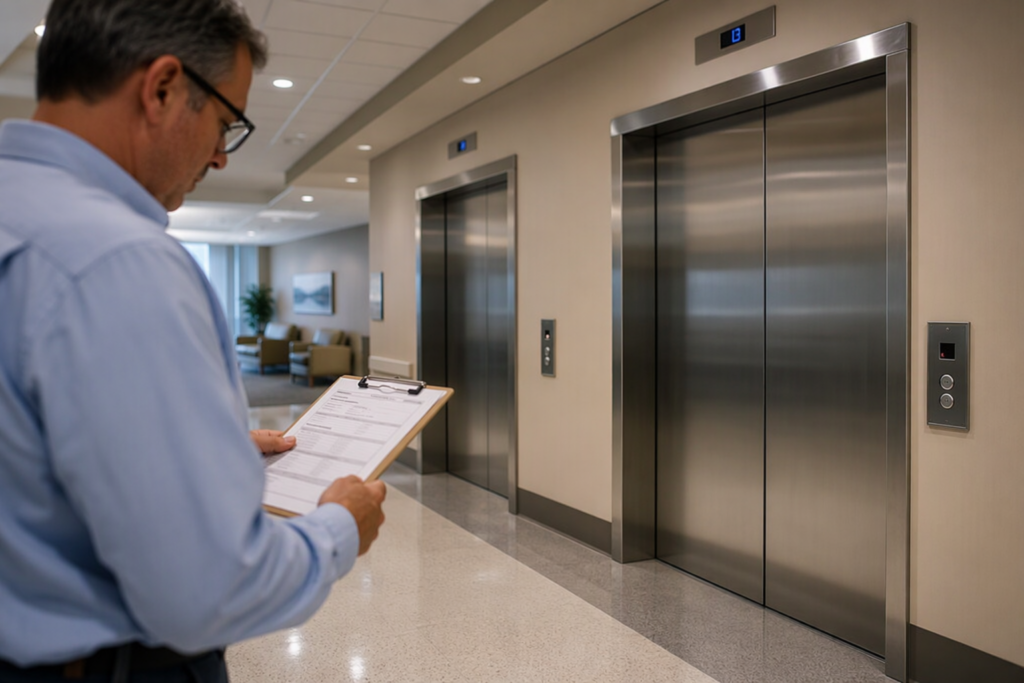
A professional assessment systematically evaluates every major subsystem—machine room, controller, drive, door systems, cab, pit, and hoistway—and produces a written report categorizing each element as compliant, repairable, or requiring replacement.
A thorough assessment follows this process:
- Review the current certificate of inspection, the maintenance log, and any outstanding violation notices from the ICA Elevator Division or the City of Phoenix Elevator Section.
- Inspect the machine room: motor, brake, controller, mainline disconnect, and state serial number tag on the controller.
- Test door operation, including opening and closing force, detector function, and door speed compliance with ASME A17.1-2019.
- Evaluate the drive system—hydraulic power unit condition, oil condition, jack assembly, or traction machine depending on elevator type.
- Test all safety devices: governor, safeties, buffers, oil buffers, and pit switches.
- Verify firefighters’ emergency operation and confirm the AZFS key compatibility.
- Assess cab interior, lighting, two-way communication system, and ADA compliance of fixtures and signage.
- Review callback history and identify any recurring fault patterns.
- Produce a written report with a prioritized scope of work, distinguishing items that require immediate action for safety or code compliance from those that are recommended for efficiency or longevity.
How Do Energy Efficiency and Operating Costs Influence the Modernization Decision?
Older drive systems—particularly motor-generator sets and older hydraulic units—consume substantially more energy than modern variable-voltage variable-frequency drives, and the operational savings from a modernization can contribute meaningfully to justifying the investment over time.
A modern VVVF drive adjusts motor speed precisely to load demand, reducing peak power draw during acceleration and enabling regenerative braking in traction applications that returns energy to the building’s electrical system. Older hydraulic systems run their motors at full speed whenever the elevator moves up and dissipate heat as a byproduct. Building owners evaluating modernization should request a full life-cycle cost analysis that accounts for current energy consumption, projected savings from modern drive technology, reduced callback costs, and the avoided cost of emergency repairs to obsolete equipment.
Does an Elevator Modernization Require a New Arizona State Inspection?
Yes—Arizona law requires a new inspection after any modification or alteration to a conveyance, and a modernization that replaces major systems constitutes such an alteration under Arizona Administrative Code R20-5-502 through R20-5-515.
Owners must notify the Industrial Commission of Arizona at least 90 days before installing, relocating, or altering a conveyance, as required under A.R.S. § 23-491 et seq. Following the modernization, the elevator must pass inspection before returning to service, and a new certificate of inspection must be issued and posted. Failure to follow this process can result in the elevator being ordered out of service. Contractors performing the modernization work must hold the appropriate Arizona Registrar of Contractors R-12 or C-12 elevator license classification.
How Long Does an Elevator Modernization Take?
The duration of a modernization depends on the scope of work, parts lead times, and building access, but typical projects range from a few days for a controller-only upgrade to several weeks for a full machine, cab, and door system replacement.
Building owners should plan for elevator downtime during the modernization and communicate the schedule to tenants and occupants in advance. For multi-elevator buildings, a phased approach—modernizing one car at a time—can maintain continuous elevator service. Lead times for custom control panels or specialty machine components can extend the schedule, so early planning and procurement are critical. The 90-day advance notification requirement to the ICA should be built into the project timeline from the outset.
What Should Building Owners in Phoenix, Scottsdale, Mesa, and Tucson Know About Local Jurisdiction Requirements?
Within the City of Phoenix, the City of Phoenix Elevator Section (Planning and Development Department) performs inspections of elevators, escalators, moving walks, dumbwaiters, and chairlifts, while equipment elsewhere in Arizona falls under the ICA Elevator Division.
Building owners in Scottsdale, Mesa, and Tucson should direct regulatory questions to the ICA Elevator Division as their authority having jurisdiction. All Arizona owners share the same statutory obligations under A.R.S. §§ 23-491 through 23-491.16, including the requirement to report any accident that injures a person or disables a conveyance within 24 hours. Arizona Elevator Solutions works with building owners across all four markets to navigate both state and local inspection requirements correctly.
How Do Platform Lifts and Stairway Chairlifts Fit Into This Analysis?
Platform lifts and stairway chairlifts installed, repaired, or altered in Arizona on or after January 1, 2023 must comply with ASME A18.1-2020, and the same repair-versus-modernization framework applies to these conveyances as to full elevators.
Because platform lifts and chairlifts often serve occupants with mobility impairments, their reliability is directly tied to building accessibility obligations under the ADA. A chronically malfunctioning chairlift that provides the only accessible route to a floor may expose a building owner to ADA liability in addition to safety concerns. Owners should evaluate these units using the same criteria—callback frequency, parts availability, code compliance, and safety device condition—as larger elevators.
What Is the Financial Framework for Comparing Repair Costs to Modernization Costs?
The standard industry approach is to compare the projected cost of continued repairs over a defined period—typically five years—against the cost of modernization amortized over its expected additional service life, factoring in energy savings, reduced downtime, and avoided emergency repair premiums.
No Arizona statute sets a specific cost threshold that triggers mandatory modernization. The economic decision rests with the building owner, ideally informed by a written assessment from a qualified elevator contractor. Key financial variables include: the frequency and cost of recent repair events; the cost premium for sourcing obsolete parts; the downtime cost per outage (particularly important in healthcare, hospitality, or high-rise residential settings); the energy savings from a modern drive; and any financing or capital improvement incentives available to the owner. A written assessment from a qualified contractor—using documented service history, not estimates—produces the most defensible comparison.
Can a Building Owner Be Held Liable for Operating an Elevator That Needs Modernization?
Yes—an Arizona building owner who continues to operate an elevator with known safety deficiencies or outstanding violation orders from the ICA Elevator Division can face legal liability for injuries and regulatory penalties under A.R.S. §§ 23-491 through 23-491.16.
Arizona law permits lawfully installed older conveyances to remain in service, but specifically reserves the authority for the state’s elevator chief to order a unit out of service if its use is deemed a hazard to life, health, or property. An owner who ignores a documented safety deficiency—even one that has not yet prompted a formal order—assumes significant exposure. The Occupational Safety and Health Administration (OSHA) also maintains general duty clause obligations that apply to elevator safety in workplaces. Maintaining current inspection certificates, acting promptly on violation notices, and following the recommendations of a qualified elevator contractor are the clearest paths to limiting liability.
How Should a Building Owner Choose Between Elevator Service Providers for a Modernization Project?
Building owners should verify that any contractor holds the Arizona Registrar of Contractors R-12 or C-12 elevator license, can demonstrate familiarity with Arizona-specific requirements including the AZFS key and ICA inspection procedures, and provides a detailed written scope of work referencing applicable ASME A17.1-2019 sections.
Red flags include contractors who cannot produce a current ROC license number for elevator work, who propose modernization scopes without a site assessment, or who cannot explain how the project will be permitted, inspected, and certified under Arizona law. A qualified provider will submit the required 90-day advance notification to the ICA on the owner’s behalf and coordinate the post-completion inspection as part of the project scope. Arizona Elevator Solutions serves building owners in Phoenix, Scottsdale, Mesa, and Tucson with modernization assessments that include a detailed written evaluation of compliance status, parts availability, and prioritized recommendations.
What Immediate Steps Should an Owner Take If an Elevator Has a Serious Malfunction or Injures a Passenger?
If an elevator malfunction injures a person or disables the conveyance, Arizona law requires the owner to notify the state within 24 hours, and the elevator must not be returned to service until it has been inspected and cleared.
Owners should follow these steps immediately:
- Ensure any injured person receives appropriate medical attention and document the incident thoroughly.
- Take the elevator out of service immediately by locking out the mainline disconnect and posting the unit as out of service.
- Notify the Industrial Commission of Arizona Elevator Division within 24 hours as required by Arizona law.
- If the elevator is within the City of Phoenix, also notify the City of Phoenix Elevator Section.
- Contact a licensed elevator contractor (R-12 or C-12) to conduct an emergency inspection and document findings in writing.
- Do not return the elevator to service until the required post-incident inspection is completed and any necessary repairs are made and certified.
- Preserve all maintenance logs, inspection certificates, and service records related to the malfunction for legal and regulatory purposes.
How Can Building Owners Proactively Avoid the Repair-vs.-Modernization Crisis Point?
Proactive planning—through consistent preventive maintenance, detailed service recordkeeping, and scheduled capital planning reviews—allows building owners to modernize on their own timeline rather than under emergency conditions or regulatory pressure.
The most effective approach combines annual ICA-required inspections with an ongoing maintenance agreement that documents component condition at every visit. When a technician notes that a control board is approaching end-of-life or that a hydraulic cylinder is showing early signs of seal deterioration, those findings should trigger a capital planning conversation—not be filed away until the component fails. Building owners with elevators approaching the age ranges shown in the comparison table above should request a formal modernization assessment as part of their five-year capital planning cycle. Arizona Elevator Solutions provides comprehensive assessments to building owners and property managers across Phoenix, Scottsdale, Mesa, and Tucson to support exactly this kind of proactive planning.
Contact Arizona Elevator Solutions for a free elevator assessment at 480-557-7600.
Need elevator service you can rely on? Arizona Elevator Solutions is ready to help.