Storage facilities present a unique set of demands on vertical transportation equipment. Heavy rolling loads, high cycle counts, extreme temperature swings common to Phoenix, Scottsdale, Mesa, and Tucson, and the need for wide-door access combine to make equipment selection more complex than a standard commercial elevator installation. The questions below address every major component category, compliance requirement, and practical consideration Arizona self-storage and commercial warehouse owners should understand before selecting or servicing a storage facility elevator.
What type of elevator drive system is best suited for a storage facility?
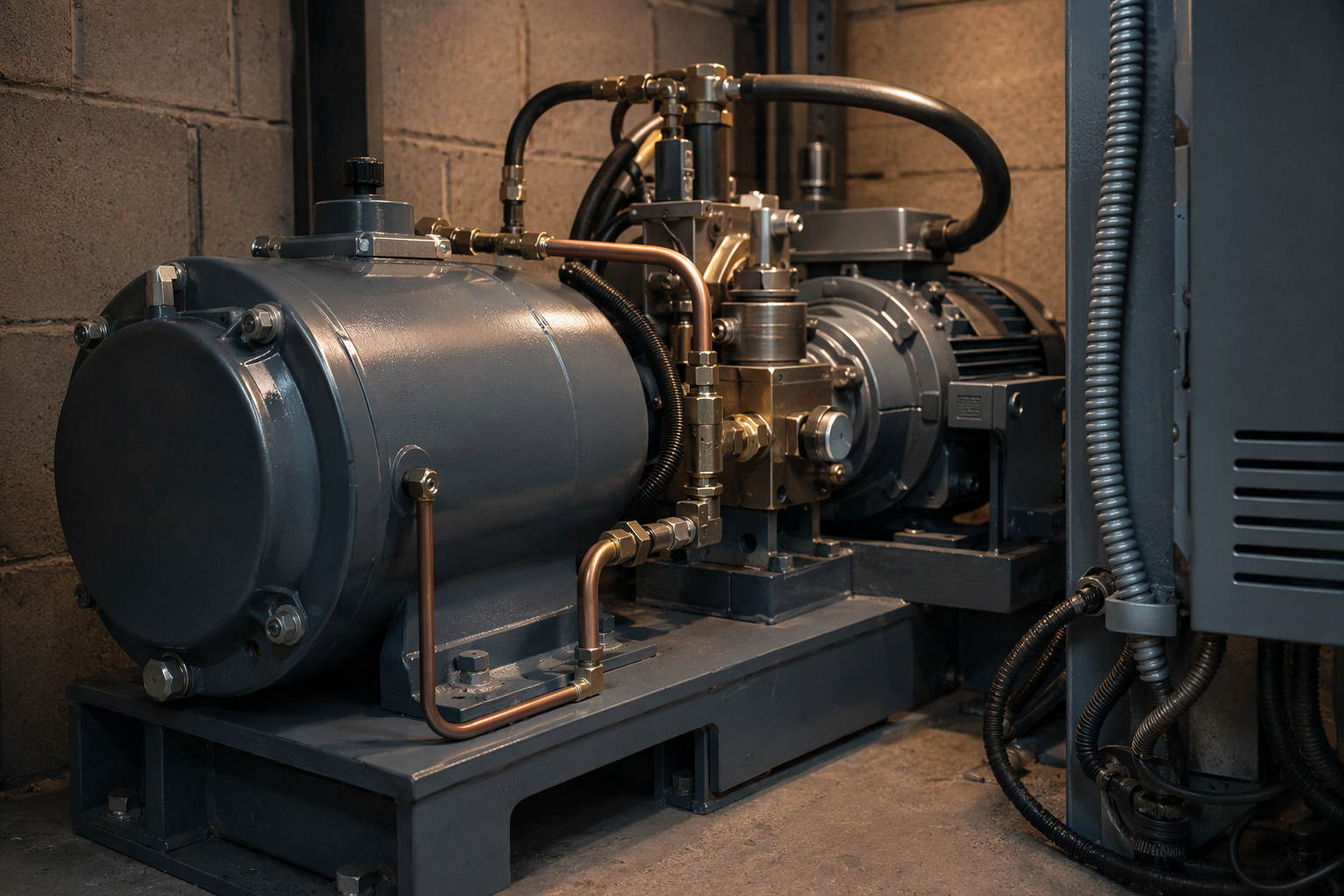
Hydraulic and geared traction drives are both used in storage facilities, but the right choice depends on building height, load requirements, and available machine room space.
Hydraulic elevators use a fluid-driven piston or cylinder to raise and lower the cab and are well suited to low-rise storage buildings of four stories or fewer. They excel at handling high-capacity loads — a critical trait when tenants move heavy furniture, appliances, or palletized goods — and their initial installation cost is generally lower than traction systems. The trade-off is energy consumption during the up cycle and the need for a machine room to house the hydraulic power unit and fluid reservoir.
Geared or gearless traction systems use a motor, sheave, and wire ropes to lift the cab counterweighted against the load. They are preferred when the building exceeds four or five stories, when energy efficiency is a priority, or when machine-room-less (MRL) architecture is specified. MRL traction systems mount drive components inside the hoistway, eliminating the need for a separate machine room — a meaningful space savings in a storage environment where every square foot is revenue-generating.
Under ASME A17.1-2019, which Arizona adopted effective January 1, 2023, both drive types must meet defined performance, safety, and testing requirements. Arizona owners planning a new installation must notify the Industrial Commission of Arizona (ICA) Elevator Division at least 90 days before work begins, per A.R.S. §§ 23-491 through 23-491.16.
What hoistway specifications are required for a storage facility elevator?
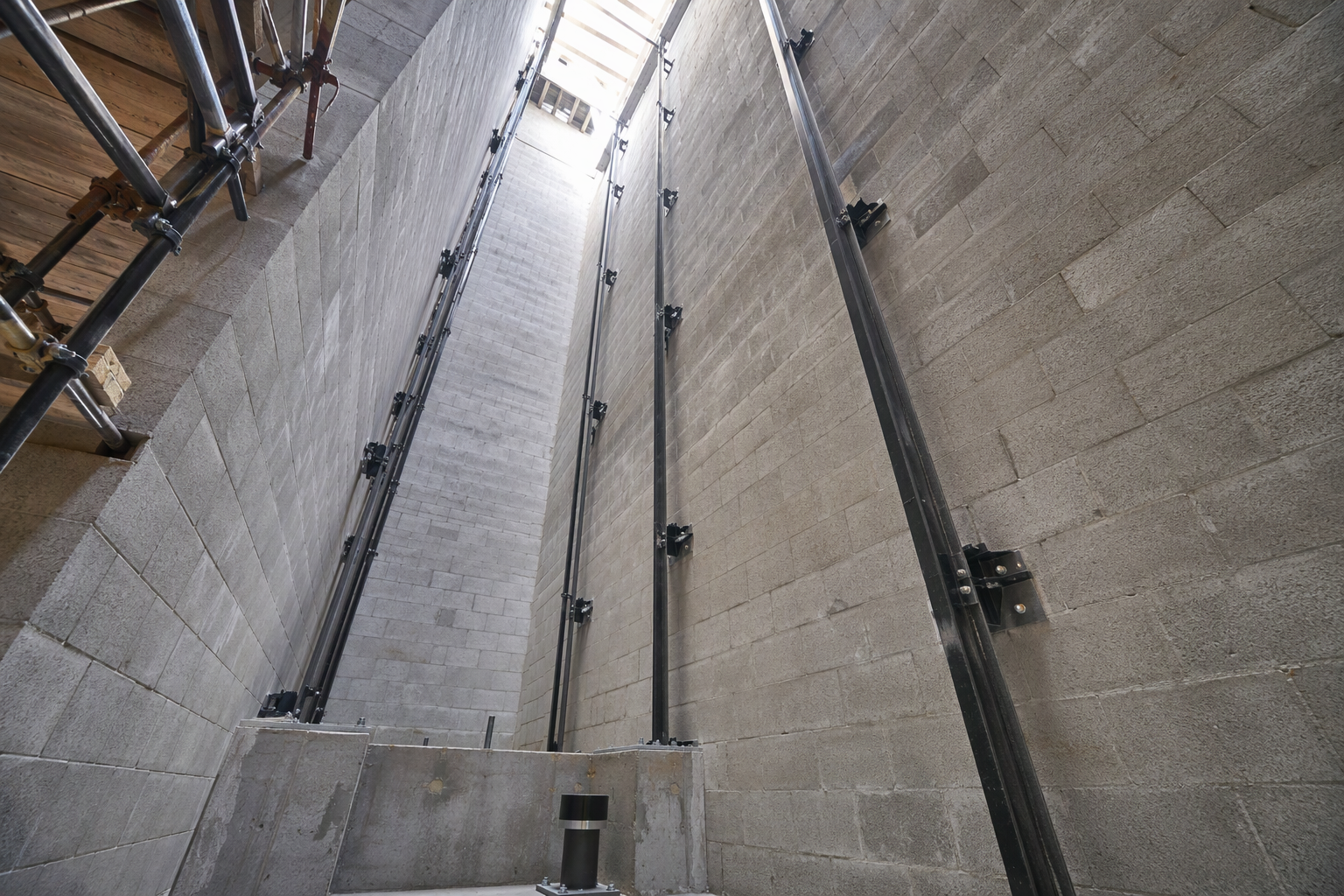
The hoistway must be a fully enclosed, fire-rated shaft sized to accommodate the cab dimensions, clearances, and all safety devices required by ASME A17.1.
Storage elevators typically require wider and deeper hoistways than standard commercial units to handle the large carts, dollies, and bulky items tenants move. A common cab interior for self-storage is 5 feet wide by 7 feet deep or larger, requiring a correspondingly larger hoistway footprint. The hoistway must include pit space at the bottom for buffers and runby clearance, and overhead clearance at the top for the sheave assembly or hydraulic components. Hoistway walls, doors, and enclosures must be constructed of fire-resistive materials consistent with applicable building codes. Guide rails, rail brackets, and fasteners are installed inside the hoistway to keep the cab aligned during travel.
What cab components and interior finishes are essential for heavy-load storage use?
The cab must include a structurally reinforced car frame, heavy-duty flooring rated for the intended load, full-height door protection, and all code-required interior fixtures.
Standard cab components for a storage facility elevator include:
- Car frame and sling: Engineered steel structure that transfers load forces to the guide rails and buffer system.
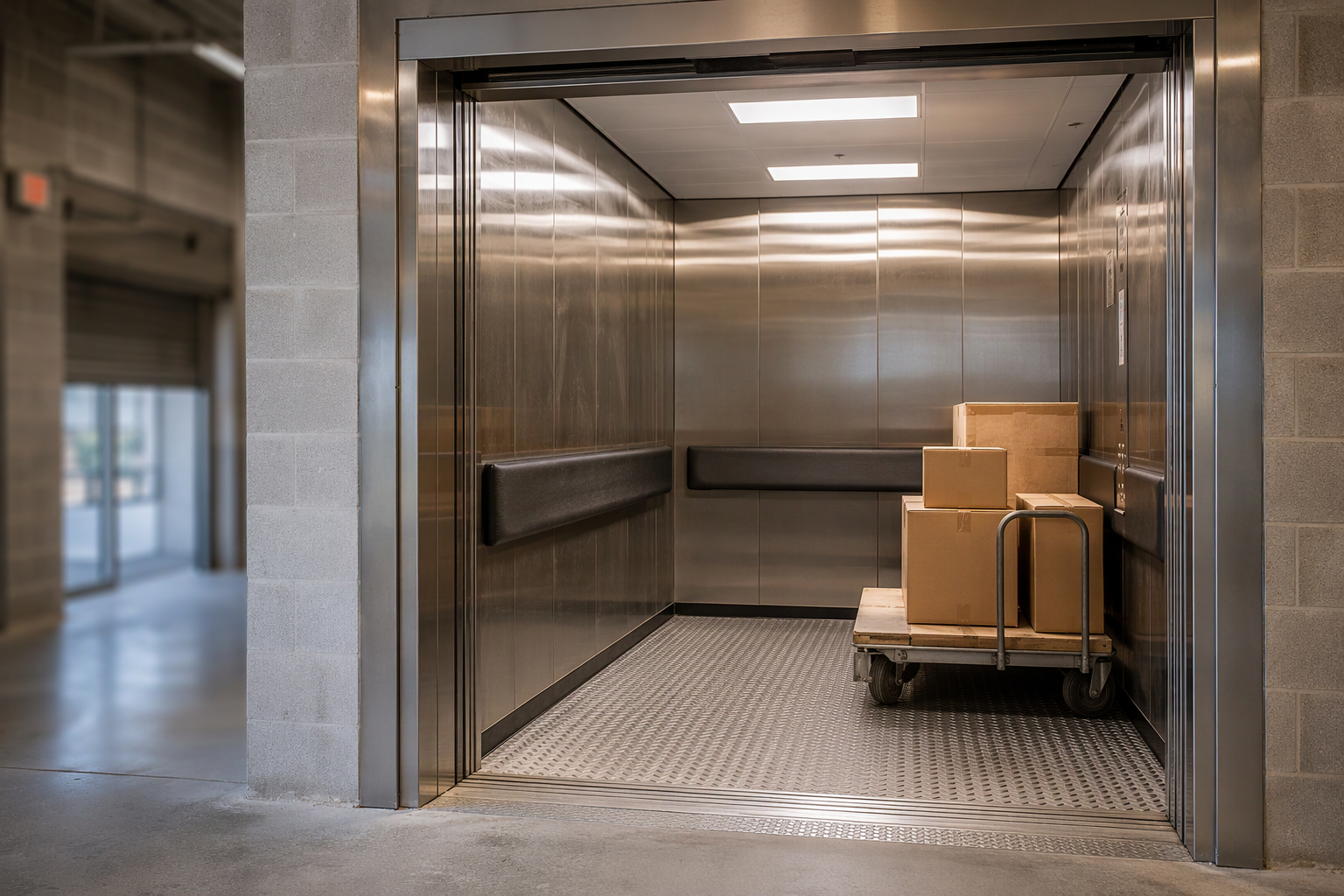
- Platform and flooring: Commercial-grade or industrial steel diamond-plate flooring capable of handling concentrated point loads from hand trucks and pallet jacks. Rated capacity for storage elevators commonly ranges from 2,500 to 5,000 pounds or more depending on the facility’s intended use.
- Wall panels: Stainless steel or heavy-gauge painted steel rather than decorative panels used in office elevators, as storage tenants frequently impact cab walls with carts and furniture.
- Cab doors: Heavy-duty automatic sliding doors with a full-height door restrictor or bumper to prevent damage from oversized loads pushing against the door edge.
- Door reopening device: Light curtain or safety edge required by ASME A17.1 to reverse door closing on obstruction detection.
- Handrail: At least one handrail mounted at ADA-compliant height per ADA guidelines.
- Certificate holder or posting location: Arizona law requires the state certificate of inspection to be kept at the same location as the conveyance and the state serial number to be posted in or close to the cab in an easily accessible location.
What safety devices must be installed on a storage facility elevator?
At minimum, a storage facility elevator must include car safeties, speed governors, buffers, interlocks on every hoistway door, and an emergency lighting and communication system as required by ASME A17.1.
Key safety devices include:
- Overspeed governor and car safety: Detects excessive downward speed and mechanically clamps the car to the guide rails.
- Buffers: Energy-absorbing devices installed in the pit beneath the car and counterweight to cushion impact at terminal limits.
- Hoistway door interlocks: Prevent the car from moving unless all hoistway doors and car gates are fully closed and latched.
- Emergency lighting: Battery-backed lighting inside the cab that activates on power failure.
- Emergency communication: A means to contact emergency services or building personnel when a passenger is trapped — required by ASME A17.1 and strongly advisable in after-hours storage environments where tenants may access units at night.
- Firefighters’ emergency operation: Arizona conveyances equipped with this feature must use the Arizona Firefighters Service (AZFS) key as required under state rules.
- Pit ladder and pit lighting: Required for safe maintenance access.
- Top-of-car clearance protection: Guards technicians servicing equipment above the cab.
What controller and electrical equipment are required?
A dedicated elevator controller — a programmable logic unit that manages drive, door, and safety functions — along with a mainline disconnect switch, wiring, and a machine room or control panel enclosure compliant with ASME A17.1 are all required.
The controller interprets floor calls, manages door timing, enforces load weighing if equipped, and monitors safety circuit continuity. Modern microprocessor-based controllers offer diagnostic logging useful for maintenance tracking. The state serial number tag for Arizona registration is affixed to the controller or mainline disconnect, as specified by A.R.S. §§ 23-491 through 23-491.16. Electrical supply must be sized to meet the motor’s full-load amperage demand, and a dedicated circuit with appropriate overcurrent protection is required. Backup power or automatic rescue devices (ARDs) may be added to bring the cab to the nearest landing during a power outage — a practical upgrade for storage facilities in Phoenix and Mesa where summer storm outages can trap tenants.
What door configuration is recommended for a storage facility elevator?
A center-opening or two-speed side-opening automatic sliding door with a wide clear opening — typically 42 to 48 inches — is recommended for storage facilities to accommodate wide loads.
Wider door openings reduce bottlenecks when tenants move oversized items and reduce door-contact incidents. Heavy-duty operators with higher-cycle ratings are essential because storage facility elevators often run significantly more door cycles per day than typical office elevators. Door sills should be threshold-level with the landing floor to allow easy passage of wheeled carts. All door hardware must comply with ASME A17.1, and door dimensions must meet ADA minimum clear opening requirements to ensure accessibility for tenants using wheelchairs or mobility aids.
What ADA requirements apply to storage facility elevators in Arizona?
Storage facility elevators serving the public or tenants must comply with ADA accessibility standards, including minimum cab dimensions, control height, Braille signage, and audible/visual floor indicators.
ADA requirements for passenger elevators include a minimum inside cab dimension of 80 inches deep by 68 inches wide for center-opening doors, or as specified in the ADA Standards for Accessible Design. Control panels must be reachable from a wheelchair, with buttons no higher than 48 inches above the floor. Each button must have raised characters and Braille. The elevator must provide audible signals and visual floor indicators. While some self-storage facilities argue that “public accommodation” status is limited, facilities with public-facing rental offices and elevators accessible to tenants are generally considered covered entities under the ADA. Arizona Elevator Solutions evaluates ADA compliance as part of its standard equipment assessments for storage facilities in Phoenix, Scottsdale, Tucson, and Mesa.
What capacity rating is appropriate for a storage facility elevator?
Storage facility elevators are most commonly rated between 2,500 and 5,000 pounds, with the specific capacity determined by anticipated load types, cab size, and traffic analysis.
Capacity is not just a performance specification — it is a legal rating stamped on the elevator data plate and enforced by ASME A17.1. Overloading an elevator is a code violation and a liability risk. For self-storage, 3,500 pounds is a frequently specified minimum because it accommodates a loaded moving dolly, a standard pallet, and one or two persons simultaneously. Facilities storing heavier commercial goods, vehicles, or industrial equipment may require freight-rated equipment with capacities well above 5,000 pounds. Freight elevators have distinct design requirements under ASME A17.1, including gate-style doors and specific floor ratings. The rated capacity must be posted conspicuously inside the cab.
What is the difference between a freight elevator and a passenger elevator for storage use?
Freight elevators are designed exclusively for goods transport and have different door, cab, and load-distribution requirements than passenger elevators; most self-storage facilities use passenger-rated or combination-service elevators rather than true freight elevators.
| Feature | Passenger Elevator | Combination Service Elevator | Freight Elevator (Class A–F) |
|---|---|---|---|
| Typical Capacity | 2,000–3,500 lbs | 2,500–5,000 lbs | 5,000–20,000+ lbs |
| Door Type | Automatic sliding | Automatic sliding (heavy-duty) | Bi-parting vertical or manual gate |
| ADA Compliance Required | Yes (public access) | Yes (if tenants use it) | No (freight only, no passengers) |
| Floor Load Rating | Standard commercial | Heavy-duty industrial | Specified by class (A17.1) |
| Permitted Passengers | Yes | Yes (with goods) | Operator only or none |
| Typical Storage Facility Use | Small self-storage | Most self-storage facilities | Industrial warehouses |
| Governing Standard | ASME A17.1 | ASME A17.1 | ASME A17.1 |
What machine room equipment is needed if a traditional machine room is used?
A traditional machine room must house the hydraulic power unit or traction motor and sheave assembly, the controller, the mainline disconnect, ventilation equipment, and adequate lighting and working clearances per ASME A17.1.
Machine rooms in Arizona’s desert climate require particular attention to thermal management. Phoenix and Tucson summer temperatures routinely exceed 110°F outdoors, and an inadequately ventilated machine room can expose controllers and motor windings to heat stress that shortens equipment life. ASME A17.1 specifies minimum ventilation requirements, and Arizona Elevator Solutions recommends supplemental cooling or dedicated HVAC for machine rooms in Arizona storage facilities when ambient conditions warrant. The machine room must be accessible only to authorized personnel and kept clear of non-elevator equipment and storage materials.
What pit equipment is required beneath a storage facility elevator?
The elevator pit must contain buffers, a pit ladder, pit lighting, a pit stop switch, and sufficient clear depth to meet ASME A17.1 runby and buffer-compression requirements.
Pit depth requirements vary by elevator type and speed — hydraulic units typically require shallower pits than traction units. The pit must be waterproofed or drained to prevent moisture accumulation, which is particularly relevant for Arizona facilities where monsoon-season flooding can inundate below-grade pits. A sump pump is advisable in areas with seasonal water infiltration. The pit stop switch allows a technician working in the pit to disable the elevator drive before the car descends. Pit lighting must be permanently wired with a switch accessible from the pit entrance.
What inspection and certification equipment or documentation is required by Arizona law?
Arizona law requires that every storage facility elevator hold a current certificate of inspection issued by the Industrial Commission of Arizona (ICA) Elevator Division, with the certificate kept at the facility and the state serial number posted near the conveyance.
Under A.R.S. §§ 23-491 through 23-491.16, no conveyance may operate in Arizona without this annual certificate. The state serial number, assigned at registration, is affixed to the controller or mainline disconnect on a tag. Owners must have the elevator inspected before first use, after any modification or alteration, and annually thereafter. Within the City of Phoenix, the City of Phoenix Elevator Section (Planning and Development Department) performs inspections for elevators located inside city limits; the ICA Elevator Division handles equipment elsewhere in Arizona. Arizona owners may engage a private elevator inspector authorized by the ICA, provided that inspector meets annual registration and continuing education requirements and has no conflict of interest with the equipment being inspected.
What signage and posting requirements apply inside a storage facility elevator?
At minimum, the elevator must display the rated capacity in pounds, the state certificate of inspection or its location, the state serial number, and any required emergency instruction signage.
Rated capacity must be conspicuously posted inside the cab. Arizona law requires the state serial number or certificate to be posted in or close to the conveyance in an easily accessible location. Emergency instruction placards — including who to call and what to do if trapped — are strongly recommended for storage facilities where tenants may be alone in the building. ADA-required signage including Braille floor designations on jamb panels must also be present. Failure to maintain required postings can result in the ICA Elevator Division placing the elevator out of service.
What steps should a storage facility owner take when installing a new elevator in Arizona?
Installing a new elevator in an Arizona storage facility involves a defined sequence of regulatory notifications, contractor licensing, equipment procurement, inspection, and certification steps.
- Confirm that the elevator contractor holds an Arizona Registrar of Contractors R-12 or C-12 elevator license classification before signing any installation contract.
- Submit written notification to the Industrial Commission of Arizona Elevator Division at least 90 days before the planned installation date, as required by A.R.S. §§ 23-491 through 23-491.16.
- If the facility is located within Phoenix city limits, also coordinate with the City of Phoenix Elevator Section, Planning and Development Department, regarding local permit requirements.
- Finalize equipment specifications — drive type, capacity, cab dimensions, door configuration, and safety devices — with the licensed contractor, ensuring all specifications conform to ASME A17.1-2019 (Arizona’s adopted code edition as of January 1, 2023).
- Complete installation with licensed personnel and schedule a pre-service inspection with either the ICA Elevator Division or an ICA-authorized private inspector.
- Obtain the certificate of inspection before placing the elevator in service.
- Post the state serial number and keep the certificate accessible at the facility.
- Establish a preventive maintenance schedule and retain maintenance records.
What maintenance equipment and ongoing service requirements apply to storage facility elevators?
Storage facility elevators require scheduled preventive maintenance covering lubrication, adjustment of door operators and safety devices, controller diagnostics, hydraulic fluid inspection, and wire rope or drive component checks.
High-cycle-count environments like storage facilities accelerate wear on door operators, rollers, and sill grooves. Preventive maintenance programs typically include monthly or quarterly visits depending on equipment type and usage volume, with annual inspections required by Arizona law. Maintaining accurate service records is essential both for regulatory compliance and for diagnosing recurring issues. Arizona Elevator Solutions provides preventive maintenance programs for storage facility elevators throughout Phoenix, Scottsdale, Tucson, and Mesa, covering all major drive types and manufacturers.
What should a storage facility owner do immediately after an elevator accident or breakdown in Arizona?
Arizona law requires the owner to notify the Industrial Commission of Arizona Elevator Division within 24 hours of any accident that injures a person or disables a conveyance.
- Ensure the safety of all individuals — if anyone is trapped, contact emergency services immediately.
- Take the elevator out of service and secure it so no one can attempt to use the disabled equipment.
- Document the incident with photographs, written descriptions, and witness accounts.
- Notify the ICA Elevator Division within 24 hours as required by A.R.S. §§ 23-491 through 23-491.16.
- Contact a licensed elevator contractor for an emergency assessment and repair — do not return the elevator to service until it has passed inspection and the certificate is reissued if required.
- Retain all service records and incident documentation for potential regulatory review.
How does Arizona’s desert climate affect elevator equipment selection for storage facilities?
Extreme heat, monsoon moisture intrusion, and dust are the three primary environmental factors that affect component longevity and equipment selection for Arizona storage facility elevators.
Hydraulic fluid viscosity changes with temperature, meaning hydraulic systems in Phoenix or Tucson storage facilities may require fluid formulations rated for higher operating temperatures than those used in cooler climates. Controller circuit boards and motor drives are sensitive to heat; machine rooms without adequate thermal management will see accelerated component degradation. Dust intrusion from Arizona’s haboob events can contaminate hydraulic reservoirs and mechanical components if seals and filters are not maintained. Monsoon-season moisture creates pit flooding risks. Arizona Elevator Solutions recommends that storage facility owners in the Phoenix, Scottsdale, Mesa, and Tucson markets discuss climate-specific equipment options — including sealed controllers, high-temperature hydraulic fluids, and pit sump systems — during the equipment planning phase.
What additional features or optional equipment improve storage facility elevator performance?
Useful optional equipment for storage facility elevators includes load-weighing systems, automatic rescue devices, vandal-resistant fixtures, security card readers, and remote monitoring systems.
- Load-weighing devices: Prevent overloading by audibly warning users and preventing door closure when the rated capacity is exceeded.
- Automatic rescue devices (ARDs): Battery-powered systems that move a stranded cab to the nearest landing on power failure, reducing entrapment incidents in after-hours storage environments.
- Vandal-resistant fixtures: Stainless steel push buttons and anti-graffiti cab finishes reduce repair frequency in public-access storage facilities.
- Access control integration: Key-card or PIN readers prevent unauthorized floor access — particularly useful in multi-tenant storage buildings with restricted upper floors.
- Remote monitoring: Connected controllers transmit fault codes and performance data to a service center, enabling proactive maintenance dispatching.
- Cab fans or ventilation: Improve passenger comfort in Arizona summer heat, particularly during extended use periods.
What licenses must an elevator contractor hold to work on a storage facility elevator in Arizona?
Any contractor installing or repairing an elevator in Arizona must hold an R-12 (residential) or C-12 (commercial) elevator contractor license classification from the Arizona Registrar of Contractors.
The Arizona Registrar of Contractors issues R-12 and C-12 license classifications covering the installation and repair of elevators, dumbwaiters, escalators, and moving walks. Storage facility owners should verify contractor license status directly with the Arizona Registrar of Contractors before awarding any installation or service contract. The ROC license authorizes the contractor to perform the work but does not issue the annual certificate of inspection — that remains the responsibility of the ICA Elevator Division or an ICA-authorized private inspector. Using an unlicensed contractor exposes the facility owner to regulatory and liability risk.
How much does a storage facility elevator cost, and what factors affect pricing in Arizona?
Equipment and installation costs for storage facility elevators vary substantially based on drive type, capacity, number of stops, cab size, and site-specific conditions, and no accurate price can be stated without a site assessment.
Cost variables include: hydraulic versus traction drive selection, machine room versus MRL configuration, number of floors served, required structural modifications to the building, cab size and finish specifications, door width and operator type, and local labor and permitting costs. For Arizona storage facilities, the 90-day advance notice requirement for new installations means that project planning timelines must account for regulatory lead time. Obtaining multiple bids from licensed R-12/C-12 contractors and comparing full-scope proposals — including maintenance provisions — is the best practice for Arizona storage facility owners. Arizona Elevator Solutions offers free equipment assessments to help facility owners in Phoenix, Scottsdale, Mesa, and Tucson define specifications before soliciting bids.
Contact Arizona Elevator Solutions for a free elevator assessment at 480-557-7600.
Need elevator service you can rely on? Arizona Elevator Solutions is ready to help.