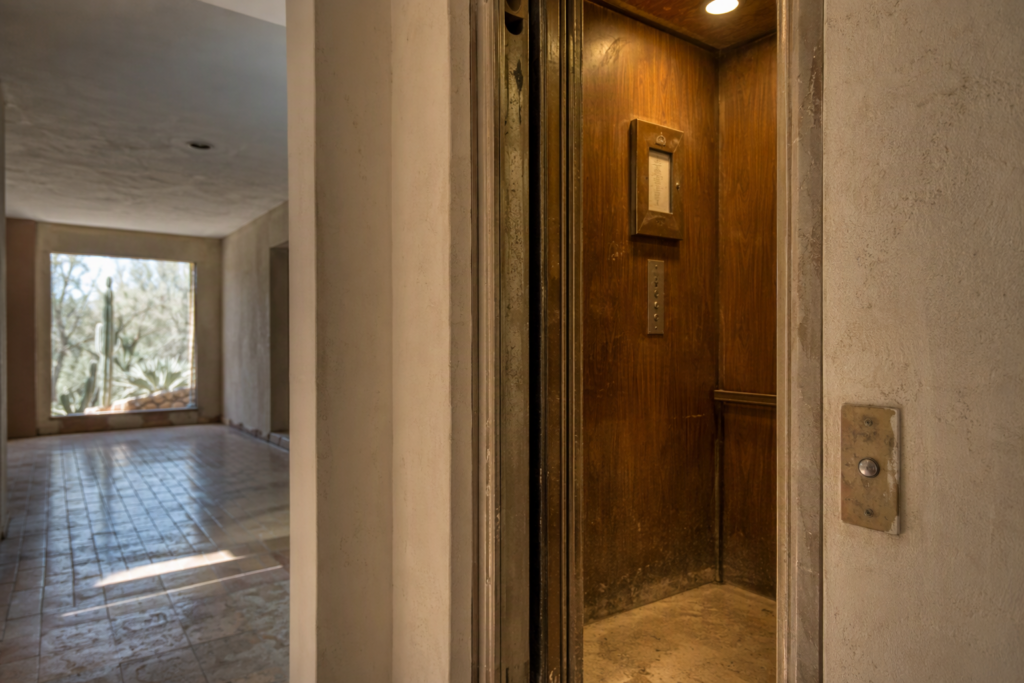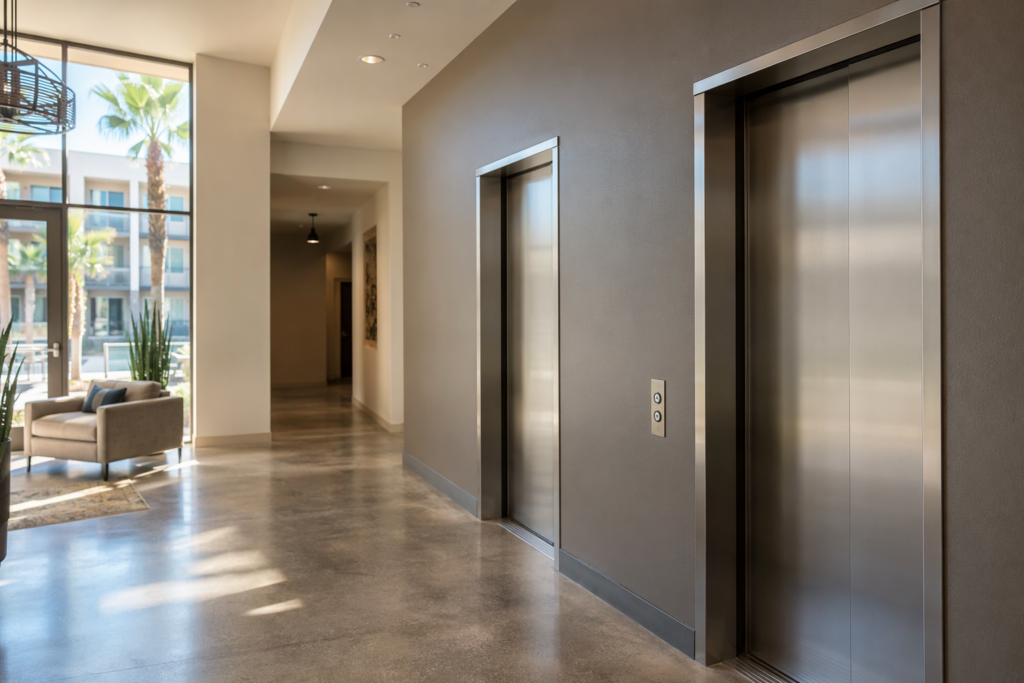
Yes, Arizona Elevator Solutions offers on-call elevator services for residential and commercial buildings throughout Phoenix, Tucson, Scottsdale, and Mesa. When a building enrolls in an on-call program, a qualified elevator contractor is dispatched whenever equipment fails or an emergency arises, ensuring occupants are never stranded and the conveyance returns to safe operation as quickly as possible.
What Is On-Call Elevator Service and How Does It Work?

On-call elevator service is a contractual arrangement in which a licensed elevator contractor agrees to respond to unplanned outages, entrapments, or mechanical failures at a specific building whenever they occur.
Under a standard on-call program, a building owner or property manager contacts the service provider the moment an elevator stops working, traps a passenger, or triggers a fault alarm. The contractor dispatches a qualified technician to diagnose and resolve the problem. The scope of work covered—parts, labor, emergency callout fees—is defined in the service agreement negotiated before the program begins. Some agreements bundle on-call response with scheduled preventive maintenance visits, while others treat emergency response as a standalone service billed separately per incident. Building owners should read their contracts carefully to understand exactly what is included.
In Arizona, every conveyance must hold a valid annual certificate of inspection issued under A.R.S. §§ 23-491 through 23-491.16 and administered by the Industrial Commission of Arizona (ICA), Elevator Division. An on-call contractor who responds to a breakdown will typically review the equipment’s current certificate status, since any repair work that could constitute a “modification or alteration” may trigger a follow-up inspection requirement under Arizona Administrative Code R20-5-502 through R20-5-515.
Why Do Buildings Need On-Call Elevator Coverage?
Buildings need on-call elevator coverage because an out-of-service elevator creates immediate safety risks, potential ADA violations, and legal exposure under Arizona statutes.
Under ADA Title III and Title II, elevators are often the only accessible route for people with mobility impairments. A prolonged outage with no response plan in place can expose a building owner to accessibility complaints. Beyond federal law, Arizona owners are legally prohibited from operating a conveyance without a valid certificate of inspection. When a failure disables a conveyance, Arizona owners must notify the ICA Elevator Division within 24 hours if the incident injures a person or disables a conveyance—making rapid contractor response a compliance necessity, not just a convenience.
Practically speaking, an entrapment—where one or more passengers are physically stuck inside a car—requires immediate intervention. Fire departments can perform emergency rescues, but they are not elevator repair technicians. Only a qualified elevator contractor can restore the equipment to full, safe operation after a rescue.
What Types of Elevator Emergencies Qualify for On-Call Response?
On-call response typically covers any unplanned event that renders the elevator unsafe to operate or traps a passenger, including entrapments, door malfunctions, control system failures, and hydraulic fluid loss.
Common on-call situations include:
- Passenger entrapment: The car stops between floors or the doors will not open with passengers inside.
- Door malfunctions: Doors fail to close properly, triggering a safety fault that prevents the car from moving.
- Drive system failures: The motor, controller, or drive unit loses power or throws a fault code.
- Hydraulic system issues: On hydraulic elevators, a sudden loss of fluid pressure causes the car to sink or become inoperable.
- Safety circuit trips: Any of the multiple safety devices mandated by the ASME A17.1 Safety Code for Elevators and Escalators trips, locking the car in place.
- Fire service activation faults: Problems with Phase I or Phase II firefighters’ emergency operation, which in Arizona must be compatible with the Arizona Firefighters Service (AZFS) key.
- Lighting or communication failures: Loss of cab lighting or the two-way communication system required by ASME A17.1.
How Is an On-Call Response Dispatched?
Dispatch is initiated when a building contact—property manager, security desk, or automated monitoring system—places a service call to the contractor’s designated emergency line, triggering a response protocol.
Once the call is received, the contractor gathers key details: the building address, the elevator’s state serial number (found on the tag fixed to the controller or mainline disconnect under Arizona rules), the nature of the fault, and whether any passengers are entrapped. This information allows the responding technician to arrive with the most likely replacement parts and the correct tools for that specific equipment type. Arizona Elevator Solutions serves buildings across Phoenix, Tucson, Scottsdale, and Mesa, so proximity to the building influences how the dispatch is routed.
Many modern on-call programs also integrate remote monitoring. Sensors and internet-connected controllers can transmit fault data to the contractor before a human ever calls, allowing the technician to begin diagnosing the problem in transit.
What Happens Step-by-Step During an On-Call Elevator Response?
A structured response protocol ensures safety and regulatory compliance from the moment a fault is reported to the moment the elevator is returned to service.
- Receive and log the service call. The building contact calls the contractor’s emergency line. The dispatcher records the building address, elevator serial number, reported fault, and whether passengers are trapped.
- Assess entrapment risk. If passengers are confirmed trapped, the dispatcher advises the building contact on communication with trapped occupants and, if necessary, coordinates with local emergency services for a safe, supervised rescue.
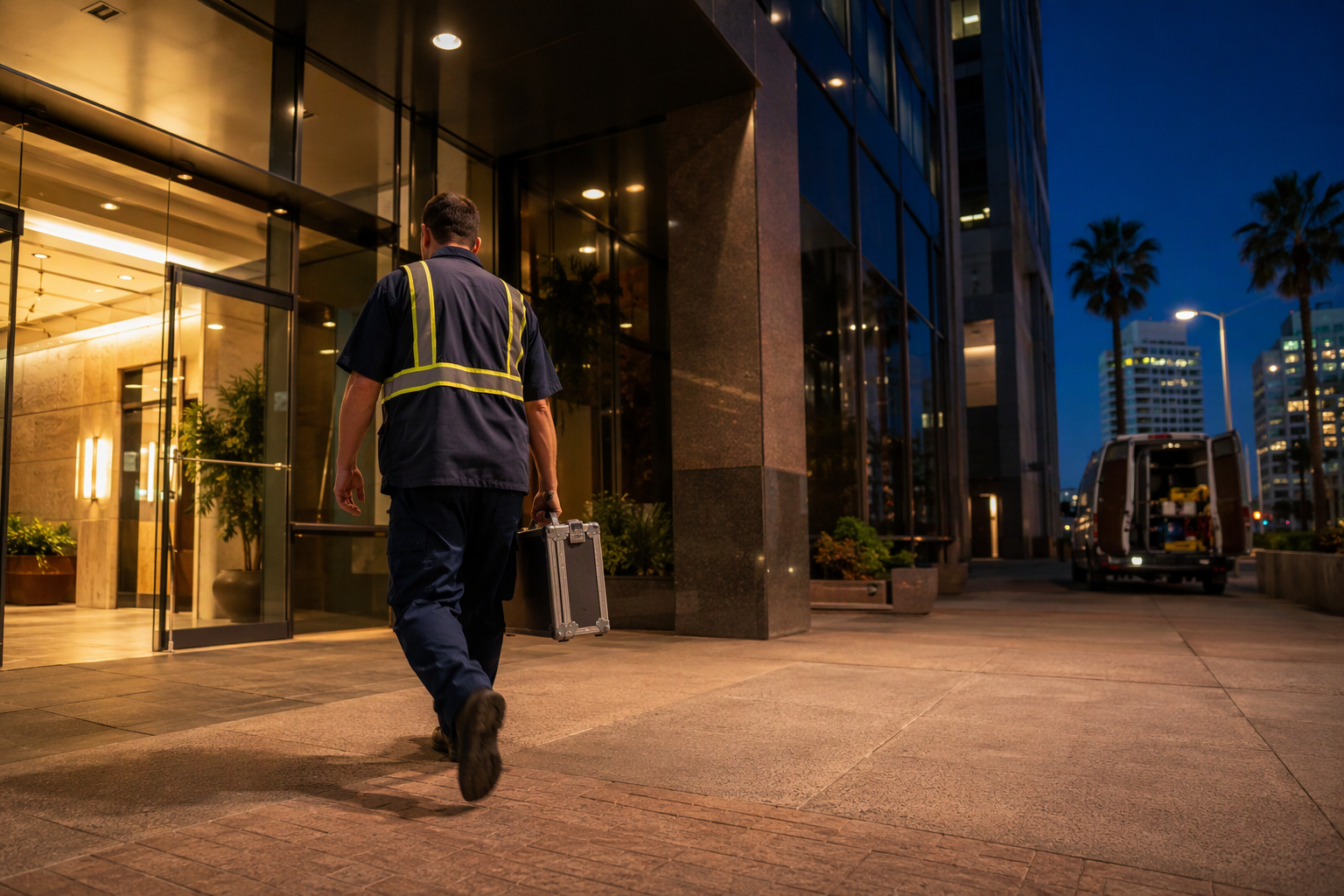
- Dispatch a qualified technician. A technician holding the appropriate Arizona Registrar of Contractors (ROC) R-12 or C-12 license classification is routed to the building.
- Secure the equipment on arrival. The technician locks out and tags out the elevator per OSHA lockout/tagout standards (29 CFR 1910.147) before beginning diagnostic work.
- Diagnose the fault. The technician inspects the control panel fault log, safety circuits, mechanical components, and hydraulic system (if applicable) to identify the root cause.
- Execute the repair. Parts are replaced or adjusted. All work must conform to ASME A17.1-2019, the edition adopted by Arizona for equipment installed, repaired, or altered on or after January 1, 2023.
- Conduct a post-repair safety test. The technician performs no-load and loaded test runs, verifies door operation, leveling, and all required safety devices before returning the elevator to service.
- Notify the building contact and document the work. A written service record is provided. If the repair constitutes a modification or alteration under Arizona rules, the contractor advises the owner of the notification and inspection requirements owed to the ICA Elevator Division.
- Notify the ICA Elevator Division if required. If the incident injured a person or disabled a conveyance, the building owner must notify the state within 24 hours under Arizona law—the contractor can assist in preparing that notification.
How Does On-Call Service Differ from Preventive Maintenance?
On-call service is reactive—triggered by an unexpected failure—while preventive maintenance is a scheduled program designed to find and fix problems before they cause a failure or compliance issue.
| Feature | On-Call / Emergency Service | Preventive Maintenance (PM) |
|---|---|---|
| Trigger | Unplanned failure or entrapment | Scheduled calendar interval |
| Goal | Restore equipment to safe operation quickly | Prevent failures before they occur |
| Inspection coordination | May trigger follow-up state inspection if alteration is made | Prepares equipment for annual state certificate inspection |
| Arizona regulatory link | 24-hour owner notification requirement for disabling incidents | Annual certificate of inspection required; owner must notify ICA 90 days before alterations |
| ASME A17.1 relevance | Repair work must meet code for equipment installed/repaired on or after Jan. 1, 2023 | Maintenance tasks follow ASME A17.1 requirements for periodic testing |
| Typical contract structure | Per-incident billing or included in full-service agreement | Monthly or annual flat fee |
| Best suited for | All buildings as a safety backstop | All buildings as the primary compliance strategy |
Industry best practice—and the structure most Arizona building owners choose—is to combine both: a preventive maintenance program that keeps the equipment in good condition and reduces the frequency of failures, plus an on-call agreement that covers the unexpected events that preventive maintenance cannot entirely eliminate.
Who Is Authorized to Perform On-Call Elevator Repairs in Arizona?
In Arizona, elevator repair work must be performed by a contractor holding an R-12 (residential) or C-12 (commercial) elevator license classification issued by the Arizona Registrar of Contractors.
The Arizona Registrar of Contractors (ROC) R-12 and C-12 license classifications authorize the holder to install and repair elevators, dumbwaiters, escalators, and moving walks. Building owners should verify that any on-call elevator contractor they engage holds the appropriate ROC license before signing a service agreement. This protects the building owner against unlicensed work, which can void insurance coverage and jeopardize the elevator’s annual certificate of inspection.
Inspection of the repaired equipment, if required, must be performed by an inspector authorized by the Industrial Commission of Arizona. Arizona also permits private elevator inspectors registered with the ICA—who must renew their registration annually and document at least eight hours of approved continuing education—to conduct initial or annual inspections. However, a private inspector may not inspect equipment that was owned, operated, or last serviced by their own company or employer.
What Arizona Regulations Govern On-Call Elevator Work?
On-call elevator repairs in Arizona are governed by A.R.S. §§ 23-491 through 23-491.16, Arizona Administrative Code R20-5-502 through R20-5-515, and the ASME A17.1-2019 Safety Code adopted by the state effective January 9, 2023.
Several specific regulatory obligations are directly relevant to on-call service situations:
- 24-hour incident notification: Under A.R.S. §§ 23-491 through 23-491.16, Arizona owners must notify the ICA Elevator Division within 24 hours of any accident that injures a person or disables a conveyance.
- No operation without a valid certificate: No conveyance may operate in Arizona without an annual certificate of inspection. If a repair constitutes a modification or alteration, an inspection may be required before the elevator returns to public service.
- Alteration notification: Arizona owners must notify the ICA Elevator Division at least 90 days before installing, relocating, or altering a conveyance—a threshold that on-call technicians will help building owners determine when a repair crosses into alteration territory.
- Certificate posting: The state certificate must be kept at the building, and the state serial number or certificate must be posted in or close to the conveyance. An on-call technician should verify this is in order after completing repairs.
- AZFS key compliance: Elevators with firefighters’ emergency operation must use the Arizona Firefighters Service (AZFS) key. Any repair affecting this system must maintain AZFS key compatibility.
- Phoenix local authority: Buildings within the City of Phoenix are inspected by the City of Phoenix Elevator Section (Planning and Development Department). Outside Phoenix, the ICA Elevator Division handles inspection. On-call contractors working in Phoenix should be familiar with both authorities.
What Should a Building Owner Look for in an On-Call Service Agreement?
A sound on-call service agreement should clearly define the scope of covered work, response expectations, billing structure, and how regulatory obligations are handled after a repair.
Key terms to review before signing any on-call elevator service contract include:
- Scope of covered repairs: Does the agreement cover parts, labor, or both? Are hydraulic fluid replacement, controller components, and door hardware included?
- Callout billing: Is there a flat emergency callout fee, an hourly rate, or a minimum billing period? Are after-hours or holiday callouts billed at a premium?
- Contractor licensing: Confirm the contractor holds an active ROC R-12 or C-12 license and that the license number is stated in the agreement.
- Post-repair documentation: Will the contractor provide a written service report for every callout? This is essential for the owner’s compliance records.
- Regulatory notification assistance: Does the contractor assist with or advise on 24-hour incident notifications to the ICA Elevator Division when required?
- Equipment exclusions: Are certain components—such as rope and cable replacement, cab interior work, or major hydraulic cylinder repairs—excluded from on-call coverage?
- Multi-unit buildings: If the building has multiple elevators or escalators, confirm whether each conveyance is covered and how simultaneous failures are handled.
Does On-Call Service Satisfy Arizona’s Annual Inspection Requirement?
No—on-call service and emergency repairs do not substitute for the annual certificate of inspection that every Arizona conveyance is legally required to hold.
Under A.R.S. §§ 23-491 through 23-491.16, every elevator, escalator, platform lift, and similar conveyance in Arizona must be inspected and issued a certificate of inspection before it first goes into service, after any modification or alteration, and annually thereafter. The ICA Elevator Division issues this certificate; the Arizona Registrar of Contractors issues contractor licenses—these are distinct processes. An on-call contractor may perform outstanding repairs that help the equipment pass its annual inspection, but the inspection itself must be conducted by an ICA-authorized inspector. Arizona owners should track their certificate expiration dates and schedule inspections well in advance to avoid gaps that would legally prohibit operation.
How Do On-Call Services Handle ADA Accessibility Obligations?
On-call services support ADA compliance by minimizing elevator downtime, which is the primary accessibility risk a building faces when a conveyance fails.
Under the Americans with Disabilities Act, buildings covered by Title II (state and local government) or Title III (places of public accommodation) are generally required to maintain accessible routes. Where an elevator is the only accessible means of reaching a floor, an extended outage can constitute a failure to maintain accessible features in operable condition. Prompt on-call response reduces the duration of any such gap. Building owners with ADA obligations should ensure their on-call agreement prioritizes entrapment and total outage events, since those carry the greatest accessibility risk.
For platform lifts and stairway chairlifts installed, repaired, or altered in Arizona on or after January 1, 2023, compliance with ASME A18.1-2020 is also required—and on-call technicians working on these units must apply that standard to any repair work.
What Information Should a Building Manager Have Ready When Calling for On-Call Service?
Having key information ready when placing an emergency service call significantly reduces diagnostic time and helps the technician arrive prepared.
Building managers and property staff should keep the following readily accessible:
- The elevator’s Arizona state serial number, found on the tag attached to the controller or mainline disconnect
- The make, model, and type of elevator (traction, hydraulic, MRL, platform lift)
- The building address and the specific floor or location of the affected elevator
- The nature of the fault as observed (doors not closing, car stuck between floors, error code displayed)
- Whether any passengers are currently entrapped
- The date and number of the current annual certificate of inspection
- The building’s after-hours access protocol so the technician can reach the machine room
Can Remote Monitoring Replace Traditional On-Call Elevator Service?
Remote monitoring enhances on-call service by detecting faults earlier and transmitting diagnostic data before a technician arrives, but it does not replace the need for a qualified technician to physically respond and perform repairs.
Modern elevator controllers can transmit fault codes, door cycle data, and motor performance metrics to a monitoring platform in real time. When a threshold is crossed—such as an unusual number of door reversals or a safety circuit trip—the monitoring system can alert the contractor automatically, sometimes before building staff are even aware of a problem. This compresses the time between fault occurrence and technician dispatch. However, Arizona law requires physical inspection and certificate issuance by an authorized inspector; remote monitoring data, however detailed, does not satisfy that requirement. Remote monitoring is best understood as an intelligence layer on top of a traditional on-call and maintenance program.
How Are On-Call Services Priced for Arizona Buildings?
Pricing for on-call elevator service varies based on the building’s equipment type, number of units, and the scope of the service agreement negotiated with the contractor.
Because Arizona Elevator Solutions does not publish standardized on-call pricing—rates depend on building-specific factors—building owners should request a formal assessment. Common pricing structures in the elevator service industry include:
- Time-and-materials billing: The building is charged for each service call at an hourly labor rate plus the cost of parts used.
- Full-service agreement: A fixed monthly or annual fee covers both scheduled preventive maintenance visits and emergency on-call response, often with parts included up to a specified value.
- Maintenance-plus-on-call bundling: PM is billed at a fixed rate, with on-call response covered at a discounted emergency callout rate compared to a time-and-materials arrangement.
Buildings with older equipment, high passenger traffic, or complex drive systems typically carry higher service costs than newer, simpler installations, because the probability and complexity of failures is greater.
What Building Types in Arizona Benefit Most from On-Call Elevator Coverage?
Any Arizona building with a conveyance—whether a mid-rise apartment, office tower, hospital, hotel, or retail center—benefits from on-call coverage, but buildings with high occupancy or ADA-critical routes face the greatest risk from an unplanned outage.
Categories where on-call coverage is particularly important include:
- Healthcare facilities: Hospitals, medical office buildings, and skilled nursing facilities rely on elevators for patient transport. An outage can create immediate patient safety risks.
- Multi-family residential buildings: Apartment and condominium residents, especially those with mobility impairments, depend on elevators as their only accessible route to upper floors.
- Hospitality: Hotels in Phoenix, Scottsdale, Tucson, and Mesa serve guests who expect continuous elevator availability; a failure during peak occupancy periods is particularly disruptive.
- High-rise commercial office buildings: With dozens or hundreds of occupants depending on elevator access, even a short outage disrupts business operations significantly.
- Schools and universities: ADA obligations and student safety make rapid response critical during operating hours.
What Is the Difference Between an On-Call Elevator Contractor and a Building’s In-House Maintenance Staff?
On-call elevator contractors hold the specific ROC licensure, code knowledge, and specialized equipment required to legally perform elevator repairs in Arizona—capabilities that go beyond the scope of general building maintenance staff.
General facility maintenance personnel can perform many building system tasks, but elevator work is a licensed trade in Arizona. Repairs, adjustments to safety-critical systems, and work that could constitute an alteration under state rules must be performed by an ROC-licensed elevator contractor. Unlicensed elevator work can expose a building owner to liability, void insurance coverage, and jeopardize the annual certificate of inspection. In-house staff should know how to communicate with trapped passengers, contact the on-call contractor, and facilitate access to the machine room—not attempt mechanical repairs themselves.
How Quickly Should an On-Call Elevator Contractor Respond to an Entrapment?
Response expectations for entrapments should be established in the service agreement before an emergency occurs, since Arizona law does not prescribe a specific contractor response time—though the 24-hour incident notification requirement creates urgency for the building owner.
Entrapments are the most time-sensitive on-call scenario. Passengers trapped in an elevator car may experience heat stress (a particular concern in Arizona’s climate), anxiety, or medical distress. Local fire departments are trained to perform emergency rescues when a situation becomes life-threatening, but contractor response should follow as quickly as possible to restore the equipment to service. Building owners negotiating on-call agreements should discuss and document response expectations for entrapment events specifically, as distinct from non-entrapment equipment failures. Arizona Elevator Solutions serves the Phoenix, Tucson, Scottsdale, and Mesa markets and can discuss realistic response logistics during the assessment process.
What Happens After a Major Repair — Does Arizona Require a New Inspection?
Yes—when a repair constitutes a modification or alteration under Arizona rules, a new inspection is required before the conveyance may return to service.
Under A.R.S. §§ 23-491 through 23-491.16 and Arizona Administrative Code R20-5-502 through R20-5-515, Arizona owners must have each conveyance inspected before it first goes into service and after any modification or alteration. The distinction between a routine repair and an alteration is defined in the adopted code; when in doubt, the qualified elevator contractor should advise the building owner. Additionally, Arizona owners must notify the ICA Elevator Division at least 90 days before installing, relocating, or altering a conveyance—meaning substantial work requires advance planning, not just post-repair notification. Arizona Elevator Solutions works with building owners to identify when a planned major repair will cross into alteration territory so the required notifications and inspections can be coordinated proactively.
How Should a Building Owner Choose an On-Call Elevator Service Provider in Arizona?
Building owners should evaluate on-call providers based on ROC licensure, familiarity with ICA Elevator Division requirements, geographic coverage of the building’s market, and the clarity and completeness of the service agreement offered.
A practical evaluation checklist includes:
- Verify the contractor holds an active Arizona Registrar of Contractors R-12 or C-12 license
- Confirm the contractor is familiar with both ICA Elevator Division requirements and, for Phoenix buildings, the City of Phoenix Elevator Section
- Ask whether the contractor works with the specific brand and type of elevator installed in the building
- Request a sample service agreement and review all terms related to scope, billing, documentation, and regulatory notification
- Ask how the contractor handles situations where a repair may require an alteration notification to the ICA Elevator Division
- Confirm geographic service coverage—a contractor based far from the building may not serve the building’s market efficiently
Arizona Elevator Solutions provides certified elevator services across Phoenix, Tucson, Scottsdale, and Mesa, and offers free building assessments to help owners understand the scope of on-call coverage appropriate for their specific equipment and occupancy.
How Do On-Call Elevator Services Support Long-Term Equipment Reliability?
On-call service generates a repair history for each conveyance that, when analyzed over time, reveals recurring fault patterns and informs smarter preventive maintenance planning.
Every on-call service visit produces a written record: the fault reported, the diagnosis, the parts replaced, and the corrective action taken. When these records are maintained systematically across multiple visits, patterns emerge—a door operator that fails repeatedly, a hydraulic packing that requires frequent service, a control board that resets under heat load. This data allows a qualified elevator contractor to recommend targeted component replacements before the next failure, shifting the building’s maintenance posture from purely reactive to genuinely predictive. Under ASME A17.1-2019, certain periodic tests and inspections are required at defined intervals; a thorough service record also helps ensure those intervals are tracked and met. Arizona Elevator Solutions uses service records from on-call responses to inform preventive maintenance recommendations for buildings in its Phoenix, Tucson, Scottsdale, and Mesa service areas.
Contact Arizona Elevator Solutions for a free elevator assessment at 480-557-7600.
Need elevator service you can rely on? Arizona Elevator Solutions is ready to help.