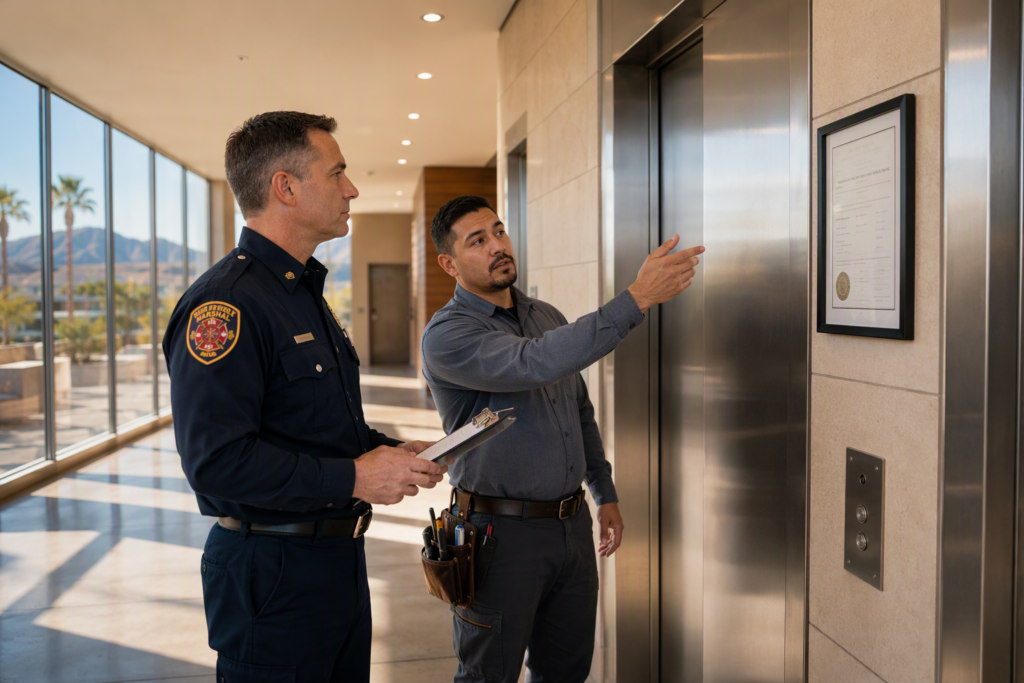
When an elevator repeatedly traps passengers, every minute of inaction compounds legal liability, safety risk, and regulatory exposure. The correct response combines immediate emergency action, mandatory state reporting, a root-cause diagnostic, and documented corrective maintenance — all performed under Arizona law and applicable federal codes. Building owners, property managers, and facility directors in Phoenix, Tucson, Scottsdale, and Mesa must understand each layer of that response before a crisis occurs.
What is the immediate step-by-step protocol when an elevator traps passengers?
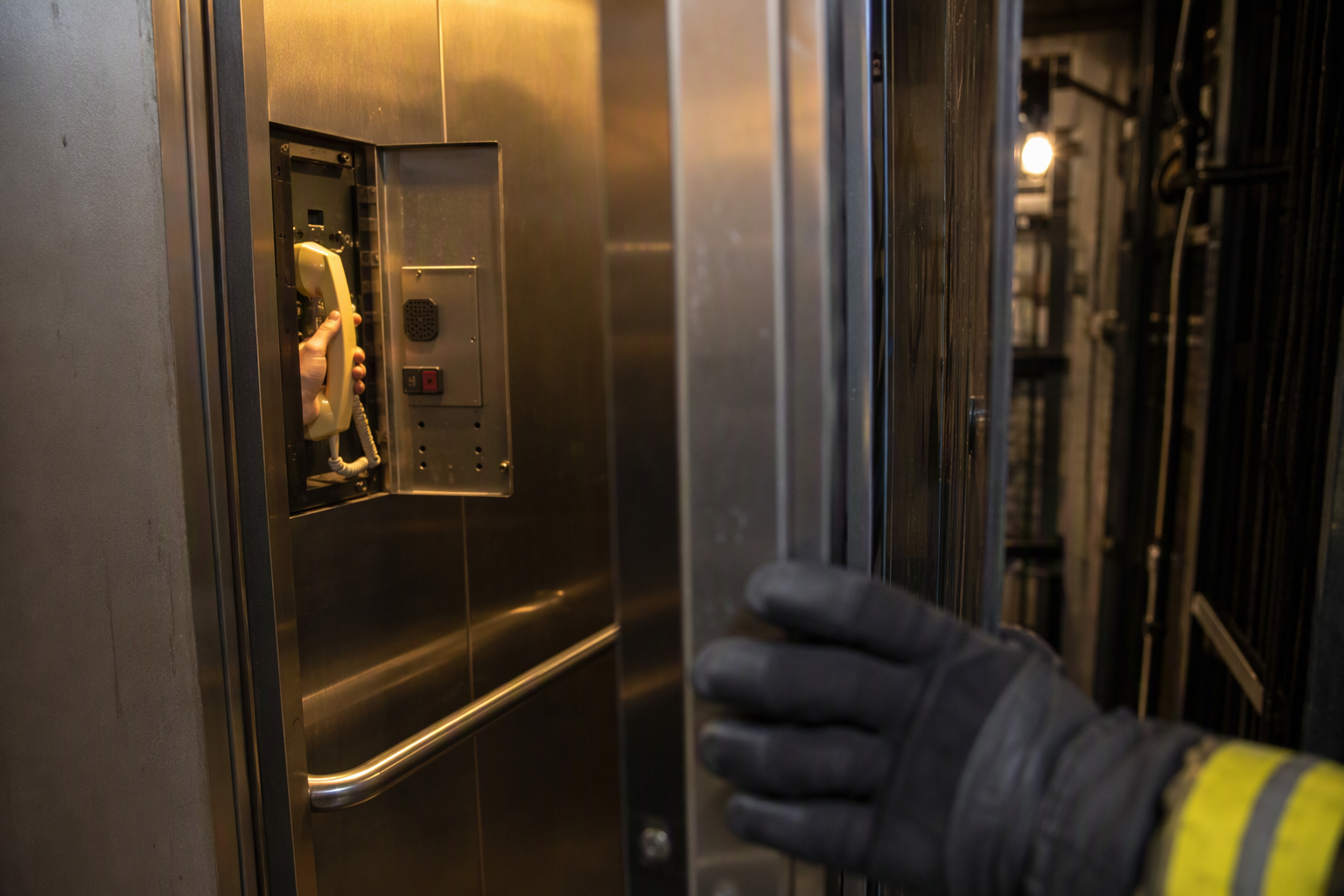
The single most important immediate action is to call emergency services if passengers cannot safely self-exit, then secure the elevator out of service and contact a licensed elevator contractor for emergency inspection.
Follow this ordered sequence every time a trapping incident occurs:
- Call 911 if passengers are in distress. If anyone is injured, unconscious, experiencing a medical emergency, or if the car is stopped between floors with no safe egress, emergency responders must be contacted first. Do not attempt to pry open doors or force the car to move without trained personnel present.
- Use the in-car emergency communication device. Under ASME A17.1 Safety Code for Elevators and Escalators, elevators are required to have a means of two-way communication so trapped passengers can reach a monitoring station or building staff. Confirm the system is functioning and maintain voice contact until rescuers arrive.
- Alert building staff or security. A trained staff member should proceed to the machine room or control panel and be ready to assist emergency responders, but must not attempt unauthorized manual lowering unless specifically trained and authorized to do so.
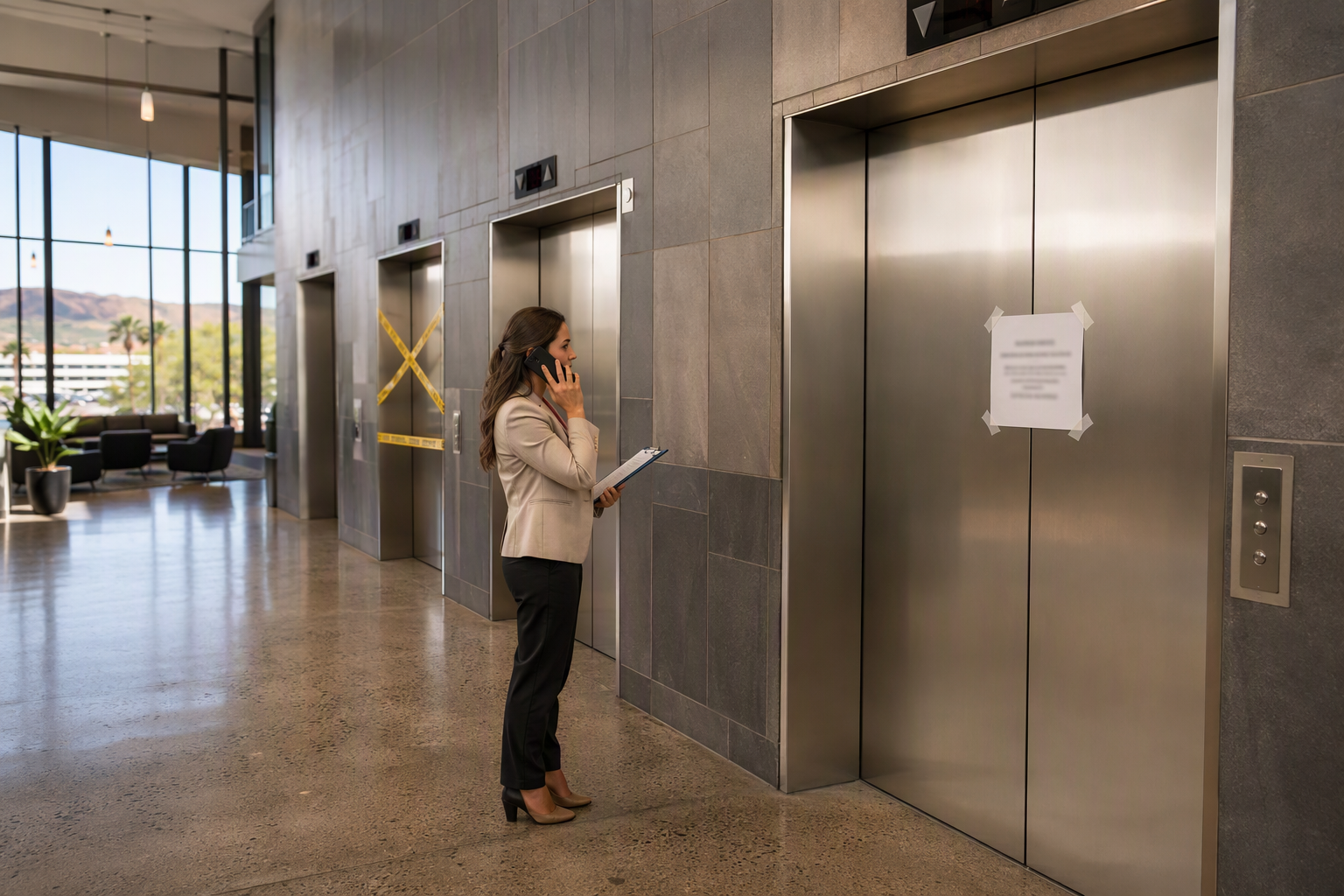
- Place the elevator out of service. Once the car is safely evacuated, place the unit in the “off” or “inspection” mode. Post visible signage on every landing door: “ELEVATOR OUT OF SERVICE — DO NOT USE.”
- Document everything immediately. Record the date, time, floor level, number of passengers, reported symptoms (sudden stop, door failure, unusual noise), and the names and contact information of everyone involved.
- Notify the Industrial Commission of Arizona’s Elevator Division within 24 hours if anyone was injured or the conveyance was disabled. Arizona law under A.R.S. §§ 23-491 through 23-491.16 requires this notification without exception.
- Contact a licensed elevator contractor for a diagnostic inspection. The unit must not be returned to service until the fault is found, corrected, and the conveyance is verified safe by qualified personnel.
Who is legally responsible when an elevator malfunctions and traps someone in Arizona?
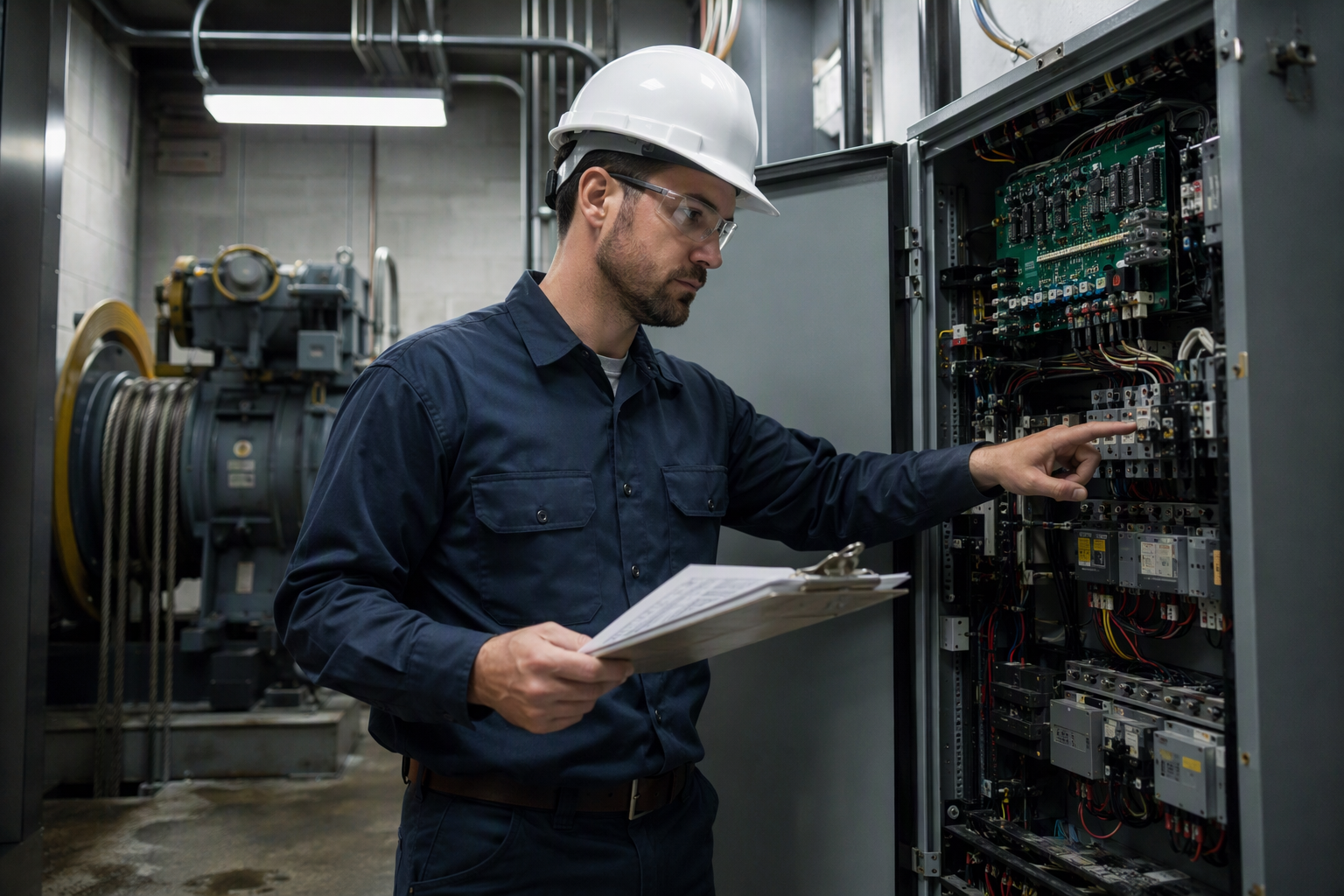
Under Arizona law, the building owner or operator bears primary legal responsibility for the safe condition of every conveyance on their property.
A.R.S. §§ 23-491 through 23-491.16, as amended by Laws 2026, Ch. 73, places the obligation to maintain elevators in a safe condition squarely on owners and operators. Hiring a private elevator inspector or a maintenance contractor does not transfer that legal obligation. Owners must ensure annual certificates of inspection are current, that state serial numbers are posted in or near the conveyance, and that the certificate is kept at the same location as the unit. If a repeated-malfunction event reveals that a conveyance was operated without a valid certificate or in a known unsafe condition, regulatory penalties and civil liability exposure increase substantially.
When must Arizona building owners report an elevator malfunction to the state?
Arizona owners must notify the Industrial Commission of Arizona’s Elevator Division within 24 hours of any accident that injures a person or disables a conveyance.
The 24-hour reporting window is non-negotiable under Arizona Administrative Code R20-5-502 through R20-5-515. “Disabled” means the conveyance is rendered incapable of normal operation — a recurring entrapment that forces the unit out of service qualifies. Property managers in Phoenix should also note that the City of Phoenix Elevator Section (Planning and Development Department) inspects elevators within city limits; a malfunction event may trigger parallel notification obligations at the local level. Outside Phoenix, the Industrial Commission of Arizona’s Elevator Division handles regulatory oversight statewide.
What are the most common mechanical causes of repeated elevator entrapments?
Repeated entrapments are almost always a symptom of an unresolved root-cause failure rather than a series of independent incidents, and the most frequent culprits are door system faults, control system errors, and hydraulic or traction drive issues.
Door system problems — worn door gibs, misaligned rollers, faulty door operators, or degraded door safety edges — are among the most frequently identified causes of entrapments. When a door fails to fully open or close, the controller may keep the car stationary indefinitely. Control system faults, including corrupted software parameters, failing relay logic, or worn contactors, can cause erratic car behavior such as leveling failures and unexpected stops between floors. On hydraulic elevators, seal degradation, valve wear, or fluid contamination can cause slow or failed levering. On traction elevators, worn brake linings, sheave groove wear, or governor malfunctions can similarly strand a car. A single-event inspection that clears a fault code without identifying the underlying mechanical cause is not sufficient when entrapments recur.
How does ASME A17.1 define acceptable elevator safety performance standards?
The ASME A17.1 Safety Code for Elevators and Escalators establishes design, installation, and maintenance requirements that govern what constitutes a safe and serviceable elevator.
Arizona adopted ASME A17.1-2019 (the 2019 edition) for equipment installed, repaired, or altered on or after January 1, 2023. This edition covers requirements for door reopening devices, car enclosure strength, emergency lighting, communication systems, governor and safety device testing, and periodic maintenance examination intervals. When a building owner documents repeated malfunctions, comparing current elevator conditions against ASME A17.1-2019 benchmarks is an essential step in determining whether the equipment requires repair, modernization, or removal from service. Contractors holding Arizona Registrar of Contractors R-12 or C-12 elevator license classifications are authorized to perform this work.
How often must elevators be inspected in Arizona to prevent chronic malfunctions?
Arizona law requires every conveyance to be inspected before it first goes into service, after any modification or alteration, and at least annually after that — and no conveyance may operate without a valid annual certificate of inspection.
Annual inspections are a regulatory minimum, not a maintenance ceiling. For high-traffic commercial properties or equipment showing signs of wear, more frequent maintenance visits are advisable. Building owners who experience recurring entrapments should consider whether their current maintenance contract delivers adequate preventive coverage. Arizona owners may hire a private elevator inspector authorized by the Industrial Commission of Arizona, provided that inspector is registered with the commission annually and has completed at least eight hours of approved continuing education. Critically, a private inspector may not inspect any conveyance owned, operated, or last serviced by the inspector’s own company or employer.
What are the ADA compliance implications of a chronically malfunctioning elevator?
Under the Americans with Disabilities Act (ADA), building owners with elevators serving multiple floors are generally required to maintain those elevators in operable condition, because elevator downtime can deny access to people with disabilities.
The ADA’s maintenance obligations mean that a repeatedly out-of-service elevator is not simply a convenience issue — it is a potential civil rights compliance failure. If a building’s sole accessible route to an upper floor is an elevator that regularly traps passengers and is subsequently taken offline, occupants and visitors who use wheelchairs or have mobility impairments may be denied equal access. This can expose the owner to ADA complaints filed with the U.S. Department of Justice and civil litigation. Prompt repair and diligent preventive maintenance are the primary defenses.
What documentation should a building owner maintain after an entrapment incident?
After any entrapment, building owners should maintain a dated incident report, a repair work order with technician findings, photographic or video evidence of the fault condition, and proof of state notification where required by law.
This documentation serves multiple purposes: it supports the mandatory state report to the Industrial Commission of Arizona’s Elevator Division, provides a defense record in any subsequent litigation, and creates a maintenance history that helps elevator technicians identify recurring failure patterns. Every inspection and repair record should reference the conveyance’s state serial number — the tag fixed to the controller or mainline disconnect — so the documentation trail is traceable through the state’s records. Arizona Elevator Solutions recommends that clients retain elevator maintenance logs for the life of the equipment.
When should a building owner consider elevator modernization instead of continued repair?
Modernization becomes the more cost-effective and safer choice when repair costs are escalating, replacement parts are obsolete, code compliance gaps exist in legacy equipment, or recurring malfunctions cannot be resolved through maintenance alone.
Older conveyances lawfully installed prior to Arizona’s adoption of ASME A17.1-2019 may continue operating under grandfather provisions, but only as long as the Industrial Commission of Arizona’s Elevator Division does not determine that continued use constitutes a hazard to life, health, or property. A pattern of repeated entrapments is precisely the type of evidence that can prompt regulatory scrutiny of whether legacy equipment meets that threshold. A licensed elevator contractor can perform a comprehensive condition assessment to compare the cost of ongoing repairs against modernization, helping owners make an informed decision before a regulator compels action.
What role does OSHA play when an elevator malfunction injures a worker?
When a worker is injured in an elevator incident in an occupational setting, OSHA has authority to investigate under general industry standards governing workplace safety, independent of state elevator regulations.
OSHA’s General Duty Clause requires employers to provide a workplace free from recognized hazards likely to cause death or serious physical harm. A repeatedly malfunctioning elevator in a workplace environment — office building, hotel, hospital, warehouse — is a recognized hazard once the pattern is documented. OSHA investigations can result in citations, fines, and mandatory abatement orders. Employers should treat an elevator entrapment that injures a worker as a dual-reporting event: notification to the Industrial Commission of Arizona’s Elevator Division under state law and evaluation of OSHA reporting obligations under federal law.
How do I choose a qualified elevator contractor in Arizona to diagnose recurring faults?
Building owners should select an elevator contractor holding an Arizona Registrar of Contractors R-12 (residential) or C-12 (commercial) elevator license classification, with documented experience in diagnostic troubleshooting and familiarity with ASME A17.1-2019 requirements.
Verifying ROC licensure is the baseline. Beyond that, owners should ask whether the contractor can perform a full maintenance examination consistent with ASME A17.1-2019 requirements, whether they carry appropriate insurance, and whether they have experience with the specific type and brand of elevator equipment installed at the property. Arizona Elevator Solutions serves building owners throughout Phoenix, Tucson, Scottsdale, and Mesa with diagnostic and corrective maintenance services for a broad range of commercial and residential elevator equipment.
What is the difference between a safety inspection and a maintenance examination, and which does a malfunctioning elevator need?
A safety inspection verifies regulatory compliance and results in the issuance of a state certificate; a maintenance examination is an operational review performed by the service contractor to identify and correct mechanical and electrical faults — and a repeatedly malfunctioning elevator needs both.
The annual state inspection conducted by an authorized inspector confirms that the conveyance meets minimum legal requirements. It does not substitute for routine preventive maintenance, which involves lubrication, adjustment, component testing, wear measurement, and fault diagnosis. When entrapments recur, the maintenance examination — not the inspection certificate — is the tool that identifies the underlying cause. A conveyance may pass its annual inspection and still have developing faults that produce entrapments between inspection cycles if preventive maintenance is inadequate.
What benchmarks help determine whether an elevator’s malfunction rate is abnormal?
Rather than a single industry-wide threshold, whether a malfunction rate is abnormal is evaluated relative to the equipment type, age, traffic volume, and the nature of the faults — recurring entrapments of any frequency indicate an unresolved problem that warrants immediate investigation.
| Requirement or Benchmark | Standard or Source | Arizona-Specific Detail |
|---|---|---|
| Inspection frequency | A.R.S. §§ 23-491 through 23-491.16 | Annual minimum; also required before first use and after any alteration |
| Incident reporting window | Arizona Admin. Code R20-5-502 through R20-5-515 | 24 hours for any injury or disabling of a conveyance |
| Pre-installation notification | A.R.S. §§ 23-491 through 23-491.16 | At least 90 days before installing, relocating, or altering a conveyance |
| Adopted safety code (new/altered equipment) | ASME A17.1-2019 | Applies to equipment installed, repaired, or altered on or after January 1, 2023 |
| Platform and stair lifts code | ASME A18.1-2020 | Applies to platform and stairway chairlifts installed, repaired, or altered on or after January 1, 2023 |
| Private inspector continuing education | Arizona Admin. Code R20-5-502 through R20-5-515 | At least 8 hours of approved continuing education per annual registration cycle |
| Contractor licensing | Arizona Registrar of Contractors | R-12 (residential) or C-12 (commercial) elevator license classifications |
| Certificate posting requirement | A.R.S. §§ 23-491 through 23-491.16 | State serial number or certificate posted in or near the conveyance in an easily accessible location |
| ADA elevator availability obligation | Americans with Disabilities Act | Applies to covered buildings; chronic downtime may constitute an access barrier |
| Local inspection authority (Phoenix) | City of Phoenix Elevator Section, Planning and Development Department | Inspects elevators, escalators, moving walks, dumbwaiters, and chair lifts within Phoenix city limits |
Can a building owner be required to shut down an elevator permanently in Arizona?
Yes — the state’s elevator chief has authority under Arizona law to order a conveyance removed from service if its continued operation is determined to be a hazard to life, health, or property.
Although older, lawfully installed conveyances may ordinarily remain in use under grandfather provisions, that protection is not unconditional. A documented pattern of recurring entrapments, failure to obtain or maintain an annual certificate of inspection, or evidence of structural or mechanical deterioration can all lead to a mandatory shutdown order from the Industrial Commission of Arizona’s Elevator Division. Building owners who receive a notice of violation or a shutdown order should engage a licensed elevator contractor immediately and should not attempt to return the unit to service without regulatory clearance.
What should be included in an elevator emergency response plan for a building?
An effective elevator emergency response plan should include posted emergency contacts, staff roles and responsibilities, passenger communication protocols, a procedure for coordinating with emergency responders, and a clear chain of authority for taking the elevator out of service.
The plan should be written, reviewed at least annually, and made available to all relevant building staff. Key elements include: the location of the machine room and main disconnect; the conveyance’s state serial number; the 24-hour emergency contact for the elevator service contractor; the non-emergency line for the Industrial Commission of Arizona’s Elevator Division; and step-by-step procedures for staff who respond before emergency services arrive. Arizona Elevator Solutions advises building managers to conduct periodic tabletop exercises with staff so that procedures are familiar before an actual entrapment occurs.
How does a firefighters’ emergency operation system affect entrapment response in Arizona?
Arizona conveyances equipped with firefighters’ emergency operation must use the Arizona Firefighters Service (AZFS) key, and building staff should understand how this system interacts with normal elevator operation during emergencies.
When fire alarm systems activate, elevators with firefighters’ emergency operation automatically recall to a designated landing and open their doors, keeping passengers from being transported to potentially dangerous floors. Fire department personnel then take manual control using the AZFS key. Building owners and facility managers should verify that firefighters’ emergency operation is functioning correctly during every maintenance examination and that local fire departments are familiar with the AZFS key system installed at the property. A malfunctioning recall or firefighters’ service system is a separate and serious code deficiency that warrants immediate corrective action.
Are there specific concerns for hydraulic versus traction elevators that repeatedly malfunction?
Yes — hydraulic and traction elevators have distinct failure modes, and the diagnostic approach, regulatory requirements for repair, and modernization considerations differ meaningfully between the two types.
Hydraulic elevators rely on fluid pressure to raise the car; common recurring-malfunction causes include worn jack seals that cause slow descent or leveling errors, valve assemblies that stick or fail to respond, and fluid contamination. Environmental considerations apply in Arizona because hydraulic fluid leaks can affect soil and groundwater. Traction elevators use a motor, sheave, and counterweight system; recurring faults often involve brake wear, rope or belt elongation, governor issues, and motor or drive controller faults. Under ASME A17.1-2019, both types have specific maintenance examination and testing requirements, and repairs must be performed by contractors licensed under the Arizona Registrar of Contractors R-12 or C-12 classifications.
What questions should a building owner ask a potential elevator service contractor after a recurring entrapment?
Building owners should ask about ROC license classification, diagnostic methodology for identifying root causes rather than just clearing fault codes, familiarity with the specific elevator equipment installed, documentation practices, and whether the contractor is familiar with Arizona’s reporting and certificate requirements.
A qualified contractor should be able to explain their diagnostic process clearly, provide a written findings report after every service visit, and advise the owner on regulatory obligations including reporting timelines and certificate compliance. They should not simply reset fault codes and restore service without identifying what triggered the fault. Recurring entrapments demand a systematic investigation — reviewing the fault log history, testing safety devices, measuring component wear, and performing a full maintenance examination — not a reactive call-and-clear approach. Arizona Elevator Solutions provides detailed written reports following each diagnostic inspection, supporting owners’ regulatory documentation requirements.
How do elevator modernization projects interact with Arizona’s 90-day notification requirement?
Any modernization that constitutes an alteration to the conveyance triggers the requirement that Arizona owners notify the Industrial Commission of Arizona’s Elevator Division at least 90 days before the work begins.
Under A.R.S. §§ 23-491 through 23-491.16, the 90-day advance notice applies to installing, relocating, or altering a conveyance. Modernization projects — which typically involve replacing the controller, drive, doors, or cab finishes — generally constitute alterations and therefore require this advance notification. After alteration, the conveyance must pass an inspection before returning to service. Equipment installed, repaired, or altered on or after January 1, 2023 must comply with ASME A17.1-2019. Building owners planning a modernization as a solution to chronic malfunctions should factor the 90-day notice period and post-alteration inspection into their project schedule to avoid extended downtime.
What preventive maintenance practices most effectively reduce the risk of future entrapments?
Systematic preventive maintenance — including regular lubrication, door system adjustment, safety device testing, fault log review, and component wear measurement — is the most reliable method for reducing entrapment incidents before they occur.
Door systems deserve particular attention because door-related faults are a leading cause of entrapments. Maintenance technicians should inspect and adjust door gibs, rollers, clutches, and safety edges on a scheduled basis. Safety devices including buffers, governors, and safeties must be tested at intervals consistent with ASME A17.1-2019 requirements. Fault log data from the elevator controller should be reviewed at every maintenance visit, not only when a complaint is received — fault codes that do not yet produce noticeable symptoms often precede a more serious failure. Arizona Elevator Solutions structures its maintenance programs for commercial clients in Phoenix, Tucson, Scottsdale, and Mesa to include systematic fault log review as a standard component of every visit.
Contact Arizona Elevator Solutions for a free elevator assessment at 480-557-7600.
Need elevator service you can rely on? Arizona Elevator Solutions is ready to help.