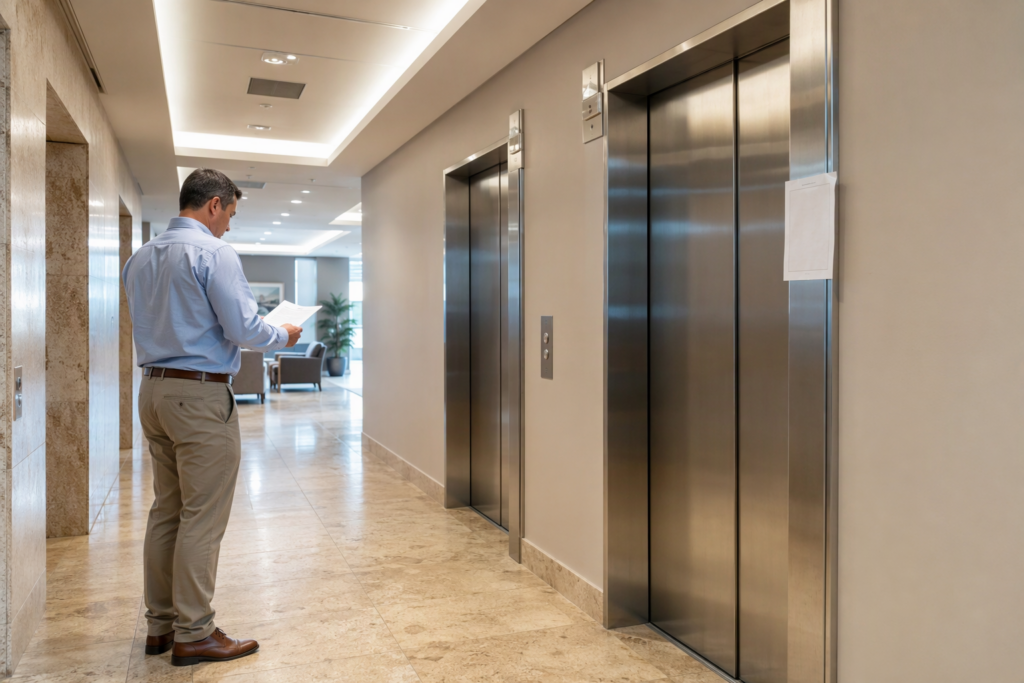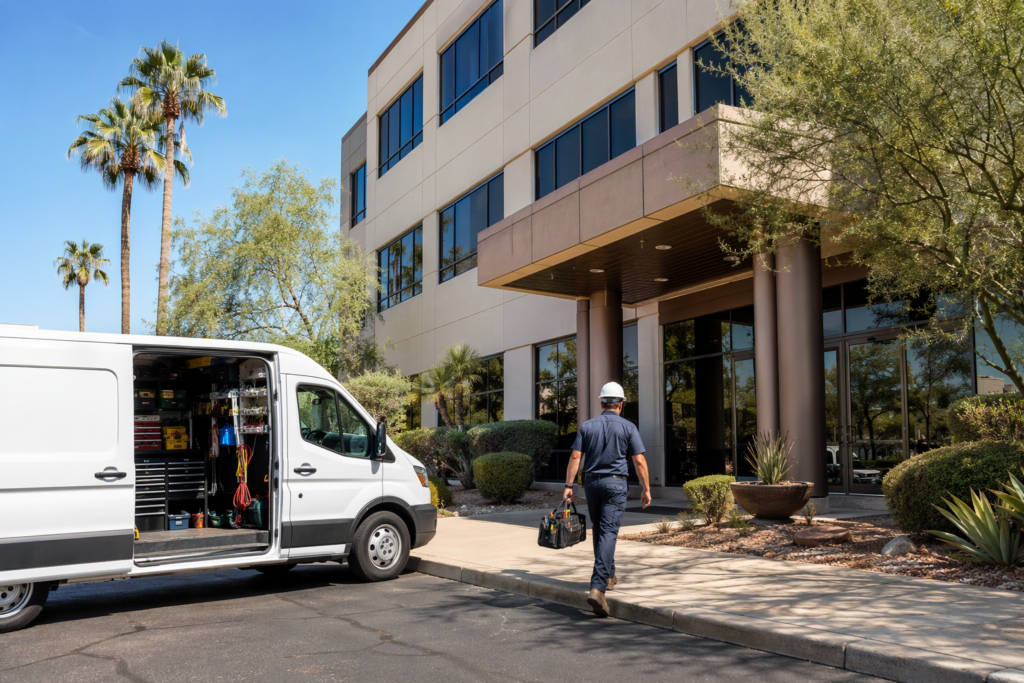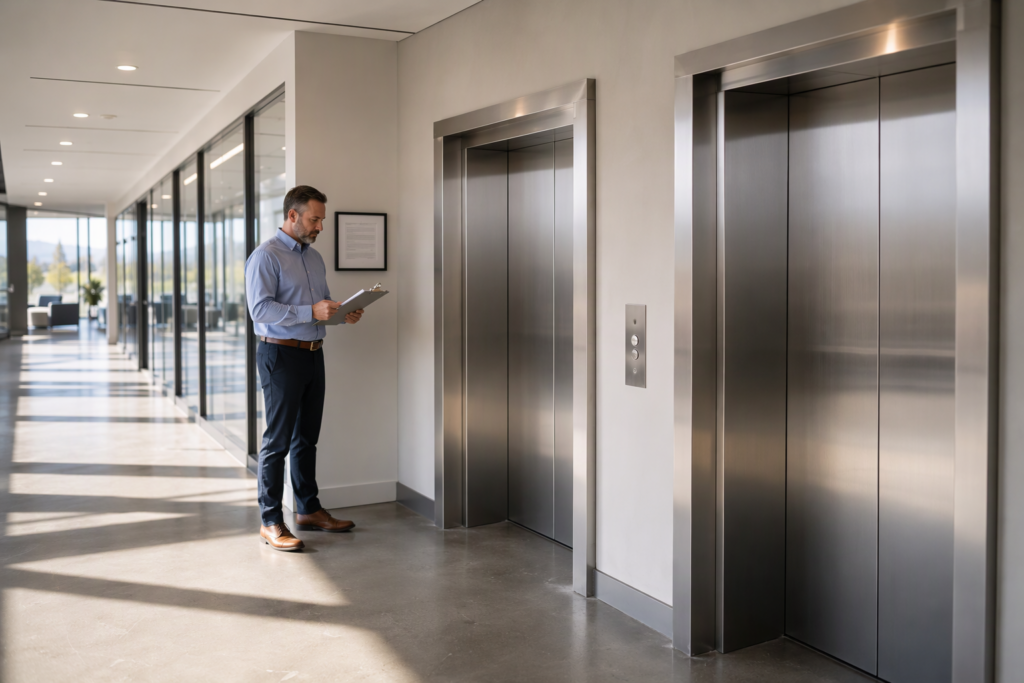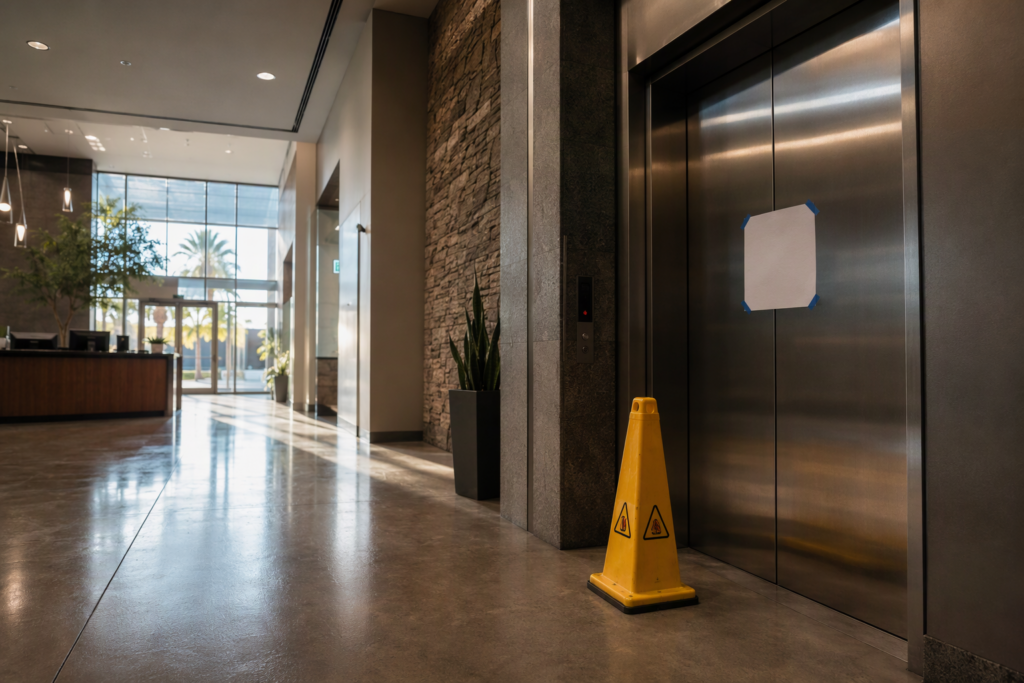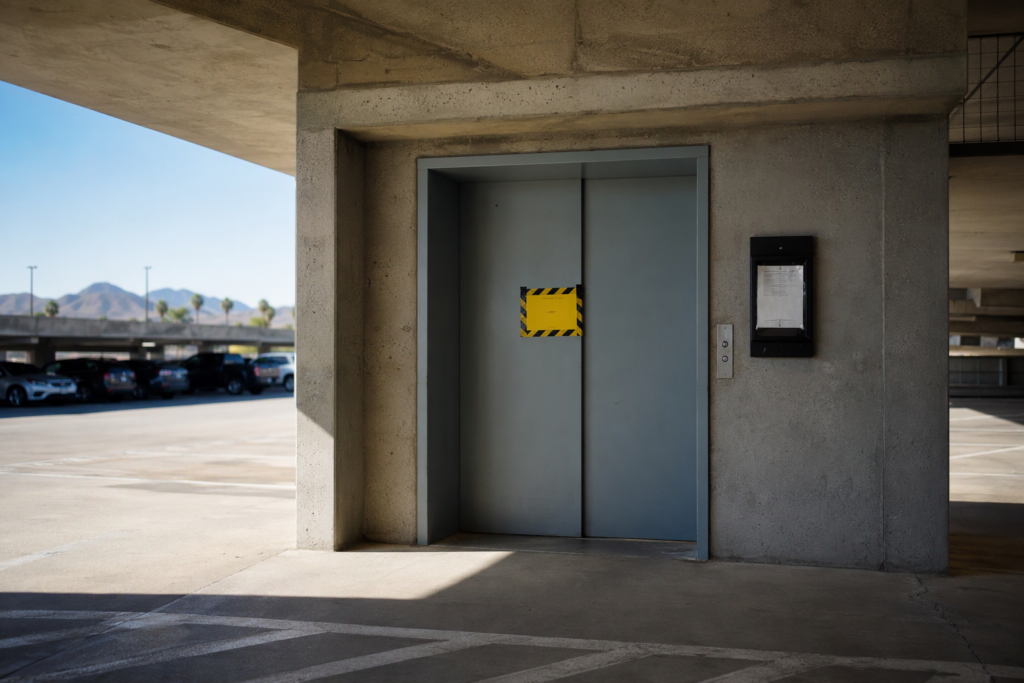
Yes, an elevator technician can come on-site to assist with the fire inspection process as it relates to elevator systems. Building owners in Phoenix, Tucson, Scottsdale, and Mesa commonly arrange for a qualified elevator technician to be present during fire inspections to operate, demonstrate, and verify elevator fire service features so the fire marshal’s review proceeds without delays or failed items.
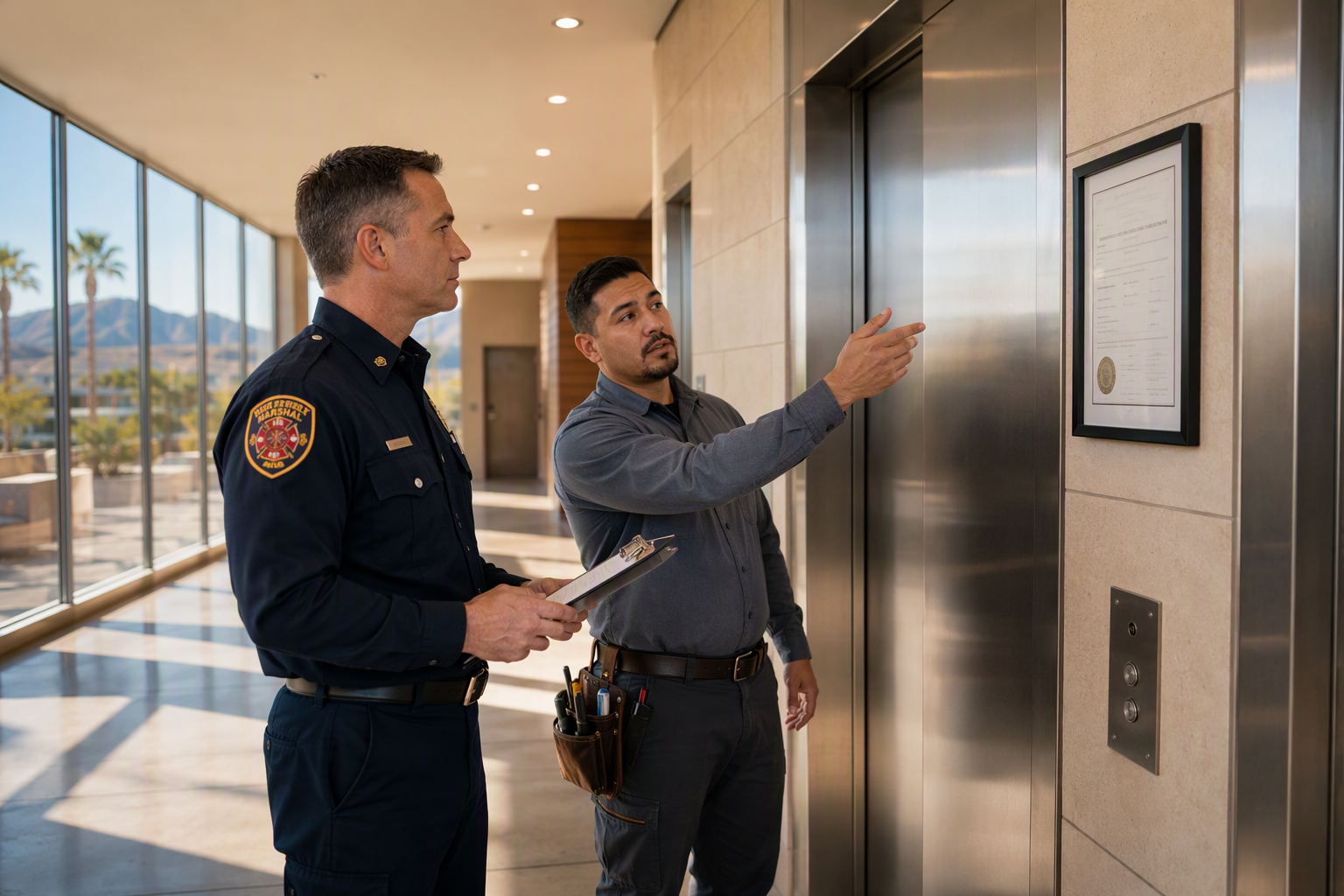
What exactly does a fire inspector examine on an elevator?
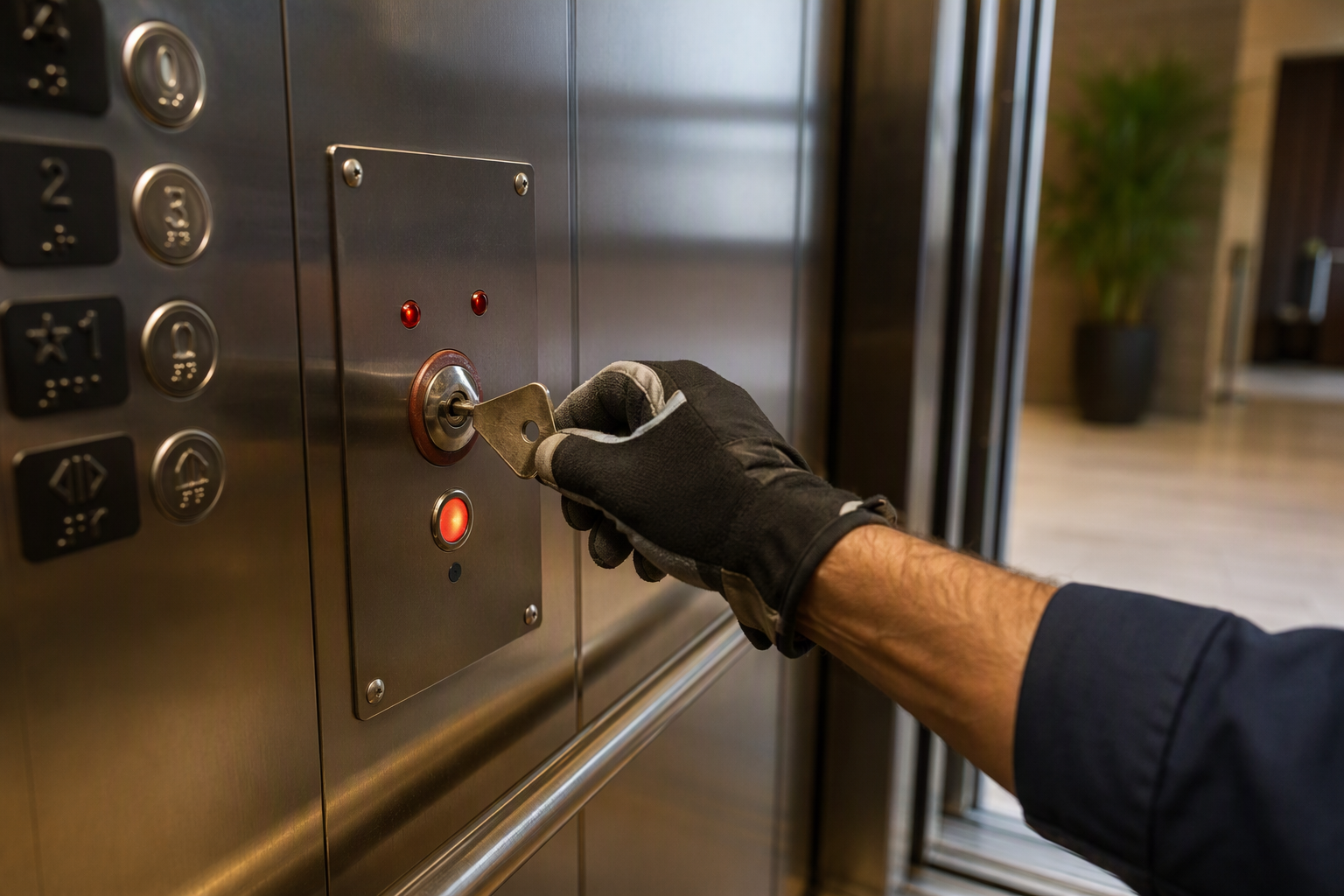
A fire inspector evaluates whether the elevator’s life-safety systems function correctly under emergency conditions, not the general mechanical condition of the elevator itself.
During a building fire inspection, the authority having jurisdiction (AHJ) — typically the local fire marshal or fire prevention bureau — checks elevator systems for compliance with adopted fire and life-safety codes. In Arizona, elevators must meet the ASME A17.1/CSA B44 Safety Code for Elevators and Escalators (2019 edition for equipment installed, repaired, or altered on or after January 1, 2023). The fire-specific portion of that review typically covers:
- Phase I Recall — automatic or key-switch-activated return of the elevator to a designated landing when smoke is detected
- Phase II In-Car Operation — in-car key switch that allows a firefighter to manually control the elevator
- Firefighters’ emergency operation key compatibility
- Lobby and hoistway smoke/heat detector placement and function
- Elevator machine room fire suppression, ventilation, and signage
- Emergency lighting and communication systems inside the cab
- Posting of the valid state certificate of inspection
Under A.R.S. §§ 23-491 through 23-491.16 and Arizona Administrative Code R20-5-502 through R20-5-515, no conveyance may operate in Arizona without a current annual certificate of inspection. A fire inspector who notices an expired or missing certificate will flag it immediately, potentially triggering an order to take the unit out of service.
Why should a building owner have an elevator technician present during a fire inspection?
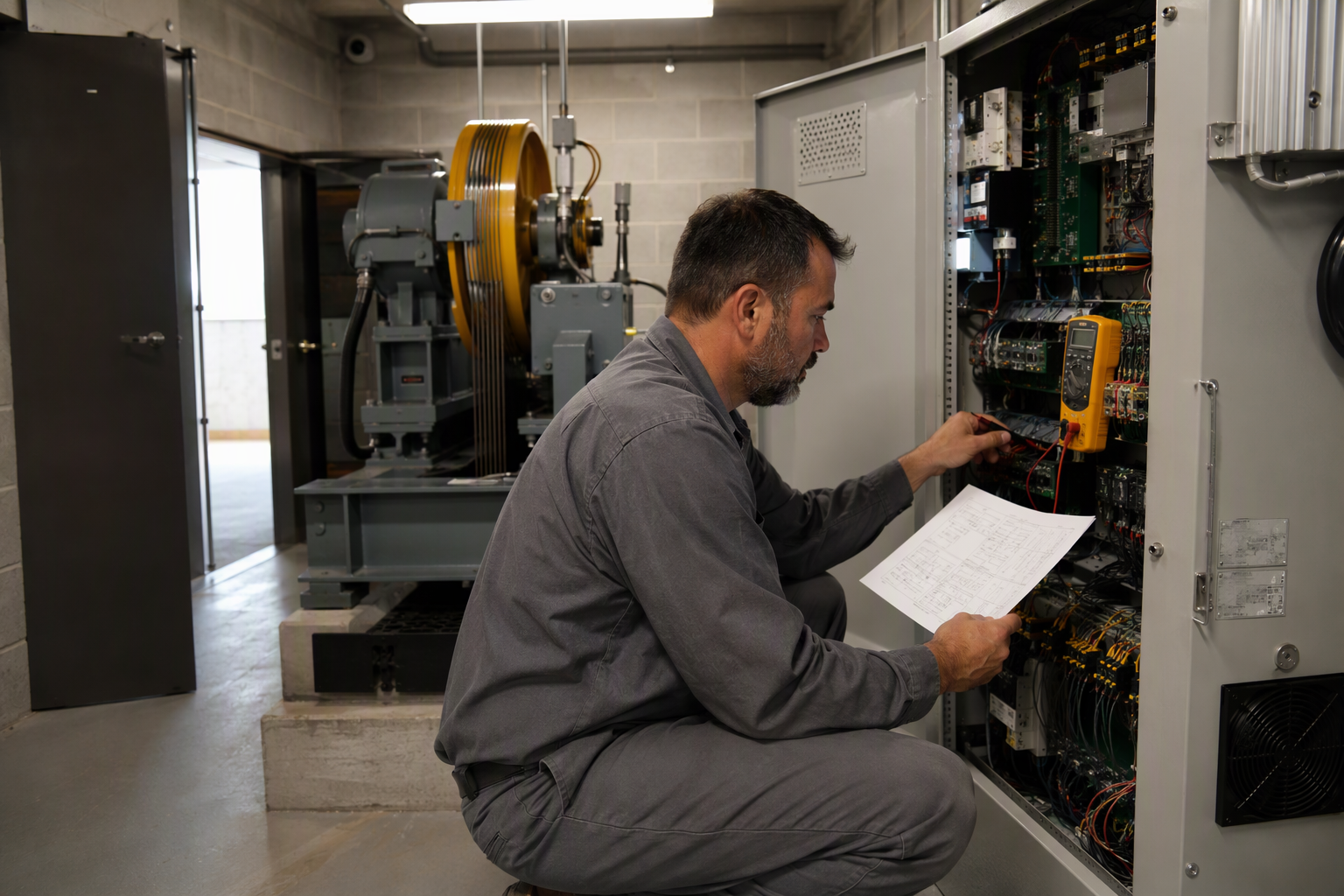
An elevator technician on-site can operate firefighters’ service features on command, answer technical questions, and resolve minor discrepancies before the inspector closes out the visit.
Fire inspectors are life-safety generalists. They know what firefighters’ emergency operation is supposed to do, but they typically cannot access the machine room, interpret elevator-specific wiring diagrams, or recalibrate a recall function. When a technician is standing by, the inspector can call for a live demonstration of Phase I and Phase II operation without waiting for a separate appointment. If a door sensor is slightly out of adjustment or a key switch fails to respond, the technician can often make the correction on the spot rather than scheduling a follow-up visit that delays the certificate of occupancy or annual fire inspection sign-off.
For multi-tenant commercial buildings in Phoenix and Scottsdale, a failed elevator item on a fire inspection can trigger re-inspection fees, tenant complaints, and liability exposure. Having a technician present is a proactive measure that reduces that risk significantly.
What is firefighters’ emergency operation and why does it matter for fire inspections in Arizona?
Firefighters’ emergency operation is a two-phase elevator control system defined by ASME A17.1 that allows fire departments to recall and manually operate elevators during a building emergency.
Phase I (Firefighters’ Emergency Return) brings the elevator automatically to the designated recall floor when a building smoke detector activates, or when a key switch in the lobby is turned to the recall position. The doors open and remain open so the cab cannot be called by passengers. Phase II (Firefighters’ In-Car Operation) lets a trained firefighter use a key switch inside the cab to operate the elevator manually, bypassing normal hall calls.
Arizona has a state-specific key requirement: under the Arizona Administrative Code, conveyances with firefighters’ emergency operation must use the Arizona Firefighters Service (AZFS) key. This is a critical compliance detail that distinguishes Arizona from many other jurisdictions. If a building has installed a different key type — for example, as a result of a manufacturer default — a fire inspector in Phoenix or Tucson can flag the non-conforming key as a deficiency. An elevator technician can verify and, if necessary, arrange for the correct AZFS key hardware before or during the inspection.
Which Arizona authority oversees elevator safety, and how does that relate to fire inspections?
The Industrial Commission of Arizona (ICA) Elevator Division is the state elevator safety regulator, while local fire marshals are the AHJ for fire and life-safety code compliance during fire inspections.
These are two separate oversight tracks that sometimes overlap at the elevator cab. The Industrial Commission of Arizona Elevator Division (formerly the ADOSH Elevator Safety Section until September 12, 2026) issues the annual certificate of inspection required by A.R.S. § 23-491 et seq. and enforces ASME A17.1-2019 for equipment installed, repaired, or altered on or after January 1, 2023. The local fire marshal enforces adopted fire codes — typically the International Fire Code as locally amended — and focuses on whether fire service features actually work.
Inside the City of Phoenix, the City of Phoenix Elevator Section (Planning and Development Department) inspects elevators in addition to the state. Outside Phoenix, the ICA Elevator Division handles state inspections. Regardless of jurisdiction, if the annual elevator certificate has lapsed, a fire inspector will likely note it as a building code violation even though the certificate itself is issued by the elevator regulator, not the fire department.
What documents should a building owner have ready for the elevator portion of a fire inspection?
The owner should have the current state certificate of inspection, the maintenance log, wiring diagrams, and the firefighters’ service test record readily available before the fire inspector arrives.
- State Certificate of Inspection: Under Arizona law, the certificate must be kept at the same location as the conveyance and the state serial number or certificate must be posted in or close to the conveyance in an easily accessible location.
- Maintenance and service records: Documentation showing regular lubrication, adjustment, and safety device testing as required by ASME A17.1.
- Firefighters’ service test log: A record of the most recent Phase I and Phase II functional tests.
- Wiring and equipment diagrams: Kept in the machine room for reference by inspectors and technicians.
- Permit history: Records of any alterations or repairs that required permits under A.R.S. § 23-491, including the 90-day advance notification to the state for installations, relocations, or alterations.
An elevator technician attending the fire inspection can locate these documents within the machine room and confirm that the serial number tag affixed to the controller or mainline disconnect matches the certificate on file — a small detail that is sometimes flagged as a discrepancy.
How should a building owner prepare step-by-step before the fire inspection’s elevator review?
Following a structured preparation sequence minimizes deficiencies and avoids the cost and disruption of a re-inspection.
- Confirm the inspection date and scope with the fire marshal’s office and identify which elevator systems will be evaluated.
- Locate the current ICA certificate of inspection and verify it has not expired. If it is expired or close to expiration, contact a qualified elevator service company immediately.
- Verify the AZFS key is present for every elevator with firefighters’ emergency operation and that all key switches are functional.
- Conduct a pre-inspection Phase I and Phase II test by activating the lobby smoke detector input or key switch and confirming correct recall behavior, then test Phase II in-car operation.
- Inspect machine room conditions — lighting, fire suppression equipment, ventilation, and locked access.
- Review the cab interior for emergency lighting, two-way communication, and required posted signage.
- Schedule a qualified elevator technician to be on-site for the duration of the fire inspection’s elevator segment.
- Assemble all documentation listed in the previous section and place it in the machine room or a readily accessible location.
- Notify the technician of any known deficiencies so repair parts or tools can be brought to the site.
What are the most common elevator deficiencies cited during fire inspections in Arizona?
The most frequently cited elevator-related fire inspection deficiencies involve non-functional Phase I recall, incorrect or missing firefighters’ service keys, expired certificates of inspection, and inadequate machine room conditions.
| Deficiency Category | Common Cause | Applicable Standard | On-Site Fix Possible? |
|---|---|---|---|
| Phase I recall failure | Disconnected or failed smoke detector input, wiring fault | ASME A17.1 | Often yes, if wiring related |
| Incorrect firefighters’ key | Non-AZFS key installed by manufacturer or prior vendor | Arizona Administrative Code / AZFS requirement | Yes, if replacement key on hand |
| Expired certificate of inspection | Owner missed annual renewal cycle | A.R.S. § 23-491 | No — requires ICA or private inspector process |
| Certificate not posted in cab | Certificate stored in office rather than at conveyance | A.R.S. § 23-491 | Yes — immediate correction |
| Phase II key switch malfunction | Worn or damaged in-car switch assembly | ASME A17.1 | Yes, with correct parts |
| Machine room door unlocked or improper access | Lost key, propped door | ASME A17.1 | Yes — administrative correction |
| Emergency lighting failure in cab | Dead backup battery | ASME A17.1 | Yes, if battery on hand |
| Two-way communication failure | Phone line disconnected or failed intercom unit | ASME A17.1, ADA | Partial — line issues may need telecom |
Does an elevator technician on-site actually interact with the fire inspector, or do they simply stand by?
An elevator technician actively participates by operating the elevator on request, explaining technical details, accessing restricted spaces such as the machine room, and providing documentation to the inspector.
Fire inspectors are often not authorized to operate elevator controls themselves in ways that require machine room access or bypassing of safety circuits. The technician serves as the hands-on operator who can safely demonstrate Phase I recall by activating the proper input, then reset the system, activate Phase II, and run the cab under firefighters’ control to show the inspector that each function responds correctly. The technician can also unlock and escort the inspector through the machine room, explain any equipment that appears non-standard, and take notes on items the inspector flags so corrective work can begin immediately.
What is the difference between an elevator fire inspection and the annual elevator inspection required by Arizona law?
The annual elevator inspection required under A.R.S. § 23-491 evaluates the mechanical and electrical safety of the entire elevator system, while a fire inspection focuses specifically on life-safety and fire service features.
The annual inspection is conducted by the Industrial Commission of Arizona Elevator Division or an authorized private elevator inspector and results in the issuance of a certificate of inspection. It covers the full scope of ASME A17.1-2019 requirements — buffers, safeties, governors, door operators, interlocks, and more. The fire inspection, conducted by the local fire marshal, looks at a narrower subset: does firefighters’ emergency operation work, are emergency systems in the cab functional, and does the machine room meet fire safety requirements? Both are legally required, and a deficiency in either can result in the elevator being taken out of service.
Arizona Elevator Solutions works with building owners to ensure elevator systems are in compliance with both tracks simultaneously, so a deficiency discovered during one inspection does not create a cascading failure in the other.
How does ADA compliance intersect with fire inspection requirements for elevators?
The Americans with Disabilities Act requires that elevators providing access to public accommodations remain functional and accessible, which includes emergency communication systems that must also satisfy fire inspection requirements.
ASME A17.1 requires a two-way means of communication in every elevator cab. The ADA independently requires that this communication system be usable by individuals who are deaf or hard of hearing — typically through a visual display or TTY-compatible signaling. During a fire inspection, an inspector may check that the emergency telephone or intercom is operational. If the device has failed, it may represent both a fire code deficiency and an ADA accessibility issue simultaneously. Building owners should understand that correcting the emergency communication system satisfies multiple compliance requirements at once.
What qualifications should the elevator technician attending a fire inspection have?
The technician should be employed by an elevator contractor holding the appropriate Arizona Registrar of Contractors license classification and should be familiar with the specific make, model, and control system of the elevators in the building.
The Arizona Registrar of Contractors issues R-12 (residential) and C-12 (commercial) elevator license classifications that authorize the holder to install and repair elevators, dumbwaiters, escalators, and moving walks. A contractor holding the appropriate ROC classification provides assurance that the company is authorized to perform work on Arizona elevators. It is important to note that the Arizona Registrar of Contractors licenses the contracting entity; the ROC does not issue the annual certificate of inspection — that remains the function of the Industrial Commission of Arizona Elevator Division or an authorized private inspector.
Beyond licensing of the contractor, the technician attending the inspection should have direct working knowledge of the specific controller brand and software version installed in the building, since Phase I and Phase II behavior is programmed and may require parameter-level access to diagnose or adjust.
Can the elevator technician correct deficiencies found during the fire inspection on the same visit?
Many common deficiencies — such as a failed Phase II key switch, a missing certificate posting, or a Phase I input wiring fault — can be corrected during the same visit if the technician arrives with appropriate parts and tools.
Technicians who coordinate in advance with the building owner can review any prior inspection reports, identify likely deficiency areas, and stock the service vehicle with the most probable repair components. Items that cannot be corrected on the same visit — such as an expired certificate of inspection that requires a full reinspection cycle, a failed smoke detector that falls under the fire alarm contractor’s scope, or significant controller repairs — will be documented and scheduled as follow-up work. The ability to make immediate corrections is one of the strongest arguments for having a technician present rather than allowing the fire inspector to complete the elevator portion of the review without technical support on-site.
How far in advance should a building owner schedule an elevator technician for a fire inspection?
Building owners should schedule the elevator technician as soon as the fire inspection date is confirmed, ideally allowing enough lead time for a pre-inspection walkthrough of the elevator system.
A pre-inspection walkthrough — sometimes called a courtesy inspection or pre-check — allows the technician to identify and resolve deficiencies before the fire marshal arrives. If the annual elevator certificate is approaching expiration, the building owner should notify the elevator service company well in advance so that an authorized inspection can be scheduled, completed, and the certificate issued before the fire inspection date. Under Arizona law, owners must notify the state at least 90 days before installing, relocating, or altering a conveyance, which underscores the regulatory preference for proactive rather than reactive scheduling. While that 90-day rule applies to alterations rather than inspections, it reflects the broader compliance culture that rewards advance planning.
Arizona Elevator Solutions serves building owners throughout Phoenix, Tucson, Scottsdale, and Mesa, and can coordinate both the pre-inspection preparation and technician attendance during the fire inspection.
What happens if an elevator fails the fire inspection?
A failed elevator fire inspection typically results in a written notice of violation specifying the deficiency, a required correction timeline, and a mandatory re-inspection before the building receives final fire inspection clearance.
The severity of the response depends on the nature of the deficiency. A non-functional Phase I recall in a high-rise building is a life-safety issue that may prompt the AHJ to require the elevator be taken out of service until repaired. A missing certificate posting or an improperly stored maintenance log may be given a correction deadline of days or weeks without requiring the elevator to be shut down. In either case, the building owner is responsible for arranging corrective work and scheduling the re-inspection. If the deficiency relates to the state certificate of inspection — for example, the certificate has lapsed — the owner must work through the Industrial Commission of Arizona Elevator Division process to obtain a new certificate, which cannot be short-circuited by simply performing repairs without an authorized inspection following them.
Are private elevator inspectors authorized in Arizona, and can they help with fire inspection preparation?
Yes, Arizona authorizes private elevator inspectors to conduct initial and annual inspections, and their pre-inspection reports can be highly useful in preparing for the fire inspection’s elevator component.
Under Arizona law, building owners may hire a private elevator inspector authorized by the Industrial Commission of Arizona to perform initial or annual inspections. Arizona private elevator inspectors must register with the commission every year and demonstrate at least eight hours of approved continuing education annually. There is an important restriction: a private inspector may not inspect a conveyance owned, operated, or last serviced by the inspector, a company the inspector owns, or the inspector’s employer. Using a private inspector does not relieve the owner or operator of their legal obligations under A.R.S. §§ 23-491 through 23-491.16.
A recent annual inspection report from an authorized private inspector can serve as a baseline document showing the fire marshal that the elevator has been evaluated against ASME A17.1-2019 standards. However, the fire inspector will still conduct their own fire-service-specific review and cannot simply accept the elevator inspection report in lieu of a live Phase I and Phase II demonstration.
Does elevator type affect what a fire inspector will check?
Yes — hydraulic elevators, traction elevators, and limited-use/limited-application (LU/LA) elevators each have different firefighters’ emergency operation requirements, and the fire inspector’s review will vary accordingly.
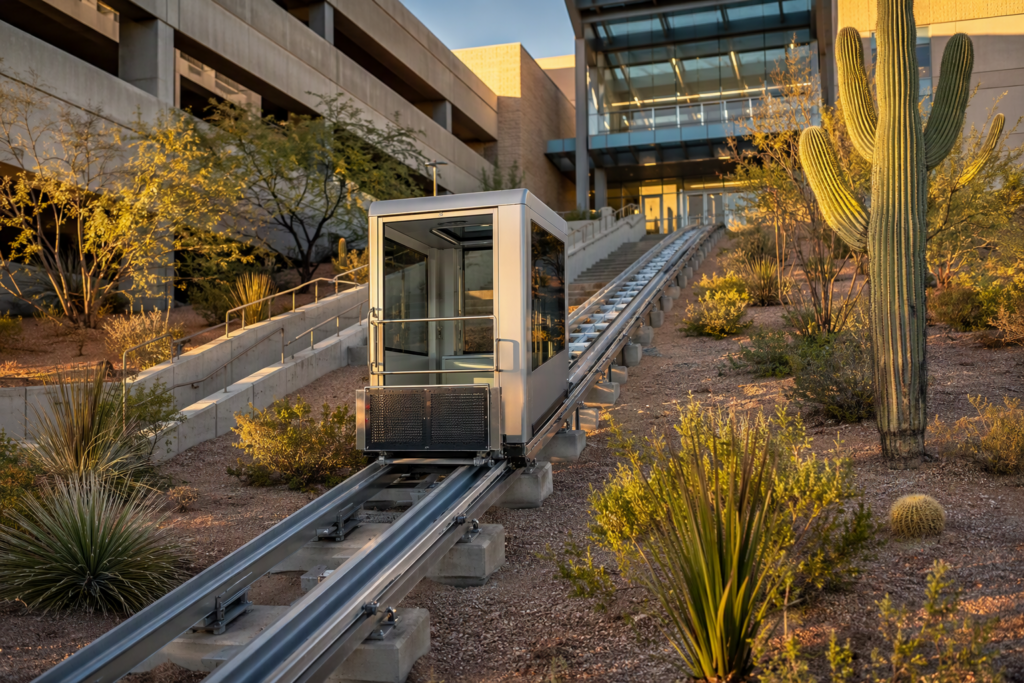
Full commercial traction and hydraulic elevators that serve floors above the main egress level are subject to full Phase I and Phase II requirements under ASME A17.1. Smaller LU/LA elevators installed in smaller commercial buildings may have modified requirements depending on the building’s height, occupancy, and applicable fire code amendments. Platform lifts governed by ASME A18.1-2020 (required in Arizona for lifts installed, repaired, or altered on or after January 1, 2023) have different emergency operation specifications and may not require the same firefighters’ service key or Phase II functionality as a full elevator. An elevator technician attending the inspection can explain to the fire inspector which standard applies to each piece of equipment in the building, reducing the risk of a deficiency being cited based on the wrong equipment category.
What role does OSHA play in elevator safety during a fire inspection?
The Occupational Safety and Health Administration (OSHA) governs elevator safety as it relates to worker protection, including the safety of elevator technicians performing maintenance or repair work, but OSHA does not conduct building fire inspections.
OSHA’s elevator-related requirements focus on the safety of workers who install, inspect, maintain, and repair elevators — including lockout/tagout procedures, fall protection in hoistways, and machine room safety conditions. A fire inspector is not an OSHA inspector, and OSHA compliance is a parallel obligation of the elevator contractor rather than something evaluated during a building fire inspection. That said, an elevator machine room that is cluttered, has blocked egress, or contains improperly stored materials may draw comment from a fire inspector on fire safety grounds even if OSHA compliance is a separate issue.
How does the City of Phoenix handle elevator portions of fire inspections differently from other Arizona cities?
The City of Phoenix Elevator Section, part of the Planning and Development Department, conducts elevator inspections for equipment inside Phoenix city limits, creating a dual-layer oversight structure not present in Tucson, Scottsdale, or Mesa.
For buildings inside Phoenix, the city elevator section handles elevator-specific inspections separately from the ICA Elevator Division, which handles equipment outside Phoenix. The Phoenix fire marshal still conducts the fire inspection for all buildings within the city, including the fire-service features of elevators. Building owners in Phoenix may therefore interact with both the city elevator section (for the annual mechanical safety inspection) and the Phoenix fire marshal (for the fire inspection’s life-safety review). In Tucson, Scottsdale, and Mesa, the ICA Elevator Division handles state elevator inspections, while local fire marshals handle fire inspections. Arizona Elevator Solutions is familiar with the inspection requirements across all four of these markets and can help owners navigate the appropriate contacts and documentation for each jurisdiction.
What ongoing maintenance practices reduce elevator deficiencies at fire inspections?
Regular preventive maintenance that includes periodic testing of Phase I and Phase II firefighters’ emergency operation, emergency lighting battery checks, and AZFS key function verification will substantially reduce the likelihood of deficiencies at any fire inspection.
ASME A17.1 establishes maintenance requirements for elevator owners, including that equipment be maintained in a safe operating condition. A maintenance program that schedules firefighters’ service functional tests on a documented periodic basis creates a paper trail demonstrating ongoing compliance — something that both fire inspectors and the ICA Elevator Division respond to positively. Emergency lighting backup batteries should be tested under load periodically, since batteries can degrade without any visible indication of failure. The two-way communication system should be tested on a call-and-response basis, not just by confirming that a phone is present. AZFS key switches should be operated at each maintenance visit to confirm smooth function, since key switches that are rarely used tend to corrode or seize over time.
Arizona Elevator Solutions provides maintenance programs for commercial elevator owners in Phoenix, Tucson, Scottsdale, and Mesa that incorporate fire-service feature verification as a standard element of each maintenance visit.
What should a building owner do immediately after receiving a fire inspection deficiency notice related to elevators?
The owner should contact a qualified elevator service company immediately, document the exact deficiency language from the notice, and determine whether the elevator must be taken out of service pending correction.
- Read the deficiency notice carefully and note the correction deadline and any out-of-service order.
- Do not ignore an out-of-service order — operating an elevator under a suspension order creates serious liability exposure and may violate A.R.S. § 23-491.
- Contact a qualified elevator service company and share the exact text of the deficiency notice so technicians arrive with appropriate materials.
- Determine whether the deficiency falls under elevator contractor scope or fire alarm contractor scope — smoke detector failures, for example, are typically remedied by the fire alarm contractor, not the elevator contractor.
- If the annual certificate of inspection has lapsed, contact the Industrial Commission of Arizona Elevator Division or an authorized private inspector to initiate the reinspection process.
- Schedule corrective work promptly and obtain written confirmation from the contractor that repairs meet ASME A17.1-2019 requirements.
- Request a re-inspection from the fire marshal’s office and confirm the re-inspection date in writing.
- Retain all repair documentation — invoices, work orders, and technician sign-offs — to present at the re-inspection.
Contact Arizona Elevator Solutions for a free elevator assessment at 480-557-7600.
Need elevator service you can rely on? Arizona Elevator Solutions is ready to help.