Elevator Compliance for Senior Living and Assisted Living Facilities in Arizona: Inspection Requirements, Accessibility Standards, and Administrator Responsibilities
For administrators of senior living and assisted living communities, elevator compliance is not optional — it is a legal, operational, and safety obligation that touches state elevator law, federal accessibility standards, and the daily wellbeing of residents who depend on vertical access for mobility. This guide breaks down every major requirement, explains who is responsible for what, and helps facility leadership make informed decisions about maintenance contracts, inspection schedules, and equipment upgrades.
Why Elevator Compliance Is Different for Senior and Assisted Living Facilities

Residential care communities present a unique compliance profile compared to commercial office buildings or retail spaces. Residents may use wheelchairs, walkers, or scooters; staff transport medical equipment and meal carts; and equipment runs continuously across multiple shifts. A conveyance failure or compliance gap can disrupt care delivery, trigger regulatory action from both elevator and healthcare licensing authorities, and create significant liability exposure.
Arizona’s elevator law governs the mechanical safety and certification side. Federal ADA law governs accessibility for people with disabilities. Both apply simultaneously to senior living facilities, and administrators are responsible for maintaining compliance with both frameworks at all times.
What Does Arizona Law Actually Require for Elevator Inspections?

Arizona’s elevator safety requirements are established under A.R.S. §§ 23-491 through 23-491.16 and implemented through Arizona Administrative Code R20-5-502 through R20-5-515. As of September 12, 2026, the governing authority is the Industrial Commission of Arizona (ICA), Elevator Division (previously known as the ADOSH Elevator Safety Section).
The core requirements every Arizona elevator owner — including senior living facility operators — must meet are:
- Pre-service inspection: Every conveyance must be inspected before it first goes into service.
- Post-alteration inspection: Any modification or alteration to a conveyance triggers a required inspection before the unit is returned to service.
- Annual inspection: Every conveyance must be inspected at least once per year after initial certification.
- Certificate of inspection: No conveyance may legally operate in Arizona without a valid, current certificate of inspection issued by the state.
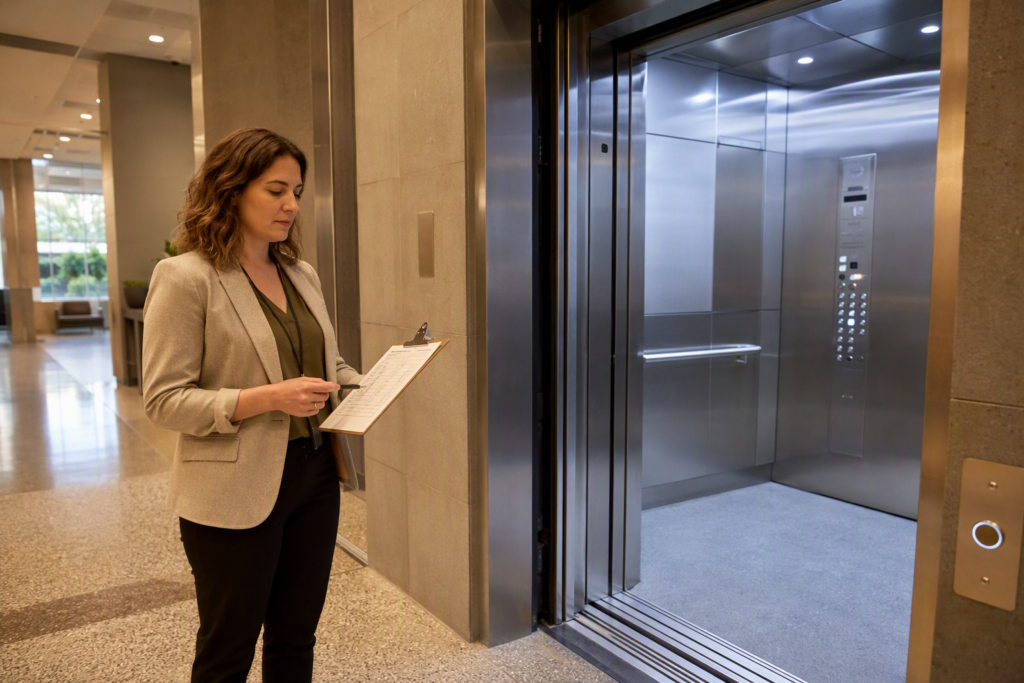
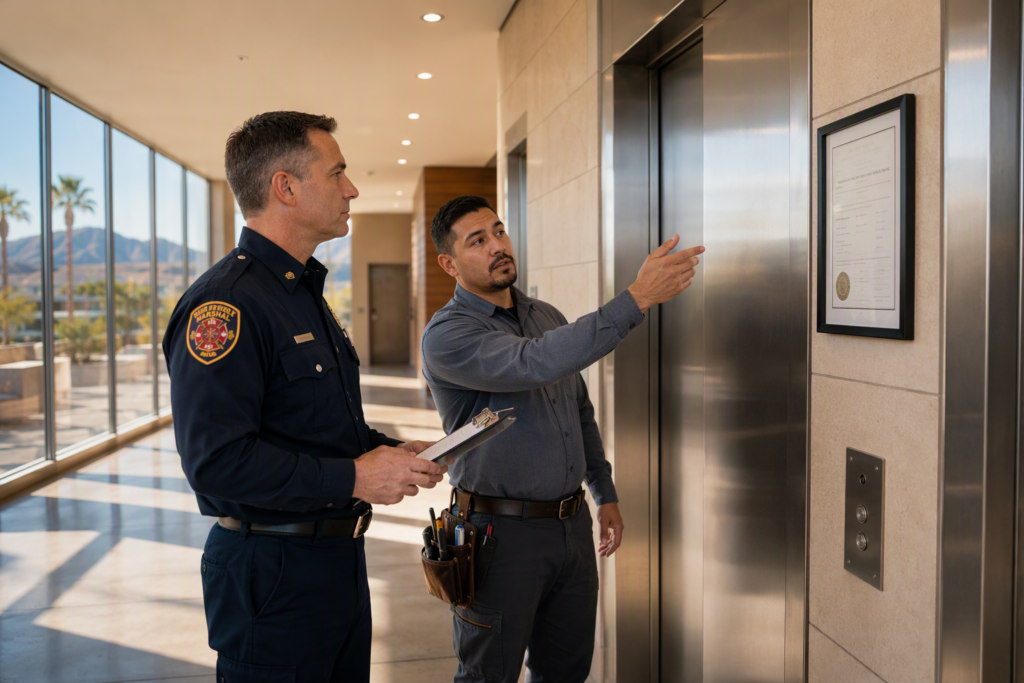
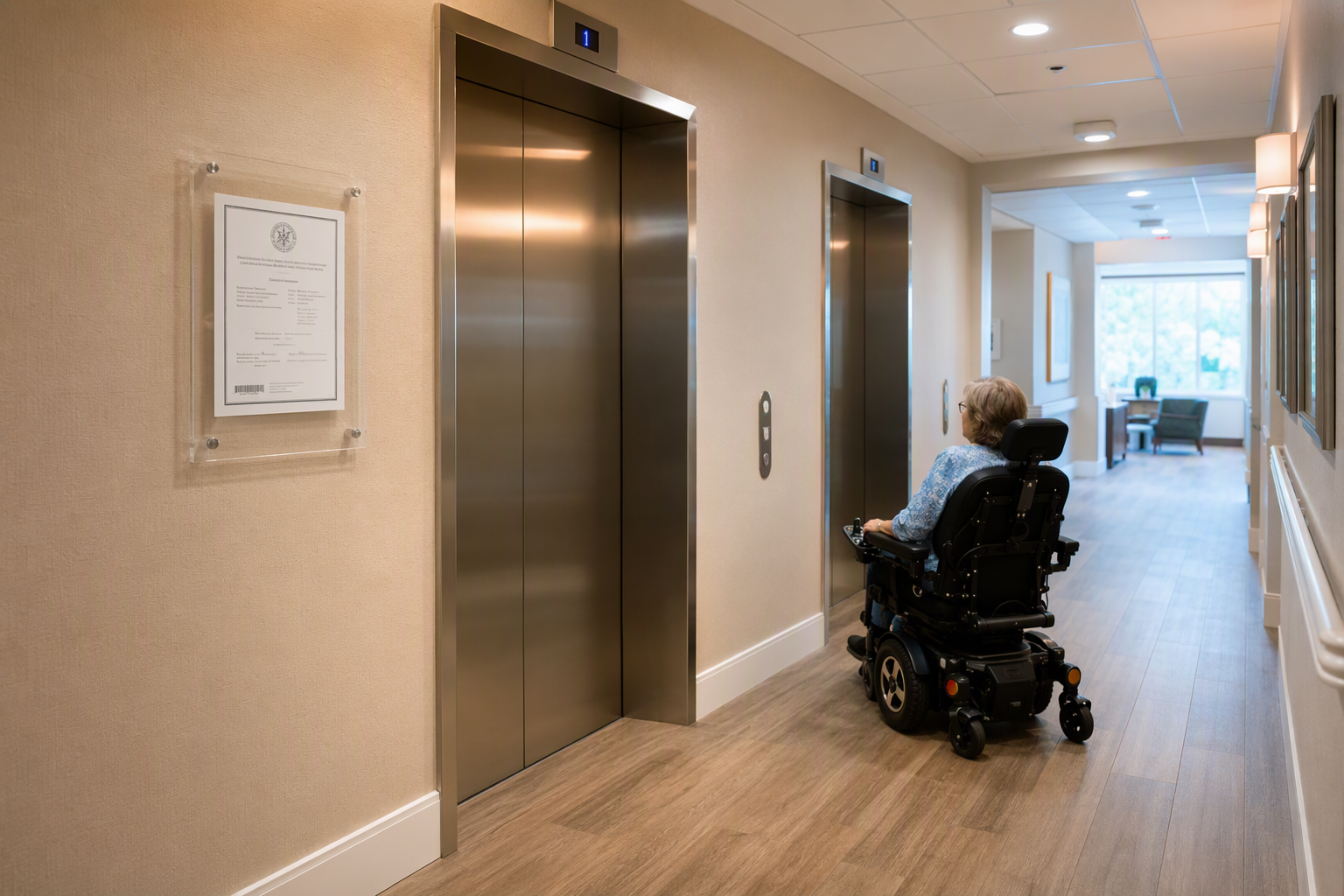
- Certificate posting: The owner must keep the state certificate at the same location as the conveyance and make it available for inspection on request. The state serial number or certificate must be posted in or close to the conveyance in an easily accessible location.
- 90-day advance notice: Owners must notify the state at least 90 days before installing, relocating, or altering a conveyance.
- 24-hour accident notification: Any accident that injures a person or disables a conveyance must be reported to the state within 24 hours.
- State serial number: Every Arizona conveyance is assigned a state serial number displayed on a tag fixed to the controller or mainline disconnect.
For facilities located within the City of Phoenix, the City of Phoenix Elevator Section (Planning and Development Department) handles inspections of elevators, escalators, moving walks, dumbwaiters, and chairlifts. For all equipment located outside Phoenix city limits, the ICA Elevator Division is the authority having jurisdiction.
Which Equipment in a Senior Living Facility Requires Compliance?
| Equipment Type | Governing Standard | Annual Inspection Required? | Certificate Required? | Common Senior Living Use |
|---|---|---|---|---|
| Passenger Elevator | ASME A17.1-2019 | Yes | Yes | Resident and staff vertical transit between floors |
| Freight / Service Elevator | ASME A17.1-2019 | Yes | Yes | Meal carts, laundry, medical supply transport |
| Platform Lift (Vertical) | ASME A18.1-2020 (installed/altered on or after January 1, 2023) | Yes | Yes | Wheelchair access between split-level areas |
| Stairway Chairlift | ASME A18.1-2020 (installed/altered on or after January 1, 2023) | Yes | Yes | Ambulatory-assist access on stairways |
| Dumbwaiter | ASME A17.1-2019 | Yes | Yes | Food and medication delivery between floors |
| Escalator / Moving Walk | ASME A17.1-2019 | Yes | Yes | Less common but present in larger campus facilities |
Note: Equipment installed, repaired, or altered before January 1, 2023 may remain in service under the code edition applicable at its installation, unless the ICA Elevator Division determines the condition constitutes a hazard to life, health, or property.
What Are the ADA Accessibility Requirements for Elevators in Senior Living Facilities?
Federal Americans with Disabilities Act (ADA) requirements apply to the accessibility dimensions and features of elevators in facilities that serve the public or residents with disabilities — which includes virtually every assisted living and senior living community. ADA standards address features such as:
- Minimum cab dimensions to accommodate wheelchair turning radius
- Call button height, size, and braille labeling requirements
- Door reopening devices and timing requirements
- Floor level indicators and audible announcements
- Handrail requirements inside elevator cabs
- Leveling accuracy at each floor landing
ADA compliance is a separate obligation from Arizona’s annual inspection certificate. A facility can hold a valid state certificate of inspection and still be out of ADA compliance if accessibility features have degraded or were never correctly installed. Administrators should treat these as two distinct but overlapping compliance tracks.
Who Is Responsible — The Facility Owner, the Management Company, or the Contractor?
Under Arizona law, legal responsibility for elevator compliance rests with the owner or operator of the conveyance. This is a critical point for senior living facilities structured with management companies or third-party operators: even when a management agreement delegates day-to-day operations, the entity that owns or operates the building retains full legal accountability for maintaining valid inspection certificates and meeting all statutory obligations.
Hiring a private elevator inspector or a third-party maintenance contractor does not transfer or relieve the owner or operator of their legal obligations under Arizona law. The certificate of inspection must remain on-site and accessible at all times regardless of who performed the inspection or maintenance work.
Can a Senior Living Facility Use a Private Inspector Instead of a State Inspector?
Yes. Arizona allows facility owners to hire a private elevator inspector who is authorized by the Industrial Commission of Arizona to perform initial or annual inspections. However, Arizona private elevator inspectors must:
- Register with the ICA commission every year
- Complete at least eight hours of approved continuing education per registration cycle
- Refrain from inspecting any conveyance owned, operated, or last serviced by themselves, a company they own, or their employer
For senior living administrators, using a private inspector can offer scheduling flexibility and faster turnaround on annual certifications — but vetting the inspector’s current ICA registration status is the facility’s responsibility.
Maintenance Contract vs. Time-and-Materials: Which Is Right for Senior Living?
| Factor | Full-Service Maintenance Contract | Time-and-Materials (T&M) | Better for Senior Living? |
|---|---|---|---|
| Cost predictability | Fixed monthly or annual fee | Variable — billed per visit and parts | Contract (budget stability) |
| Preventive maintenance frequency | Scheduled per contract terms | Ad hoc / reactive only | Contract (proactive compliance) |
| Compliance documentation | Typically included in contract scope | May require separate arrangement | Contract (audit readiness) |
| Response to breakdowns | Often prioritized for contract clients | Available but may be slower | Contract (resident safety priority) |
| Parts and labor transparency | Bundled — less granular visibility | Itemized per invoice | Depends on facility preference |
| Flexibility to switch providers | Subject to contract terms | High flexibility | T&M (when evaluating new vendors) |
| Best for high-use, multi-unit facilities | Yes — multiple lifts, daily use | Less efficient at scale | Contract |
For most senior living and assisted living facilities in Arizona — where elevators and lifts operate continuously and resident access is a care-delivery issue, not merely a convenience — a full-service preventive maintenance contract provides the most reliable compliance posture and the most defensible documentation trail in the event of a state inspection or incident investigation.
What Happens If a Senior Living Facility Fails an Elevator Inspection in Arizona?
If an inspection reveals violations, the ICA Elevator Division (or the City of Phoenix Elevator Section within Phoenix) has authority to require corrective action before the conveyance is returned to service. The owner is responsible for making required repairs and scheduling a re-inspection. Operating a conveyance without a valid certificate of inspection is a violation of Arizona law under A.R.S. §§ 23-491 through 23-491.16.
For senior living facilities, an elevator that is taken out of service for compliance failures creates an immediate resident access problem — particularly for residents who are non-ambulatory or mobility-impaired. This operational risk reinforces why proactive maintenance is strategically essential, not merely a regulatory formality.
What Should a Facility Administrator Do Immediately After an Elevator Accident?
- Ensure all persons involved receive appropriate medical attention as the immediate priority.
- Take the conveyance out of service and secure the area to prevent further access or injury.
- Do not alter, clean, or repair the conveyance or the immediate area until authorized by the relevant authority.
- Notify the Industrial Commission of Arizona, Elevator Division (or the City of Phoenix Elevator Section if within Phoenix) within 24 hours of any accident that injures a person or disables a conveyance — this is a legal requirement under Arizona law.
- Document all observable conditions, times, and individuals involved, and preserve any available video or electronic records.
- Notify your elevator maintenance provider so they are aware of the incident and available to cooperate with the investigation.
- Consult legal counsel regarding liability documentation and any obligations to other regulatory bodies, such as the Arizona Department of Health Services if the facility holds a healthcare license.
- Coordinate a re-inspection and certification before returning the conveyance to service.
Does Arizona Require Firefighters’ Emergency Operation on Senior Living Elevators?
Arizona conveyances equipped with firefighters’ emergency operation must use the Arizona Firefighters Service (AZFS) key. Senior living administrators should confirm with their maintenance provider that any elevator in their facility equipped with Phase I and Phase II emergency recall and operation is keyed to the AZFS standard. Using a non-conforming key can result in inspection deficiencies and, more critically, can impair emergency responder access during an actual fire event.
What Is the Role of the Arizona Registrar of Contractors in Elevator Compliance?
The Arizona Registrar of Contractors (ROC) issues R-12 (residential) and C-12 (commercial) elevator license classifications, which authorize contractors to install and repair elevators, dumbwaiters, escalators, and moving walks in Arizona. When a senior living facility contracts with an elevator company for installation, major repair, or alteration work, that company should hold the appropriate ROC license classification.
It is important to understand the distinction: the ROC licenses elevator contractors for installation and repair work, but it does not issue the annual certificate of inspection. The annual certificate comes only from the ICA Elevator Division (or the City of Phoenix Elevator Section within Phoenix).
Independent Elevator Service vs. OEM/Manufacturer Service: What Should Senior Living Facilities Consider?
| Consideration | OEM / Manufacturer Service | Independent Certified Service Provider |
|---|---|---|
| Proprietary parts availability | Direct access to OEM parts | Broad aftermarket access; OEM parts available through channels |
| Contract flexibility | Often restrictive; long terms | Typically more flexible terms |
| Multi-brand expertise | Limited to own equipment lines | Trained across multiple manufacturers |
| Local Arizona responsiveness | Varies by regional coverage model | Arizona-based providers offer local proximity |
| Arizona code compliance knowledge | Varies | Local providers specialize in Arizona ICA requirements |
| Documentation for state inspections | Available | Available; locally familiar with ICA and Phoenix processes |
| Competitive pricing leverage | Limited when under OEM contract | Greater ability to negotiate |
Arizona Elevator Solutions is an independent, Arizona-based elevator service provider offering preventive maintenance, compliance inspections, and modernization services for senior living and assisted living facilities across Arizona. As an independent provider, Arizona Elevator Solutions works across multiple equipment brands and is deeply familiar with ICA Elevator Division requirements, City of Phoenix inspection processes, and the operational demands of residential care environments.
Compliance Timeline: What Does the Annual Elevator Compliance Cycle Look Like for a Senior Living Facility?
| Phase | Timing | Action Required | Responsible Party |
|---|---|---|---|
| Certificate review | Ongoing | Confirm current certificate is posted at each conveyance | Facility owner/operator |
| Preventive maintenance visits | Per contract schedule | Lubrication, adjustments, safety device testing, documentation | Certified elevator contractor |
| Pre-inspection audit | 30–60 days before annual inspection | Internal review of maintenance logs, certificate status, AZFS key conformance | Facility administrator + contractor |
| Annual inspection | Once per calendar year | State or private authorized inspector conducts full inspection | ICA Elevator Division, Phoenix Elevator Section, or private authorized inspector |
| Certificate renewal | Following successful inspection | New certificate issued; post at conveyance location | Issuing authority; posting is owner’s responsibility |
| Alteration notification | At least 90 days before any installation, relocation, or alteration | Written notice to ICA Elevator Division | Facility owner/operator |
| Accident reporting | Within 24 hours of incident | Report injury or disabling incident to state authority | Facility owner/operator |
Pros and Cons of Different Inspection Approaches for Senior Living Facilities
| Approach | Pros | Cons |
|---|---|---|
| State ICA inspector conducts annual inspection | Direct state authority; no question about inspector’s standing | Scheduling may be less flexible; lead times can vary |
| Private ICA-authorized inspector | Scheduling flexibility; can coordinate with facility operational needs | Facility must verify current registration and independence requirements |
| Maintenance contractor performs pre-inspection prep | Identifies issues before formal inspection; reduces risk of citation | Contractor cannot inspect own work; separate inspector still required |
Frequently Asked Questions
Does Arizona’s elevator law apply to small assisted living homes with only one or two residents?
Arizona’s elevator law under A.R.S. §§ 23-491 through 23-491.16 applies to conveyances based on the equipment itself, not the size of the facility. If a conveyance is installed, it must meet state inspection and certification requirements. Administrators of smaller residential care homes should contact the ICA Elevator Division directly to confirm which specific provisions apply to their equipment type and installation context.
What is the difference between a maintenance inspection and the annual state inspection?
A preventive maintenance visit is performed by the facility’s contracted elevator service company and focuses on lubrication, adjustments, parts replacement, and safety device testing to keep the conveyance in good working order. The annual state inspection is conducted by either a state inspector or an ICA-authorized private inspector and results in the issuance (or denial) of the certificate of inspection required to legally operate the conveyance. Both are necessary but serve different purposes.
Can a senior living facility’s maintenance contractor also perform the annual state inspection?
No. Arizona law prohibits a private authorized inspector from inspecting any conveyance that was owned, operated, or last serviced by the inspector, a company the inspector owns, or the inspector’s employer. This means the company that maintains your elevator cannot also serve as the inspector of record for that same equipment. Facilities need to maintain these as separate relationships.
What happens to older elevator equipment that was installed before the 2023 Arizona code update?
Under Arizona law, lawfully installed older conveyances may remain in service under the code edition applicable at the time of their installation. They do not automatically need to be brought up to ASME A17.1-2019 standards unless they undergo repair or alteration. The exception is if the ICA’s elevator chief determines that the equipment’s continued use constitutes a hazard to life, health, or property, in which case upgrades can be required.
Are platform lifts and stairway chairlifts in senior living facilities subject to the same rules as passenger elevators?
Platform lifts and stairway chairlifts are subject to annual inspection and certification requirements under Arizona law. Those installed, repaired, or altered on or after January 1, 2023 must comply with ASME A18.1-2020. The inspection and certificate requirements parallel those for passenger elevators, meaning no platform lift or chairlift may legally operate without a current state certificate.
What documentation should a senior living administrator keep on file for elevator compliance?
At minimum, administrators should maintain: the current and prior certificates of inspection for each conveyance, documentation of all preventive maintenance visits, records of any repairs or alterations performed, the state serial number assignment for each unit, documentation of any incident reports filed with the state, and confirmation of contractor ROC license status. This documentation is essential for state audits, healthcare licensing reviews, and liability defense.
Does the ADA require an elevator in every multi-story senior living building?
The ADA generally requires that multi-story facilities open to the public or serving individuals with disabilities provide accessible routes between floors. Specific exemptions may apply in certain building types or sizes, but assisted living and senior living communities that house residents with mobility impairments are expected to provide accessible vertical access. Administrators should consult their ADA compliance counsel and review current ADA Standards for Accessible Design for specific requirements applicable to their facility type.
How far in advance should a senior living facility plan for an elevator modernization or major alteration?
Arizona requires at least 90 days’ advance notification to the ICA Elevator Division before installing, relocating, or altering a conveyance. Beyond the regulatory notice period, practical planning for a major modernization — including equipment procurement, contractor scheduling, permit processing, and post-alteration inspection — typically extends the overall timeline further. Facilities should plan accordingly to avoid lapses in resident access and to ensure the post-alteration inspection and new certificate are in place before the conveyance returns to service.
Why Senior Living Facilities Choose Arizona Elevator Solutions
Arizona Elevator Solutions specializes in elevator maintenance, compliance support, and modernization services for senior living and assisted living communities throughout Arizona. As an independent, Arizona-based provider, the company understands the unique operational demands of residential care environments — continuous equipment use, resident mobility dependency, and the dual compliance requirements of state elevator law and federal ADA standards.
Working with an independent provider means facilities are not locked into OEM contract terms, benefit from multi-brand technical expertise, and receive service from a team that is specifically familiar with ICA Elevator Division requirements and City of Phoenix inspection processes.
Arizona Elevator Solutions helps senior living administrators maintain current certificates of inspection, prepare for annual inspections, navigate post-incident reporting obligations, and plan equipment upgrades with the 90-day state notification process in mind.
Ready to Confirm Your Facility’s Elevator Compliance Status?
Elevator compliance for senior living facilities in Arizona involves multiple moving parts — annual state certifications, ADA accessibility obligations, post-alteration inspection requirements, and ongoing preventive maintenance. A gap in any one area creates both regulatory and operational risk for residents and staff.
Contact Arizona Elevator Solutions for a free elevator assessment. The team will review your current certificate status, identify any compliance gaps, and recommend a maintenance and inspection plan aligned with Arizona’s ICA Elevator Division requirements and your facility’s operational schedule.
Call Arizona Elevator Solutions today: 480-557-7600