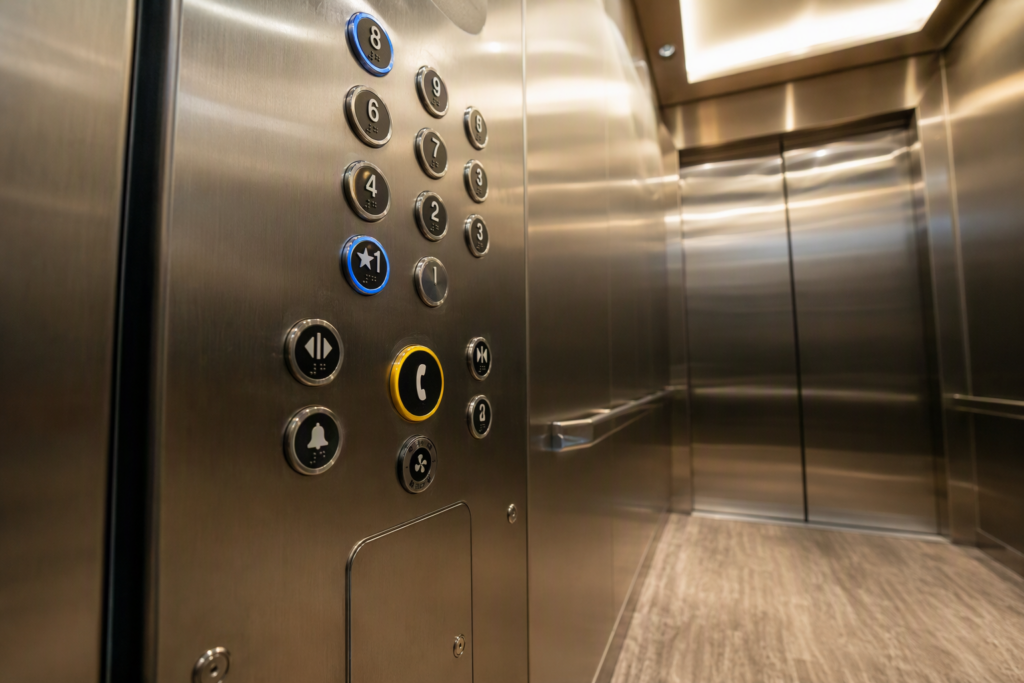
When a service contract is in place, commercial elevator repair pricing is determined by the contract tier (full-maintenance, parts-and-labor, or inspection-only), the scope of covered components, the age and condition of the equipment, and whether the required repair falls inside or outside the contract’s defined exclusions—with out-of-contract work billed separately at negotiated or standard time-and-material rates.

Commercial Elevator Repair Pricing With a Service Contract: Complete FAQ Guide
Understanding how repair costs are calculated under a service contract helps building owners in Phoenix, Tucson, Scottsdale, and Mesa budget accurately, avoid surprise invoices, and hold vendors accountable to contract terms. This guide answers the most common questions about commercial elevator repair pricing when a maintenance agreement is involved, with specific reference to ASME A17.1 Safety Code for Elevators and Escalators, ADA requirements, and Arizona regulatory obligations under A.R.S. §§ 23-491 through 23-491.16.
How is pricing determined for a commercial elevator repair when a service contract is involved?
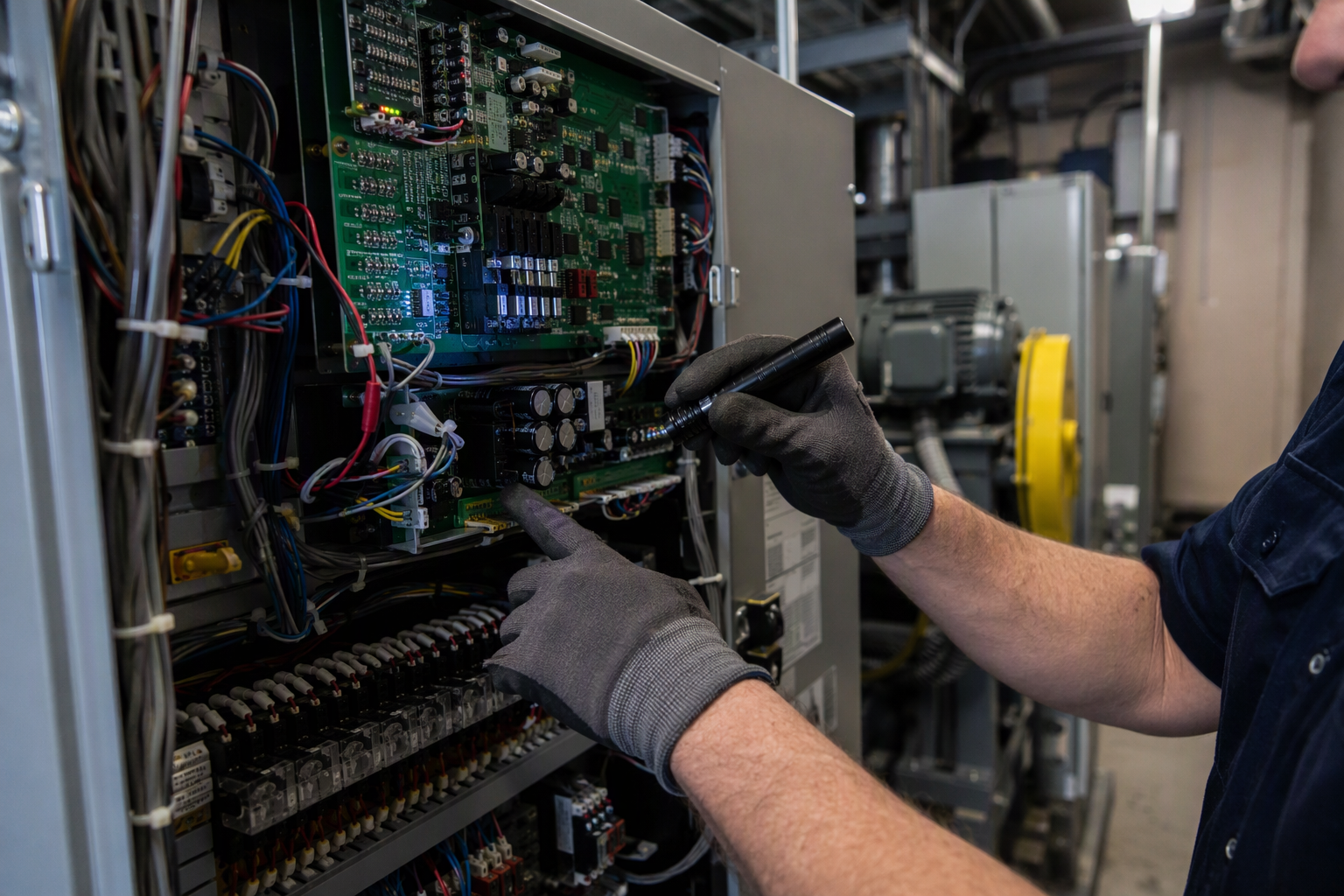
Repair pricing under a service contract depends on three factors: what the contract tier covers, whether the specific repair falls within that coverage, and how out-of-scope work is rated—either at a pre-negotiated discount or at standard time-and-material rates.
Service contracts are not uniform documents. A full-maintenance agreement typically bundles routine inspections, lubrication, adjustments, and the labor and parts for most mechanical and electrical repairs into a single monthly fee. A parts-and-labor agreement covers listed components but may exclude proprietary control systems, hydraulic cylinders, or cab finishes. An inspection-only or oil-and-grease agreement covers the minimum maintenance visits but leaves nearly all repair costs to be billed separately.
Within any tier, the contract should define a parts list or a schedule of covered assemblies. When a technician identifies a defective component, the first question is whether that component appears on the covered list. If it does, the repair cost to the owner is either zero or a capped co-pay depending on contract language. If it does not, the owner receives a separate repair quote—often at a rate that was pre-negotiated in the agreement itself.
What are the main types of elevator service contracts, and how does each affect repair costs?
The three primary contract structures—full-maintenance, parts-and-labor, and oil-and-grease—each create a different pricing relationship between the building owner and the service provider when a repair is needed.
Full-maintenance contracts offer the broadest coverage and carry the highest monthly fee. In exchange, the service provider absorbs most repair costs as part of the contract, which creates a strong financial incentive for the contractor to maintain equipment proactively rather than reactively. These contracts are most cost-effective for older equipment or high-use installations where repairs are frequent.
Parts-and-labor contracts cover a defined list of assemblies—commonly drive motors, brake assemblies, door operators, and selector systems—while excluding items like cab interiors, hoistway wiring added during a modernization, or proprietary microprocessor boards not originally covered. Repair costs for excluded items are billed as change orders.
Oil-and-grease (inspection-only) contracts cover only lubrication, minor adjustments, and the labor for scheduled maintenance visits. All parts and most labor for actual repairs are billed at time-and-material rates. These contracts carry the lowest monthly cost but the highest exposure to unplanned repair expenses.
What is a “covered” versus “excluded” repair, and how does that distinction affect what an owner pays?
A covered repair is one involving a component or labor category explicitly listed in the contract’s scope of work, meaning the contractor absorbs the cost; an excluded repair triggers a separate invoice, typically at time-and-material or pre-negotiated rates.
Common exclusions across all contract tiers include vandalism damage, hoistway structural work, pit waterproofing, code-compliance upgrades mandated after the contract was signed, and proprietary parts that require the original equipment manufacturer’s involvement. Cab renovation, pit lighting replacement beyond basic bulb changes, and ADA-required modifications are frequently excluded as well.
Building owners should request an itemized exclusion list before signing any agreement. Ambiguous language such as “normal wear and tear” can be interpreted narrowly by the contractor to exclude components that the owner assumed were covered. Clear contract language specifying covered assemblies by name or part category prevents disputes when a repair quote arrives.
How does the age and condition of equipment influence repair pricing under a contract?
Older or deteriorated equipment increases repair pricing risk because contractors price contracts to reflect the expected repair frequency and parts cost of the installed equipment, often applying surcharges or narrower coverage terms to aging units.
When a service provider inspects equipment before offering a contract, they assess the remaining useful life of major components such as the machine, controller, and hydraulic power unit. Equipment that has not been modernized within a reasonable timeframe may be offered only an oil-and-grease contract, or a full-maintenance contract with explicit carve-outs for the aging components most likely to fail.
In Arizona, conveyances installed before the current code adoption may remain in service under A.R.S. § 23-491 as long as the Industrial Commission of Arizona’s Elevator Division does not determine that continued use poses a hazard to life, health, or property. However, older equipment operating under that grandfather provision is often the most expensive to maintain because parts availability is limited, labor hours per repair are higher, and the probability of failure is greater.
How do time-and-material rates for out-of-contract repairs get calculated?
Time-and-material billing for out-of-contract elevator repairs is calculated by adding the actual cost of parts (often at a marked-up list price) to the labor hours required, multiplied by the applicable labor rate, plus any travel, freight, or crane charges.
Many service contracts pre-negotiate the labor rate and parts markup that apply to out-of-scope repairs. This is one of the most financially significant clauses in any agreement because it determines the actual cost exposure for excluded work. A contract that locks in a favorable labor rate and a reasonable parts markup—rather than leaving those rates to the contractor’s discretion at time of repair—protects the owner from market-rate exposure during emergency situations.
Straight-time versus overtime labor rates also matter. Emergency repairs that occur outside normal business hours, on weekends, or on holidays are commonly billed at a premium multiplier. Contracts that specify how overtime is defined and what multiplier applies give owners predictable cost structures even during after-hours breakdowns.
What role do Arizona’s regulatory requirements play in repair pricing?
Arizona’s mandatory inspection and certification requirements directly affect repair pricing because any repair that triggers a re-inspection—such as a modification or alteration—requires the owner to coordinate and pay for an inspection by the Industrial Commission of Arizona’s Elevator Division or an authorized private inspector before the unit can return to service.
Under A.R.S. §§ 23-491 through 23-491.16 and Arizona Administrative Code R20-5-502 through R20-5-515, every conveyance must hold a current annual certificate of inspection, and no conveyance may operate without one. If a repair crosses the threshold into an “alteration” as defined under the ASME A17.1-2019 Safety Code for Elevators and Escalators (the edition adopted in Arizona for equipment installed, repaired, or altered on or after January 1, 2023), an additional inspection and re-certification is required before the unit is placed back in service.
Arizona owners must also notify the state at least 90 days before installing, relocating, or altering a conveyance. Failure to provide that notice can result in a stop-work situation that adds both time and cost to a repair project. Service contracts that include permit coordination and inspection scheduling as part of the covered services reduce the administrative burden on building staff.
Within the City of Phoenix, the City of Phoenix Elevator Section (Planning and Development Department) handles inspections for equipment located inside city limits. Building owners in Phoenix should confirm whether their service contract explicitly addresses coordination with the City’s Elevator Section, since that coordination involves a separate process from the state-level ICA process that applies in Tucson, Scottsdale, Mesa, and unincorporated areas.
How does ASME A17.1-2019 compliance affect the cost of a covered repair in Arizona?
When a repair or replacement brings a component into scope under the ASME A17.1-2019 Safety Code for Elevators and Escalators, the contractor must ensure the replaced component meets the 2019 edition’s requirements, which can increase parts cost compared to installing a like-for-like legacy component.
Arizona adopted ASME A17.1-2019 effective January 9, 2023, applying it to equipment installed, repaired, or altered on or after January 1, 2023. This means that a repair performed today on a 1995 hydraulic elevator may require a modern replacement component that meets 2019 code specifications rather than the original design specification. The cost difference between a legacy part and a code-compliant modern equivalent is a legitimate repair cost that a service provider may pass through even under a full-maintenance contract if the contract language specifies code-upgrade costs as the owner’s responsibility.
Owners reviewing contract language should look specifically for clauses addressing “code compliance upgrades” or “regulatory changes.” If the contract requires the owner to fund upgrades mandated by changes in law or code adoption after the contract signing date, the owner carries that financial exposure. Negotiating a cap on the owner’s code-upgrade liability is a reasonable protective measure.
Does ADA compliance factor into elevator repair pricing under a service contract?
Yes—ADA compliance requirements can create repair costs that fall outside a standard service contract’s covered scope because ADA modifications are typically classified as alterations, not maintenance.
When a covered repair is performed on a passenger elevator that serves the public, contractors and building owners must be mindful that certain repairs—particularly to door timing, call button height, Braille signage, or audible signal systems—may trigger ADA compliance review if the repair constitutes an alteration under federal accessibility standards. ADA-required modifications to bring the unit into compliance are generally the building owner’s financial responsibility and are not absorbed by a maintenance contract.
Proactive owners incorporate an ADA accessibility checklist into their annual inspection process so that compliance gaps are identified and budgeted in advance rather than discovered during a repair visit that then triggers a compliance obligation.
What is a callback clause, and how does it protect owners from repeated repair charges?
A callback clause requires the service provider to return and correct a repair at no additional charge within a specified period if the same problem recurs after the initial fix, protecting the owner from paying multiple times for the same underlying defect.
Callback periods commonly range from 30 to 90 days depending on the component type and contract tier. A strong callback clause specifies that the contractor is responsible for both labor and parts on a callback, not just labor. Without a callback clause, an owner could face repeated invoices for what is effectively the same failed repair—a situation that is particularly costly for hydraulic system issues or door operator problems that are difficult to diagnose definitively in a single visit.
How does emergency versus scheduled repair pricing differ under a service contract?
Emergency repairs—those required to restore a disabled or unsafe elevator to service outside normal business hours—are typically priced at a higher labor rate than scheduled repairs, with contract terms governing whether that premium is absorbed by the contractor or passed to the owner.
Arizona law under A.R.S. § 23-491 requires owners to notify the state within 24 hours of any accident that injures a person or disables a conveyance. In practice, this creates urgency around after-hours repairs that can drive up costs if the contract does not pre-define emergency labor rates. Full-maintenance contracts from reputable providers often include after-hours emergency response as a covered service, but the definition of “emergency” and the labor rate structure should be explicit in the contract language.
What should an owner look for in a contract’s parts pricing terms?
Owners should look for explicit language defining whether parts are billed at list price, actual cost, or a pre-negotiated discount off list, and whether proprietary or OEM-required components are priced differently from generic replacements.
Some service contracts cap the per-incident parts cost the contractor will absorb before billing the owner. Others include a “betterment” clause under which the owner shares cost when a repair results in an upgrade rather than a like-for-like replacement. Understanding these terms before signing prevents unexpected invoices after a major component failure such as a hydraulic power unit replacement or a controller board failure on a microprocessor-based system.
How do multi-unit buildings or elevator portfolios affect contract pricing structures?
Buildings with multiple elevators or property owners with elevator portfolios across multiple locations typically qualify for volume pricing structures that lower the per-unit contract cost and may also improve the labor rate applied to out-of-scope repairs.
Bundling multiple units under a single contract with one service provider creates leverage in negotiations over coverage breadth, callback periods, emergency response terms, and out-of-contract labor rates. Arizona Elevator Solutions structures agreements for multi-unit clients across Phoenix, Tucson, Scottsdale, and Mesa to reflect the operational and administrative efficiencies of portfolio service, which can produce more favorable terms than individual unit contracts.
How do modernization projects interact with existing service contract pricing?
A modernization project typically voids or restructures the existing service contract because the scope of covered components changes substantially when a controller, drive system, or door operator is replaced with new equipment.
After modernization, the service provider reassesses the equipment and issues a revised or new contract reflecting the updated component list. Modernized equipment under the current ASME A17.1-2019 standard often requires fewer emergency repairs in the near term, which can make a broader coverage contract more financially favorable for the contractor and thus easier to negotiate for the owner.
Arizona owners undertaking a modernization must also notify the Industrial Commission of Arizona’s Elevator Division at least 90 days in advance under A.R.S. § 23-491, and the modernized unit must pass inspection and receive a new certificate of inspection before returning to service. These administrative costs and timelines should be factored into the total project budget.
What steps should a building owner take immediately when a repair is needed under an active contract?
When a repair need arises under an active service contract, owners should follow a documented process to ensure proper notification, cost authorization, and compliance with Arizona’s regulatory reporting requirements.
- Secure the elevator. If the unit is unsafe or has disabled a person, take it out of service immediately and post it as unavailable to prevent further use.
- Notify the service contractor. Contact the contractor through the emergency or service line specified in the contract. Document the date and time of the call and the name of the person notified.
- Report to the state if required. Under Arizona law, any accident that injures a person or disables a conveyance must be reported to the Industrial Commission of Arizona’s Elevator Division within 24 hours.
- Request a written scope of work before authorizing repairs. Ask the contractor to identify in writing whether the repair is covered under the contract or is a billable change order. Do not authorize out-of-contract work verbally without a written quote.
- Verify inspection requirements. If the repair qualifies as an alteration under ASME A17.1-2019, confirm that the contractor will coordinate the required re-inspection with the ICA Elevator Division or, for Phoenix properties, with the City of Phoenix Elevator Section.
- Document the repair record. Maintain copies of all service reports, inspection certificates, and repair invoices in the building’s elevator maintenance log. Arizona law requires the certificate of inspection to be kept at the same location as the conveyance.
How does contractor licensing in Arizona affect repair pricing accountability?
Only contractors holding an Arizona Registrar of Contractors R-12 or C-12 elevator license classification are authorized to install and repair elevators in Arizona, and working with a licensed contractor provides a layer of pricing accountability through the ROC’s disciplinary process.
The Arizona Registrar of Contractors licenses elevator contractors under R-12 (residential elevator contractor) and C-12 (commercial elevator contractor) classifications, which authorize the licensee to install and repair elevators, dumbwaiters, escalators, and moving walks. Building owners can verify a contractor’s ROC license status before engaging any service provider. Unlicensed repair work creates liability exposure for the building owner and may invalidate the conveyance’s certificate of inspection under Arizona Administrative Code R20-5-502 through R20-5-515.
Arizona Elevator Solutions holds the required Arizona Registrar of Contractors licensing to perform commercial elevator repair and maintenance work throughout Phoenix, Tucson, Scottsdale, and Mesa, providing building owners with the regulatory accountability that licensed contractor status requires.
What is a price escalation clause, and how does it affect multi-year elevator service contracts?
A price escalation clause allows the service provider to increase the monthly contract rate annually—typically tied to an index or a fixed percentage—which affects the total cost of covered repairs over the contract term.
Multi-year service contracts often include an annual escalation provision. Owners negotiating a new contract should understand the escalation formula: a capped percentage escalation provides cost predictability, while an uncapped index-linked escalation creates exposure if the underlying index rises sharply. Knowing the escalation terms also helps owners compare the total cost of contract options across different tier levels rather than focusing solely on the initial monthly rate.
How does private inspector use in Arizona affect repair and re-inspection costs?
Arizona owners may hire a private elevator inspector authorized by the Industrial Commission of Arizona to conduct initial or annual inspections, which can affect the scheduling and cost of re-inspections that are required after certain repairs.
Under A.R.S. §§ 23-491 through 23-491.16, Arizona permits the use of private inspectors who must register with the Industrial Commission of Arizona annually and demonstrate at least eight hours of approved continuing education. However, a private inspector may not inspect a conveyance owned, operated, or last serviced by the inspector, a company the inspector owns, or the inspector’s employer. This conflict-of-interest rule means that the service contractor cannot use their own inspector to certify work they performed—the re-inspection must be conducted by an independent party, which adds a coordination step and cost after certain repairs.
Building owners should confirm in their service contract which party is responsible for arranging and funding re-inspections after covered repairs that qualify as alterations. If that responsibility is left ambiguous, the owner may face an unexpected inspection fee after a major covered repair.
What benchmarks help an owner evaluate whether a contract pricing structure is reasonable?
A reasonable service contract pricing structure can be evaluated by comparing the tier of coverage offered against the scope of equipment, the age of the installation, local code compliance requirements, and the pre-negotiated rates for out-of-contract work.
The table below provides a framework for comparing the three primary contract structures across key pricing and coverage dimensions. Specific dollar figures vary by market, equipment type, and contractor—owners should use this framework as an evaluation structure rather than a price guide.
| Contract Tier | Typical Coverage Scope | Out-of-Scope Repair Exposure | Best Suited For | Key Negotiation Points |
|---|---|---|---|---|
| Full-Maintenance | Labor, most parts, inspections, callbacks, adjustments | Low — limited to defined exclusions (vandalism, cab finishes, code upgrades) | High-use equipment, older installations, buildings requiring cost predictability | Exclusion list specificity, callback period, emergency labor rate definition |
| Parts-and-Labor | Listed assemblies (motor, brake, door operator); inspections; labor for covered components | Moderate — proprietary boards, hydraulic cylinders, hoistway wiring often excluded | Mid-age equipment with known component risk areas | Parts markup rate, covered assembly list, per-incident parts cost cap |
| Oil-and-Grease (Inspection-Only) | Lubrication, minor adjustments, scheduled visit labor | High — virtually all parts and most repair labor billed separately | Newer equipment under manufacturer warranty, low-use installations | Pre-negotiated time-and-material rate, overtime multiplier cap, callback provision |
How can building owners in Phoenix, Tucson, Scottsdale, and Mesa reduce their out-of-pocket repair costs under a service contract?
Owners can reduce out-of-pocket exposure by selecting the appropriate contract tier for their equipment’s age and use intensity, negotiating pre-defined out-of-contract labor rates, and maintaining accurate maintenance logs that demonstrate ongoing compliance.
Proactive maintenance documentation is one of the most effective cost-reduction tools available to building owners. When a service contractor can demonstrate that a component was regularly maintained and inspected, warranty and coverage disputes are resolved more quickly in the owner’s favor. Arizona law requires the certificate of inspection to be kept at the conveyance location, and keeping a complete maintenance log alongside that certificate demonstrates regulatory compliance and operational diligence.
Engaging a service provider that is familiar with local Authority Having Jurisdiction requirements—including both the Industrial Commission of Arizona’s Elevator Division at the state level and the City of Phoenix Elevator Section for properties within Phoenix—reduces the risk of compliance gaps that create unplanned repair and re-inspection costs. Arizona Elevator Solutions works with commercial property owners across Phoenix, Tucson, Scottsdale, and Mesa to structure service agreements that align contract coverage with the actual risk profile of each installation.
How should owners handle a situation where the contractor claims a repair is excluded but the owner believes it is covered?
When a coverage dispute arises, the owner should follow the contract’s formal dispute resolution process, request written documentation of the contractor’s exclusion rationale, and if necessary, obtain an independent assessment of the repair classification.
The contract itself is the governing document in any coverage dispute. Owners should read the exclusion language against the specific component that failed and ask the contractor to cite the specific exclusion clause that applies. If the contract language is ambiguous, Arizona contract law principles generally apply, and the ambiguity may be interpreted in the non-drafting party’s favor—a point that gives owners some leverage in good-faith negotiations.
For disputes that cannot be resolved directly, Arizona Elevator Solutions can provide a third-party technical assessment of whether a repair classification is consistent with industry-standard contract interpretation for the Phoenix, Tucson, Scottsdale, and Mesa markets, helping building owners make informed decisions before escalating to formal dispute resolution.
Get Expert Guidance on Your Elevator Service Contract
Commercial elevator repair pricing under a service contract involves multiple variables—coverage tiers, exclusion language, Arizona regulatory requirements, and pre-negotiated out-of-contract rates—that directly affect what a building owner pays when a repair is needed. Understanding those variables before signing a contract is the most effective way to control long-term elevator maintenance costs.
Contact Arizona Elevator Solutions for a free elevator assessment. Whether you operate a single commercial elevator in Scottsdale or a multi-unit portfolio across Phoenix, Tucson, and Mesa, the team at Arizona Elevator Solutions will evaluate your current equipment condition, review your existing contract terms, and help you select or negotiate a service agreement that aligns coverage with your building’s actual risk profile.
Call Arizona Elevator Solutions today: 480-557-7600
Need elevator service you can rely on? Arizona Elevator Solutions is ready to help.