Elevator Diagnostic Service Charge: Complete FAQ for Arizona Building Owners
Elevator diagnostic service charges are fees assessed by a licensed elevator contractor to evaluate, troubleshoot, and identify the root cause of a malfunction or performance issue in an elevator system. The charge covers the technician’s time, travel, and specialized diagnostic equipment and is separate from any parts or repair labor billed afterward. In Arizona, these charges apply to all conveyance types regulated under A.R.S. §§ 23-491 through 23-491.16.
What Does an Elevator Diagnostic Service Charge Actually Cover?
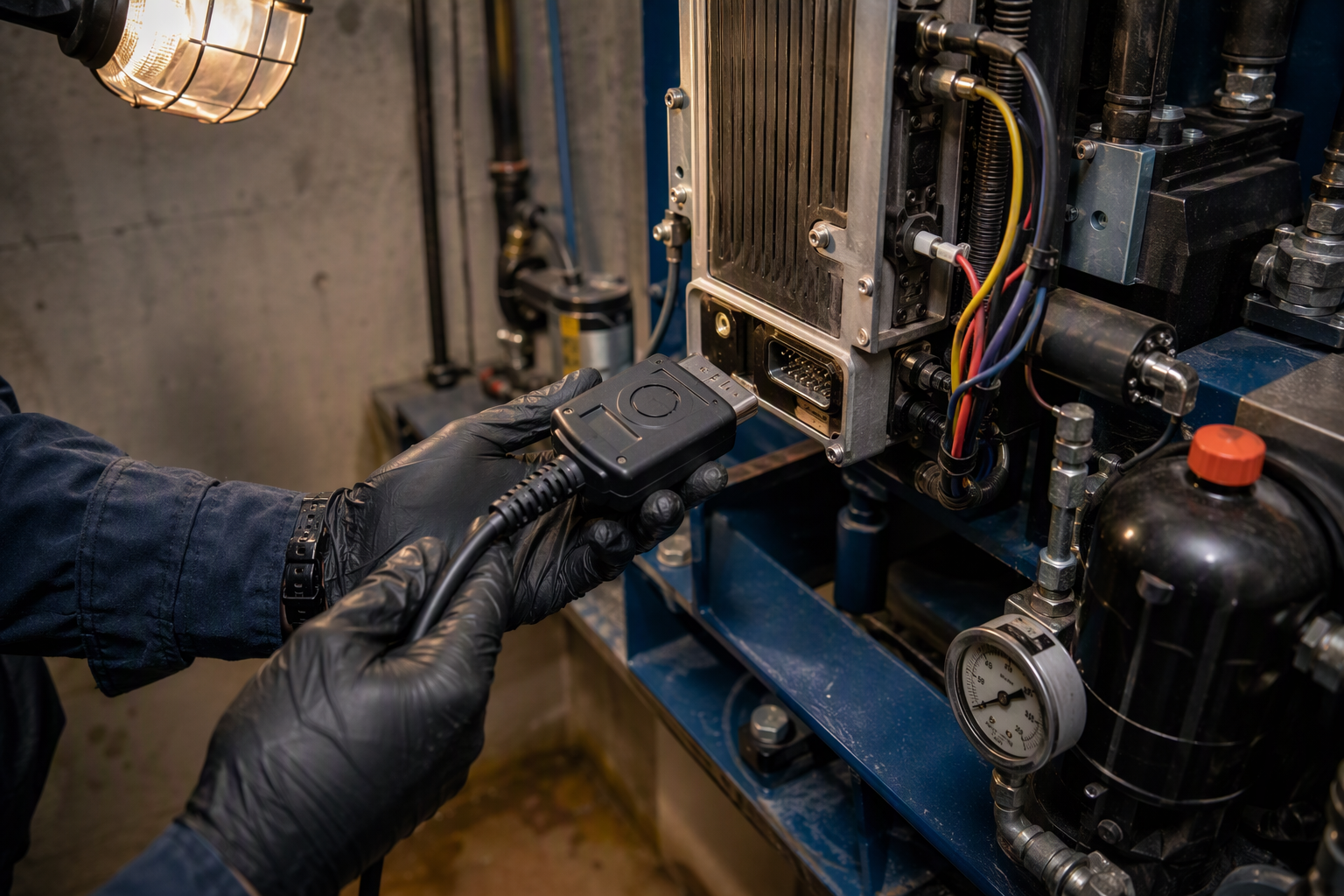
A diagnostic service charge covers the skilled labor required to inspect, test, and identify the specific fault or failure point within an elevator system — it does not include parts replacement or corrective repair work.
When an elevator malfunctions, the cause is rarely visible without systematic testing. A diagnostic visit typically involves reviewing the elevator’s fault log, testing electrical and mechanical components, checking safety circuits, and evaluating controller behavior. The charge compensates the contractor for this investigative work before any repair quote can be issued.
Depending on the service agreement in place, a diagnostic charge may be billed as a flat “trip fee,” an hourly rate for time spent on-site, or as part of a bundled service contract where such visits are covered. Building owners without a maintenance contract should expect to see a diagnostic line item on every service call invoice before repair costs are listed separately.
Why Do Elevator Companies Charge a Separate Diagnostic Fee?

Elevator companies charge a separate diagnostic fee because fault isolation on modern elevator systems requires certified expertise, proprietary tools, and significant time that cannot be recovered through parts sales alone.
Modern traction elevators, hydraulic systems, and machine-room-less (MRL) units each use proprietary controllers with manufacturer-specific diagnostic software. A technician may need to interface with a drive unit, download error codes, and trace signal paths across dozens of safety relays before identifying a failed component. That process has real labor costs regardless of whether a repair follows immediately.
The diagnostic charge also protects building owners from being quoted repair work they don’t need. A proper diagnosis ensures that the correct component is replaced the first time, avoiding repeat service calls and unnecessary downtime — particularly important in multi-tenant buildings in Phoenix and Scottsdale where elevator outages directly affect occupancy agreements.
What Factors Determine the Size of a Diagnostic Service Charge?
The diagnostic service charge is shaped by equipment type, system age, building location, time of service, and whether the property has an active maintenance contract.
Key factors include:
- Equipment type: Hydraulic, traction, MRL, platform lift, and dumbwaiter systems each require different diagnostic approaches and tools.
- System age and code edition: Equipment installed before January 1, 2023 operates under older ASME editions; equipment installed on or after that date must comply with ASME A17.1-2019 as adopted by Arizona, which may affect diagnostic complexity.
- After-hours service: Emergency diagnostic calls outside of standard business hours carry premium labor rates.
- Building access complexity: High-rise buildings, secured facilities, or equipment rooms with restricted access may add time to a diagnostic visit.
- Contract status: Properties with a full-service maintenance agreement frequently have diagnostic trip charges waived or reduced as a contractual benefit.
- Travel distance: Properties in outlying parts of the Phoenix metro or in Tucson may incur additional travel charges depending on the contractor’s dispatch location.
How Does an Elevator Diagnostic Charge Compare Across Service Contract Types?
The structure of a service agreement directly determines whether a diagnostic charge is billed separately or absorbed into a monthly maintenance fee.
| Service Agreement Type | Diagnostic Trip Charge | Parts Coverage | Labor for Repairs | Best Suited For |
|---|---|---|---|---|
| No Contract (Time & Material) | Billed per visit | Billed separately | Billed at hourly rate | Low-use or single-stop elevators |
| Basic Maintenance Contract | Often waived for scheduled visits; billed for emergency calls | Consumables only | Discounted rate | Small commercial buildings |
| Full-Service / Comprehensive Contract | Typically included | Covered up to defined limits | Included | High-traffic commercial or residential properties |
| Modernization / Major Repair Package | Diagnostic included in project scope | Covered per contract | Included in project bid | Aging systems needing upgrade |
Building owners in Mesa and Tucson who operate multiple elevators often find that a comprehensive service agreement eliminates the unpredictability of per-visit diagnostic charges. Arizona Elevator Solutions can evaluate the right contract structure based on each property’s usage patterns and regulatory obligations.
Is an Elevator Diagnostic Service the Same as an Annual Inspection?
No — a diagnostic service call addresses a specific malfunction or performance concern, while an annual inspection is a compliance-driven evaluation required by Arizona law regardless of whether the elevator is experiencing problems.
Under A.R.S. § 23-491 et seq., every conveyance in Arizona must be inspected annually, and no elevator may operate without a valid certificate of inspection issued by the state. The Industrial Commission of Arizona’s Elevator Division administers this requirement. An annual inspection evaluates code compliance across all safety systems; a diagnostic service call is narrowly focused on identifying why a specific fault or behavior is occurring.
Confusing the two can create compliance gaps. A building owner who schedules a diagnostic call after a malfunction may still have a separate annual inspection obligation approaching — and skipping that inspection can result in an elevator being placed out of service by the state. The owner must also keep the certificate of inspection at the same location as the conveyance and ensure the state serial number is posted in or near the elevator, as required by Arizona Administrative Code R20-5-502 through R20-5-515.
What Happens During an Elevator Diagnostic Visit?
A diagnostic visit follows a structured process designed to isolate the fault efficiently, minimize equipment downtime, and produce a documented finding that supports a repair authorization.
- Review the service history: The technician examines the elevator’s maintenance log, prior service records, and any fault codes stored in the controller to identify recurring patterns.
- Conduct a visual and operational inspection: The technician rides the elevator, observes behavior, listens for abnormal sounds, and checks door operation, leveling accuracy, and ride quality.
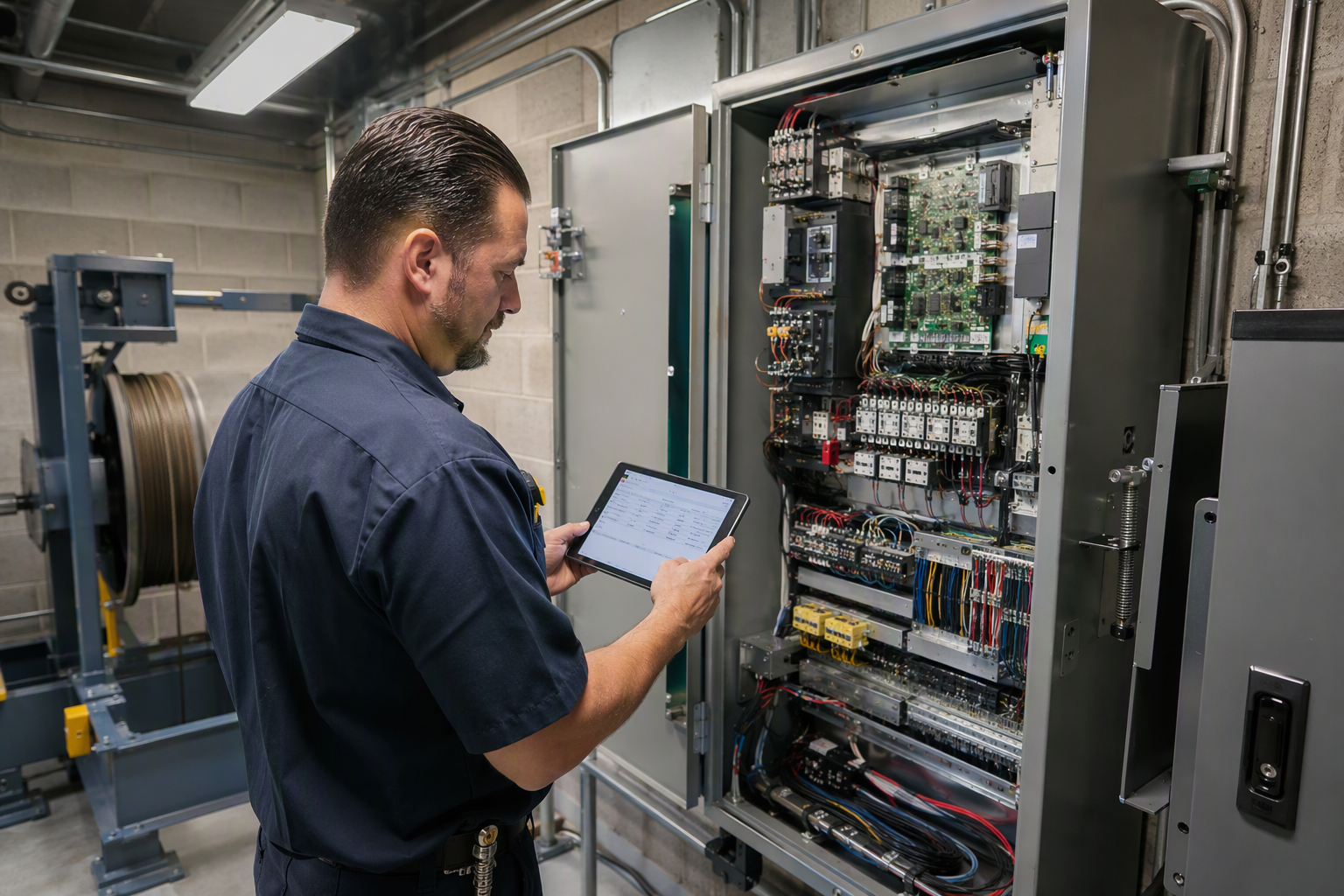
- Access the controller and machine room: Electrical panels, drive units, and safety relay boards are inspected for visible damage, loose connections, or burned components.
- Run diagnostic software: For modern controllers, fault logs are downloaded and analyzed using manufacturer-specific diagnostic tools.
- Test individual safety circuits: Safeties, buffers, limit switches, and interlocks are tested individually to rule out false fault triggers.
- Identify the root cause: Once the fault is isolated, the technician documents the finding, notes any secondary conditions, and provides a written summary to the building owner.
- Provide a repair recommendation: A scope of work and parts list is delivered, allowing the owner to authorize repairs or seek a second opinion.
Can a Diagnostic Visit Reveal Code Compliance Issues That Require Separate Work?
Yes — a diagnostic visit frequently uncovers code deficiencies that are separate from the original malfunction and may require corrective action to maintain the elevator’s legal operating status in Arizona.
When a technician accesses a machine room or controller cabinet, conditions unrelated to the reported fault may be visible — worn ropes, degraded buffers, door operator issues, or safety devices that no longer meet the requirements of ASME A17.1-2019 as adopted by Arizona for equipment installed or altered on or after January 1, 2023. For older equipment installed before that date, the applicable legacy edition applies, but Arizona law still allows the state’s elevator chief to order equipment out of service if it poses a hazard to life, health, or property.
Building owners should understand that a diagnostic charge and a compliance remediation project are distinct billing events, even when discovered in the same visit. Arizona Elevator Solutions provides clear written documentation separating the diagnostic finding from any code-driven corrective work so owners can make informed decisions.
How Does the Arizona Regulatory Framework Affect Diagnostic and Repair Decisions?
Arizona’s elevator regulatory framework requires that all installation, repair, and alteration work be performed by contractors holding the appropriate license from the Arizona Registrar of Contractors, and that the resulting work be subject to state oversight — which means a diagnostic finding can trigger formal regulatory obligations.
The Industrial Commission of Arizona’s Elevator Division (formerly the ADOSH Elevator Safety Section prior to September 12, 2026) regulates all conveyances in Arizona except those within the City of Phoenix, where the City of Phoenix Elevator Section of the Planning and Development Department has local jurisdiction. For Phoenix properties, owners should confirm which authority governs their specific equipment.
The Arizona Registrar of Contractors issues R-12 (residential) and C-12 (commercial) elevator license classifications. Only contractors holding these classifications are authorized to install and repair elevators, dumbwaiters, escalators, and moving walks in Arizona. Before authorizing repair work arising from a diagnostic finding, building owners should verify that their service provider holds the applicable Arizona Registrar of Contractors license classification.
Additionally, Arizona owners must notify the state at least 90 days before installing, relocating, or altering a conveyance, and within 24 hours of any accident that injures a person or disables a conveyance. A diagnostic visit that reveals the need for major alteration work therefore starts a regulatory notification clock that owners must be prepared to meet.
What Is the Difference Between a Diagnostic Charge and a Repair Estimate?
A diagnostic charge is a fee for the technical work of identifying a fault; a repair estimate is a no-cost or separately billed document that quantifies the labor and materials needed to correct the fault once it has been identified.
Some contractors bundle the diagnostic work into a free estimate, absorbing the labor cost as a sales activity. Others — particularly for complex systems or emergency calls — bill the diagnostic work as a standalone line item regardless of whether the building owner proceeds with the repair. Building owners should clarify this distinction before a technician is dispatched to avoid unexpected charges on the invoice.
For transparency, Arizona Elevator Solutions provides building owners in Phoenix, Tucson, Scottsdale, and Mesa with documented service findings that clearly separate diagnostic labor from proposed repair costs.
Does ADA Compliance Factor Into Elevator Diagnostic and Repair Decisions?
Yes — when a diagnostic visit reveals an elevator that is out of service or operating with degraded function, building owners must consider their obligations under the Americans with Disabilities Act regarding accessible route maintenance.
The ADA requires that accessible routes remain operational, and an elevator that serves as the only accessible path to a floor creates a legal exposure when it is disabled. While the ADA does not set specific diagnostic or repair timelines for private elevator malfunctions, the practical obligation to restore accessible service quickly is significant — especially for commercial properties, hotels, and multi-family housing in Phoenix, Scottsdale, and Tucson where ADA compliance is actively enforced.
Prioritizing diagnostic speed and repair authorization for elevators on accessible routes is both a legal risk-management strategy and a customer service obligation for building operators.
How Often Should Elevators Be Serviced to Minimize the Need for Diagnostic Calls?
Regular preventive maintenance performed at intervals consistent with the equipment manufacturer’s recommendations and the requirements of ASME A17.1-2019 is the most effective way to reduce unplanned diagnostic service calls.
ASME A17.1 establishes maintenance, inspection, and testing requirements for elevators, including periodic examinations and tests. Preventive maintenance programs that follow these requirements address lubrication, adjustment, safety device testing, and component wear assessment before failures occur. Properties that defer maintenance to save costs typically experience higher diagnostic call frequency and larger repair bills when systems fail under load rather than during controlled maintenance inspections.
Arizona’s annual inspection requirement provides a minimum regulatory floor, but manufacturers and industry standards generally call for more frequent scheduled maintenance — particularly for high-traffic commercial elevators in dense urban markets like Phoenix and Mesa.
What Should a Building Owner Do Immediately After an Elevator Malfunction?
After an elevator malfunction, building owners should follow a structured response protocol to protect occupants, preserve compliance, and establish a clear record for the diagnostic technician.
- Secure the elevator: If the elevator is behaving abnormally, take it out of service immediately by posting it as unavailable and preventing passenger use.
- Confirm no one is trapped: Contact building security or the elevator’s emergency phone line to verify no passengers are in the cab. If passengers are trapped, contact emergency services and do not attempt a manual rescue without trained personnel.
- Document the incident: Record the date, time, floor where the failure occurred, reported symptoms, and any witness accounts. This documentation is essential for the technician’s diagnostic process.
- Notify the state within 24 hours if required: Under Arizona law, if the malfunction injured a person or disabled the conveyance, the owner must notify the Industrial Commission of Arizona’s Elevator Division within 24 hours, as required by A.R.S. § 23-491 et seq.
- Contact a licensed elevator contractor: Dispatch a contractor holding the appropriate Arizona Registrar of Contractors R-12 or C-12 license classification to perform the diagnostic evaluation.
- Preserve the fault environment: Where possible, do not reset controller fault codes or attempt informal repairs before the technician arrives, as this can erase diagnostic data.
- Provide access: Ensure the machine room, controller cabinet, and pit are accessible to the technician upon arrival.
Are Diagnostic Charges Different for Hydraulic Versus Traction Elevators?
Yes — hydraulic and traction elevator systems have fundamentally different mechanical and electrical architectures, which affects the scope and complexity of diagnostic work and can influence the associated charge.
Hydraulic elevator diagnostics frequently involve oil system analysis, cylinder integrity assessment, valve unit testing, and leak detection — all requiring specialized tools and often more time than traction elevator electrical fault-tracing. Traction elevator diagnostics, particularly on variable-frequency drive (VFD) systems, require interfacing with complex drive software and can involve rope, sheave, and brake system evaluations that hydraulic systems do not share.
Platform lifts and stairway chairlifts installed, repaired, or altered on or after January 1, 2023 must comply with ASME A18.1-2020 under Arizona regulations. Diagnostic work on these units follows a different technical path than commercial elevator diagnostics, and building owners should ensure their service provider has specific experience with the applicable equipment type.
How Do Diagnostic Findings Relate to Elevator Modernization Decisions?
A diagnostic finding that reveals aging components, discontinued parts, or repeated systemic failures often becomes the business case for an elevator modernization project rather than a piecemeal repair strategy.
When a diagnostic visit documents that a controller, motor, or rope system is beyond economical repair — particularly on equipment that predates Arizona’s adoption of ASME A17.1-2019 — building owners face a decision about whether to repair or modernize. Modernization may bring older equipment into alignment with current code requirements, extend useful service life, and reduce ongoing diagnostic and repair call frequency. Any modernization constitutes an alteration under Arizona law, triggering the requirement to notify the Industrial Commission of Arizona’s Elevator Division at least 90 days in advance.
What Documentation Should a Building Owner Receive After a Diagnostic Visit?
After a diagnostic visit, a building owner should receive a written service report that documents the fault found, the diagnostic method used, any secondary conditions observed, the recommended corrective action, and a clear breakdown of the diagnostic charge versus any proposed repair costs.
This documentation serves multiple purposes: it provides the basis for repair authorization, supports recordkeeping obligations under Arizona administrative rules, and creates evidence of due diligence if a regulatory inquiry or accident investigation follows. In Phoenix, where the City of Phoenix Elevator Section has local jurisdiction, documentation of service activity may also be relevant to local compliance reviews.
Building owners should retain diagnostic service reports as part of the permanent elevator maintenance record maintained at the building, alongside the required Arizona certificate of inspection and the posted state serial number documentation.
How Does the City of Phoenix’s Local Jurisdiction Affect Diagnostic and Repair Service?
Elevators located within the City of Phoenix fall under the jurisdiction of the City of Phoenix Elevator Section within the Planning and Development Department rather than the statewide Industrial Commission of Arizona Elevator Division — which affects permit requirements and inspection authority for repair work following a diagnostic finding.
Building owners with Phoenix properties should confirm with the City of Phoenix Elevator Section whether a repair arising from a diagnostic finding requires a local permit before work proceeds. For properties in Tucson, Scottsdale, and Mesa that are outside Phoenix city limits, the Industrial Commission of Arizona’s Elevator Division is the relevant authority for compliance questions related to diagnostic findings and subsequent repairs.
Arizona Elevator Solutions serves all four markets and is familiar with the distinct requirements that apply in each jurisdiction.
Can Building Owners Reduce Diagnostic Charges by Gathering Information Before Calling?
Yes — building owners who document symptoms, collect fault code readouts where accessible, and gather basic equipment information before placing a service call can meaningfully reduce the time a technician spends on-site during a diagnostic visit, which can lower the overall charge on time-and-material invoices.
Useful pre-call information includes: the elevator’s state serial number (found on the tag fixed to the controller or mainline disconnect), the make and model of the controller, a description of when symptoms occur (time of day, load conditions, specific floors), any error codes displayed on in-cab indicators, and the date of the most recent service visit. Providing this information to the dispatcher allows the technician to arrive with the correct tools and potentially with relevant replacement parts, reducing diagnostic time.
What Role Does OSHA Play in Elevator Diagnostic and Service Activities?
The Occupational Safety and Health Administration (OSHA) regulates the working conditions of elevator technicians performing diagnostic and repair activities, including lockout/tagout procedures, machine room safety, and pit entry protocols — separate from the building owner’s elevator compliance obligations under Arizona state law.
OSHA’s general industry and construction standards require that elevator service technicians follow specific energy control procedures when working on powered equipment. Building owners are not directly responsible for a contractor’s OSHA compliance but should ensure their service provider follows proper safety protocols during diagnostic visits, particularly when pit access, machine room entry, or working on energized components is involved. A contractor’s adherence to OSHA standards is a meaningful indicator of overall professionalism and technical discipline.
How Should Building Owners Evaluate and Compare Elevator Service Providers for Diagnostic Work?
Building owners evaluating elevator service providers for diagnostic work should assess licensing credentials, equipment-specific expertise, transparency in charge structure, documentation practices, and familiarity with Arizona’s regulatory requirements.
Key evaluation criteria include:
- Arizona ROC license: Confirm the contractor holds an R-12 or C-12 license classification from the Arizona Registrar of Contractors before authorizing any diagnostic or repair work.
- Equipment familiarity: Ask whether the provider has specific experience with your elevator’s make, model, and controller type — proprietary systems require manufacturer-specific diagnostic tools.
- Charge transparency: Request a written explanation of how diagnostic charges are structured before the visit — flat fee, hourly, or contract-inclusive.
- Documentation standard: Ask what written documentation the provider delivers after a diagnostic visit, and confirm it includes fault findings and repair recommendations as separate line items.
- Regulatory knowledge: The provider should be fluent in Arizona’s requirements under A.R.S. §§ 23-491 through 23-491.16, the Industrial Commission of Arizona Elevator Division’s role, and local jurisdiction distinctions in Phoenix.
- Service area: Confirm the provider serves your specific market — Phoenix, Tucson, Scottsdale, or Mesa — and understand how travel distance affects charges.
Arizona Elevator Solutions serves building owners across Phoenix, Tucson, Scottsdale, and Mesa with diagnostic and service work grounded in Arizona’s specific regulatory framework.
What Are the Consequences of Deferring an Elevator Diagnostic After a Known Malfunction?
Deferring a diagnostic evaluation after a known elevator malfunction creates compounding risks — including passenger safety exposure, accelerating mechanical damage, potential regulatory violations, and expanded liability for the building owner.
An elevator exhibiting a known fault that continues to operate without diagnosis may experience a secondary failure that causes passenger entrapment, injury, or a reportable accident triggering the Arizona owner’s 24-hour notification obligation to the Industrial Commission of Arizona Elevator Division under A.R.S. § 23-491 et seq. A documented failure to act promptly after a known malfunction significantly worsens the building owner’s legal position in any subsequent liability action.
From a mechanical standpoint, faults that are inexpensive to correct in isolation — a misadjusted door cam, a degraded buffer, a loose safety relay connection — become far costlier when they cascade into damage to major components. Timely diagnostic service is an asset protection strategy as well as a safety and compliance obligation.
Get a Free Elevator Assessment for Your Arizona Property
Whether your elevator is showing signs of a malfunction, approaching its annual inspection date, or due for a modernization evaluation, Arizona Elevator Solutions is ready to help building owners in Phoenix, Tucson, Scottsdale, and Mesa understand their diagnostic and compliance obligations. The team brings deep familiarity with Arizona’s regulatory framework under the Industrial Commission of Arizona Elevator Division and the requirements of ASME A17.1-2019 as adopted by Arizona.
Contact Arizona Elevator Solutions for a free elevator assessment: 480-557-7600
Need elevator service you can rely on? Arizona Elevator Solutions is ready to help.