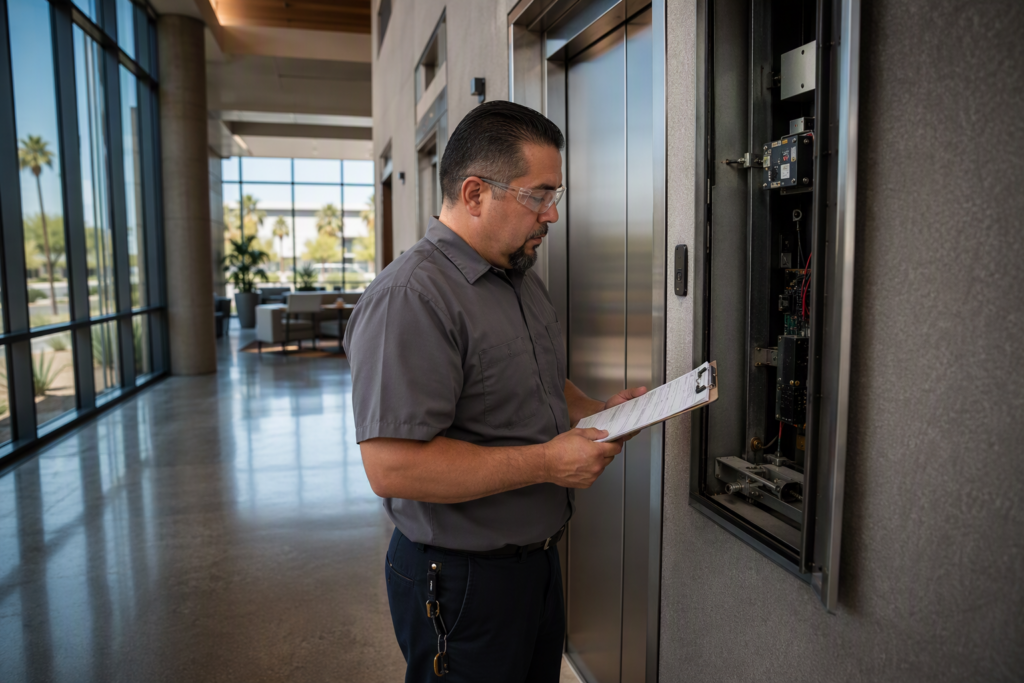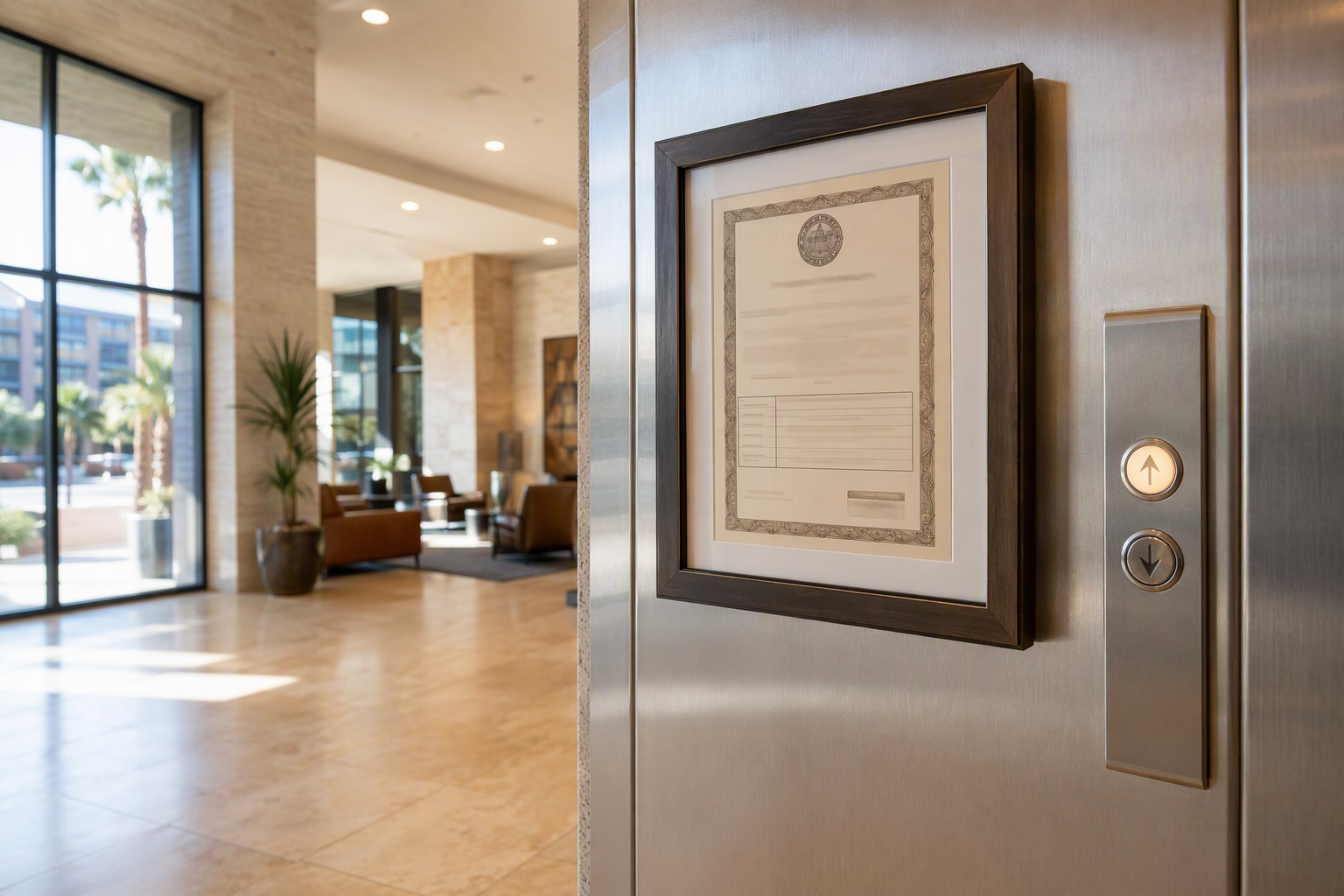
Elevator compliance is the ongoing process of meeting all federal, state, and local safety codes that govern the installation, operation, maintenance, and inspection of elevators and related conveyances. In Arizona, compliance is enforced by the Industrial Commission of Arizona (ICA) Elevator Division under A.R.S. §§ 23-491 through 23-491.16. Equipment must hold a current annual certificate of inspection, conform to the adopted edition of the ASME A17.1 Safety Code for Elevators and Escalators, and satisfy ADA accessibility requirements where applicable. Owners who fall out of compliance risk equipment shutdown, civil liability, and fines.
What does elevator compliance mean for Arizona building owners?
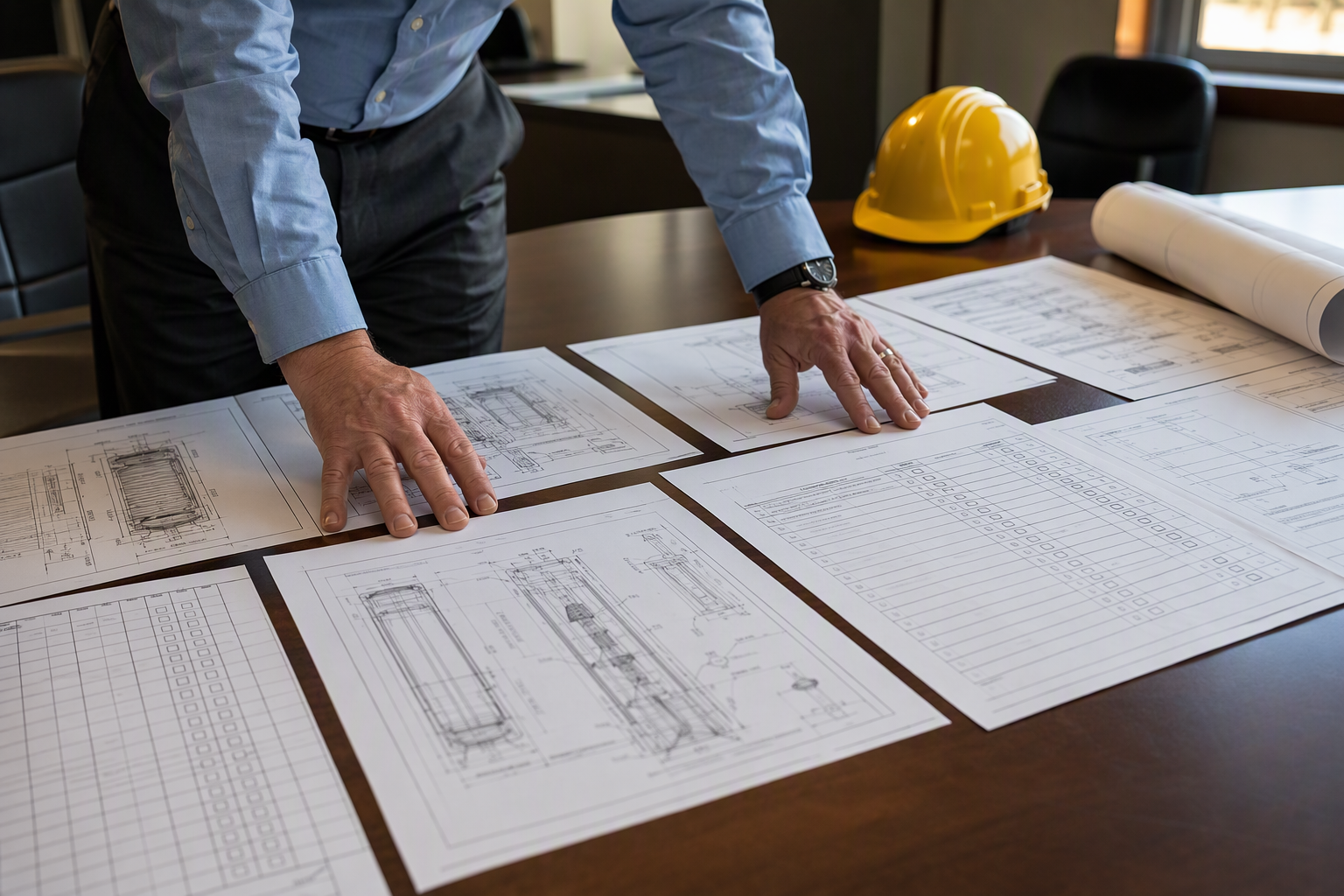
Elevator compliance means an Arizona building owner is legally responsible for ensuring every conveyance on their property is inspected on schedule, holds a current state certificate, and operates in accordance with the adopted safety code.
Under A.R.S. §§ 23-491 through 23-491.16, as amended by Laws 2026, Ch. 73, the obligation rests squarely with the owner or operator — not the maintenance contractor. Compliance covers initial inspection before first use, inspection after any modification or alteration, and annual inspection thereafter. A conveyance may not legally operate in Arizona without a valid annual certificate of inspection issued by the state.
Arizona Administrative Code R20-5-502 through R20-5-515 specifies the procedural rules governing conveyance safety, and the ASME A17.1-2019 is the adopted technical standard for equipment installed, repaired, or altered on or after January 1, 2023.
Which Arizona agency regulates elevator compliance?
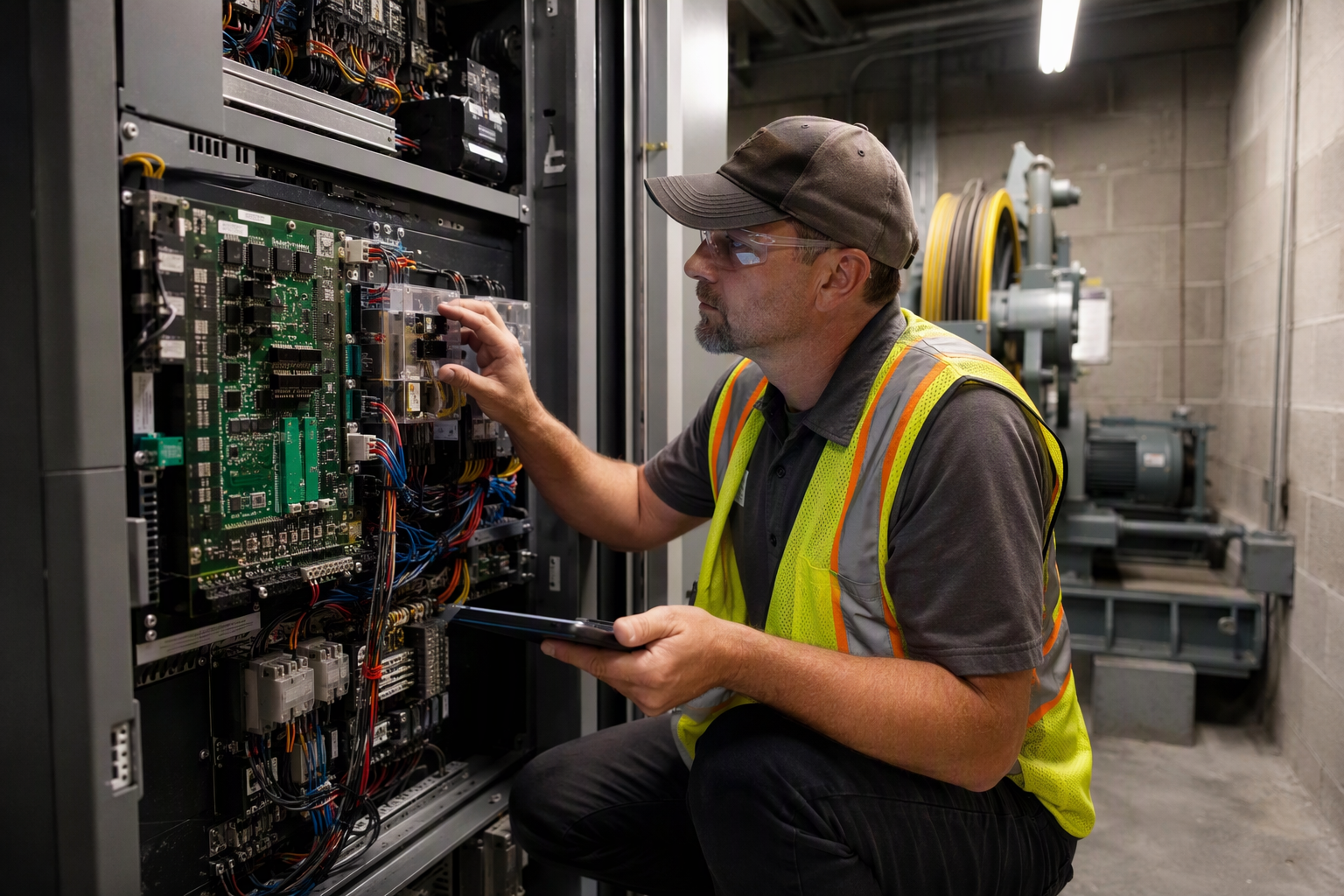
The Industrial Commission of Arizona (ICA) Elevator Division is the state regulator for elevator compliance in Arizona, having taken over from the former ADOSH Elevator Safety Section effective September 12, 2026.
Prior to September 12, 2026, the function was carried out by the ADOSH Elevator Safety Section. Under Laws 2026, Ch. 73, authority was transferred to the ICA Elevator Division, which now administers all permitting, inspection oversight, certificate issuance, and enforcement statewide — except within the City of Phoenix, where the City of Phoenix Elevator Section (Planning and Development Department) retains jurisdiction over elevators, escalators, moving walks, dumbwaiters, and chairlifts inside city limits.
Building owners in Phoenix should coordinate with both the City of Phoenix Elevator Section and, where applicable, the ICA Elevator Division. Owners in Tucson, Scottsdale, and Mesa work directly with the ICA Elevator Division. Arizona Elevator Solutions assists clients in all four markets in identifying the correct authority having jurisdiction (AHJ) for their specific property.
What is the ASME A17.1 code and why does it matter for Arizona compliance?
ASME A17.1 is the Safety Code for Elevators and Escalators — the primary technical standard Arizona has adopted, making it legally binding for all covered conveyances installed, repaired, or altered on or after January 1, 2023.
Arizona adopted the ASME A17.1/CSA B44, 2019 edition, effective January 9, 2023. The code covers design, construction, operation, inspection, testing, maintenance, alteration, and repair of elevators, escalators, moving walks, dumbwaiters, material lifts, and related conveyances. Specific sections address safety devices, hoistway enclosures, machine rooms, control systems, and firefighters’ emergency operation — all areas evaluated during a compliance inspection.
For older equipment lawfully installed before the 2019 edition took effect, Arizona allows continued operation provided the ICA Elevator Division’s chief does not determine the use to be a hazard to life, health, or property. Owners of legacy equipment should obtain a documented assessment to confirm their ongoing compliance posture.
How often must elevators be inspected in Arizona?
Arizona requires every conveyance to be inspected before it first goes into service, after any modification or alteration, and at least annually thereafter to maintain a valid certificate of inspection.
The annual inspection is not optional — no conveyance may legally operate in Arizona without a current certificate. Owners should schedule inspections well in advance of certificate expiration to avoid lapses that could require equipment shutdown. The certificate must be kept at the same location as the conveyance and made available for inspection on request; additionally, the state serial number or the certificate must be posted in or near the conveyance in an easily accessible location.
Who is authorized to inspect elevators in Arizona?
In Arizona, inspections may be performed by ICA Elevator Division inspectors or by private elevator inspectors who are authorized and registered with the Industrial Commission of Arizona.
Private inspectors must register with the commission every year and demonstrate at least eight hours of approved continuing education to maintain their authorization. Critically, a private inspector may not inspect any conveyance owned, operated, or last serviced by the inspector themselves, a company the inspector owns, or the inspector’s employer — this conflict-of-interest rule protects the integrity of the compliance process.
Building owners should verify that any private inspector they engage holds a current registration with the ICA Elevator Division. Hiring an authorized inspector does not shift legal compliance obligations away from the owner; the owner remains fully responsible under A.R.S. §§ 23-491 through 23-491.16.
What are Arizona’s notification requirements for elevator installation or alteration?
Arizona owners must notify the state at least 90 days before installing, relocating, or altering any conveyance, and must notify the state within 24 hours of any accident that injures a person or disables the conveyance.
The 90-day advance notice requirement applies to new installations, equipment relocations, and alterations — giving the ICA Elevator Division time to schedule the required pre-service inspection. Failing to provide this notice before work begins can result in regulatory penalties and may require the equipment to be idled until a compliant inspection is completed.
The 24-hour accident reporting requirement is equally strict. An accident that injures any person or disables the conveyance triggers immediate notification obligations. Owners should establish an internal emergency response procedure so that facility managers know exactly how to report incidents without delay.
What should building owners do immediately after an elevator accident in Arizona?
Arizona law requires the owner to notify the state within 24 hours of any elevator accident that injures a person or disables the conveyance — making rapid, documented action essential.
- Secure the scene and prevent further access to the affected conveyance.
- Ensure any injured persons receive prompt medical attention and document the incident.
- Contact the ICA Elevator Division (or the City of Phoenix Elevator Section if the equipment is inside Phoenix city limits) within 24 hours to report the accident, as required under A.R.S. §§ 23-491 through 23-491.16.
- Preserve all physical evidence and do not alter the equipment until authorized by the relevant AHJ.
- Document the state serial number of the affected conveyance (found on the tag fixed to the controller or mainline disconnect) so it can be included in the report.
- Engage an authorized elevator service provider to assess the equipment before it is returned to service.
- Retain all inspection records, maintenance logs, and certificates of inspection in preparation for any regulatory review.
Arizona Elevator Solutions provides post-incident assessment services in Phoenix, Tucson, Scottsdale, and Mesa to help owners navigate the regulatory reporting process and return equipment to safe operation.
What do the ADA accessibility requirements add to elevator compliance?
The Americans with Disabilities Act (ADA) imposes accessibility requirements — separate from Arizona’s safety codes — that apply to most commercial elevators and require features such as specific cab dimensions, door timing, tactile controls, and audible floor announcements.
The ADA’s Standards for Accessible Design specify minimum cab interior dimensions, door reopening devices, floor buttons and Braille signage, two-way emergency communication systems, and leveling accuracy. These requirements apply to places of public accommodation and commercial facilities and are enforced through both federal civil rights law and local building codes.
ADA compliance is evaluated separately from the ASME A17.1 safety inspection, meaning an elevator can pass its annual safety inspection and still be out of ADA compliance. Building owners should conduct periodic ADA accessibility audits as part of a comprehensive compliance program, particularly following renovations or tenant changes that alter how a building is used.
What is the Arizona Firefighters Service (AZFS) key requirement?
Any Arizona conveyance equipped with firefighters’ emergency operation must use the Arizona Firefighters Service (AZFS) key — a state-specific keying standard that ensures uniformity for emergency responders.
This requirement means that elevator contractors performing installation, alteration, or maintenance on fire service-capable equipment must use the AZFS key rather than generic or manufacturer-specific keys. Building owners should verify that their elevator’s firefighters’ emergency operation is keyed to the AZFS standard, as non-compliant keying is a code violation that will be flagged during inspection.
What elevator contractor license is required in Arizona?
The Arizona Registrar of Contractors (ROC) issues R-12 (residential) and C-12 (commercial) elevator contractor license classifications, which authorize licensees to install and repair elevators, dumbwaiters, escalators, and moving walks in Arizona.
Building owners should verify that any contractor performing elevator installation or repair holds a current R-12 or C-12 license from the Arizona ROC. It is important to note that the ROC license authorizes the contractor to perform the work — it does not issue the annual certificate of inspection, which is the exclusive responsibility of an ICA-authorized inspector. These are two distinct credentials serving two distinct compliance functions.
How does elevator compliance differ for platform lifts and stairway chairlifts in Arizona?
Platform lifts and stairway chairlifts installed, repaired, or altered in Arizona on or after January 1, 2023 must comply with ASME A18.1-2020, the Safety Standard for Platform Lifts and Stairway Chairlifts, rather than ASME A17.1.
These conveyances are still subject to the same general inspection, certification, and notification requirements under A.R.S. §§ 23-491 through 23-491.16 — including the requirement for an annual certificate of inspection and the 90-day advance notice before installation or alteration. Owners of platform lifts and chairlifts in commercial or multifamily settings should ensure their maintenance and inspection program specifically references ASME A18.1-2020 to avoid compliance gaps.
What records must Arizona building owners maintain for elevator compliance?
Arizona owners must keep the state certificate of inspection at the same location as the conveyance, post the state serial number or certificate in an easily accessible location near the conveyance, and make both available for inspection on request.
Beyond these statutory minimums, a defensible compliance program should include maintenance logs documenting all service visits, repair records tied to specific components, test reports for required periodic tests under the applicable ASME standard, and accident reports. Organized records protect owners during regulatory inspections and are critical evidence in the event of a liability claim. Arizona Elevator Solutions recommends that clients maintain a dedicated compliance file for each conveyance on their property.
What is a state serial number and where is it found on an Arizona elevator?
Every Arizona conveyance is assigned a unique state serial number by the ICA Elevator Division; the number appears on a tag fixed to the controller or mainline disconnect of the equipment.
The serial number is the state’s primary identifier for tracking inspection history, certificate status, and regulatory correspondence. Owners should record this number in their compliance files and reference it in any communications with the ICA Elevator Division or the City of Phoenix Elevator Section. If a serial number tag is missing or illegible, the owner should notify the relevant AHJ promptly, as missing identification is a compliance issue in its own right.
Can older elevators remain in service if they were installed before the current Arizona code?
Yes — Arizona’s laws allow lawfully installed older conveyances to remain in service, but only as long as the ICA Elevator Division’s chief does not determine that continued operation poses a hazard to life, health, or property.
This “grandfathering” provision under A.R.S. §§ 23-491 through 23-491.16 does not exempt older equipment from annual inspection or certificate requirements. If an inspection reveals conditions the state considers hazardous, the equipment can be ordered out of service regardless of its installation date. Proactive maintenance, documentation, and periodic safety assessments are the most effective ways to protect the operational status of legacy equipment.
How does elevator compliance interact with OSHA requirements?
OSHA standards apply to elevators used in construction and general industry workplaces, adding a layer of federal workplace safety compliance that operates alongside Arizona’s state elevator safety laws.
For building owners and facility managers, the most relevant OSHA intersection typically involves elevators in construction sites or industrial facilities, where OSHA’s general duty clause and specific standards for powered platforms and material hoists may apply. Commercial passenger elevators in office or retail buildings are primarily regulated under Arizona’s AHJ framework, but any elevator used as part of workplace operations should be reviewed against applicable OSHA standards as well. Owners uncertain about their OSHA obligations should consult a qualified safety professional in addition to ensuring state elevator compliance.
What is the compliance process for a new elevator installation in Arizona?
A new elevator installation in Arizona requires advance notice to the state at least 90 days before work begins, installation by a licensed R-12 or C-12 contractor, and a pre-service inspection resulting in a certificate of inspection before the conveyance may operate.
- Notify the ICA Elevator Division (or City of Phoenix Elevator Section for Phoenix installations) at least 90 days before the planned installation date.
- Engage an elevator contractor holding a current Arizona ROC R-12 or C-12 license.
- Ensure all equipment, materials, and installation work conform to ASME A17.1-2019 (or ASME A18.1-2020 for platform lifts and chairlifts).
- Confirm the AZFS key is installed on any equipment with firefighters’ emergency operation.
- Schedule the pre-service inspection with an ICA-authorized inspector (who must have no conflict of interest with the installation contractor).
- Obtain the state serial number tag, which will be affixed to the controller or mainline disconnect.
- Receive the certificate of inspection and post or store it as required before placing the conveyance in service.
- Establish an annual inspection schedule to maintain continuous compliance.
What are the most common elevator compliance violations found in Arizona?
Common compliance issues include expired or missing certificates of inspection, unposted state serial numbers, deferred maintenance that creates code-level deficiencies, non-compliant firefighters’ emergency operation keying, and failure to notify the state before alterations.
Equipment that has missed its annual inspection cycle is among the most frequent issues encountered during compliance reviews. Even minor alterations — such as cab interior renovations or control system upgrades — trigger the 90-day advance notice and post-alteration inspection requirements that owners sometimes overlook. ADA deficiencies, such as non-functioning audible floor announcements or worn tactile controls, are another area frequently identified during comprehensive audits.
Arizona Elevator Solutions conducts compliance assessments in Phoenix, Tucson, Scottsdale, and Mesa to help owners identify and remediate violations before they result in regulatory action or equipment shutdown.
How do elevator compliance requirements compare across key categories?
| Compliance Category | Requirement | Governing Authority | Applicable Standard / Statute |
|---|---|---|---|
| Annual Inspection & Certificate | Required every year; no operation without valid certificate | ICA Elevator Division (state); City of Phoenix Elevator Section (within Phoenix) | A.R.S. §§ 23-491 through 23-491.16 |
| New Installation / Alteration | 90-day advance notice required; post-work inspection before use | ICA Elevator Division / City of Phoenix Elevator Section | A.R.S. §§ 23-491 through 23-491.16 |
| Technical Safety Code (elevators) | ASME A17.1-2019 for equipment installed, repaired, or altered on or after Jan 1, 2023 | ICA Elevator Division | ASME A17.1/CSA B44-2019 |
| Technical Safety Code (platform lifts / chairlifts) | ASME A18.1-2020 for equipment installed, repaired, or altered on or after Jan 1, 2023 | ICA Elevator Division | ASME A18.1-2020 |
| Accident Reporting | Notify state within 24 hours of injury or conveyance disablement | ICA Elevator Division / City of Phoenix Elevator Section | A.R.S. §§ 23-491 through 23-491.16 |
| Accessibility | ADA Standards for Accessible Design — cab dimensions, controls, signage, leveling, communication | Federal (DOJ / Access Board) | Americans with Disabilities Act (ADA) |
| Firefighters’ Emergency Operation | Must use Arizona Firefighters Service (AZFS) key | ICA Elevator Division | Arizona Administrative Code R20-5-502 through R20-5-515 |
| Contractor Licensing | R-12 (residential) or C-12 (commercial) license from Arizona ROC required for installation and repair | Arizona Registrar of Contractors (ROC) | Arizona ROC licensing requirements |
| Private Inspector Registration | Annual registration with ICA; minimum 8 hours approved continuing education per year | ICA Elevator Division | A.R.S. §§ 23-491 through 23-491.16 |
| Certificate Posting | Certificate kept at conveyance location; serial number or certificate posted in accessible location near conveyance | ICA Elevator Division | A.R.S. §§ 23-491 through 23-491.16 |
What happens if an Arizona building owner does not comply with elevator regulations?
Non-compliant elevator equipment in Arizona can be ordered out of service by the ICA Elevator Division, exposing building owners to operational disruption, regulatory enforcement action, and heightened civil liability in the event of an incident.
The ICA Elevator Division has authority under A.R.S. §§ 23-491 through 23-491.16 to require that unsafe or non-compliant conveyances be taken out of service. For commercial properties in Phoenix, Tucson, Scottsdale, or Mesa that rely on elevator access for tenants, customers, or employees, an unplanned shutdown carries significant operational and reputational consequences. Moreover, a history of missed inspections or unresolved violations substantially increases an owner’s exposure to liability claims following any incident involving the equipment.
Proactive compliance is far less costly than reactive enforcement. Building owners are encouraged to maintain continuous inspection schedules, address deficiencies promptly, and keep complete compliance records for every conveyance on their property.
How can building owners in Phoenix, Tucson, Scottsdale, and Mesa maintain ongoing elevator compliance?
Ongoing compliance requires scheduling annual inspections before certificate expiration, maintaining complete maintenance and repair records, promptly notifying the appropriate authority before any alteration, and auditing equipment periodically against both ASME and ADA requirements.
A structured compliance calendar is the most practical tool: track inspection due dates, certificate expiration dates, and any planned alteration or repair work that triggers notification or post-work inspection requirements. Building owners with multiple conveyances — a common situation in large commercial or multifamily properties — benefit from a centralized compliance log that captures the state serial number, certificate status, and service history for each unit.
Arizona Elevator Solutions works with property owners and managers across Phoenix, Tucson, Scottsdale, and Mesa to establish and maintain elevator compliance programs tailored to the specific regulatory requirements of each jurisdiction. From coordinating inspections with the ICA Elevator Division or the City of Phoenix Elevator Section, to assessing equipment against the ASME A17.1-2019 technical standard and ADA accessibility requirements, Arizona Elevator Solutions provides the technical guidance building owners need to stay continuously compliant.
Get Expert Elevator Compliance Support in Arizona
Whether a property requires an annual inspection, a pre-alteration compliance review, an ADA accessibility audit, or guidance after an incident, Arizona Elevator Solutions provides comprehensive elevator compliance services in Phoenix, Tucson, Scottsdale, and Mesa. The team is familiar with the requirements of the Industrial Commission of Arizona’s Elevator Division, the City of Phoenix Elevator Section, and the adopted ASME A17.1-2019 technical standard.
Contact Arizona Elevator Solutions for a free elevator assessment — call 480-557-7600 today.
Need elevator service you can rely on? Arizona Elevator Solutions is ready to help.