Commercial Elevator Repair: Complete FAQ for Arizona Building Owners
Commercial elevator repair is the process of diagnosing, correcting, and verifying the safe operation of passenger and freight elevator systems in office buildings, retail centers, hotels, healthcare facilities, and industrial properties. In Arizona, repair work must comply with ASME A17.1-2019 Safety Code for Elevators and Escalators and state statute, and certain repairs trigger a mandatory state inspection before the unit returns to service. Arizona Elevator Solutions serves building owners and property managers throughout Phoenix, Tucson, Scottsdale, and Mesa with licensed commercial elevator repair and compliance support.
What is commercial elevator repair and when is it required?
Commercial elevator repair is any corrective work performed on a freight or passenger elevator system to restore safe, fully functional operation after a component failure, safety deficiency, or code violation is identified.
Repair is distinct from routine maintenance, which is preventive in nature, and from alteration, which modifies the elevator’s original design or capacity. Common triggers for repair include door malfunctions, hydraulic fluid leaks, motor or drive failures, rope or chain wear beyond allowable limits, faulty safety circuits, and non-functioning emergency lighting or communications systems. Under A.R.S. §§ 23-491 through 23-491.16, no conveyance may operate in Arizona without a valid annual certificate of inspection — meaning a unit that is taken out of service for a significant repair typically cannot return to service until the appropriate inspection authority confirms its compliance.
For building owners in Phoenix, Tucson, Scottsdale, and Mesa, understanding when a service call crosses the line from maintenance into repair — and when that repair requires a state or local inspection sign-off — is essential to avoiding both liability exposure and unplanned downtime.
What are the most common types of commercial elevator repairs?

The most common commercial elevator repairs involve door systems, control systems, hydraulic components, drive machines, and safety devices — any of which can cause immediate service disruptions if they fail.
Door-related issues are the single most frequent cause of elevator outages in commercial buildings. Worn door rollers, misaligned tracks, faulty door operators, and defective interlock mechanisms can prevent doors from opening or closing correctly, triggering the elevator’s safety system and halting service. Because ASME A17.1 requires that doors open and close reliably within specific force and timing parameters, door repairs are not optional and cannot be deferred indefinitely.
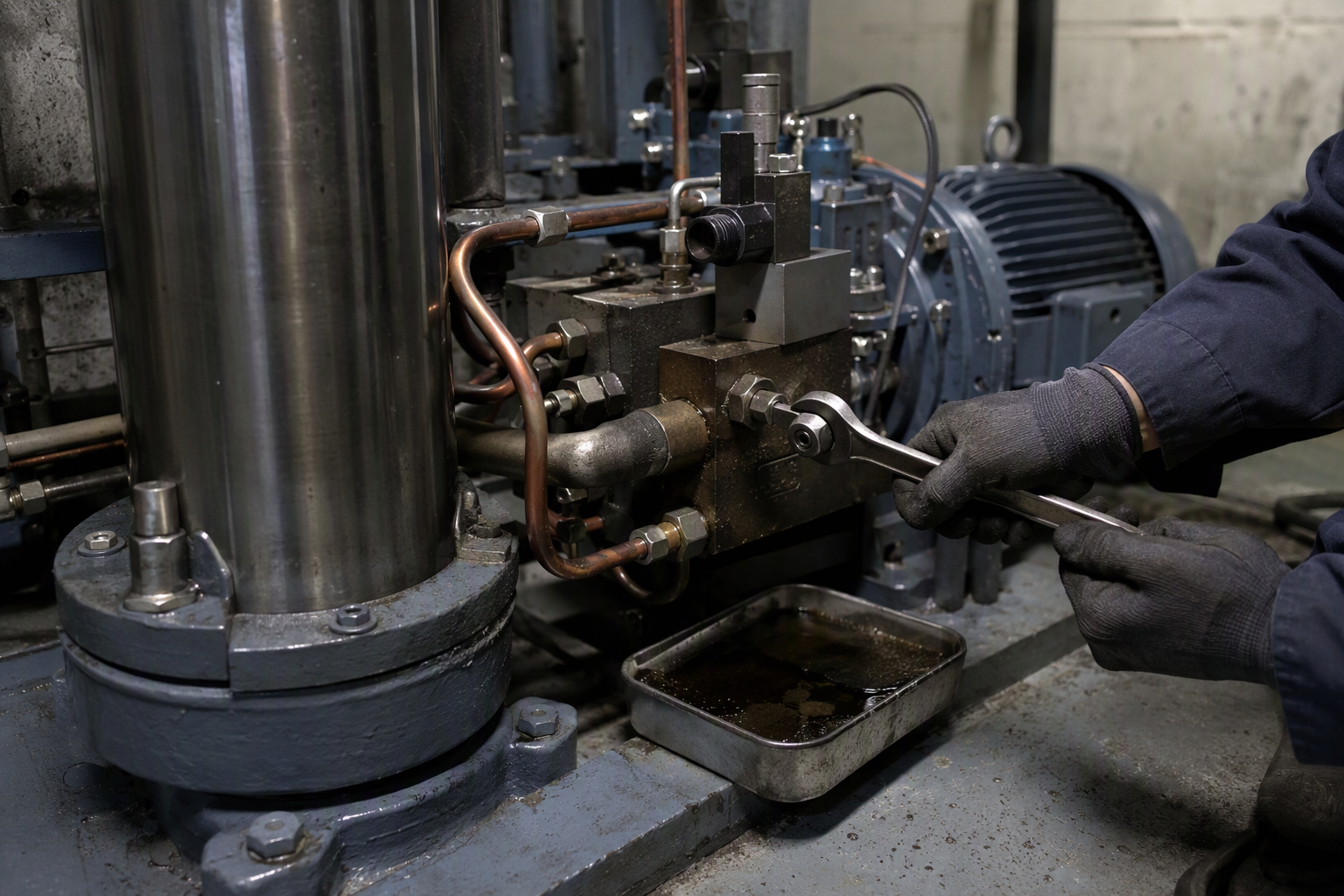
Hydraulic elevator repairs are particularly common in low-rise commercial buildings across Arizona, where hydraulic units are widely installed. These repairs include cylinder replacement or re-lining, hydraulic fluid remediation, power unit seal replacement, and muffler or silencer repair. Traction elevator repairs — more typical in mid- and high-rise commercial properties — commonly involve worn hoist ropes, sheave re-grooving, brake adjustment or replacement, and variable-frequency drive (VFD) failures.
Control system repairs, including printed circuit board replacement and relay logic updates, round out the most frequent repair categories. Older commercial elevators running relay-based controls may face increasing parts availability challenges, making upgrade planning a parallel consideration during repair consultations.
What Arizona regulations govern commercial elevator repair?
Commercial elevator repair in Arizona is governed by A.R.S. §§ 23-491 through 23-491.16, administered by the Industrial Commission of Arizona (ICA) Elevator Division, and must comply with the ASME A17.1-2019 edition for equipment installed, repaired, or altered on or after January 1, 2023.
The Industrial Commission of Arizona (ICA) Elevator Division — formerly known as the ADOSH Elevator Safety Section until September 12, 2026, when Laws 2026, Ch. 73 took effect — serves as the primary state regulator for elevators outside the City of Phoenix. Inside Phoenix city limits, the City of Phoenix Elevator Section (within the Planning and Development Department) performs inspections and has local oversight authority.
Arizona Administrative Code R20-5-502 through R20-5-515 establishes the procedural requirements for inspection, certification, and contractor conduct. Building owners must notify the state at least 90 days before installing, relocating, or altering a conveyance. After any accident that injures a person or disables a conveyance, owners must notify the state within 24 hours. The repair contractor performing the work must hold an Arizona Registrar of Contractors R-12 (residential) or C-12 (commercial) elevator license classification, which authorizes the licensee to install and repair elevators, dumbwaiters, escalators, and moving walks.
Platform lifts and stairway chairlifts installed, repaired, or altered on or after January 1, 2023 must comply with ASME A18.1-2020. Federal Americans with Disabilities Act (ADA) requirements also apply to elevators serving public accommodations and commercial facilities, affecting cab dimensions, control panel height, floor indicators, and emergency communication systems.
Does a commercial elevator repair require a state inspection in Arizona?
Yes — Arizona law requires that a conveyance be inspected after any modification or alteration, and the ICA Elevator Division or an authorized private inspector must issue a certificate before the unit returns to service following significant repair work.
Under A.R.S. §§ 23-491 through 23-491.16, no conveyance may operate in Arizona without a valid certificate of inspection. After a repair that qualifies as an alteration under the adopted code, the elevator must be re-inspected before it resumes service. Building owners may engage a private elevator inspector authorized by the ICA to perform the inspection, but that inspector may not inspect a conveyance owned, operated, or last serviced by the inspector’s own company or employer. Using a private inspector does not relieve the owner of their legal obligations under state statute.
The state serial number or certificate must be posted in or close to the conveyance in an easily accessible location, and the certificate itself must be kept at the same location as the conveyance and made available for inspection on request. Arizona Elevator Solutions coordinates the inspection process for building owners in Phoenix, Scottsdale, Mesa, and Tucson to ensure that post-repair compliance documentation is in order before units are returned to full service.
What should a building owner do immediately when a commercial elevator breaks down?
When a commercial elevator breaks down, the owner or property manager should immediately ensure passenger safety, document the failure, secure the unit from further use, and contact a licensed elevator repair contractor.
- Confirm no passengers are trapped. If anyone is inside the cab, contact the local fire department immediately. Do not attempt to open doors manually unless trained to do so — improper door release can create a fall hazard between floors.
- Take the unit out of service. Lock out the elevator using the machine room disconnect and post clear out-of-service signage at every landing to prevent unauthorized use.
- Document conditions. Note the time, floor level, any error codes displayed on the controller, unusual sounds or smells observed before the failure, and the number of passengers affected.
- Notify the appropriate authority if required. Under Arizona law, any accident that injures a person or disables a conveyance must be reported to the ICA Elevator Division within 24 hours.
- Contact a licensed elevator repair contractor. Provide documentation from Step 3 to help technicians diagnose the failure efficiently. The contractor must hold an Arizona ROC R-12 or C-12 license classification.
- Do not restore power or reopen the unit without clearance. The elevator must not return to service until the repair is complete and any required inspection or certification has been obtained.
How does a licensed technician diagnose a commercial elevator problem?
A licensed elevator technician diagnoses commercial elevator problems through a systematic review of error codes, mechanical components, electrical circuits, hydraulic systems, and safety devices, cross-referenced against the applicable ASME A17.1 code requirements.
Modern commercial elevators equipped with microprocessor-based controllers store fault logs that a technician can retrieve to identify recent error events, repeated fault patterns, and the sequence of failures leading to an outage. This data-driven starting point significantly narrows the diagnostic scope. On older relay-logic systems, diagnosis relies on systematic circuit tracing, voltage and continuity testing, and visual inspection of mechanical components.
Hydraulic systems require pressure testing, fluid analysis, and inspection of the power unit, cylinder, and piping for leaks or wear. Traction systems require rope tension and wear measurement, brake torque verification, and safety gear testing. In all cases, the technician evaluates whether the failure is isolated or symptomatic of broader equipment deterioration that may warrant a modernization consultation rather than a single-component repair.
How long does a commercial elevator repair typically take?
Repair duration depends entirely on the type of failure, parts availability, and whether a post-repair inspection is required — minor repairs may be completed in hours, while major hydraulic or drive repairs can take several days to weeks.
Door operator and interlock repairs are generally among the fastest to complete, often resolved within a single service visit when parts are in stock. Control board replacements depend on whether the board is a current-production item or a legacy component requiring sourcing from specialty suppliers. Hydraulic cylinder replacements — one of the more complex commercial elevator repairs — require the elevator to be de-watered, the old cylinder removed, a new cylinder set and grouted, and the system re-pressurized and tested, a process that typically spans multiple days at minimum.
Owners should factor in the post-repair inspection timeline when estimating total downtime, particularly for work that qualifies as an alteration under Arizona’s adopted ASME A17.1-2019 standard. Scheduling an authorized private inspector in parallel with the repair work, rather than waiting until repair completion, can reduce the gap between repair completion and return to service.
What is the difference between elevator repair and elevator modernization?
Elevator repair restores a failed or deficient component to its original functional specification, while modernization replaces or upgrades systems — such as controls, drives, or doors — to improve performance, efficiency, or code compliance beyond the original design.
The distinction matters for Arizona building owners because modernization constitutes an alteration under A.R.S. §§ 23-491 through 23-491.16 and triggers the 90-day advance notice requirement to the ICA Elevator Division, as well as a mandatory post-alteration inspection before the unit returns to service. A repair — replacing a failed motor with an identical unit, for example — does not carry the same administrative lead time, though it may still require a post-repair inspection depending on its scope.
From a financial and operational planning perspective, when repair costs for an aging system approach a substantial portion of modernization costs, building owners are often better served by a full modernization that delivers improved energy efficiency, reduced future maintenance costs, and upgraded ADA compliance. Arizona Elevator Solutions can evaluate both repair and modernization pathways and help building owners make an informed decision based on the condition of their specific equipment.
What are the ADA requirements relevant to commercial elevator repair?
Under the Americans with Disabilities Act, commercial elevators serving public accommodations and commercial facilities must meet specific requirements for cab dimensions, control panel placement, floor indicators, door timing, and two-way emergency communication that must be maintained through repair and not diminished.
When a commercial elevator undergoes repair, any ADA-required features that were functioning before the failure must be restored to at least their pre-repair level of compliance. ADA requirements affecting elevator systems include minimum cab interior dimensions, compliant braille and tactile floor designations on control panels, audible floor announcements, door reopening devices that respond to contact within a required time period, and fully functional two-way communication systems accessible to passengers with disabilities.
Building owners should treat a repair event as an opportunity to review the overall ADA compliance posture of the elevator cab and controls. Non-compliant features identified during a repair visit that were not caused by the failure itself are technically separate obligations, but proactively addressing them during a planned repair reduces future compliance exposure and the cost of return visits.
How do I know if my elevator repair contractor is properly licensed in Arizona?
In Arizona, elevator repair contractors must hold an R-12 or C-12 elevator license classification issued by the Arizona Registrar of Contractors (ROC), and building owners can verify license status directly through the ROC’s public license lookup tool.
The Arizona Registrar of Contractors R-12 and C-12 classifications specifically authorize the licensee to install and repair elevators, dumbwaiters, escalators, and moving walks. Hiring an unlicensed contractor for elevator repair work exposes the building owner to significant liability — not only for the quality of the work itself but for any resulting injuries, insurance claims, or state enforcement actions. The ROC is separate from the ICA Elevator Division; the ROC licenses contractors while the ICA issues certificates of inspection for equipment.
When evaluating a repair contractor, building owners should request the contractor’s ROC license number and confirm it is current and in good standing before authorizing work. Arizona Elevator Solutions holds the required Arizona contractor licensing to perform commercial elevator repair work in Phoenix, Tucson, Scottsdale, and Mesa.
What routine maintenance practices reduce commercial elevator repair frequency?
Consistent preventive maintenance — including lubrication, adjustment, safety device testing, and component wear inspection — is the most effective strategy for reducing unplanned commercial elevator repairs and extending equipment service life.
Door systems benefit from regular inspection and adjustment of tracks, rollers, gibs, and interlock mechanisms. Lubrication of guide rails, hoist ropes, and machine components prevents accelerated wear. Hydraulic systems require fluid condition monitoring, filter replacement, and seal inspection to prevent leaks that can escalate into cylinder or power unit failures. Safety device testing — including governors, safeties, and buffers — must be performed at intervals consistent with the requirements of the adopted ASME A17.1-2019 code.
A structured maintenance program also provides the documentation history that supports Arizona’s annual inspection process. Inspectors reviewing a well-documented maintenance log have a clearer picture of the equipment’s service history, which can streamline the inspection process and reduce the likelihood of findings that require follow-up corrective action before the certificate is issued.
What is Arizona’s annual elevator inspection requirement for commercial buildings?
Arizona law requires that every conveyance, including commercial elevators, be inspected annually and receive a valid certificate of inspection, without which the elevator may not legally operate.
Under A.R.S. §§ 23-491 through 23-491.16 and Arizona Administrative Code R20-5-502 through R20-5-515, the annual inspection may be conducted by the ICA Elevator Division directly or by an Arizona-authorized private elevator inspector. Private inspectors must register with the ICA annually and demonstrate at least eight hours of approved continuing education per registration cycle. A private inspector may not inspect a conveyance owned, operated, or last serviced by a company the inspector owns or is employed by.
Inside the City of Phoenix, the City of Phoenix Elevator Section within the Planning and Development Department handles inspections. For commercial elevators in Tucson, Scottsdale, Mesa, and other Arizona jurisdictions outside Phoenix city limits, the ICA Elevator Division is the responsible authority. The state serial number assigned to each conveyance — fixed to the controller or mainline disconnect — and the certificate of inspection must both be accessible at or near the conveyance at all times.
What happens if a commercial elevator fails a state inspection in Arizona?
If a commercial elevator fails a state inspection in Arizona, the ICA Elevator Division or the City of Phoenix Elevator Section can require the unit to be taken out of service until all deficiencies are corrected and a re-inspection confirms compliance.
Inspection findings are typically documented in writing, identifying each deficiency and the applicable code provision it violates. The building owner is responsible for contracting with a licensed elevator repair contractor to correct the identified deficiencies. Once corrective work is complete, a follow-up inspection must confirm that all items have been resolved before a new certificate of inspection is issued and the elevator is authorized to return to service.
Under Arizona law, lawfully installed older conveyances may remain in use unless the state’s elevator chief determines the use constitutes a hazard to life, health, or property. This provision means that not every aged or legacy elevator is automatically condemned — but it does not protect equipment with active safety deficiencies from an out-of-service order. Proactive repair and maintenance is always preferable to reactive compliance after an inspection failure.
How does the ASME A17.1-2019 code affect commercial elevator repair in Arizona?
Arizona has adopted ASME A17.1-2019 as the mandatory standard for equipment installed, repaired, or altered on or after January 1, 2023, meaning all commercial elevator repair work performed in Arizona from that date must conform to its requirements.
The ASME A17.1 Safety Code for Elevators and Escalators establishes detailed requirements for safety devices, door systems, machine rooms, hydraulic equipment, emergency operations, and testing protocols. When a repair involves replacing a component or correcting a deficiency in equipment installed or altered on or after January 1, 2023, the repair must be performed to the 2019 edition’s standards. For older equipment installed under a prior edition, Arizona allows lawfully installed conveyances to remain in service unless the elevator chief determines the condition constitutes a hazard — meaning the repair standard applied may vary based on the installation date of the specific equipment.
Contractors performing commercial elevator repair in Arizona need a working knowledge of the ASME A17.1-2019 edition to ensure that parts, procedures, and documentation meet current state requirements. This technical fluency is a core expectation in Arizona Elevator Solutions’ approach to repair work across its Phoenix, Tucson, Scottsdale, and Mesa service areas.
What firefighters’ service requirements apply to commercial elevators in Arizona?
Commercial elevators in Arizona equipped with firefighters’ emergency operation must use the Arizona Firefighters Service (AZFS) key, a state-specific requirement that affects both repair and testing of emergency recall and in-car firefighters’ service functions.
The AZFS key requirement means that replacement or repair of key switches, interlock components, or firefighters’ service panels in Arizona elevators must accommodate the AZFS key standard rather than a generic or out-of-state key specification. During repair work that touches firefighters’ service systems, the technician must verify that the AZFS key switch operates correctly and that all Phase I and Phase II firefighters’ service functions perform as required under the adopted ASME A17.1-2019 code.
Building owners should ensure that their elevator maintenance and repair contractor is specifically familiar with the AZFS key standard. An out-of-state contractor unfamiliar with Arizona-specific requirements may install non-compliant key switches, creating a deficiency that will be identified at the next annual inspection and require a return repair visit.
What is the repair vs. replace decision framework for aging commercial elevators?
The repair-versus-replace decision for aging commercial elevators should be evaluated based on repair cost relative to modernization cost, equipment age, parts availability, frequency of prior outages, and the elevator’s ability to meet current code and ADA requirements.
| Factor | Favor Repair | Favor Modernization |
|---|---|---|
| Equipment age | Relatively recent installation with original components in reasonable condition | Equipment approaching or beyond typical service life for the system type |
| Parts availability | Current-production parts readily sourced | Legacy or obsolete parts requiring specialty sourcing or fabrication |
| Repair cost vs. modernization cost | Repair cost is a small fraction of full modernization cost | Repair cost approaches a significant share of modernization cost |
| Outage history | First or isolated failure event with no prior pattern | Recurring outages indicating systemic wear or obsolescence |
| Code compliance posture | Equipment meets current requirements with minor corrective repairs | Multiple code deficiencies requiring substantial retrofit to achieve compliance |
| ADA compliance | All ADA-required features functional and compliant | Cab dimensions, controls, or communication systems require upgrade |
| Energy consumption | Drive and motor efficiency acceptable for building’s operational profile | Significant energy savings achievable through drive or motor replacement |
This framework is intended as a starting point for discussion with a qualified elevator repair and modernization contractor. Arizona Elevator Solutions provides formal repair-versus-modernization assessments for commercial building owners in Phoenix, Tucson, Scottsdale, and Mesa to support informed capital planning decisions.
What workplace safety obligations apply during commercial elevator repair in Arizona?
Elevator repair work in Arizona is subject to federal OSHA standards for general industry and construction, including lockout/tagout procedures, confined space protocols, and fall protection requirements that protect both technicians and building occupants during repair activities.
Lockout/tagout (LOTO) procedures are mandatory during repair work to prevent unexpected energization of elevator systems while technicians are working in the pit, hoistway, or machine room. Elevator pits may qualify as permit-required confined spaces depending on their configuration and atmospheric conditions, triggering additional OSHA compliance requirements. Fall protection measures must be in place when technicians work at or near open hoistways.
Building owners have an obligation to provide repair contractors with safe access to machine rooms, pits, and other elevator infrastructure. Machine room access must be restricted to authorized personnel during repair activities, and contractor safety plans should be reviewed before work begins. OSHA’s standards are enforced federally in Arizona through federal OSHA authority; building owners and contractors share responsibility for maintaining a safe worksite throughout the repair process.
How should a commercial building owner document elevator repairs for compliance purposes?
Commercial building owners should maintain a complete elevator service record including repair work orders, parts documentation, contractor license information, inspection certificates, and any state notification submissions — and keep these records accessible at the building for the life of the equipment.
Arizona law requires the certificate of inspection to be kept at the same location as the conveyance and made available on request. Beyond this minimum, thorough repair documentation protects building owners in insurance claims, liability proceedings, and state enforcement actions. A well-organized service record that shows consistent maintenance and prompt repair of identified deficiencies demonstrates reasonable care in elevator safety management.
Each repair record should capture at minimum: the date of service, the nature of the failure or deficiency, the corrective action taken, the parts replaced with part numbers and serial numbers where applicable, the name and ROC license number of the performing contractor, and the signature of the technician completing the work. For any repair triggering a state inspection, the resulting certificate or inspection report should be filed with the service record. The state serial number on the controller or mainline disconnect tag provides the unique identifier linking all documentation to the specific conveyance.
What questions should a building owner ask before hiring a commercial elevator repair company in Arizona?
Before hiring a commercial elevator repair company in Arizona, building owners should verify the contractor’s ROC license classification, confirm familiarity with the ASME A17.1-2019 edition and Arizona-specific requirements like the AZFS key standard, and ask about their process for managing post-repair inspections.
Key questions to ask a prospective elevator repair contractor include: Does the company hold an active Arizona Registrar of Contractors R-12 or C-12 license, and can they provide the license number for verification? Is the company’s technician workforce familiar with the ASME A17.1-2019 edition adopted in Arizona? How does the company manage coordination with the ICA Elevator Division or City of Phoenix Elevator Section for post-repair inspections? Does the company have experience with the specific elevator manufacturer and model in the building? Can they provide references from comparable commercial properties in the Phoenix metro or Tucson areas?
A qualified contractor will answer these questions directly and transparently. Evasiveness about licensing, regulatory familiarity, or inspection coordination is a significant red flag when evaluating elevator repair companies for commercial properties.
Does OSHA have specific requirements for elevator machine rooms and pits that affect repair work?
Yes — federal OSHA standards require that elevator machine rooms be kept clean and dry, with adequate lighting, clear access paths, and properly maintained electrical equipment, and that pits be evaluated for confined space classification before repair work begins.
Machine rooms must be dedicated to elevator equipment and kept free of storage, combustible materials, and obstructions that would impede technician access or emergency egress. Adequate lighting is required in both machine rooms and pits for safe working conditions. Electrical panels, disconnect switches, and control equipment must be properly maintained and labeled.
Elevator pits present specific OSHA considerations because they may accumulate water, vapors, or limited oxygen depending on building conditions and season. Before beginning pit repair work, the responsible contractor should assess whether the pit meets the criteria for a permit-required confined space and implement the corresponding entry procedures if it does. Arizona’s desert climate does not eliminate this consideration, particularly in facilities where pit drainage or waterproofing is inadequate. Building owners should confirm that their elevator repair contractor has documented confined space and LOTO procedures before authorizing pit work.
Need elevator service you can rely on? Arizona Elevator Solutions is ready to help.