What exactly does it mean when an elevator component is “discontinued”?
A discontinued elevator component is one the original equipment manufacturer (OEM) has ceased producing, stocking, and supporting, leaving owners responsible for sourcing replacements through alternative channels.
Elevator manufacturers periodically retire product lines as technology advances, supply chains shift, or regulatory requirements change. When a control board, door edge sensor, or door operator reaches end-of-life status, the OEM typically issues a formal discontinuation notice and may offer a limited supply-out period before halting all production. After that window closes, the component is no longer available through standard distribution channels.
The practical consequences extend beyond simple availability. Discontinued components often mean discontinued technical support documentation, discontinued firmware updates for electronic boards, and discontinued OEM training. For building owners in Phoenix, Tucson, Scottsdale, and Mesa, this creates urgency: Arizona law prohibits operating a conveyance without a valid annual certificate of inspection, so an elevator idled by an unavailable part is a liability and a service disruption simultaneously.
Why do elevator control boards, door edges, and door operators get discontinued so frequently?

These three component categories are discontinued frequently because they contain semiconductor chips, proprietary firmware, and mechanical tolerances tied to specific manufacturing eras that become economically impractical to sustain as technology evolves.
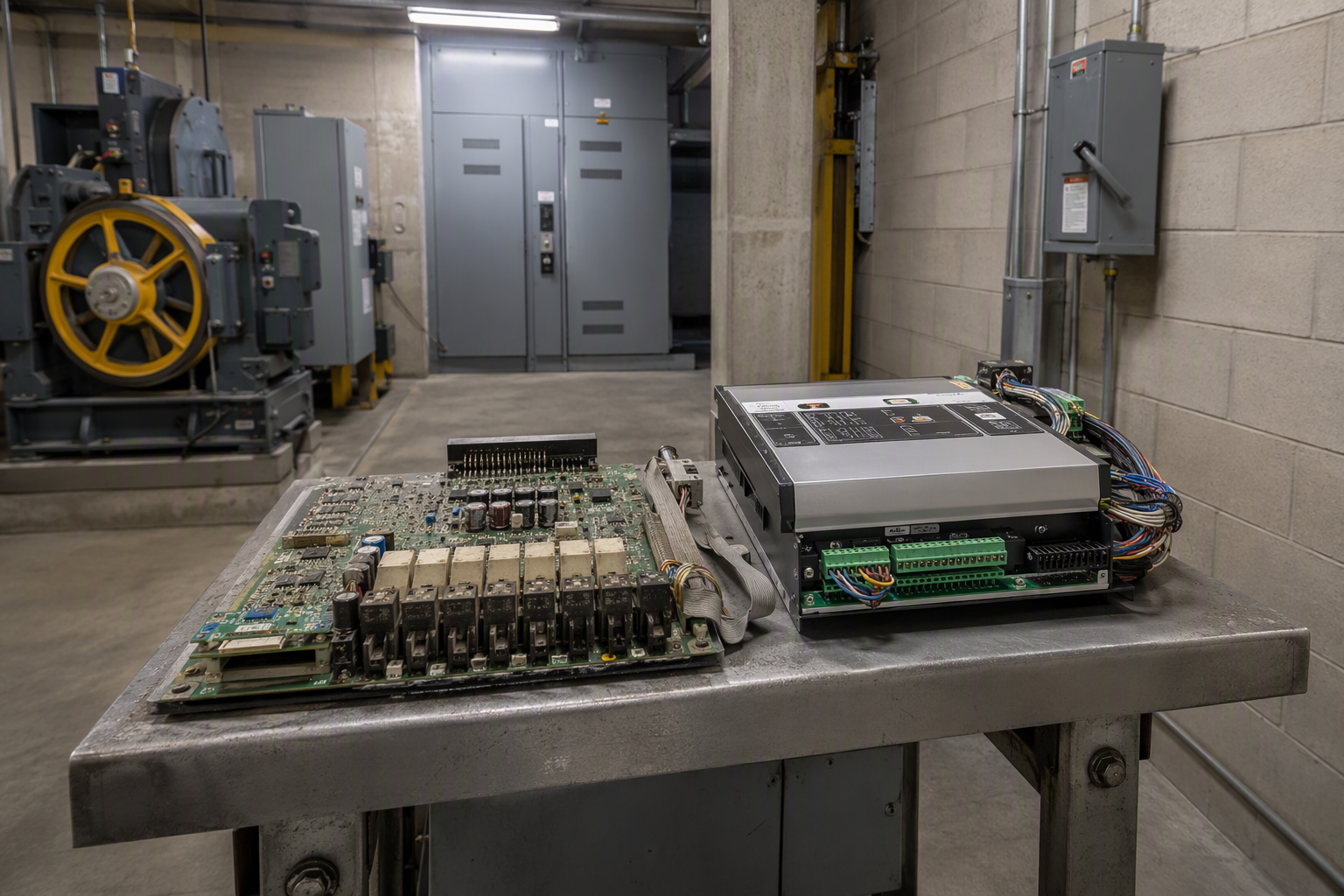
Control boards are especially vulnerable because they rely on integrated circuits that semiconductor foundries retire on their own schedules, independent of the elevator industry. A control board designed in the 1990s or early 2000s may depend on microprocessors that have not been manufactured for over a decade. When the last stockpile of those chips is exhausted, even a willing manufacturer cannot resume production without a complete board redesign.
Door edges—particularly the older pneumatic and mechanical safety edges—are discontinued when safer, more reliable light-curtain and multi-beam infrared technologies render them obsolete. Regulatory pressure from updated editions of the ASME A17.1 Safety Code for Elevators and Escalators has accelerated this transition. Door operators are discontinued when motor drive technology, encoder systems, or cam profiles are superseded by variable-frequency drive (VFD) systems that offer superior performance and energy efficiency.
What are the four main replacement options when a component is discontinued?
The four main options are: sourcing new-old-stock (NOS) from parts brokers, installing a remanufactured or aftermarket equivalent, upgrading to a modern drop-in compatible component, or undertaking a broader modernization that replaces the discontinued piece within a larger system upgrade.
Option 1: New-Old-Stock (NOS) from Parts Brokers
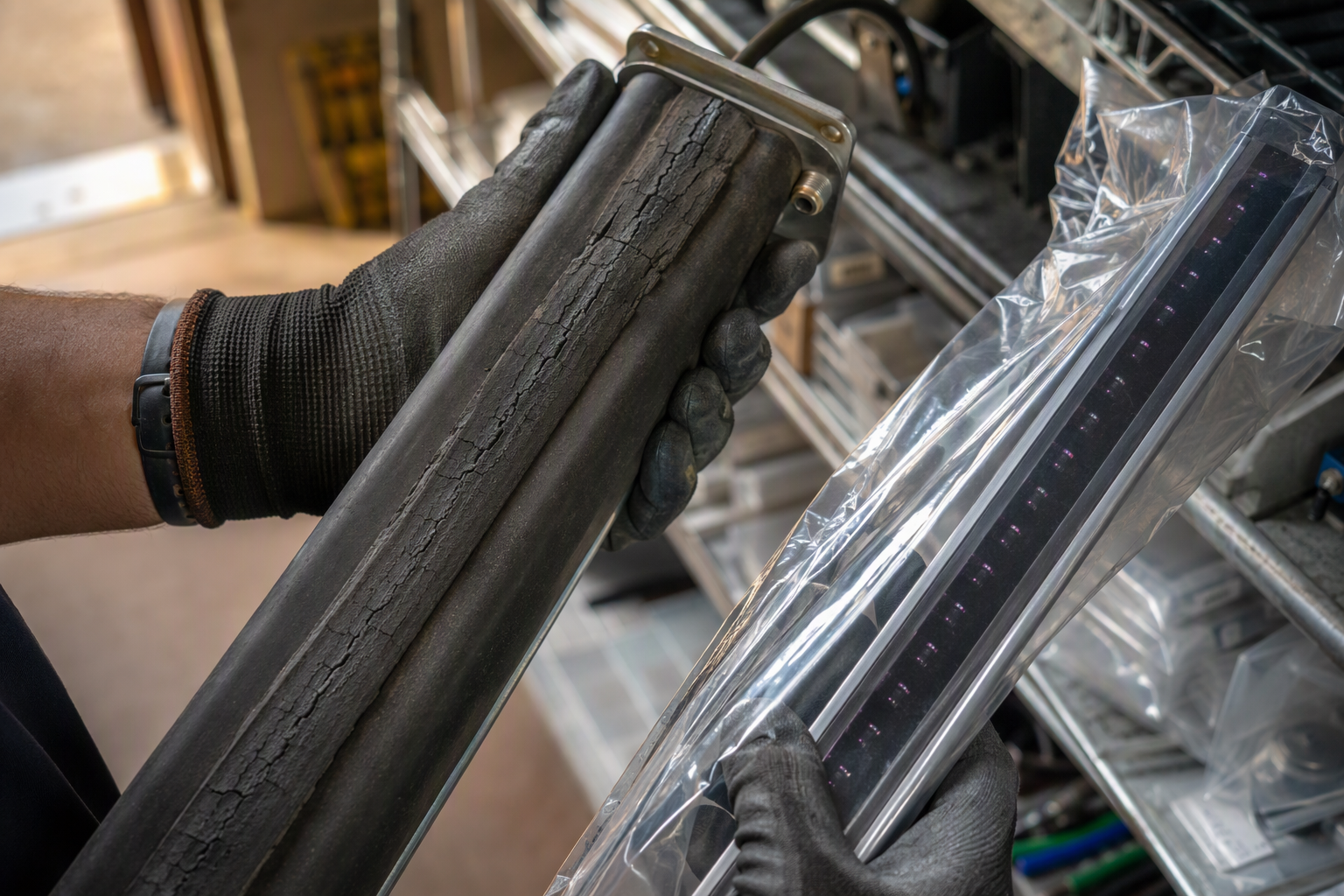
A network of elevator parts brokers and surplus dealers maintains inventories of components purchased before OEM discontinuation. NOS parts are technically genuine original components, but their condition, storage history, and remaining service life are highly variable. Capacitors on control boards degrade over time even without use, and rubber or foam components in door edges can harden or deteriorate in storage. Any NOS part should be evaluated by a qualified technician before installation.
Option 2: Remanufactured or Aftermarket Equivalents
Third-party manufacturers and elevator parts specialists produce aftermarket control boards, door edges, and operators designed to function as drop-in replacements for discontinued OEM parts. Reputable aftermarket boards undergo load testing and quality checks, and many carry limited warranties. Door edges from established safety-device manufacturers often meet or exceed the original safety edge standards referenced in ASME A17.1.
Option 3: Modern Compatible Upgrades
In many cases, a modern component can replace a discontinued one without requiring a complete system overhaul. A current VFD door operator may mount to existing hanger brackets with adapter kits. A new-generation control board may interface with existing car-top wiring through adapter harnesses. These targeted upgrades can restore full operation while bringing the replaced component into compliance with the 2019 edition of ASME A17.1, which Arizona adopted for equipment installed, repaired, or altered on or after January 1, 2023.
Option 4: Partial or Full Modernization
When a discontinued component is part of an aging system where multiple elements are approaching end-of-life, a partial or full modernization is often the most economical long-term decision. Modernization replaces the controller, door systems, and often cab finishes in a planned sequence that minimizes downtime and spreads capital expenditure strategically.
How does ASME A17.1 apply when replacing a discontinued elevator component in Arizona?
Under the ASME A17.1 Safety Code for Elevators and Escalators (2019 edition, adopted by Arizona effective January 9, 2023), any repair or alteration to a conveyance must comply with the applicable requirements of the code in force at the time the work is performed.
The distinction between a “repair” and an “alteration” is critical. A repair restores equipment to its original design intent and specification, while an alteration changes the original design or performance. Replacing a discontinued control board with an identical or functionally equivalent component is generally classified as a repair. Replacing a mechanical safety edge with a multi-beam infrared door edge system or swapping a DC door operator for a VFD-based operator is typically classified as an alteration, triggering additional code compliance requirements, plan submission, and potentially a new inspection before the elevator returns to service.
Under A.R.S. §§ 23-491 through 23-491.16 and the Arizona Administrative Code R20-5-502 through R20-5-515, Arizona owners must notify the Industrial Commission of Arizona’s Elevator Division at least 90 days before any alteration. The elevator may not resume operation after an alteration without a new inspection and a valid certificate of inspection.
What is the difference between a repair and an alteration when replacing discontinued parts?
A repair restores original function using equivalent materials or parts, while an alteration changes the design, capacity, speed, operation, or safety features of the equipment, and the distinction determines which code requirements and regulatory notifications apply.
For Arizona building owners, the alteration classification carries significant procedural weight. An alteration requires 90-day advance notice to the Industrial Commission of Arizona’s Elevator Division, plan review, and a post-alteration inspection before the elevator may resume service. A repair, by contrast, still requires the elevator to maintain its valid certificate of inspection and pass its next annual inspection, but does not trigger the advance-notice and plan-review process by itself.
Because the line between repair and alteration can be ambiguous—particularly when an aftermarket control board changes the software logic or a new door operator changes the reopening timing profile—building owners are strongly advised to consult with an experienced elevator service company before ordering parts. Arizona Elevator Solutions assists Phoenix, Tucson, Scottsdale, and Mesa building owners in making this determination accurately before work begins.
What happens if an elevator stays out of service while a discontinued part is being sourced?
An elevator taken out of service must be secured against unauthorized use, and the building owner remains legally responsible for the unit’s compliance status, insurance implications, and ADA accessibility obligations throughout any downtime period.
From a regulatory standpoint, the existing certificate of inspection remains valid for its annual term even if the elevator is temporarily out of service, provided the equipment is not operated. However, extended out-of-service periods create several compounding risks. ADA obligations under Title III of the Americans with Disabilities Act require building owners to ensure accessible routes remain available; a prolonged elevator outage in a multi-story building serving the public or commercial tenants can trigger ADA compliance concerns. Additionally, Arizona law under A.R.S. § 23-491 requires prompt action when a conveyance is disabled, and any accident or injury occurring in or around a disabled conveyance must be reported to the state within 24 hours.
What should a building owner do immediately when a discontinued part is identified?
Building owners should take the following steps in order as soon as a component is identified as discontinued:
- Obtain the full OEM part number, serial number, and equipment specification sheet for the discontinued component before contacting any supplier or service company.
- Contact the current elevator service company to confirm whether the component qualifies as a repair or alteration under ASME A17.1 and Arizona Administrative Code R20-5-502 through R20-5-515.
- If the replacement constitutes an alteration, file the required 90-day advance notice with the Industrial Commission of Arizona’s Elevator Division before ordering parts or scheduling work.
- Request quotes from at least two sources: a reputable elevator parts broker for NOS or remanufactured options and a modernization contractor for a component-upgrade alternative, so a true cost comparison can be made.
- Verify that any replacement part or upgraded component carries documentation of conformance with the applicable edition of ASME A17.1 or, for door edges, the relevant safety device standard.
- Secure the elevator against use if it cannot safely operate during the sourcing period, post appropriate signage, and notify building management and tenants.
- Schedule the post-repair or post-alteration inspection with a private elevator inspector authorized by the Industrial Commission of Arizona, or through the City of Phoenix Elevator Section if the building is within Phoenix city limits.
Are aftermarket control boards compliant with Arizona elevator code?
Aftermarket control boards are compliant in Arizona when they meet the applicable requirements of the ASME A17.1-2019 Safety Code and the replacement is properly documented, inspected, and certified under Arizona Administrative Code R20-5-502 through R20-5-515.
The key compliance factors are functional equivalence, safety circuit integrity, and inspectable documentation. An aftermarket board must maintain all safety circuit functions required by ASME A17.1—terminal slowdown, final limits, safety string integrity, and door interlock monitoring among them. The board must be installed by a contractor holding the appropriate Arizona Registrar of Contractors R-12 or C-12 elevator license classification. Following installation, the elevator must pass inspection before returning to passenger service.
Arizona Elevator Solutions works with vetted aftermarket suppliers whose products carry traceable testing documentation, enabling inspectors to verify code compliance during the post-installation inspection.
What are the options specifically for discontinued door edge sensors?
Discontinued door edge sensors can be replaced with equivalent mechanical or pneumatic edges from alternative manufacturers, upgraded to multi-beam infrared light curtain systems, or replaced with three-dimensional volumetric sensor systems—with the upgrade path selected based on the door operator type, regulatory classification of the change, and building use profile.
Mechanical and pneumatic safety edges were standard for decades, but many OEM versions are now discontinued. Aftermarket equivalents exist for the most common door widths and are generally installed as repairs. The more significant upgrade—replacing a contact edge with a multi-beam infrared light curtain—substantially improves performance, detecting obstructions without requiring physical contact. Because light curtains change the reopening function’s operating principle, this replacement is typically classified as an alteration under ASME A17.1 and requires the Arizona regulatory notification process.
Three-dimensional volumetric sensors represent the current state of the art, using ultrasonic or 3D imaging to detect passengers before they reach the door plane. These are installed primarily on high-traffic commercial elevators and are always treated as alterations.
What are the options specifically for discontinued door operators?
Discontinued door operators can be replaced with direct-equivalent aftermarket operators, adapted with universal VFD door operator kits that mount to existing hanger hardware, or addressed through a full door system replacement that includes new hangers, gibs, and operator as a package.
The most practical path depends on the door operator type. Older DC motor operators with relay-based control logic can often be replaced by universal VFD operators from specialists such as GAL, Fermator, or Wittur using manufacturer-supplied mounting adapter kits. These kits are designed to reduce installation time and cost by preserving existing door panels and hanger tracks. The resulting installation typically improves door speed, reduces motor heat, and lowers energy consumption compared to the original DC system.
When hanger hardware is worn or corroded—a common finding on elevators where a door operator has been in service long enough to reach end-of-life—a complete door system replacement is more cost-effective than piecemeal repair. Arizona Elevator Solutions evaluates hanger condition, gibs, clutch mechanisms, and door panel alignment as part of any door operator replacement assessment.
What is a modernization, and when does it make more sense than sourcing discontinued parts?
A modernization is a planned replacement of major elevator system components—typically the controller, drive, door system, and often cab finishes—undertaken as a coordinated project rather than reactive component-by-component repair, and it makes more sense than sourcing discontinued parts when multiple systems are simultaneously aging or when a targeted part replacement would deliver only short-term relief on a system that will require further significant investment within a few years.
The economic calculus favors modernization when the discontinued component is not the only aging element. A control board that has reached end-of-life on a 30-year-old elevator is rarely the only component approaching failure. The wiring harness insulation, relay logic panels, and selector systems on equipment of that age may be equally fragile. Sourcing a replacement board for several thousand dollars provides temporary relief while leaving the underlying aging infrastructure intact.
A modernization, by contrast, resets the equipment’s reliability baseline, typically extends the useful service life by 20 or more years, and brings the entire system into compliance with the current edition of ASME A17.1 as adopted by Arizona. Building owners in Phoenix, Tucson, Scottsdale, and Mesa who are navigating a discontinued part decision should request a system-wide condition assessment alongside any specific part-sourcing quote to make a fully informed comparison.
How does the repair or replacement affect the annual inspection and certificate of inspection in Arizona?
In Arizona, any repair or alteration to a conveyance must result in a passing inspection before the elevator may return to passenger service, and the owner must maintain and post the valid certificate of inspection at the equipment location as required by state law.
Under A.R.S. §§ 23-491 through 23-491.16, no conveyance may operate in Arizona without an annual certificate of inspection issued by the state. The Industrial Commission of Arizona’s Elevator Division or an authorized private inspector must inspect the elevator after any alteration before it resumes service. The certificate must be kept at the same location as the conveyance and made available upon request, and the state serial number or certificate must be posted in or close to the conveyance in an accessible location.
For elevators within the City of Phoenix, the City of Phoenix Elevator Section within the Planning and Development Department handles inspection oversight for equipment inside city limits; the Industrial Commission of Arizona’s Elevator Division handles equipment elsewhere in Arizona.
Can a building owner legally source and install elevator parts themselves in Arizona?
No—in Arizona, elevator installation and repair work must be performed by a contractor holding the appropriate Arizona Registrar of Contractors R-12 (residential) or C-12 (commercial) elevator license classification, and self-installation by a building owner does not satisfy this requirement.
The Arizona Registrar of Contractors’ R-12 and C-12 license classifications authorize the licensee to install and repair elevators, dumbwaiters, escalators, and moving walks. These classifications exist separately from the annual inspection and certification process managed by the Industrial Commission of Arizona’s Elevator Division. A building owner who installs replacement components without a licensed contractor is in violation of state contractor licensing law and risks voiding the elevator’s insurance coverage, invalidating the certificate of inspection, and creating personal liability exposure in the event of an injury.
What data should be compared when evaluating NOS parts versus aftermarket versus modernization?
The following comparison table outlines the key evaluation dimensions across the three principal options for discontinued elevator components. All figures are qualitative indicators based on industry-standard considerations, not guaranteed outcomes for any specific installation.
| Evaluation Factor | New-Old-Stock (NOS) | Aftermarket / Remanufactured | Modernization |
|---|---|---|---|
| Parts Availability | Limited; dependent on broker inventory | Generally available from multiple suppliers | Standard current-production components |
| Compatibility Risk | Low (original spec) if verified genuine | Low to moderate; varies by supplier quality | Low; designed as integrated system |
| Expected Service Life After Installation | Uncertain; degraded by storage age | Moderate; typically warranted by supplier | Long-term; resets system baseline |
| Code Compliance Classification | Usually repair; must verify no functional change | Usually repair; alteration if function changes | Alteration; full ASME A17.1-2019 compliance |
| Arizona 90-Day Notice Required? | Typically not (repair) | Possibly (if alteration) | Yes (alteration) |
| Post-Work Inspection Required? | Annual cycle continues; post-alteration if alteration | Post-alteration inspection if classified as alteration | Yes; required before return to service |
| Ongoing OEM Support | None | Limited to aftermarket supplier support | Full current manufacturer support |
| Relative Capital Expenditure | Lowest upfront | Low to moderate upfront | Highest upfront; lowest long-term lifecycle cost |
| Downtime During Installation | Shortest (if part is in stock) | Short to moderate | Longest; planned and scheduled |
| ADA Accessibility Improvement | None beyond original design | Minimal unless door system upgraded | Significant; modern door systems improve ADA performance |
How does ADA compliance factor into decisions about discontinued door edges and operators?
The Americans with Disabilities Act establishes specific door timing and reopening requirements for elevators serving public accommodations and commercial facilities, and a discontinued door edge or operator that cannot be replaced with an equivalent may create an opportunity to upgrade to a system that better meets or exceeds ADA door-timing standards.
ADA Standards for Accessible Design specify that elevator doors must remain open long enough for passengers using mobility devices to enter and exit. The reopening device must be capable of stopping and reopening the door if an obstruction is detected. Older pneumatic edges and some discontinued mechanical edges had contact-force tolerances that fell below what modern light curtains achieve. Upgrading to a multi-beam infrared door edge during a replacement project brings the door reopening function into closer alignment with ADA intent, even if the door operator hardware itself is retained.
Building owners subject to ADA—including commercial office buildings, retail properties, hotels, and multi-tenant residential buildings in Phoenix, Tucson, Scottsdale, and Mesa—should treat a discontinued door edge or operator replacement as an opportunity to assess the complete door system’s ADA performance alongside the technical replacement decision.
How long does it typically take to source a discontinued elevator part in 2026?
Lead times for discontinued elevator components vary considerably based on the part type, the age of the equipment, and current parts broker inventory levels, and building owners should plan conservatively because delays are common and difficult to predict.
Control boards for equipment manufactured before approximately 2005 are among the most difficult to source because the underlying semiconductor components may themselves be obsolete. Brokers may quote weeks-long search periods before confirming availability or unavailability. Aftermarket board manufacturers typically require production lead times that can extend from several weeks to a few months depending on the complexity of the remanufacturing process.
Door edges are generally faster to source because the mechanical and infrared technologies are more standardized, and aftermarket manufacturers maintain broader inventories. Door operators occupy a middle ground: adapter kits for common discontinued operators are often in stock, but unique proprietary operator configurations from smaller historical manufacturers may require custom fabrication.
Building owners should initiate sourcing efforts as early as possible—ideally before the component fails entirely—and use the lead time to complete any required regulatory notifications and plan the post-installation inspection in advance.
What information should a building owner have ready when calling an elevator service company about a discontinued part?
A building owner should have the elevator’s state serial number, OEM control panel model number, the discontinued part number and description, the date of original installation, and the most recent inspection certificate information ready before contacting a service company.
The state serial number is located on the tag fixed to the controller or mainline disconnect, as required under Arizona law. This number allows the service company to access the elevator’s regulatory history and confirm what alterations or repairs have previously been filed with the Industrial Commission of Arizona’s Elevator Division. The OEM model number and discontinued part number enable the service company to immediately begin evaluating broker availability, aftermarket equivalents, and compatibility with the existing control system. The installation date helps establish the applicable code edition at the time of original installation, which informs the repair-versus-alteration determination.
Does replacing a discontinued component affect an elevator’s firefighters’ service operation in Arizona?
Yes—any replacement of a control board or door operator that affects the firefighters’ emergency operation function must preserve full compliance with the firefighters’ service requirements of ASME A17.1, and Arizona-specific requirements mandate the use of the Arizona Firefighters Service (AZFS) key for conveyances equipped with firefighters’ emergency operation.
Arizona law specifically requires that conveyances with firefighters’ emergency operation use the AZFS key, which is a state-specific requirement distinct from the standard key specifications referenced in ASME A17.1. A replacement control board must replicate all Phase I and Phase II firefighters’ service logic precisely, and any change to this logic—whether through firmware differences in an aftermarket board or programming changes in a new controller—constitutes an alteration requiring regulatory notification and post-installation inspection. Fire departments in Phoenix, Tucson, Scottsdale, and Mesa may also verify AZFS key compatibility during fire inspections independent of the elevator inspection process.
What qualifications should an elevator service company have to perform this type of work in Arizona?
An elevator service company performing replacement, repair, or modernization work in Arizona must hold the appropriate Arizona Registrar of Contractors R-12 or C-12 elevator license classification, which authorizes the company to install and repair elevators, dumbwaiters, escalators, and moving walks in Arizona.
Beyond the licensing requirement, building owners should verify that the service company has documented experience with the specific equipment type and brand involved, access to reputable parts suppliers and aftermarket sources, familiarity with the regulatory notification and inspection process administered by the Industrial Commission of Arizona’s Elevator Division, and established relationships with authorized private inspectors for post-work inspections. Arizona Elevator Solutions serves building owners across Phoenix, Tucson, Scottsdale, and Mesa with this full scope of service, from initial parts assessment through regulatory filing support and post-installation inspection coordination.
What are the risks of delaying action when a critical elevator component is discontinued?
Delaying action on a discontinued critical component increases the risk of sudden equipment failure, extended unplanned downtime, regulatory non-compliance, ADA accessibility violations, and potential injury liability, all of which are more costly and disruptive than a planned replacement.
Control boards operating beyond their reliable service life are subject to sudden failure without warning. Unlike a worn mechanical component that may show progressive symptoms, a failing circuit board can fail completely and instantaneously, stranding passengers between floors or rendering door systems inoperative. An elevator that fails in service due to a known discontinued component, when the owner was aware of the part’s status and delayed replacement, may face heightened liability exposure in the event of an injury or property damage claim.
Additionally, as time passes, parts broker inventories of NOS components are depleted without replenishment, making the sourcing problem progressively harder. An aftermarket manufacturer that currently supports a particular control board model may discontinue that aftermarket option as well if demand falls below a sustainable threshold. Proactive planning—engaging an experienced service company while options remain open—consistently produces better outcomes than reactive emergency sourcing.
Contact Arizona Elevator Solutions for a free elevator assessment at 480-557-7600.
Need elevator service you can rely on? Arizona Elevator Solutions is ready to help.