
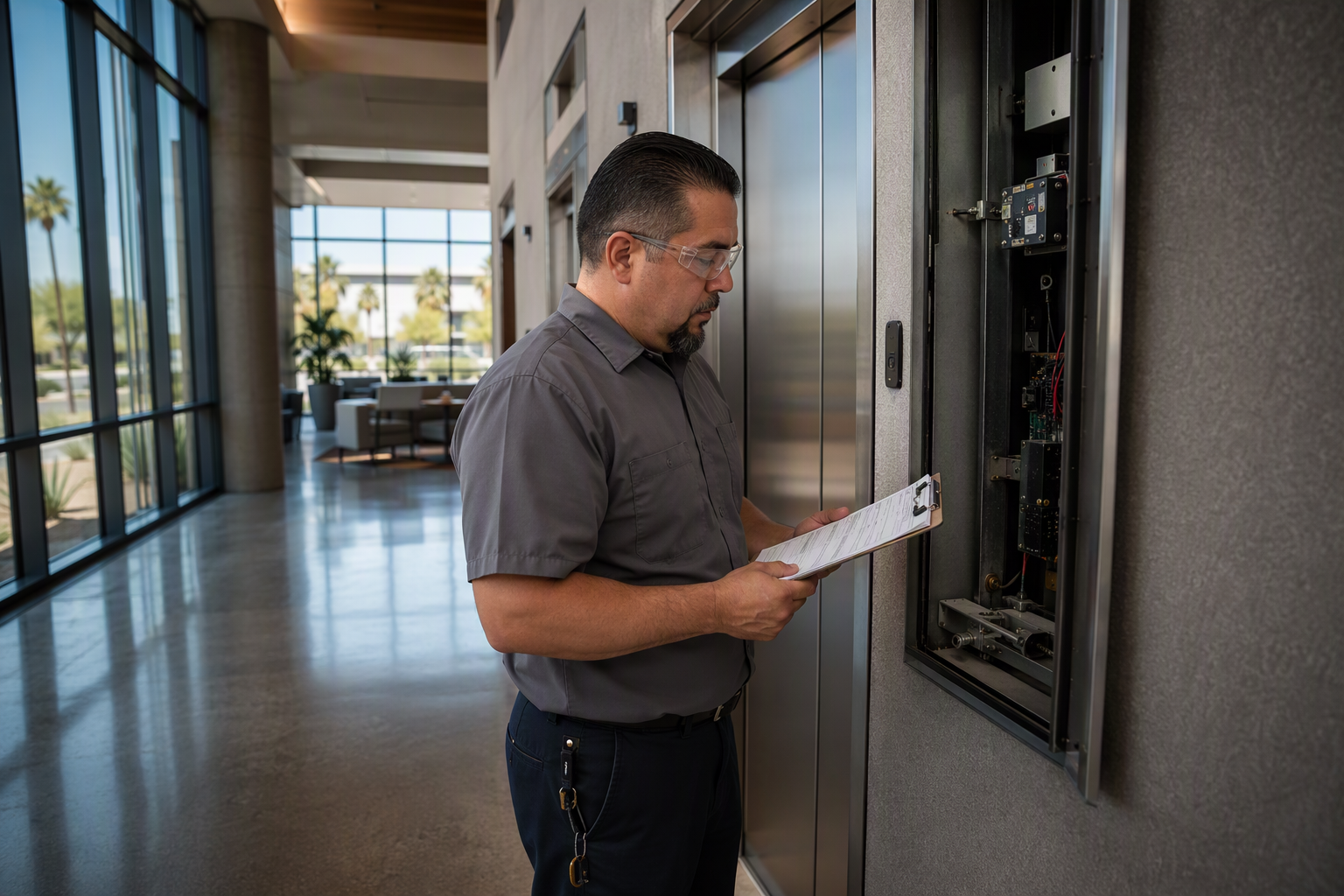
Commercial Elevator Maintenance: Complete FAQ for Arizona Building Owners and Facility Managers
Commercial elevator maintenance encompasses every scheduled and corrective service task required to keep elevators safe, code-compliant, and operationally reliable. For Arizona property owners, that means aligning with federal standards under ASME A17.1 Safety Code for Elevators and Escalators, satisfying the annual inspection requirements of the Industrial Commission of Arizona (ICA), Elevator Division, and following any local requirements such as the City of Phoenix Elevator Section. The sections below answer the most common questions facility managers, building owners, and property management companies ask about commercial elevator maintenance in Arizona.
What is commercial elevator maintenance and why is it required?
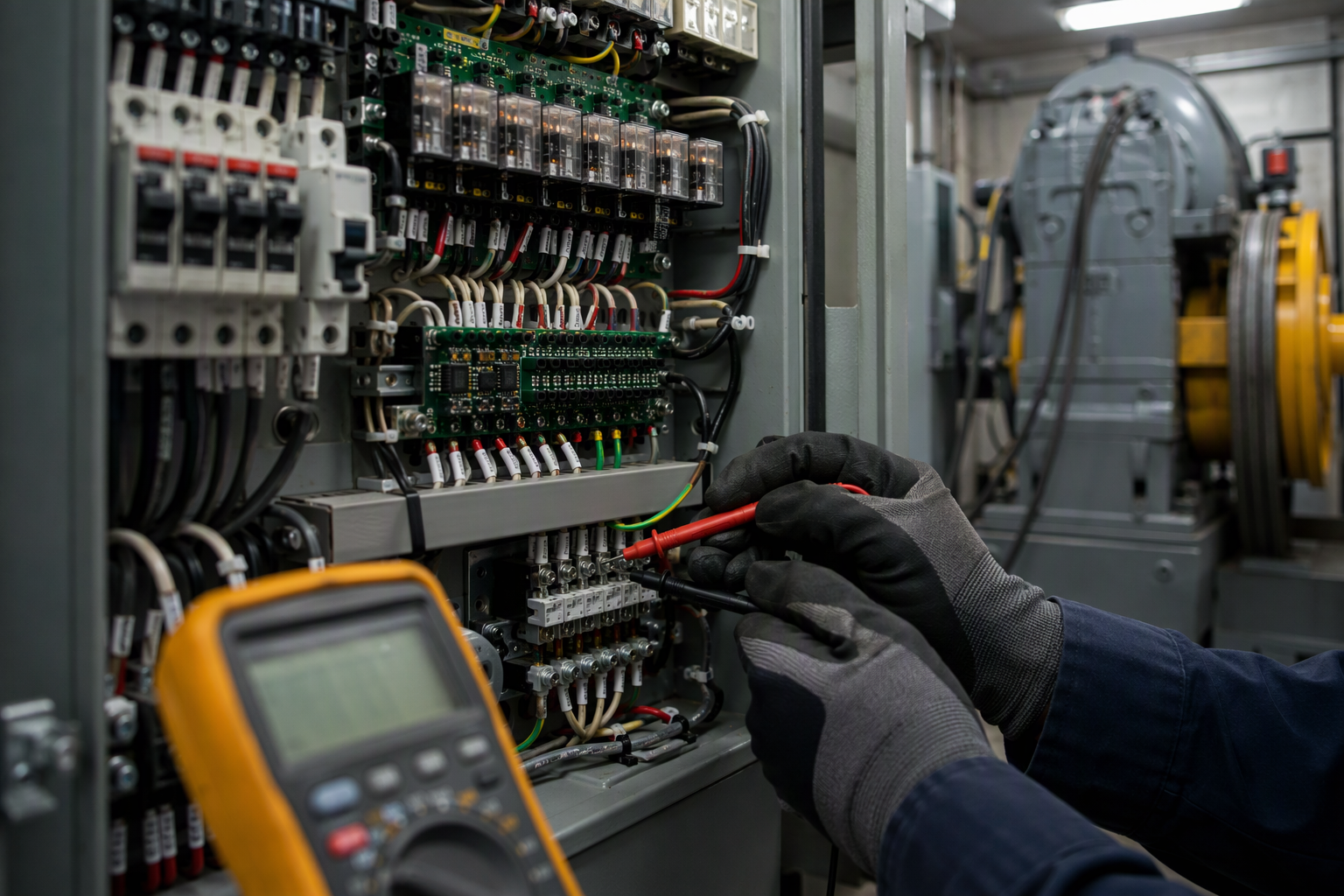
Commercial elevator maintenance is a planned program of inspections, lubrication, adjustments, parts replacement, and safety testing performed on elevators in office buildings, retail centers, hotels, medical facilities, and other commercial properties to ensure safe, legal operation.
Elevators are among the most heavily regulated mechanical systems in any commercial building. At the federal level, the ASME A17.1/CSA B44 Safety Code for Elevators and Escalators defines minimum maintenance, testing, and inspection requirements for elevator systems. At the state level, Arizona statute A.R.S. §§ 23-491 through 23-491.16 establishes a comprehensive safety framework enforced by the ICA Elevator Division. Without a documented maintenance program, a building owner risks equipment failure, regulatory penalties, certificate revocation, and personal injury liability.
Beyond legal obligation, properly maintained elevators consume less energy, experience fewer unexpected breakdowns, and have longer service lives — all factors that directly affect a commercial property’s operating budget and tenant satisfaction.
What does a commercial elevator maintenance program include?

A comprehensive maintenance program covers mechanical, electrical, hydraulic or traction components across multiple service intervals — from monthly lubrication checks to annual safety tests mandated by code.
Typical program elements include:
- Monthly tasks: Lubrication of guide rails, roller guides, door operator components, and sheaves; cleaning of pit and machine room; verification of lighting and ventilation; visual inspection of ropes or hydraulic lines; door force and speed checks.
- Quarterly tasks: Testing of safety circuits, door reversal devices, leveling accuracy, and emergency lighting; inspection of buffers, safeties, and governor; review of hydraulic fluid levels and seals.
- Annual tasks: Full operational test of all safety devices; no-load and full-load running tests; inspection of machine, brake, and motor; review of code compliance documentation; coordination of the state annual inspection required under Arizona Administrative Code R20-5-502 through R20-5-515.
- Periodic major tests: Five-year full-load safety test and governor/car safety test as required by ASME A17.1; hydraulic pressure tests for hydraulic units at the interval specified by code.
Arizona Elevator Solutions structures its maintenance agreements around these intervals so clients are never caught underprepared for an ICA Elevator Division inspection.
How often does Arizona require commercial elevators to be inspected?
Under Arizona law, every conveyance must be inspected before it first goes into service, after any modification or alteration, and at least annually after that — and no conveyance may legally operate in Arizona without a valid annual certificate of inspection.
This requirement is established in A.R.S. §§ 23-491 through 23-491.16 and implemented through Arizona Administrative Code R20-5-502 through R20-5-515. The ICA Elevator Division administers inspections statewide, while the City of Phoenix Elevator Section (within the Planning and Development Department) handles inspections for equipment located inside Phoenix city limits.
Arizona building owners have the option to engage a private elevator inspector authorized by the ICA to conduct initial or annual inspections. Private inspectors must register with the commission annually and demonstrate at least eight hours of approved continuing education per registration period. Importantly, using a private inspector does not transfer legal responsibility away from the owner — the owner remains fully accountable for compliance.
Additionally, any elevator accident that injures a person or disables a conveyance must be reported to the state within 24 hours, and owners must notify the state at least 90 days before installing, relocating, or altering a conveyance.
Which codes govern commercial elevator maintenance in Arizona?
Arizona commercial elevator maintenance is governed by a layered framework of federal safety codes and state statutes, with the primary technical standard being ASME A17.1-2019.
Key applicable standards include:
- ASME A17.1/CSA B44, 2019 edition: Adopted by Arizona for equipment installed, repaired, or altered on or after January 1, 2023. This is the primary technical code defining maintenance, testing, and inspection requirements for new and recently altered elevators in Arizona.
- ASME A17.3: The Safety Code for Existing Elevators and Escalators applies to equipment installed before the current adoption date. Under Arizona’s framework, lawfully installed older conveyances may remain in service unless the state’s elevator chief determines the equipment poses a hazard to life, health, or property.
- Americans with Disabilities Act (ADA): Federal requirements for elevator accessibility, including cab dimensions, door timing, control height, and tactile indicators, must be maintained as part of any commercial elevator program.
- OSHA: Federal Occupational Safety and Health Administration standards apply to the working conditions of elevator mechanics performing maintenance and repair work.
- Arizona ASME A18.1-2020: Applies to platform lifts and stairway chairlifts installed, repaired, or altered on or after January 1, 2023.
For equipment inside Phoenix, the City of Phoenix Elevator Section coordinates with state requirements and may conduct its own inspections.
What are the consequences of failing to maintain a commercial elevator in Arizona?
Operating a commercial elevator in Arizona without a valid certificate of inspection or with known code violations can result in forced shutdown of the equipment, regulatory penalties under A.R.S. §§ 23-491 through 23-491.16, and significant civil liability exposure if an incident occurs.
The ICA Elevator Division has authority to order a conveyance taken out of service if it poses a hazard. For multi-story commercial buildings, an elevator shutdown can render upper floors inaccessible, triggering lease disputes, ADA compliance issues, and loss of tenants. Insurance carriers also scrutinize maintenance records following elevator-related incidents; gaps in documentation can complicate or void coverage claims. The reputational and financial costs of deferred maintenance consistently exceed the cost of proactive service programs.
What is the difference between a maintenance contract and an inspection?
A maintenance contract governs ongoing, scheduled service performed by an elevator service company, while an inspection is a formal evaluation by an authorized inspector that results in a certificate of compliance — these are two distinct and complementary obligations.
Maintenance is the day-to-day and month-to-month work that keeps equipment running safely: lubrication, adjustments, parts replacement, and testing. Inspection is the independent, code-required verification by a qualified inspector (state or private) that the equipment meets applicable code requirements. In Arizona, having a maintenance contract does not eliminate the requirement for an independent annual inspection — the two must coexist.
It is also worth noting that an Arizona private elevator inspector is expressly prohibited from inspecting any conveyance owned, operated, or last serviced by themselves, a company they own, or their employer — ensuring genuine independence between the maintenance and inspection functions.
What types of commercial elevators require maintenance programs?
In Arizona, every conveyance regulated under A.R.S. §§ 23-491 through 23-491.16 requires a maintenance program, including traction passenger elevators, hydraulic elevators, freight elevators, escalators, moving walks, dumbwaiters, and platform lifts in commercial buildings.
The applicable maintenance protocols differ by equipment type:
- Traction elevators (geared and gearless): Machine room equipment, wire ropes, sheaves, brakes, governors, and safety devices require regular attention. High-rise and mid-rise commercial buildings in Phoenix, Scottsdale, and Tucson commonly use traction systems.
- Hydraulic elevators: Fluid level, cylinder integrity, pump unit, valve, and seals require monitoring; underground cylinders may be subject to additional inspection protocols under ASME A17.1.
- Freight elevators: Higher load ratings and heavier use cycles require more frequent lubrication and wear-part inspection than passenger units.
- Escalators and moving walks: Step chains, handrail systems, comb plates, and safety devices must be serviced on separate maintenance schedules.
- Platform lifts: Subject to ASME A18.1-2020 for post-January 2023 installations in Arizona; ADA compliance for public accommodations is also mandatory.
How is an elevator maintenance program structured as a contract?
Commercial elevator maintenance agreements are typically structured as full-maintenance, oil-and-grease, or parts-and-labor contracts, each representing a different allocation of risk and cost between the building owner and the service provider.
| Contract Type | What’s Included | Owner Risk Level | Best Suited For |
|---|---|---|---|
| Full Maintenance (Comprehensive) | All labor, routine parts, lubrication, adjustments, callbacks, and major components (may exclude vandalism/misuse) | Low | High-traffic commercial buildings, medical facilities, hotels |
| Parts & Labor | Labor and routine parts; owner pays for major component replacements separately | Moderate | Mid-traffic office or retail buildings with newer equipment |
| Oil & Grease (Lubrication Only) | Lubrication and basic adjustments only; all repairs billed separately | High | Low-use equipment or buildings with in-house facilities staff |
| Examination & Report | Periodic inspection with written report; no repairs performed under contract | Very High | Owner-managed properties with qualified on-site personnel |
Arizona Elevator Solutions can help building owners in Phoenix, Scottsdale, Tucson, and Mesa evaluate which contract structure is appropriate based on equipment age, usage volume, and risk tolerance.
What qualifications must an elevator contractor have in Arizona?
In Arizona, contractors performing elevator installation and repair work must hold an R-12 (residential) or C-12 (commercial) elevator license classification issued by the Arizona Registrar of Contractors, which authorizes work on elevators, dumbwaiters, escalators, and moving walks.
The Arizona Registrar of Contractors (ROC) issues these classifications but does not issue the annual certificate of inspection — that certificate is issued exclusively by the ICA Elevator Division or a private inspector authorized by the commission. Building owners should verify that any elevator service company they engage holds the appropriate ROC license classification before signing a maintenance agreement.
What happens during an annual elevator inspection in Arizona?
An annual Arizona elevator inspection evaluates whether the conveyance, its safety devices, machine room, pit, and documentation comply with the applicable edition of ASME A17.1 and Arizona Administrative Code requirements, culminating in either a certificate of inspection or a notice of violation.
The process typically follows these steps:
- The inspector reviews the elevator’s state serial number tag fixed to the controller or mainline disconnect and confirms it matches state records.
- The inspector examines machine room conditions — cleanliness, lighting, ventilation, and access — and reviews the maintenance logbook.
- A pit inspection covers buffer condition, lighting, stop switch, pit ladder, and evidence of water intrusion or contamination.
- Car and hoistway components are checked: guides, ropes or chains, safeties, governor, doors, interlocks, and leveling accuracy.
- Operational tests are performed: door reopening devices, emergency stop, emergency lighting, firefighters’ emergency operation (including Arizona Firefighters Service [AZFS] key compliance), and leveling under load.
- Safety device tests are conducted per the applicable ASME A17.1 schedule.
- ADA-related items — control panel height, button labeling, door timing — are commonly reviewed as part of the overall compliance evaluation.
- The inspector issues a certificate of inspection (to be kept at the conveyance location and available on request) or a violation notice with required corrective actions and deadlines.
- The state serial number or certificate must be posted in or near the conveyance in an accessible location.
What is Arizona Firefighters Service (AZFS) key compliance?
Arizona requires that conveyances equipped with firefighters’ emergency operation use the Arizona Firefighters Service (AZFS) key — a state-specific key standard that ensures Arizona fire departments can operate elevators consistently across all buildings during emergencies.
AZFS key compliance is a maintenance and inspection checkpoint. During routine service, technicians verify that the Phase I and Phase II firefighters’ service operates correctly and that the key switch accepts the AZFS key. Buildings that installed elevator systems using a different key standard before Arizona adopted the AZFS requirement may need hardware upgrades. Facility managers in Phoenix, Scottsdale, Tucson, and Mesa should confirm AZFS compliance as part of any maintenance contract review.
How do ADA requirements affect commercial elevator maintenance?
The Americans with Disabilities Act requires that elevators serving public accommodations and commercial facilities be accessible and remain accessible — meaning ADA-compliant features must be maintained in working order, not just installed at the time of construction.
Key ADA maintenance considerations for commercial elevators include:
- Door reopening devices must be tested and adjusted to ensure they respond to both light and force obstructions without injuring passengers.
- Door timing (dwell time) must be sufficient for individuals using mobility aids to board and exit safely.
- Audible and visual signals for floor level and direction of travel must be operational.
- Raised and Braille floor designations must be legible and intact on jamb panels.
- Car controls must be within accessible reach ranges and remain properly labeled.
- Cab leveling must be maintained within the tolerance required for wheelchair boarding — typically within a half-inch of the floor landing.
ADA violations discovered during an inspection or through a complaint can result in federal enforcement action and private lawsuits, making these maintenance items high priority for commercial building owners.
What are common signs that a commercial elevator needs service?
Warning signs that a commercial elevator requires immediate service attention include unusual noises, rough or jerky ride quality, doors that hesitate, fail to close fully, or reverse unexpectedly, and leveling inaccuracies that create a step between the cab floor and the landing.
Additional indicators include:
- Burning odors from the machine room, which may indicate overheating motor, brake, or electrical components.
- Hydraulic fluid visible in the pit or along the cylinder, indicating seal failure.
- Slow response to floor calls or sluggish acceleration and deceleration.
- Flickering or inoperative cab lighting or display panels.
- Emergency phone or intercom failures — a code-required safety feature.
- Excessive vibration during travel, often indicating worn guide shoes or roller guides.
Under Arizona’s 24-hour accident reporting rule, any incident that injures a person or disables a conveyance must be reported to the ICA Elevator Division immediately. Building owners should not wait for a scheduled service visit if these symptoms appear — taking the elevator out of service and contacting a qualified contractor is the appropriate immediate response.
How should a building owner respond immediately after an elevator incident?
When an elevator incident occurs that injures a person or disables a conveyance, Arizona law requires specific immediate actions to protect occupants, preserve evidence, and fulfill legal notification obligations.
- Ensure the safety of any passengers. If anyone is trapped, contact emergency services (911) — do not attempt a manual rescue without qualified personnel.
- Remove the elevator from service immediately by securing the machine room or placing an out-of-service notice on each landing.
- Preserve the scene as much as possible — do not operate the elevator or direct maintenance personnel to make repairs before the inspection.
- Notify the ICA Elevator Division within 24 hours of any accident that injures a person or disables a conveyance, as required under A.R.S. §§ 23-491 through 23-491.16.
- If the elevator is inside Phoenix city limits, also notify the City of Phoenix Elevator Section.
- Contact your elevator maintenance contractor to arrange a post-incident inspection and document the findings in writing.
- Notify your property insurance carrier and retain all maintenance records, inspection certificates, and incident documentation.
- Do not return the elevator to service until the required corrective work is completed and any required follow-up inspection is satisfied.
How does commercial elevator maintenance differ for older versus newer equipment?
Older elevators installed before Arizona’s January 1, 2023 adoption of ASME A17.1-2019 are governed by ASME A17.3 (the existing installations code), while newer or recently altered equipment must comply with the 2019 edition — resulting in different maintenance, testing, and retrofitting obligations depending on the equipment’s installation date.
Key differences in practice include:
- Existing equipment: Arizona permits lawfully installed older conveyances to remain in service unless the state elevator chief determines the equipment poses a hazard. However, any repair or alteration to that equipment triggers the requirement to bring the affected system into compliance with current code.
- New and recently altered equipment: Must fully comply with ASME A17.1-2019, including updated testing intervals, safety device requirements, and documentation standards.
- Parts availability: Older systems may use obsolete components that require custom sourcing or approved alternatives, which can affect maintenance timelines and cost.
- Modernization triggers: If maintenance reveals that an older system requires repairs that qualify as alterations under ASME A17.1-2019, the owner may need to notify the ICA at least 90 days before the work begins and bring additional systems into current code compliance.
What records should a commercial building owner maintain for elevator compliance?
Arizona building owners are required to keep the state certificate of inspection at the same location as the conveyance and must make it available for inspection on request — and best practice requires maintaining a comprehensive maintenance logbook alongside that certificate.
Recommended documentation includes:
- Current certificate of inspection issued by the ICA Elevator Division or authorized private inspector, kept at the conveyance location.
- State serial number tag on the controller or mainline disconnect (fixed by the state, not removable).
- Maintenance logbook recording all service visits, work performed, parts replaced, and technician notes.
- Copies of all periodic and five-year safety test reports as required by ASME A17.1.
- Records of any alterations and the corresponding 90-day state notification.
- Copies of incident reports and 24-hour notifications submitted to the ICA Elevator Division.
- ADA compliance documentation, including any accessibility survey or modification records.
- Maintenance contract and contractor’s ROC license verification.
Gaps in documentation are among the most common findings during ICA Elevator Division inspections and can delay certificate issuance even when the equipment itself is in good condition.
What is the process for elevator modernization and how does it relate to maintenance?
Elevator modernization — the replacement of major components such as the control system, drive, doors, or cab — is often initiated when maintenance costs on aging equipment rise to the point where continued repair is less economical than upgrading, and any modernization in Arizona must be treated as an alteration requiring advance state notification.
The relationship between maintenance and modernization includes:
- Maintenance records provide the historical data that justifies a modernization business case — tracking repair frequency and cost over time helps building owners time the investment appropriately.
- Arizona owners must notify the ICA Elevator Division at least 90 days before any alteration begins. Modernization components typically fall within the definition of alteration under ASME A17.1-2019.
- After modernization, the elevator must pass an initial inspection before returning to service.
- Modernized components must comply with ASME A17.1-2019 (for work performed on or after January 1, 2023), even if the overall elevator predates that edition.
- Post-modernization, a new maintenance schedule aligned with the updated equipment specifications should be established with the service contractor.
Arizona Elevator Solutions assists commercial clients in Phoenix, Scottsdale, Mesa, and Tucson in planning modernization projects with full attention to ICA notification requirements and code compliance.
How does elevator maintenance affect a building’s energy performance?
Poorly maintained commercial elevators consume meaningfully more energy than properly serviced units — worn components, misadjusted brakes, degraded lubrication, and inefficient drive operation all increase electrical load and contribute to higher utility costs in commercial buildings.
Maintenance practices that support energy efficiency include:
- Keeping guide shoes and roller guides properly adjusted to minimize friction.
- Maintaining brake clearance and tension within manufacturer specifications to prevent parasitic drag.
- Verifying that machine room ventilation and cooling systems operate efficiently, preventing motor overheating that drives excessive current draw.
- Servicing hydraulic systems to maintain proper fluid viscosity and pump efficiency.
- Replacing aging lighting systems in cabs and machine rooms with LED alternatives where code permits.
For commercial buildings in Arizona’s desert climate, machine room temperature management is a particularly important maintenance consideration — Phoenix, Scottsdale, Mesa, and Tucson regularly experience extreme summer temperatures that can stress elevator mechanical and electronic systems if machine rooms are not properly cooled and ventilated.
What should building owners look for when selecting a commercial elevator maintenance company in Arizona?
When evaluating elevator maintenance providers in Arizona, building owners should verify ROC licensing, confirm familiarity with ICA Elevator Division requirements, and assess the provider’s technical capability with the specific equipment types installed in their building.
Key selection criteria include:
- Arizona Registrar of Contractors (ROC) license: Confirm the company holds an active C-12 or R-12 elevator license classification for commercial work.
- Code familiarity: The provider should demonstrate working knowledge of ASME A17.1-2019, Arizona Administrative Code R20-5-502 through R20-5-515, and local authority requirements in Phoenix or other markets.
- Equipment coverage: Verify the company services the specific make and type of elevator in your building — not all contractors have equal expertise across all equipment manufacturers.
- Documentation practices: Ask how they maintain service logs and whether they provide documentation compatible with ICA Elevator Division requirements.
- Contract transparency: A reputable provider clearly defines what is and is not included in each contract tier.
- Local market presence: A company serving your specific market — Phoenix, Scottsdale, Mesa, or Tucson — is better positioned to respond to urgent needs and understand local AHJ practices.
Arizona Elevator Solutions serves commercial properties across Phoenix, Scottsdale, Mesa, and Tucson with maintenance programs designed around the full scope of ICA Elevator Division and ASME A17.1 requirements.
How does preventive maintenance reduce commercial elevator lifecycle costs?
Preventive maintenance extends the operational life of commercial elevator equipment and reduces total lifecycle costs by catching component wear and minor deficiencies before they escalate into major system failures requiring costly emergency repairs or premature modernization.
The economic rationale for preventive programs includes:
- Door operators, guide shoes, ropes, and brake linings are wear items with predictable service lives — replacing them on schedule prevents cascading failures to more expensive components.
- Hydraulic systems that are regularly serviced avoid the significantly more costly scenario of cylinder replacement due to neglected seal failure and corrosion.
- Control system components — contactors, relays, and solid-state electronics — last longer when machine room environments are kept clean, dry, and within temperature limits.
- Proactive maintenance keeps the elevator on schedule for annual inspections, avoiding the cost and disruption of emergency shutdown while corrective work is completed.
- Consistent documentation of maintenance history supports favorable insurance terms and reduces liability exposure.
Get a Free Commercial Elevator Assessment in Phoenix, Scottsdale, Mesa, or Tucson
Whether your facility needs a new maintenance program, is approaching an annual ICA Elevator Division inspection, or is evaluating aging equipment for modernization, Arizona Elevator Solutions provides professional commercial elevator maintenance services aligned with ASME A17.1-2019, Arizona Administrative Code requirements, and local AHJ standards. Serving Phoenix, Scottsdale, Mesa, and Tucson.
Contact Arizona Elevator Solutions for a free elevator assessment: 480-557-7600
Need elevator service you can rely on? Arizona Elevator Solutions is ready to help.






