
Repair, Modernize, or Replace Your Elevator? How to Evaluate Your Options
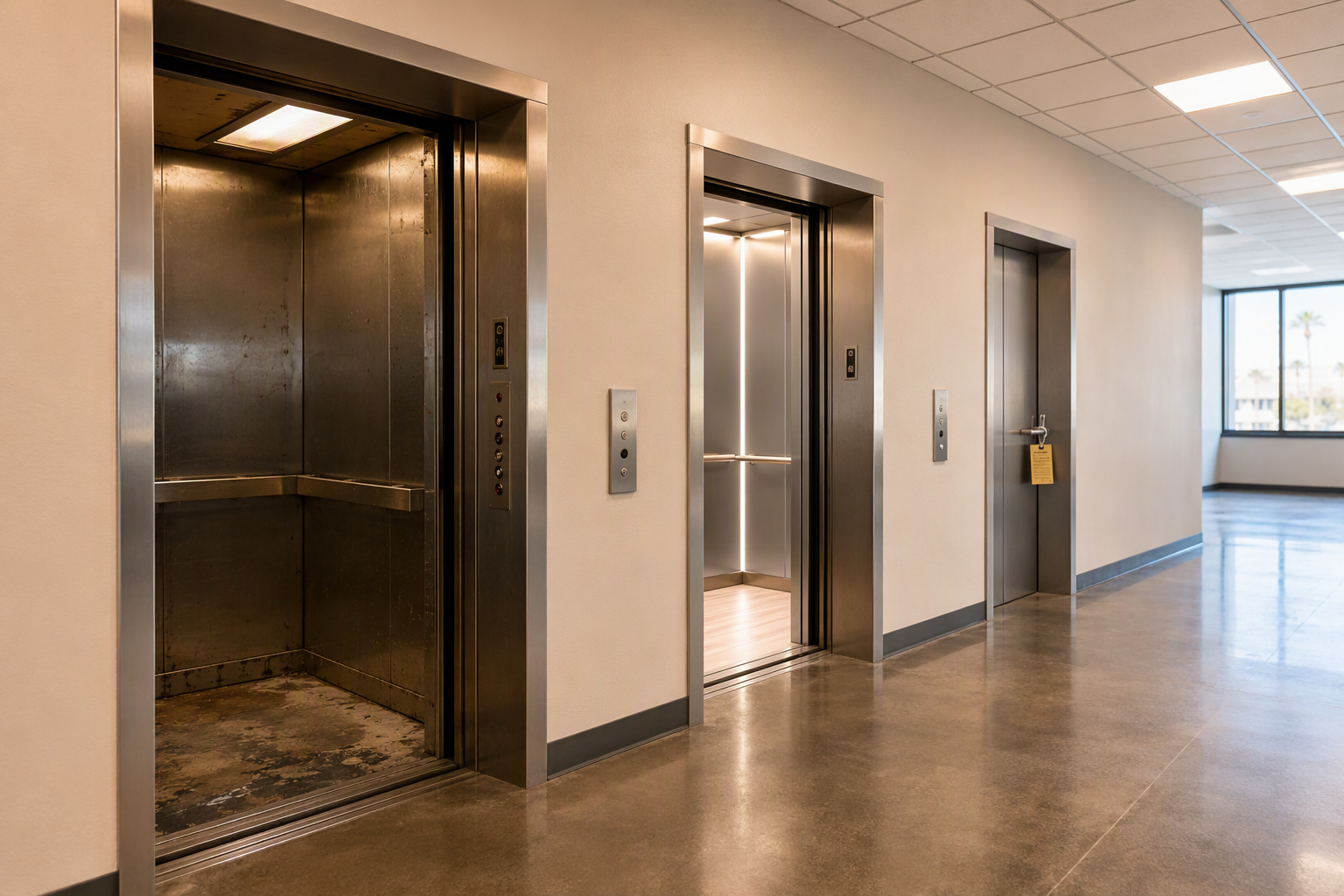
For Arizona building owners, facility managers, and property investors, the elevator repair-versus-replace question is one of the most consequential capital decisions you will face. Make the wrong call and you risk either spending money on a system that will demand expensive repairs within a few years, or committing to a full replacement when targeted modernization would have served you at a fraction of the cost. This guide walks through every factor that should drive that decision — from regulatory compliance under Arizona law to equipment lifecycle considerations — without fabricated numbers or guesswork.
What Is the Difference Between Elevator Repair, Modernization, and Replacement?
These three terms are often used interchangeably, but they represent very different scopes of work, costs, and outcomes.
- Repair addresses a specific failed or degraded component — a worn hoist rope, a faulty door operator, a malfunctioning controller board — without changing the overall system design. Repairs restore existing functionality.
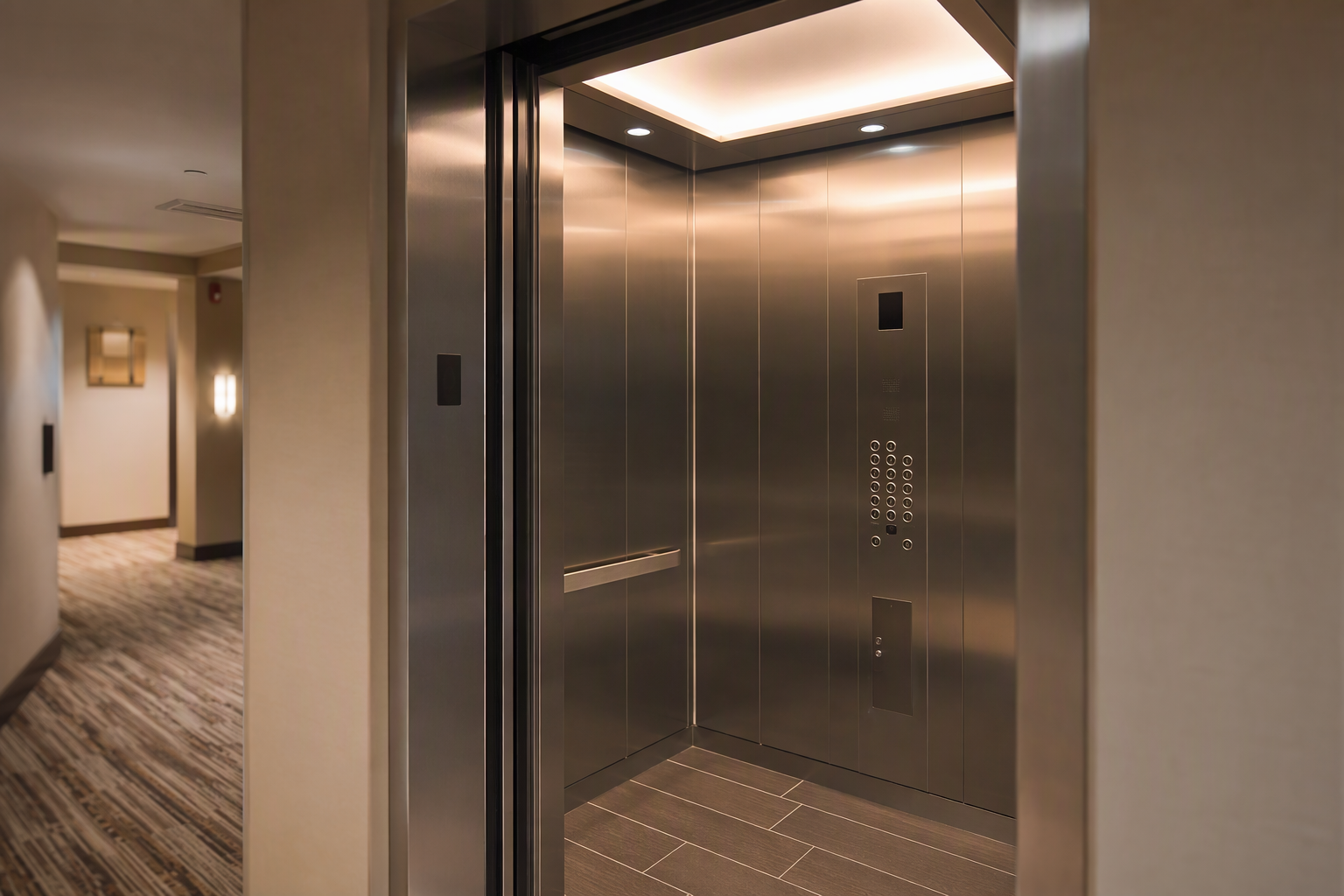
- Modernization upgrades one or more major subsystems — typically the controller, drive, fixtures, cab interior, or door systems — while retaining the structural components such as the hoistway, rail system, and machine room. Modernization improves reliability, energy efficiency, aesthetics, and code compliance without the cost of full installation.
- Replacement involves removing the entire elevator system and installing new equipment. It is the highest-cost option but may be necessary when structural or hoistway components are beyond economical repair, or when a building is undergoing major renovation that justifies a complete system upgrade.
Understanding which category your situation falls into is the first step. The sections below give you a structured framework for making that determination.
What Are the Key Factors That Drive the Repair-or-Replace Decision?
No single metric determines the right path. Qualified elevator consultants and contractors typically weigh the following factors together:
- Equipment age and lifecycle stage: Elevator systems are engineered for a general service life measured in decades, but hydraulic and traction systems age differently and are affected by local climate, duty cycle, and maintenance history. An older system that has been well-maintained may still be a candidate for modernization, while a poorly maintained younger system could demand replacement.
- Breakdown frequency and pattern: Isolated incidents differ from a pattern of recurring failures across multiple subsystems. When the same components fail repeatedly or failures cascade into adjacent systems, the underlying equipment may be reaching the end of its serviceable life.
- Parts availability: Discontinued or obsolete components — particularly proprietary controllers manufactured by companies that no longer support them — can make even minor repairs expensive and slow. If sourcing parts requires fabrication or custom sourcing, modernization of the affected subsystem often becomes more economical than continued repair.
- Code compliance status: Arizona requires that conveyances comply with ASME A17.1-2019 for equipment installed, repaired, or altered on or after January 1, 2023. Older equipment that is lawfully installed may remain in service under Arizona’s grandfather provisions unless the state’s elevator chief determines it poses a hazard to life, health, or property. However, any alteration or modernization triggers compliance with current code requirements for the altered scope — which must be factored into the project budget.
- Energy performance: Older hydraulic systems and relay-logic-controlled traction elevators consume significantly more energy than modern variable-frequency drive (VFD) systems and regenerative drives. The energy savings from a drive modernization can offset a meaningful portion of the project cost over the equipment’s remaining life, though building owners should obtain actual utility quotes and energy audits rather than relying on generic projections.
- Accessibility compliance: The Americans with Disabilities Act (ADA) imposes requirements on elevator accessibility in buildings subject to its scope. If an existing elevator does not meet ADA standards — for cab dimensions, door timing, floor leveling, signage, or controls — a major modernization project presents an opportunity to achieve compliance that continued repair alone would not address.
- Tenant and occupant experience: Ride quality, noise, door speed, cab condition, and wait times affect tenant satisfaction and, in commercial and multifamily properties, lease renewal rates. These qualitative factors carry real financial weight that belongs in any honest cost-benefit analysis.
- Capital budget cycle: Full replacement typically requires a larger upfront expenditure than modernization. For building owners with near-term capital constraints, a phased modernization approach — addressing the controller and drive in one phase, cab and fixtures in another — can spread costs across budget cycles while progressively improving performance.
How Does Arizona Law Affect the Repair-or-Replace Decision?
Arizona elevator safety is governed by A.R.S. §§ 23-491 through 23-491.16 (Safety Conditions for Elevators and Similar Conveyances), as amended by Laws 2026, Ch. 73, and administered by the Industrial Commission of Arizona (ICA), Elevator Division (formerly the ADOSH Elevator Safety Section prior to September 12, 2026).
Several Arizona regulatory requirements have direct implications for the repair-or-replace decision:
- Annual inspection and certificate requirement: Every conveyance operating in Arizona must hold a valid annual certificate of inspection. No conveyance may operate without one. This means any system — regardless of its age or condition — must pass inspection each year. A system that cannot pass inspection without significant work is, effectively, already requiring repair or modernization investment just to remain legally operational.
- Pre-work notification: Arizona owners must notify the ICA Elevator Division at least 90 days before installing, relocating, or altering a conveyance. This timeline must be built into any modernization or replacement project schedule. Failing to plan for this lead time can result in costly delays.
- Alteration triggers current code compliance: Under Arizona Administrative Code R20-5-502 through R20-5-515 and ASME A17.1-2019 (the Arizona adopted code for equipment installed, repaired, or altered on or after January 1, 2023), altering a component may require the altered scope to meet the current edition’s requirements. This is a critical consideration: a partial modernization that triggers a broader compliance obligation can change the project’s economics significantly. Competent elevator contractors licensed by the Arizona Registrar of Contractors under R-12 or C-12 classifications should evaluate this exposure before a scope of work is finalized.
- Post-modification inspection: After any modification or alteration, Arizona owners must have the conveyance inspected before it returns to service. This inspection must be performed by the ICA Elevator Division or by an authorized private elevator inspector registered with the commission.
- City of Phoenix jurisdiction: For conveyances located within the City of Phoenix, the City of Phoenix Elevator Section (Planning and Development Department) handles inspections of elevators, escalators, moving walks, dumbwaiters, and chair lifts. Outside Phoenix, the ICA Elevator Division has jurisdiction. This distinction matters when coordinating permit timelines and inspection scheduling for modernization and replacement projects.
- Firefighters’ emergency operation: Any conveyance in Arizona with firefighters’ emergency operation must use the Arizona Firefighters Service (AZFS) key. Modernization projects that include control system upgrades must verify AZFS key compatibility with the new controller.
What Are the Most Common Signs That Repair Is No Longer Sufficient?
Experienced elevator professionals look for a cluster of warning signs that, taken together, indicate a system has moved beyond the repair stage:
- Recurring failures in the same subsystem within short intervals, suggesting a systemic rather than isolated problem
- Controller components that are no longer manufactured and must be sourced from salvage or rebuilt from obsolete inventory
- Hydraulic systems with repeated oil leaks, degraded cylinders, or underground single-bottom jack assemblies that present environmental liability risk
- Persistent floor-leveling problems despite repeated adjustment, which can signal worn guide rails, deteriorated buffers, or machine wear beyond adjustment range
- Repeated door entrapment incidents or door-related service calls, which elevate OSHA-relevant safety concerns and liability exposure
- Failure to meet ADA door timing, leveling accuracy, or cab dimension requirements that cannot be corrected through adjustment alone
- An annual inspection that results in a conditional certificate or a cited deficiency list that costs more to remediate than a modernization would
When Does Full Replacement Make More Sense Than Modernization?
Modernization is not always the right answer. Full replacement becomes the more logical choice in the following circumstances:
- The hoistway structure itself is compromised, undersized for current occupancy loads, or incompatible with any available modern equipment configuration
- The building is undergoing a complete renovation that requires hoistway reconfiguration or relocation of the elevator core
- The total cost of the modernization scope approaches or exceeds the cost of new equipment installation, eliminating the economic advantage of preserving existing structural components
- The existing equipment is a single-bottom hydraulic jack with a buried cylinder where environmental remediation and cylinder replacement costs alone justify starting fresh
- The building is converting to a use that demands a different elevator type — for example, a freight elevator conversion or a high-rise building adding a passenger elevator in a space that previously had none
How Should Building Owners Evaluate Bids for Modernization or Replacement?
A competitive bid process for elevator modernization or replacement is more nuanced than comparing line-item totals. Building owners and facility managers should evaluate proposals on the following dimensions:
- Verify contractor licensing: Confirm that any elevator contractor you consider holds an active R-12 or C-12 license issued by the Arizona Registrar of Contractors. This is a legal requirement for installing and repairing elevators, dumbwaiters, escalators, and moving walks in Arizona.
- Confirm scope specificity: A credible proposal should specify which components are being replaced, the manufacturer and model of new components, the warranty terms for parts and labor, and the code edition to which the work will conform.
- Evaluate the compliance analysis: Ask each bidder to document which existing components trigger code upgrade requirements under ASME A17.1-2019 and the Arizona Administrative Code, and what the associated cost and scope implications are. A bidder who cannot answer this question is not equipped to manage the project’s regulatory exposure.
- Review the notification and permit plan: Confirm that the contractor’s schedule accounts for the 90-day advance notification requirement to the ICA Elevator Division (or the City of Phoenix Elevator Section, if applicable) and the post-modification inspection before return to service.
- Assess parts and service availability: Ask what components are proprietary to the installing contractor versus open-market, and what future service and parts availability looks like. Proprietary systems can create long-term vendor dependency that affects lifecycle costs.
- Request references for comparable projects: Ask for references from Arizona building owners who have completed similar modernization or replacement projects — ideally in comparable building types and with similar equipment configurations.
- Compare lifecycle cost, not just upfront cost: A lower bid may reflect a shorter warranty, lower-quality components, or a scope that defers necessary work. A true cost comparison models energy consumption, projected maintenance frequency, and expected component lifespan over a defined period.
What Is the Typical Project Timeline for an Elevator Modernization in Arizona?
Timeline varies substantially based on scope, equipment lead times, and jurisdictional scheduling. However, the regulatory framework creates certain fixed milestones that every Arizona project must accommodate:
- Conduct a comprehensive condition assessment and code compliance review of the existing equipment.
- Define the modernization scope and confirm which alterations trigger ASME A17.1-2019 compliance requirements.
- Submit the 90-day advance notification to the ICA Elevator Division (or the City of Phoenix Elevator Section, if applicable) before work begins.
- Finalize equipment procurement — component lead times for controllers, drives, and fixtures vary and can affect the overall schedule significantly.
- Execute the modernization work with a licensed R-12 or C-12 elevator contractor.
- Schedule and pass the post-modification inspection by the ICA Elevator Division or an authorized private elevator inspector before the conveyance returns to service.
- Obtain the updated certificate of inspection and post the state serial number or certificate as required by Arizona law.
Building owners should plan for the elevator to be out of service during the active work phase. For properties with a single elevator or where elevator downtime significantly affects occupants, the communication and coordination plan for this period deserves as much attention as the technical scope.
How Do ADA Requirements Factor Into the Decision?
The Americans with Disabilities Act establishes accessibility requirements for elevators in covered buildings. A repair-or-replace evaluation should include an ADA audit of the existing elevator, assessing factors such as:
- Cab interior dimensions and door clear width
- Door opening timing and reopening device sensitivity
- Floor leveling accuracy (within tolerances required for wheelchair users)
- Control panel layout, height, and Braille/raised character signage
- Emergency two-way communication system compliance
- Audible and visible floor indicators
A major modernization project is one of the most cost-effective moments to achieve ADA compliance, because cab, fixture, and control system work that would be required anyway can incorporate accessibility upgrades at marginal additional cost. Continued repair of a non-compliant elevator, by contrast, defers a compliance obligation that does not diminish over time.
What Industry Trends Are Shaping Elevator Decisions in 2025 and 2026?
Several qualitative trends are reshaping how building owners and elevator professionals approach the repair-modernize-replace decision as of 2026:
- Remote monitoring and predictive maintenance: Modern elevator controllers increasingly support IoT-enabled remote monitoring platforms that can detect anomalies, log performance data, and alert technicians to emerging issues before they become failures. Building owners evaluating modernization should assess whether new controllers support these capabilities, which can meaningfully reduce unplanned downtime and emergency service costs.
- Energy efficiency and sustainability mandates: Building owners facing energy benchmarking requirements or sustainability commitments are factoring elevator energy consumption into modernization business cases. Variable-frequency drives and regenerative systems represent meaningful contributors to a building’s overall energy profile, particularly in high-rise and high-traffic applications.
- Supply chain and lead time volatility: Component lead times for controllers, drives, and specialty fixtures have experienced variability in recent years. Building owners planning modernization or replacement projects should engage contractors early and discuss procurement timelines as part of the project planning process, rather than assuming components will be available on short notice.
- Increased regulatory enforcement attention: The transition of Arizona elevator safety administration from ADOSH to the Industrial Commission of Arizona’s Elevator Division reflects ongoing regulatory evolution in this space. Building owners should stay current with any updated guidance or inspection priorities issued by the ICA Elevator Division.
- Hydraulic environmental liability: Older single-bottom hydraulic jack installations with buried cylinders represent a continuing environmental concern. As these systems age, many building owners are choosing to convert to MRL (machine-room-less) traction systems during replacement, eliminating the buried cylinder liability entirely.
How Does Arizona’s Regulatory Environment Differ From the General National Framework?
While ASME A17.1 Safety Code for Elevators and Escalators serves as the foundational technical standard across most of the United States, its adoption and enforcement vary by jurisdiction. Arizona has adopted ASME A17.1-2019 as its governing code for equipment installed, repaired, or altered on or after January 1, 2023, effective January 9, 2023. This is the specific edition that applies to modernization and replacement work performed today in Arizona.
Arizona’s regulatory structure also includes a dual-jurisdiction model: the ICA Elevator Division covers most of the state, while the City of Phoenix Elevator Section handles inspections within Phoenix city limits. Building owners with properties in both jurisdictions — or evaluating a portfolio of Arizona properties — need to coordinate with both agencies as appropriate.
Additionally, Arizona’s 90-day advance notification requirement for alterations is a planning factor that does not exist in all jurisdictions, and must be built into any project timeline from the outset.
What Role Does a Condition Assessment Play in the Decision Process?
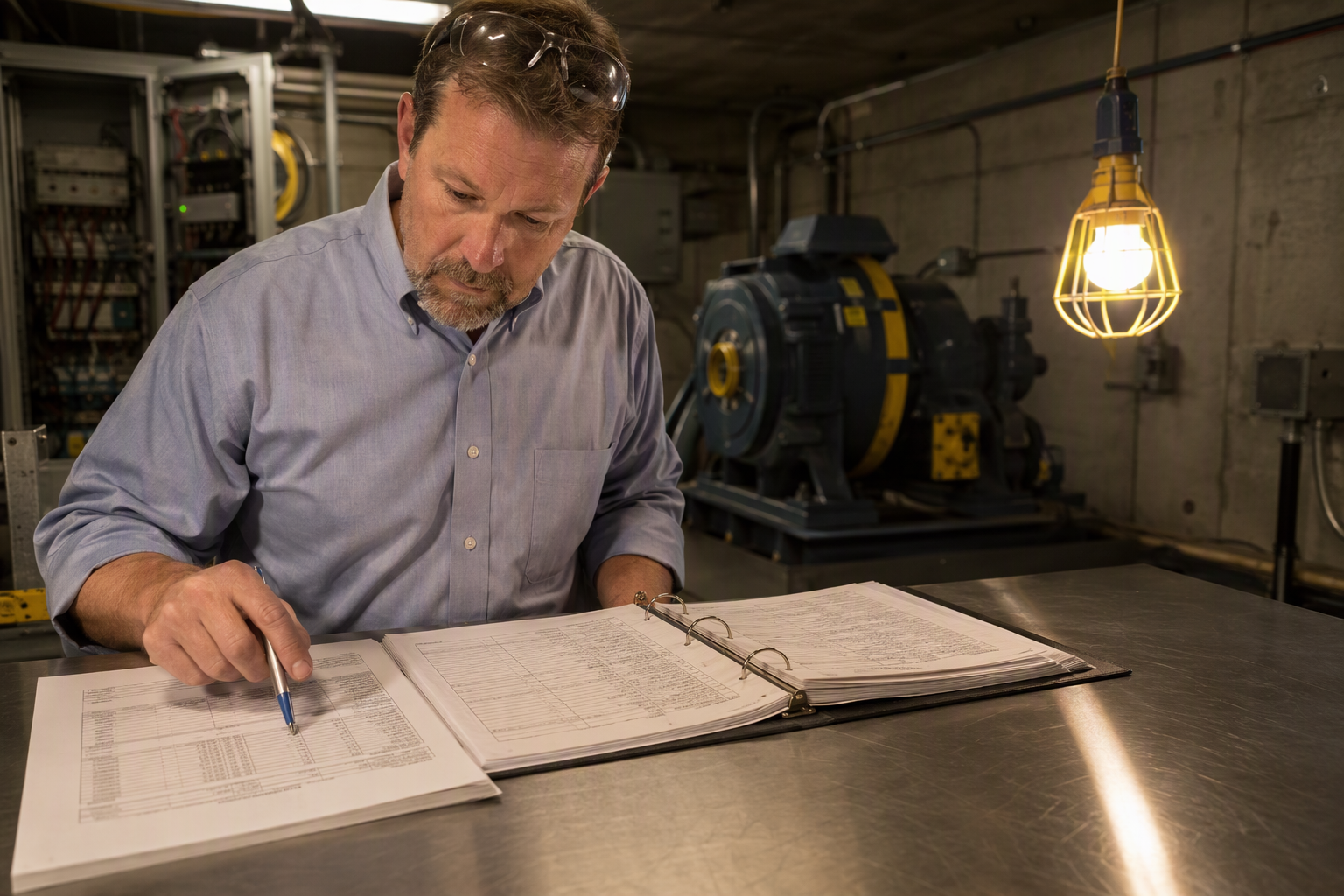
A formal elevator condition assessment — conducted by a qualified professional before any repair-modernize-replace decision is finalized — is the foundation of a sound business case. A thorough assessment typically covers:
- Visual and operational inspection of all major subsystems: machine, controller, hoistway, cab, doors, and pit equipment
- Review of the elevator’s maintenance and service history, including recurring failure patterns
- Code compliance gap analysis against ASME A17.1-2019 and applicable Arizona Administrative Code requirements
- ADA accessibility review against ADA standards
- Parts availability and obsolescence analysis for critical components
- Remaining useful life estimate for structural components (hoistway, rails, buffers)
- Modernization scope options with relative cost ranges and compliance implications
Arizona Elevator Solutions provides this type of data-driven assessment as the starting point for every client engagement, ensuring that recommendations are grounded in documented equipment condition rather than generalized assumptions about equipment age or type.
What Questions Should I Ask Before Signing a Modernization or Replacement Contract?
- Does the contractor hold an active R-12 or C-12 license from the Arizona Registrar of Contractors?
- Which specific components are included in the scope, and which are excluded?
- What is the warranty coverage for new components, and what are the exclusions?
- How does the contractor handle compliance triggers — components that, when altered, require additional scope to meet ASME A17.1-2019?
- Has the contractor accounted for the 90-day ICA Elevator Division notification requirement in the project schedule?
- Who will conduct the post-modification inspection, and is that inspector authorized by the ICA?
- What is the contingency plan if the elevator is out of service longer than projected?
- Are the new controller and drive components open-market or proprietary to this contractor?
- What remote monitoring or predictive maintenance capabilities does the new equipment support?
- Can the contractor provide references from comparable Arizona projects completed within the past three years?
How Can Arizona Elevator Solutions Help Building Owners Navigate This Decision?
Arizona Elevator Solutions approaches the repair-modernize-replace evaluation as a data-driven process, not a sales exercise. The team begins with a documented condition assessment that gives building owners an objective view of their equipment’s current state, compliance status, and realistic options — before any scope or budget commitment is made.
Working exclusively within Arizona, the team understands the regulatory requirements administered by the Industrial Commission of Arizona’s Elevator Division, the City of Phoenix Elevator Section’s jurisdiction within Phoenix, and the specific compliance obligations that ASME A17.1-2019 and Arizona Administrative Code R20-5-502 through R20-5-515 impose on modernization and replacement projects. That regulatory fluency translates directly into projects that are scoped correctly from the outset — avoiding the costly surprises that arise when compliance triggers are discovered mid-project.
Summary: A Framework for the Decision
The repair-modernize-replace decision is not a formula — it is a structured judgment that weighs equipment condition, compliance status, parts availability, lifecycle cost, and capital availability against each other. The table below summarizes the qualitative signals associated with each path:
| Decision Path | Primary Indicators | Key Arizona Regulatory Consideration |
|---|---|---|
| Repair | Isolated, non-recurring failure in a single component; parts available; system otherwise passing annual inspection | Post-repair inspection may be required before return to service if the repair constitutes an alteration under Arizona Administrative Code |
| Modernization | Recurring failures across subsystems; obsolete controller or drive; energy performance gap; ADA deficiencies; structural components still serviceable | 90-day advance ICA notification required; alteration triggers ASME A17.1-2019 compliance for altered scope; post-modernization inspection mandatory |
| Replacement | Hoistway or structural components beyond economical repair; buried single-bottom hydraulic cylinder with environmental liability; modernization cost approaches replacement cost; building renovation requiring hoistway reconfiguration | 90-day advance ICA notification required; full installation must comply with ASME A17.1-2019; new certificate of inspection required before operation |
Note: This table presents qualitative guidance based on industry practice and Arizona regulatory requirements. It does not substitute for a site-specific condition assessment and professional engineering evaluation.
Get the Facts Before You Decide
The wrong decision on a repair-versus-modernize-versus-replace question can cost Arizona building owners significant time and capital. Arizona Elevator Solutions conducts structured, data-driven elevator assessments that give you an objective picture of your equipment’s condition, compliance status, and realistic options — before any contract is signed.
Contact Arizona Elevator Solutions for a free elevator assessment: 480-557-7600
Need elevator service you can rely on? Arizona Elevator Solutions is ready to help.






