
Before calling a technician, safely evacuate any passengers if the elevator is stopped between floors, note all error codes displayed on the panel, listen carefully to identify where and when noises occur, check whether the certificate of inspection is current and posted, and document everything so the technician can diagnose the problem faster.
What to Do When Your Elevator Is Making Strange Noises or Showing Error Codes Before You Call a Technician
When an elevator begins behaving abnormally — grinding, banging, beeping, or flashing fault codes — building owners and managers in Phoenix, Tucson, Scottsdale, and Mesa face an immediate judgment call: is this a safety emergency, a maintenance warning, or a nuisance quirk? Understanding how to assess the situation before a technician arrives can protect passengers, limit liability, and give the service provider the information needed to diagnose and repair the problem efficiently. The guidance below covers every dimension of that assessment, grounded in federal codes and Arizona regulatory requirements.
What is the very first thing to do when an elevator makes an unexpected noise or shows an error code?
Stop the elevator from accepting new passengers immediately, then determine whether anyone is already trapped inside.
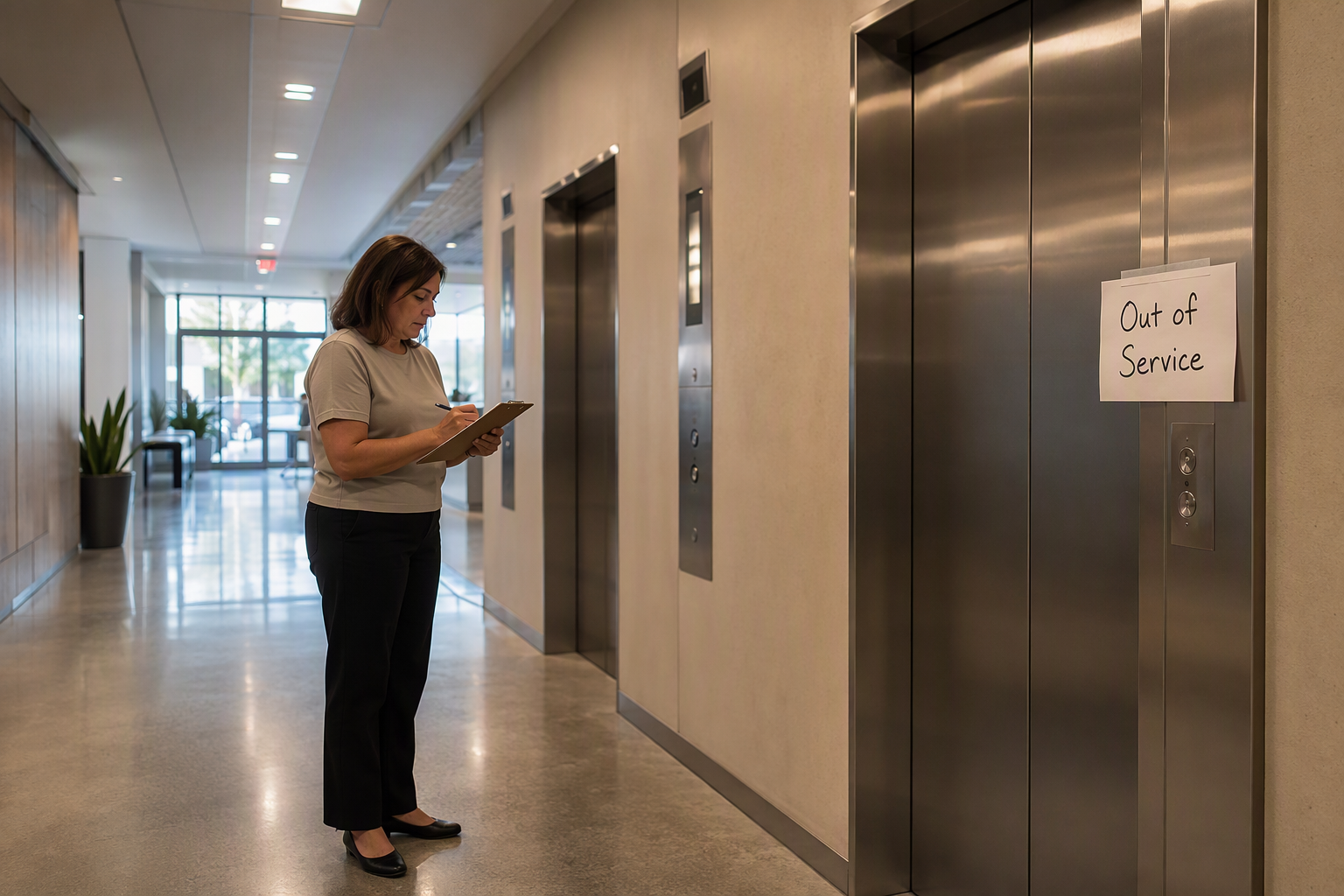
The priority in any abnormal elevator event is passenger safety. Place an “Out of Service” sign at every floor landing served by the elevator. If the cab is between floors or doors will not open, follow the emergency communication procedure in your building’s posted emergency plan — never attempt to pry doors open manually, as this creates crush and fall hazards. Once you have confirmed no one is trapped, document the situation before touching anything else. Arizona owners are required under A.R.S. §§ 23-491 through 23-491.16 to notify the Industrial Commission of Arizona’s Elevator Division within 24 hours of any accident that injures a person or disables a conveyance.
Are strange elevator noises always a sign of a serious mechanical failure?
Not always, but every unfamiliar noise deserves immediate documentation and professional evaluation because the underlying cause can range from a loose guide rail bracket to a failing hoist motor.
Some sounds — a light hum when the motor starts, a soft click as doors engage — are normal. Abnormal sounds are those that are new, intermittent, or changing in character. Common abnormal noises and their frequent causes include squealing (worn or dry guide shoe gibs), grinding (debris on the rail or deteriorating roller guides), banging (slack in the hoist ropes or counterweight chain), and rattling (loose cab panels, door operator hardware, or pit components). A technician cannot diagnose remotely without a detailed description, so your documentation directly reduces the time — and cost — of the service call.
What information should be recorded before calling the elevator service company?
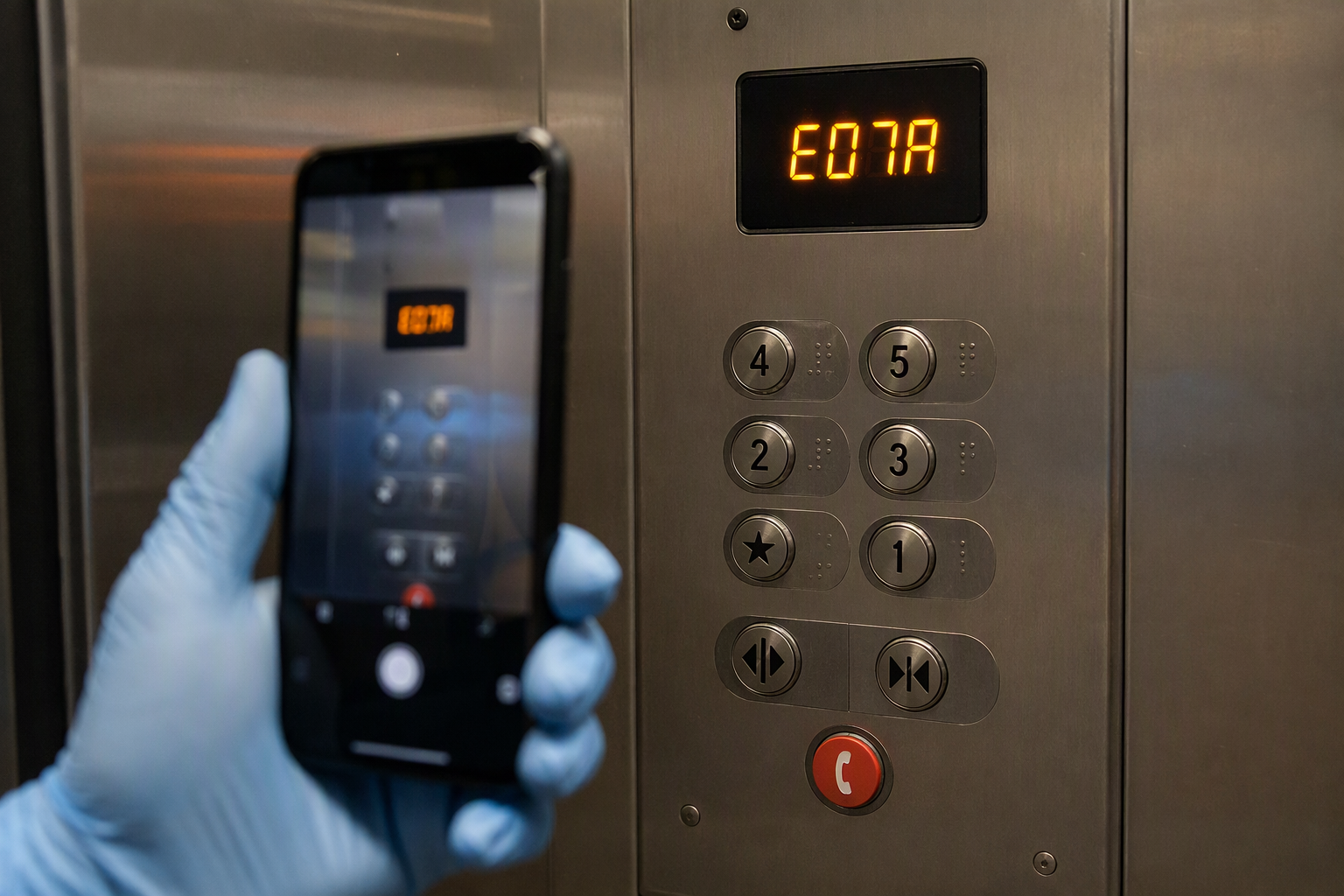
Record the elevator’s state serial number, any error or fault codes on the control panel, a description of every noise including when it occurs in the travel cycle, and the exact time and date of the incident.
The state serial number is located on a tag fixed to the controller or mainline disconnect, as required by Arizona Administrative Code R20-5-502 through R20-5-515. It uniquely identifies the conveyance in state records and helps the service company pull maintenance history quickly. In addition, note:
- Which floor or floors the problem occurs at, or whether it happens throughout the full travel range
- Whether the noise or fault is constant or only triggered by starting, stopping, or door movement
- How many passengers were on board and approximately what combined load
- Whether the cab leveling (floor-to-landing alignment) appears off
- Whether any alarms, intercoms, or emergency lights activated
- The current certificate of inspection expiration date, which should be posted in or near the cab
Photographs or short video clips of displayed error codes are especially useful because fault code libraries vary by manufacturer and model year.
What do common elevator error codes mean and which ones require immediate shutdown?
Error codes are manufacturer-specific fault identifiers; while their exact meanings differ across brands, codes related to safety circuits, overspeed, or door lock failures generally require immediate shutdown and should not be reset without technician authorization.
Modern elevator controllers log fault codes that correspond to specific subsystem failures. Safety-critical categories that universally warrant taking the unit out of service include:
- Safety circuit faults: Any code indicating an open safety chain (governor, safeties, buffers, pit switch)
- Door lock or gate switch faults: Codes indicating a door is not fully closed or locked before travel begins
- Overspeed or governor faults: Codes that indicate the car exceeded or approached its rated speed limit
- Drive or motor faults: Thermal overloads, encoder errors, or inverter faults that could cause uncontrolled movement
Non-critical codes — such as a door re-open retry count or a load-weighing calibration reminder — may allow temporary continued operation at reduced capacity, but that determination should only be made by a qualified technician familiar with ASME A17.1 Safety Code for Elevators and Escalators, which establishes the performance requirements these fault codes are designed to protect.
Which elevator noises should trigger an immediate evacuation and shutdown?
Grinding or scraping sounds accompanied by abnormal stopping, any sound of cable tension releasing, burning smells, or any noise paired with unexpected cab movement are all immediate evacuation triggers.
The following table provides a practical reference for categorizing elevator sounds by urgency level:
| Sound or Symptom | Likely Source | Recommended Action | Urgency Level |
|---|---|---|---|
| Grinding or metal-on-metal scraping | Worn guide rollers, debris on rail, or brake drag | Shut down immediately, call technician | High — Do not operate |
| Loud bang or thud during travel | Slack hoist rope, counterweight impact, or buffer contact | Shut down immediately, call technician | High — Do not operate |
| Burning smell or smoke | Motor overheating, brake lining, or electrical fault | Evacuate, call emergency services, then technician | Emergency |
| Squealing during travel | Dry guide shoe gibs or worn roller guides | Schedule priority service; monitor until serviced | Medium — Limited operation |
| Intermittent rattling or vibration | Loose cab panel, door track hardware, or pit components | Inspect visually; schedule service | Low — Document and monitor |
| Door hesitation or repeated re-opening | Door operator adjustment, obstruction, or sensor fault | Check for visible obstruction; schedule service | Medium — Inspect before continued use |
| Cab leveling off by more than ½ inch | Leveling sensor, brake, or drive fault | Shut down; ADA accessibility concern and trip hazard | High — Do not operate |
| Unusual electrical hum or buzzing | Drive inverter, transformer, or contactors | Schedule service; do not ignore | Medium — Monitor closely |
What steps should be taken if passengers are trapped inside a stopped elevator?
Communicate with trapped passengers to reassure them, contact emergency services if needed, and wait for a qualified elevator technician — never attempt to manually open hoistway doors or assist passengers out between floors.
- Use the in-cab emergency phone or intercom to speak directly with trapped passengers. Modern elevators connected to a central monitoring service will already be alerting a response center.
- Confirm passengers are not in medical distress. If anyone reports a cardiac event, difficulty breathing, or injury, call 911 immediately.
- Instruct passengers to press the “Door Open” button repeatedly if the cab has stopped at a floor landing — sometimes a re-level command or door retry will free the cab.
- Do not instruct passengers to attempt to force doors open from inside or try to exit if the cab is not level with a floor landing.
- Contact your elevator service company and provide the state serial number, floor location, and number of passengers.
- Remain in communication with passengers until the technician or emergency responders arrive.
- After the incident, notify the Industrial Commission of Arizona’s Elevator Division within 24 hours as required under A.R.S. § 23-491 if the event disabled the conveyance or injured any person.
How does Arizona law require building owners to respond to elevator malfunctions?
Arizona law under A.R.S. §§ 23-491 through 23-491.16 requires owners to notify the Industrial Commission of Arizona’s Elevator Division within 24 hours of any accident that injures a person or disables a conveyance.
Beyond the 24-hour accident notification, Arizona owners have ongoing statutory obligations that become especially relevant when a malfunction is detected. The elevator may not operate without a valid annual certificate of inspection issued by the state, and that certificate must be kept at the location of the conveyance and made available on request. The state serial number or certificate must be posted in or near the cab in an easily accessible location. If a malfunction renders the elevator unsafe, removing it from service is not just a practical decision — it is an owner’s legal responsibility under Arizona Administrative Code R20-5-502 through R20-5-515.
Contractors who perform repairs on Arizona elevators must hold either an R-12 or C-12 elevator contractor license issued by the Arizona Registrar of Contractors. This requirement protects owners from unqualified repairs that could compound a malfunction and create additional liability. Arizona Elevator Solutions holds the appropriate contractor licensing and operates in full compliance with these requirements across Phoenix, Scottsdale, Mesa, and Tucson.
Should the elevator be reset or restarted after an error code appears?
A reset may be appropriate for clearly minor, non-safety-related codes when authorized by the service provider, but resetting a safety-circuit fault without a physical inspection is prohibited under ASME A17.1 and can mask a dangerous underlying condition.
Some modern controllers allow building staff to perform a soft reset — cycling power at the main disconnect — to clear a transient fault caused by a power fluctuation or a momentary sensor trigger. This is only acceptable when the error code is classified by the manufacturer as a non-safety code, no physical symptoms (noises, leveling errors, door problems) accompanied the fault, and the service company explicitly authorizes the reset procedure over the phone. In every other case, resetting the controller without inspection risks re-energizing a system that has a genuine mechanical or electrical failure. Under ASME A17.1 Safety Code for Elevators and Escalators, safety devices such as the governor, safeties, and door interlocks must be manually reset and inspected by a qualified person after activation.
What is the role of the annual certificate of inspection during a malfunction event?
The certificate of inspection confirms the elevator was last found compliant with Arizona code, and its expiration date tells you whether the unit is currently authorized to operate at all.
When a malfunction occurs, the certificate serves as a baseline document. If the certificate is expired, the elevator is not legally permitted to operate in Arizona regardless of whether a malfunction has occurred — and continuing to run it compounds the owner’s liability. If the certificate is current, it provides the inspection date and inspector information that helps a technician understand how recently safety-critical components were verified. Arizona Elevator Solutions recommends that property managers in Phoenix, Tucson, Scottsdale, and Mesa maintain a facility log that tracks inspection dates, service visits, and any observed anomalies so that this documentation is immediately available when a malfunction occurs.
How should a building manager document elevator noises for the service technician?
Use a written log that captures the date, time, floor location, sound description, and any associated symptoms for every instance the abnormal noise occurs.
An effective noise documentation log should include:
- Date and time of each occurrence
- Floor or zone of the travel path where the noise is loudest
- Phase of operation: door opening, door closing, acceleration, constant-speed travel, deceleration, or leveling
- Character of the sound: grinding, squealing, banging, rattling, humming, clicking
- Approximate duration
- Estimated load in the cab at the time
- Any simultaneous symptoms: vibration, leveling error, slow door operation, or error code display
A video recording using a phone — capturing the control panel display, the cab interior behavior, and the audio — provides the technician with diagnostic evidence that a written description alone cannot convey. Many elevator service companies, including Arizona Elevator Solutions, can pre-diagnose likely fault categories from video before dispatching, which allows technicians to arrive with the correct parts and tools.
What are the most common causes of grinding or scraping noises in elevator systems?
Grinding or scraping in an elevator most commonly originates from worn or contaminated guide rollers, deteriorated slide shoe gibs, debris in the hoistway, or brake components that are dragging.
Guide rollers and slide shoes are the components that keep the elevator car centered on the guide rails throughout its travel. When these wear beyond specification or lose lubrication, the car makes direct metal contact with the rail, producing grinding or scraping sounds. In Arizona’s climate — with extreme summer heat, dust, and low humidity — rail lubrication degrades faster than in cooler or higher-humidity environments. Debris accumulation in the pit is also a contributing factor: dirt, construction material, or pests can displace into the hoistway and contact moving components. Brake drag — where the electromagnetic brake does not fully release — produces a consistent grinding or burning smell during travel. All of these conditions are detectable during a routine maintenance visit and preventable with a proactive maintenance schedule aligned with ASME A17.1 maintenance requirements.
Can unusual elevator noises indicate an ADA compliance problem?
Yes — cab leveling errors that accompany certain noises create a floor-to-landing gap exceeding ADA tolerances, which is both a trip hazard and a federal accessibility violation.
Under the Americans with Disabilities Act, elevator cab floors must be level with the floor landing within a defined tolerance. When brake wear, drive malfunctions, or leveling sensor failures cause the cab to stop several inches above or below a landing, wheelchair users and individuals with mobility impairments face a barrier that constitutes an ADA violation. Building owners in Phoenix, Scottsdale, Mesa, and Tucson who operate elevators as the accessible route in their facility have a heightened obligation to correct leveling faults promptly, because the accessible route must remain continuously available. A leveling noise or fault code should therefore be treated as both a mechanical and an accessibility compliance issue.
What is the difference between a hydraulic elevator noise and a traction elevator noise?
Hydraulic elevators most commonly produce fluid-related sounds — hissing, whining, or surging — while traction elevators produce mechanical sounds related to ropes, sheaves, brakes, and guides.
Understanding which type of elevator a building has helps narrow the diagnostic range before the technician arrives. Hydraulic elevator abnormal sounds to document include a hissing sound during descent (possible fluid leak or valve wear), a whining or surging pump noise during ascent (pump cavitation or worn pump components), or a jolt at the end of travel (valve timing or fluid pressure issue). Traction elevator abnormal sounds include rope slap or flutter (rope tension imbalance or sheave groove wear), a thud at the top or bottom of travel (buffer contact, which indicates a serious speed or leveling problem), and gear noise in geared traction machines (gear oil degradation or worn gearing). Knowing the elevator type and communicating it when calling the service company allows the dispatcher to route a technician with the appropriate tools and fluid inventories for your system.
How does Arizona’s climate specifically affect elevator mechanical wear and noise generation?
Phoenix-area heat exceeding 110°F accelerates hydraulic fluid degradation, lubricant evaporation on guide rails, and thermal stress on electronic drive components, all of which can produce abnormal noises or fault codes sooner than manufacturer maintenance intervals might predict.
Arizona’s desert climate creates conditions that differ materially from the temperate environments in which most elevator maintenance schedules are designed. Hydraulic fluid operating in a machine room without adequate cooling will thin, cavitate, and produce surging or hissing sounds during operation. Guide rail lubricants evaporate faster in high-heat, low-humidity environments, increasing metal-on-guide friction and noise. Electronic variable-frequency drives — increasingly common on both hydraulic and traction systems — are sensitive to ambient temperature, and sustained machine room heat can trigger thermal protection fault codes that would not occur in cooler climates. Arizona Elevator Solutions incorporates Arizona-specific environmental factors into its maintenance planning recommendations for properties in Phoenix, Tucson, Scottsdale, and Mesa.
What should a building owner check about the machine room before calling for service?
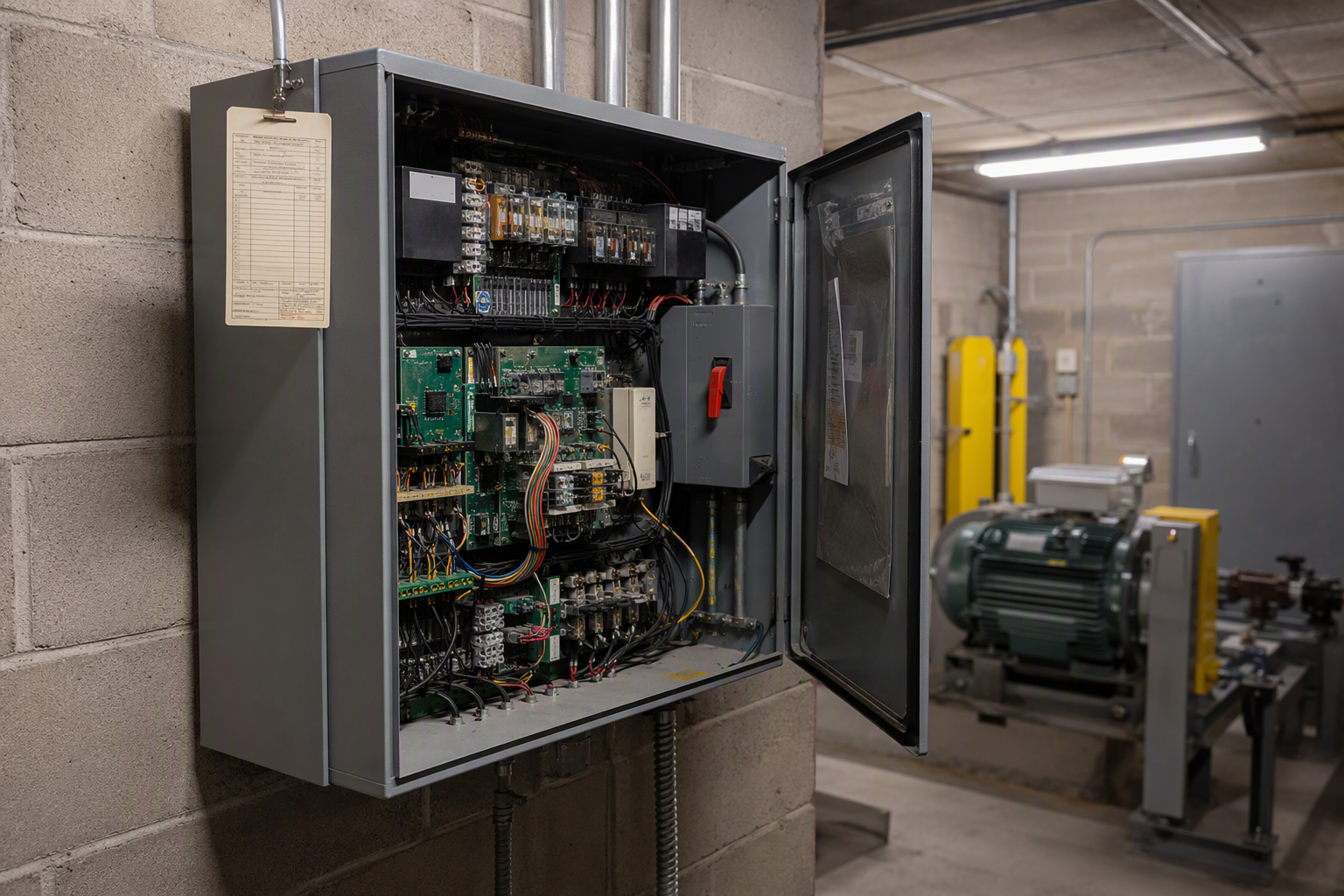
Check that the machine room door is closed and secured, that no water intrusion or flooding is visible, that the machine room temperature appears within normal range, and that no circuit breakers serving the elevator have tripped — then report these observations to the service company without touching any equipment.
- Verify the machine room access door is shut and that no unauthorized personnel have been in the room.
- Look for any signs of water intrusion, which in Arizona can occur during monsoon season through roof penetrations.
- Observe — without touching — whether any indicator lights on the controller panel are flashing or illuminated red.
- Check the main elevator disconnect switch and associated circuit breakers for a tripped position.
- Note whether the machine room is excessively hot, which could indicate HVAC failure affecting the controller.
- Photograph the controller display panel to capture fault codes before they scroll or reset.
- Do not attempt to manually move any machinery, reset breakers on safety circuits, or access the top of car or pit without elevator-specific training.
This information, communicated to the service technician at the time of the call, materially reduces diagnostic time on site.
What should be done in the elevator pit or on top of the car before technician arrival?
Nothing — the pit and top-of-car are restricted access areas governed by ASME A17.1 safety requirements, and entry by untrained personnel before the elevator is properly locked out is a serious injury risk.
Under ASME A17.1 Safety Code for Elevators and Escalators, specific procedures must be followed before any person enters the pit or accesses the top of the car, including activating stop switches and establishing lockout/tagout. These procedures require elevator-specific training. A building engineer or facilities manager who enters the pit to “check for something” without following these procedures risks being struck by a moving counterweight or car. The correct pre-call action for the pit is to look through the pit access door window (if equipped) without entering, note whether any water, debris, or unusual conditions are visible, and report observations to the service company. OSHA standards also govern confined space entry procedures relevant to elevator pits.
How often should an elevator be inspected under Arizona law to prevent these problems from developing?
Arizona law requires each conveyance to be inspected annually, and before it first goes into service and after any modification or alteration.
The annual inspection requirement under A.R.S. §§ 23-491 through 23-491.16 establishes the minimum legally required frequency. It is important to understand that the annual inspection is a compliance checkpoint, not a substitute for ongoing maintenance. Many of the mechanical conditions that produce abnormal noises — worn guide rollers, degraded lubricants, brake adjustment drift — develop between inspections and are best caught through a proactive maintenance program with intervals more frequent than once per year. Arizona owners may engage a private elevator inspector authorized by the Industrial Commission of Arizona, provided that inspector is independently registered and not affiliated with the company that services the elevator. The annual certificate of inspection issued following a successful inspection is the document that legally authorizes the elevator to remain in service in Arizona.
What distinguishes a fault code reset from a required safety inspection after a fault?
A fault code reset clears the error display in the controller; a required safety inspection is a physical examination of the specific component or system that triggered the fault, and the two are not interchangeable.
When a safety device such as the car or counterweight safety, the governor, or a door interlock triggers, ASME A17.1 Safety Code for Elevators and Escalators requires that the device be manually reset and inspected by a qualified person before the elevator returns to service. Simply cycling power to reset the fault code does not constitute this inspection and does not satisfy the code requirement. If the fault was triggered by an actual overspeed event, for example, the safety jaws, the governor rope, and the buffer must all be examined before return to service. Building owners who allow an elevator to return to service solely on the basis of a code reset — without the required physical inspection — are operating outside the requirements of Arizona Administrative Code R20-5-502 through R20-5-515 and assume full liability for any subsequent incident.
Does the City of Phoenix have additional local requirements for elevator malfunction reporting?
Yes — elevators inside the City of Phoenix are inspected by the City of Phoenix Elevator Section within the Planning and Development Department, and owners with malfunctions may need to coordinate with this local authority in addition to the state.
The Industrial Commission of Arizona’s Elevator Division administers elevator safety statewide, but within the City of Phoenix, the City of Phoenix Elevator Section (Planning and Development Department) inspects elevators, escalators, moving walks, dumbwaiters, and chair lifts. Building owners in Phoenix experiencing a significant malfunction or disability should be aware that both the city’s inspection authority and the state’s 24-hour accident notification requirement may apply. Owners in Scottsdale, Mesa, and Tucson are regulated directly by the state’s Elevator Division. Understanding the applicable authority-having-jurisdiction (AHJ) for your property’s location matters when reporting incidents and scheduling the return-to-service inspection that follows a significant malfunction repair.
What should property managers in Phoenix, Scottsdale, Mesa, or Tucson do to prepare for a technician visit after a noise or fault code event?
Secure the elevator from passenger use, compile all documentation of the incident, locate the state serial number and current certificate of inspection, and ensure unobstructed access to the machine room, pit access door, and all floor landings.
- Place “Out of Service” notices at every floor landing served by the elevator.
- Gather the written noise log, photographs, and video clips of any error code displays.
- Locate the elevator’s state serial number (on the controller or mainline disconnect tag).
- Confirm the current certificate of inspection is present in or near the cab.
- Clear any stored items from the machine room that would obstruct technician access.
- Identify the location of the pit access door and confirm its key or access code is available.
- Have the building’s elevator maintenance agreement or service history record available for the technician’s review.
- Be prepared to describe all prior service events, even informal ones, related to the current symptoms.
Arizona Elevator Solutions technicians serving Phoenix, Tucson, Scottsdale, and Mesa are prepared to conduct a comprehensive diagnostic assessment when all of this information is ready at the start of the service visit, reducing time on site and getting the elevator back in safe, compliant operation as quickly as possible.
When should an elevator simply be taken out of service and left out until a full inspection is completed?
An elevator should remain out of service — regardless of operational demand — whenever a safety circuit has tripped, a grinding or burning symptom is present, cab leveling is visibly off, or any code governing safety device operation requires a post-activation inspection before return to service.
The pressure to return an elevator to service quickly is understandable, particularly in multi-story buildings where the elevator serves as the primary accessible route. However, operating an elevator with an unresolved safety fault is a legal violation under A.R.S. §§ 23-491 through 23-491.16 and a direct exposure to liability if a passenger is subsequently injured. Qualitative risk assessment — not passenger demand or lease pressure — must drive the return-to-service decision. The standard is clear under ASME A17.1 Safety Code for Elevators and Escalators: equipment must be in safe operating condition before it is returned to public use. Arizona Elevator Solutions provides documented return-to-service verification that building owners can retain alongside their certificate of inspection to demonstrate due diligence.
Ready for a Professional Assessment?
When an elevator begins making unusual noises or displaying error codes, the steps described above will protect passengers, preserve compliance, and give a technician the information needed to resolve the problem efficiently. However, no amount of pre-call documentation replaces a hands-on evaluation by a qualified elevator service provider operating under the requirements of Arizona law and ASME A17.1.
Contact Arizona Elevator Solutions for a free elevator assessment. Arizona Elevator Solutions serves building owners, property managers, and facility directors throughout Phoenix, Scottsdale, Mesa, and Tucson with code-compliant elevator service, maintenance, and inspection coordination.
Call now: 480-557-7600
Need elevator service you can rely on? Arizona Elevator Solutions is ready to help.






