
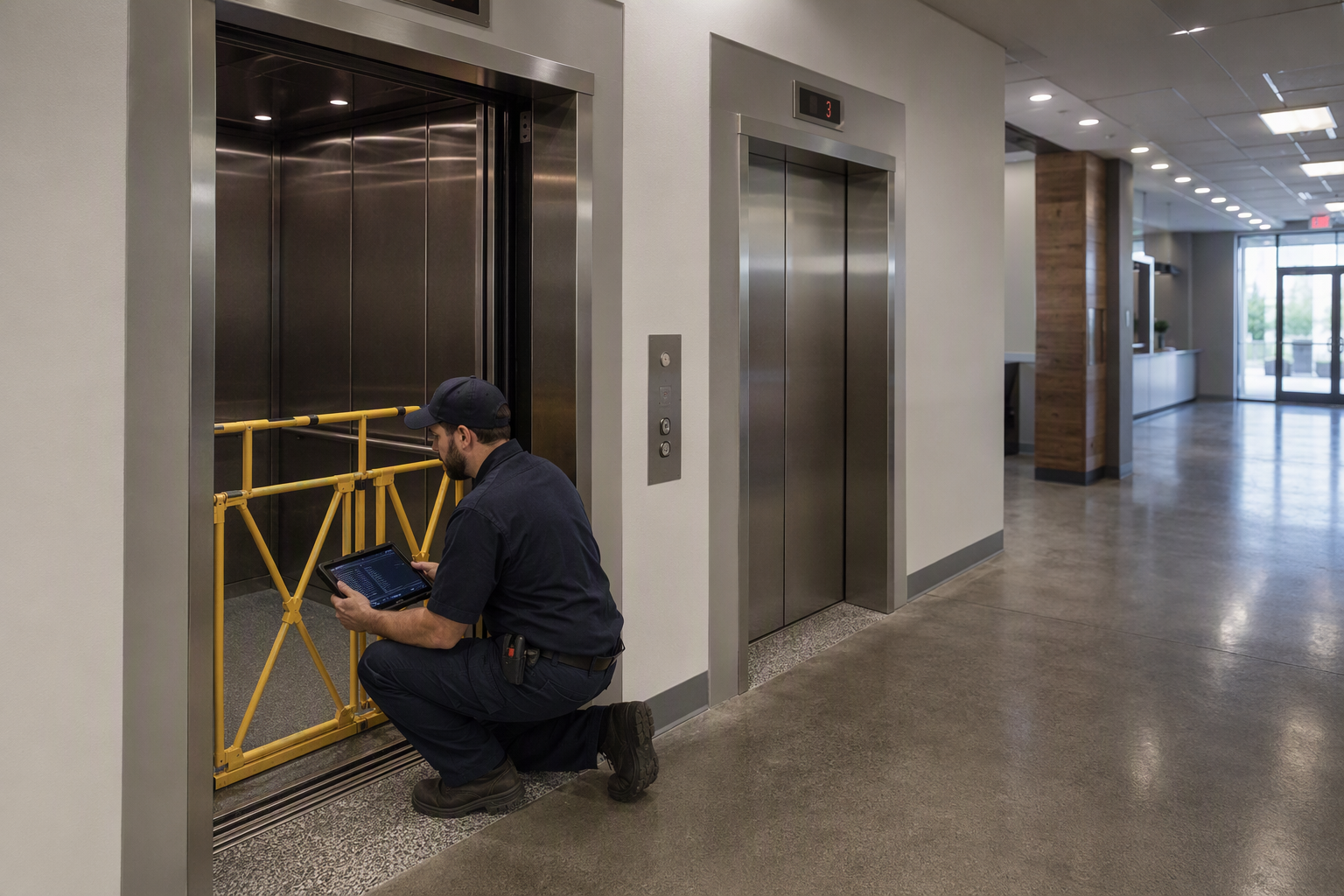
Building owners and property managers in Arizona face a recurring question: is this elevator problem a straightforward fix, or a signal that the unit needs a full modernization? The answer shapes budgets, timelines, tenant satisfaction, and legal compliance. This guide walks through the most common commercial elevator repair problems, explains how to recognize when a repair is no longer enough, and provides a structured framework for making the right call.
What Are the Most Common Elevator Repair Problems in Commercial Buildings?
Commercial elevators experience a predictable set of recurring issues. Understanding these categories helps building owners communicate accurately with service providers and make faster decisions when problems arise.
1. Door System Failures
Door malfunctions are among the most frequently reported issues in commercial elevator service calls. Problems include doors that fail to open or close fully, doors that reverse unexpectedly, worn door tracks, misaligned sills, and failing door operators or clutches. Because the door system interacts with safety circuits, even a minor mechanical misalignment can trigger a safety shutdown.
2. Control System and Circuit Board Faults
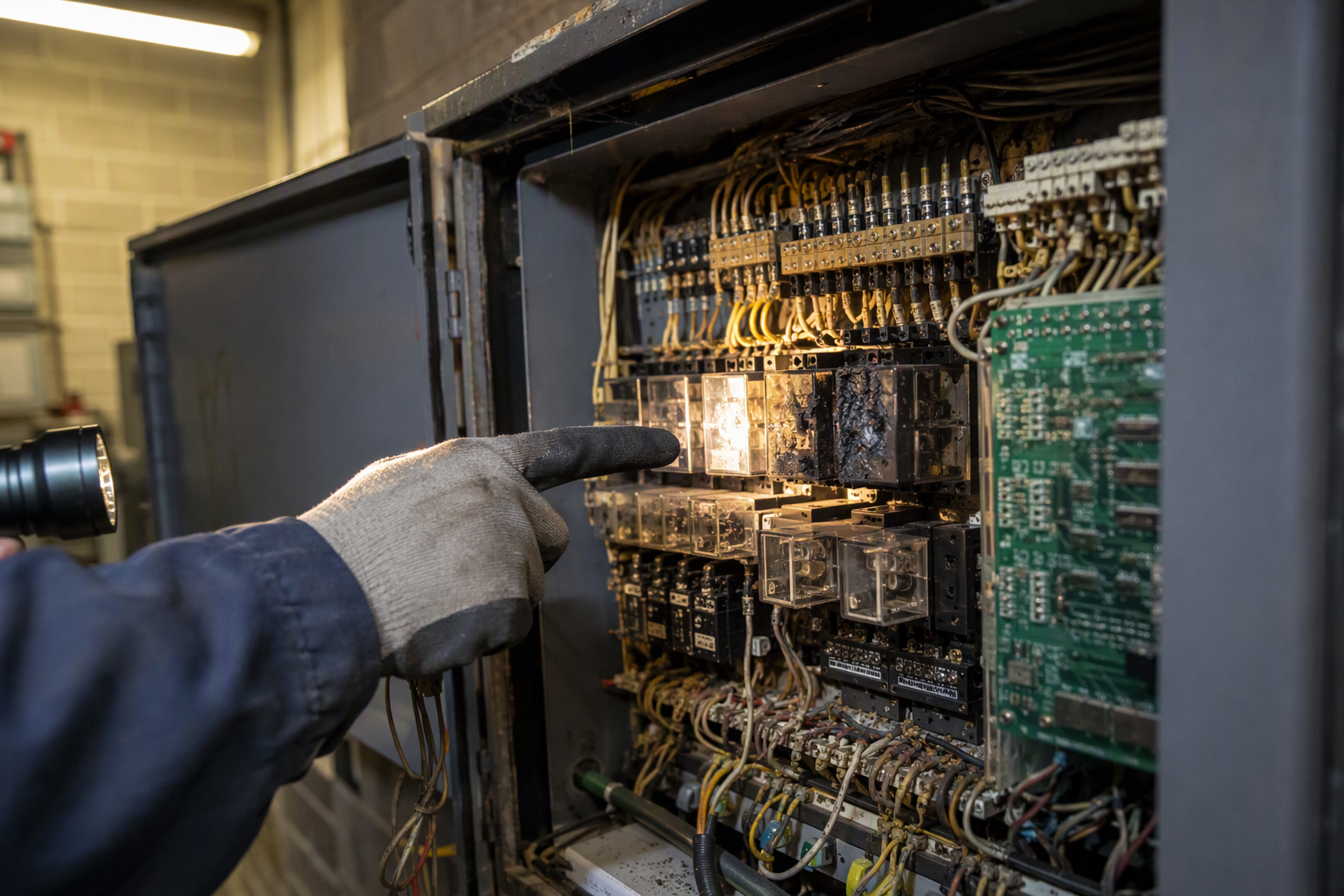
Older relay-based or proprietary microprocessor control systems develop faults that cause erratic floor stopping, unresponsive hall calls, failure to level at landings, and nuisance shutdowns. When a control system relies on obsolete logic boards, replacement parts may be unavailable, which often forces a controls modernization even when the rest of the elevator is mechanically sound.
3. Drive and Motor Issues
Hydraulic elevators may suffer from oil leaks, cylinder wear, or failing power units. Traction elevators experience motor overheating, worn sheaves, and aging or broken hoist ropes. These issues directly affect ride quality, leveling accuracy, and energy consumption.
4. Safety Device Malfunctions
Under the ASME A17.1 Safety Code for Elevators and Escalators adopted by Arizona for equipment installed, repaired, or altered on or after January 1, 2023 (ASME A17.1-2019), elevators must maintain functioning safety devices including governors, safeties, buffers, and overspeed protection. When these components fail inspection or show wear, repair or replacement is not optional — it is a legal requirement under A.R.S. §§ 23-491 through 23-491.16.
5. Hydraulic Cylinder and Seals
In-ground hydraulic cylinders can develop leaks that release hydraulic fluid into the soil, a serious environmental and regulatory concern. Depending on cylinder condition and age, repair or full cylinder replacement may be required.
6. Cab Interior and Accessibility Components
Damaged flooring, failing cab lighting, worn handrails, and malfunctioning call buttons are operational nuisances that also carry Americans with Disabilities Act (ADA) implications. Inoperable controls, non-compliant button heights, or missing tactile indicators can expose building owners to accessibility complaints.
7. Rope and Suspension System Wear
Hoist ropes on traction elevators wear over time and must be replaced before they reach discard criteria established in ASME A17.1. Rope replacement is a defined repair; however, if sheaves and other suspension system components are simultaneously worn, the scope may expand significantly.
8. Electrical and Wiring Degradation
Aging wiring insulation, corroded terminals, and outdated electrical panels create intermittent faults that are difficult to diagnose and increasingly dangerous. Older wiring systems may also be incompatible with modern replacement components, pushing a repair toward a broader electrical modernization.
How Do I Know If a Problem Is a Minor Repair or a Major Modernization?
The repair-vs.-modernize decision rarely reduces to a single symptom. Evaluating the right path requires weighing equipment age, parts availability, compliance status, repair frequency, and total cost of ownership. The following diagnostic questions provide a reliable starting framework.
- How old is the equipment? Older equipment is more likely to have obsolete components, aging wiring, and systems that fall short of current code requirements under ASME A17.1-2019.
- Are replacement parts readily available? If control boards, door operators, or motor components are no longer manufactured, a single repair can become a months-long parts search — often at premium cost.
- How frequently is the elevator being taken out of service? Repeated shutdowns compound tenant dissatisfaction and lost productivity. A pattern of recurring failures across multiple systems is a strong modernization signal.
- Does the elevator comply with current ASME A17.1-2019 requirements and Arizona Administrative Code R20-5-502 through R20-5-515? Arizona requires that equipment installed, repaired, or altered on or after January 1, 2023 comply with the current adopted edition. Significant alterations can trigger broader code compliance obligations.
- Has the elevator passed its most recent annual inspection? Under Arizona law, no conveyance may operate without an annual certificate of inspection issued by the state. A failed inspection that requires multiple system corrections may be more economically addressed through modernization.
- What is the projected repair cost relative to modernization cost? A qualified elevator service provider can produce a cost comparison that accounts for expected future repair calls alongside a modernization quote.
- Does the building have plans for renovation, sale, or occupancy changes? A planned property transaction or occupancy upgrade often makes modernization a more strategic investment than patch repairs.
Repair vs. Modernization: Side-by-Side Comparison
| Factor | Targeted Repair | Full or Partial Modernization |
|---|---|---|
| Typical Scope | Single system or component (doors, motor, control board) | Multiple systems — controls, drives, cab, doors, safety devices |
| Upfront Investment | Lower immediate cost | Higher initial investment; lower total cost over time if equipment was failing repeatedly |
| Typical Downtime | Hours to a few days depending on parts availability | Weeks; scope and phasing plan determine duration |
| Parts Availability Risk | High for older equipment — obsolete components cause delays | Eliminates obsolescence risk; new components with manufacturer support |
| Code Compliance Impact | Limited; repair must meet current code for the specific work performed | Significant alterations may trigger broader ASME A17.1-2019 compliance requirements under Arizona rules |
| Energy Efficiency | Little to no improvement | Modern variable-frequency drives and LED lighting reduce energy consumption |
| Ride Quality & Reliability | Restored to prior baseline — underlying aging persists | Substantially improved; new components reset reliability expectations |
| ADA Compliance | Addressed only if ADA item is the specific repair | Modernization provides a structured opportunity to remediate all ADA gaps simultaneously |
| Warranty | Warranty applies only to replaced component | Broader warranty coverage on new systems; reduced maintenance liability |
| Best Fit | Isolated failure, equipment under moderate age, parts available, compliance current | Repeated failures, obsolete parts, failed inspections, aging electrical systems, property upgrades |
What Are the Signs That Repairs Are No Longer Enough?
Several conditions individually or in combination indicate that repair is no longer the most prudent course of action for a commercial elevator.
- The elevator has required service calls across multiple, unrelated systems within a short period.
- The control system uses proprietary or discontinued logic that cannot be sourced through the original manufacturer or the aftermarket.
- The annual inspection has produced a list of deficiencies rather than a clean certificate.
- Hydraulic fluid contamination or in-ground cylinder corrosion has been identified.
- Hoist ropes are at or near discard criteria under ASME A17.1 simultaneously with worn sheaves, meaning full suspension system work is required anyway.
- The building’s insurance carrier or legal counsel has flagged elevator liability exposure.
- A significant alteration is already being planned, which would trigger Arizona’s 90-day notification requirement to the Industrial Commission of Arizona’s Elevator Division.
What Are the Arizona Compliance Requirements That Affect This Decision?
Arizona elevator compliance directly shapes the repair-vs.-modernization calculus. Building owners should understand the following verified regulatory requirements when evaluating any elevator work.
- Arizona elevator safety is administered by the Industrial Commission of Arizona (ICA), Elevator Division (formerly the ADOSH Elevator Safety Section prior to September 12, 2026), under A.R.S. §§ 23-491 through 23-491.16 and Arizona Administrative Code R20-5-502 through R20-5-515.
- Equipment installed, repaired, or altered on or after January 1, 2023 must comply with ASME A17.1/CSA B44, 2019 edition.
- No conveyance may operate in Arizona without an annual certificate of inspection.
- Arizona owners must notify the ICA Elevator Division at least 90 days before installing, relocating, or altering a conveyance — making early planning essential.
- Arizona owners must notify the state within 24 hours of any accident that injures a person or disables a conveyance.
- The annual certificate of inspection must be kept at the same location as the conveyance and made available on request.
- Elevator contractors performing installations and repairs in Arizona must hold an R-12 or C-12 license from the Arizona Registrar of Contractors.
- Within the City of Phoenix, the City of Phoenix Elevator Section (Planning and Development Department) handles inspections; the state handles equipment outside Phoenix.
- Arizona conveyances equipped with firefighters’ emergency operation must use the Arizona Firefighters Service (AZFS) key.
- Platform lifts and stairway chairlifts installed, repaired, or altered on or after January 1, 2023 must comply with ASME A18.1-2020.
When a building owner in Arizona authorizes significant repair work that qualifies as an alteration under the adopted code, that alteration may trigger compliance with ASME A17.1-2019 provisions that were not previously required on the existing installation. This is a critical factor in the repair-vs.-modernization cost comparison that is often underestimated.
What Happens During a Professional Elevator Assessment?
A professional elevator assessment is the most reliable way to move from uncertainty to a documented decision. Arizona Elevator Solutions provides free elevator assessments for commercial building owners and property managers across Arizona. A structured assessment typically follows these steps:
- Documentation review: The current certificate of inspection, maintenance records, prior repair invoices, and inspection deficiency reports are reviewed.
- Physical inspection of the machine room: The controller, motor, drive, mainline disconnect, and state serial number tag are examined for condition, component age, and parts availability status.
- Cab, door, and landing inspection: Door operators, rollers, sills, cab interiors, lighting, call fixtures, and accessibility features are evaluated.
- Safety device verification: Governors, safeties, buffers, pit equipment, and emergency communication systems are checked against current ASME A17.1 requirements.
- Hydraulic system check (if applicable): Power unit, valve, cylinder, and hydraulic lines are assessed for leaks, contamination, and condition.
- Wiring and electrical assessment: Insulation condition, panel age, and compatibility with modern replacement components are evaluated.
- Written findings report: All deficiencies are documented with a clear categorization of safety-critical items, compliance gaps, and maintenance deferrals.
- Repair vs. modernization recommendation: Based on findings, a recommendation is provided with a scope breakdown for both paths, allowing the building owner to make an informed financial and operational decision.
Is a Partial Modernization an Option?
Yes. Partial or phased modernization allows building owners to prioritize the highest-impact or most critical systems while managing capital outlay over time. Common partial modernization scopes include:
- Controls-only modernization: Replacing obsolete relay or proprietary microprocessor controls with a modern, serviceable control system while retaining the mechanical package.
- Door system modernization: Replacing door operators, tracks, rollers, and related components across all landings to eliminate the leading cause of service calls.
- Drive modernization: Upgrading to a variable-frequency drive on a traction elevator to improve ride quality and energy efficiency without replacing the entire system.
- Cab and accessibility upgrade: Updating cab interiors, lighting, and call fixtures to address ADA compliance and tenant experience simultaneously.
A phased approach requires careful planning to ensure that each phase’s work meets Arizona code requirements at the time of the alteration, and that subsequent phases remain compatible with completed work. Arizona Elevator Solutions helps building owners develop phased modernization plans that align with both code timelines and capital budgets.
How Does ADA Compliance Factor Into the Repair vs. Modernization Decision?
The Americans with Disabilities Act (ADA) requires that elevators serving commercial buildings comply with accessibility standards for controls, signage, dimensions, and door timing. When a building undertakes alterations to an area served by an elevator, ADA accessibility requirements for the elevator path of travel may be triggered.
Building owners who are already investing in elevator repair work should evaluate whether that work constitutes a path-of-travel alteration that creates a concurrent ADA obligation. In many cases, modernization that addresses ADA compliance proactively is more cost-effective than completing a repair and later facing a separate accessibility remediation project.
What Should I Do Immediately If My Commercial Elevator Fails or Is Unsafe?
- Take the elevator out of service immediately if passengers are trapped, if unusual sounds, smells, or movement are present, or if a safety device has activated.
- Ensure no one enters the elevator until a qualified elevator mechanic has cleared the unit.
- Contact your elevator service provider as soon as possible to initiate a service call and document the failure.
- If anyone is injured or the conveyance is disabled by an accident, notify the Industrial Commission of Arizona’s Elevator Division within 24 hours, as required under Arizona law.
- Document all observable symptoms: floor the failure occurred on, time of day, any error codes displayed, and the sequence of events leading to the shutdown.
- Notify building tenants and management of the outage and expected service timeline.
- Request written findings from the service technician and retain those findings for your maintenance records and any subsequent inspection review.
How Does Elevator Age Affect the Repair vs. Modernization Decision?
Equipment age is one of the most practical indicators in the repair-vs.-modernize decision. As a commercial elevator ages, the probability of component failure increases across multiple systems simultaneously. Parts for older systems become scarce, and the engineering knowledge required to service discontinued control systems narrows the pool of qualified technicians. Beyond mechanical considerations, aging equipment is less likely to meet the current adopted edition of ASME A17.1 without significant upgrades.
Arizona’s regulatory framework permits lawfully installed older conveyances to remain in service unless the ICA Elevator Division’s elevator chief determines that continued use poses a hazard to life, health, or property. However, this allowance does not eliminate the obligation to maintain a valid annual certificate of inspection or to bring altered components into compliance with ASME A17.1-2019 when repair work qualifies as an alteration.
How Long Does a Commercial Elevator Modernization Take?
Modernization timelines vary significantly based on the scope of work, parts lead times, Arizona permitting and notification requirements, and whether the building has a single elevator or multiple units that can be taken down in sequence. A controls-only modernization on a single elevator typically takes less time than a full mechanical and cab modernization. Building owners should expect that the ICA Elevator Division must be notified at least 90 days before alteration work begins, and that inspection and certification must occur before the modernized elevator returns to service.
Arizona Elevator Solutions works with building owners to develop realistic project timelines, coordinate required notifications, and schedule modernization work to minimize tenant disruption.
Why Choose Arizona Elevator Solutions for Repair and Modernization Services?
Arizona Elevator Solutions is a certified independent elevator service provider operating exclusively in Arizona. As an independent provider, Arizona Elevator Solutions is not tied to a single equipment manufacturer, which means recommendations are based on the building’s specific needs rather than brand preference. The team works with building owners across Arizona to navigate ICA Elevator Division requirements, develop repair-vs.-modernization analyses, and execute work in compliance with ASME A17.1-2019, Arizona Administrative Code R20-5-502 through R20-5-515, and ADA accessibility standards.
Independent service providers like Arizona Elevator Solutions also offer an important advantage in legacy equipment: the ability to source components across multiple manufacturers and aftermarket suppliers rather than being limited to a single OEM’s parts catalog.
Quick Reference: Common Problems and Typical Path
| Problem | Typical First Step | Modernization Signal |
|---|---|---|
| Door fails to close or reverses | Door operator and safety edge inspection and repair | If full door package across all landings is worn simultaneously |
| Control board fault or erratic stopping | Diagnostic and board replacement if available | Discontinued control system; parts unavailable |
| Elevator won’t level at floor | Selector, drive, or hydraulic valve adjustment | Aging drive and controls require simultaneous replacement |
| Hydraulic oil leak | Seal or valve replacement; environmental assessment | In-ground cylinder corrosion or contamination requiring full cylinder replacement |
| Worn hoist ropes | Rope replacement per ASME A17.1 discard criteria | Sheaves, motor, and wiring also at end of service life |
| Failed annual inspection | Address specific cited deficiencies | Multiple citations across unrelated systems |
| ADA non-compliance | Fixture and signage updates | Structural cab changes required to meet clearance or dimension standards |
| Repeated nuisance shutdowns | Full diagnostic to isolate root cause | No single root cause; systemic aging across multiple components |
Get a Free Elevator Assessment from Arizona Elevator Solutions
Whether a commercial elevator is showing early warning signs or has already failed inspection, the right next step is a professional, documented assessment — not a guess. Arizona Elevator Solutions provides free elevator assessments for commercial building owners and property managers throughout Arizona, with clear written findings and honest repair-vs.-modernization recommendations based on each building’s specific equipment, compliance status, and budget.
Contact Arizona Elevator Solutions for a free elevator assessment: 480-557-7600
Need elevator service you can rely on? Arizona Elevator Solutions is ready to help.






