
Direct Answer: Before signing an elevator maintenance contract, verify that it specifies covered components in writing, defines response time commitments, includes a parts exclusion list, allows third-party inspection, and does not contain automatic renewal or proprietary lock-in clauses — push back on or reject any provision that limits your rights under Arizona law or obscures total cost.

Signing an elevator maintenance agreement without reading every clause can expose Arizona building owners to unexpected costs, compliance gaps, and service lock-ins that are difficult to escape. This guide breaks down the contract provisions that matter most, the clauses that should raise immediate concern, and how to negotiate terms that protect your building and your budget in 2026.
What Are the Most Important Things to Look for in an Elevator Maintenance Contract?
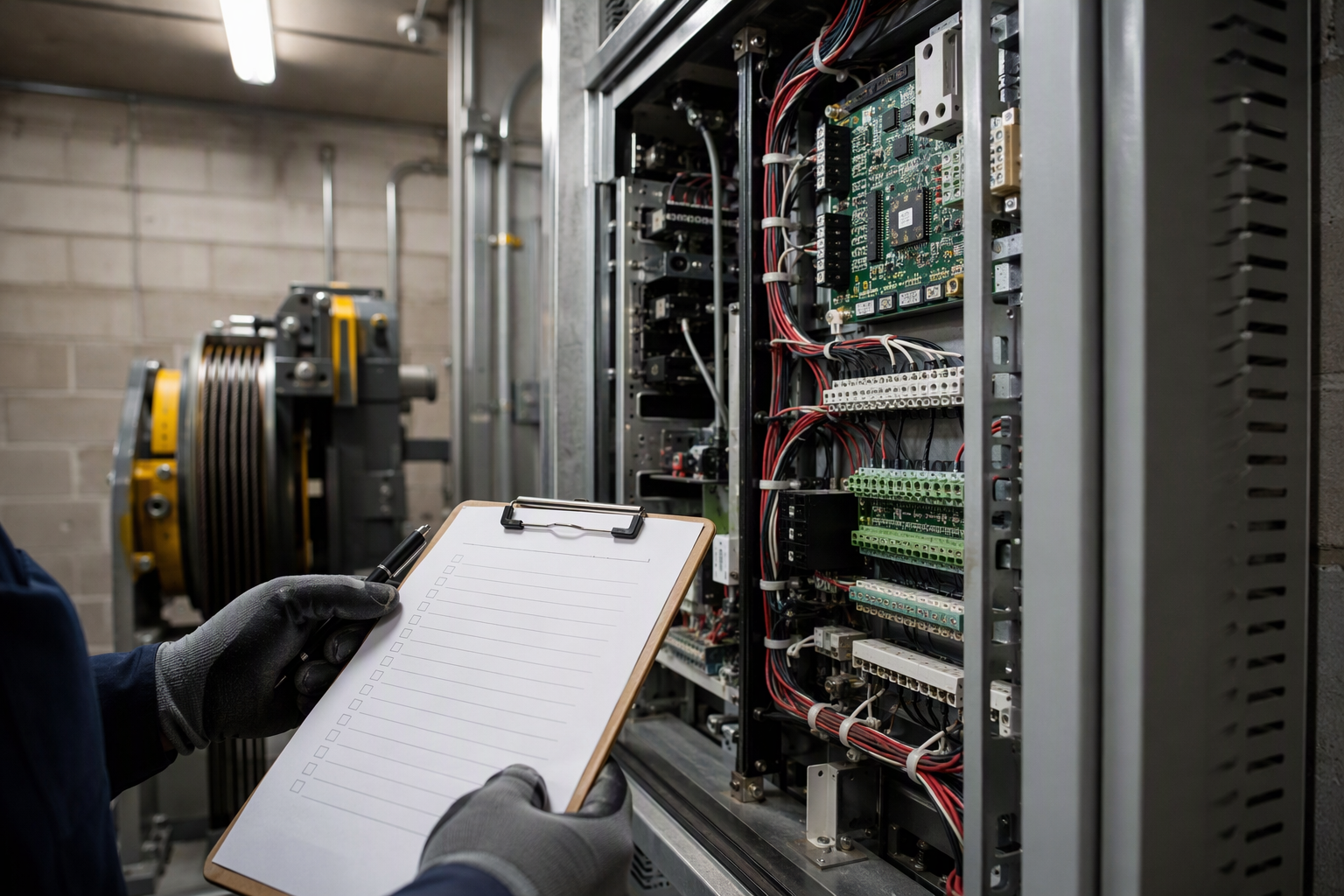
A well-structured elevator maintenance contract should accomplish three things: define exactly what is included, establish measurable service standards, and protect the owner’s rights under Arizona statute. The following elements are non-negotiable starting points for any review.
- Scope of work in writing. The contract must list every covered component — motor, controller, hydraulic pump, doors, buffers, safety devices — rather than relying on vague language like “routine maintenance.”
- Parts and labor clarity. The agreement should distinguish between parts covered under the contract, parts billed separately, and parts sourced exclusively through the vendor at marked-up prices.
- Compliance alignment. Under A.R.S. §§ 23-491 through 23-491.16 and Arizona Administrative Code R20-5-502 through R20-5-515, Arizona building owners bear direct legal responsibility for conveyance safety — the maintenance vendor does not absorb that liability. The contract must support your ability to meet those obligations.
- Inspection access. Arizona owners may hire a private elevator inspector authorized by the Industrial Commission of Arizona’s Elevator Division for annual inspections. The contract should not restrict this right.
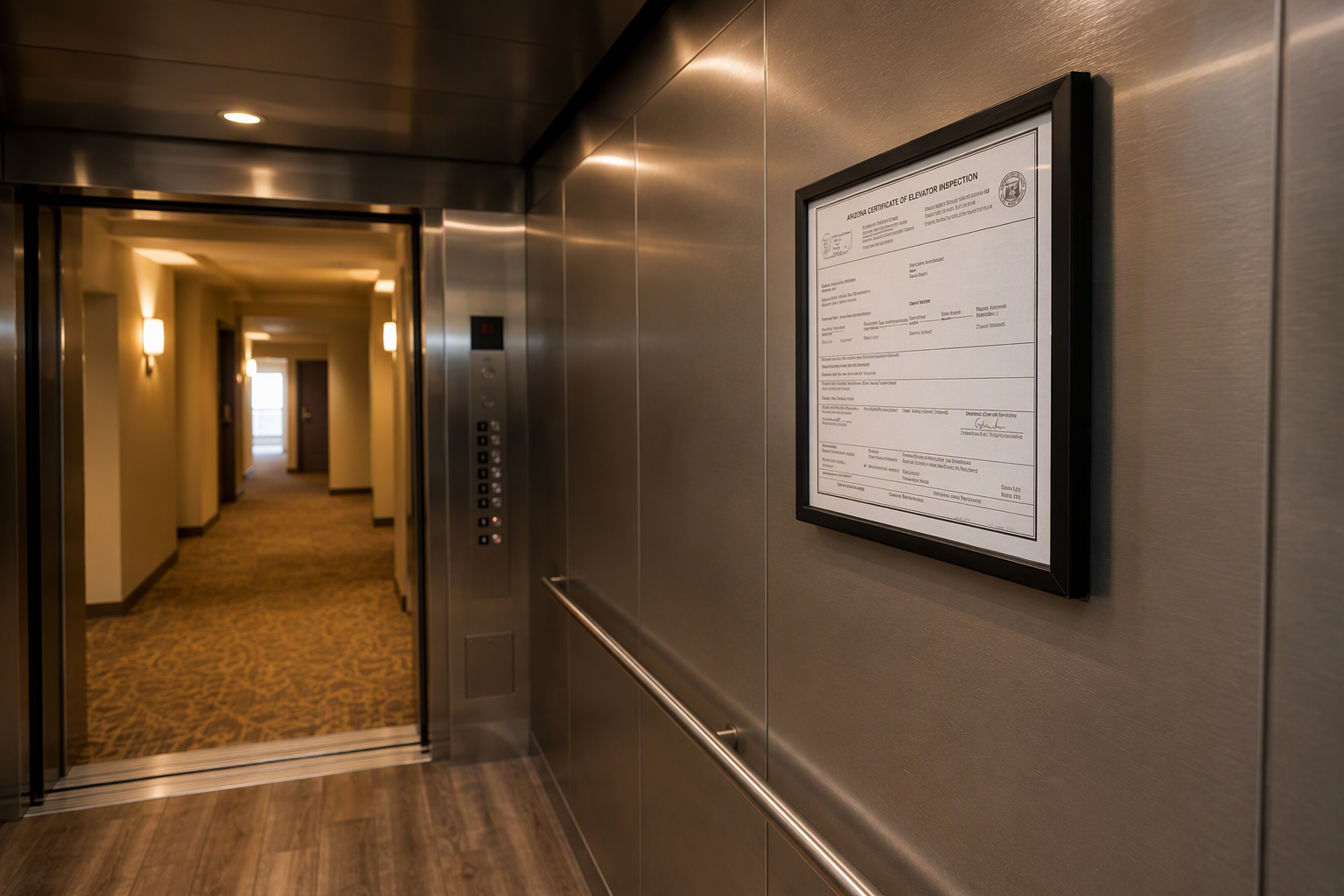
- Documentation provisions. Arizona law requires that the state certificate of inspection be kept at the location of the conveyance and that the state serial number or certificate be posted in or close to the conveyance. The contract should address which party is responsible for facilitating inspections and maintaining records.
- Exit terms. Contract length, renewal conditions, and early termination fees must be stated explicitly.
What Contract Types Are Available and How Do They Compare?
Elevator maintenance agreements generally fall into four tiers. Understanding the differences before you compare proposals prevents vendors from presenting incompatible options side by side.
| Contract Type | What’s Typically Included | What’s Typically Excluded | Best Suited For | Key Risk |
|---|---|---|---|---|
| Oil & Grease (Basic) | Lubrication, minor adjustments, visual inspections | Most parts, labor for repairs, callbacks | New equipment under manufacturer warranty | Unpredictable repair costs; owner pays full rate for most service calls |
| Maintenance Only | Preventive maintenance visits, adjustments, safety tests | Parts, major repairs, callbacks above a set threshold | Owners with in-house capital reserves for repairs | Parts markups can be steep when repairs arise outside the agreement |
| Full Maintenance | Preventive maintenance, most parts, labor, callbacks | Modernization, vandalism damage, some major components | Mid-age equipment in commercial buildings | Exclusion list may quietly omit the most expensive components |
| Comprehensive (All-Inclusive) | All of the above plus major components, emergency callbacks, regulatory support | Very few items — typically vandalism, code upgrades beyond current scope | High-traffic buildings, aging equipment, owners seeking cost certainty | Higher base cost; vendor may front-load pricing to offset risk |
What Red Flag Clauses Should I Push Back on Before Signing?
Certain contract provisions consistently work against building owners. Knowing them in advance gives negotiators a clear list of items to challenge before execution.
| Clause Type | What It Says (in plain language) | Why It’s a Problem | What to Demand Instead |
|---|---|---|---|
| Automatic Evergreen Renewal | Contract renews automatically unless you cancel within a narrow window (often 30–90 days before expiration) | Owners miss the window; vendor locks in multi-year terms without renegotiation | Written notice period of no less than 90 days; opt-in renewal, not opt-out |
| Proprietary Parts Exclusivity | Only vendor-supplied parts may be used; any non-vendor part voids coverage | Eliminates competitive pricing and can artificially delay repairs while parts are “sourced” | Parts from any manufacturer meeting ASME A17.1 Safety Code for Elevators and Escalators specifications should be permissible |
| Vague Exclusion Lists | Exclusions described with catch-all language (“wear and tear,” “normal deterioration”) | Vendor can classify almost any expensive repair as excluded | Itemized exclusion list naming specific components; everything not listed is covered |
| Unlimited Price Escalation | Vendor may increase contract price at will or tied to an undefined index | No cost ceiling; budgeting becomes impossible | Annual cap tied to a published index (e.g., CPI) with 60-day advance notice required |
| No-Audit / No-Access Clause | Owner may not inspect service records or bring in a third-party inspector without vendor consent | Conflicts with Arizona’s right to use an independent private inspector authorized by the ICA Elevator Division | Explicit language affirming the owner’s right to independent inspection at any time |
| Liquidated Damages on Early Exit | Owner owes the full remaining contract value if they terminate early for any reason | Creates financial hostage scenario even if vendor performance is poor | Early termination for cause (vendor non-performance) should carry no penalty; termination for convenience should be capped at a reasonable fraction of remaining term |
| Unilateral Contract Modification | Vendor reserves the right to change terms with limited notice | Core service obligations can be reduced mid-term without consent | Any modification requires written consent from both parties |
| Liability Waiver for Code Violations | Vendor not responsible for fines, penalties, or losses arising from regulatory non-compliance | Under Arizona statute, the owner bears compliance responsibility — but a vendor performing deficient work that causes a violation should share accountability | Mutual indemnification language; vendor liable for violations caused directly by their workmanship |
What Clauses Should I Reject Outright Rather Than Try to Negotiate?
Some provisions are structured in ways that cannot be made acceptable through negotiation. These warrant walking away from a contract or selecting a different vendor.
- Equipment takeover or “hostile takeover” provisions. Some agreements give the incumbent vendor the right to retain proprietary elevator monitoring equipment or software installed during the contract term, leaving the owner unable to switch vendors without replacing entire systems. Reject any clause that transfers ownership of monitoring hardware or data to the vendor.
- Complete waiver of the owner’s right to independent inspection. Arizona owners have a statutory right to engage a private inspector authorized by the Industrial Commission of Arizona’s Elevator Division. Any clause that purports to waive or restrict this right conflicts with state law and should be rejected entirely.
- Perpetual exclusivity for future work. A clause giving the current vendor the right of first refusal — or exclusive rights — to all future modernization, repair, or alteration work removes competition and inflates long-term costs. Future work should always go to open bidding.
- Indemnification language that makes the owner liable for the vendor’s negligence. Standard indemnification should be mutual; any clause that requires the owner to indemnify the vendor for claims arising from the vendor’s own acts or omissions is commercially unreasonable and potentially unenforceable.
How Does Arizona Law Affect What a Maintenance Contract Must Support?
Arizona building owners operate under a clear statutory framework that maintenance contracts must accommodate — not undermine. Key obligations under A.R.S. §§ 23-491 through 23-491.16 and Arizona Administrative Code R20-5-502 through R20-5-515 include:
- No conveyance may operate without a current annual certificate of inspection issued by the state.
- The certificate must be kept at the same location as the conveyance and available for inspection on request.
- The state serial number or certificate must be posted in or close to the conveyance in an easily accessible location.
- Owners must notify the Industrial Commission of Arizona’s Elevator Division within 24 hours of any accident that injures a person or disables a conveyance.
- Owners must notify the state at least 90 days before installing, relocating, or altering a conveyance.
- Equipment installed, repaired, or altered on or after January 1, 2023 must comply with the ASME A17.1/CSA B44 Safety Code for Elevators and Escalators, 2019 edition.
- Within the City of Phoenix, the City of Phoenix Elevator Section (Planning and Development Department) handles inspections; the state handles equipment outside Phoenix.
A maintenance contract that prevents or complicates any of these obligations creates direct legal exposure for the building owner. Arizona Elevator Solutions advises clients to cross-reference every proposed contract against these requirements before signing.
What Is the Difference Between a Manufacturer Contract and an Independent Service Provider Contract?
| Factor | Manufacturer/OEM Service Contract | Independent Service Provider (ISP) Contract |
|---|---|---|
| Parts Sourcing | Often limited to OEM parts; proprietary access to some systems | Broader parts sourcing options; competitive pricing more feasible |
| Pricing Flexibility | Rate structures tend to be standardized with limited negotiation room | Generally more negotiable; scope can be customized |
| Technology Access | Proprietary diagnostic tools may only be available to OEM technicians | Reputable ISPs invest in diagnostics for major platforms; some OEM-specific systems remain restricted |
| Contract Flexibility | Standardized contracts with limited ability to strike individual clauses | Contracts are typically more negotiable; individual clauses can often be modified |
| Regulatory Support (Arizona) | May or may not include assistance with ICA Elevator Division documentation | Local ISPs familiar with Arizona-specific requirements can integrate compliance support into the agreement |
| Lock-in Risk | Higher — proprietary software, parts, and hardware can make switching costly | Lower — equipment and records should remain accessible to the owner |
Arizona Elevator Solutions is an independent certified elevator service provider serving Arizona building owners. As an ISP, the company’s contracts are structured to give owners clear rights, transparent exclusion lists, and access to third-party inspection — without proprietary lock-in provisions.
What Should I Do Step by Step When Reviewing an Elevator Maintenance Contract?
- Request the full contract document — not a summary sheet. Insist on the complete agreement including all schedules, exhibits, and appendices before any review begins.
- Map the scope of work against your equipment inventory. List every component in your elevator system and check whether each one appears in the covered-components section or the exclusions list.
- Identify the exclusion list and read it in full. Note every excluded component by name. Obtain cost estimates for repairing those components at standard rates to understand your residual financial exposure.
- Locate the renewal, escalation, and termination clauses. Note the notice window for opting out of renewal, any price escalation formula, and the early termination penalty structure.
- Check for proprietary equipment and data provisions. Confirm that any monitoring hardware installed under the contract will remain the property of the building owner or be removable at the owner’s discretion upon contract termination.
- Confirm compliance with Arizona law. Verify that the contract does not restrict your right to engage a private inspector authorized by the Industrial Commission of Arizona’s Elevator Division and that the vendor’s obligations support your certificate-of-inspection requirements.
- Consult an independent elevator service provider for a parallel assessment. Have a qualified ISP — such as Arizona Elevator Solutions — review the proposed contract and identify gaps relative to your equipment’s current condition and maintenance history.
- Submit written redlines before signing. Do not negotiate verbally. Put every requested change in a marked-up document so there is a clear record of what was agreed.
- Retain a signed copy with all exhibits. File the executed agreement with your property records and set a calendar reminder for the renewal opt-out window.
What Questions Should I Ask Every Vendor Before Signing?
These questions surface contractual weaknesses that are rarely volunteered by vendors during the sales process.
- Can you provide an itemized list of every component that is excluded from coverage under this contract?
- If an excluded component fails, what labor and parts rates will I be billed at?
- Does this contract restrict my right to hire an independent inspector authorized by the Industrial Commission of Arizona’s Elevator Division?
- Who owns any monitoring equipment or software you install during the contract term?
- What happens to my service records and equipment data if I terminate the contract?
- What is the notice period for opting out of automatic renewal, and how must that notice be delivered?
- Is there a cap on annual price increases? If so, to what index is it tied?
- Does your company hold an active Arizona Registrar of Contractors R-12 or C-12 license for elevator work?
Does ADA Compliance Affect What a Maintenance Contract Should Cover?
Yes. Under the Americans with Disabilities Act, building owners — not maintenance vendors — are responsible for ensuring that accessible routes, including elevators, remain operational. An elevator that is out of service due to a maintenance failure can create an ADA accessibility gap with direct legal consequences for the building owner.
A maintenance contract that covers only routine lubrication and adjustments — while excluding door operators, leveling systems, or controls — leaves critical components unprotected. Owners should ensure that the components most directly related to ADA-compliant operation are explicitly covered, or budget separately for their repair.
How Do I Compare Multiple Elevator Maintenance Contract Proposals Side by Side?
| Evaluation Criterion | Questions to Ask of Each Proposal | Weight in Decision |
|---|---|---|
| Scope Completeness | Are all major components named and covered? Is the exclusion list short and specific? | High |
| Total Cost of Ownership | What is the base contract cost plus realistic repair costs for excluded components over the contract term? | High |
| Arizona Compliance Support | Does the vendor support annual inspection scheduling and ICA Elevator Division documentation? | High |
| Exit Flexibility | What are the termination-for-cause and termination-for-convenience provisions? | Medium–High |
| Proprietary Lock-in Risk | Does the vendor install proprietary hardware or software? Who owns it at contract end? | Medium–High |
| Licensing Verification | Does the contractor hold an active Arizona Registrar of Contractors R-12 or C-12 license? | Medium |
| Renewal Terms | Is renewal opt-out or opt-in? How long is the notice window? | Medium |
| Price Escalation Limits | Is there a cap? Is it tied to a transparent, published index? | Medium |
What Are the Pros and Cons of Long-Term vs. Short-Term Elevator Maintenance Contracts?
| Long-Term Contract (3–5 Years) | Short-Term Contract (1 Year) | |
|---|---|---|
| Pros |
|
|
| Cons |
|
|
For most Arizona building owners, a one- to two-year initial term with a clearly defined renewal option provides the best balance of pricing leverage and exit flexibility — particularly when working with a new vendor whose performance has not yet been established.
Why Should Arizona Building Owners Choose Arizona Elevator Solutions?
Arizona Elevator Solutions is a certified independent elevator service provider operating exclusively in Arizona. The company offers maintenance agreements structured without proprietary lock-in clauses, with itemized exclusion lists and explicit support for owners’ obligations under Arizona Administrative Code R20-5-502 through R20-5-515 and A.R.S. §§ 23-491 through 23-491.16. As an independent provider, Arizona Elevator Solutions does not restrict building owners from engaging an ICA Elevator Division-authorized private inspector, and all equipment data and service records remain the property of the building owner.
For building owners navigating complex proposals from national manufacturers or large regional chains, Arizona Elevator Solutions provides transparent contract comparisons and independent assessments of existing agreements — with no obligation to sign.
Ready to Review Your Elevator Maintenance Contract?
Contact Arizona Elevator Solutions for a free elevator assessment. A qualified representative will review your current or proposed maintenance agreement, identify red flags, and provide a transparent alternative proposal aligned with Arizona code requirements.
Call us today: 480-557-7600
Need elevator service you can rely on? Arizona Elevator Solutions is ready to help.






