
Elevator Requirements for Senior Living and Assisted Living Facilities in Arizona
Quick Answer: Senior living and assisted living facilities in Arizona must meet ASME A17.1-2019 safety requirements, ADA accessibility standards, and state oversight under A.R.S. §§ 23-491 through 23-491.16; older buildings typically need cab dimension upgrades, door-timing modifications, emergency communication improvements, and modernized controls to remain compliant and safe for residents with mobility limitations.

Senior living and assisted living communities across Phoenix, Tucson, Scottsdale, and Mesa face a layered set of elevator compliance obligations. Residents depend on vertical access for daily living, medical appointments, and emergency evacuation — making elevator reliability a life-safety issue, not merely a regulatory checkbox. This guide covers the specific code requirements, inspection obligations, and upgrade pathways that apply to Arizona healthcare and senior housing properties in 2026.
What Federal Elevator Codes Apply to Senior and Assisted Living Facilities?
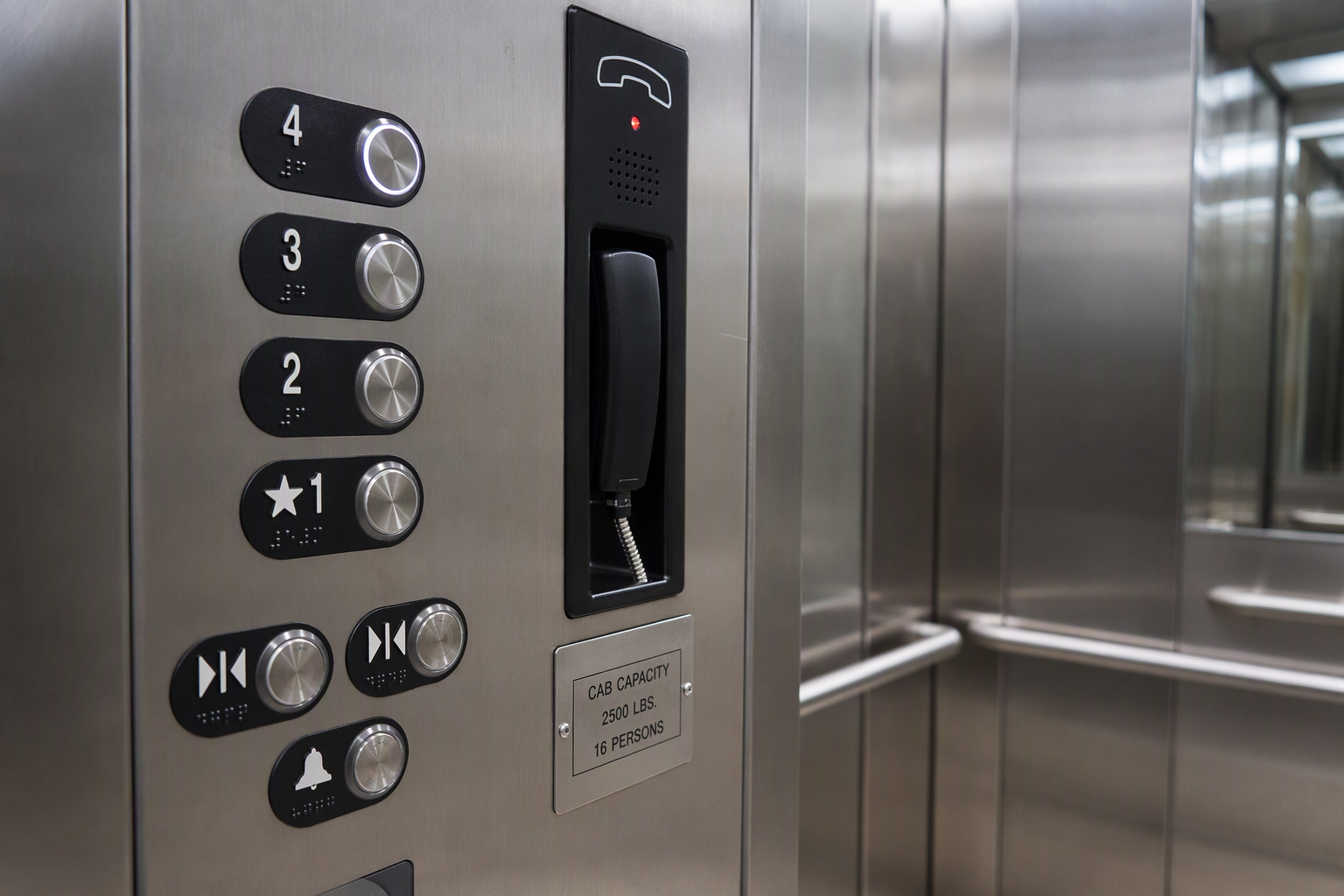
Two federal frameworks govern elevator accessibility and safety in senior care settings:
- ASME A17.1 Safety Code for Elevators and Escalators: The national technical standard covering equipment construction, operation, testing, and maintenance. Arizona has adopted the 2019 edition for equipment installed, repaired, or altered on or after January 1, 2023.
- Americans with Disabilities Act (ADA): The ADA requires that elevators in multi-story facilities be accessible to people who use wheelchairs, walkers, and other mobility aids. Specific requirements address cab dimensions, door clear-opening widths, floor-to-threshold gaps, call button heights, audible signals, and Braille/raised-character signage.
For senior living properties, the ADA requirements carry particular weight because a significant portion of residents and visitors use mobility devices. A facility that fails to meet ADA elevator standards may face federal civil rights complaints in addition to state code violations.
What Are Arizona’s State Elevator Requirements for Healthcare Facilities?
Arizona elevator safety is administered by the Industrial Commission of Arizona (ICA), Elevator Division (formerly the ADOSH Elevator Safety Section before September 12, 2026). The governing statute is A.R.S. §§ 23-491 through 23-491.16, with technical rules in Arizona Administrative Code R20-5-502 through R20-5-515.
Key Arizona obligations for senior living facility owners include:
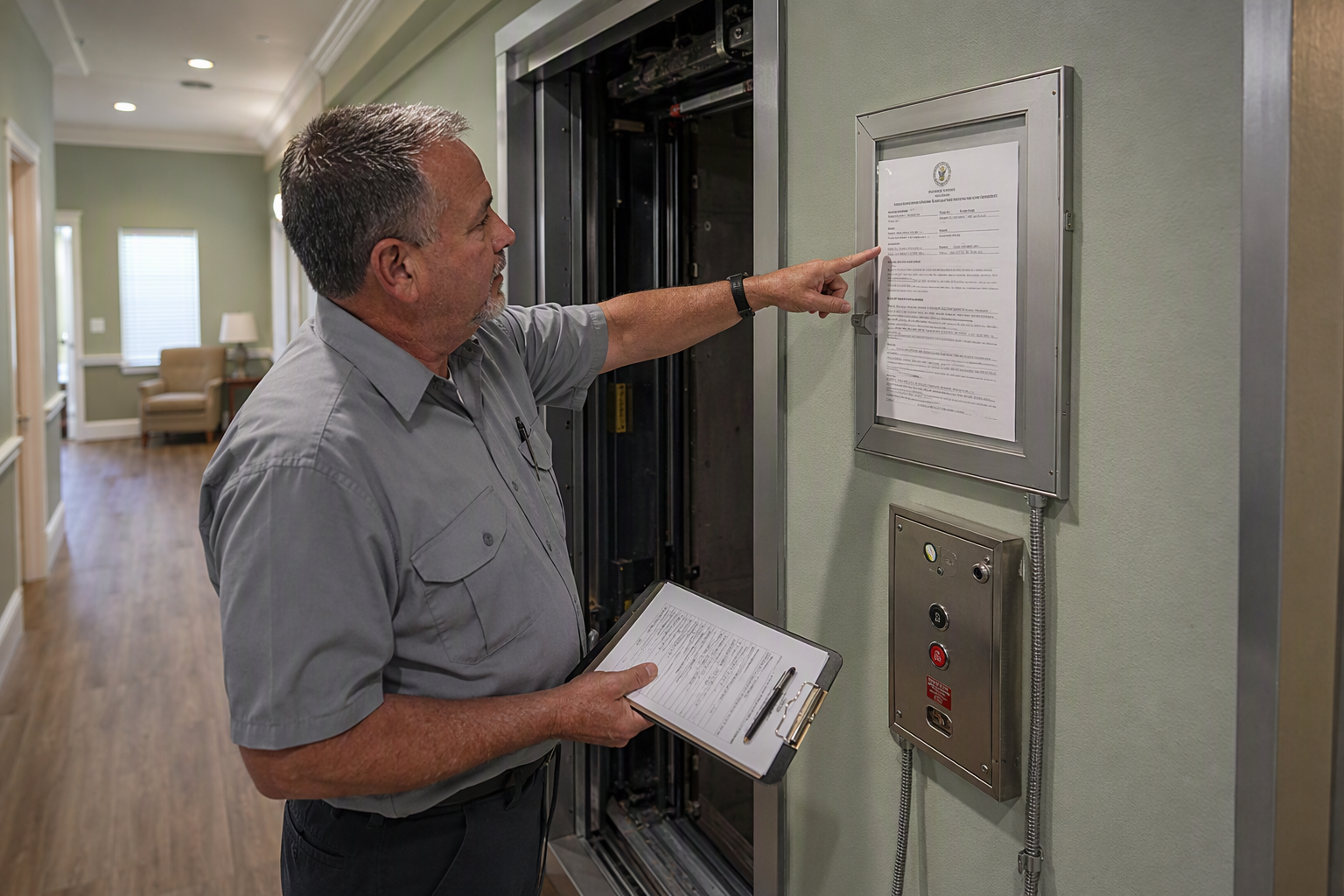
- Annual inspection certificate: No elevator may operate in Arizona without a current certificate of inspection issued by the state. This requirement applies equally to a high-rise senior apartment tower and a small two-story assisted living home.
- Certificate posting: The state certificate must be kept at the same location as the elevator and posted in or near the cab in an easily accessible location.
- State serial number tag: Every Arizona conveyance carries a state serial number on a tag fixed to the controller or mainline disconnect — inspectors verify this during every visit.
- Pre-service inspection: Before any elevator goes into service for the first time, or after modification or alteration, a full inspection must be completed.
- 90-day advance notice: Owners must notify the ICA Elevator Division at least 90 days before installing, relocating, or altering a conveyance.
- 24-hour accident reporting: Any accident that injures a person or disables a conveyance must be reported to the state within 24 hours.
- Firefighters’ Emergency Operation: Arizona elevators with firefighters’ emergency operation must use the Arizona Firefighters Service (AZFS) key — a state-specific requirement that differs from the generic ASME key designation.
Properties located within the City of Phoenix fall under an additional layer of local authority: the City of Phoenix Elevator Section (Planning and Development Department) inspects elevators, escalators, moving walks, dumbwaiters, and chairlifts within Phoenix city limits. Facilities in Tucson, Scottsdale, and Mesa are inspected by the ICA Elevator Division at the state level.
What ADA Accessibility Features Must Elevators in Senior Living Facilities Have?
Under the ADA, accessible elevators serving senior living facilities must include:
- Door clear-opening widths sufficient to accommodate power wheelchairs and wide-frame walkers
- Cab interior dimensions that allow a wheelchair user to enter, turn, and exit without obstruction
- Hall call and car operating panel buttons positioned at accessible heights for ambulatory and seated users
- Audible and visible floor signals (chimes and illuminated indicators) to assist residents with vision or hearing impairments
- Raised-character and Braille designations on all control buttons and floor indicators
- A two-way emergency communication system in the cab — critical for residents who may need assistance but cannot speak loudly
- Leveling accuracy that keeps the cab floor within a close tolerance of the landing floor, reducing trip-and-fall risk for residents with limited balance
Arizona Elevator Solutions evaluates each of these ADA requirements during a facility assessment and identifies which elements require retrofit or modernization.
What Upgrades Do Older Assisted Living Buildings Typically Need?
Many assisted living buildings in the Phoenix metro, Tucson, Scottsdale, and Mesa markets were built decades before current ADA and ASME standards took effect. Common upgrade categories include:
- Cab and door dimension expansion: Older cabs may be too narrow for power wheelchairs. Door upgrades or cab restructuring may be required.
- Door timing and force adjustments: Doors that close too quickly or with excessive force pose injury risks to slower-moving residents. Sensors and timing controls must meet current standards.
- Emergency communication system replacement: Pre-ADA cabs often have only a bell or intercom; modern requirements mandate a two-way voice communication system with visible signals for residents who are deaf or hard of hearing.
- Control panel relocation or replacement: Button heights and Braille markings must meet ADA specifications, which often requires new button panels.
- Leveling system modernization: Older hydraulic and traction systems frequently mis-level, creating dangerous floor gaps. Updated leveling controls correct this.
- Firefighters’ emergency operation upgrade: Buildings that predate the Arizona Firefighters Service (AZFS) key requirement must retrofit their emergency operation systems.
- Machine room and controller updates: Equipment installed before January 1, 2023 may operate under previously adopted code editions, but the ICA Elevator Division may order corrections if the elevator chief determines the condition presents a hazard to life, health, or property.
How Does Arizona Handle Legacy Elevators in Older Senior Care Buildings?
Arizona law takes a practical approach to older equipment. Under A.R.S. §§ 23-491 through 23-491.16, lawfully installed older conveyances may remain in service unless the state’s elevator chief determines the condition is a hazard to life, health, or property. This means a 1985-era elevator does not automatically require a full replacement — but it must pass annual inspection and cannot present a safety hazard.
Facility owners should not interpret this as a permanent exemption. Inspectors apply current standards when reviewing complaints, post-accident reports, or modification permits. Arizona Elevator Solutions recommends that senior living operators in Phoenix, Tucson, Scottsdale, and Mesa conduct periodic voluntary assessments between required annual inspections to identify developing issues before they trigger mandatory corrections.
What Role Do Platform Lifts and Stairway Chairlifts Play in Senior Living Compliance?
Some smaller assisted living homes use platform lifts or stairway chairlifts rather than full elevators. In Arizona, these devices installed, repaired, or altered on or after January 1, 2023 must comply with ASME A18.1-2020 (ASME Codes & Standards). They remain subject to the same ICA Elevator Division inspection certificate requirement as full elevators — no platform lift may operate in Arizona without a current annual certificate.
What Is the Inspection and Certification Process for Senior Living Elevators in Arizona?
The process for maintaining a compliant senior living elevator in Arizona follows this sequence:
- Confirm current certificate status: Verify that the annual certificate of inspection is posted in or near the cab and that the state serial number tag is present on the controller or mainline disconnect.
- Schedule the annual inspection: The ICA Elevator Division may conduct the inspection, or the owner may hire a private elevator inspector authorized by the Industrial Commission of Arizona. (Private inspectors must register with the commission annually and complete at least eight hours of approved continuing education.)
- Complete any pre-inspection maintenance: Address known issues — door sensors, leveling accuracy, emergency lighting, communication systems — before the inspector arrives.
- Accompany the inspector: A facility representative should be present to provide access to the machine room, controller, pit, and cab.
- Receive the inspection report: If deficiencies are noted, the owner receives a list of required corrections with timelines.
- Complete corrections and re-inspection: All cited deficiencies must be corrected by a contractor holding the appropriate Arizona Registrar of Contractors R-12 or C-12 elevator license classification. A follow-up inspection confirms compliance before the certificate is issued or renewed.
- File any required notifications: If the corrections constitute an alteration, the owner must notify the ICA Elevator Division at least 90 days in advance.
What Specific Features Improve Safety for Residents with Dementia or Limited Mobility?
Beyond minimum code compliance, senior living facilities often benefit from features that address the specific cognitive and physical challenges of their resident population:
- Hands-free or large-button controls: Easier for residents with arthritis or limited fine-motor control
- Extended door open times: Programmed door hold times that accommodate residents using walkers or wheelchairs without triggering the door-close cycle
- Floor number voice announcements: Audio floor announcements that assist residents with cognitive impairments in orienting themselves
- Non-slip cab flooring: Surfaces that reduce fall risk when entering or exiting
- Emergency lighting and backup power: Ensures residents are not stranded in the dark during a power interruption — particularly important in Arizona’s summer heat
- Smooth, accurate leveling: Minimizes the floor gap that can catch wheelchair wheels or walker tips
Questions Your Inspector Will Ask
When the ICA Elevator Division or an authorized private inspector visits a senior living or assisted living facility, facility managers should be prepared to answer the following:
- Is the current state certificate of inspection posted in or near the cab?
- Is the state serial number tag present and legible on the controller or mainline disconnect?
- Has the elevator been modified or altered since the last inspection? If so, was the ICA Elevator Division notified at least 90 days in advance?
- Has any incident occurred that injured a person or disabled the elevator? Was it reported within 24 hours?
- Does the firefighters’ emergency operation use the Arizona Firefighters Service (AZFS) key?
- Is a two-way emergency communication system operational in the cab?
- Who performs routine maintenance, and do they hold an R-12 or C-12 license from the Arizona Registrar of Contractors?
- Are maintenance logs available for review?
- When was the last full load test performed?
- Are all ADA-required signage elements (Braille, raised characters, audible signals) intact and functional?
How Should a Senior Living Facility Prioritize Elevator Upgrades?
Not every older elevator requires immediate full modernization. A structured approach helps facility operators manage compliance costs while keeping residents safe:
- Commission a condition assessment: Identify all existing deficiencies against current ASME A17.1-2019 and ADA requirements before any budget decisions are made.
- Address life-safety items first: Emergency communication, door force and timing, leveling accuracy, and firefighters’ emergency operation take priority.
- Correct ADA non-conformances: Door clear widths, button heights, Braille signage, and audible signals affect daily resident dignity and expose the facility to civil rights liability.
- Plan for long-term reliability: Aging hydraulic or traction systems may pass inspection today but face declining reliability. Phased modernization planning avoids emergency downtime in a residential care setting.
- Coordinate with local authorities: Phoenix facilities must coordinate with the City of Phoenix Elevator Section; facilities elsewhere in Arizona work with the ICA Elevator Division.
Why Do Senior Living Facilities in Arizona Work With Arizona Elevator Solutions?
Senior living operators in Phoenix, Tucson, Scottsdale, and Mesa turn to Arizona Elevator Solutions because the company understands the intersection of life-safety codes, ADA accessibility requirements, and the unique operational demands of a 24-hour residential care environment. Elevator downtime in a senior living facility is not a minor inconvenience — it can cut off residents from dining, therapy, outdoor access, and emergency egress.
Arizona Elevator Solutions provides facility assessments that map existing equipment against ASME A17.1-2019, ADA requirements, and Arizona Administrative Code R20-5-502 through R20-5-515 — giving operators a clear, prioritized picture of what must be corrected, what should be upgraded, and what can be deferred.
Get a Free Elevator Assessment for Your Senior Living Facility
Whether your community is preparing for an annual inspection, planning a renovation, or responding to an inspector’s findings, the team at Arizona Elevator Solutions can help. Serving senior living and assisted living facilities across Phoenix, Tucson, Scottsdale, and Mesa, Arizona Elevator Solutions delivers thorough assessments, compliant upgrades, and ongoing maintenance programs designed for the demands of residential healthcare environments.
Contact Arizona Elevator Solutions for a free elevator assessment: 480-557-7600
Need elevator service you can rely on? Arizona Elevator Solutions is ready to help.






