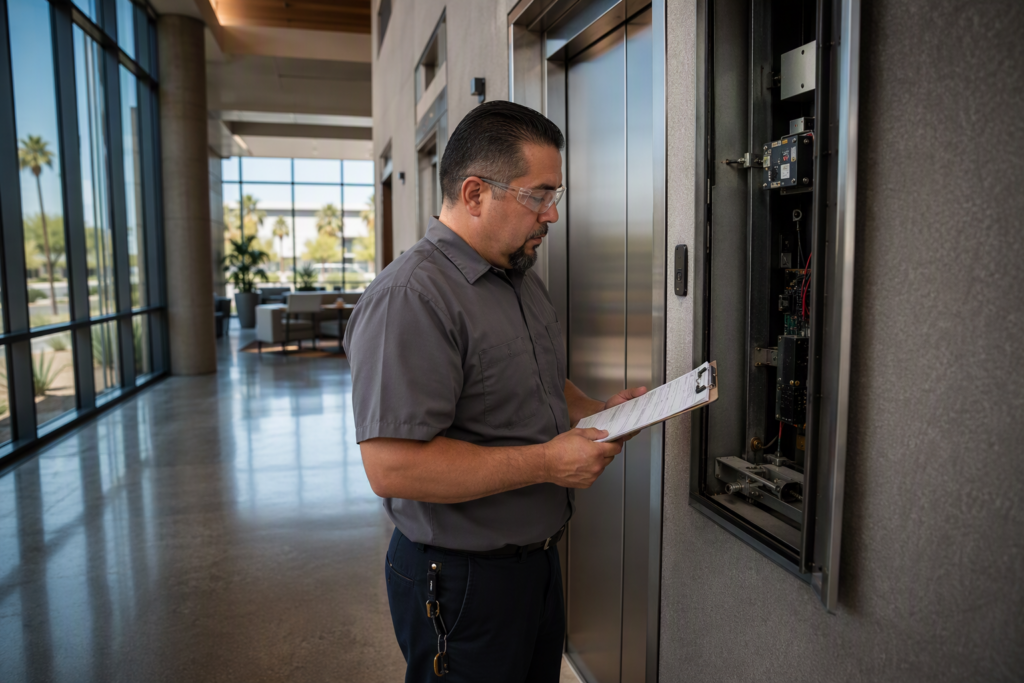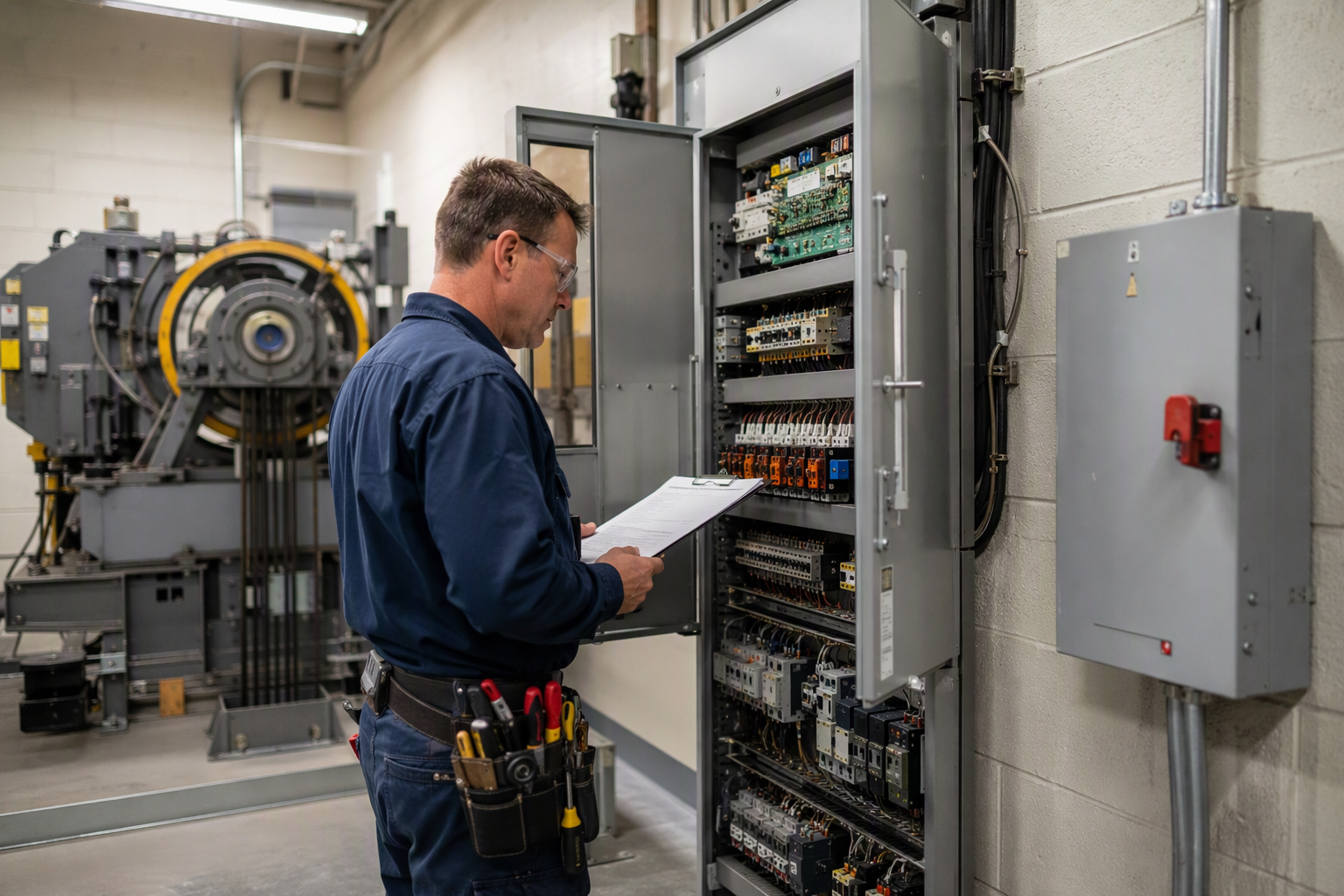
A preventative maintenance (PM) plan for an elevator is a structured, recurring service program that addresses every mechanical, electrical, hydraulic, and safety system within a conveyance before problems arise. Unlike reactive repairs — which occur after a failure — preventative maintenance follows defined checklists aligned with manufacturer specifications, the ASME A17.1 Safety Code for Elevators and Escalators, and Arizona’s own regulatory requirements under A.R.S. §§ 23-491 through 23-491.16. For building owners in Phoenix, Tucson, Scottsdale, and Mesa, a well-executed PM program is both a legal obligation and a sound asset-protection strategy.
What are the core components included in every elevator preventative maintenance plan?
Every professional elevator PM plan covers mechanical inspection, lubrication, electrical system checks, safety device testing, pit and machine room maintenance, and documentation — with the specific scope varying by elevator type and age.
A comprehensive plan systematically addresses each subsystem of the elevator. On the mechanical side, technicians inspect and adjust door operators, door gibs, sill grooves, hanger rollers, and interlocks — the door system being the most frequent source of service calls in any elevator fleet. Guide rails, rollers or sliding guides, and buffers are examined for wear. The drive system — whether traction (geared or gearless) or hydraulic — receives specific attention based on its design.
Electrical systems require inspection of the controller, relay logic or microprocessor boards, wiring harnesses, traveling cables, motor contactors, and selector equipment. Safety circuits, including the governor, safeties, and oil buffers, must be tested to verify they function within the tolerances prescribed by ASME A17.1. Hydraulic elevators additionally require inspection of the power unit, hydraulic fluid level and quality, jack and cylinder seals, and rupture valves.
Machine rooms and pits must be kept clean, dry, adequately lit, and accessible only to authorized personnel — all conditions verified during PM visits. Documentation review ensures the current state certificate of inspection is posted, that the Arizona state serial number tag is intact on the controller or mainline disconnect, and that all logs are current.
How often should elevator preventative maintenance visits be scheduled?
The required frequency depends on elevator type, usage volume, age, and building occupancy, but most commercial elevators require monthly or quarterly PM visits at minimum, with annual inspections mandated by Arizona law.
Under Arizona Administrative Code R20-5-502 through R20-5-515 and A.R.S. §§ 23-491 through 23-491.16, every conveyance must be inspected annually and must hold a valid certificate of inspection to remain in operation. That statutory annual inspection is distinct from the ongoing PM visits a service company provides throughout the year.
High-traffic installations — such as hospitals, hotels, and large office towers — typically benefit from monthly PM visits. Lower-traffic installations in smaller commercial or residential buildings may be adequately served on a quarterly schedule. The ASME A17.1 Safety Code provides guidance on inspection and test intervals for individual components, and a qualified elevator service contractor will use those intervals alongside manufacturer recommendations to build the appropriate schedule.
What lubrication tasks are included in elevator preventative maintenance?
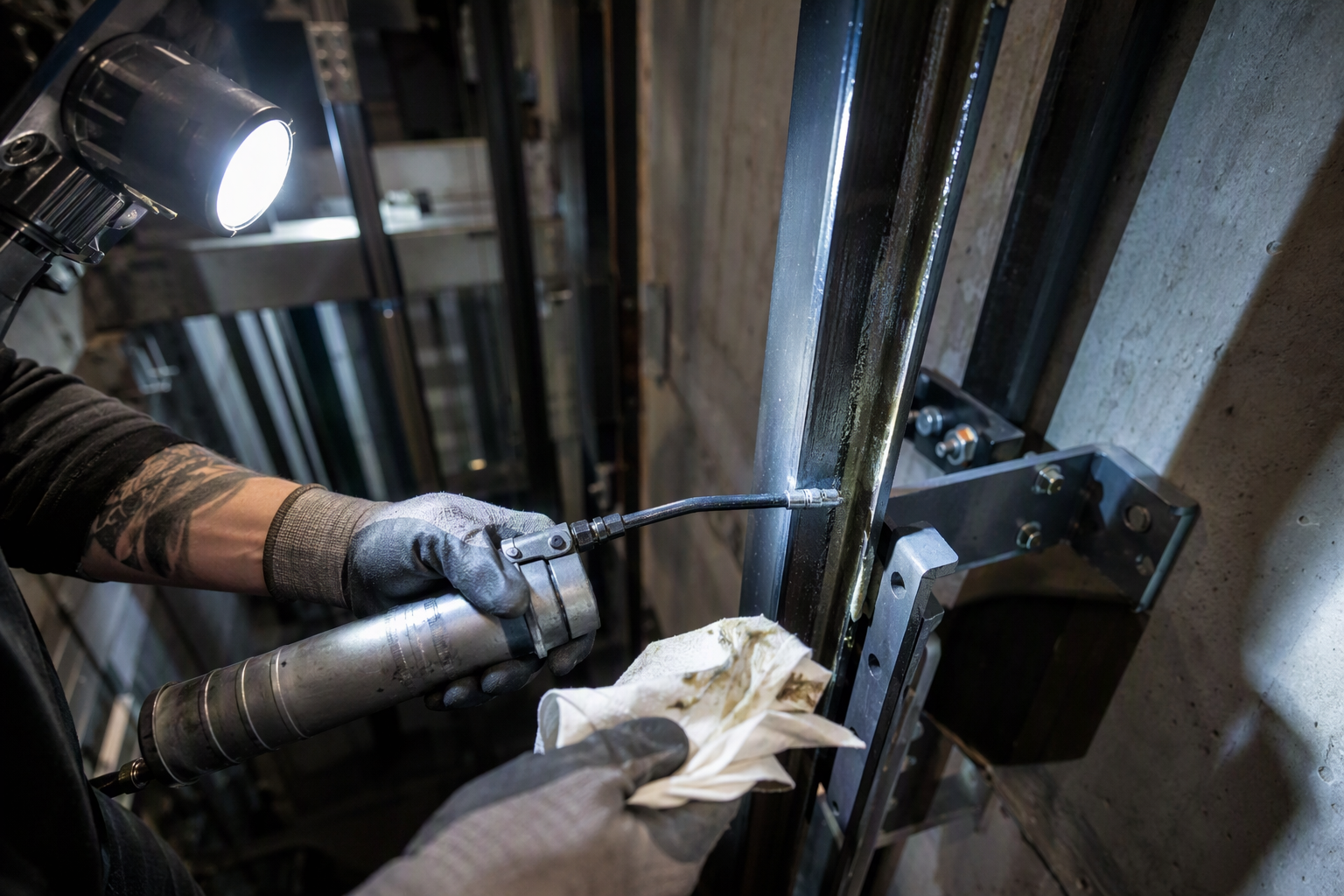
Lubrication tasks cover every moving mechanical interface in the elevator system, including guide rails, sheaves, governor rope and components, door operator chains or belts, roller guides, and hoist motor and gear unit where applicable.
Proper lubrication is one of the highest-value tasks in any PM program because inadequate or incorrect lubricant accelerates wear on components that are expensive to replace. Guide rails receive rail lubricators or manual application depending on the equipment type. Traction geared elevators require oil changes and level checks in the worm gear unit. Hydraulic units require monitoring of fluid viscosity and contamination levels. Using the wrong lubricant or applying it incorrectly can void manufacturer warranties and create safety hazards, so PM technicians follow equipment-specific lubrication charts.
What safety device tests are part of a preventative maintenance program?
Safety device testing within a PM program includes functional checks of the governor and safeties, buffer tests, car and counterweight overtravel protection, door reopening devices, emergency lighting, alarm systems, and firefighters’ emergency operation.
The ASME A17.1 Safety Code for Elevators and Escalators establishes specific periodic test requirements for each safety component. Some tests — such as full-load safety and buffer tests — are performed on defined cycles (not necessarily at every visit) and must be witnessed and documented. These periodic tests are distinct from daily or monthly functional checks, and a well-structured PM plan schedules them in advance so neither the building owner nor the service company is caught unprepared at annual inspection time.
In Arizona, conveyances equipped with firefighters’ emergency operation must use the Arizona Firefighters Service (AZFS) key. Technicians verify that AZFS key operation functions correctly and that Phase I and Phase II controls respond as required during each PM cycle that covers safety devices.
What electrical and controller inspections are performed during preventative maintenance?
Electrical PM tasks include inspecting the main line disconnect, controller boards, contactors, relays, motor starters, traveling cables, safety circuit continuity, and all selector and floor-leveling components.
Controllers on modern microprocessor-driven elevators require checking fault logs for stored error codes that may not yet have caused a callback but indicate developing issues. Older relay-logic controllers require physical inspection of contact surfaces, coil resistance, and wiring insulation. Technicians also verify that the machine room environment — temperature, humidity, and cleanliness — remains within the limits the controller manufacturer specifies, which is a particular concern in Arizona’s extreme summer heat.
How does preventative maintenance address elevator door systems specifically?
Door system PM includes adjusting door operators, replacing worn gibs and rollers, lubricating hanger tracks, testing door reversal and reopening devices, checking interlock contacts, and verifying closing force compliance.
Door-related issues account for a disproportionate share of elevator service calls and entrapments. The ASME A17.1 Safety Code sets maximum door closing force and kinetic energy limits that protect passengers. PM technicians measure and adjust these parameters at each visit. Worn gibs and holdown devices are replaced before they cause misalignment. Sill grooves are cleaned to prevent debris-induced door failures — especially relevant in desert environments where dust and sand intrusion is common in Phoenix, Mesa, and Scottsdale.
What does elevator pit maintenance include in a PM plan?
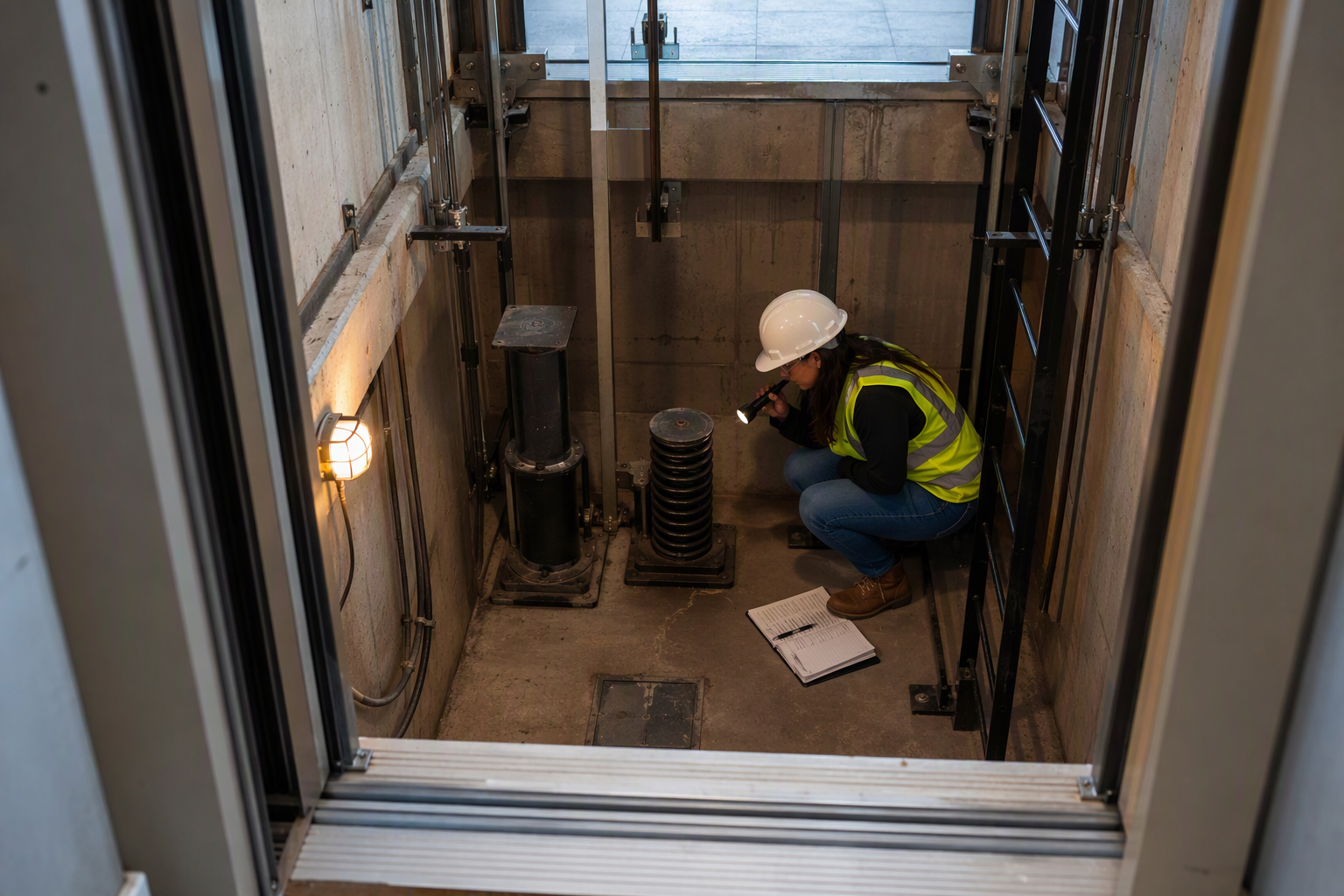
Pit maintenance within a PM plan covers cleaning accumulated debris and water, inspecting pit lighting and stop switch, checking buffer condition and oil level, verifying ladder integrity, and confirming no hydraulic leaks are present.
A clean, dry, well-lit pit is a regulatory requirement, not simply a best practice. Water intrusion — even in Arizona’s arid climate during monsoon season — can damage electrical components in the pit and accelerate corrosion on buffers and rail bases. Hydraulic elevator pits require additional attention: any evidence of hydraulic oil on the pit floor must be investigated to identify the source, as leaking jack seals or fittings represent both an environmental concern and a potential performance issue. Arizona law requires owners to report accidents or conveyance disablements to the state within 24 hours, making the early detection possible through PM visits especially valuable.
What machine room tasks are included in preventative maintenance?
Machine room PM covers inspection of the motor and brake, sheave and rope condition, machine room temperature and ventilation, controller cleanliness, oil levels, and verification that the room remains secured and free of unauthorized storage.
The machine room is the operational heart of a traction elevator. Motor brake adjustment is a critical safety function: a brake that releases too slowly affects performance, while one that holds too loosely can allow car drift. Rope inspection covers broken wires, wear patterns, and equalization — ropes that have unequal tension distribute load unevenly across the drive sheave, accelerating groove wear. Arizona’s summer ambient temperatures place additional stress on machine room equipment, making ventilation checks particularly important during spring PM visits in Phoenix and surrounding markets.
How does a preventative maintenance plan help building owners meet Arizona’s annual inspection requirement?
A structured PM program ensures that all required periodic tests are completed, records are current, and deficiencies are corrected before the annual inspection, preventing failed inspections that could result in the state ordering a conveyance out of service.
Under A.R.S. §§ 23-491 through 23-491.16, no conveyance may operate in Arizona without a valid annual certificate of inspection issued by the state. The Industrial Commission of Arizona’s Elevator Division (formerly the ADOSH Elevator Safety Section until September 12, 2026) administers this requirement. Building owners may utilize a private elevator inspector authorized by the Industrial Commission, provided that inspector is not affiliated with the company that owns, operates, or last serviced the equipment.
Arizona Elevator Solutions structures its PM programs specifically to align with the annual inspection cycle, so that when the inspector arrives, the equipment is in full compliance with ASME A17.1-2019 — the edition Arizona has adopted for equipment installed, repaired, or altered on or after January 1, 2023. The owner must keep the state certificate at the equipment’s location and post the state serial number or certificate in or near the conveyance in an easily accessible location — administrative details that PM documentation reviews help owners track.
What documentation is reviewed or produced during preventative maintenance visits?
PM visits produce service logs, lubrication records, component condition notes, corrective action reports, and updates to the equipment’s maintenance history — all of which are essential for regulatory compliance, warranty preservation, and liability protection.
Arizona law requires that the state certificate of inspection be kept at the location of the conveyance. The state serial number tag must be posted in or close to the conveyance. Technicians performing PM verify these administrative requirements are met alongside the physical work. Detailed service records also establish a baseline for component life, making it easier to project when major items such as ropes, hydraulic jacks, or controllers will require replacement — enabling owners to budget predictably rather than absorb emergency capital expenditures.
What is typically NOT included in a standard preventative maintenance plan?
Standard PM plans generally do not cover major component replacements (ropes, jacks, controllers), cab interior repairs, vandalism damage, modernization work, or repairs made necessary by misuse — these are typically billed as additional work orders.
Building owners should review their PM contract carefully to understand the boundary between routine maintenance and repair work. Full-coverage contracts (“full maintenance” agreements) often include parts and some repairs up to a defined scope, while “oil and grease” or “periodic” contracts cover only the inspection and lubrication tasks, with all parts and labor for repairs billed separately. Understanding this distinction is important when comparing service proposals from different elevator contractors operating in the Phoenix, Tucson, Scottsdale, and Mesa markets.
How does preventative maintenance differ for hydraulic versus traction elevators?
Hydraulic and traction elevators share many PM tasks but differ significantly in their drive system maintenance requirements — hydraulic units require fluid management, jack and seal inspection, and rupture valve testing, while traction units require rope and sheave inspection, brake adjustment, and gear unit servicing.
| PM Task Category | Hydraulic Elevator | Traction Elevator (Geared) | Traction Elevator (Gearless / MRL) |
|---|---|---|---|
| Drive System Lubrication | Hydraulic fluid level & quality check | Gear unit oil change & level check | Motor bearing lubrication (per OEM) |
| Suspension / Lifting Component | Hydraulic jack, cylinder, seals | Wire ropes, sheaves, hitch | Wire ropes or belts, sheaves, hitch |
| Safety Valve / Device | Rupture valve & lowering valve test | Governor, safeties, buffers | Governor, safeties, buffers |
| Brake System | Lowering valve / check valve | Electromechanical brake adjustment | Electromechanical brake adjustment |
| Pit Requirements | Leak inspection, fluid containment | Buffer oil level, cleanliness | Buffer oil level, cleanliness |
| Machine Room / Control Space | Power unit, pump, motor, tank | Motor, gearbox, machine room | Compact drive unit, often in hoistway |
| Typical PM Visit Frequency (Commercial) | Quarterly to monthly | Quarterly to monthly | Quarterly to monthly |
Does a preventative maintenance plan cover ADA compliance checks?
ADA compliance is not strictly a PM function, but qualified technicians routinely identify accessibility-related conditions — such as leveling accuracy, door timing, and accessible control panel operation — that affect compliance with the Americans with Disabilities Act.
The ADA requires that elevators serving multiple floors in covered facilities be accessible and meet specific standards for car controls, door operation, leveling, and audible signals. While the ADA does not set a PM schedule, the operational conditions it requires — such as landing accuracy within defined tolerances and door open times sufficient for passengers with disabilities — are maintained through proper PM. Technicians from Arizona Elevator Solutions note leveling drift, door timing deviations, and control panel issues when they are identified during PM visits, alerting owners to conditions that may create accessibility or liability concerns.
What should building owners in Phoenix and other Arizona markets look for when evaluating a PM contract?
Building owners should evaluate the scope of covered tasks, parts and labor inclusions, response provisions for entrapments and callbacks, technician qualifications, and whether the contractor holds the appropriate Arizona Registrar of Contractors license classification.
In Arizona, elevator installation and repair contractors must hold an R-12 or C-12 license classification issued by the Arizona Registrar of Contractors. This licensing is separate from the annual certificate of inspection issued by the state but is an important credential to verify before engaging any elevator service company. Owners should also ask contractors to provide references from comparable properties in their market — a contractor experienced with high-rise traction systems in downtown Phoenix may have different relevant experience than one primarily serving low-rise hydraulic installations.
Arizona Elevator Solutions holds the appropriate contractor credentials and serves commercial, residential, and institutional building owners across Phoenix, Tucson, Scottsdale, and Mesa, providing PM programs tailored to each equipment type and use profile.
What happens if elevator preventative maintenance is deferred or skipped?
Deferred maintenance leads to accelerated component wear, increased callback frequency, higher repair costs, potential regulatory violations, and — most seriously — elevated risk of passenger injury or entrapment.
From a regulatory standpoint, operating a conveyance in Arizona without maintaining it in safe condition and without a current certificate of inspection is a violation of A.R.S. §§ 23-491 through 23-491.16. The Industrial Commission of Arizona’s Elevator Division has authority to order conveyances out of service when conditions pose a hazard to life, health, or property. An out-of-service elevator in a commercial building creates immediate operational disruption, potential ADA compliance issues, and legal exposure for the building owner.
From a practical standpoint, neglected lubrication causes premature wear on ropes, guide shoes, and door components. Unchecked hydraulic leaks can result in car drift and eventually jack failure. Deferred controller maintenance can allow developing faults to escalate into full controller failures. The cost of systematic preventative maintenance is consistently lower than the cost of the emergency repairs and equipment replacements that result from its absence.
What is the step-by-step process Arizona Elevator Solutions follows when setting up a new PM program?
Setting up a new preventative maintenance program involves a structured onboarding process to establish the equipment baseline, identify existing deficiencies, and build a compliant service schedule.
- Initial Equipment Survey: Technicians conduct a full physical inspection of every conveyance, documenting the equipment type, installation date, current condition, existing deficiencies, and the status of required documentation including the state serial number tag and current certificate of inspection.
- Regulatory Status Review: The team verifies whether each unit has a current certificate issued under Arizona requirements, confirms the equipment is registered with the Industrial Commission of Arizona’s Elevator Division, and identifies any outstanding violations or notices.
- Deficiency Reporting: A written deficiency report is provided to the building owner, categorizing items by safety priority — distinguishing immediate safety concerns from items requiring attention before the next annual inspection versus longer-term capital planning items.
- PM Schedule Development: A customized service schedule is created based on equipment type, age, traffic patterns, and the required ASME A17.1 periodic test intervals, specifying visit frequency, tasks at each visit, and annual test dates.
- Contract Documentation: The PM agreement is finalized with a clear scope of work defining included tasks, exclusions, and procedures for approving additional repair work.
- First PM Visit: The program launches with a comprehensive baseline PM visit that brings all lubrication, adjustments, and cleaning to the standard, establishing the condition from which ongoing maintenance will be measured.
- Ongoing Record-Keeping: After each visit, service records are updated and made available to the building owner, supporting compliance documentation requirements and providing the paper trail needed at annual inspection time.
How does Arizona’s desert climate affect elevator preventative maintenance requirements?
Arizona’s extreme heat, monsoon moisture, and pervasive fine dust create specific maintenance challenges — particularly for cooling, lubrication degradation, door contamination, and hydraulic fluid viscosity — that require climate-aware PM protocols.
Phoenix and the surrounding Valley of the Sun regularly see summer temperatures that stress elevator machine room environments beyond what equipment was designed to handle in more temperate climates. Machine room ventilation and cooling systems must be verified functional before the summer heat peak. Hydraulic fluid viscosity changes with temperature, and fluids selected for winter conditions may thin excessively in summer, affecting jack performance and seal integrity. Door sill grooves in ground-floor lobbies collect wind-blown grit year-round, requiring more frequent cleaning than in other regions. Monsoon season introduces moisture intrusion risks into pits — particularly in older buildings without sealed pit floors. Arizona Elevator Solutions incorporates these regional factors into its PM protocols for properties across Phoenix, Tucson, Scottsdale, and Mesa.
What records must Arizona building owners maintain related to elevator maintenance?
Arizona building owners must keep the current state certificate of inspection at the conveyance location, ensure the state serial number or certificate is posted accessibly near the conveyance, and maintain maintenance and inspection records that support compliance with state and federal requirements.
Under A.R.S. §§ 23-491 through 23-491.16, the certificate of inspection must be kept at the same location as the conveyance and must be made available for inspection on request. The state serial number tag is affixed to the controller or mainline disconnect by the state, and owners are responsible for ensuring it remains in place. Beyond these specific statutory requirements, thorough PM service records serve owners in warranty claims, insurance assessments, and potential liability matters. Arizona owners must also notify the Industrial Commission of Arizona’s Elevator Division within 24 hours of any accident that injures a person or disables a conveyance.
Are platform lifts and stairway chairlifts covered under the same preventative maintenance standards as elevators?
Platform lifts and stairway chairlifts are subject to separate code requirements under ASME A18.1 and require their own PM programs, though many of the fundamental principles — regular lubrication, safety device testing, and annual inspection — apply equally.
Arizona requires that platform lifts and stairway chairlifts installed, repaired, or altered on or after January 1, 2023 comply with ASME A18.1-2020. These conveyances are regulated under the same A.R.S. §§ 23-491 through 23-491.16 framework that governs elevators and are subject to the annual inspection and certification requirement. PM for these units focuses on drive chain or screw drive lubrication, safety obstruction sensor testing, platform barrier operation, and electrical system checks appropriate to their simpler but still safety-critical design. For ADA-accessible facilities, maintaining these lifts in continuous reliable service is often as operationally critical as maintaining a full elevator.
How should a building owner respond if a deficiency is found during a preventative maintenance visit?
When a PM technician identifies a deficiency, the owner should obtain a written description categorized by severity, approve safety-critical repairs immediately, schedule non-immediate items before the next inspection cycle, and document all actions taken.
Not all deficiencies carry equal urgency. A PM technician may identify a worn door gib that should be replaced within the next service cycle alongside a safety circuit irregularity that requires same-day correction before the elevator is returned to service. Owners should ensure their PM contract or service agreement specifies how deficiencies are communicated and what authority the technician has to take a unit out of service for safety reasons without prior owner approval — which is the appropriate industry practice for genuine safety hazards. Arizona’s requirement to report accidents and disablements within 24 hours further underscores the importance of prompt response to identified deficiencies.
Schedule a Free Elevator Assessment with Arizona Elevator Solutions
Building owners in Phoenix, Tucson, Scottsdale, and Mesa who want to understand the current condition of their elevator equipment, verify compliance with Arizona’s inspection and certification requirements, and establish a maintenance program aligned with ASME A17.1 and A.R.S. §§ 23-491 through 23-491.16 should contact Arizona Elevator Solutions for a no-obligation equipment assessment.
Arizona Elevator Solutions develops preventative maintenance programs customized to each property’s equipment, traffic profile, and regulatory status — helping owners avoid failed inspections, reduce unplanned downtime, and protect the safety of everyone who depends on their conveyances.
Contact Arizona Elevator Solutions for a free elevator assessment: 480-557-7600