
Elevator Service in Phoenix, AZ | Arizona Elevator Solutions

If elevator performance has become unreliable, response times feel unpredictable, or service costs no longer match the value received, switching maintenance vendors is a practical and often overdue decision. Building owners and property managers in Phoenix and throughout Arizona have the right to change elevator service providers at any time, subject to contract terms — and doing it correctly protects both compliance standing and tenant safety. Arizona Elevator Solutions helps property owners navigate the transition with minimal disruption.
When Should a Building Owner Consider Switching Elevator Maintenance Companies?
Several patterns consistently signal that a change in elevator service provider is worth evaluating:
- Recurring callbacks: The same issue returns shortly after a service visit, suggesting repairs are incomplete or parts are being deferred.
- Inspection failures: Equipment that fails annual inspections after routine maintenance calls the vendor’s competency into question.
- Poor documentation: A reputable vendor provides written maintenance logs, parts records, and code compliance updates. Gaps in these records create liability.
- Lack of local familiarity: Arizona operates under a specific regulatory framework governed by the Industrial Commission of Arizona (ICA) Elevator Division and, for equipment inside city limits, the City of Phoenix Elevator Section. Vendors unfamiliar with these local authorities may overlook jurisdiction-specific requirements.
- Communication breakdowns: Difficulty reaching the vendor, vague service reports, or unexplained billing changes are legitimate reasons to explore alternatives.
Dissatisfaction alone is enough justification. Arizona law does not require an owner to remain with any particular contractor — the obligation is to keep the conveyance safe, properly maintained, and in compliance with state requirements.
What Does Arizona Require from an Elevator Service Contractor?
Under A.R.S. §§ 23-491 through 23-491.16 and Arizona Administrative Code R20-5-502 through R20-5-515, building owners bear ultimate responsibility for keeping conveyances in safe operating condition. The contractor a building owner selects must be able to support that obligation.
The Arizona Registrar of Contractors issues R-12 and C-12 license classifications specifically for elevator contractors — covering installation and repair of elevators, dumbwaiters, escalators, and moving walks. Before signing any service agreement, building owners should confirm the prospective vendor holds a current ROC license in the appropriate classification. Note that the ROC licenses the contractor but does not issue the annual certificate of inspection — that certificate is issued by the state following a completed inspection.
Arizona equipment installed, repaired, or altered on or after January 1, 2023 must comply with the ASME A17.1/CSA B44, 2019 edition. Platform lifts and stairway chairlifts in the same installation window must meet ASME A18.1-2020. Any incoming maintenance vendor should be fluent in these adopted editions.
How Do I Review My Existing Elevator Service Contract Before Switching?
Before initiating a transition, the existing maintenance agreement should be reviewed carefully for:
- Notice period: Most contracts require written notice of cancellation — commonly 30, 60, or 90 days. Failing to provide proper notice can trigger automatic renewal or early termination penalties.
- Proprietary parts clauses: Some vendors install components they claim ownership of, which can complicate the handoff. Ask the outgoing vendor in writing whether any proprietary parts are present and what, if anything, must be returned.
- Non-transfer clauses: Verify whether the contract can be assigned to a new owner if the building is sold, and whether the service agreement travels with the building or the owner.
- Documentation ownership: Confirm that maintenance logs, inspection reports, and equipment records belong to the building owner. This documentation is critical for the incoming vendor and for satisfying Arizona’s recordkeeping expectations.
Consulting a real estate or facilities attorney before sending a cancellation notice is advisable if contract language is ambiguous.
What Steps Should a Building Owner Follow to Transfer to a New Elevator Vendor?
- Review and serve notice under the existing contract. Send written cancellation within the required notice window and keep a timestamped copy.
- Request a complete equipment file from the outgoing vendor. This should include maintenance logs, parts change records, open deficiency notices, and the most recent inspection report.
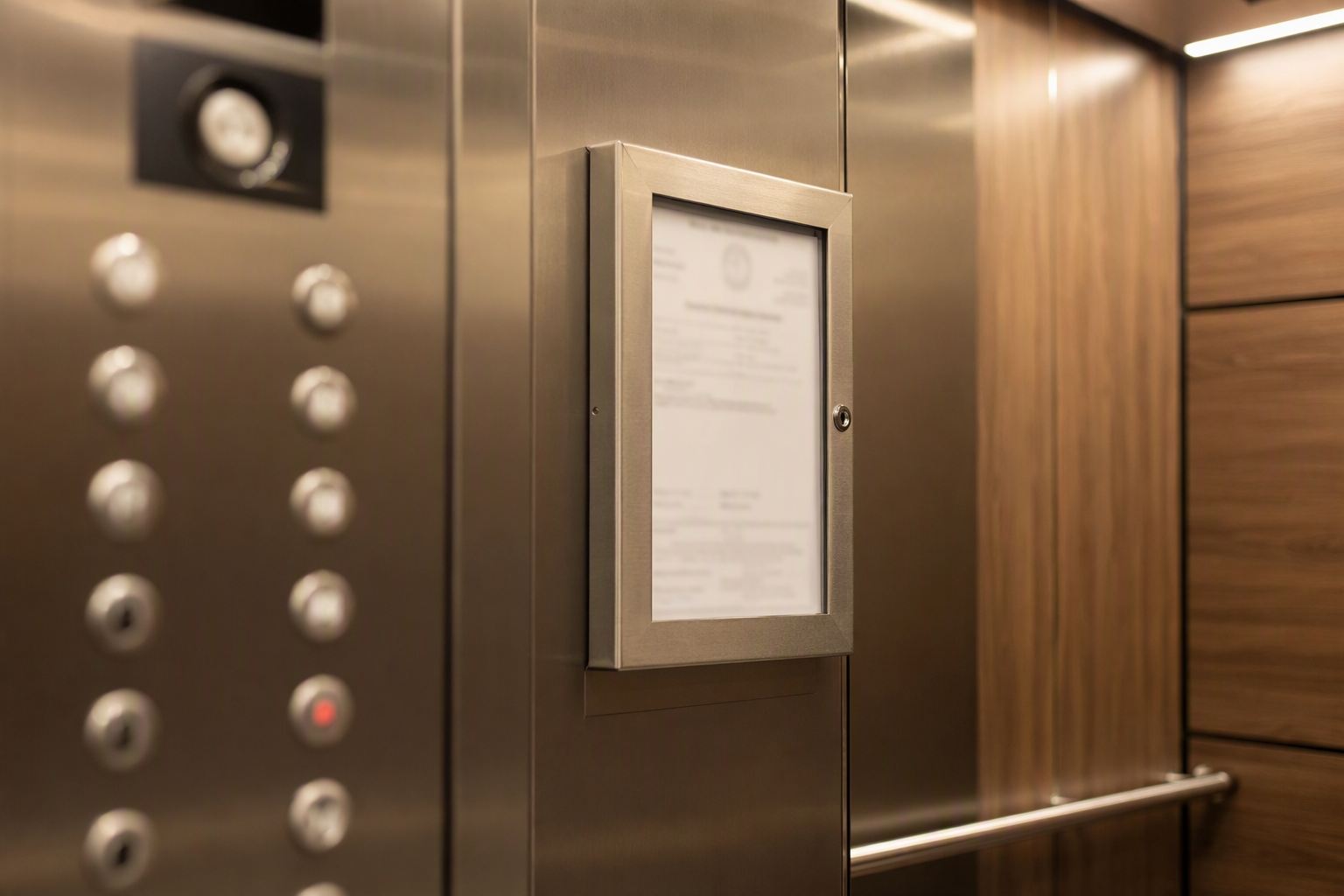
- Locate the current certificate of inspection. Arizona law requires the certificate to be kept at the same location as the conveyance and made available on request. Confirm its validity date and the state serial number posted on or near the conveyance.
- Verify the new vendor’s ROC license classification. Confirm R-12 or C-12 status is current before executing a new agreement.
- Schedule a condition assessment with the incoming vendor. A thorough inspection of equipment, controller, cab, pit, and machine room establishes a documented baseline and identifies any deferred maintenance the previous vendor may have left unresolved.
- Confirm compliance with the AZFS key requirement. Arizona conveyances with firefighters’ emergency operation must use the Arizona Firefighters Service (AZFS) key. The new vendor should verify proper key configuration during onboarding.
- Notify the City of Phoenix Elevator Section if applicable. For equipment located inside Phoenix city limits, the City of Phoenix Elevator Section (Planning and Development Department) oversees local inspections. Confirm any local notification or permit requirements with the incoming vendor.
- Keep inspection scheduling uninterrupted. Arizona owners must have each conveyance inspected annually, and no conveyance may operate without a valid annual certificate of inspection. Coordinate timing so no gap occurs during the vendor transition.
Will Switching Vendors Affect My Elevator’s Inspection Certificate or Compliance Status?
Changing maintenance companies does not automatically affect the validity of an existing annual certificate of inspection, provided the equipment remains in safe operating condition and no unauthorized modifications are made during the transition. However, building owners should be aware of several compliance touchpoints:
- Arizona owners must notify the ICA Elevator Division within 24 hours of any accident that injures a person or disables a conveyance — this obligation does not pause during a vendor change.
- If the transition coincides with, or triggers, any repair or alteration, Arizona owners must notify the state at least 90 days before installing, relocating, or altering a conveyance.
- Private elevator inspectors authorized by the ICA may be hired to conduct initial or annual inspections. However, a private inspector may not inspect a conveyance owned, operated, or last serviced by that inspector, a company the inspector owns, or the inspector’s employer — an important conflict-of-interest rule to keep in mind when selecting inspection services alongside a new maintenance vendor.
What Should I Look for in a Replacement Elevator Maintenance Company in Phoenix?
The right vendor for Phoenix-area buildings will demonstrate:
- Arizona-specific regulatory knowledge: Familiarity with the ICA Elevator Division, ASME A17.1-2019 as adopted in Arizona, and the City of Phoenix Elevator Section’s local jurisdiction.
- Current ROC licensure: Verified R-12 or C-12 classification from the Arizona Registrar of Contractors.
- Transparent maintenance reporting: Written logs after every visit, documented parts usage, and clear communication about open items.
- Broad equipment familiarity: Phoenix’s commercial, residential, and healthcare building stock includes a wide range of elevator makes and vintages. The incoming vendor should be able to service the specific equipment installed.
- Emergency availability: Elevators can malfunction outside normal business hours. Confirm how after-hours situations are handled before signing a new agreement.
- ADA awareness: Elevators in public accommodations must meet ADA accessibility requirements. The incoming vendor should be able to identify and flag accessibility-related deficiencies.
Are There Risks to Switching Elevator Companies, and How Can They Be Minimized?
Transition risks are real but manageable. The most common concerns include:
- Documentation gaps: If the outgoing vendor retains or destroys service records, the incoming vendor starts blind. Request all records in writing at the time of cancellation notice.
- Deferred maintenance surfacing: A fresh condition assessment may reveal work the previous vendor deprioritized. This is better discovered early than during an inspection.
- Proprietary component disputes: Clarify in writing, before the outgoing vendor’s last visit, whether any installed components are considered proprietary and subject to removal.
- Certificate timing: If the annual inspection is due within the notice period, coordinate with the incoming vendor to ensure it is completed without lapse — no Arizona conveyance may legally operate without a valid certificate.
Working with an experienced local vendor who understands Arizona’s regulatory calendar and Phoenix’s local inspection authority significantly reduces transition friction.
Why Do Phoenix Building Owners Choose Arizona Elevator Solutions for Elevator Service?
Arizona Elevator Solutions is a certified elevator service company serving Phoenix and communities throughout Arizona. The team brings deep familiarity with the regulatory environment governed by the Industrial Commission of Arizona’s Elevator Division, the City of Phoenix Elevator Section, and the adopted ASME codes. Arizona Elevator Solutions supports building owners through every phase of a vendor transition — from reviewing outgoing contract obligations to conducting a thorough equipment assessment and maintaining inspection continuity. The focus is always on keeping conveyances safe, compliant, and running reliably for the people who depend on them every day.
For building owners ready to evaluate their current elevator service arrangement or move forward with a transition, the first step is a straightforward conversation.
Schedule a Free Consultation with Arizona Elevator Solutions today. Call 480-557-7600 to speak with the team about your Phoenix-area elevator service needs.
Need elevator service you can rely on? Arizona Elevator Solutions is ready to help.






