
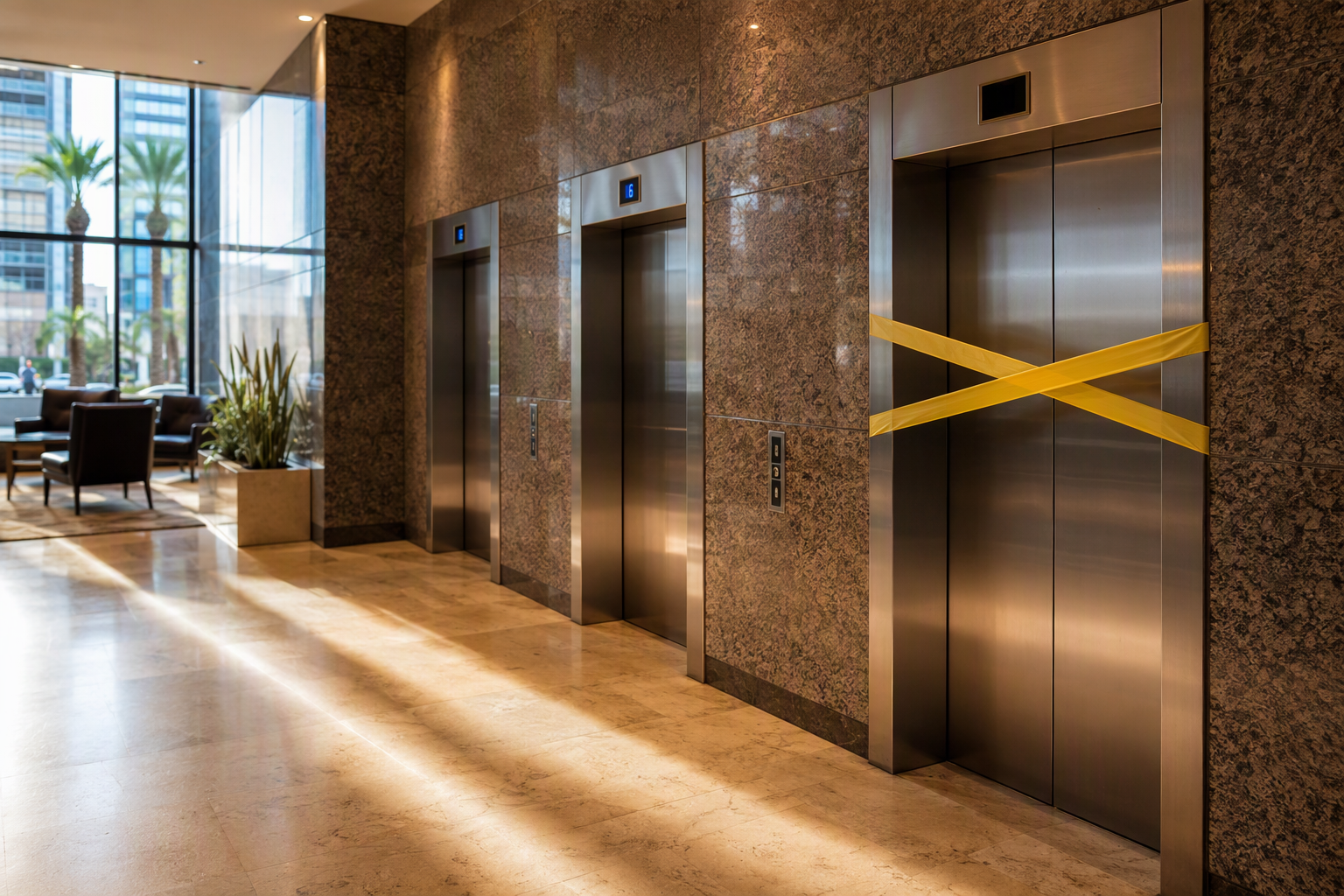
Why Elevators Go Out of Service Unexpectedly: Causes, Responsibilities, and Emergency Repair Guide for Arizona Commercial Buildings
Unexpected elevator shutdowns disrupt building operations, create ADA accessibility barriers, and — depending on the cause — can expose building owners to serious regulatory and legal liability. This comprehensive FAQ covers every dimension of unplanned elevator outages: the mechanical and electrical triggers, the regulatory framework that governs them in Arizona, the chain of responsibility, and the steps commercial property teams should take the moment a unit goes dark.
What Are the Most Common Causes of an Unexpected Elevator Outage?

The most common causes are safety device activations, motor or drive system failures, door malfunctions, power interruptions, and overdue maintenance that allows minor faults to escalate into full shutdowns.
Modern elevators are engineered with layered safety systems under the ASME A17.1 Safety Code for Elevators and Escalators. These systems are designed to stop a car rather than allow it to operate unsafely. When a sensor, switch, or interlock detects an out-of-tolerance condition, the controller removes power from the drive system and the elevator becomes unavailable until a qualified technician diagnoses and clears the fault.
Door-related faults are among the leading contributors to unplanned shutdowns. A door that fails to confirm full closure or full opening within a programmed time window triggers a fault code that halts operation. Worn door gibs, debris on the sill, misaligned clutches, and failing door operators are all frequent culprits — particularly in high-traffic Phoenix and Scottsdale commercial buildings where doors cycle thousands of times per week.
Hydraulic leaks, rope stretch beyond tolerance, and brake adjustment drift are mechanical contributors. On the electrical side, overheated motors, failing capacitors, corrupted controller boards, and ground faults in traveling cables all produce sudden shutdowns. Arizona’s extreme summer heat accelerates component wear, making thermal protection trips more common here than in moderate climates.
How Does Arizona Law Define Who Is Responsible for Elevator Safety and Repairs?

Under A.R.S. §§ 23-491 through 23-491.16, the owner or operator of an elevator is legally responsible for maintaining it in safe operating condition and for ensuring all required inspections, certificates, and repairs are current.
Arizona law places the duty of compliance squarely on the owner or operator, not on the tenant or the elevator service company. The Industrial Commission of Arizona’s Elevator Division (formerly known as the ADOSH Elevator Safety Section until September 12, 2026) is the state agency charged with enforcing these obligations. A building owner who allows an elevator to operate without a valid annual certificate of inspection, or who fails to remove a defective unit from service, faces enforcement action from the Elevator Division.
In a leased commercial building, the lease agreement often governs whether landlord or tenant bears operational responsibility, but the statutory obligation to the state remains with the owner of record. Building managers should ensure that maintenance agreements with elevator contractors clearly delineate emergency response duties so that responsibility gaps do not delay repairs when a shutdown occurs.
What Role Does the Industrial Commission of Arizona Play After an Elevator Outage?
The Industrial Commission of Arizona’s Elevator Division has authority to investigate elevator incidents, require shutdowns, and mandate repairs before a unit is returned to service.
The Elevator Division oversees elevator safety under A.R.S. §§ 23-491 through 23-491.16 and Arizona Administrative Code R20-5-502 through R20-5-515. When an elevator causes a personal injury or disables a conveyance, Arizona owners must notify the Elevator Division within 24 hours. Failure to report is itself a violation. Inside the City of Phoenix, the City of Phoenix Elevator Section within the Planning and Development Department has concurrent inspection authority — building operators there should be prepared to coordinate with both the city and the state.
Following an incident or a failed inspection, the Elevator Division may issue an order to cease operation. The elevator cannot legally return to service until the deficiency is corrected, a follow-up inspection is completed, and a new certificate of inspection is issued. This process underscores why rapid access to a licensed elevator contractor is critical — delays in repair directly extend the shutdown period.
What Is the Annual Certificate of Inspection and What Happens If It Lapses?
Arizona law prohibits any conveyance from operating without a current annual certificate of inspection issued by the state, and operating without one exposes the building owner to enforcement action and potential liability.
Under Arizona Administrative Code R20-5-502 through R20-5-515, every elevator must be inspected before it first enters service, after any modification or alteration, and annually thereafter. The certificate of inspection must be kept at the same location as the conveyance and made available for inspection on request. The state serial number or certificate must be posted in or close to the elevator in an easily accessible location.
A lapsed certificate does not automatically trigger a shutdown, but if an Elevator Division inspector or the Phoenix Elevator Section discovers an elevator operating without a current certificate, they can order it removed from service immediately. From a liability standpoint, an owner who cannot produce a current certificate after a passenger incident is in a significantly weakened legal position. Arizona Elevator Solutions assists commercial clients in Phoenix, Tucson, Scottsdale, and Mesa with tracking certification timelines and coordinating inspections so certificate gaps do not occur.
What Specific Safety Devices Most Frequently Trigger an Emergency Shutdown?
The devices most likely to trigger unplanned shutdowns include the door interlock system, the governor and safety plank, the car and counterweight buffer switches, pit and top-of-car stop switches, and overspeed or under-speed governors.
The ASME A17.1 Safety Code for Elevators and Escalators requires each of these devices to be present, functional, and capable of removing drive power independently. When any one of them detects an unsafe condition, the elevator controller stops the car and locks it out until the condition is cleared by a technician. In Arizona’s heat, thermal cutouts on hydraulic power units and motor temperature sensors add another category of common shutdowns from May through September.
Door interlocks are the single most frequent trigger in commercial buildings. ASME A17.1 requires that landing door interlocks be tested at each inspection. A worn interlock contact may pass inspection but fail weeks later under daily traffic, producing an unexpected mid-day shutdown with no prior warning to building staff.
Who Is Permitted to Perform Emergency Elevator Repairs in Arizona?
Emergency elevator repairs in Arizona must be performed by a contractor holding an R-12 or C-12 elevator license classification from the Arizona Registrar of Contractors.
The Arizona Registrar of Contractors issues R-12 (residential) and C-12 (commercial) elevator license classifications that authorize the licensee to install and repair elevators, dumbwaiters, escalators, and moving walks. Using an unlicensed contractor to perform repairs — even in an emergency — violates Arizona law and may invalidate insurance coverage and inspection certificates. Building managers under pressure to restore service quickly should confirm contractor licensing before authorizing any work.
Arizona Elevator Solutions holds the appropriate Registrar of Contractors licensing to perform emergency repair work on commercial elevators in Phoenix, Scottsdale, Mesa, and Tucson. After any repair that constitutes an alteration under Arizona Administrative Code definitions, owners must notify the Industrial Commission of Arizona’s Elevator Division at least 90 days before planned alterations — or immediately in emergency scenarios where regulatory contact is required — and may need a follow-up inspection before the unit is returned to service.
What Should Building Management Do Immediately When an Elevator Goes Out of Service?
Building management should immediately secure the elevator, check for trapped passengers, notify occupants, contact a licensed elevator contractor, and document the incident.
- Confirm passenger status. Contact the elevator car through the in-car emergency communication system. If passengers are trapped, do not attempt a rescue using building staff — contact the local fire department, who are trained for elevator rescue operations.
- Secure the elevator. Post clear “Out of Service” signage at every landing. If the unit is accessible, lock off the machine room to prevent unauthorized entry or restart attempts.
- Document the failure. Note the time, floor position of the car, any fault codes displayed on the controller or lobby panel, and any reports from passengers or staff about unusual sounds or behavior before the shutdown.
- Contact a licensed elevator contractor. Provide the technician with the state serial number (found on the tag fixed to the controller or mainline disconnect), the fault code if available, and a description of events leading to the shutdown.
- Notify the Industrial Commission of Arizona’s Elevator Division within 24 hours if the outage involved a personal injury or if the conveyance was disabled in a manner that may require state review under A.R.S. § 23-491.
- Activate ADA accommodation procedures. Under the Americans with Disabilities Act, commercial building operators must have plans to provide equivalent access to persons with disabilities when vertical transportation is unavailable. Notify tenants and arrange alternative assistance as needed.
- Retain repair documentation. Obtain a written report from the elevator contractor detailing the fault cause, components replaced or adjusted, and the unit’s condition at return to service. This documentation supports your inspection record and any insurance or liability review.
How Does Arizona’s Adopted ASME A17.1-2019 Code Affect Emergency Repair Standards?
For equipment installed, repaired, or altered on or after January 1, 2023, Arizona requires compliance with ASME A17.1/CSA B44, 2019 edition, which sets detailed standards for every component a technician may touch during emergency repairs.
The ASME A17.1-2019 adoption, effective January 9, 2023, means that any repair or alteration performed today in Arizona must meet 2019 edition requirements for the affected components. A technician replacing a door operator, for example, must install and adjust it to 2019 code tolerances, not to the standard in effect when the elevator was originally installed. This creates a practical compliance burden for older buildings where original equipment may not align with current specifications.
Older conveyances that were lawfully installed under a prior code edition may remain in service in Arizona unless the Elevator Division’s chief determines that continued use poses a hazard to life, health, or property. However, once repairs or alterations are made, the affected systems must meet current code. Building owners should work with a knowledgeable contractor who understands this distinction to avoid inadvertent code violations during emergency repairs.
What Are the ADA Obligations When a Commercial Elevator Is Out of Service?
Under the Americans with Disabilities Act, commercial building operators must ensure that persons with disabilities have equivalent access to goods, services, and facilities even when an elevator is temporarily unavailable.
The ADA does not require a building to maintain a backup elevator, but it does require operators to have a plan for providing equivalent service during an outage. Depending on the building type, this may include staff assistance, temporary relocation of services to accessible floors, or coordination with tenants to deliver services in an accessible location. The longer the outage, the greater the scrutiny from a compliance standpoint — a same-day repair generally carries less ADA risk than a multi-day shutdown with no accommodation plan.
For multi-story commercial buildings in Phoenix, Scottsdale, Mesa, and Tucson where upper-floor tenants serve the public, the absence of a functioning elevator can constitute a Title III ADA violation if no alternative access is provided. Building managers should consult legal counsel and maintain a written ADA emergency access plan as part of standard elevator maintenance planning.
What Is the Difference Between a Maintenance Shutdown and an Emergency Outage?
A maintenance shutdown is a planned, scheduled event coordinated with building management, while an emergency outage is an unplanned failure that may trap passengers, create ADA barriers, and trigger regulatory notification requirements.
Planned maintenance shutdowns allow building operators to notify tenants, arrange alternative access, and schedule work during low-traffic periods. Emergency outages offer none of these advantages and typically require a faster, more costly response. Regular preventive maintenance reduces the probability of emergency outages by identifying worn components, calibrating safety devices, and clearing fault codes before they escalate into full shutdowns.
A well-structured maintenance agreement with a licensed elevator contractor should clearly differentiate between routine maintenance visits and emergency call response, define what constitutes a callback, and specify which types of faults trigger immediate dispatch versus next-business-day response. Arizona Elevator Solutions recommends that commercial building operators in Phoenix and the surrounding markets review their maintenance contracts annually to confirm these provisions are current and enforceable.
How Often Must Commercial Elevators in Arizona Be Inspected to Remain in Compliance?
Arizona requires that every conveyance be inspected before first use, after any modification or alteration, and annually thereafter, with the resulting certificate of inspection kept on-site and the state serial number posted near the unit.
| Inspection Trigger | Required Action | Authority | Certificate Required? |
|---|---|---|---|
| Before first use (new installation) | Full initial inspection | ICA Elevator Division or authorized private inspector | Yes |
| After modification or alteration | Post-alteration inspection | ICA Elevator Division or authorized private inspector | Yes (renewed) |
| Annual recurring | Annual inspection | ICA Elevator Division or authorized private inspector | Yes (renewed annually) |
| After injury or disabling incident | Incident notification within 24 hours; inspection before return to service | ICA Elevator Division | Required before restart |
| City of Phoenix elevators | Inspected by City of Phoenix Elevator Section (Planning and Development Dept.) | City of Phoenix Elevator Section | Yes |
Arizona owners have the option to hire a private elevator inspector authorized by the Industrial Commission of Arizona rather than waiting for a state inspector, which can reduce scheduling delays. Private inspectors must register with the commission annually and demonstrate at least eight hours of approved continuing education. However, a private inspector may not inspect a conveyance that was owned, operated, or last serviced by the inspector, a company the inspector owns, or the inspector’s employer — a conflict-of-interest rule that building owners should keep in mind when selecting inspectors.
Can a Building Owner Be Fined or Face Legal Action for an Elevator That Goes Out of Service?
Yes — building owners can face enforcement action from the Industrial Commission of Arizona’s Elevator Division, civil liability for injuries, and ADA complaints if an elevator goes out of service due to neglected maintenance or expired certification.
The enforcement framework under A.R.S. §§ 23-491 through 23-491.16 gives the Elevator Division authority to order a conveyance out of service and to pursue enforcement remedies against non-compliant owners. An elevator that was operating without a current certificate of inspection, or that was known to have safety defects that went unaddressed, creates significant exposure in personal injury litigation. Plaintiffs’ attorneys routinely request inspection records, maintenance logs, and contractor invoices in elevator injury cases.
Proactive compliance — maintaining current certificates, documenting maintenance, addressing fault codes promptly, and keeping maintenance agreements current with a licensed contractor — is the most effective legal and financial risk management strategy available to commercial building owners.
What Are the Most Overlooked Maintenance Items That Lead to Unexpected Elevator Outages?
The most overlooked items are door system components, hydraulic fluid condition and level, controller board diagnostics, and pit sump and water intrusion — all of which can cause sudden shutdowns with little visible warning.
Door gibs, sill guides, clutch rollers, and interlock contacts wear gradually and do not fail dramatically until they reach the point of triggering fault codes. Regular lubrication schedules and dimensional checks catch these components before they cause shutdowns. In hydraulic elevators common in Arizona’s low-rise commercial inventory, fluid contamination, seal degradation, and fluid level drops produce slow response, leveling errors, and eventually controller-driven shutdowns to protect the pump unit.
Controller diagnostics are an increasingly important maintenance area as older relay-logic controllers are replaced with microprocessor systems. Modern controllers log fault histories that a technician can read with a laptop or handheld device, enabling predictive maintenance. Building owners whose maintenance agreements do not include periodic controller diagnostic downloads are missing a valuable early-warning tool.
Pit water intrusion is particularly relevant in Arizona monsoon season. Water in the pit activates the pit stop switch, immediately removing power from the drive system. A pit that drains slowly or has no active sump can cause repeated shutdowns during July through September. Arizona Elevator Solutions evaluates pit drainage and water intrusion risks as part of elevator assessments for commercial buildings in the Phoenix metro and Tucson markets.
What Is the Role of the Arizona Firefighters Service (AZFS) Key in an Emergency Shutdown?
The Arizona Firefighters Service (AZFS) key is the standardized key required for firefighters’ emergency operation in Arizona conveyances, and its availability must be confirmed during any emergency shutdown involving fire department personnel.
Arizona conveyances equipped with firefighters’ emergency operation are required to use the AZFS key — Arizona’s designated firefighter operation key standard. During an elevator emergency that involves fire or building evacuation, fire department personnel will use this key to assume control of elevator cars for emergency access and evacuation support. Building staff and maintenance personnel should confirm that fire department personnel have access to AZFS key locations as part of the building’s emergency response plan.
This requirement is distinct from the general maintenance key or the building engineer’s keys. Elevator contractors performing maintenance or emergency repairs in Arizona should verify AZFS key compliance as part of any service visit on a qualifying unit.
How Do Power Outages and Electrical Events Affect Elevator Operation and Restart?
Power outages, voltage sags, phase loss, and lightning surge events can all trigger elevator shutdowns and may damage controller boards, drive units, or motor windings that require professional evaluation before restart.
Elevators are sensitive to power quality. A momentary voltage sag can corrupt a microprocessor controller’s memory registers, leaving the unit non-operational even after power is restored. Phase loss — where one of three phases of commercial power is lost — activates phase-monitoring relays that shut down the drive to prevent single-phase motor damage. These conditions often look like a simple power outage to building staff but require a technician to reset, re-initialize, and test the controller before the elevator is safe to return to service.
In Arizona, monsoon season brings lightning and power quality events that can damage elevator electronics. Surge protection on elevator power feeds and controller panels is a worthwhile investment for commercial properties. After any significant electrical event, building engineers should not attempt to restart an elevator by simply resetting circuit breakers — a technician should perform a diagnostic check first to confirm that no damage occurred to safety-critical components.
What Documentation Should a Building Owner Maintain Regarding Elevator Outages and Repairs?
Building owners should maintain a log that includes the date and duration of each outage, the cause, the technician and contractor who responded, the repairs performed, and the date the unit returned to service — along with all inspection certificates and maintenance records.
This documentation serves multiple purposes: it satisfies the record-keeping expectations of the Industrial Commission of Arizona’s Elevator Division, supports insurance claims, provides a defense in personal injury litigation, and creates a maintenance history that helps identify recurring problems before they become major failures. The state serial number tag on the controller or mainline disconnect is the reference identifier that should appear on all records for each specific unit.
Inspection certificates must be kept at the same location as the conveyance under Arizona law. Many commercial building operators create a dedicated elevator compliance binder for each unit that contains the current certificate, prior certificates, maintenance logs, and contractor contact information. Digital records stored in a building management system provide backup and facilitate audit response.
How Does Elevator Age Affect the Probability and Severity of Unexpected Outages?
Older elevators experience significantly higher rates of unplanned outages as mechanical components wear, original parts become harder to source, and original code editions diverge increasingly from current ASME A17.1-2019 requirements.
Hydraulic systems, relay-logic controllers, and older traction drive systems all have finite service lives. Parts availability becomes a critical issue for units that are several decades old — when a controller board or a proprietary hydraulic valve is discontinued, sourcing a replacement can extend an outage from hours to days or weeks. Building owners with aging elevator inventories should request a modernization feasibility assessment from a licensed contractor to understand when component obsolescence begins to create unacceptable operational risk.
Modernization projects — replacing controllers, drive systems, door operators, and fixtures — bring older units into closer compliance with current ASME A17.1-2019 standards, improve reliability, and often reduce energy consumption. Arizona owners must notify the Industrial Commission of Arizona’s Elevator Division at least 90 days before any alteration, and a post-alteration inspection is required before the modernized unit returns to service.
What Is the Difference Between an Emergency Repair and an Alteration Under Arizona Law?
An emergency repair restores a failed component to its original specification and does not require 90-day advance notice, while an alteration modifies the design, capacity, speed, or operation of the conveyance and triggers state notification and post-alteration inspection requirements.
The distinction matters because the notification and inspection timelines differ. Replacing a failed door operator with an identical unit is generally a repair. Replacing it with a different model that changes door speed, force, or operation sequence may be classified as an alteration under Arizona Administrative Code R20-5-502 through R20-5-515. Contractors performing emergency work should document what was replaced and confirm with the building owner whether the work constitutes an alteration requiring Elevator Division notification.
When in doubt, consulting with the Industrial Commission of Arizona’s Elevator Division or working with an experienced contractor like Arizona Elevator Solutions — which serves commercial properties across Phoenix, Scottsdale, Mesa, and Tucson — is the safest path. A repair incorrectly characterized as an alteration causes unnecessary regulatory delay; an alteration incorrectly characterized as a repair can result in enforcement action when the next annual inspection identifies the change.
What Should Building Owners Look for When Selecting an Emergency Elevator Repair Contractor?
Building owners should verify that any emergency elevator repair contractor holds a current R-12 or C-12 license from the Arizona Registrar of Contractors, carries appropriate insurance, is familiar with ASME A17.1-2019 requirements, and has documented experience with the specific type of elevator in the building.
License verification can be performed through the Arizona Registrar of Contractors’ public license search. Owners should ask for the license number before authorizing work and confirm that the license is active and not under suspension. Insurance verification — including general liability and workers’ compensation — protects the building owner from liability if an injury occurs during repair work.
Type-specific experience matters because hydraulic, geared traction, gearless traction, and machine-room-less (MRL) elevators have fundamentally different systems. A contractor experienced primarily with hydraulic units may not have the diagnostic tools or parts inventory to efficiently resolve a gearless traction fault. When selecting a service partner for emergency response, building operators benefit from working with a contractor who services a broad range of elevator types and manufacturers.
What Platform Lift and Stairway Chairlift Requirements Apply to Arizona Commercial Buildings?
Arizona platform lifts and stairway chairlifts installed, repaired, or altered on or after January 1, 2023 must comply with ASME A18.1-2020, and they are subject to the same Industrial Commission of Arizona certification and inspection framework as full elevators.
Platform lifts are commonly used in Arizona commercial buildings to provide ADA-compliant access at entry-level changes, stages, or mezzanines where a full elevator installation is not feasible. Because they carry people, they are classified as conveyances under A.R.S. §§ 23-491 through 23-491.16 and are subject to the same annual certification, posting, and notification requirements as elevators.
Unexpected shutdowns of platform lifts can create immediate ADA access problems for buildings where the lift is the sole means of access to a program area or service counter. Building operators should ensure that platform lifts are included in their preventive maintenance schedules and that the annual certificate of inspection is current — an oversight that occurs more frequently with lifts than with full elevators because they are sometimes perceived as lower-priority equipment.
Get a Professional Elevator Assessment Before the Next Outage Occurs
Unexpected elevator outages cost commercial buildings in Phoenix, Scottsdale, Mesa, and Tucson in lost productivity, tenant complaints, ADA liability exposure, and emergency repair premiums. Proactive assessment and a structured maintenance program — performed by a licensed Arizona elevator contractor — is the most effective way to reduce unplanned downtime and maintain compliance with the Industrial Commission of Arizona’s Elevator Division requirements under A.R.S. §§ 23-491 through 23-491.16 and the ASME A17.1 Safety Code for Elevators and Escalators.
Contact Arizona Elevator Solutions for a free elevator assessment. Call us at 480-557-7600 to schedule a comprehensive review of your commercial elevator’s mechanical condition, safety device status, documentation compliance, and modernization outlook. Arizona Elevator Solutions serves commercial properties throughout Phoenix, Tucson, Scottsdale, and Mesa.
Need elevator service you can rely on? Arizona Elevator Solutions is ready to help.






