ADA Upgrades for Elevators: Complete FAQ Guide for Arizona Building Owners
ADA upgrades refer to modifications made to elevator systems, platform lifts, and related conveyances to achieve compliance with the Americans with Disabilities Act accessibility standards. For Arizona building owners in Phoenix, Tucson, Scottsdale, and Mesa, these upgrades must also satisfy state requirements under A.R.S. §§ 23-491 through 23-491.16 and the ASME A17.1-2019 Safety Code for Elevators and Escalators, which Arizona adopted for equipment installed, repaired, or altered on or after January 1, 2023.
What Are ADA Elevator Upgrades and Why Are They Required?

ADA elevator upgrades are physical and operational modifications made to vertical transportation equipment to remove barriers for people with disabilities, as mandated by the Americans with Disabilities Act.
The ADA establishes minimum accessibility requirements for places of public accommodation and commercial facilities. Elevators are specifically addressed under the ADA’s Accessibility Guidelines (ADAAG) and the 2010 ADA Standards for Accessible Design, which set measurable criteria for cab size, door clearance, control reach ranges, signage, and auditory features. Building owners who fail to bring their elevators into compliance expose themselves to civil complaints, Department of Justice enforcement actions, and costly retrofits performed under adverse circumstances.
Beyond the federal mandate, Arizona’s adoption of ASME A17.1-2019 for new or altered equipment reinforces many accessibility-related mechanical requirements. Any alteration to an existing elevator — including an ADA upgrade — triggers the requirement for a new inspection and an updated certificate of inspection issued by the Industrial Commission of Arizona’s Elevator Division before the equipment returns to service.
Which Specific Elevator Features Must Be Upgraded to Meet ADA Standards?
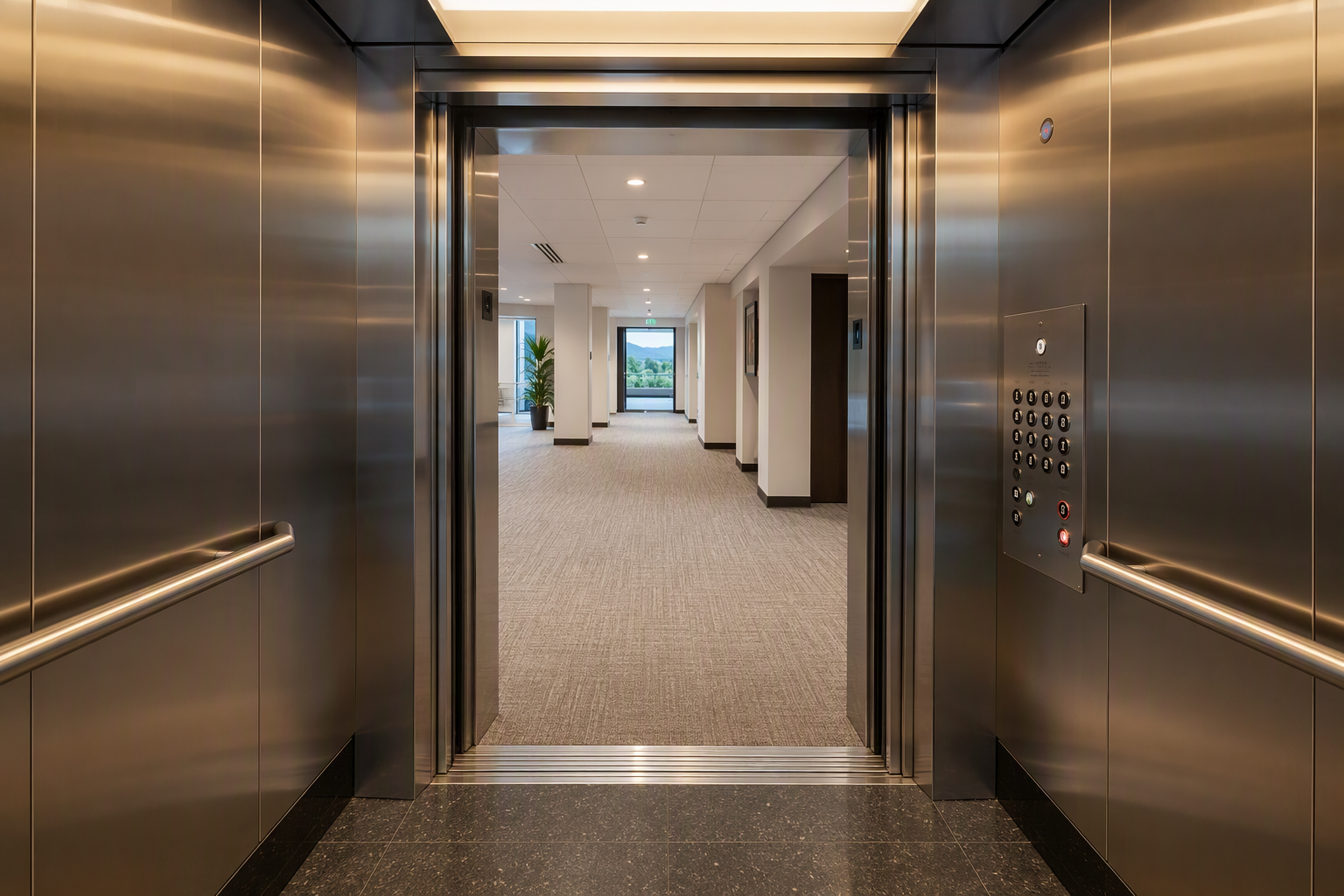
The ADA requires that elevator cabs, doors, controls, signage, and floor-leveling performance all meet defined minimum standards before a conveyance is considered accessible.
Key features addressed by ADA upgrade projects typically include:
- Door clear width: A minimum 36-inch clear opening width is required for elevator doors serving accessible routes.
- Cab interior dimensions: Sufficient floor space must allow a wheelchair user to enter, turn, and exit — the 2010 ADA Standards specify minimum inside cab dimensions.
- Control panel height and reach range: Operable controls must be within the forward and side reach ranges specified in the ADA Standards (generally no higher than 48 inches above the finished floor for a forward reach, and no lower than 15 inches).
- Tactile and Braille floor designations: Each floor button must be accompanied by raised characters and Grade 2 Braille.
- Audible and visible signals: Hall lanterns must produce both an audible signal and a visible signal indicating car direction of travel.
- Car position indicators: Audible announcements or visible indicators must communicate floor location to passengers.
- Leveling accuracy: The elevator must stop within one-half inch of the landing floor level, ensuring safe wheelchair transitions.
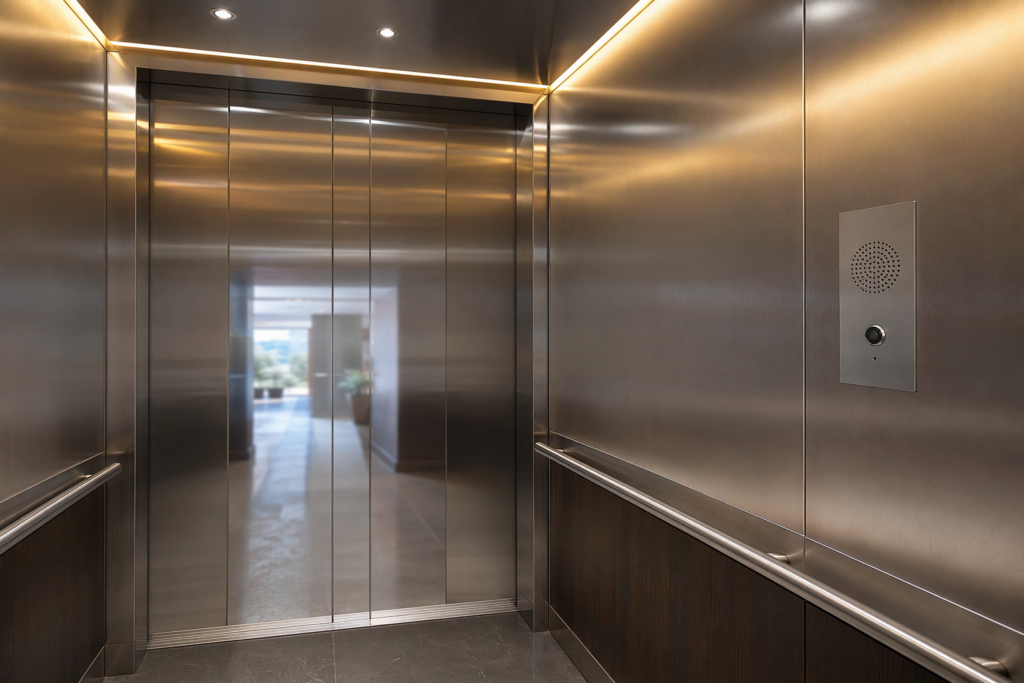
- Emergency communication: A two-way communication system accessible to people with hearing and speech impairments must be installed in the cab.
Does Every Existing Elevator in Arizona Need ADA Upgrades?
Not every existing elevator requires immediate full ADA compliance, but building owners must remove barriers in elevators that serve as part of an accessible route when doing so is readily achievable — and any alteration to an elevator triggers path-of-travel obligations under the ADA.
The ADA’s “readily achievable” standard for existing buildings differs from the strict requirements applied to new construction and alterations. However, “readily achievable” is not a permanent exemption; it requires ongoing reassessment as a building’s financial circumstances change. More critically, whenever a building owner undertakes an alteration to a primary function area, the path of travel to that area — including the elevator serving it — must be made accessible to the extent that costs do not exceed a defined threshold of the overall alteration budget under ADA regulations.
Under Arizona law, lawfully installed older conveyances may remain in use unless the state’s elevator chief considers the condition a hazard to life, health, or property. This provision does not override federal ADA obligations, which are separately enforced.
What Is the Difference Between ADA Compliance and ASME A17.1 Compliance for Elevators?
ADA compliance governs accessibility for people with disabilities and is enforced by the federal government and through private litigation, while ASME A17.1 is a mechanical safety code enforced by state elevator regulators including Arizona’s Industrial Commission of Arizona Elevator Division.
The two frameworks overlap but are not identical. ASME A17.1-2019 — the edition Arizona adopted effective January 9, 2023 for equipment installed, repaired, or altered on or after January 1, 2023 — addresses structural integrity, mechanical performance, safety devices, and operational parameters. The ADA addresses the user experience and dimensional accessibility of those same systems. A building can have a mechanically safe elevator that is nonetheless inaccessible, and vice versa. A comprehensive ADA upgrade project must satisfy both frameworks simultaneously. Any repair or alteration performed during an ADA upgrade must comply with ASME A17.1-2019 and will require notification to and inspection by the appropriate authority.
What Are the Steps in a Typical ADA Elevator Upgrade Project?
A typical ADA elevator upgrade follows a structured process from initial assessment through final state certification, ensuring that the finished installation meets both federal accessibility requirements and Arizona’s mechanical safety code.
- Accessibility audit: A qualified elevator service company performs a detailed inspection of the existing equipment, measuring cab dimensions, door widths, control heights, and operational performance against current ADA Standards and ASME A17.1-2019 requirements.
- Deficiency report and scope development: A written report identifies every non-conforming feature and prioritizes modifications by risk and regulatory urgency.
- Notification to the Industrial Commission of Arizona: Arizona owners must notify the Elevator Division at least 90 days before altering a conveyance. This notification is a legal obligation under A.R.S. §§ 23-491 through 23-491.16.
- Permitting with local authorities: In the City of Phoenix, the Phoenix Elevator Section within the Planning and Development Department handles elevator permits and inspections. In other Arizona jurisdictions, the Industrial Commission of Arizona Elevator Division is the authority having jurisdiction.
- Equipment procurement: Tactile button panels, Braille signage, hall lanterns, leveling control components, and communication systems are sourced and scheduled for installation.
- Installation by a licensed contractor: Work must be performed by a contractor holding an R-12 or C-12 elevator license from the Arizona Registrar of Contractors.
- Post-alteration inspection: Before the elevator returns to service, it must be inspected by an authorized inspector, and a new certificate of inspection must be issued by the Elevator Division.
- Certificate posting: The updated certificate must be kept at the conveyance location and made available on request; the state serial number or certificate must be posted in or close to the conveyance in an accessible location.
Who Has Jurisdiction Over ADA Elevator Upgrades in Arizona?
Jurisdiction depends on location: the City of Phoenix Elevator Section (Planning and Development Department) oversees elevators inside Phoenix city limits, while the Industrial Commission of Arizona Elevator Division has authority over conveyances in all other parts of Arizona.
For building owners in Scottsdale, Mesa, Tucson, and unincorporated areas, all permit applications, notifications, and inspection requests flow through the Industrial Commission of Arizona Elevator Division. Phoenix property owners interact with the City of Phoenix Elevator Section for inspections but remain subject to state statute under A.R.S. §§ 23-491 through 23-491.16. In both cases, the ADA is enforced federally and is not dependent on local permitting authority. Arizona Elevator Solutions assists clients in all four markets — Phoenix, Tucson, Scottsdale, and Mesa — in navigating the correct permitting pathway for their jurisdiction.
How Long Does an ADA Elevator Upgrade Take to Complete?
The timeline for an ADA elevator upgrade varies based on the scope of deficiencies identified, component lead times, permit processing duration, and the scheduling of the post-alteration state inspection, but projects can span from several weeks for targeted modifications to several months for comprehensive cab and control system replacements.
The 90-day advance notification requirement imposed by Arizona law on owners planning to alter a conveyance is a key scheduling constraint. Building owners who fail to account for this window before beginning work risk code violations. Component procurement — particularly custom Braille panels, proprietary control systems, and hall lantern assemblies for older equipment — can extend lead times considerably. Early planning is essential to minimizing elevator downtime, particularly for buildings with a single elevator serving persons with disabilities.
What Is the Role of ASME A17.3 in ADA Upgrade Projects?
ASME A17.3, the Safety Code for Existing Elevators and Escalators, provides the retroactive safety requirements that apply to existing conveyances, and it is often referenced alongside ADA upgrade work to ensure that older equipment meets current safety thresholds during the modification process.
While Arizona has adopted ASME A17.1-2019 for equipment installed, repaired, or altered on or after January 1, 2023, the retroactive provisions within ASME A17.3 address safety devices and performance requirements for equipment already in service. During an ADA upgrade, the repair and alteration work performed may bring additional ASME A17.3 requirements into scope. An experienced elevator service company will assess both frameworks during the initial audit to avoid discovering retroactive safety deficiencies mid-project, which could substantially expand scope and cost.
What Is the Difference Between an ADA Upgrade and a Full Elevator Modernization?
An ADA upgrade addresses specifically the accessibility features required by the Americans with Disabilities Act, while a full modernization replaces major mechanical, electrical, and control systems — though many building owners choose to combine both to maximize return on investment and minimize future downtime.
| Feature / Scope Element | ADA Upgrade Only | Full Modernization |
|---|---|---|
| Tactile/Braille button panels | Yes | Yes |
| Hall lanterns and audible signals | Yes | Yes |
| Cab interior dimensions | If non-compliant | Yes (new cab) |
| Door operator and timing | If non-compliant | Yes (new equipment) |
| Leveling control system | If accuracy is insufficient | Yes (full controller) |
| Machine, motor, and drive | No | Yes |
| Emergency communication system | Yes | Yes |
| ASME A17.1-2019 full compliance | Partial (alteration scope) | Full |
| Expected disruption to service | Days to weeks | Weeks to months |
| State post-alteration inspection required | Yes | Yes |
Building owners who are already planning a modernization should integrate ADA compliance into that project scope from the outset. Doing so avoids a second round of permit fees, inspection downtime, and contractor mobilization costs. Arizona Elevator Solutions routinely advises clients on sequencing and combining these projects to minimize disruption and total project expenditure.
Are Platform Lifts and Stairway Chairlifts Subject to ADA and Arizona Upgrade Requirements?
Yes — platform lifts are recognized as an accessible means of vertical access under the ADA in limited circumstances, and in Arizona, platform lifts and stairway chairlifts installed, repaired, or altered on or after January 1, 2023 must comply with ASME A18.1-2020, as required by Arizona Administrative Code R20-5-502 through R20-5-515.
The ADA permits platform lifts as an accessible route element in specific scenarios, including within dwelling units, where space constraints prohibit elevator installation, and for access to raised or sunken areas in assembly spaces. However, platform lifts used in lieu of elevators in larger commercial facilities may face additional scrutiny. Any repair or alteration to a platform lift in Arizona triggers the same notification, inspection, and certificate requirements that apply to full elevators under A.R.S. §§ 23-491 through 23-491.16. Stairway chairlifts are generally not an ADA-compliant substitute for accessible elevator service in public accommodations.
What Documentation Must Arizona Building Owners Maintain After an ADA Upgrade?
After an ADA upgrade, Arizona building owners must maintain a current certificate of inspection issued by the Industrial Commission of Arizona Elevator Division at the conveyance location, available on request, with the state serial number or certificate posted in or near the conveyance in an accessible location.
Beyond state-mandated documentation, prudent building owners retain the complete project file from any ADA upgrade, including the initial accessibility audit report, the contractor’s scope-of-work documents, permit applications and approvals, inspection reports, and any correspondence with the Elevator Division or local authority. This documentation provides critical evidence of good-faith compliance efforts in the event of an ADA complaint or Department of Justice inquiry. Every Arizona conveyance is assigned a state serial number on a tag fixed to the controller or mainline disconnect, and this number should be referenced in all maintenance and upgrade documentation.
How Do ADA Upgrades Interact With Annual Elevator Inspection Requirements in Arizona?
ADA upgrades that constitute alterations require a post-alteration inspection before the elevator returns to service, and the elevator must then continue to be inspected annually in accordance with Arizona law — two distinct inspection obligations that building owners must track separately.
Arizona law requires that every conveyance be inspected before it first goes into service, after any modification or alteration, and annually thereafter. No conveyance may operate without a valid annual certificate of inspection. An ADA upgrade — because it constitutes an alteration — resets this cycle with a mandatory post-alteration inspection. Arizona owners may engage a private elevator inspector authorized by the Industrial Commission of Arizona, provided that inspector is not affiliated with the company that performed the upgrade work, as an Arizona private elevator inspector may not inspect a conveyance owned, operated, or last serviced by the inspector’s employer. Private inspectors must also register with the commission annually and demonstrate at least eight hours of approved continuing education.
What Happens if an Arizona Building Owner Fails to Complete Required ADA Upgrades?
Failure to achieve ADA compliance exposes building owners to federal civil rights complaints, Department of Justice enforcement actions, and private lawsuits, while operating a conveyance without a valid Arizona inspection certificate violates A.R.S. §§ 23-491 through 23-491.16 and can result in the elevator being ordered out of service.
The ADA enforcement mechanism is separate from Arizona’s elevator safety statute. A person with a disability can file a complaint with the U.S. Department of Justice or bring a private lawsuit under Title III of the ADA. At the state level, operating a conveyance without a valid certificate of inspection is a violation of Arizona law, and the Industrial Commission of Arizona Elevator Division has authority to require that the equipment be taken out of service. For building owners in the City of Phoenix, the Phoenix Elevator Section may also take action independently. The combination of federal accessibility liability and state safety enforcement creates a compelling case for proactive compliance planning.
Who Can Legally Perform ADA Upgrade Work on Elevators in Arizona?
Elevator installation, repair, and alteration work in Arizona — including ADA upgrades — must be performed by a contractor holding an R-12 or C-12 elevator license classification issued by the Arizona Registrar of Contractors.
The Arizona Registrar of Contractors’ R-12 and C-12 classifications authorize the licensee to install and repair elevators, dumbwaiters, escalators, and moving walks. Building owners should verify that any contractor engaged for ADA upgrade work holds one of these license classifications before work begins. Engaging an unlicensed contractor for elevator alteration work creates liability for the building owner and may invalidate the post-alteration inspection and certificate. Arizona Elevator Solutions holds the appropriate Arizona contractor licensing to perform ADA upgrade and modernization work throughout its service territory.
What Emergency Communication Requirements Apply Under the ADA for Elevator Cabs?
The ADA requires that elevator emergency communication systems be accessible to people with hearing and speech impairments, which in practice means that a voice-only emergency phone does not satisfy ADA requirements without additional features enabling non-verbal communication.
The 2010 ADA Standards for Accessible Design require a two-way communication system within elevator cabs that must be usable without voice communication. This typically means the system must include a visual signal to acknowledge that a call has been received and that help is on the way. Many older elevator emergency phones are voice-only and therefore non-compliant. During an ADA upgrade assessment, the emergency communication system should be evaluated alongside dimensional and signage features. Replacement units that incorporate both audio and visual elements are widely available and represent a relatively contained scope of work within a broader upgrade project.
How Should Arizona Building Owners Prioritize Multiple ADA Deficiencies?
Deficiencies should be prioritized based on their impact on independent access for people with disabilities, the complexity and cost of the corrective work, and the legal exposure associated with each non-conforming feature — with items that prevent any elevator use by wheelchair users treated as highest priority.
A practical prioritization framework considers three factors: (1) severity — does the deficiency prevent access entirely, or merely inconvenience users? (2) feasibility — can the item be corrected without a major structural alteration, or does it require cab reconstruction? (3) cost — is the correction readily achievable given the building owner’s resources? Braille panel replacements, audible signal additions, and emergency phone upgrades are typically low-cost, high-impact items that should be addressed first. Cab dimension deficiencies requiring structural work represent the most complex and expensive corrections and may require a phased approach. A written accessibility audit from a qualified provider like Arizona Elevator Solutions gives building owners the documentation needed to develop a defensible prioritization plan.
Does an ADA Upgrade Require an Arizona Firefighters Service (AZFS) Key Update?
Any alteration to elevator firefighters’ emergency operation components during an ADA upgrade must ensure that the equipment uses the Arizona Firefighters Service (AZFS) key, as required by Arizona’s elevator safety regulations for conveyances equipped with firefighters’ emergency operation.
Arizona conveyances with firefighters’ emergency operation are required to use the AZFS key. If an ADA upgrade project involves modifications to the elevator’s control panel, operating panel, or fire service interface, the contractor must verify that firefighters’ emergency operation remains fully functional and keyed appropriately. This is a state-specific requirement that applies in addition to federal ADA standards and ASME A17.1-2019 provisions. Building owners should confirm with their elevator service contractor that firefighters’ service compatibility is explicitly included in the upgrade scope of work.
What Should Building Owners Know About ADA Upgrade Timelines and the 90-Day Notification Rule?
Arizona building owners must notify the Industrial Commission of Arizona Elevator Division at least 90 days before installing, relocating, or altering a conveyance — making early planning essential for any ADA upgrade project to avoid legal violations and project delays.
The 90-day advance notification requirement under A.R.S. §§ 23-491 through 23-491.16 is one of the most commonly overlooked procedural obligations in elevator upgrade projects. Building owners who are responding to an ADA complaint or approaching a lease-required accessibility deadline must factor this window into their project timeline from the outset. The notification should be submitted before contractor selection is finalized to avoid any appearance of commencing work without proper notice. Arizona Elevator Solutions assists building owners in preparing and submitting required notifications as part of project coordination services.
How Do ADA Upgrades Affect Elevator Maintenance Contracts in Arizona?
ADA upgrades that replace control panels, door operators, or communication systems may change the technical scope of an existing maintenance contract, requiring owners to update the contract to cover new equipment and components added during the upgrade.
After an ADA upgrade, maintenance technicians must be familiar with any new equipment installed — particularly updated leveling controls, tactile panel assemblies, and two-way communication systems. If the upgrade introduced components from a different manufacturer than the original equipment, the maintenance contractor must have access to appropriate parts, diagnostic tools, and technical documentation for those components. Building owners should review their maintenance agreement after any significant upgrade to confirm coverage scope, parts availability, and any changes to periodic testing requirements under ASME A17.1-2019. Annual inspection obligations under Arizona law remain unchanged and must continue uninterrupted.
How Can Arizona Building Owners Get Started With an ADA Elevator Upgrade Assessment?
The first step for Arizona building owners is to commission a detailed elevator accessibility audit from a qualified, licensed elevator service company that can assess both ADA compliance and Arizona regulatory requirements simultaneously.
A thorough assessment documents every measurable dimension, operational parameter, and signage element against the 2010 ADA Standards for Accessible Design and applicable ASME A17.1-2019 requirements. The audit should produce a written deficiency report, a prioritized scope of corrective work, and a preliminary project timeline that accounts for the 90-day state notification requirement and post-alteration inspection scheduling. Building owners in Phoenix, Tucson, Scottsdale, and Mesa can contact Arizona Elevator Solutions for this initial assessment. Having a documented audit in hand before any enforcement action or complaint is filed strengthens the owner’s position considerably and demonstrates a good-faith commitment to accessibility compliance.
Get Your Free ADA Elevator Assessment Today
ADA upgrade requirements are complex, and the consequences of non-compliance — both federal and under Arizona law — are significant. Arizona Elevator Solutions provides comprehensive ADA elevator assessments for building owners throughout Phoenix, Tucson, Scottsdale, and Mesa, covering accessibility audits, deficiency reporting, 90-day notification preparation, licensed upgrade installation, and post-alteration inspection coordination.
Contact Arizona Elevator Solutions for a free elevator assessment: 480-557-7600
Need elevator service you can rely on? Arizona Elevator Solutions is ready to help.