ADA Elevator Code: Requirements, Compliance, and Arizona Standards
The Americans with Disabilities Act (ADA) sets the federal accessibility floor for elevators in public accommodations, commercial facilities, and state and local government buildings. Compliance is not optional: a facility that installs or alters an elevator must meet ADA Standards for Accessible Design, and an existing building must remove accessibility barriers where doing so is readily achievable. Understanding exactly what the ADA elevator code requires — and how it intersects with Arizona’s own conveyance safety statute — is essential for any building owner, property manager, or contractor operating in the state.
What Does the ADA Elevator Code Require?
The ADA and its implementing regulations — the ADA Standards for Accessible Design — establish minimum specifications for elevators that serve as a means of vertical access in covered facilities. The core requirements address five broad areas:
- Car size: The elevator car must be large enough to allow a wheelchair user to enter, maneuver, and exit. The standards specify minimum clear floor dimensions based on whether the car has a center-opening or side-opening door configuration.
- Door timing and force: Doors must remain open long enough for a person using a mobility device to enter or exit without the door closing on them, and the reopening device must respond to both a low (shin/cane) and a high (chest) obstruction.
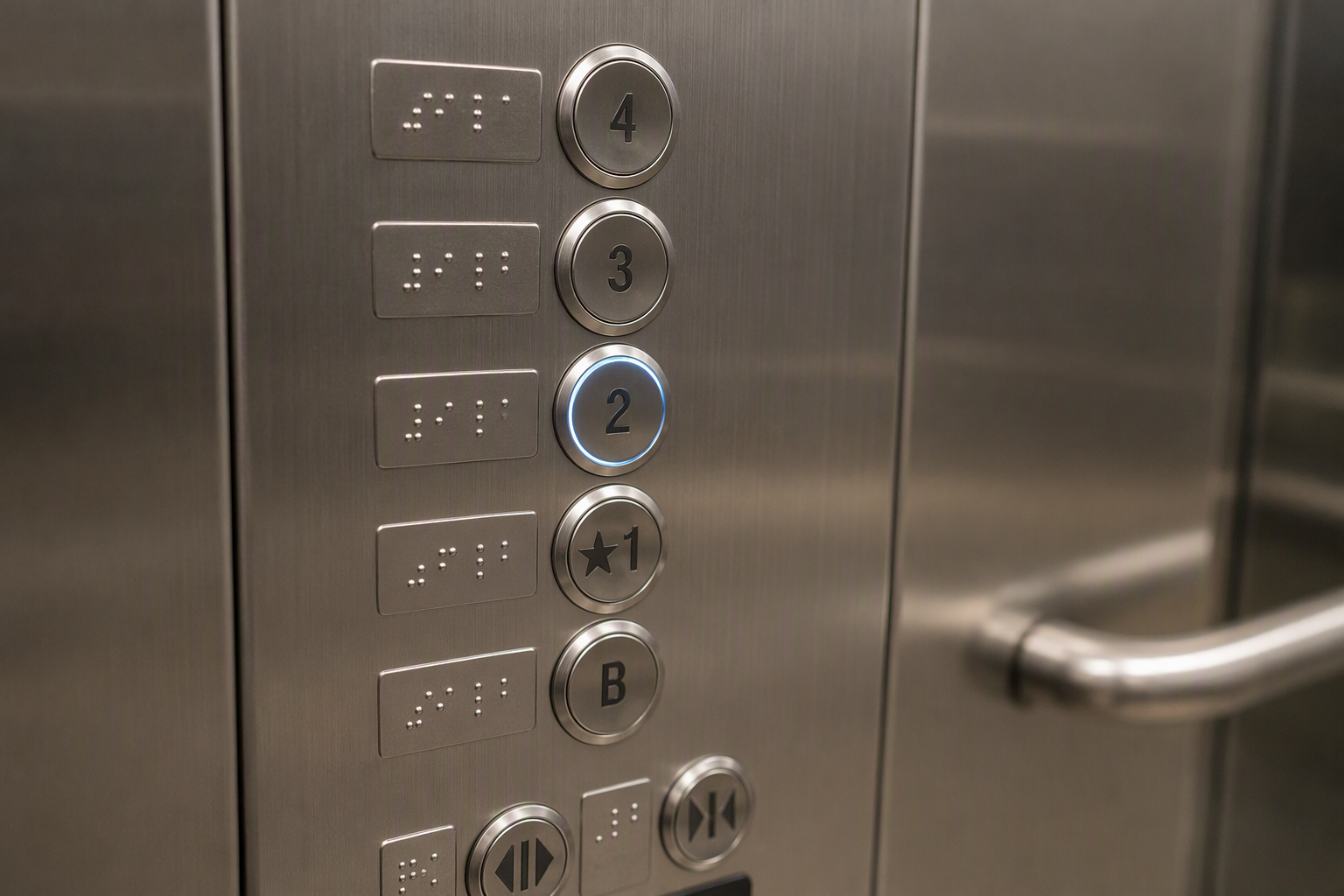
- Controls and call buttons: Call buttons outside the elevator must be at a reachable height (maximum 48 inches above the floor for a forward reach, or 54 inches for a side reach), must be at least ¾ inch in their smallest dimension, and must light up when activated. Floor buttons inside the car must also meet reach-range and size requirements.
- Floor designations: Each car must display raised and Braille floor designations on both jambs of the car entrance at a consistent mounting height so that a person who is blind can identify their floor.
- Audible and visible signals: A hall signal must indicate the direction of travel with both an audible tone and a visible indicator. An in-car audible announcement must identify each floor as the car passes or stops.
- Leveling: The car must stop within ½ inch of the floor level to eliminate a tripping hazard and to allow wheelchair users to roll on and off without difficulty.
- Emergency communication: The car must include a two-way communication system that does not require voice communication as the only means of contact, ensuring access for people who are deaf or hard of hearing.
Which Buildings Must Have ADA-Compliant Elevators?
The ADA distinguishes between new construction, alterations, and existing buildings, and the obligation to provide an accessible elevator differs across those categories.
For new construction, any building that has more than one story and is a place of public accommodation or a commercial facility must provide at least one accessible route connecting all floors — and, in most cases, that accessible route must include an elevator. The ADA does provide a limited elevator exemption for buildings that have no more than two stories and are not shopping centers, shopping malls, professional offices of health care providers, transportation terminals, or certain other facility types. If that exemption applies, a ramp or other accessible means of vertical access may substitute for an elevator.
For alterations, when an entity undertakes a physical change to an elevator itself, that elevator must be brought into compliance with the ADA Standards to the maximum extent feasible. Additionally, when an alteration affects or could affect the usability of a primary function area, the path of travel to that area — including the elevator serving it — must be made accessible to the extent that the cost does not exceed a defined proportion of the overall alteration cost.
For existing facilities (places of public accommodation under Title III), the obligation is to remove barriers to access where doing so is readily achievable — meaning it can be accomplished without much difficulty or expense. Courts and the ADA guidance consider the overall financial resources of the entity when evaluating what is readily achievable.
How Do ADA Requirements Interact with ASME A17.1 in Arizona?
The ADA sets accessibility standards; ASME A17.1 Safety Code for Elevators and Escalators sets mechanical and structural safety standards. In Arizona, both apply simultaneously, and a compliant installation must satisfy both bodies of requirements.
Arizona has adopted ASME A17.1-2019 for equipment installed, repaired, or altered on or after January 1, 2023, under Arizona Administrative Code R20-5-502 through R20-5-515. The Arizona Revised Statutes §§ 23-491 through 23-491.16 (Safety Conditions for Elevators and Similar Conveyances), as amended by Laws 2026, Ch. 73, govern the overall conveyance safety program in the state. The agency responsible for administering that program is the Industrial Commission of Arizona (ICA), Elevator Division — formerly known as the ADOSH Elevator Safety Section until September 12, 2026.
Building owners in Arizona must therefore satisfy:
- ADA accessibility requirements (federal law, enforced through the U.S. Department of Justice and private litigation)
- ASME A17.1-2019 safety requirements (adopted by Arizona statute)
- Arizona conveyance inspection, certificate, and notification requirements (ICA Elevator Division)
- Local requirements where applicable — within the City of Phoenix, the Phoenix Elevator Section of the Planning and Development Department performs inspections; the ICA Elevator Division handles equipment outside Phoenix
What Are the Arizona-Specific Inspection and Certificate Requirements?
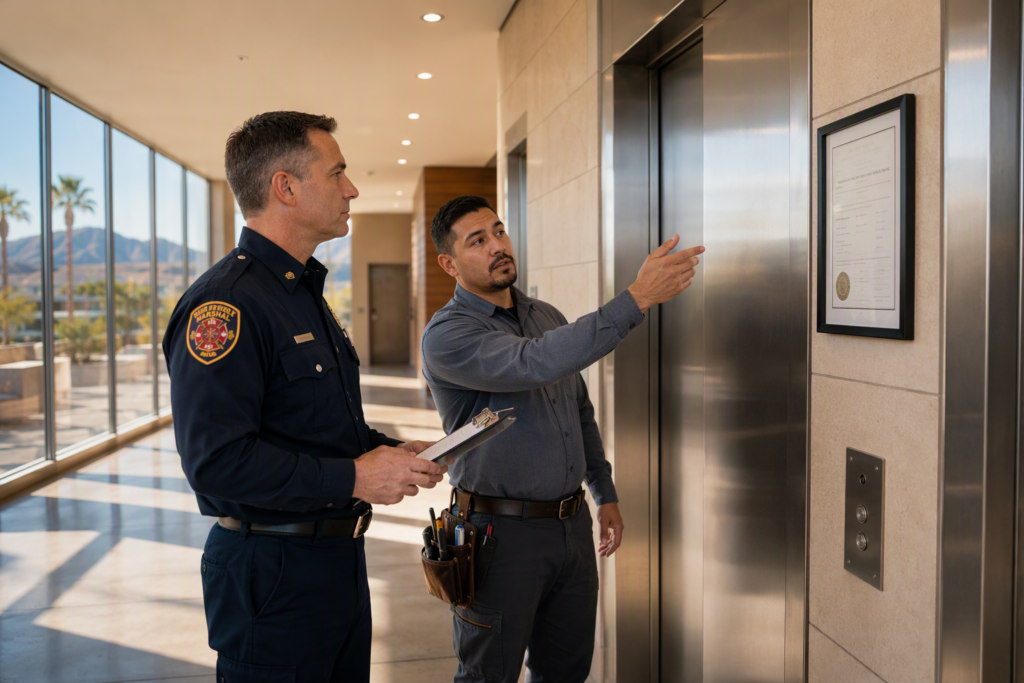
Arizona owners must have each conveyance inspected before it first goes into service, after any modification or alteration, and annually thereafter. No conveyance may legally operate in Arizona without a current annual certificate of inspection issued by the state. The owner must keep that certificate at the same location as the conveyance and make it available for inspection on request. The state serial number or certificate must be posted in or near the conveyance in an easily accessible location.
Arizona allows building owners to engage a private elevator inspector authorized by the ICA to conduct initial or annual inspections. Private inspectors must register with the commission every year and demonstrate at least eight hours of approved continuing education. One important restriction: a private inspector may not inspect any conveyance owned, operated, or last serviced by that inspector, a company the inspector owns, or the inspector’s employer. Using a private inspector does not relieve the owner or operator of their legal obligations under Arizona law.
Owners must also notify the state at least 90 days before installing, relocating, or altering a conveyance, and within 24 hours of any accident that injures a person or disables a conveyance.
What Is the ADA Elevator Exemption and Does It Apply in Arizona?
The ADA elevator exemption allows certain small buildings to omit an elevator from their accessible route design. The exemption generally applies when a building has no more than two stories above grade and does not fall into a listed category of facilities that must always provide elevator access regardless of building height. Facility types that are never exempt include shopping centers and malls, professional offices of health care providers, and transportation facilities.
Even when the ADA exemption applies and a building does not install an elevator, any elevator that is voluntarily installed must still comply with the ADA Standards for Accessible Design. In Arizona, that voluntarily installed elevator must also comply with ASME A17.1-2019 and all ICA Elevator Division requirements — the state’s safety law does not mirror the ADA’s exemption framework.
What Types of Lifts Qualify as Accessible Alternatives?
Where the ADA elevator exemption applies, or in existing buildings where full elevator installation is not readily achievable, the ADA Standards permit platform lifts (also called vertical platform lifts) as an accessible means of vertical access in limited situations. The standards specify conditions under which a platform lift may serve as part of an accessible route — for example, to provide access to a performance area, a speaker’s platform, or a space that is not required to be accessible to the public.
In Arizona, platform lifts and stairway chairlifts installed, repaired, or altered on or after January 1, 2023 must comply with ASME A18.1-2020, the Safety Standard for Platform Lifts and Stairway Chairlifts. Platform lifts serving as part of an accessible route must also meet the ADA’s dimensional and operational requirements for that equipment type. Arizona Elevator Solutions evaluates whether a proposed lift configuration satisfies both the ADA’s accessibility criteria and Arizona’s ASME A18.1-2020 safety requirements before recommending any solution to a client.
How Does ADA Elevator Code Apply to Existing Buildings?
Retrofitting an existing building for ADA elevator compliance typically involves a structured process. Arizona Elevator Solutions recommends the following sequence when an owner is assessing an existing conveyance for ADA compliance:
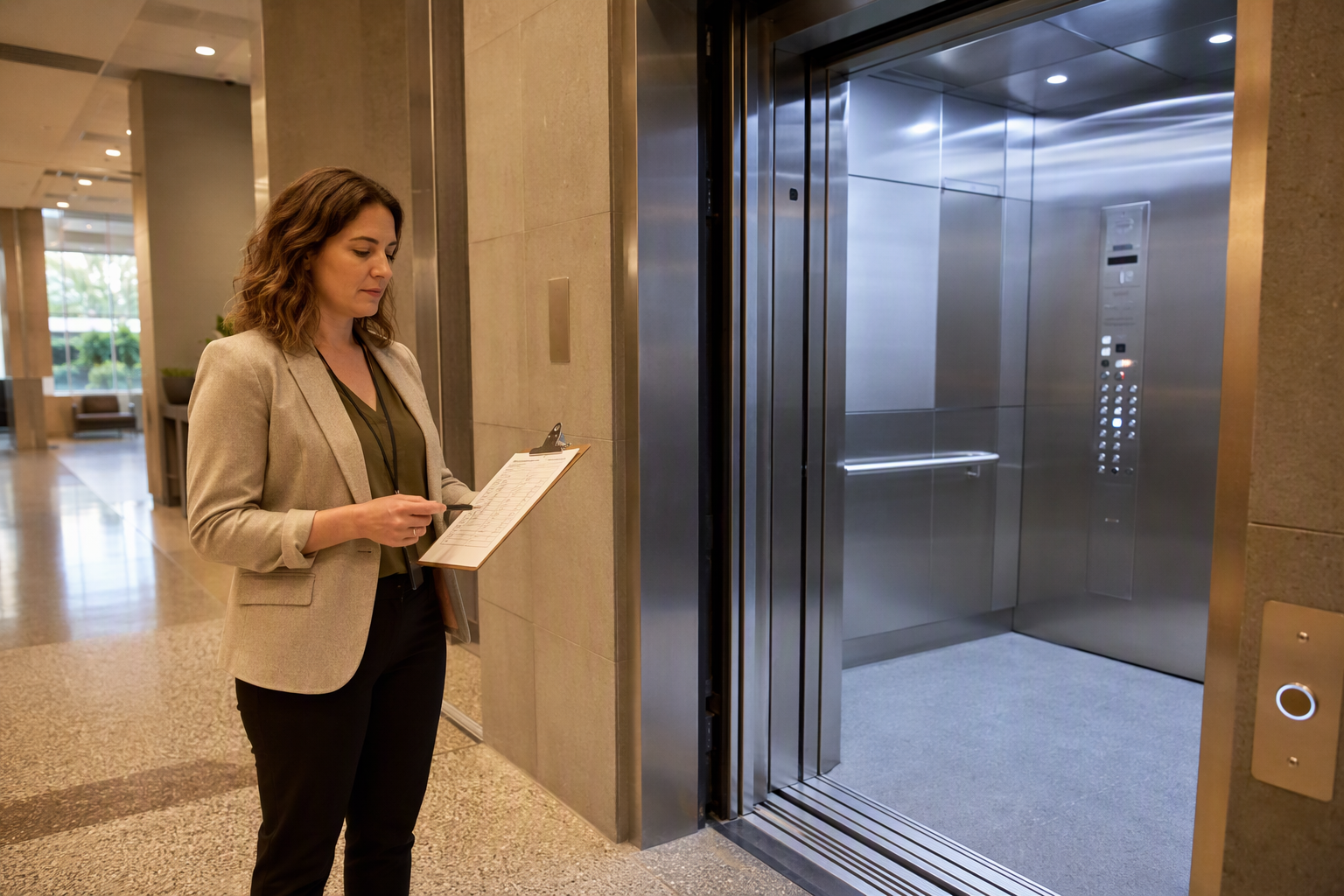
- Commission an accessibility audit. A qualified professional surveys the existing elevator — car dimensions, door timing, control heights, signage, leveling tolerance, and emergency communication — and documents every point of deviation from current ADA Standards.
- Prioritize barriers. The ADA’s readily achievable standard requires removing barriers in a priority order: first, ensuring a person with a disability can reach the elevator; second, ensuring the person can use the elevator controls; third, addressing signage and communication features.
- Notify the ICA Elevator Division. In Arizona, any alteration to a conveyance requires notifying the Industrial Commission of Arizona at least 90 days before work begins.
- Engage a licensed Arizona elevator contractor. Work must be performed by a contractor holding the appropriate Arizona Registrar of Contractors license — R-12 or C-12 — which covers installation and repair of elevators, dumbwaiters, escalators, and moving walks.
- Complete modifications to meet ASME A17.1-2019. All physical changes must conform to the ASME code edition adopted by Arizona, ensuring the safety system is upgraded in parallel with accessibility improvements.
- Schedule an inspection. After any modification or alteration, Arizona law requires a new inspection before the conveyance returns to service. The owner arranges this through the ICA Elevator Division or an authorized private inspector.
- Post the new certificate. Once the certificate of inspection is issued, the owner must post or keep it as required by Arizona law before resuming operation.
What Signage Does ADA Elevator Code Require?
ADA elevator signage requirements are detailed and easy to overlook during a renovation. Key requirements include:
- Raised and Braille characters identifying the floor must appear on both jambs of each car entrance, centered at a height that allows a person in a wheelchair to read by touch.
- The main lobby level must be indicated by a star (asterisk) tactile symbol next to the floor designation on the jamb.
- Hall call buttons must be located on an accessible surface and positioned within the maximum reach ranges established by the ADA Standards.
- Floor buttons inside the car must be arranged so that higher floor numbers are generally above lower ones, and each button must have a raised or Braille designation.
- Emergency controls — including the stop, alarm, and door open/close buttons — must be grouped at the bottom of the control panel, below the floor buttons, so that they remain within reach of a wheelchair user.
What Are Common ADA Elevator Violations Found During Inspections?
Accessibility audits of existing elevator installations frequently identify recurring deficiencies. While the specific frequency of each violation type varies by facility age and prior renovation history, the following issues are among the most commonly documented:
- Door-hold timing set too short, causing doors to begin closing before a person with a mobility device can fully board
- Reopening devices that respond only to a single obstruction zone rather than both high and low zones
- Call buttons mounted above the maximum allowable reach height, particularly in lobbies retrofitted after original construction
- Missing or damaged Braille floor designations on car entrance jambs
- Emergency intercoms that require voice communication without a text or visual alternative
- Car leveling beyond the ½-inch tolerance, creating a lip at the threshold
- Audible floor announcements that are absent or inaudible due to speaker degradation
What Is the Relationship Between ADA, Section 504, and Fair Housing Elevator Requirements?
The ADA is not the only federal law that can compel elevator accessibility. Buildings that receive federal financial assistance — including many hospitals, universities, and housing developments — are also subject to Section 504 of the Rehabilitation Act of 1973, which has requirements that parallel the ADA. Residential buildings with four or more units built for first occupancy after March 13, 1991 must comply with the Fair Housing Act’s design and construction requirements, which include accessible routes and usable elevators where applicable. While the substantive accessibility requirements under these statutes largely align with the ADA Standards, the enforcement mechanisms, covered entities, and specific technical requirements can differ. Building owners should evaluate which statutes apply to their specific facility type and funding source.
What Are the 2025–2026 Trends in ADA Elevator Compliance?
Several trends are shaping how building owners and elevator contractors approach ADA compliance heading into 2026:
Increased enforcement activity: Advocates and enforcement agencies have intensified scrutiny of elevator accessibility in transit stations, healthcare facilities, and multifamily housing. Litigation under Title III of the ADA continues to target elevator deficiencies as barrier-removal obligations that are clearly readily achievable for larger property owners.
Modernization as a compliance trigger: As building owners upgrade aging cab interiors, control systems, and drive units to extend equipment life, those modernizations frequently constitute “alterations” under the ADA and ASME A17.1-2019, triggering full accessibility compliance for the altered element. Planning modernization projects with ADA compliance built into the scope from the outset avoids costly retrofits after the fact.
Emergency communication upgrades: The shift to IP-based monitoring and emergency communication systems has raised questions about what constitutes a compliant two-way system under the ADA. Industry guidance continues to evolve, and owners replacing older phone-based intercoms are evaluating whether new systems satisfy both the ADA’s communication requirements and ASME A17.1-2019’s provisions for emergency signaling.
Integration with smart building systems: Destination-dispatch and touchless elevator systems are becoming more common in commercial renovations. These systems must be configured to remain operable by people with visual, motor, and cognitive disabilities, which requires careful evaluation against ADA control-reach and usability requirements during design and commissioning.
Arizona Elevator Solutions monitors these trends and applies current ADA Standards and ASME A17.1-2019 requirements to every assessment it conducts for Arizona building owners.
How Much Does ADA Elevator Compliance Work Typically Cost?
The cost of bringing an elevator into ADA compliance varies substantially based on what deficiencies exist and how the equipment was originally installed. Minor corrective work — adjusting door-hold timing, replacing a call button panel, or adding Braille jamb signage — is typically far less expensive than structural work such as enlarging a car or relocating a shaft entrance. When ADA compliance work coincides with a broader modernization project, costs can often be distributed across the project budget rather than treated as a standalone expense.
Arizona Elevator Solutions conducts facility assessments to identify the scope of required work before owners commit to a project budget, helping to distinguish between low-cost adjustments and capital-level improvements.
What Is the Difference Between ADA Compliance and ADA Certification?
The ADA does not establish a formal “certification” program for elevators in the way that some product safety standards do. An elevator that meets the ADA Standards for Accessible Design is considered compliant — there is no government-issued ADA compliance certificate for the equipment itself. Some states have sought certification from the Department of Justice that their state accessibility codes meet or exceed the ADA Standards (a process known as “certification of equivalency”), but that certification applies to the state code, not to individual installations.
In Arizona, the annual certificate of inspection issued by the ICA Elevator Division confirms that the conveyance met the safety requirements of ASME A17.1-2019 at the time of inspection. It does not constitute a finding that the elevator satisfies ADA accessibility requirements — those two bodies of law are enforced by different authorities and through different mechanisms.
What Steps Should Arizona Building Owners Take to Maintain Ongoing ADA Elevator Compliance?
- Schedule annual inspections as required by Arizona law through the ICA Elevator Division or an authorized private inspector, and use the inspection as an opportunity to document the condition of ADA-specific components.
- Implement a preventive maintenance program that specifically includes door-timing tests, leveling checks, call-button illumination tests, audible-signal testing, and emergency-communication verification at regular intervals.
- Review ADA requirements before any alteration. Consult with a qualified elevator contractor holding an Arizona R-12 or C-12 license and an accessibility specialist before beginning any cab, door, control, or drive modernization work.
- Notify the ICA Elevator Division at least 90 days before installing, relocating, or altering a conveyance, as required under Arizona law.
- Keep records. Maintain documentation of accessibility audits, completed modifications, inspection certificates, and maintenance logs — these records support a defense in the event of an ADA complaint or litigation.
Where Can Arizona Building Owners Find Authoritative ADA Elevator Guidance?
The primary sources of authoritative guidance for Arizona building owners are:
- ADA.gov — the official federal ADA information portal, including the ADA Standards for Accessible Design and technical assistance materials
- ASME Codes and Standards — the source for ASME A17.1-2019 and ASME A18.1-2020, the codes adopted by Arizona
- Arizona Revised Statutes §§ 23-491 through 23-491.16 — Arizona’s conveyance safety statute, as amended by Laws 2026, Ch. 73, administered by the Industrial Commission of Arizona, Elevator Division
- The City of Phoenix Elevator Section (Planning and Development Department) — for equipment located within the City of Phoenix
Arizona Elevator Solutions coordinates with these agencies and applies their current requirements when assessing, modernizing, or maintaining conveyances for Arizona clients.
Contact Arizona Elevator Solutions for a free elevator assessment at 480-557-7600.
Need elevator service you can rely on? Arizona Elevator Solutions is ready to help.