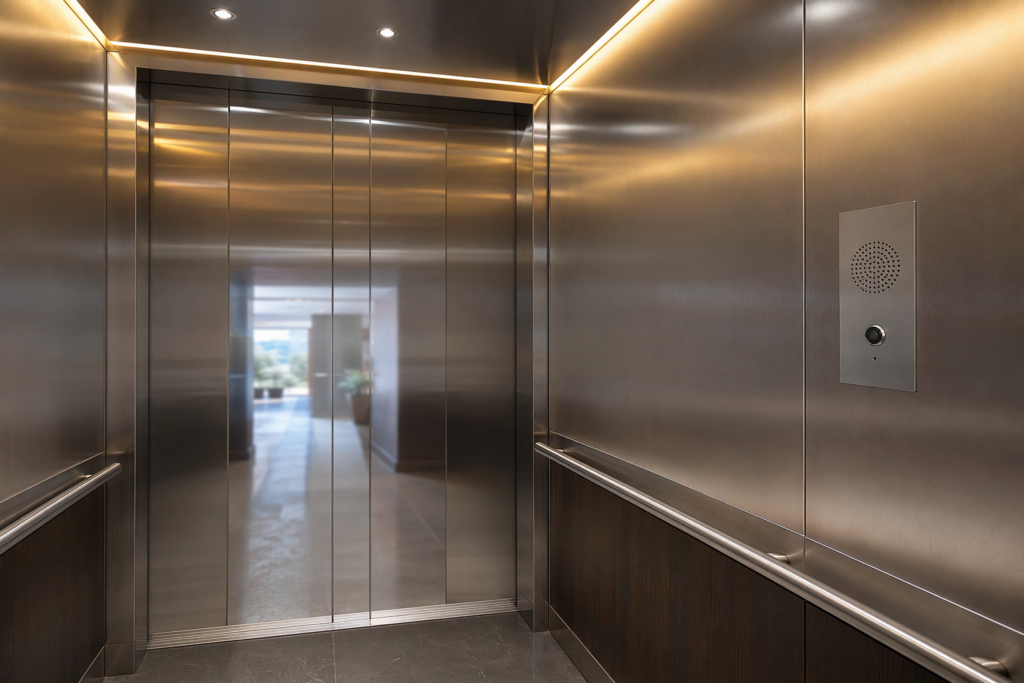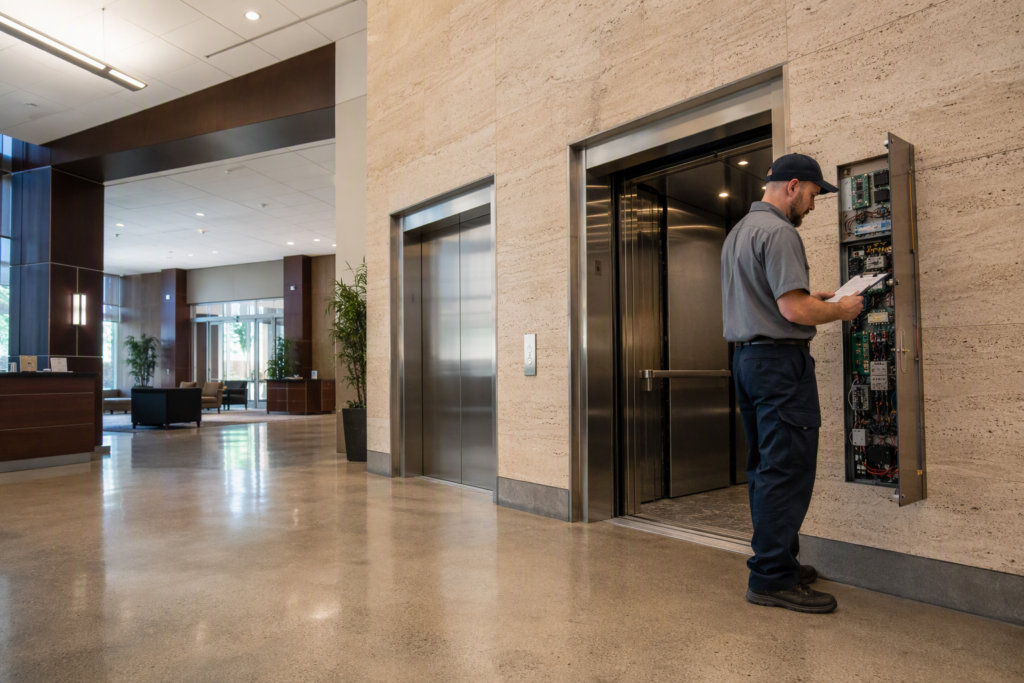
Yes, Arizona Elevator Solutions provides call box monitoring for elevator emergencies. Monitored two-way emergency communication systems connect trapped passengers directly to a live operator around the clock, satisfying the requirements of the ASME A17.1 Safety Code for Elevators and Escalators and ADA guidelines for accessible emergency communication.
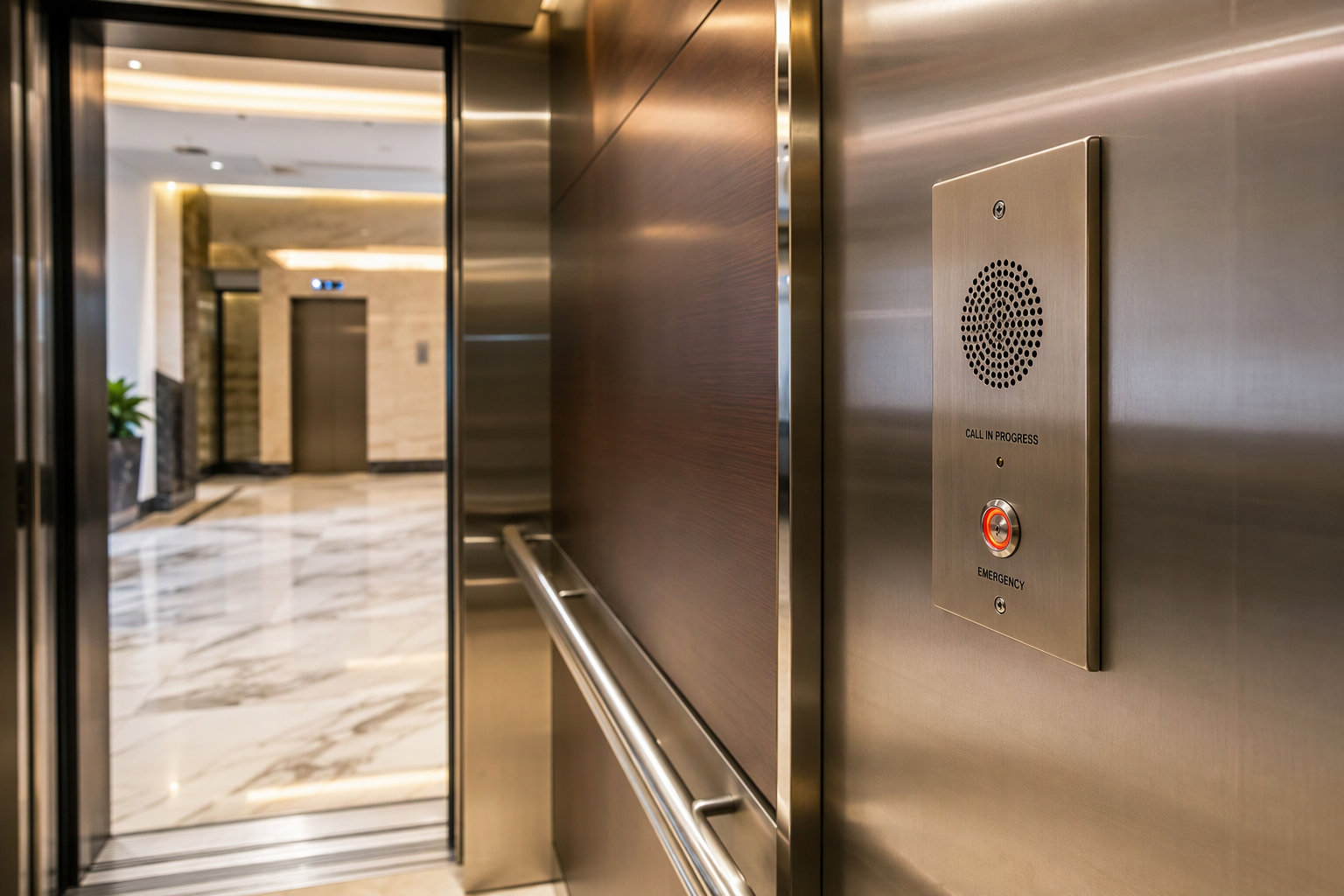
Call Box Monitoring for Elevator Emergencies: Complete FAQ for Arizona Building Owners
What is elevator call box monitoring and how does it work?
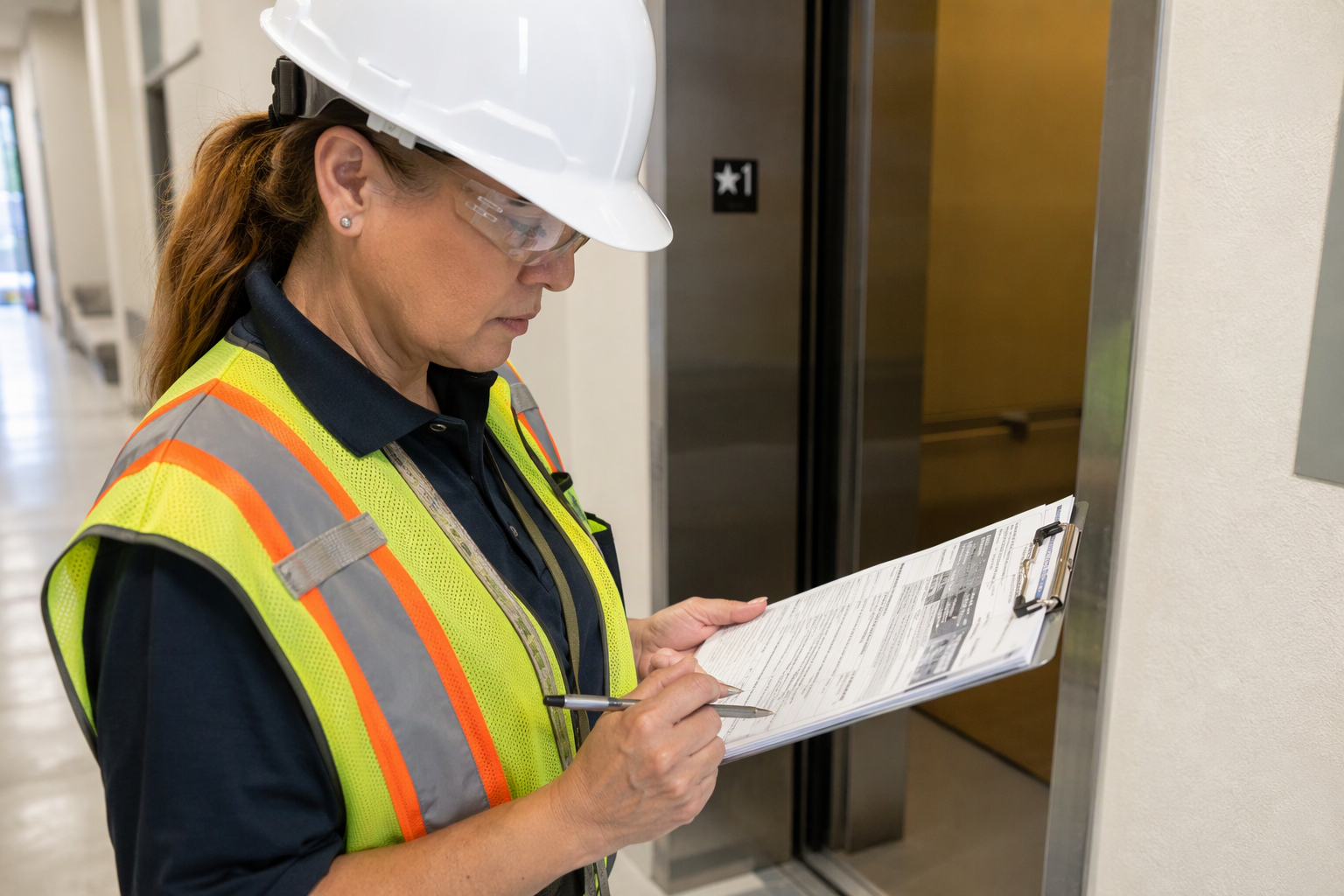
Elevator call box monitoring is a 24/7 two-way voice communication service that connects a passenger who activates the in-car emergency telephone directly to a trained live operator capable of dispatching emergency assistance.
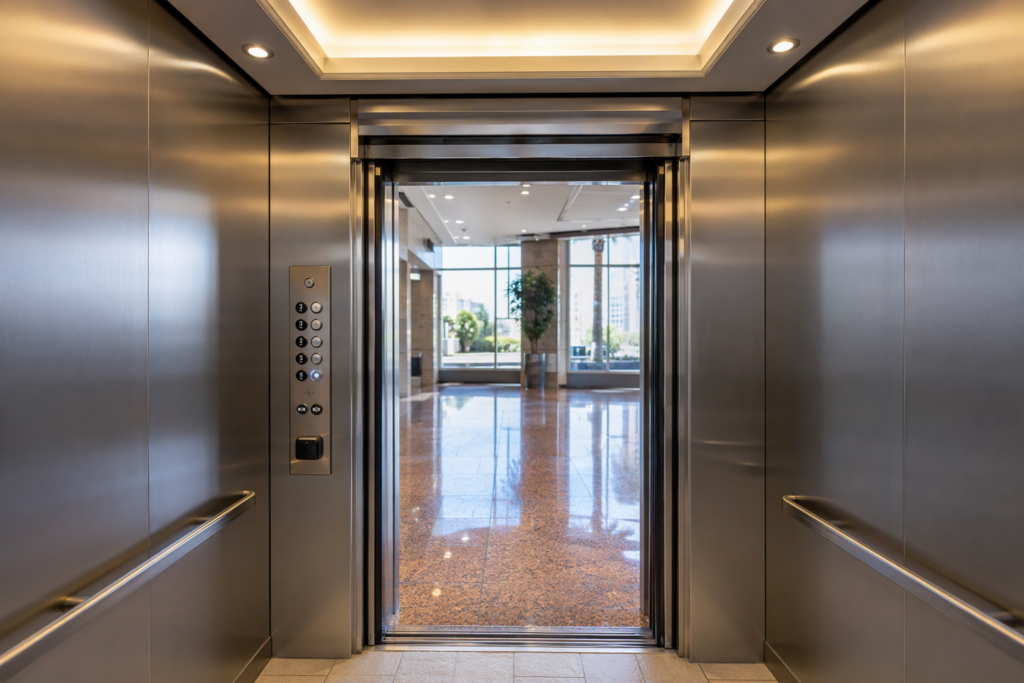
When a passenger presses the emergency call button inside an elevator cab, the call box dials out through a dedicated telephone line or cellular/VoIP connection to a central monitoring station. A live operator answers, identifies the building location and cab number, assesses the nature of the emergency, and dispatches the appropriate responders — whether that is the local fire department, elevator technicians, or emergency medical services. The operator stays on the line with the trapped passenger until help arrives, providing reassurance and status updates.
Modern monitoring platforms log every call with a time-stamp, duration, and incident type, creating an auditable record that building owners can present during inspections or liability reviews.
Is two-way emergency communication legally required in Arizona elevators?
Yes. The ASME A17.1 Safety Code for Elevators and Escalators mandates a two-way means of communication in every elevator car, and Arizona has adopted the ASME A17.1-2019 edition as its governing code for equipment installed, repaired, or altered on or after January 1, 2023.
Arizona’s elevator safety requirements are established under A.R.S. §§ 23-491 through 23-491.16 and administered by the Industrial Commission of Arizona (ICA), Elevator Division — formerly known as the ADOSH Elevator Safety Section until September 12, 2026. The companion administrative rules appear in Arizona Administrative Code R20-5-502 through R20-5-515. Taken together, these statutes, rules, and the adopted ASME A17.1-2019 standard create a binding obligation for building owners to maintain functional emergency communication in every elevator car.
Within the City of Phoenix, the City of Phoenix Elevator Section (Planning and Development Department) inspects elevators and verifies emergency communication compliance at the local level, while the ICA Elevator Division covers equipment elsewhere in Arizona.
What does the ADA require for elevator emergency communication?
The Americans with Disabilities Act requires elevator emergency communication systems to be usable by people who are deaf or hard of hearing, meaning the system cannot rely on voice alone.
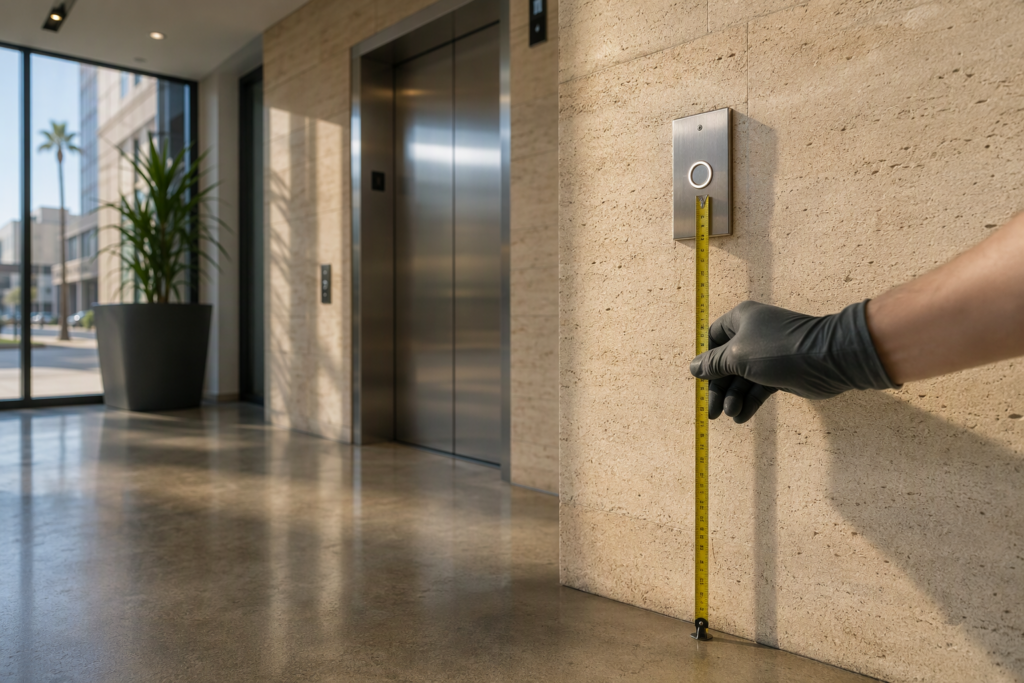
ADA accessibility guidelines specify that emergency two-way communication systems must include both a visual and an audible signal to acknowledge that a call has been placed. The activation button must be identified with the International Symbol of Accessibility when it serves as the primary communication method for people with hearing or speech disabilities. For buildings that serve members of the public, the ADA’s requirements layer on top of — not in place of — the ASME A17.1 technical requirements, so building owners must satisfy both frameworks simultaneously.
Call box monitoring providers that serve Arizona properties should be able to confirm whether their monitoring platform supports TTY/TDD or IP-based text relay for deaf users, a point Arizona Elevator Solutions can help building owners evaluate during an elevator assessment.
What components make up a compliant elevator call box system?
A code-compliant elevator call box system consists of an in-car two-way communication device, a reliable transmission pathway, and a staffed monitoring endpoint capable of dispatching emergency response.
The key hardware and service components include:
- In-car call button and speaker/microphone: Mounted on the car operating panel, clearly labeled, and tested for audibility in ambient noise conditions.
- Transmission pathway: May be a dedicated POTS (plain old telephone service) line, a cellular dialer, or a VoIP connection with battery backup to maintain function during a power outage.
- Battery backup: ASME A17.1-2019 requires that lighting and emergency communication remain operational for a minimum period after a power failure — backup power for the call box is not optional.
- Visual and audible acknowledgment signals: Confirm to the passenger that the call has connected, satisfying the ADA’s accessibility requirement.
- Central monitoring station: Staffed around the clock with operators trained to handle medical, entrapment, fire, and general emergency scenarios.
- Incident logging system: Records call metadata for compliance documentation and liability protection.
How is call box monitoring different from a standard landline in the elevator?
A standard landline dials a fixed number — often a building management desk that is unstaffed after hours — while monitored call box service connects the passenger to a live, trained operator 24 hours a day, every day of the year.
Many older Arizona buildings were originally wired with elevator telephones that ring to a lobby desk, security station, or property management office. Those endpoints are rarely staffed overnight, on weekends, or on holidays — precisely when entrapments are most likely to go unresolved for extended periods. Monitored call box service replaces or supplements that endpoint with a professional dispatch center, ensuring every activation reaches a human being regardless of time or day. The monitoring provider also maintains the communication link, troubleshoots outages, and delivers the incident reports that building owners need for annual inspections.
What Arizona inspection requirements apply to elevator call boxes?
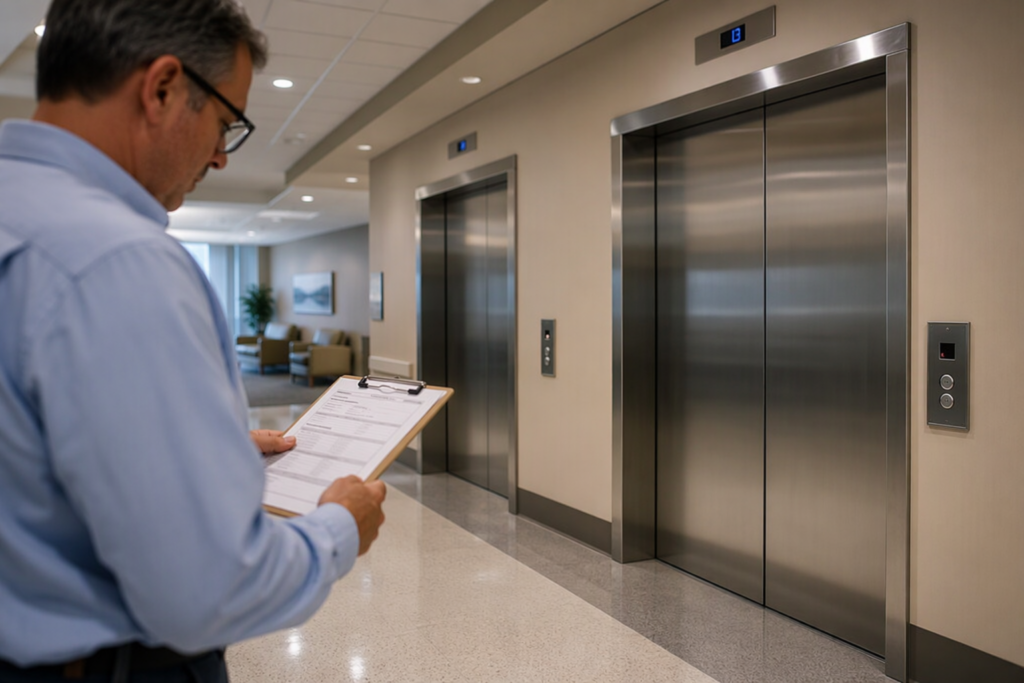
Under Arizona law, every conveyance must be inspected before it first enters service, after any modification or alteration, and annually thereafter, with no elevator permitted to operate without a valid annual certificate of inspection.
During a standard annual inspection conducted under Arizona Administrative Code R20-5-502 through R20-5-515, the inspector tests the two-way emergency communication system to confirm it activates properly, connects to a live answer point, and meets the audibility and acknowledgment requirements of ASME A17.1-2019. A non-functional or unmonitored call box is a deficiency that can result in the elevator being taken out of service until the condition is corrected.
Arizona owners may hire a private elevator inspector authorized by the ICA, provided that inspector registers with the commission annually, demonstrates at least eight hours of approved continuing education, and has no ownership or employment conflict with the equipment being inspected. Using a private inspector does not relieve the owner of any legal obligation under Arizona law.
The certificate of inspection must be kept at the location of the conveyance and made available on request; the state serial number or certificate must also be posted in or near the cab in an accessible location.
What happens if an elevator call box fails during an inspection?
A failed or non-functional emergency communication device is an inspection deficiency that can result in a stop-use order, preventing the elevator from operating until the system is repaired and re-inspected.
Arizona owners must notify the ICA Elevator Division within 24 hours of any accident that injures a person or disables a conveyance. While a call box failure alone may not constitute a “disabling” event in every scenario, inspectors have authority to flag deficiencies that present a risk to life, health, or property. Building owners who discover a call box failure between scheduled inspections should arrange for prompt repair and document the corrective action, both to protect occupants and to demonstrate due diligence. Arizona Elevator Solutions provides call box inspection, repair, and replacement services across Phoenix, Tucson, Scottsdale, and Mesa to help owners resolve deficiencies before they become enforcement actions.
What should a building owner do immediately after an elevator entrapment is reported?
Building owners and property managers should follow a clear sequence of steps when an elevator entrapment is reported to minimize passenger distress and ensure regulatory compliance.
- Confirm communication with the trapped passenger — Verify through the building’s monitoring station or by speaking through the cab intercom that the passenger is conscious and not in immediate medical distress.
- Contact emergency services if medical attention is needed — If the passenger reports a medical emergency, call 911 immediately without waiting for the elevator technician.
- Contact your elevator service provider — Dispatch a qualified elevator technician to perform a safe, code-compliant rescue. Untrained building staff should never attempt to manually open doors or move a car.
- Keep communication open — Maintain contact with the passenger through the monitoring station or intercom, providing updates on estimated rescue time.
- Document the incident — Record the time the entrapment was reported, the time communication was established, the time the technician arrived, and the time the passenger was freed.
- Notify the ICA Elevator Division within 24 hours — If the entrapment involved injury or the conveyance was disabled, Arizona law requires notification to the state within 24 hours under A.R.S. §§ 23-491 through 23-491.16.
- Arrange a post-incident inspection — Have a qualified technician inspect the elevator before returning it to service, and document any corrective maintenance performed.
What transmission technologies are used for modern elevator call boxes?
Modern elevator call boxes use cellular dialers, VoIP connections, or dedicated POTS lines as transmission pathways, with cellular and VoIP increasingly favored as copper telephone infrastructure is retired across Arizona.
The widespread retirement of traditional copper phone lines by carriers has made cellular-based elevator dialers the dominant technology in new installations and retrofits across the Phoenix, Scottsdale, Tucson, and Mesa markets. Cellular dialers connect through 4G LTE or 5G networks, providing reliable coverage in urban and suburban Arizona locations. VoIP dialers use the building’s internet connection with a battery backup, while some installations combine cellular and VoIP for redundancy. Building owners with elevators still connected to aging POTS lines should consult a qualified elevator service provider about transitioning to a supported transmission technology before carrier sunset dates cause an unplanned communication failure.
How often should elevator call boxes be tested?
ASME A17.1-2019 requires periodic testing of elevator emergency communication systems, and building owners should also implement a routine self-test program between formal inspections to catch failures early.
At a minimum, call box function should be verified during each annual state inspection. However, relying solely on annual inspections means a failure could go undetected for up to twelve months — an unacceptable gap for passenger safety. Best practice is a documented monthly activation test in which building staff press the emergency button, confirm the monitoring station answers, and log the result. Many monitoring providers include automated line-supervision signals that alert the monitoring center if the call box goes offline, adding a layer of continuous verification between manual tests.
What are the differences between monitored call box service tiers?
Monitored call box service providers typically offer tiered plans that differ in staffing model, response protocol depth, incident reporting detail, and ancillary services such as automated line supervision and maintenance alerts.
| Feature | Basic Monitoring | Standard Monitoring | Full-Service Monitoring |
|---|---|---|---|
| Live operator answer 24/7 | Yes | Yes | Yes |
| Emergency dispatch (fire, EMS, police) | Yes | Yes | Yes |
| Elevator technician dispatch | No | Yes | Yes |
| Automated line supervision / outage alert | No | Varies | Yes |
| Detailed incident reports for compliance | Basic log | Standard report | Full audit-ready report |
| Multi-cab identification | Varies | Yes | Yes |
| ADA-compatible visual acknowledgment support | Varies | Yes | Yes |
| Cellular dialer retrofit included | No | No | Typically available |
Building owners should confirm that any monitoring tier they select satisfies both the ASME A17.1-2019 requirements adopted by Arizona and the ADA’s accessibility obligations before signing a service agreement.
Does elevator call box monitoring satisfy OSHA requirements for worker safety?
Monitored emergency communication supports compliance with OSHA general duty obligations by ensuring workers who use or service elevators have access to emergency assistance, though OSHA does not prescribe a specific call box standard independent of the adopted elevator code.
Under the OSHA General Duty Clause, employers must provide a workplace free from recognized hazards that are causing or likely to cause death or serious physical harm. For facilities where workers routinely use elevators — warehouses, hospitals, office towers, manufacturing plants — a non-functional emergency communication system is a recognizable hazard. Maintaining monitored call box service and documenting regular testing demonstrates that the employer has taken feasible steps to address that hazard. Elevator technicians performing maintenance inside elevator shafts and machine rooms also benefit from functional communication systems as part of a broader confined-space and lockout/tagout safety program.
What is the role of the Arizona Firefighters Service (AZFS) key in elevator emergencies?
Arizona conveyances equipped with firefighters’ emergency operation must use the Arizona Firefighters Service (AZFS) key, which allows firefighters to take manual control of the elevator during a fire or other emergency.
The AZFS key requirement is specific to Arizona and ensures that every fire department in the state uses a standardized key to operate elevator firefighters’ service, eliminating the confusion that arises when different buildings use different key types. Call box monitoring complements firefighters’ emergency operation: while the AZFS key enables the fire department to control the elevator’s movement, the monitored call box keeps communication open with any passengers still in the building during an emergency. Building owners and property managers in Phoenix, Tucson, Scottsdale, and Mesa should verify that their elevators are equipped with the AZFS key switch and that it is tested during annual inspections.
How does call box monitoring integrate with a building’s overall emergency response plan?
Call box monitoring functions as a critical communication node within a building’s emergency response plan, connecting isolated elevator passengers to both the monitoring station and, through that station, to on-site emergency personnel and first responders.
Effective integration requires that the monitoring station have current building contact information, including the names and phone numbers of property managers, on-call maintenance staff, and any contracted elevator service provider. The monitoring station should also know the building’s physical address, cab numbering convention, and any access restrictions that could affect emergency responders. Building owners should review and update this profile with their monitoring provider at least annually — changes in management, security protocols, or elevator configurations can render outdated profiles useless during an actual emergency.
Who is responsible for maintaining the elevator call box — the building owner or the elevator company?
Under Arizona law, the building owner or operator bears ultimate legal responsibility for maintaining the elevator and all its safety systems, including the call box, though maintenance agreements with a licensed elevator contractor typically assign day-to-day maintenance duties to the contractor.
A.R.S. §§ 23-491 through 23-491.16 place responsibility for safe operation squarely on the owner. When a building owner contracts with a licensed elevator maintenance company — one holding the appropriate R-12 or C-12 license classification issued by the Arizona Registrar of Contractors — the contractor takes on operational responsibility for maintaining the elevator to code standards, but this does not transfer the owner’s legal obligations under Arizona statute. Building owners should ensure their maintenance agreements explicitly include call box inspection, testing, and repair, and that the contractor’s scope covers cellular dialer maintenance if applicable.
What should Arizona building owners look for when selecting a call box monitoring provider?
Building owners should evaluate a monitoring provider on operator training standards, geographic redundancy of monitoring centers, incident reporting quality, ADA compatibility, and the provider’s ability to coordinate with local Arizona emergency services.
Key evaluation criteria include:
- Live staffing model: Confirm that the monitoring center is staffed with live operators at all hours, not an auto-attendant or voicemail fallback.
- Arizona-specific dispatch familiarity: Operators should know how to reach Phoenix, Tucson, Scottsdale, and Mesa emergency dispatch centers quickly and accurately.
- Incident documentation: Reports should be detailed enough to satisfy ICA Elevator Division inspection documentation requirements.
- ADA-compatible features: Verify visual acknowledgment signals and TTY/text relay support.
- Line supervision: Automated monitoring of the call box connection catches outages without waiting for the next manual test.
- Integration with elevator service provider: A monitoring provider that works directly with the building’s elevator maintenance company streamlines technician dispatch and reduces response delays.
Arizona Elevator Solutions works with building owners in Phoenix, Tucson, Scottsdale, and Mesa to evaluate existing call box systems, identify compliance gaps, and recommend or install monitoring solutions tailored to each property’s configuration.
Can an older elevator that predates ASME A17.1-2019 be required to upgrade its call box?
Lawfully installed older conveyances in Arizona may remain in service unless the ICA Elevator Division determines the equipment poses a hazard to life, health, or property, though alterations or repairs that trigger a code review can require modernization of communication systems.
Arizona’s adoption of ASME A17.1-2019 applies to equipment installed, repaired, or altered on or after January 1, 2023. For pre-existing equipment, the general principle is that lawfully installed older conveyances may remain in use under the code edition in effect at the time of their installation, with exceptions for safety hazards. However, any significant repair or alteration — such as replacing the controller, modernizing the cab, or upgrading the door operator — can trigger a requirement to bring associated systems, including emergency communication, into conformance with the current adopted code. Building owners should discuss planned modernization scopes with a qualified elevator contractor before beginning work to understand which code editions apply to each component.
What records should building owners keep related to elevator call box monitoring?
Building owners should retain the annual certificate of inspection, monthly call box test logs, monitoring service agreements, incident reports from the monitoring station, and records of any call box repairs or replacements.
Arizona law requires that the certificate of inspection be kept at the location of the conveyance and made available on request. While the statute specifically addresses the inspection certificate, prudent owners maintain a broader elevator file that includes all maintenance and monitoring records. These records serve multiple purposes: demonstrating compliance during ICA Elevator Division audits, supporting insurance claims, defending against premises liability claims, and providing a maintenance history that informs future repair decisions. Monitoring providers that deliver structured incident reports in a consistent, audit-ready format make record-keeping substantially easier for multi-elevator properties.
How does call box monitoring protect building owners from liability?
Documented, operational call box monitoring demonstrates that the building owner took affirmative steps to protect passenger safety, which is a material factor in premises liability evaluations following an elevator entrapment or injury.
Courts and insurance adjusters examine whether a property owner met the applicable standard of care when evaluating elevator-related injury claims. A monitored call box that connects passengers to live emergency dispatch, combined with thorough incident logs and regular test documentation, provides concrete evidence that the owner met — and in many cases exceeded — the minimum legal requirements. Conversely, an unmonitored or non-functional call box that leaves a passenger without communication for an extended period is a significant liability exposure. Arizona Elevator Solutions advises building owners across its service territory to treat call box monitoring not only as a code requirement but as a foundational element of their risk management program.
Does Arizona require building owners to notify the state if the call box goes out of service?
Arizona law requires owners to notify the ICA Elevator Division within 24 hours of any accident that injures a person or disables a conveyance, and a prolonged communication system failure may qualify as a condition that disables the elevator’s safe operation.
The 24-hour notification requirement under A.R.S. §§ 23-491 through 23-491.16 is specifically triggered by injury or conveyance disablement, not by component-level deficiencies in isolation. However, a building owner who continues operating an elevator with a known, non-functional emergency communication system risks a finding that the elevator presents a hazard, which could result in a stop-use order. The prudent course when a call box fails is to arrange emergency repair promptly, document the outage and corrective action, and consult with a qualified elevator contractor about whether the specific failure requires state notification. Arizona owners must also notify the state at least 90 days before any alteration that would affect the elevator’s emergency communication configuration.
Contact Arizona Elevator Solutions for a free elevator assessment at 480-557-7600.
Need elevator service you can rely on? Arizona Elevator Solutions is ready to help.