Elevator Entrapment Rescue Procedure: Complete FAQ Guide for Building Owners & Passengers
Elevator entrapments remain a serious operational and life-safety concern for building owners across Arizona. The Consumer Product Safety Commission’s NEISS injury database consistently documents thousands of elevator-related injuries annually in the United States, with passenger entrapments representing a significant share of emergency service calls. Having a properly documented and practiced rescue procedure is not just sound risk management — in Arizona, it is a compliance requirement under both state statutes and the ASME A17.1/CSA B44 Safety Code for Elevators and Escalators (2025 edition).
Whether you manage a high-rise in Phoenix, a medical office in Scottsdale, or a mid-rise apartment complex in Tucson, this guide covers everything you need to know about elevator entrapment rescue — from the first phone call to post-rescue inspection protocols, compliance costs, and how to evaluate service providers.
1. What exactly is an elevator entrapment rescue procedure?
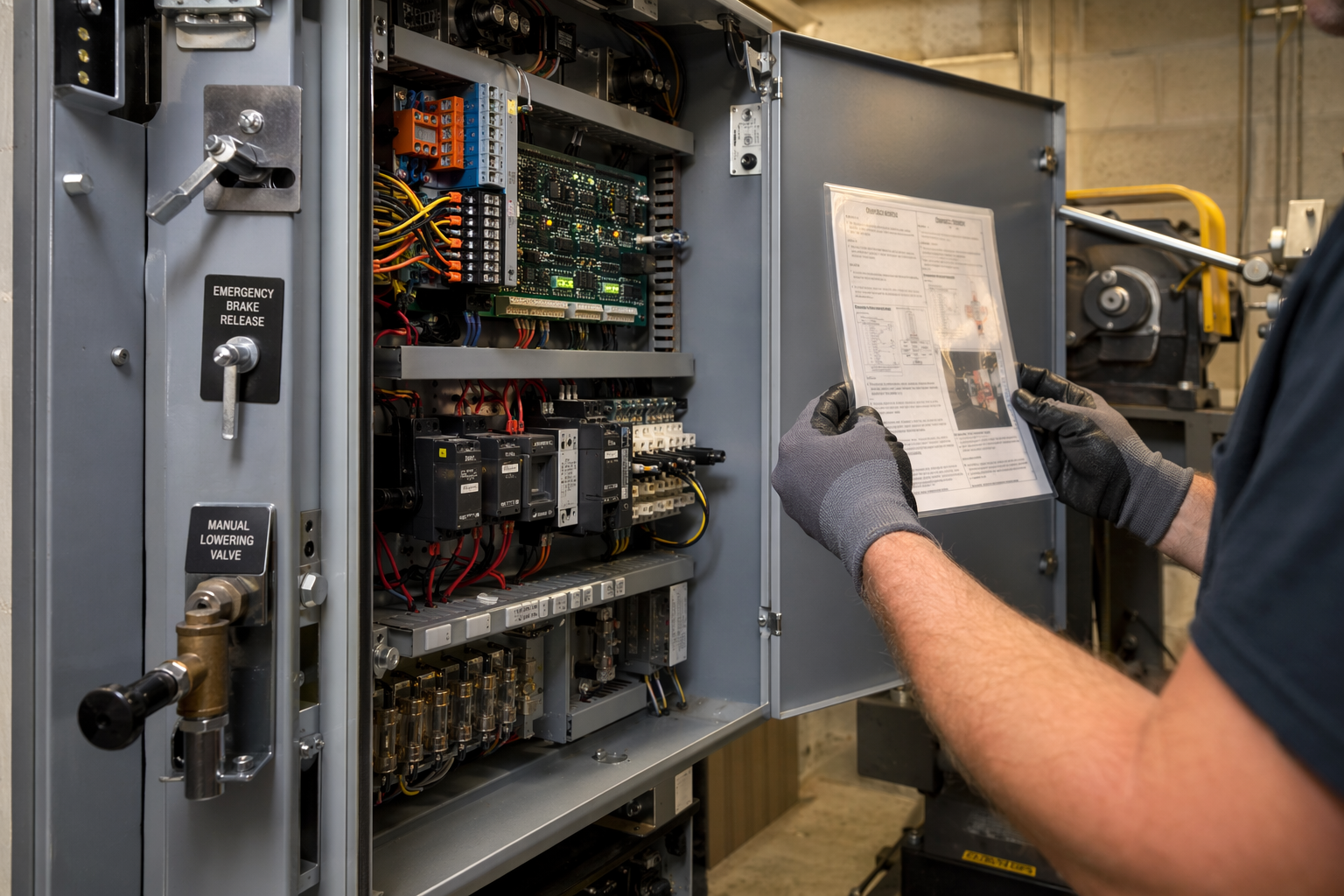
An elevator entrapment rescue procedure is a structured, step-by-step emergency response protocol that trained elevator technicians and fire department personnel follow to safely extract passengers from a stalled elevator cab without causing injury.
The procedure is governed primarily by ASME A17.1, Section 2.27, which mandates specific emergency features on all elevators manufactured or modernized after 2000. A compliant rescue involves at minimum: passenger communication, elevator positioning at a landing, mechanical door release, and assisted egress. In Arizona, the procedure must also comply with Arizona Administrative Code Title 18, Chapter 5, which governs elevator safety standards statewide.
What the procedure is NOT: it is not instructing a trapped passenger to pry open doors, climb out through a hatch, or jump to an adjacent floor level. These DIY attempts are responsible for a disproportionate share of entrapment-related fatalities and serious injuries according to the Arizona Division of Occupational Safety and Health.
2. Who is authorized to perform an elevator entrapment rescue?
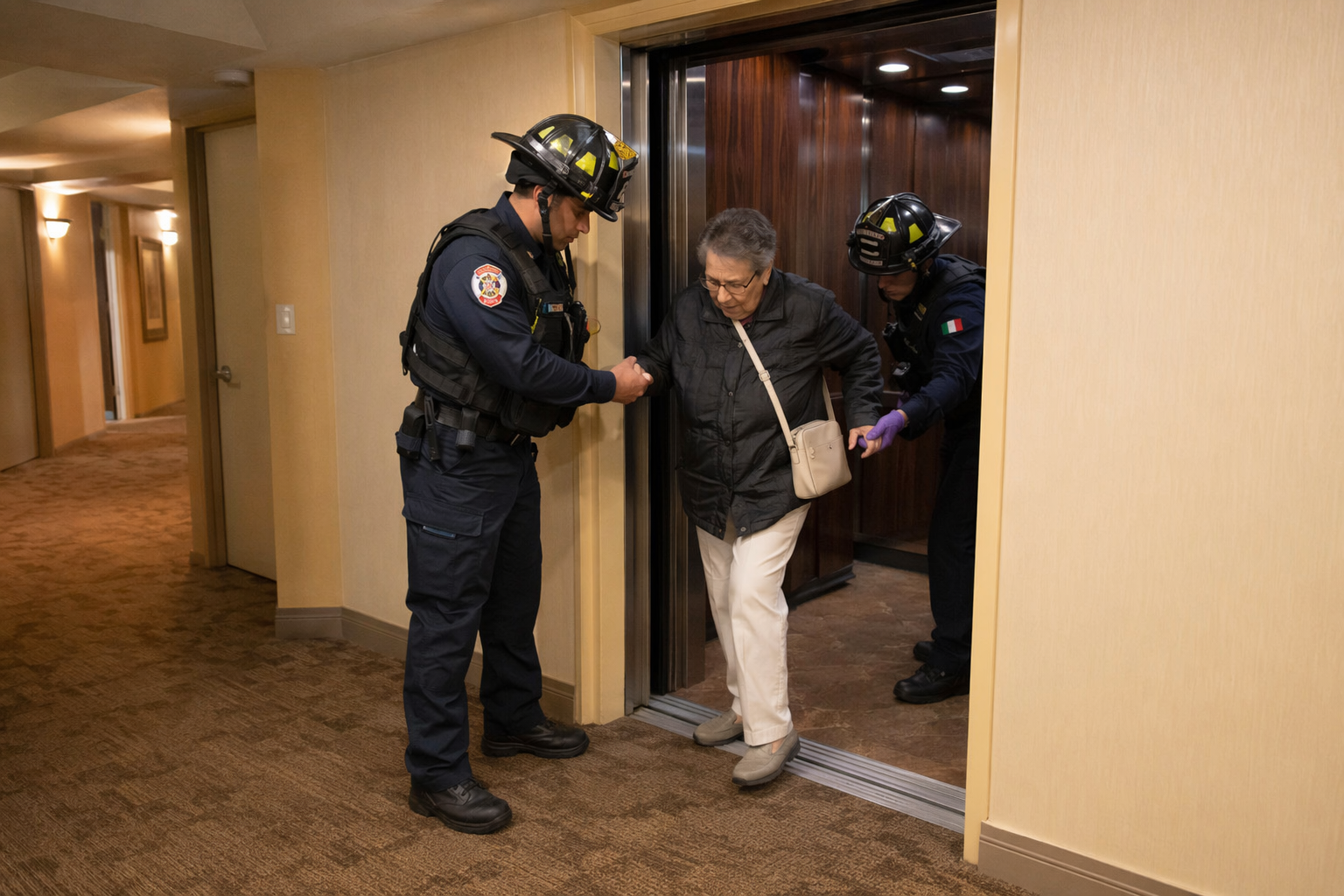
Only trained and certified personnel — specifically licensed elevator mechanics or fire department emergency responders with documented elevator rescue training — are legally authorized to perform an elevator entrapment rescue.
Under ASME A17.1 Rule 8.6, building maintenance staff who have not been specifically trained in elevator emergency procedures are prohibited from attempting mechanical rescue operations. In Arizona, the elevator mechanic must hold a valid certificate issued under Arizona Revised Statutes Title 23, Chapter 5 (the Boiler and Pressure Vessel and Elevator Safety Act).
Many Phoenix, Scottsdale, and Tucson fire departments maintain dedicated elevator rescue teams trained under the NFPA 101 Life Safety Code and coordinated with local elevator contractors. Building owners are strongly encouraged to establish a pre-incident agreement with a licensed elevator service company — such as Arizona Elevator Solutions — so that a certified mechanic can be dispatched immediately when a 911 call is made. This coordination typically reduces total entrapment duration by 20–40 minutes compared to relying solely on first responders unfamiliar with a specific elevator model.
3. What are the step-by-step phases of a compliant entrapment rescue?
A compliant elevator entrapment rescue follows six sequential phases, each with a defined responsible party and a safety checkpoint before proceeding to the next step.
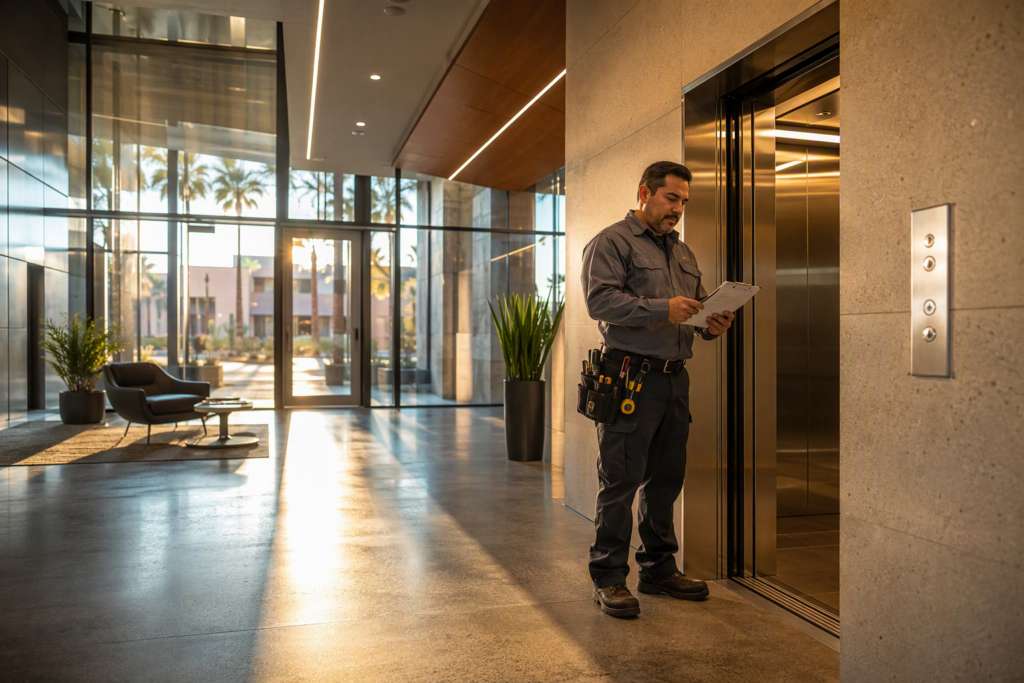
- Passenger communication and assessment. The technician or dispatcher establishes two-way voice contact with trapped passengers via the cab’s ASME-required emergency phone or intercom. Medical status, number of passengers, and cab location are confirmed.
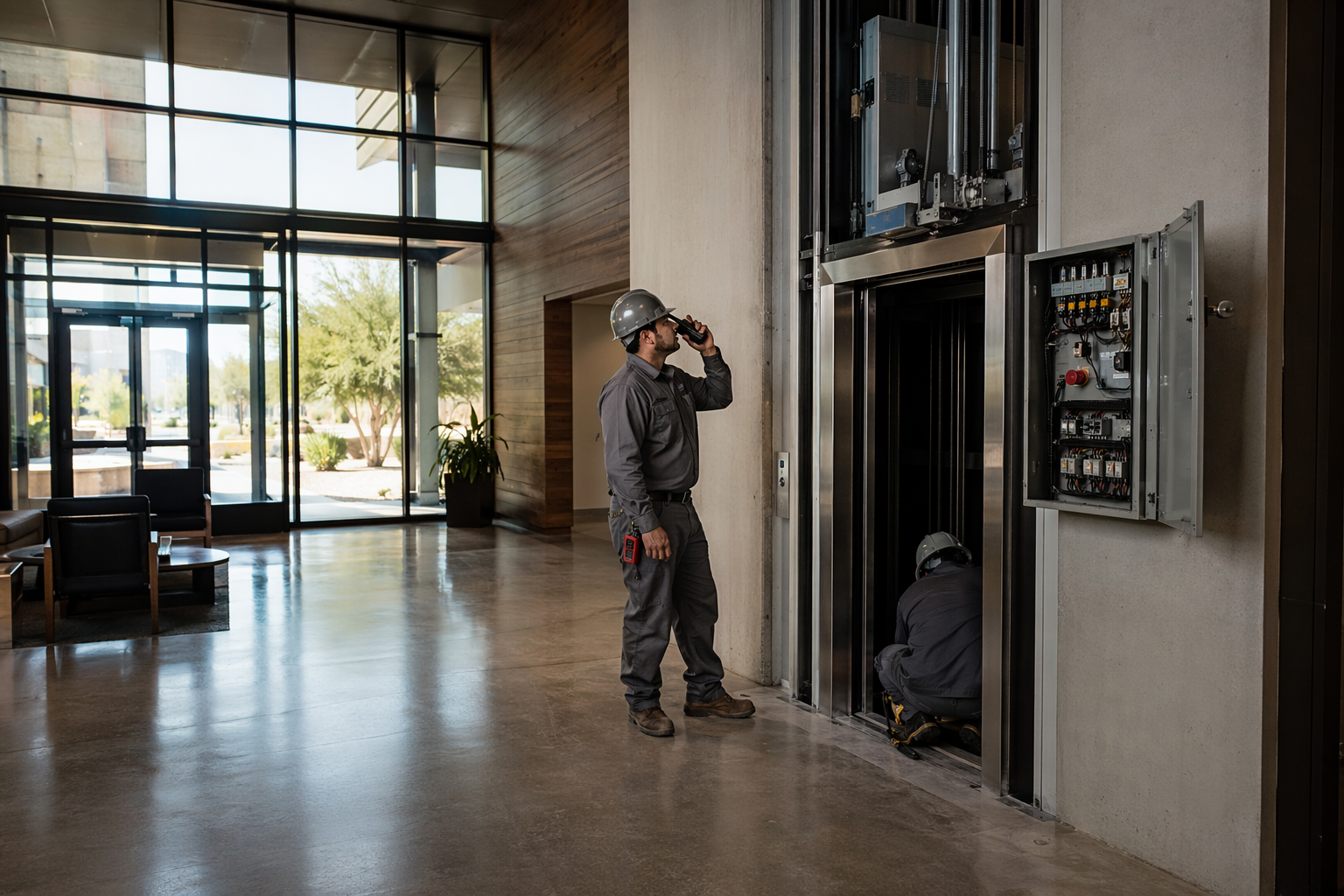
- Power verification and isolation. The responding mechanic verifies whether the elevator is energized or has experienced a complete power failure, then isolates the cab from the main disconnect at the machine room or controller.
- Cab position determination. Using hoistway position indicators, inspection lights, or mechanical position devices, the technician determines the cab’s exact distance from the nearest accessible landing.
- Manual movement or emergency lowering. Depending on the drive type (hydraulic, traction, or MRL), the technician uses the appropriate method: a manual lowering valve on hydraulic units, a brake release handle with counterweight assist on traction units, or an ARD (Automatic Rescue Device) on compliant MRL systems. The cab is moved to within the ASME-allowable threshold of landing level — typically no more than 18 inches differential.
- Mechanical door release and hoistway door opening. The hoistway door is released using the door interlock bypass key (ASME A17.1 Section 2.12.5). Cab doors are manually released only after landing-level alignment is confirmed. No passenger movement occurs until both sets of doors are fully open and stable.
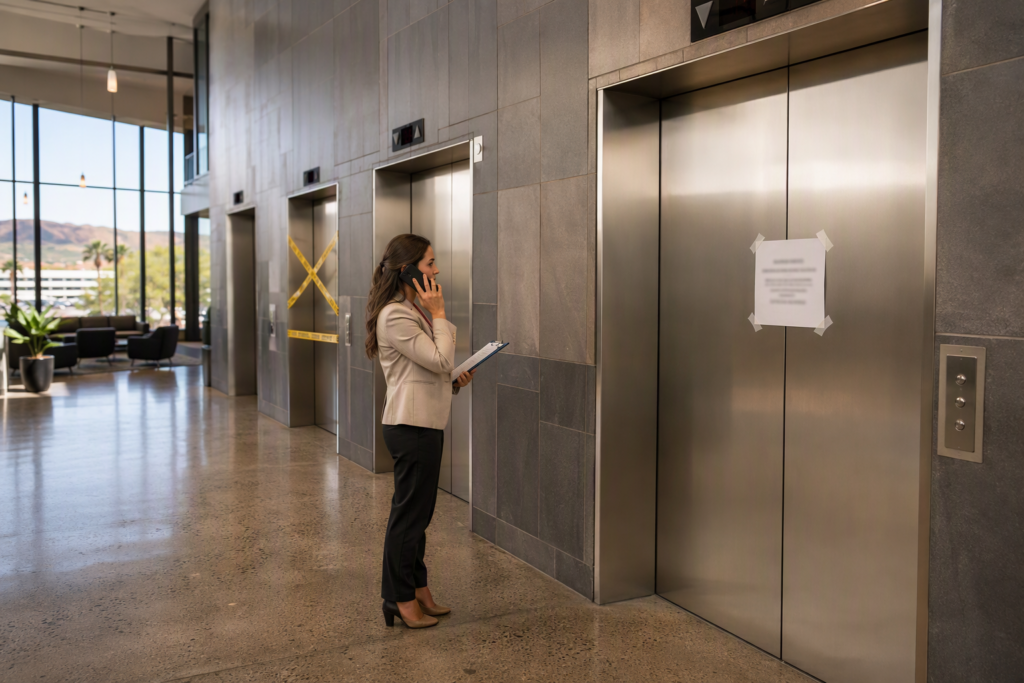
- Assisted egress and post-rescue lockout. Passengers exit with physical assistance if needed. The elevator is immediately placed out of service, tagged, and locked out until a post-entrapment inspection is completed and any fault condition is documented and corrected.
Arizona Elevator Solutions technicians follow a written Emergency Rescue Procedure form on every dispatch, which becomes part of the permanent maintenance record for the unit — a requirement under Arizona Administrative Code R18-5-410.
4. What triggers an elevator entrapment and how can building owners prevent them?
The most common causes of elevator entrapment are power interruptions, drive system faults, door mechanism failures, and deferred maintenance — most of which are preventable with a proactive maintenance program and regular code inspections.
According to the National Elevator Industry Inc. (NEII) safety data, door-related malfunctions account for the largest single category of elevator service disruptions leading to entrapment. In Arizona’s climate, thermal expansion of door tracks, dust infiltration in desert communities, and monsoon-season power surge events create additional entrapment risk factors that are less prevalent in other states.
Preventive measures building owners should implement in 2026:
- Full-maintenance service contracts that include door operator adjustments, not just oil-and-grease agreements
- Annual load testing and governor rope inspections per ASME A17.1 Section 8.6
- ASME-compliant ARD (Automatic Rescue Device) installation on MRL units — now required on all new MRL installations under the 2025 ASME A17.1 edition
- Surge protection on elevator controllers in buildings on Arizona’s distribution grid
- Semi-annual door contact and interlock testing logged in the unit’s maintenance record
5. What does an elevator entrapment rescue service call cost in Arizona?
In Arizona, an emergency elevator entrapment rescue service call typically costs between $350 and $900 for the initial response, with additional charges for parts, post-entrapment inspection, and any required repairs — though buildings with full-maintenance contracts often receive emergency rescue response at no additional labor cost.
Cost variables include:
- Time of day. After-hours, weekend, and holiday emergency dispatch rates in the Phoenix metro area generally carry a premium of 1.5x to 2x standard labor rates. Arizona Elevator Solutions publishes flat-rate emergency dispatch pricing for contract customers to eliminate billing uncertainty.
- Elevator type and drive system. Hydraulic units with a straightforward manual lowering valve require less technician time than MRL traction units with proprietary ARD systems. Complex rescues on older equipment without ASME-compliant emergency features can add 1–2 hours of billable time.
- Post-rescue inspection requirements. Arizona Administrative Code R18-5-410 requires that any elevator involved in an entrapment be inspected and returned to service documentation before passengers can ride again. This inspection is typically billed separately from the rescue call and ranges from $150 to $400 depending on scope.
- Repair costs triggered by the entrapment fault. If the stall was caused by a failed contactor, worn door gibs, or a failing hydraulic pump, repair costs are separate from rescue labor and are quoted after diagnosis.
Building owners with full-maintenance agreements through Arizona Elevator Solutions receive 24/7 emergency rescue response with no after-hours labor surcharge, as rescue dispatch is included in the contract scope. For buildings currently on a basic maintenance plan or without a service agreement, establishing a preferred vendor relationship before an entrapment occurs is strongly recommended — emergency calls to an unknown contractor almost always carry higher rates and longer response times.
6. What are the Arizona compliance requirements for elevator entrapment rescue preparedness?
Arizona law requires building owners to maintain functioning two-way emergency communication, a documented emergency recall and rescue procedure, and a current certificate of inspection — and failure to meet any of these requirements can result in mandatory elevator shutdown and civil penalties.
Key Arizona-specific compliance obligations for 2026:
- Certificate of inspection currency. Under Arizona Administrative Code R18-5-406, all elevators must display a current certificate of inspection issued by the Arizona Occupational Safety and Health Division (ADOSH). Expired certificates indicate the unit has not been verified for emergency feature compliance.
- Two-way emergency communication. ASME A17.1 Section 2.27.1 (adopted by Arizona) requires a code-compliant two-way voice communication system in every elevator cab. Systems must connect to a location staffed 24/7 — an answering machine or unmonitored security desk does not satisfy this requirement.
- Emergency lighting and power. Backup lighting capable of 4 hours of continuous operation is required inside every cab, and emergency power supply systems (EPSs) must return at least one elevator to a landing before shutting down on loss of normal power per ASME A17.1 Section 3.26.
- Posted emergency instructions. Arizona Administrative Code requires that passenger instructions for entrapment — including the emergency phone number — be posted inside the cab in both English and, for buildings with documented non-English-speaking occupant populations, in applicable languages.
- Maintenance records availability. ADOSH inspectors may request the previous 12 months of maintenance records during any inspection. Entrapment events and post-rescue inspections must be logged with date, technician name, license number, and corrective action taken.
Arizona Elevator Solutions provides a compliance audit service that reviews all documentation, tests emergency features, and generates a written gap report — a recommended annual exercise for any building owner seeking to avoid ADOSH citations.
7. How do you choose the right elevator service company for entrapment rescue coverage in Arizona?
When evaluating elevator service companies for entrapment rescue capability in Arizona, building owners should verify state licensure, confirm 24/7 dispatch availability with guaranteed response times, review their documented rescue procedure, and compare contract terms that explicitly include emergency rescue labor — not just routine maintenance visits.
A structured vendor evaluation should include the following checkpoints:
- Arizona state licensure verification. Confirm that every technician the company dispatches holds a current elevator mechanic certificate under ARS Title 23, Chapter 5. Ask for the license numbers and verify them with ADOSH’s active license registry. Unlicensed mechanics performing rescue operations expose building owners to significant liability.
- Guaranteed emergency response time. Request a written service level agreement (SLA) with a defined maximum response time for entrapment calls — typically 30 to 60 minutes for metro Phoenix and Scottsdale, and up to 90 minutes for Tucson or rural Arizona properties. Verbal assurances are not enforceable.
- Documented rescue procedure on file. A qualified contractor will have a written, ASME A17.1-referenced emergency rescue procedure that they can provide for review. Companies that cannot produce this document have not systematized their rescue operations.
- Rescue labor included in contract scope. Many low-cost maintenance contracts explicitly exclude emergency rescue labor, meaning entrapment calls are billed at premium rates regardless of the existing relationship. Arizona Elevator Solutions includes 24/7 rescue dispatch in all full-maintenance agreements — review contract language carefully before signing with any provider.
- Communication with fire departments. Ask whether the company has established pre-incident protocols with the Phoenix Fire Department, Scottsdale Fire Department, or Tucson Fire Department elevator rescue teams. Coordinated response between the contractor and first responders significantly reduces entrapment duration and passenger risk.
- Post-rescue inspection and documentation capability. The responding company should be able to complete the required ADOSH post-entrapment inspection and generate the documentation needed to return the unit to service — not refer you to a third party.
Arizona Elevator Solutions serves the Phoenix metro area, Scottsdale, Tempe, Mesa, Chandler, and Tucson with a fleet of fully equipped service vehicles staffed by ADOSH-licensed mechanics available 24 hours a day, 365 days a year. Our emergency entrapment rescue procedure is documented, trained to, and audited annually against the current ASME A17.1 edition.
This page was last reviewed and updated by the Arizona Elevator Solutions technical team in July 2026 to reflect the 2025 edition of ASME A17.1/CSA B44 and current Arizona Administrative Code provisions. For entrapment rescue service or a compliance audit, contact Arizona Elevator Solutions directly.
Need elevator service you can rely on? Arizona Elevator Solutions is ready to help.