What Is the Pricing for an Elevator Service Call?
Understanding elevator service call costs is one of the most common concerns for building owners, property managers, and facility directors across Arizona. The answer is rarely a single flat number because pricing depends on a combination of factors: the type of conveyance, the scope of work, parts availability, regulatory requirements, and whether a maintenance agreement is already in place. The sections below address every dimension of that question in practical detail.
What factors determine the cost of an elevator service call?
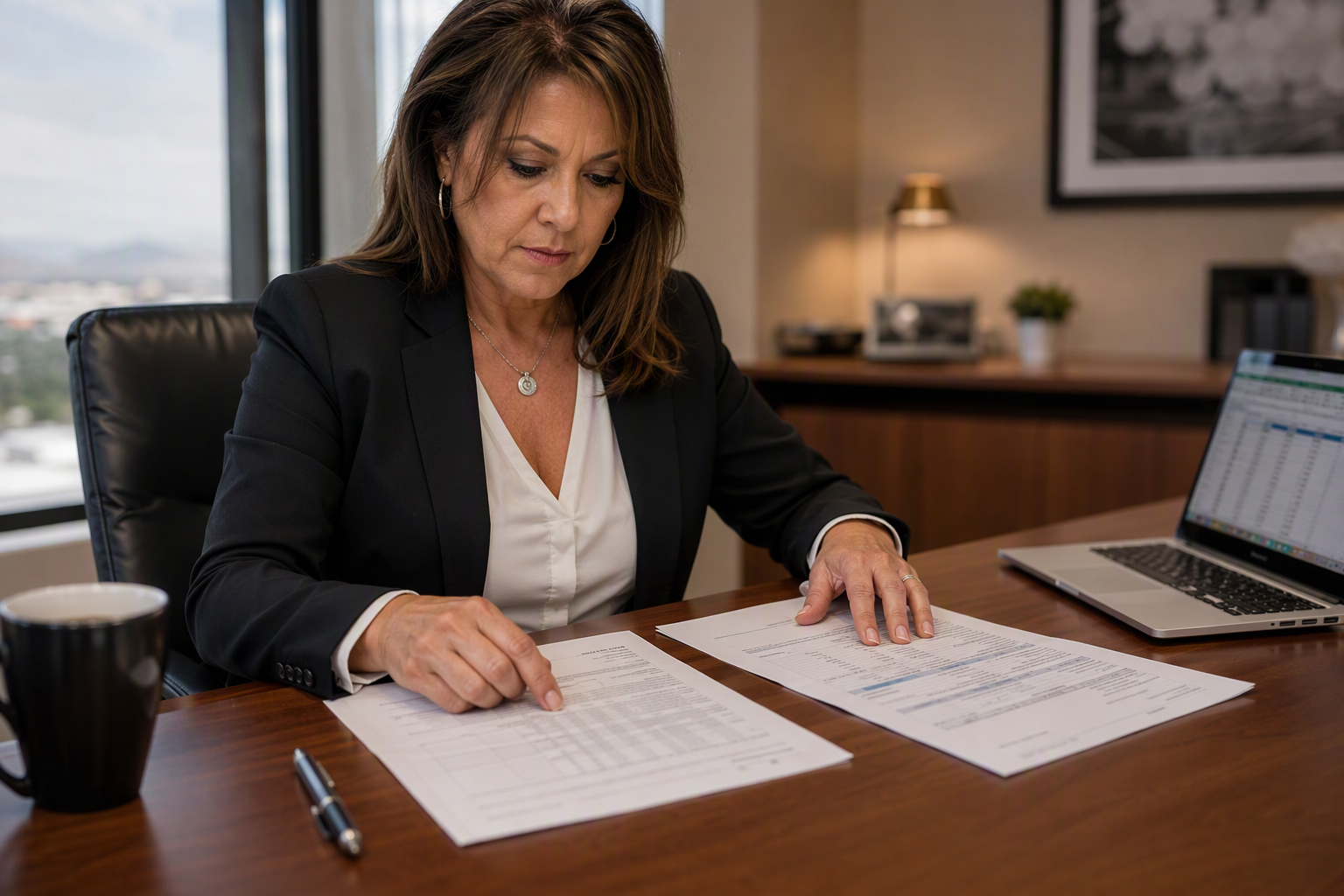
Service call pricing is driven by equipment type, the nature of the problem, travel distance, time of the call, and whether replacement parts are needed.
At a high level, elevator service calls fall into two categories: scheduled preventive maintenance visits and unscheduled repair or emergency calls. Preventive maintenance visits are typically priced into a monthly or annual contract, so there is no separate per-visit invoice. Unscheduled calls — triggered by a breakdown, entrapment, error code, or owner concern — usually carry a separate labor charge, plus any parts costs.
Labor rates in the Phoenix metro area, Tucson, Scottsdale, and Mesa reflect the skill and licensing requirements for elevator work. Under Arizona law, elevator installation and repair must be performed by contractors holding an R-12 (residential) or C-12 (commercial) elevator license issued by the Arizona Registrar of Contractors. That licensing requirement is one reason elevator labor rates differ from general electrical or mechanical trades.
Additional factors that influence cost include the age and model of the elevator controller, the availability of legacy parts for older traction or hydraulic systems, whether the call occurs during standard business hours or outside them, and the complexity of the diagnostic process required before any repair can begin.
What is the difference between a service call and a preventive maintenance visit?
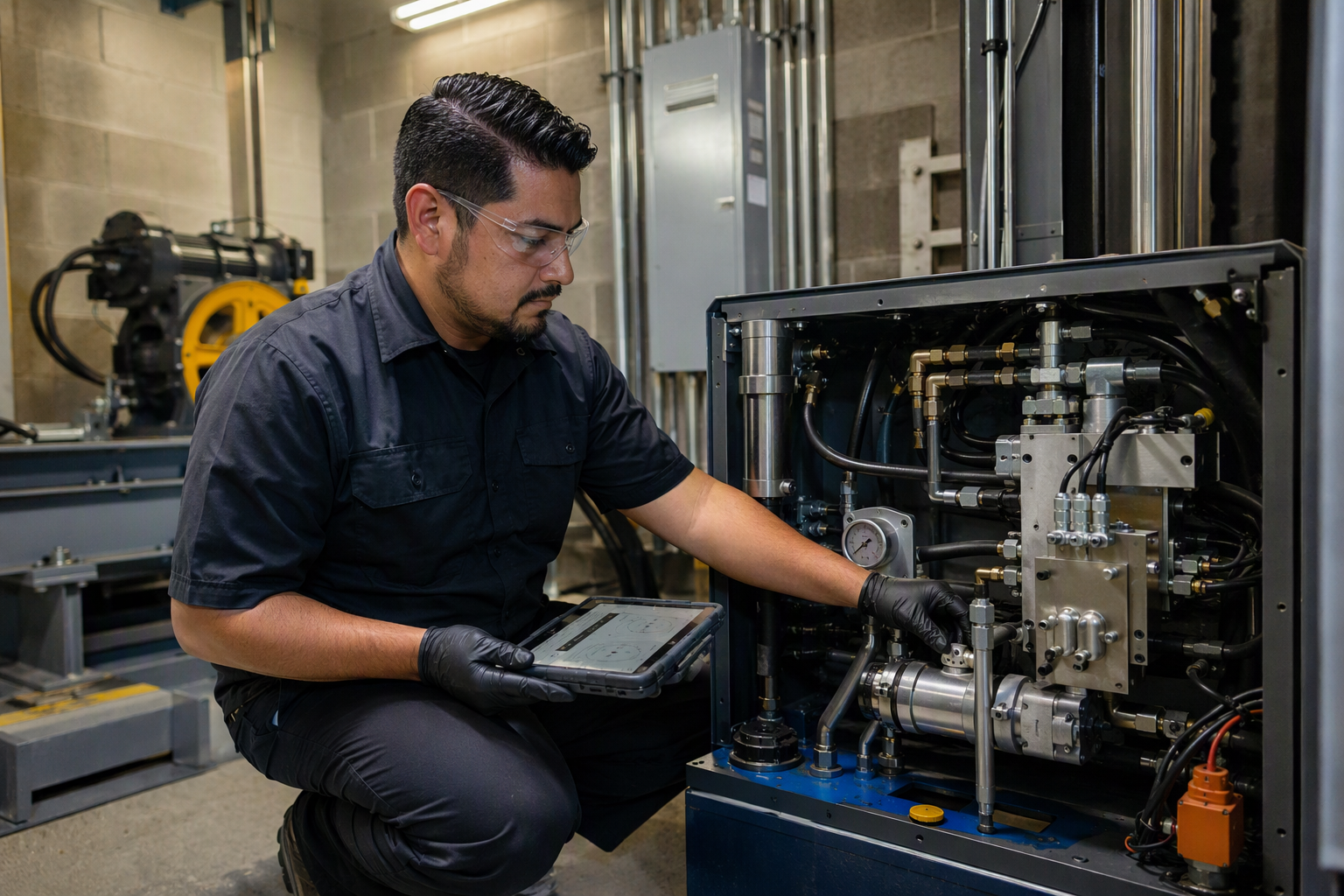
A preventive maintenance visit is a pre-scheduled inspection and lubrication routine included in a service contract, while a service call is an unscheduled visit triggered by a fault, complaint, or entrapment.
Building owners who carry a full-coverage maintenance agreement typically pay a fixed monthly fee that bundles routine maintenance, minor adjustments, and some repair labor into a single predictable cost. Agreements structured this way can reduce total annual spend because they eliminate the per-call billing that accumulates when owners operate on a time-and-materials basis with no contract in place.
Owners operating without any maintenance agreement pay for every visit individually — including travel time, diagnostic time, labor, and parts — which can result in significantly higher annual costs, particularly if the equipment is aging or has a history of unplanned downtime.
How does equipment type affect service call pricing?
Hydraulic elevators, traction elevators, platform lifts, stairway chairlifts, and escalators each carry different labor and parts costs because their mechanical and electrical systems differ substantially.
Hydraulic elevators are common in low- to mid-rise buildings across Phoenix, Scottsdale, and Mesa. Their service needs often center on the hydraulic power unit, cylinder, jack packing, and control valve. Traction elevators — found in taller buildings and many high-end commercial properties — involve hoist motors, sheaves, counterweights, and more sophisticated control systems, which can translate to higher diagnostic complexity and parts costs.
Platform lifts and stairway chairlifts, which in Arizona must comply with ASME A18.1-2020 when installed, repaired, or altered on or after January 1, 2023, are mechanically simpler but often require proprietary parts from their original manufacturer. Escalators and moving walks carry their own parts ecosystem. Technicians servicing any of these conveyance types must be familiar with the applicable edition of the code that governs that specific equipment.
Does Arizona have regulations that affect what work must be done during a service call?
Yes — Arizona law under A.R.S. §§ 23-491 through 23-491.16 and the Arizona Administrative Code R20-5-502 through R20-5-515 establishes minimum standards for elevator safety, inspection, and maintenance that directly shape what a qualified technician must address during any service visit.
Since September 12, 2026, elevator safety in Arizona has been administered by the Industrial Commission of Arizona (ICA), Elevator Division — formerly known as the ADOSH Elevator Safety Section. The ICA Elevator Division requires that every conveyance operating in Arizona hold a current annual certificate of inspection. That certificate must be kept at the same location as the conveyance and made available for inspection on request. The state serial number or the certificate itself must be posted in or close to the conveyance in an easily accessible location.
When a technician arrives on an unscheduled service call, a compliant service company will verify the status of the unit’s certificate and flag any conditions that could jeopardize the certificate at the next annual inspection. Addressing those conditions during the same visit avoids a second call-out charge and reduces regulatory risk for the building owner.
For equipment installed, repaired, or altered on or after January 1, 2023, Arizona has adopted the ASME A17.1/CSA B44, 2019 edition as the governing safety code. Any repair or alteration must conform to that edition, which can affect both the scope of work and the parts specified during a service call.
What happens if an elevator is taken out of service during a service call?
If a conveyance is disabled during a service visit, Arizona owners must notify the Industrial Commission of Arizona within 24 hours of any accident that injures a person or disables a conveyance, and the unit may not return to service until it is safe and compliant.
Under Arizona law, no conveyance may operate without a current certificate of inspection. If a service call reveals a condition that renders the elevator unsafe, the unit must be taken out of service until the deficiency is corrected. Returning it to service prematurely exposes the building owner to liability under A.R.S. § 23-491 and related statutes.
Owners should be aware that a subsequent inspection — either by the ICA Elevator Division or, inside the City of Phoenix, by the City of Phoenix Elevator Section within the Planning and Development Department — may be required before the unit is cleared to return to service. That re-inspection may carry its own fee separate from the repair service call.
What should a building owner do immediately when an elevator malfunctions?
Following a structured response protocol minimizes liability, reduces downtime, and ensures regulatory compliance under Arizona law.
- Ensure occupant safety first — if anyone is trapped, contact emergency services (911) before calling the elevator company.
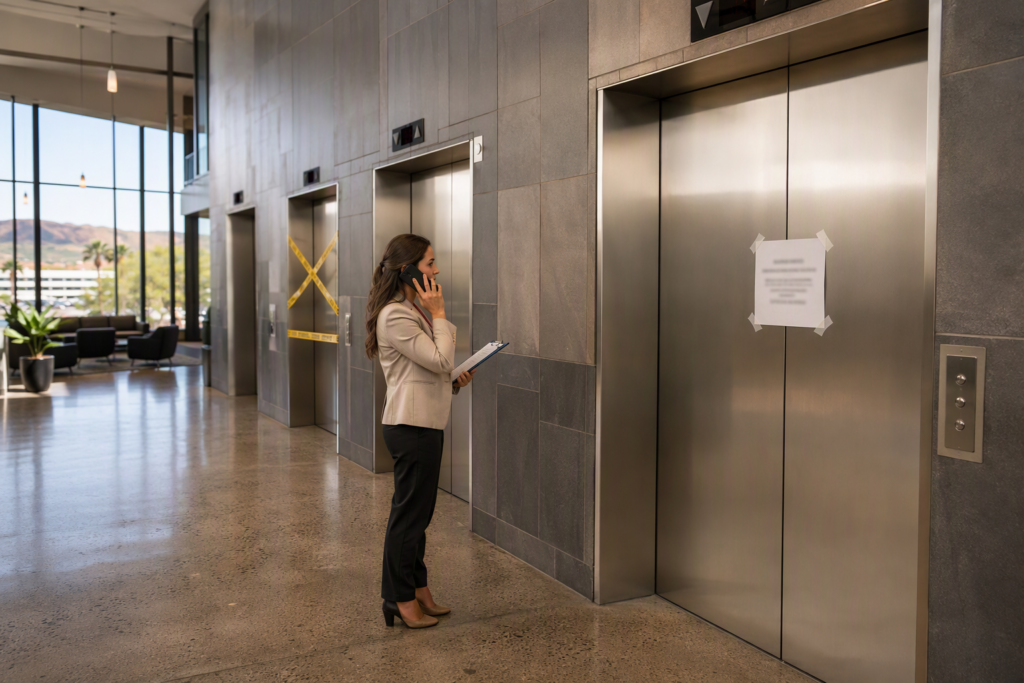
- Post signage at every landing indicating the elevator is out of service to prevent additional riders from attempting to use it.
- Locate the state-issued certificate of inspection and note the unit’s state serial number (found on a tag fixed to the controller or mainline disconnect).
- Contact a licensed elevator service contractor — one holding an R-12 or C-12 license from the Arizona Registrar of Contractors — to schedule an emergency or priority service call.
- If the malfunction involved an injury or left the conveyance disabled, notify the Industrial Commission of Arizona, Elevator Division within 24 hours as required by Arizona law.
- Document the malfunction with date, time, observed symptoms, and any error codes displayed on the controller panel.
- Review your maintenance agreement (if one is in place) to determine whether emergency call coverage applies and what authorization steps are required before the technician begins work.
- Request a written diagnostic report from the technician upon completion of the visit, and retain it with your elevator maintenance records.
How do maintenance agreement structures affect annual service costs?
The structure of a maintenance agreement — full-coverage, oil-and-grease only, or time-and-materials with a retainer — significantly changes the total cost profile over a twelve-month period.
A full-coverage or comprehensive agreement typically includes scheduled maintenance visits, lubricants, minor adjustments, and a defined scope of repair labor and parts. An oil-and-grease agreement covers only routine lubrication and minor adjustments, leaving all repair labor and parts billed separately. A time-and-materials arrangement with no contract provides maximum flexibility but offers no predictability in annual spend and no priority scheduling benefit during high-demand periods.
Arizona Elevator Solutions works with building owners across Phoenix, Tucson, Scottsdale, and Mesa to structure agreements appropriate to the age, usage, and complexity of their equipment, helping owners choose the tier that balances budget predictability with adequate coverage.
| Agreement Type | Scheduled Maintenance Included | Repair Labor Included | Parts Included | Budget Predictability | Typical Best Fit |
|---|---|---|---|---|---|
| Full-Coverage / Comprehensive | Yes | Yes (defined scope) | Yes (defined list) | High | High-traffic commercial, aging equipment |
| Oil-and-Grease Only | Yes (lubrication only) | No — billed separately | No — billed separately | Moderate | Newer equipment, low-rise residential |
| Time-and-Materials (No Contract) | No | Billed per call | Billed per call | Low | Single-unit low-use applications |
| Modernization Contract | Varies | Included during modernization scope | Included in project scope | High (project-based) | Equipment due for full modernization |
Are after-hours or emergency service calls priced differently?
Emergency or after-hours service calls typically carry different labor rates than standard business-hours visits, reflecting the premium associated with immediate dispatch outside scheduled windows.
Building owners should clarify with their elevator service contractor exactly how after-hours calls are priced before a situation arises. Key questions include whether emergency response is included in the maintenance agreement, whether there is a minimum charge for after-hours dispatch, and how overtime or holiday rates apply to the total invoice. Having these terms in writing before an emergency occurs prevents billing disputes when the situation is already stressful.
In Arizona, entrapment situations require immediate response because occupant safety is the primary concern. Arizona Elevator Solutions serves building owners in Phoenix, Tucson, Scottsdale, and Mesa and can provide detailed information about service agreement terms that address emergency response coverage.
What role does the annual inspection play in overall service costs?
The annual inspection required under Arizona law is a distinct regulatory event that may be performed by the ICA Elevator Division or an authorized private inspector, and its cost is separate from routine maintenance service calls.
Arizona owners may hire a private elevator inspector authorized by the Industrial Commission of Arizona to perform initial or annual inspections. Private elevator inspectors in Arizona must register with the commission every year and demonstrate at least eight hours of approved continuing education. Importantly, a private inspector may not inspect a conveyance owned, operated, or last serviced by the inspector, a company the inspector owns, or the inspector’s employer — a rule designed to prevent conflicts of interest.
Inside the City of Phoenix, the City of Phoenix Elevator Section within the Planning and Development Department handles inspections for elevators, escalators, moving walks, dumbwaiters, and chairlifts. Outside Phoenix, the ICA Elevator Division handles state-level inspections. Owners should budget for the annual inspection as a distinct line item separate from their service call and maintenance agreement costs.
Using a private inspector does not relieve the owner or operator of their legal obligations under Arizona law — a point that every building owner should understand clearly before delegating the inspection process.
What is the 90-day notification requirement and how does it affect project costs?
Arizona owners must notify the Industrial Commission of Arizona, Elevator Division at least 90 days before installing, relocating, or altering a conveyance, which means major project timelines and associated costs must account for this regulatory lead time.
Failing to provide the required advance notification can delay a project, trigger compliance proceedings, and ultimately increase total project costs. Budget planning for any new installation, relocation, or significant alteration in Arizona should begin well before the intended start date to accommodate this statutory requirement under A.R.S. §§ 23-491 through 23-491.16.
How do ADA requirements affect the scope and cost of elevator service work?
The Americans with Disabilities Act (ADA) establishes accessibility requirements for elevator equipment in public accommodations and commercial facilities, and ADA-related deficiencies discovered during a service call may require corrective work that adds to the service visit cost.
Common ADA-related items that a technician may flag during a service call include door timing, leveling accuracy at landings, button operability, and auditory and visual signal function. While the ADA does not require existing elevators to be retroactively upgraded in all cases, any alteration to an elevator in a facility subject to the ADA triggers full compliance requirements for the altered elements. Building owners in Phoenix, Scottsdale, Mesa, and Tucson should ask their service provider to note any observed ADA concerns during every service visit so those conditions can be addressed proactively before they create liability exposure.
What diagnostic steps does a technician typically perform on a service call?
A thorough diagnostic process is the foundation of an accurate repair estimate and prevents misdiagnosis that leads to repeat service calls and compounding costs.
- Review the elevator’s maintenance and service history, including the most recent inspection report and certificate status.
- Retrieve and document any active fault codes or logged errors from the controller or machine room panel.
- Conduct a visual inspection of the machine room, including the controller, motor, sheaves (for traction units), or power unit and hydraulic lines (for hydraulic units).
- Test door operation, leveling, safety devices, and emergency features including firefighters’ emergency operation — which in Arizona must use the Arizona Firefighters Service (AZFS) key.
- Check safety circuit components including overspeed governors, buffers, and safety gear where applicable under ASME A17.1-2019.
- Identify the root cause of the reported fault or complaint, distinguishing between a primary failure and secondary symptoms.
- Provide the building owner or manager with a written estimate covering parts, labor, and any anticipated follow-up work before proceeding with repairs.
Can building owners reduce service call frequency through better maintenance practices?
Yes — consistent preventive maintenance performed on a schedule appropriate to the equipment’s usage intensity is the most reliable way to reduce unscheduled service call frequency over the life of the equipment.
The ASME A17.1 Safety Code for Elevators and Escalators provides guidance on maintenance obligations for elevator owners and service providers. Equipment that receives regular lubrication, adjustment, and inspection of safety-critical components experiences fewer unexpected breakdowns than equipment maintained on a reactive basis.
Building owners should also maintain a log of minor anomalies — unusual sounds, door hesitation, leveling irregularities — and share that log with their service technician at each visit. Early identification of developing issues allows repairs to be scheduled during planned maintenance windows rather than addressed as emergency calls, which reduces both cost and disruption to building occupants.
What is a modernization, and how does it relate to ongoing service call costs?
A modernization is a substantial replacement or upgrade of an elevator’s drive system, controller, doors, or cab components, and modernized equipment typically requires fewer unscheduled service calls than aging original equipment.
In Arizona, any repair or alteration performed on or after January 1, 2023 must conform to ASME A17.1-2019. A modernization project may be triggered by the unavailability of replacement parts for obsolete systems, escalating repair costs on aging equipment, or a desire to improve energy efficiency, reliability, and code compliance. While a modernization represents a significant capital expenditure, owners who analyze their historical service call costs often find that the investment pays back through reduced maintenance expense and improved uptime.
How should building owners evaluate and compare elevator service proposals?
A meaningful comparison of service proposals requires evaluating the scope of included services, the specific exclusions, the pricing structure for out-of-scope work, and the contractor’s licensing status under Arizona law.
Every elevator contractor performing installation or repair work in Arizona must hold an R-12 or C-12 license from the Arizona Registrar of Contractors. Owners should verify license status before signing any service agreement. Beyond licensing, proposals should be compared on the basis of what is explicitly included in routine maintenance visits, how repair labor and parts are priced when they fall outside the agreement scope, and what the escalation or termination terms are if equipment conditions change.
Arizona Elevator Solutions provides transparent, itemized proposals for building owners in Phoenix, Tucson, Scottsdale, and Mesa, making it straightforward to compare the value and scope of coverage against competing offers.
Are there service call cost implications specific to older or legacy elevator equipment?
Yes — older conveyances with discontinued control systems, relay logic controllers, or obsolete hydraulic components often carry higher per-call parts costs because components must be sourced from specialty suppliers, rebuilt, or fabricated.
Arizona law allows lawfully installed older conveyances to remain in service unless the ICA Elevator Division’s elevator chief determines that continued use is a hazard to life, health, or property. This provision gives building owners the flexibility to maintain vintage equipment, but it does not eliminate the practical cost reality that parts for legacy systems are often more expensive and slower to procure than parts for modern equipment.
Owners of older equipment should have an honest conversation with their service provider about the long-term cost trajectory of maintaining the existing system versus investing in modernization. A service company with experience on legacy hydraulic and traction systems across the Phoenix and Tucson metro areas can provide realistic guidance on that decision.
What records should building owners keep related to service calls?
Maintaining complete, organized service records protects building owners legally, supports efficient future service visits, and satisfies Arizona’s requirement that the certificate of inspection be available at the location of the conveyance.
Records that should be retained for each conveyance include: the current state-issued certificate of inspection; the unit’s state serial number (as assigned and tagged to the controller or mainline disconnect); the report from every annual inspection; invoices and technician reports from every service call; records of any parts replaced, including part numbers and installation dates; and documentation of any notifications submitted to the ICA Elevator Division, including the 90-day pre-installation or pre-alteration notifications and any 24-hour accident notifications.
These records also provide the historical data needed to assess whether preventive maintenance is successfully reducing unscheduled call frequency over time, which informs future service agreement decisions.
What questions should a building owner ask before authorizing work on a service call?
Asking the right questions before authorizing work protects the building owner from unexpected charges and ensures the repair will bring the equipment into compliance with Arizona law and applicable codes.
- Is the diagnosed fault the root cause, or could it be a symptom of a larger underlying issue?
- Will the proposed repair bring the equipment into full compliance with ASME A17.1-2019 as adopted by Arizona for equipment installed or altered on or after January 1, 2023?
- Are the proposed replacement parts original equipment manufacturer (OEM) components, or aftermarket alternatives — and does the choice affect the equipment’s inspection certificate status?
- Will this repair require a follow-up inspection by the ICA Elevator Division or the City of Phoenix Elevator Section before the unit returns to service?
- Is this repair covered under any existing maintenance agreement, or will it be billed separately?
- What is the total estimated cost, and is the estimate fixed or subject to change based on additional findings once work begins?
- Does the contractor hold an R-12 or C-12 license from the Arizona Registrar of Contractors?
How does the City of Phoenix’s local authority affect service calls for elevators inside Phoenix?
The City of Phoenix Elevator Section, within the Phoenix Planning and Development Department, has local inspection authority over elevators, escalators, moving walks, dumbwaiters, and chairlifts located inside city limits — a jurisdiction that affects how post-repair inspections are coordinated.
Building owners in Phoenix should understand that their inspection and regulatory touchpoint is the City of Phoenix Elevator Section for routine annual inspections and post-repair clearances within city limits. For equipment located outside Phoenix — including in Scottsdale, Mesa, and Tucson — the ICA Elevator Division handles inspection authority at the state level. Understanding which agency has jurisdiction over a specific piece of equipment helps building owners anticipate the correct process for obtaining clearance after a service call results in significant repair or alteration work.
What is the best way to budget for elevator service call costs annually?
Annual elevator maintenance budgeting should account for a scheduled maintenance agreement, the annual inspection fee, a capital reserve for unplanned repairs, and a contingency for potential parts costs on aging equipment.
Property managers in Phoenix, Scottsdale, Mesa, and Tucson who plan elevator maintenance budgets reactively — only after costs are incurred — consistently report more difficulty controlling total annual spend than those who establish a structured budget that anticipates multiple cost categories. A service provider familiar with Arizona regulatory requirements, local inspection authority coordination, and the specific equipment in a building can help develop a realistic annual budget projection. Arizona Elevator Solutions offers assessments for building owners across its Arizona service markets to support exactly this kind of planning process.
Contact Arizona Elevator Solutions for a free elevator assessment at 480-557-7600.
Need elevator service you can rely on? Arizona Elevator Solutions is ready to help.