Elevator Out of Service: What to Do — Complete Guide for Building Owners & Managers

An elevator going out of service is one of the most disruptive events a building manager can face. Whether it’s a commercial high-rise in downtown Phoenix, a mid-rise apartment building in Tucson, or a medical office in Scottsdale, the immediate steps you take in the first 30 minutes determine how quickly you restore service, how well you protect your tenants, and whether you stay on the right side of Arizona state regulations. This guide answers every question building owners, property managers, and facilities directors need answered — right now.
What Should I Do Immediately When My Elevator Goes Out of Service?
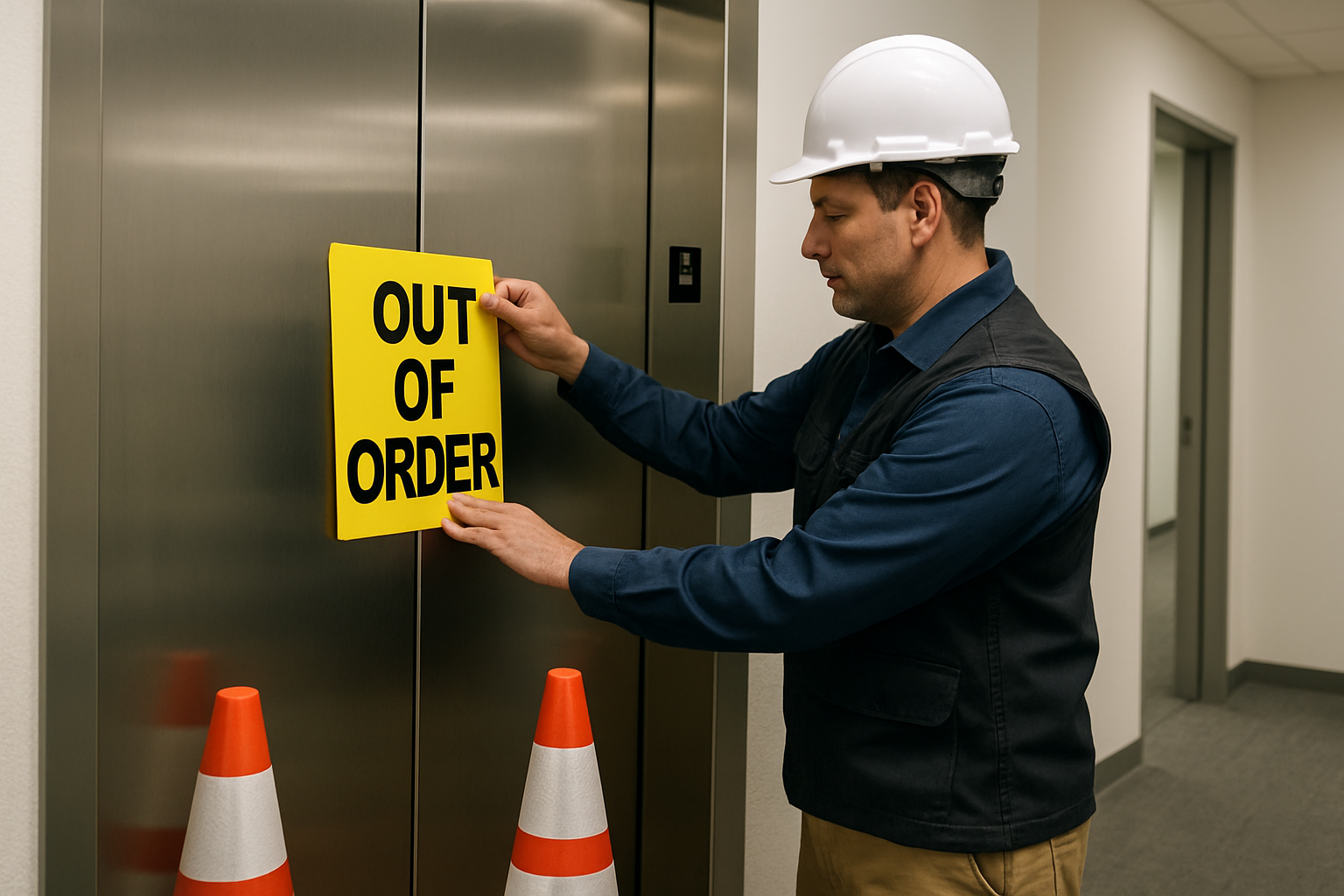
Stop elevator use immediately, secure all landings, post visible out-of-order signage at every floor served, check for trapped passengers, and call a licensed elevator technician — all within the first 15 minutes of discovering the outage.
The first 15 minutes of an elevator outage are critical. Here is a step-by-step immediate response protocol based on ASME A17.1/CSA B44-2022 Safety Code for Elevators and Escalators requirements and field experience across Arizona:
- Check for trapped passengers first. Call out at each landing. If anyone is trapped, call 911 immediately — never attempt to manually release a passenger without trained personnel on site.
- Secure all landing doors. Place physical barriers or cones at every floor entrance to prevent unauthorized access.
- Post out-of-order signage at every lobby-level entrance and each floor the elevator serves. Signage must be visible and unambiguous.
- Notify building management and tenants via email, building intercom, or posted notices within 30 minutes. For ADA-covered buildings, direct outreach to residents or tenants with mobility limitations is strongly recommended.
- Contact a licensed elevator technician for emergency dispatch. Arizona Elevator Solutions provides emergency response across Phoenix, Scottsdale, Mesa, Tempe, and Tucson.
- Document the outage thoroughly — record the exact time of failure, any error codes displayed on the controller, unusual sounds or odors preceding the event, and names of any witnesses. This documentation is essential for ADOSH reporting and insurance purposes.
Do not allow anyone to attempt a self-rescue or unauthorized reset. Unauthorized resets can mask underlying faults, void maintenance agreements, and create serious safety hazards under ASME A17.1 guidelines.
Is There a Legal Requirement to Report an Elevator Outage in Arizona?
Yes — in Arizona, elevator outages that involve injuries, entrapments, or mechanical failures posing a safety risk must be reported to the Arizona Division of Occupational Safety and Health (ADOSH), which oversees elevator inspections under ARS Title 23.
Arizona Revised Statutes §23-411 places elevator safety regulation under ADOSH. Incidents involving personal injury, entrapment exceeding 30 minutes, or catastrophic mechanical failure — including dropped car, counterweight displacement, or safety device activation — require formal incident reporting. For serious events, the reporting window is within 8 hours of the incident.
For routine outages without injury — such as a tripped breaker or door sensor fault — formal ADOSH reporting is generally not required, but written internal documentation is strongly advised. Your elevator maintenance contractor should provide a written service report for every outage call, which you should retain for a minimum of three years to support future inspection audits.
Buildings subject to the Americans with Disabilities Act (ADA) carry an additional obligation: when an elevator serving an accessible route goes out of service, building owners must provide an interim accessible alternative or post required signage directing users to the nearest accessible entrance. Failure to do so can trigger ADA complaints independent of ADOSH enforcement. Review ADA Title II and Title III guidance from ADA.gov for your specific building type.
How Long Can a Building Legally Operate With an Elevator Out of Service in Arizona?
Arizona law does not specify a universal maximum outage duration for all building types, but several overlapping regulations create practical deadlines that building managers must understand.
Under ADOSH jurisdiction, elevators that have triggered a safety device or experienced a reportable mechanical failure must not be returned to service until a licensed elevator inspector or certified technician has cleared the unit in writing. Operating a condemned or red-tagged elevator is a violation of ARS §23-411 and can result in civil penalties.
For buildings with only one elevator serving upper floors, the ADA and International Building Code (IBC) 2021 accessibility provisions — as adopted in Arizona — require that building owners make reasonable accommodations for tenants or visitors with disabilities during any extended outage. What qualifies as “reasonable” depends on building size, occupancy type, and outage duration, but best practice is to implement interim measures within 24 hours and restore full elevator service within 72 hours for most commercial and residential buildings.
Residential landlords in Arizona should also be aware that prolonged elevator outages in multi-story apartment buildings may constitute a habitability issue under ARS §33-1324, which requires landlords to maintain fit and habitable premises. Tenants in upper-floor units who cannot safely use stairs may have grounds for rent reduction or lease remedies if an outage extends beyond a reasonable repair period. Consult qualified legal counsel for any outage exceeding 5 business days in a residential setting.
What Are the Most Common Causes of an Elevator Going Out of Service — and How Long Does Each Take to Fix?
Understanding the root cause of an elevator outage helps building managers set realistic timelines, communicate accurately with tenants, and evaluate whether a repair or modernization is the better long-term decision.
Below are the most common causes Arizona Elevator Solutions technicians encounter across Phoenix metro, Tucson, and surrounding communities, along with typical repair timeframes. Actual timelines depend on parts availability, unit age, and access conditions.
| Cause | Description | Typical Repair Timeline |
|---|---|---|
| Door sensor or gate switch fault | Dirty, misaligned, or failed door contacts prevent the elevator from recognizing a fully closed door. Extremely common in high-traffic buildings. | 1–4 hours (same day) |
| Tripped breaker or power fault | Electrical surge or overload trips the elevator’s dedicated circuit breaker. Requires technician inspection before reset to rule out underlying cause. | 1–3 hours (same day) |
| Drive or controller fault | Variable frequency drives (VFDs) or main controller boards display error codes and lock out the system. May require board replacement or reprogramming. | 4–24 hours; longer if parts must be ordered |
| Safety device activation (governor, buffer, oil buffer) | A safety trip requires a full reset procedure by a licensed technician and, in most cases, an inspection sign-off before return to service. | 4–8 hours minimum; ADOSH notification may be required |
| Hydraulic fluid leak or pump failure | Common in older hydraulic units in Arizona’s heat. Fluid loss causes the car to drift or fail to rise. Requires fluid replacement and pump inspection or replacement. | 1–3 days depending on pump availability |
| Hoist rope or sheave wear | Worn ropes trigger safety inspections and mandatory replacement before the unit can return to service. | 1–5 days depending on rope specification and crane access |
| Control board or obsolete parts | Units manufactured before 2000 may require parts sourcing from specialty suppliers, significantly extending downtime. | 3–21 days or longer; modernization may be recommended |
If your technician identifies obsolete components as the underlying cause, request a written modernization assessment alongside the repair quote. In many cases, partial or full modernization under ASME A17.1/CSA B44-2022 standards reduces long-term downtime risk and may qualify for favorable financing through equipment replacement programs.
How Much Does Emergency Elevator Repair Cost in Arizona?
Emergency elevator repair costs in Arizona vary widely based on the cause of the outage, the age and type of equipment, parts availability, and whether the repair falls within a preventive maintenance agreement. Understanding the cost structure helps building managers budget accurately and evaluate service proposals.
The following ranges reflect general market conditions in the Phoenix and Tucson metro areas as of mid-2026. Individual quotes will vary — always request itemized written proposals from licensed contractors before authorizing repairs.
- Emergency dispatch and diagnostic fee: Typically $150–$400 for after-hours or weekend emergency response, often waived or credited for buildings on an active maintenance agreement.
- Minor repairs (door sensors, switches, breaker resets): $200–$800 including parts and labor for most straightforward faults.
- Drive or controller board replacement: $1,500–$8,000 depending on the manufacturer, unit age, and whether the board can be repaired or must be replaced.
- Hydraulic pump replacement: $3,000–$12,000 for most commercial hydraulic units, including fluid disposal and environmental compliance.
- Hoist rope replacement: $2,500–$9,000 depending on rope specification, car capacity, and access requirements.
- Full or partial modernization: $25,000–$150,000 or more, depending on scope. Modernization typically addresses control systems, drives, door operators, cab finishes, and ADA compliance in a single project.
Buildings enrolled in a comprehensive preventive maintenance agreement with Arizona Elevator Solutions typically receive priority emergency dispatch, reduced parts markups, and documentation that supports ADOSH audit readiness — often reducing total annual repair costs compared to reactive-only service models. Contact our team to request a maintenance agreement review for your property.
What Should I Tell Tenants and Residents When an Elevator Is Out of Service?
Clear, timely communication during an elevator outage reduces tenant frustration, limits liability exposure, and demonstrates professional property management. The message you send within the first hour sets the tone for the entire incident.
Arizona Elevator Solutions recommends the following communication framework for building managers:
- Initial notification (within 30 minutes of confirmed outage): Send a brief message via email, text, or building intercom confirming the elevator is out of service, that a licensed technician has been dispatched, and that an update will follow within a defined window (typically 2–4 hours).
- Direct outreach to residents with disabilities: Contact any known tenants or residents who rely on the elevator for mobility access. Offer interim assistance such as package delivery to ground floor, temporary unit reassignment if available, or coordination with building staff for essential access needs.
- Update notifications: Provide status updates every 2–4 hours during business hours, or at each significant milestone (technician on site, cause identified, parts ordered, estimated return-to-service time).
- Return-to-service confirmation: Once the elevator has been cleared by the technician and is back in safe operation, send a formal all-clear notification and remove all out-of-order signage promptly.
Avoid vague language such as “we are working on it” without a timeline. Tenants and residents respond better to honest uncertainty with a defined next update than to open-ended reassurances. If parts must be ordered and the outage will exceed 48 hours, communicate that clearly with a revised estimated repair date.
For commercial buildings, notify major tenants and any businesses whose operations depend on elevator access as early as possible. Ground-floor lobby signage at all elevator entrances must remain in place for the full duration of the outage.
How Do I Choose the Right Elevator Repair Company in Arizona for an Emergency Outage?
Not all elevator service providers are equal when it comes to emergency response capability, licensing compliance, and parts availability. Selecting the wrong contractor during an outage can extend downtime, create compliance gaps, and increase total repair costs.
Use the following criteria when evaluating elevator repair companies in Arizona:
- Arizona licensure: Confirm the company employs ADOSH-registered elevator mechanics and that their contractors hold current state certification. You can verify elevator contractor registrations through the ADOSH portal.
- Emergency response availability: Verify that the company offers 24/7 emergency dispatch, not just a voicemail that routes to a call center. Ask for their average on-site response time for emergency calls in your specific location.
- Parts inventory: Companies with local parts inventory for common components — door operators, drive boards, hydraulic components — resolve outages significantly faster than those who must source all parts remotely.
- Written documentation: Any reputable elevator contractor should provide a written service report for every visit, including cause of failure, corrective action taken, and technician certification number. This is your ADOSH audit trail.
- ASME A17.1/CSA B44 familiarity: Confirm that the company’s technicians are trained on the current edition of the safety code and can advise you on compliance implications of the repair.
- References and service history: Ask for references from commercial or residential buildings of similar size and elevator type in your market. A company that primarily services residential units may not have the experience or parts inventory for a complex commercial traction system.
Arizona Elevator Solutions has served building owners and property managers across the Phoenix metro area, Scottsdale, Mesa, Tempe, Chandler, and Tucson since 2008. Our technicians are ADOSH-registered, ASME-trained, and carry an extensive local parts inventory to minimize emergency repair timelines. Request an emergency service call or maintenance consultation here.
Need elevator service you can rely on? Arizona Elevator Solutions is ready to help.