Elevator Maintenance and Compliance Requirements for Apartment Buildings and Multifamily Properties in Arizona
Multifamily property owners and managers in Phoenix, Tucson, Scottsdale, and Mesa face a specific set of elevator compliance obligations that differ from commercial office or retail buildings. Elevators in apartment complexes run continuously, serve residents of every physical ability, and are subject to state inspection authority. Understanding what Arizona law requires — and what a lapse in compliance costs — is essential for every multifamily operator.
Arizona Elevator Solutions works with multifamily property owners across Arizona to keep residential elevators in continuous legal operation, from routine maintenance to full code-compliance upgrades.
What Codes Govern Multifamily Elevator Compliance in Arizona?
Arizona elevator law references two foundational national standards:
- ASME A17.1 Safety Code for Elevators and Escalators — applies to new elevator installations and major alterations. This code sets design, construction, and installation requirements that all new residential elevators must meet at the time of installation.
- ASME A17.3 Safety Code for Existing Elevators and Escalators — governs retrofits and upgrades to elevators already in service. When an existing elevator in your apartment building undergoes significant modification, A17.3 benchmarks apply.
- ADA Title III and Title II accessibility requirements — apply to common-use areas in multifamily housing, including elevator cabs, controls, and signage, requiring accessible cab dimensions, Braille floor designations, audible signals, and compliant door timing.
Enforcement authority in Arizona rests with the Arizona Division of Occupational Safety and Health (ADOSH), which operates under the Arizona Industrial Commission. ADOSH employs state-certified elevator inspectors who issue operating certificates, conduct periodic inspections, and can place elevators out of service for non-compliance.
How Often Must Apartment Building Elevators Be Inspected in Arizona?
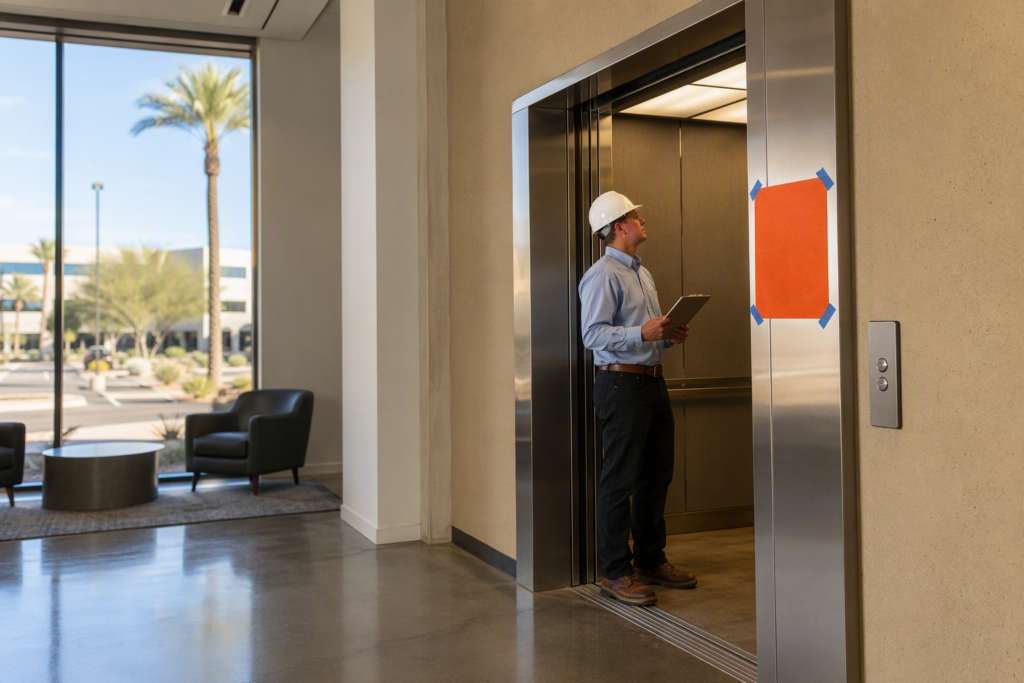
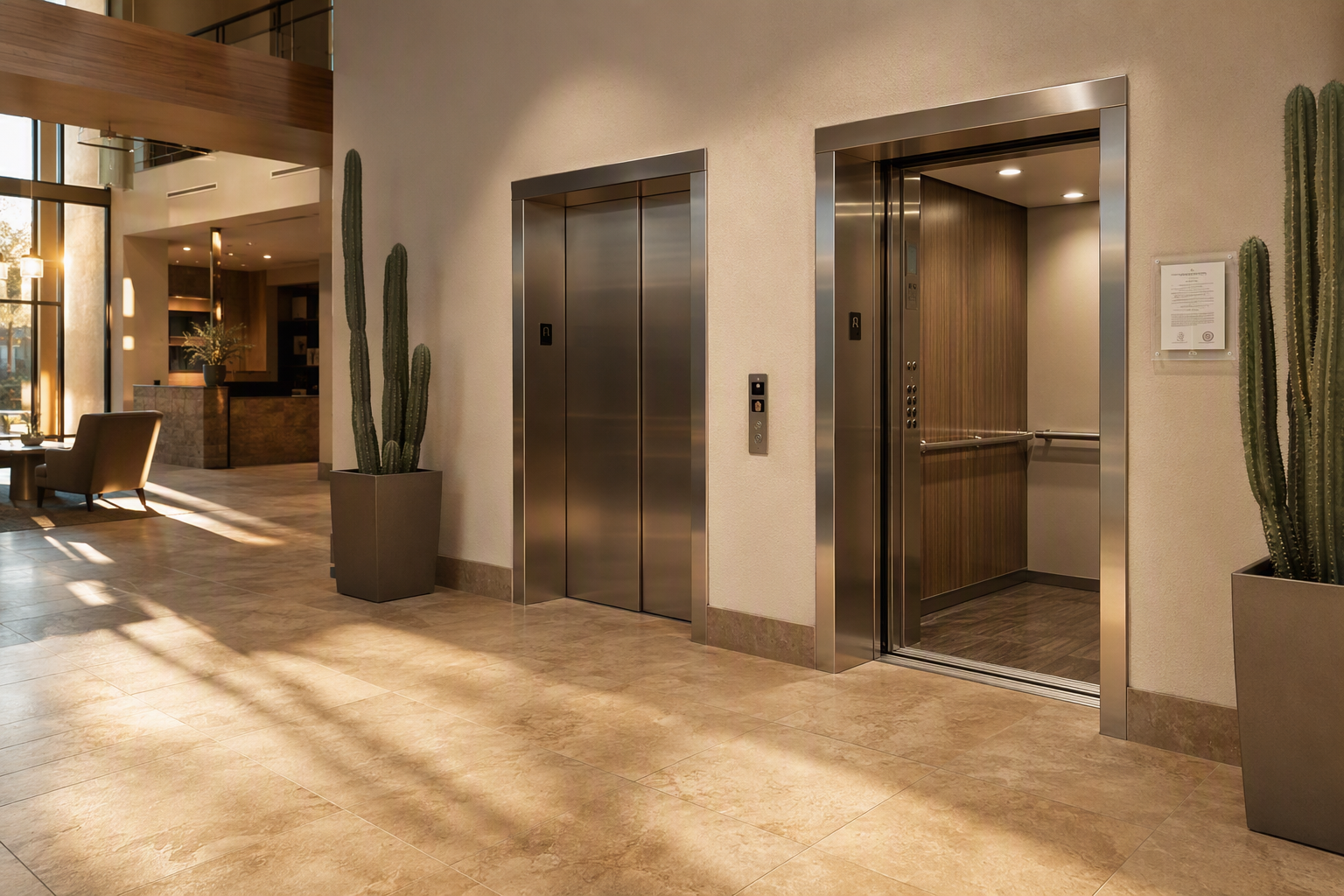
Arizona requires periodic inspections of elevators in public or common-use settings, including multifamily residential buildings. Inspections are conducted by ADOSH-licensed elevator inspectors — either state inspectors or qualified third-party inspectors authorized by ADOSH. After a passing inspection, the property receives a current operating certificate that must be posted inside or near the elevator cab.
Routine maintenance performed between inspections does not replace the formal state inspection cycle. A valid operating certificate is a legal prerequisite for keeping the elevator in service. Allowing a certificate to lapse — even unintentionally — exposes property owners to fines and potential liability if an incident occurs during the lapsed period.
Arizona Elevator Solutions helps multifamily clients track certificate expiration dates and coordinates with ADOSH-licensed inspectors to schedule timely reinspections.
What Does a Standard Elevator Maintenance Agreement Cover for Multifamily Properties?
A maintenance agreement for a residential apartment building typically covers:
- Scheduled lubrication of guide rails, door operators, and moving components
- Adjustment and testing of safety devices, including governors, buffers, and safeties
- Inspection and adjustment of door contact circuits and door timing to meet ADA requirements
- Examination of electrical controls, wiring, and motor operation
- Testing of emergency lighting, communication systems, and two-way emergency phones
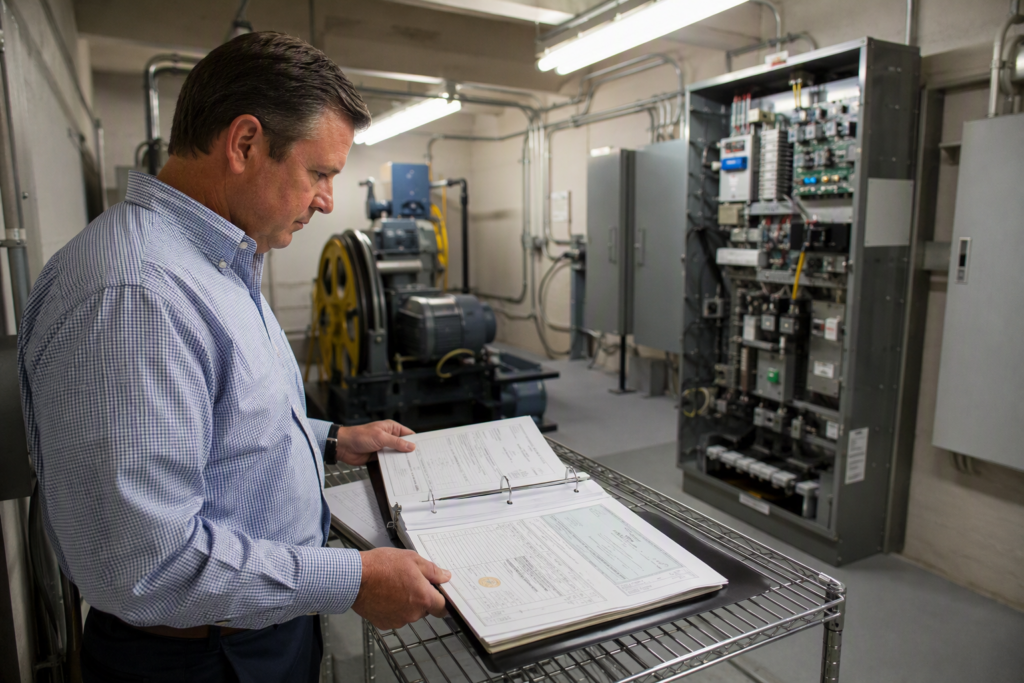
- Review of machine room conditions including temperature, ventilation, and housekeeping
- Documentation of all work performed, supporting the inspection record required by ADOSH
Preventive maintenance is not just a best practice — gaps in documented maintenance history are among the first things an ADOSH inspector reviews when deciding whether to issue or renew an operating certificate.
What ADA Requirements Apply to Elevators in Arizona Apartment Buildings?
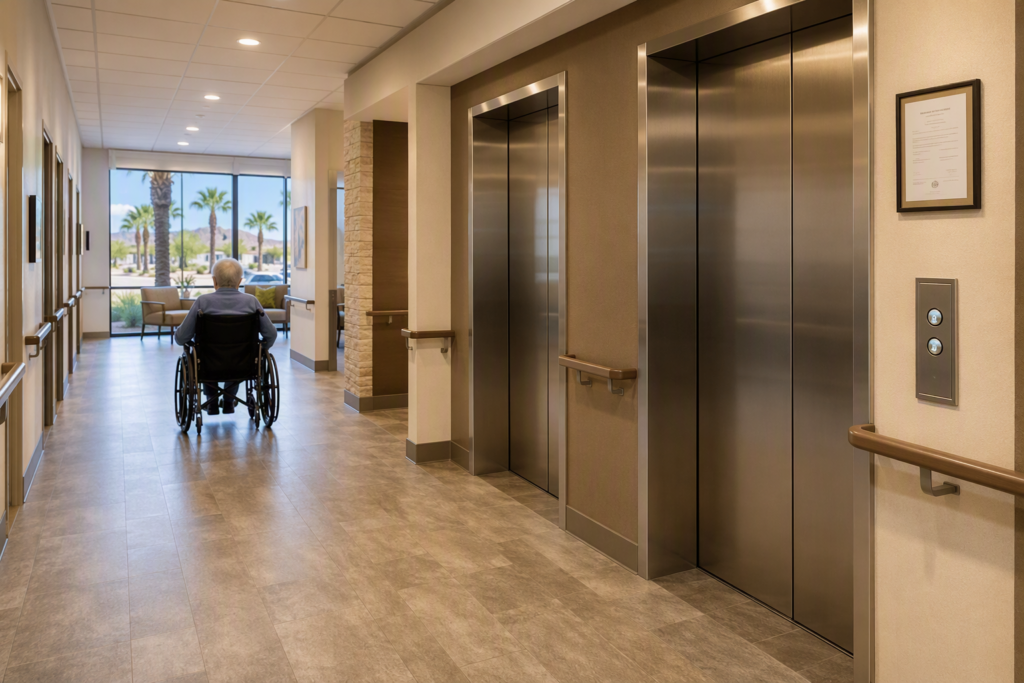
Under the Americans with Disabilities Act, elevators serving common areas of multifamily buildings must meet specific accessibility standards. Key requirements include:
- Call button height: Hall call buttons must be mounted at an accessible height, centered at a compliant position above the finished floor.
- Cab dimensions: Interior cab dimensions must allow a wheelchair to enter, maneuver, and exit — the ADA specifies minimum clear floor space.
- Door timing: Doors must remain open long enough for a person using a mobility device to enter or exit without rushing.
- Floor designations: Raised and Braille floor designations must appear on both jambs of each hoistway entrance.
- Audible and visual signals: Position indicators and audible announcements must identify the arriving floor.
- Two-way emergency communication: Cab must include a two-way means of communication that does not require voice communication as the only option.
ADA retrofits are among the most common compliance projects Arizona Elevator Solutions performs for existing multifamily properties, particularly in older Phoenix and Tucson apartment stock built before current ADA guidance was in place.
What Happens If an Apartment Building Elevator Fails an Arizona Inspection?
If ADOSH inspectors identify code violations during an inspection, the property owner receives a written notice of deficiency. Depending on the severity:
- Minor deficiencies may be corrected within a defined compliance period while the elevator remains in service.
- Serious safety violations — such as failed safety devices, inoperable emergency communications, or structural concerns — may result in an immediate out-of-service order.
- The elevator must remain shut down until corrections are made and a reinspection is passed.
- Operating an elevator under an out-of-service order exposes the property owner to significant civil and regulatory liability.
- After corrections, a reinspection must be scheduled and the new operating certificate issued before the elevator can legally return to service.
Out-of-service periods in a multifamily building create serious hardship for residents, particularly those with mobility limitations, and can trigger Fair Housing Act concerns. Proactive maintenance and compliance management are the most effective ways to prevent this scenario.
What Are the Machine Room Requirements for Multifamily Elevators in Arizona?
The machine room or control space for a residential elevator must be maintained to specific environmental and safety standards under ASME A17.1:
- The room must be kept clean, dry, and free of storage unrelated to elevator equipment.
- Temperature must be maintained within the operating range specified by the elevator manufacturer and referenced by ASME standards — excessive heat is a leading cause of control system failures.
- Adequate lighting must be present whenever personnel are working.
- Access must be restricted to authorized elevator personnel only; signage must reflect this.
- Fire suppression systems must be compatible with elevator electrical equipment.
ADOSH inspectors routinely check machine room conditions during periodic inspections. A poorly maintained machine room alone can result in a failed inspection.
Do Arizona Multifamily Elevators Need Emergency Power or Backup Systems?
Emergency power and recall requirements for Arizona multifamily elevators are governed by ASME A17.1. Key provisions include:
- Firefighters’ emergency operation (Phase I and Phase II): Elevators must be equipped with fire service recall capability. Phase I recall brings cars to a designated landing upon activation of the fire alarm. Phase II operation gives firefighters manual control from inside the cab.
- Emergency lighting: Cab emergency lighting must activate automatically upon loss of normal power and must provide illumination for a defined minimum period.
- Emergency communication: A two-way means of communication must be present and operational at all times — this is tested during every formal inspection.
Properties with backup generators should work with a qualified elevator contractor to ensure proper load sequencing so elevators return to service safely after a power event.
How Do Elevator Compliance Requirements Differ for Older Apartment Buildings in Arizona?
Older multifamily buildings — particularly those in Phoenix, Tucson, and Mesa built decades ago — often contain elevators that predate current ASME A17.1 editions. ASME A17.3 provides the applicable standard for these existing installations. A17.3 identifies specific safety requirements that must be retrofitted onto older equipment, even when a full replacement is not required.
Common retrofit requirements under A17.3 for older Arizona apartment elevators include:
- Updated door reopening devices and obstruction detection
- Upgraded governor and safety system components
- Addition of Phase I and Phase II firefighters’ operation if not present
- Modernized emergency communication systems meeting current ADA and ASME requirements
- Updated cab interiors to meet current ADA dimensional and signage standards
Arizona Elevator Solutions conducts comprehensive code-gap assessments for older multifamily properties, identifying which A17.3 retrofits are required versus which improvements are recommended best practices.
What Should Multifamily Property Managers Do After a Tenant Reports an Elevator Problem?
- Document the complaint with date, time, specific concern, and the tenant’s name and unit number.
- Notify the elevator service contractor immediately — do not wait until the next scheduled maintenance visit.
- If the problem involves safety devices, entrapment risk, or unusual sounds, take the elevator out of service voluntarily until inspected.
- Have a qualified elevator technician perform a diagnostic inspection and provide a written report.
- Correct any identified deficiency promptly and retain all service documentation.
- Notify tenants of the repair status, particularly any residents with mobility limitations who rely on the elevator for building access.
- If the issue may constitute a reportable incident under Arizona Industrial Commission rules, consult your elevator contractor about notification obligations.
Questions Your Inspector Will Ask
When an ADOSH elevator inspector arrives at an Arizona apartment building, property managers should be prepared to answer the following:
- Is the current operating certificate posted in or near the elevator cab? If it has expired or is missing, the inspection starts with a compliance problem already on record.
- Do you have a current maintenance log or service records? Inspectors review written documentation of all maintenance performed since the last inspection.
- When was the last full maintenance visit? Extended gaps between service visits raise red flags about the condition of lubricated components and safety devices.
- Has the elevator experienced any entrapments, unusual noises, or operational complaints since the last inspection? Unreported incidents can escalate a routine inspection into a detailed investigation.
- Is machine room access restricted and properly marked? Inspectors check access controls and signage as part of their review.
- Are fire service (Phase I/II) recall features functional? This is tested during every formal inspection and failures result in immediate deficiency notices.
- Is the two-way emergency communication device operational? Inspectors call the emergency line as a standard step in the inspection process.
- Have any alterations been made to the elevator since the last inspection? Unpermitted alterations are a serious compliance issue and must be disclosed.
How Does Arizona Compare to Federal OSHA Elevator Requirements?
Arizona operates its own state-plan occupational safety program under ADOSH, which has been approved by federal OSHA and must be at least as effective as the federal program. For elevator technicians working on equipment in Arizona multifamily buildings, applicable OSHA standards govern workplace safety during maintenance and repair — including lockout/tagout procedures, confined space requirements for pits, and fall protection in hoistways. Property owners should verify that any elevator service contractor working on their property follows ADOSH workplace safety requirements in addition to elevator-specific code compliance.
What Is the Typical Timeline for an Elevator Modernization in a Multifamily Building?
Elevator modernization projects in Arizona apartment buildings vary significantly based on scope. A targeted upgrade — such as a door operator replacement or control modernization — may take days. A full cab-and-controls modernization typically takes weeks, accounting for permit review by ADOSH, equipment lead times, and installation. Major structural modifications or full elevator replacements require plan submission, permit approval, installation, and a final acceptance inspection before the elevator can return to service.
Property managers should plan for temporary elevator unavailability during modernization and communicate timelines to residents — particularly those with disabilities — well in advance. Arizona Elevator Solutions coordinates directly with ADOSH on permit submissions and inspection scheduling to minimize downtime for multifamily clients in Scottsdale, Mesa, Phoenix, and Tucson.
How Should Multifamily Property Owners Choose an Elevator Service Contractor in Arizona?
When evaluating elevator service contractors for a multifamily property in Arizona, property owners should verify:
- The contractor holds applicable Arizona state licensure for elevator work.
- Technicians working on the property are certified under a recognized industry program.
- The contractor has documented experience with ASME A17.1 and A17.3 compliance work in residential settings.
- The company provides written service reports after every visit, supporting the documentation record ADOSH inspectors review.
- The contractor can assist with ADOSH permit submissions and coordinate inspection scheduling.
- References from comparable multifamily properties in Arizona are available upon request.
Arizona Elevator Solutions serves multifamily properties throughout Phoenix, Tucson, Scottsdale, and Mesa, providing maintenance, compliance assessments, modernization, and permit coordination for apartment building elevator programs.
Get a Free Elevator Assessment for Your Arizona Apartment Building
Compliance lapses in multifamily elevator programs create liability exposure, resident hardship, and costly emergency repairs. A proactive assessment identifies code gaps, documents your current maintenance standing, and outlines what is required to maintain a valid ADOSH operating certificate.
Contact Arizona Elevator Solutions for a free elevator assessment — 480-319-7157
Serving apartment buildings and multifamily properties in Phoenix, Tucson, Scottsdale, Mesa, and throughout Arizona.
Need elevator service you can rely on? Arizona Elevator Solutions is ready to help.