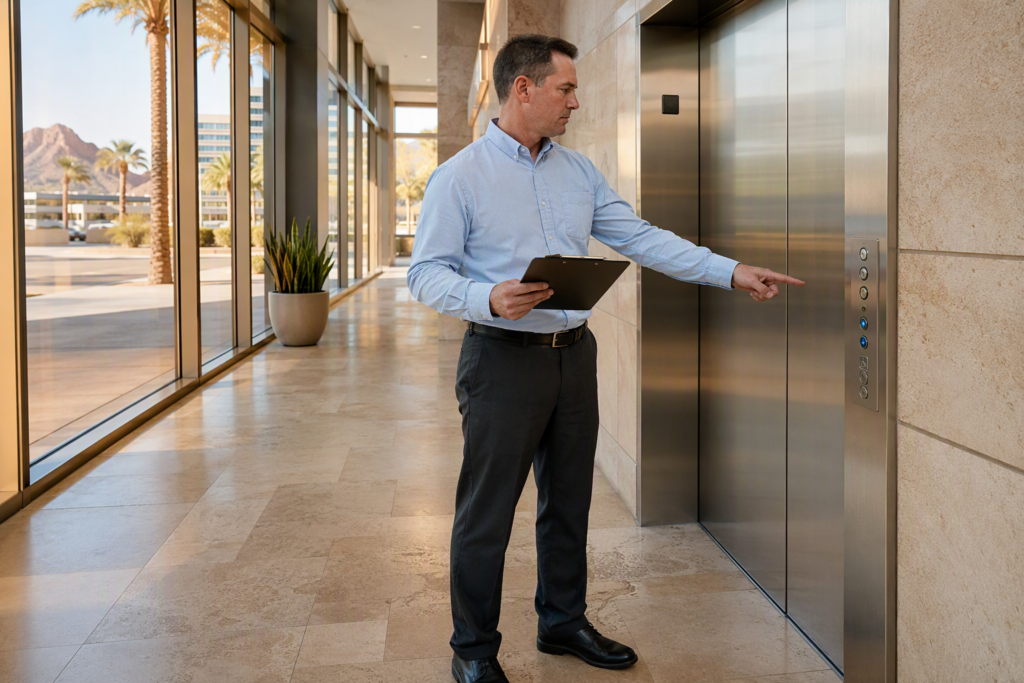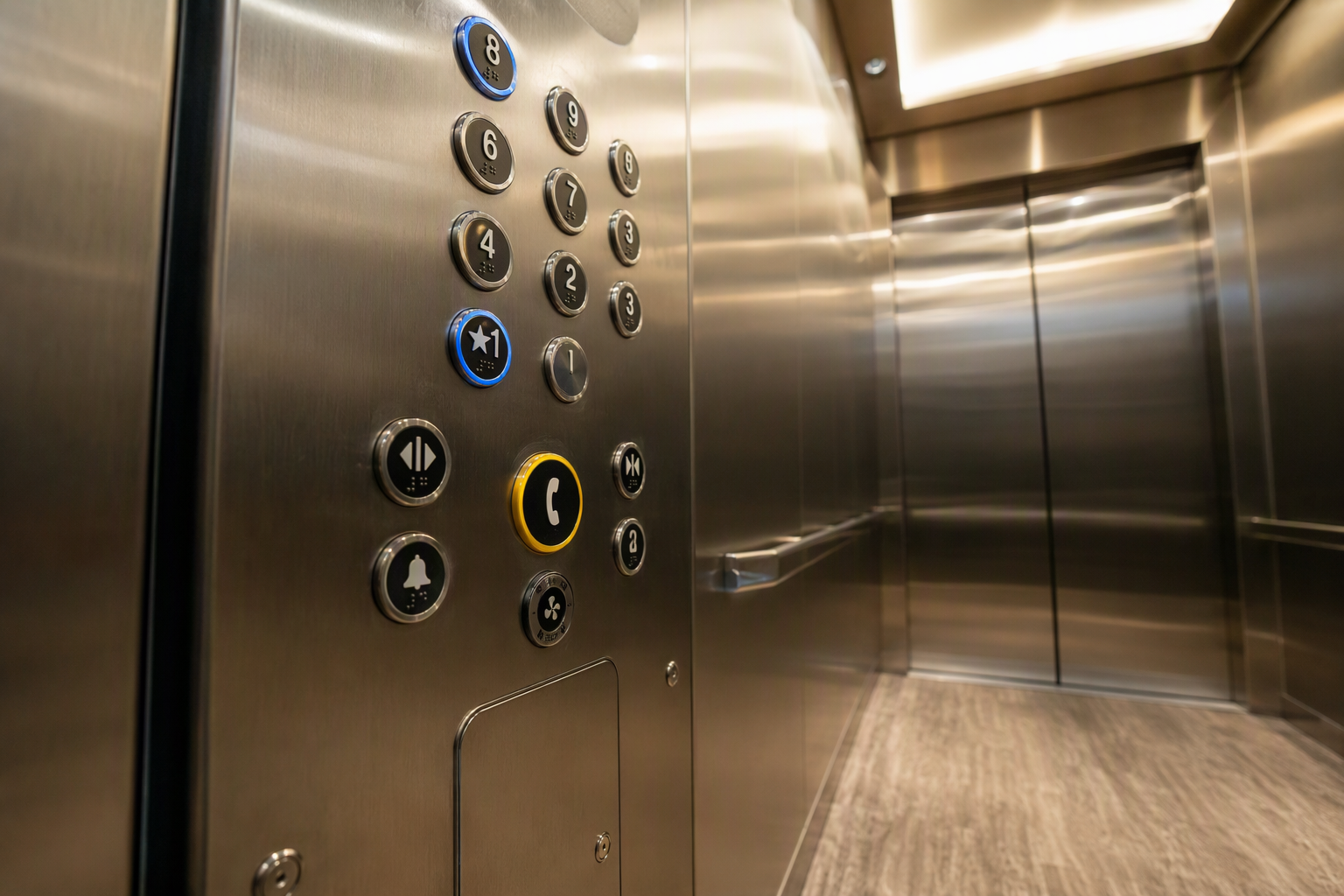
Press the emergency call button, listen for an audible acknowledgment tone, and wait for a live human dispatcher to respond verbally. Under the ASME A17.1 Safety Code for Elevators and Escalators, two-way voice communication must be functional at all times when the elevator is in service. If no dispatcher responds, the communication system is non-compliant and the unit should be taken out of service until repairs are completed.
What happens exactly when you press an elevator emergency call button?
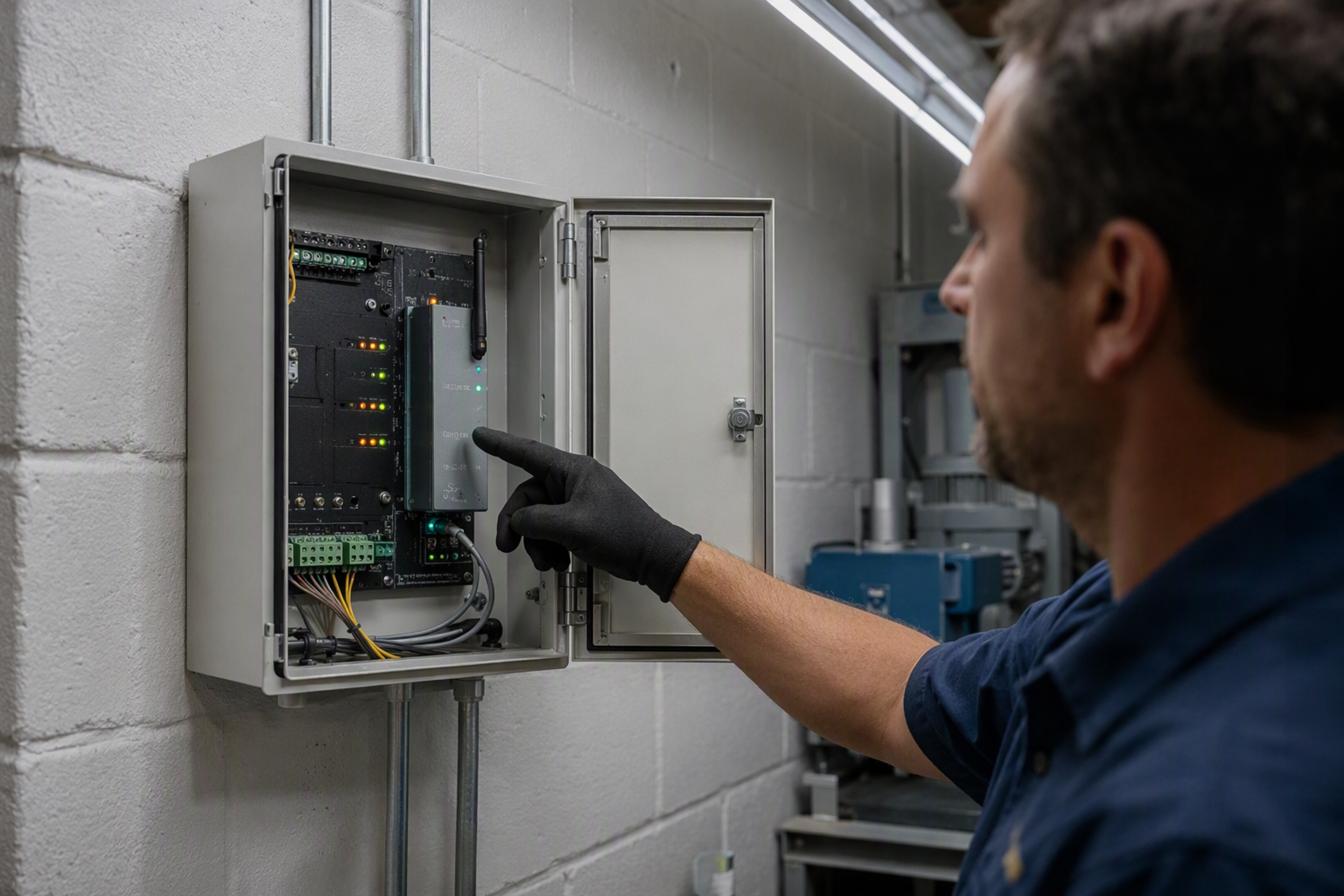
Pressing the emergency call button initiates an automatic dialing sequence that connects the elevator cab to a remote monitoring center staffed by trained dispatchers who can communicate with trapped passengers and alert emergency services.
Modern elevator emergency communication systems operate on a dedicated telephone line, a cellular network, or a Voice over Internet Protocol (VoIP) circuit. When the button is pressed, the system auto-dials a programmed number — typically a third-party monitoring center operating around the clock. The dispatcher answers, identifies the building and elevator unit using the cab’s programmed caller ID or an audio prompt, and begins two-way verbal communication with anyone inside the cab.
On older installations, the circuit may ring directly to a building management office or a front desk. In those configurations, coverage gaps exist whenever the office is unoccupied — a non-compliant condition under current code requirements.
What does the ASME A17.1 code require for elevator emergency communication?
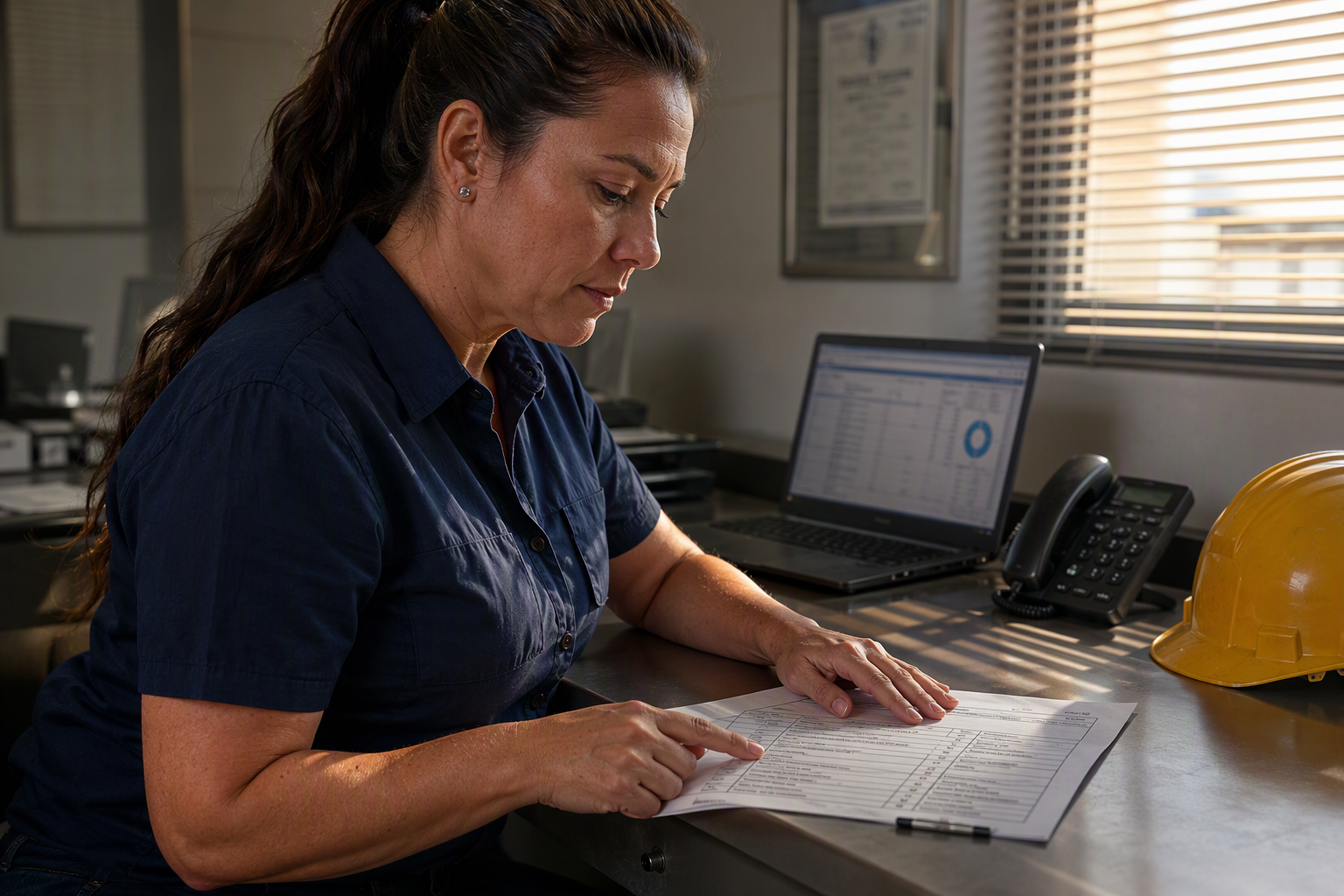
The ASME A17.1 Safety Code for Elevators and Escalators mandates a two-way means of communication between the elevator car and a location outside the hoistway that is monitored continuously when the elevator is in service.
Specifically, the code requires that every elevator car be equipped with a means of two-way communication that allows passengers to summon assistance. The communication device must be operable without a telephone handset — a hands-free speakerphone-style operation is the standard approach — so that injured or mobility-impaired passengers can activate it without difficulty. Arizona adopted ASME A17.1-2019 as the governing code for equipment installed, repaired, or altered on or after January 1, 2023, under Arizona Administrative Code R20-5-502 through R20-5-515.
The code also requires that the call button be identified with the internationally recognized telephone symbol or the word “HELP,” and that activation produce a visual and audible signal confirming the call has been placed. If the monitoring center does not answer, the system must be capable of leaving a message or queuing the call — a passive ring with no answer does not satisfy the code’s intent.
How do ADA requirements affect the emergency call button?
Under the Americans with Disabilities Act, elevator emergency controls must be located within reach range for wheelchair users and must be usable without requiring tight grasping, pinching, or twisting of the wrist.
The ADA Standards for Accessible Design require that the emergency call button be positioned no higher than 48 inches above the finished floor and no lower than 15 inches. It must provide both a visual and audible signal to confirm activation — this dual-signal requirement ensures passengers with hearing or visual impairments receive confirmation that the call has been sent. The button must also be within a clearly marked and identifiable control panel, distinct from floor selection buttons.
Buildings undergoing alterations in Phoenix, Tucson, Scottsdale, or Mesa must bring affected elevator controls into ADA compliance as part of the alteration scope, making a communication system upgrade a frequent companion to cab renovation projects.
How do you perform a step-by-step field test of the emergency call button?
A proper field test requires two people — one inside the elevator cab and one monitoring outside — and should be documented in the building’s maintenance log.
- Notify building management and the monitoring center before testing, so the test call is not treated as a genuine emergency.
- Enter the elevator cab and locate the emergency communication button, typically identified by a phone or bell symbol.
- Press and hold the button for the duration specified by the manufacturer (commonly two to three seconds for a hands-free system).
- Listen for an audible tone, beep sequence, or recorded prompt confirming the call has been initiated.
- Wait for a dispatcher to respond verbally. Note the elapsed time from button press to live voice response.
- Confirm two-way audio: speak clearly and verify the dispatcher can hear your voice; verify you can hear the dispatcher clearly.
- Ask the dispatcher to confirm the building address, floor, and elevator unit number they have on record — this verifies the caller ID data is accurate.
- End the test call and confirm with the dispatcher that the call has been properly logged and closed.
- Document the test date, tester name, dispatcher name or ID, response time, and any audio quality issues in the elevator maintenance log.
- Report any failure at any step to a qualified elevator service contractor immediately and do not return the elevator to service until the fault is resolved.
What are the most common reasons an emergency call button fails to connect?
The most frequent causes of emergency communication failure are a disconnected or expired telephone line, a drained backup battery, incorrect programming at the monitoring center, or a failed intercom circuit board inside the cab.
Analog telephone lines dedicated to elevator use have been discontinued by many carriers as telecom infrastructure migrates to digital and fiber networks. If an elevator’s communication system was installed for an analog POTS (plain old telephone service) line and that line has been converted or cancelled, the system will appear functional internally but will fail to connect externally. This is one of the most frequently overlooked failure modes in older commercial and multifamily buildings throughout the Phoenix metro area.
Cellular-based communication units resolve the POTS obsolescence problem but introduce their own failure mode: weak in-building signal. Elevator hoistways are essentially metal-lined shafts, and signal attenuation can be severe without proper antenna routing. VoIP systems depend on the building’s internet connection and are vulnerable to power outages unless protected by an uninterruptible power supply (UPS) with adequate runtime.
What visual and audible indicators confirm the call has been sent?
A properly functioning system will produce at minimum an illuminated indicator light on the call button itself and an audible tone — both must activate within seconds of pressing the button to confirm the outgoing call has been placed.
Many modern units also produce a recorded voice message such as “Your call has been received” or “Please stay on the line” while the dispatcher connection is being established. Some systems display a text message on a cab-mounted screen. The absence of any confirmation signal — no light, no tone, no voice prompt — is itself a failure indicator, even if the call theoretically connected. Under ASME A17.1, the visual signal is not optional; it exists specifically to serve passengers with hearing impairments.
How quickly should a dispatcher respond after the button is pressed?
While code establishes that the monitoring location must be continuously staffed when the elevator is in service, specific maximum response time intervals are set by individual monitoring center service contracts rather than a single universal federal or Arizona statute.
Building owners and property managers should review their monitoring center service agreement for the contractually defined answer time. Industry practice among reputable monitoring providers targets a live answer within a short number of rings, but the key compliance requirement under ASME A17.1 is continuity of staffing — not a specific number of seconds. If a building’s monitoring arrangement routes calls to an answering machine after hours, that arrangement is non-compliant and should be corrected immediately.
Does Arizona state law specifically address elevator emergency communication systems?
Yes — Arizona’s elevator safety requirements, governed by A.R.S. §§ 23-491 through 23-491.16 and administered by the Industrial Commission of Arizona’s Elevator Division, require that every conveyance in the state maintain compliance with the adopted edition of ASME A17.1, which includes mandatory emergency communication provisions.
The Industrial Commission of Arizona’s Elevator Division (formerly known as the ADOSH Elevator Safety Section until September 12, 2026) conducts and oversees annual inspections of elevators statewide. No elevator may legally operate in Arizona without a valid annual certificate of inspection, which includes verification that all safety features — including emergency communication — are functional. Within the City of Phoenix, the City of Phoenix Elevator Section of the Planning and Development Department additionally inspects elevators, escalators, moving walks, dumbwaiters, and chair lifts.
Owners must notify the Industrial Commission of Arizona within 24 hours of any accident that injures a person or disables a conveyance. A failed emergency communication system that contributes to a delayed rescue following entrapment would be scrutinized closely in any such incident review.
What is the difference between a telephone-based and a cellular emergency communication system?
Telephone-based systems use a hardwired POTS or digital phone line routed to the elevator, while cellular systems use an embedded wireless modem to connect to a mobile network — each has distinct reliability profiles and maintenance requirements.
| Feature | Analog POTS Line | Cellular (4G/5G) | VoIP |
|---|---|---|---|
| Infrastructure dependency | Copper telephone network | Mobile carrier network | Building internet / LAN |
| Vulnerability to carrier sunset | High — POTS lines being discontinued | Low (4G/5G expanding) | Low if internet is stable |
| Signal attenuation in hoistway | Not affected | Moderate to high without antenna | Not affected (wired) |
| Power outage vulnerability | Low (line-powered) | Depends on cab backup battery | High without UPS |
| Ongoing monthly cost | Line rental fee | Cellular data plan | Typically bundled with internet |
| Recommended for new AZ installs (2026) | No — being phased out | Yes, with proper antenna routing | Yes, with dedicated UPS |
Buildings in Phoenix, Scottsdale, Mesa, and Tucson that still rely on POTS-based elevator communication should have those systems evaluated for migration to cellular or VoIP alternatives. Arizona Elevator Solutions assists property owners in assessing which communication platform is most appropriate for their building’s infrastructure and local carrier coverage.
How often should emergency communication systems be tested and documented?
Emergency communication systems should be tested at every routine maintenance visit — at minimum monthly — and a full documented functional test should be completed at every annual inspection.
Arizona requires annual inspections of all conveyances, and the communication system is a verified component of that inspection. However, annual testing alone is insufficient given the failure modes described above. A monthly functional test, logged in the building’s maintenance record, creates a defensible audit trail and catches failures before they expose passengers to an unresponsive system during an actual entrapment. The maintenance log should record the date, tester, dispatcher confirmation, and any anomalies noted.
Arizona Elevator Solutions recommends that building managers include an emergency call test on their monthly safety checklist and immediately report any anomaly to their elevator service contractor for investigation.
What should a building manager do if the emergency call button test fails?
If the emergency call button fails to produce an audible confirmation, fails to connect to a live dispatcher, or produces poor audio quality, the elevator should be taken out of service and a qualified elevator service contractor contacted immediately.
- Post an “Out of Service” notice on all cab and landing entrances.
- Prevent access by activating the elevator’s key switch or contacting building security.
- Contact the building’s elevator service contractor to report the fault and schedule an emergency service call.
- Notify the monitoring center that the elevator is out of service so active alarms from that unit are handled appropriately.
- If the elevator is in the City of Phoenix, consider whether notification to the City of Phoenix Elevator Section is warranted depending on the nature of the fault.
- Document the failure, the time discovered, and all subsequent actions in the building’s maintenance log.
- Do not return the elevator to service until the service contractor provides written confirmation that the communication system has been repaired and tested successfully.
Can a property owner be held liable if the emergency call system fails during an entrapment?
Yes — under A.R.S. §§ 23-491 through 23-491.16, the owner bears legal responsibility for maintaining elevators in safe operating condition, and a non-functional emergency communication system is a direct safety deficiency.
Arizona law places the obligation for safe operating condition on the owner. A lapsed certificate of inspection, a documented pattern of deferred maintenance, or evidence that communication failures were known but unaddressed would all be relevant to any liability analysis following an injury. The requirement that owners notify the Industrial Commission of Arizona’s Elevator Division within 24 hours of any accident that injures a person reflects the seriousness with which the state treats safety system failures. Maintaining thorough monthly test logs and prompt repair records is the most effective way for owners to demonstrate due diligence.
What role does the annual elevator inspection play in verifying communication systems?
Arizona’s annual elevator inspection, required for a valid certificate of inspection from the Industrial Commission of Arizona, includes a functional check of the emergency communication system as part of the overall safety assessment.
Arizona owners may engage a private elevator inspector authorized by the Industrial Commission of Arizona to conduct initial or annual inspections, provided that inspector is not affiliated with the company that services the unit. Private inspectors must register with the commission annually and demonstrate at least eight hours of approved continuing education. The certificate of inspection must be kept at the same location as the conveyance and made available upon request, with the state serial number or certificate posted in or near the cab. A failed communication system will result in a rejection that prevents the certificate from being issued until the deficiency is corrected.
What is the difference between an emergency call button and an alarm bell, and do both need to work?
The emergency call button initiates a two-way voice communication link to a monitored dispatcher, while the alarm bell is an audible signaling device that alerts people in the vicinity of the hoistway — both are required by ASME A17.1 and serve complementary but distinct functions.
The alarm bell is intended to alert people who may be physically near the building and can take immediate action. It does not connect to a remote monitoring center. The two-way communication system is designed for situations where local response is unavailable or insufficient — for example, at night, in a high-rise, or in a remote machine room configuration. Both must be functional. A building that has a working alarm bell but a non-functional call system is still non-compliant. Conversely, a working call system does not substitute for the alarm bell, which must also be operable from inside the cab.
How does backup power affect emergency communication during a power outage?
Emergency communication systems must remain functional during a power outage, which requires a dedicated backup battery within the cab or communication unit that maintains operation for a minimum period defined by the applicable code edition.
ASME A17.1-2019, adopted by Arizona for equipment installed, repaired, or altered on or after January 1, 2023, addresses the power supply requirements for in-car emergency equipment. Battery backup systems degrade over time and must be tested and replaced on a schedule specified by the manufacturer. A battery that tests functional under no-load conditions may fail under the current draw of an active phone call. Battery load testing — applying a realistic load to the battery and measuring voltage drop — is the correct method for assessing backup power health. Arizona Elevator Solutions includes battery load testing as part of its comprehensive maintenance protocols for buildings in Phoenix, Scottsdale, Tucson, and Mesa.
What information should be programmed into the monitoring center for each elevator?
Each elevator’s monitoring record should contain the building’s street address, the specific elevator unit identifier or cab number, the building owner or property manager’s emergency contact information, and instructions for how emergency responders should access the building.
When a dispatcher answers an emergency call, the first priority is identifying the exact location of the cab. If the monitoring center’s record is outdated — containing an old building name, wrong floor count, or an emergency contact who no longer works at the property — response time increases and the risk of harm to a trapped passenger escalates. Property managers should audit their monitoring center’s records at least annually, coinciding with the elevator’s annual inspection, and update contact information whenever staff or ownership changes.
Are there specific requirements for emergency communication in residential elevators and platform lifts?
Residential elevators and platform lifts are subject to their own code standards, and while the two-way communication requirements differ from commercial elevators, emergency notification capability remains an important safety consideration.
Arizona platform lifts and stairway chairlifts installed, repaired, or altered on or after January 1, 2023 must comply with ASME A18.1-2020. Residential elevator installations are governed by separate provisions within ASME A17.1. Property owners and homebuilders in the Phoenix, Scottsdale, Mesa, and Tucson areas should confirm with their elevator contractor which specific code edition and communication requirements apply to their unit type. Arizona Elevator Solutions works with residential and commercial clients to ensure communication systems on all conveyance types meet the applicable standard.
What qualifications should an elevator contractor have to repair or upgrade an emergency communication system?
In Arizona, elevator installation and repair work must be performed by a contractor holding an R-12 or C-12 elevator license classification from the Arizona Registrar of Contractors, which authorizes work on elevators, dumbwaiters, escalators, and moving walks.
The Arizona Registrar of Contractors R-12 (residential) and C-12 (commercial) license classifications cover the scope of work involved in repairing or replacing elevator communication systems. This licensure is separate from the annual certificate of inspection issued by the Industrial Commission of Arizona’s Elevator Division — holding a contractor’s license does not authorize the contractor to conduct state inspections. Building owners should verify that any contractor performing communication system repairs holds the appropriate ROC license and is familiar with the ASME A17.1-2019 requirements adopted by Arizona.
How can Arizona property managers proactively prevent emergency communication failures?
Proactive prevention centers on monthly functional testing, a documented maintenance log, confirmed backup battery health, verified monitoring center records, and a service agreement with a licensed elevator contractor for prompt response to identified faults.
The following practices significantly reduce the risk of discovering a failed communication system during an actual emergency:
- Conduct and document a monthly emergency call test with dispatcher confirmation.
- Verify annually that the monitoring center has current building address, cab ID, and emergency contact data.
- Test backup batteries under load — not just at rest — at every preventive maintenance visit.
- Confirm telephone line, cellular plan, or VoIP service account is active and current.
- Review the POTS line status with the building’s telecom provider and plan migration if lines are being deprecated.
- Keep a copy of the communication system manufacturer’s manual accessible to building staff and service contractors.
- Ensure the annual inspection certificate is current and posted as required by Arizona law.
Building managers across Phoenix, Scottsdale, Mesa, and Tucson who partner with a licensed elevator service provider for ongoing maintenance reduce both compliance risk and the probability of a communication failure during an actual entrapment event.
How can Arizona Elevator Solutions help property owners verify and maintain emergency communication compliance?
Arizona Elevator Solutions provides comprehensive elevator maintenance, testing, and modernization services in Phoenix, Tucson, Scottsdale, and Mesa, including full verification of emergency communication systems against ASME A17.1-2019 and applicable Arizona regulatory requirements.
A thorough assessment by Arizona Elevator Solutions includes a live functional test of the emergency call system, backup battery load testing, monitoring center record verification, inspection of the physical call button and indicator lights for ADA compliance, and a written report identifying any deficiencies. For buildings operating legacy POTS-based systems, Arizona Elevator Solutions evaluates cellular and VoIP upgrade options suited to the building’s infrastructure. All repair and upgrade work is performed in accordance with the Arizona Registrar of Contractors licensing requirements and the ASME A17.1-2019 code edition adopted by the state.
Property owners who have not had their emergency communication system formally tested as part of a recent annual inspection — or whose inspection certificate is approaching its renewal date — are encouraged to schedule a proactive assessment before a compliance gap becomes a liability exposure or, more critically, a passenger safety incident.
Schedule Your Free Elevator Assessment Today
Emergency communication failures are preventable. Whether your building is located in Phoenix, Tucson, Scottsdale, or Mesa, Arizona Elevator Solutions is available to test, diagnose, and repair elevator emergency call systems to bring your conveyances into full compliance with ASME A17.1-2019, ADA requirements, and Arizona elevator law.
Contact Arizona Elevator Solutions for a free elevator assessment: 480-557-7600
Need elevator service you can rely on? Arizona Elevator Solutions is ready to help.