Yes — elevator call box monitoring can continue without interruption when you change equipment, but only if the transition is actively planned. Monitoring continuity depends on compatibility between new hardware, existing telephone line or cellular infrastructure, and your service agreement terms. A poorly coordinated equipment change can create a gap in emergency communication coverage.
What Is Elevator Call Box Monitoring and Why Does It Matter?

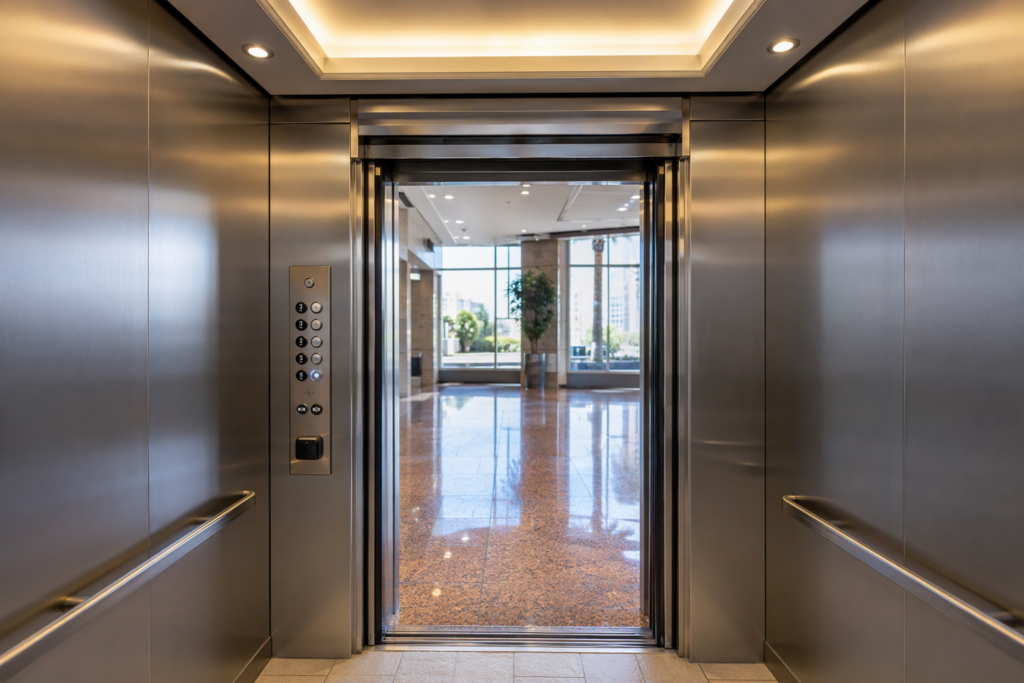
Elevator call box monitoring is the continuous 24-hour supervision of the two-way emergency communication device required inside every elevator cab, ensuring that a trapped passenger can reach a live attendant or emergency dispatch center at any time.
Under ASME A17.1 Safety Code for Elevators and Escalators, every passenger elevator must be equipped with a two-way means of communication that connects to a location staffed 24 hours a day, 7 days a week. This is not optional equipment — it is a code-mandated life safety system. The call box itself is typically a telephone handset, hands-free unit, or push-button device mounted in the cab. Monitoring refers to the contracted service that answers that call and, when necessary, dispatches emergency responders.
Monitoring continuity becomes critically important during any equipment change — cab refurbishment, controller replacement, modernization, or even a simple phone line upgrade — because each of those events can sever or disrupt the signal path between the call box hardware and the monitoring center. Building owners in Phoenix, Tucson, Scottsdale, and Mesa who do not audit their monitoring setup before and after an equipment change risk operating an elevator that appears compliant but cannot actually connect a trapped passenger to help.
What Causes Monitoring to Fail During an Equipment Change?

Monitoring failures during equipment changes most commonly occur because of incompatible hardware interfaces, severed wiring, deactivated telephone lines, or a monitoring contract that references old equipment serial numbers not updated to reflect the new installation.
Several specific failure modes are worth understanding in detail. First, traditional analog POTS (plain old telephone service) call boxes depend on a dedicated telephone line; if a building switches to VoIP during a broader technology upgrade, the analog call box signal may not transmit reliably over the digital line without a converter or replacement unit. Second, cellular-based call boxes require a valid SIM card and carrier contract — neither of which automatically transfers to new hardware. Third, when a controller is replaced or modernized, junction points in the elevator machine room wiring are often reconfigured, and a technician who does not trace the call box circuit to its monitoring interface can inadvertently disconnect it. Fourth, monitoring vendors typically register equipment by serial number and location; a new cab unit with a new serial number may not activate on the monitoring platform until the account is formally updated.
Does Arizona Law Require Call Box Monitoring After Equipment Changes?
Yes — Arizona law requires that any altered conveyance pass a state inspection before returning to service, and ASME A17.1-2019 (the code Arizona adopted effective January 9, 2023) mandates functional two-way communication as part of that inspection.
Under A.R.S. §§ 23-491 through 23-491.16 and Arizona Administrative Code R20-5-502 through R20-5-515, Arizona owners must have each conveyance inspected after any modification or alteration, in addition to the required annual inspection. The Industrial Commission of Arizona’s Elevator Division (formerly the ADOSH Elevator Safety Section until September 12, 2026) issues the certificate of inspection that allows a conveyance to legally operate. An elevator with non-functional call box monitoring will not pass that post-alteration inspection. The certificate must be kept at the same location as the conveyance and made available on request — a failed communication device is therefore not just a life safety risk but a compliance liability that prevents lawful operation.
Owners must also notify the state at least 90 days before installing, relocating, or altering a conveyance. That 90-day window is the ideal time to audit monitoring continuity and coordinate with both the monitoring vendor and the equipment contractor so that no gap in emergency communication occurs on the day of cutover.
Within the City of Phoenix, the Phoenix Elevator Section of the Planning and Development Department performs inspections inside city limits; the Industrial Commission of Arizona’s Elevator Division handles equipment outside Phoenix. Either authority will verify call box function as part of any post-alteration inspection.
Which ASME A17.1 Sections Govern Two-Way Emergency Communication?
ASME A17.1 Safety Code for Elevators and Escalators requires two-way communication capability in passenger elevator cabs, and Arizona has adopted the 2019 edition as the governing standard for equipment installed, repaired, or altered on or after January 1, 2023.
The 2019 edition of ASME A17.1 addresses two-way communication requirements for passenger elevators with the underlying principle that a person trapped in a cab must be able to initiate and sustain a voice conversation with a responsible party capable of taking action. The standard addresses both the hardware (the in-cab device) and the endpoint (a 24/7 staffed location). When equipment is changed, both elements must be verified — a functional handset that calls an unmonitored number, or a monitored number that no longer rings because a phone line was deactivated, both represent non-compliance with the intent and text of the code.
Arizona’s adoption of ASME A17.1-2019 also means that older equipment brought into compliance through modernization must meet the current edition’s requirements, not the edition in effect when the equipment was originally installed. Equipment owners who assume their legacy call box system is grandfathered may be incorrect if modernization work triggers full code compliance under the current adopted edition.
Does ADA Affect Call Box Requirements During Equipment Upgrades?
Yes — ADA (Americans with Disabilities Act) standards require that two-way emergency communication systems in elevators be accessible to people with hearing impairments, including a visual indicator that the call has been received and a means of two-way communication that does not rely solely on voice.
When equipment is upgraded, ADA compliance must be evaluated alongside ASME A17.1 compliance. An equipment change that installs a new call box without visual signaling for hearing-impaired passengers can create an ADA violation even if the unit is otherwise functional. Building owners in Arizona who use the equipment change as an opportunity to modernize call box hardware should confirm that the replacement unit meets current ADA Standards for Accessible Design, which apply to places of public accommodation and commercial facilities across all four markets — Phoenix, Tucson, Scottsdale, and Mesa.
What Steps Should Arizona Building Owners Follow Before Changing Elevator Equipment?
Building owners should follow a structured pre-change protocol to ensure monitoring continuity is preserved from the moment old equipment goes offline to the moment new equipment is activated.
- Notify the Industrial Commission of Arizona’s Elevator Division at least 90 days before the planned alteration, as required by Arizona law.
- Contact your monitoring vendor and confirm whether the new equipment’s make, model, and serial number are compatible with the monitoring platform and whether the account record must be updated.
- Determine whether the existing signal path (analog POTS line, VoIP adapter, or cellular) is compatible with the new call box hardware, and arrange for any necessary line upgrades or adapter installations before the cutover date.
- Confirm with your elevator contractor that the call box wiring circuit will be traced, labeled, and verified as intact after all other wiring work in the machine room or cab is completed.
- Schedule a full end-to-end communication test — cab to monitoring center — immediately after the new equipment is installed and before the elevator is returned to service.
- Obtain written confirmation from the monitoring vendor that the new unit is active on their platform, and retain that documentation alongside the state certificate of inspection.
- Coordinate the post-alteration inspection with either the Industrial Commission of Arizona’s Elevator Division or, for equipment inside the City of Phoenix, the Phoenix Elevator Section.
How Do Analog, VoIP, and Cellular Call Boxes Differ in Continuity Risk?
Analog (POTS), VoIP, and cellular call box systems each carry different continuity risks during an equipment change, and understanding those differences helps building owners make informed upgrade decisions.
| Call Box Technology | Primary Continuity Risk During Equipment Change | Key Mitigation Step | Compatibility with New Hardware |
|---|---|---|---|
| Analog POTS | Line deactivated by carrier or building IT during renovation | Confirm line remains active through cutover; test before reconnecting cab | Widely compatible; older hardware standard |
| VoIP (over building LAN) | Signal compression or packet loss causes garbled audio; analog call box may not handshake | Verify call box is rated for VoIP or install analog telephone adapter (ATA) | Requires VoIP-rated unit or ATA bridge |
| Cellular (GSM/LTE) | SIM and carrier contract do not transfer to new hardware; signal strength varies | Activate new SIM on new unit before removing old unit; test signal strength in hoistway | Unit-specific; SIM must be reactivated |
| IP-based (dedicated data) | Network configuration changes during IT upgrades can block monitoring platform IP | Coordinate with building IT; whitelist monitoring platform addresses | Requires network port and firewall access |
Will My Existing Monitoring Contract Cover New Equipment Automatically?
No — most monitoring contracts are tied to specific equipment identifiers such as serial numbers, cab locations, or hardware model numbers, and a new unit typically requires an explicit account update or contract amendment to be covered.
Building owners sometimes assume that because they continue paying monthly monitoring fees, the service automatically extends to replacement hardware. In practice, monitoring platforms register each call box as a distinct endpoint. When a new unit is installed, the monitoring center may receive a signal from an unrecognized device and either route it incorrectly or not route it at all. Owners should request written confirmation from their monitoring vendor that the new equipment has been registered and that a test call was received and logged correctly. This documentation is valuable both for internal records and for demonstrating compliance to inspectors.
Does Changing Only Part of the Elevator System Affect Monitoring?
Yes — partial equipment changes, including controller replacements, cab refurbishments, door operator upgrades, and signal system modernizations, can all disrupt call box monitoring if the wiring or power supply to the communication device is disturbed during the work.
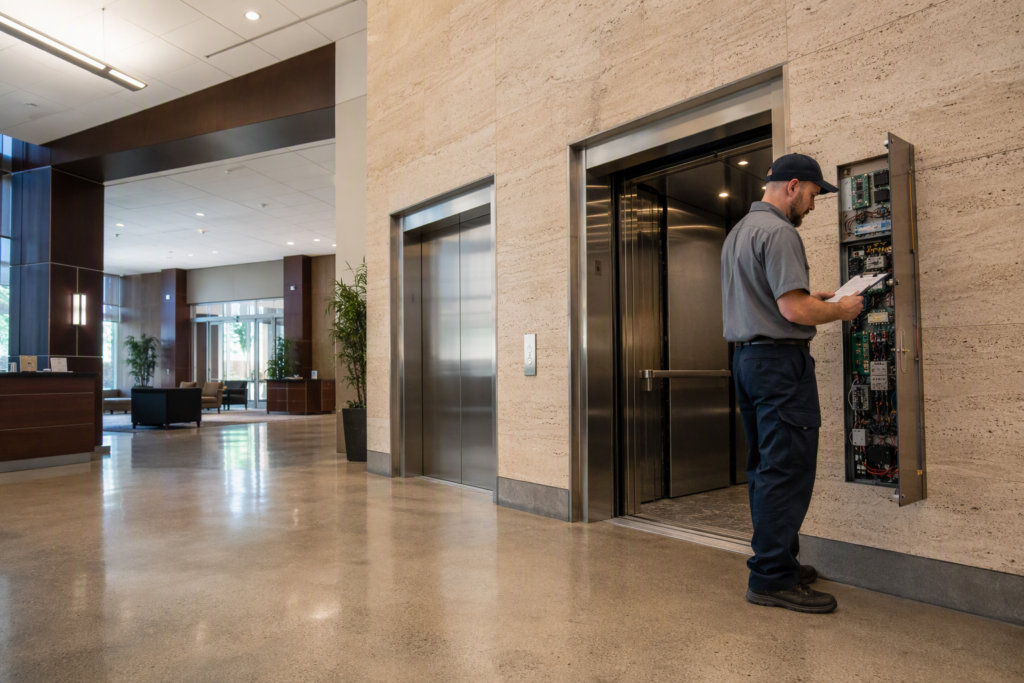
Controller replacement is one of the most common partial changes that affects monitoring. The call box circuit typically passes through or near the controller panel, and a contractor focused on the controller work may not trace or verify the communication wiring as a separate task. Similarly, cab interior refurbishments that involve pulling and reinstalling wiring behind wall panels have been known to leave call box cables disconnected after reassembly. A best practice is to treat the call box as a distinct system requiring its own verification checklist rather than assuming it will be unaffected by work performed in the same cab or machine room.
What Is the Monitoring Vendor’s Role During an Equipment Change?
The monitoring vendor must be treated as an active participant in the equipment change process, not merely notified after the fact, because the vendor controls the receiving end of the communication pathway and must be ready to accept and log calls from the new device on the first day it operates.
Responsible monitoring vendors will provide the building owner with a pre-change checklist covering hardware compatibility, account update procedures, and test call protocols. They should also confirm whether the new equipment requires firmware updates or programming changes to communicate with their specific monitoring platform. In some cases, a monitoring vendor may not support a particular new call box model, which would require either selecting a different monitoring vendor or selecting a different call box unit before purchase. Discovering that incompatibility after installation creates both cost and compliance risk.
How Should the Post-Change Monitoring Test Be Conducted?
A post-change monitoring test must verify the full communication path from the cab button or handset through the signal medium to the monitoring center operator and back, including confirmation that the operator can identify the correct location and equipment before dispatching any response.
- Ensure the elevator is in a safe, non-operating state with authorized personnel present.
- Activate the call box from inside the cab as a passenger would — pressing the help button or lifting the handset.
- Confirm that the monitoring center operator answers within the time specified in the service agreement.
- Verify that the operator correctly identifies the building address, elevator number, and cab location without being prompted — this confirms the account data was updated, not just that a signal was received.
- Confirm that any visual indicators required by ADA standards activate during the call (e.g., lighted indicators that the call was received).
- Document the test date, time, operator response, and any issues noted, and retain the record alongside the post-alteration inspection certificate.
- Repeat the test after any subsequent adjustment to wiring, software, or network configuration.
What Are the Consequences of a Monitoring Gap After an Equipment Change in Arizona?
A monitoring gap after an equipment change in Arizona can result in a failed post-alteration inspection, the inability to obtain or maintain a certificate of inspection, and potential liability if a passenger is injured or trapped without access to emergency communication.
Under A.R.S. §§ 23-491 through 23-491.16, no conveyance may legally operate in Arizona without a valid annual certificate of inspection. A post-alteration inspection that finds non-functional emergency communication will result in denial of that certificate, meaning the elevator must be taken out of service until compliance is demonstrated. For commercial buildings in Phoenix, Scottsdale, Tucson, and Mesa, an elevator outage during a tenant’s business hours carries real operational and financial consequences. Beyond regulatory compliance, the liability exposure from a trapped passenger who cannot reach emergency services because monitoring was inadvertently disconnected during an equipment change is significant.
How Long Does It Take to Restore Monitoring After a Disruption?
Restoration time depends on whether the disruption is a hardware, wiring, account, or carrier issue, and ranges from same-day resolution for account updates to several days for hardware replacement or carrier line reactivation.
Account-level issues — such as a monitoring platform not recognizing a new serial number — are typically resolved within one business day once the owner contacts the vendor with the correct equipment information. Wiring issues discovered during or after installation depend on the availability of the elevator contractor and the complexity of the cab or machine room layout. Carrier issues, particularly reactivating a POTS line that a telecom provider has deactivated or reassigned, can take several business days and sometimes require intervention by both the building’s telecom carrier and the monitoring vendor. Planning the monitoring transition before the equipment change, rather than troubleshooting after it, is the most effective way to keep restoration time at zero.
What Role Does the Arizona Contractor License Play in Equipment Changes?
Any contractor installing, altering, or repairing an elevator in Arizona must hold the appropriate license from the Arizona Registrar of Contractors — specifically the R-12 (residential) or C-12 (commercial) elevator license classification — which covers elevators, dumbwaiters, escalators, and moving walks.
The Arizona Registrar of Contractors issues R-12 and C-12 classifications that authorize the licensee to perform this work legally in Arizona. Owners who use unlicensed contractors for equipment changes take on significant legal and insurance risk, and work performed by an unlicensed contractor may not be accepted for the post-alteration inspection. The license classifications do not issue the certificate of inspection — that authority belongs to the Industrial Commission of Arizona’s Elevator Division (or the Phoenix Elevator Section for equipment inside the City of Phoenix) — but using a properly licensed contractor is a prerequisite for a clean inspection outcome. Arizona Elevator Solutions holds the appropriate contractor licensing for work in Phoenix, Tucson, Scottsdale, and Mesa.
Does Equipment Brand or Manufacturer Affect Monitoring Compatibility?
Yes — some elevator manufacturers use proprietary communication protocols or cab wiring configurations that are not universally compatible with third-party monitoring platforms, making brand selection a factor in monitoring continuity planning.
Proprietary systems are more common in fully integrated modernization packages where the cab communication unit, controller, and monitoring interface are all supplied by the same manufacturer. While these systems can offer streamlined functionality, they may also lock the building owner into a single monitoring vendor or require a certified technician from the manufacturer to make account changes. Open-platform call box systems typically offer greater flexibility in monitoring vendor selection and are easier to integrate with existing building communication infrastructure. Owners evaluating equipment changes should ask prospective vendors explicitly about monitoring platform compatibility before committing to a specific hardware package.
What Documentation Should Arizona Owners Retain After an Equipment Change?
Arizona owners should retain the post-alteration inspection certificate, written monitoring vendor confirmation that the new equipment is registered and tested, wiring diagrams showing the call box circuit as installed, and any warranty or service documentation for the new call box hardware.
Under Arizona law, the certificate of inspection must be kept at the same location as the conveyance and made available for inspection on request. The state serial number or certificate must also be posted in or close to the conveyance in an easily accessible location. Beyond those statutory requirements, retaining monitoring test records and vendor confirmation letters creates a compliance audit trail that can protect building owners in the event of a complaint, accident investigation, or regulatory audit. Arizona Elevator Solutions recommends maintaining a dedicated equipment file for each conveyance that is updated after every inspection, alteration, or monitoring system change.
How Does Firefighters’ Emergency Operation Interact with Call Box Monitoring During Equipment Changes?
Arizona conveyances with firefighters’ emergency operation must use the Arizona Firefighters Service (AZFS) key, and any equipment change that affects the firefighters’ service panel or cab communication system must be verified to ensure both systems remain functional and compliant after the alteration.
Firefighters’ emergency operation and two-way emergency communication are distinct but related life safety systems. An equipment change that inadvertently disables firefighters’ service while the contractor is working on call box wiring — or vice versa — creates a compound compliance failure. Both systems must be tested independently as part of the post-alteration inspection process. Owners planning equipment changes that affect the cab interior, controller, or machine room wiring should ensure their contractor provides a specific verification checklist for both the AZFS firefighters’ service key function and the call box monitoring circuit.
When Should Building Owners in Arizona Consider Upgrading Call Box Technology During an Equipment Change?
An equipment change is the most cost-effective time to upgrade call box technology because the cab is already open, wiring is accessible, and a post-alteration inspection is already required — making it an efficient opportunity to address aging or analog infrastructure before it fails independently.
Many buildings in Phoenix, Tucson, Scottsdale, and Mesa still operate call boxes connected via POTS lines that telecom carriers are progressively decommissioning. An equipment change that modernizes other components while leaving a legacy analog call box in place may create a secondary compliance issue within a few years as carrier infrastructure disappears. Transitioning to a cellular or IP-based call box during a planned equipment change avoids a future emergency repair scenario where monitoring fails because a phone line was quietly disconnected by the carrier. Arizona Elevator Solutions can evaluate existing call box infrastructure during any service visit and provide guidance on upgrade options that align with both current code requirements and the building’s long-term communication infrastructure.
How Can Property Managers Verify That Monitoring Is Active After an Equipment Change?
Property managers can verify active monitoring through a supervised test call, written confirmation from the monitoring vendor, and a review of the monitoring platform’s call log showing a received and logged test event linked to the specific cab and building address.
A visual inspection of the call box unit — confirming it has power, any status indicators are illuminated, and the handset or button responds — is a necessary first check but not sufficient on its own. The only reliable verification is a live end-to-end test that confirms the monitoring center operator receives the call, identifies the correct location, and logs the event. Property managers should schedule this test immediately after equipment installation, retain the log entry or written confirmation from the vendor, and repeat the test quarterly as a best practice for ongoing assurance. Arizona Elevator Solutions includes monitoring verification as part of its post-alteration service coordination for properties it services in Phoenix, Tucson, Scottsdale, and Mesa.
What Should Arizona Building Owners Do If Monitoring Fails After an Equipment Change?
If monitoring fails after an equipment change, building owners should immediately take the elevator out of service, notify the Industrial Commission of Arizona’s Elevator Division if required, and engage both the equipment contractor and monitoring vendor simultaneously to identify and resolve the failure before returning the elevator to operation.
- Post an out-of-service notice on the elevator and prevent passenger access.
- Contact the equipment contractor to verify that all call box wiring connections are intact and that the unit has power.
- Contact the monitoring vendor to confirm whether the unit is registered on their platform and whether any signal has been received from the new device.
- Determine whether the signal medium (phone line, cellular signal, or network connection) is active and passing a clean signal.
- Conduct a supervised end-to-end test call once any identified issue is resolved.
- Notify the Industrial Commission of Arizona’s Elevator Division (or the Phoenix Elevator Section for equipment inside Phoenix) if the outage constitutes a reportable condition under Arizona Administrative Code R20-5-502 through R20-5-515.
- Document all steps taken, retain the resolution confirmation from the vendor, and update the equipment file before returning the elevator to service.
Arizona Elevator Solutions is available to assist Phoenix, Tucson, Scottsdale, and Mesa property owners in diagnosing and resolving monitoring failures as part of post-alteration service support.
Contact Arizona Elevator Solutions for a free elevator assessment at 480-557-7600.
Need elevator service you can rely on? Arizona Elevator Solutions is ready to help.