How Often Should a Commercial Elevator Be Serviced — And What Does a Maintenance Visit Actually Include?
Commercial elevator maintenance is a regulatory requirement and a practical necessity for any multi-story building in Arizona. The frequency and scope of service visits depend on elevator type, usage volume, building occupancy class, and applicable codes. This guide answers the most common questions building owners, property managers, and facility directors ask about commercial elevator service schedules and what actually happens during each visit — drawing on ASME A17.1 Safety Code for Elevators and Escalators, ADA accessibility requirements, and current Arizona regulatory guidance as of 2026.
How Often Should a Commercial Elevator Be Serviced?
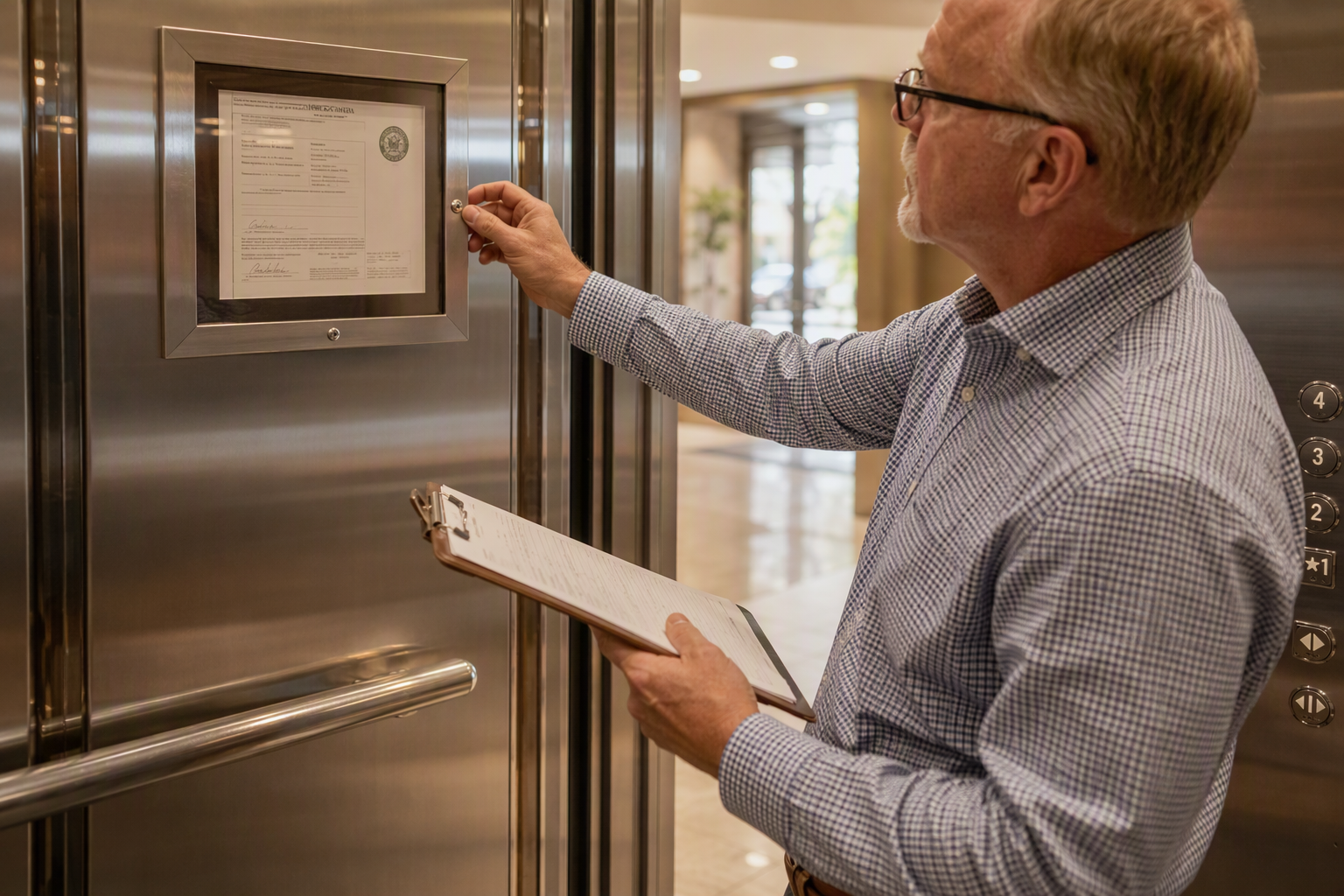
At minimum, commercial elevators require monthly lubrication and safety checks, quarterly comprehensive maintenance visits, and an annual code-mandated inspection.
High-traffic commercial installations — such as those in hospitals, hotels, or large retail environments — often benefit from bi-weekly or even weekly visits due to accelerated wear on mechanical components. Lower-traffic installations in small office buildings may safely operate on a monthly maintenance schedule provided no warning signs emerge between visits.
The baseline service interval is not arbitrary. The ASME A17.1 Safety Code for Elevators and Escalators establishes minimum maintenance, inspection, and testing requirements that elevator contractors and building owners must follow. Arizona enforces these requirements through its state elevator safety program, and non-compliance can result in shutdown orders, fines, and liability exposure for building owners.
What Is the Difference Between Routine Maintenance and a Code-Required Inspection?
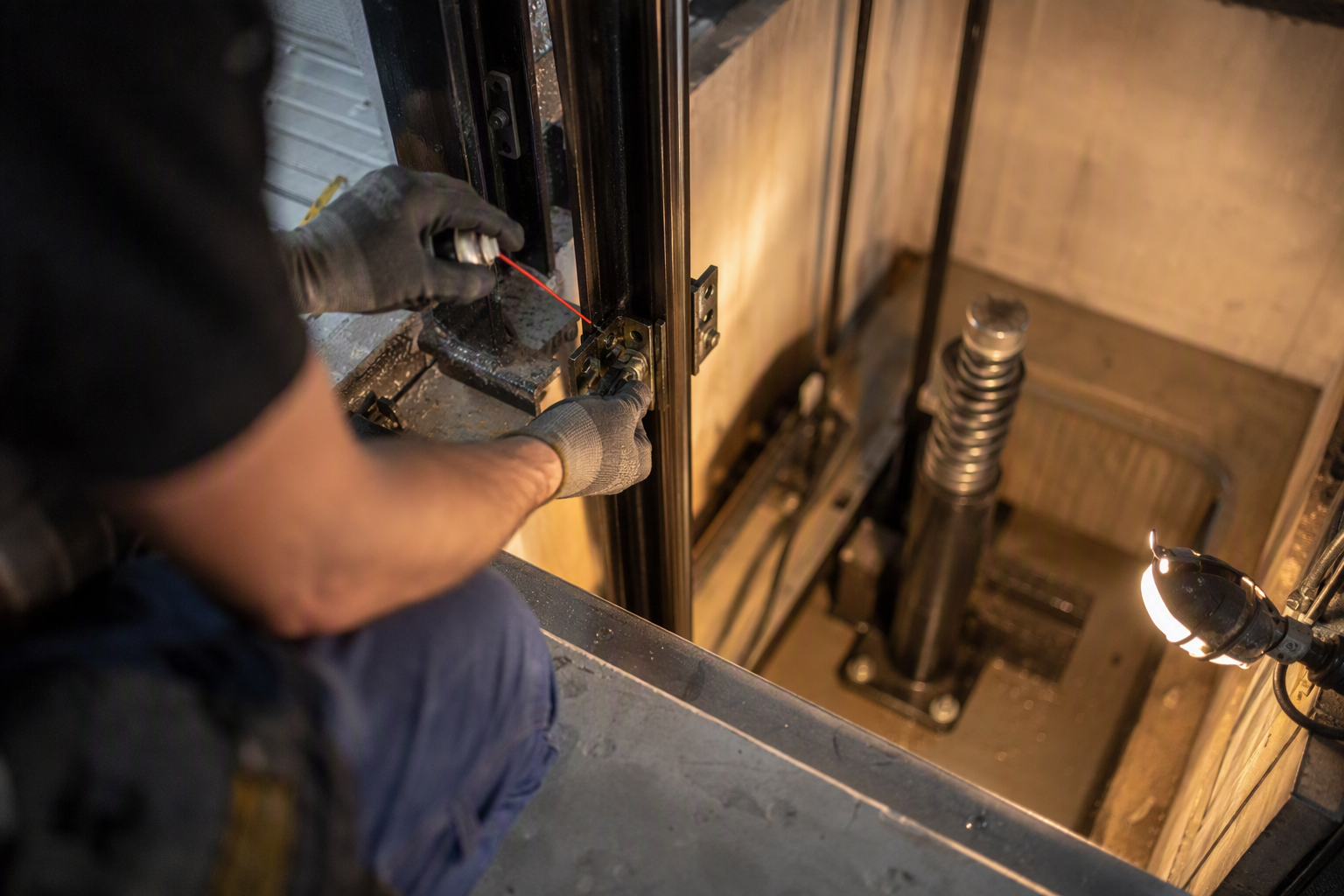
Routine maintenance is performed by an elevator service contractor on an agreed schedule to keep the unit running safely, while a code-required inspection is conducted by a licensed third-party inspector or state authority to verify that the elevator meets all applicable safety standards.
Building owners often conflate these two distinct activities. Routine maintenance visits are performed proactively by the elevator service company — tasks like lubricating moving parts, testing door operation, checking fluid levels, and monitoring safety devices. These visits do not result in a certificate; they result in a service record.
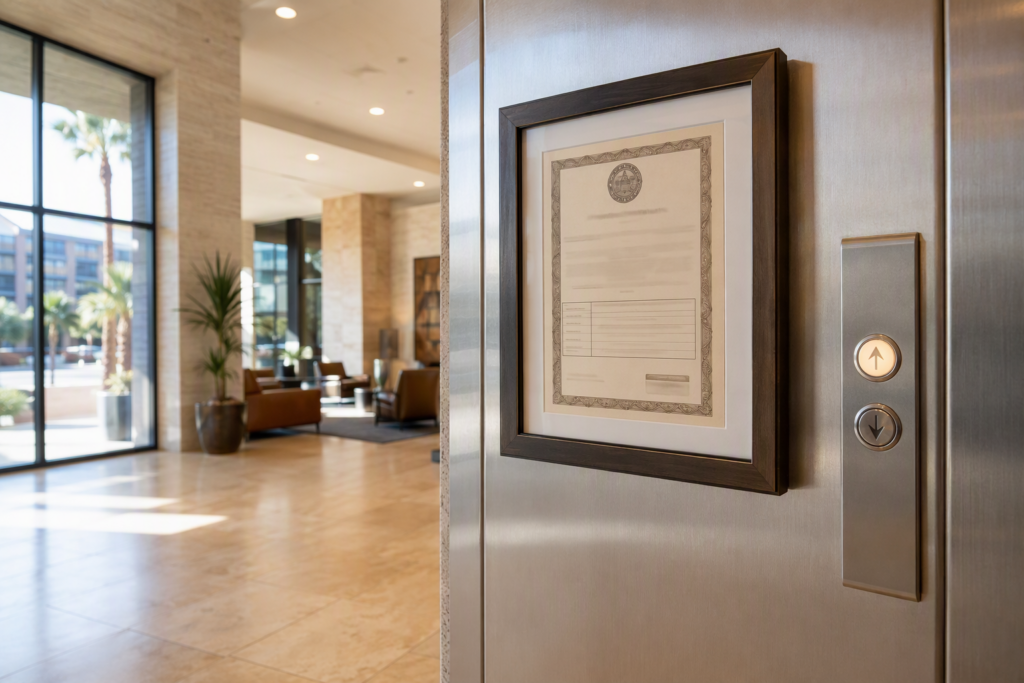
Code-required inspections, by contrast, are formal examinations that generate a certificate of inspection. In Arizona, elevators must pass a periodic inspection to receive a valid certificate, which must be posted in or near the elevator cab. Failure to maintain a valid certificate can result in the elevator being placed out of service. Arizona Elevator Solutions coordinates with state-approved inspectors to help property managers in Phoenix, Tucson, Scottsdale, and Mesa maintain continuous compliance.
What Does a Monthly Elevator Maintenance Visit Actually Include?
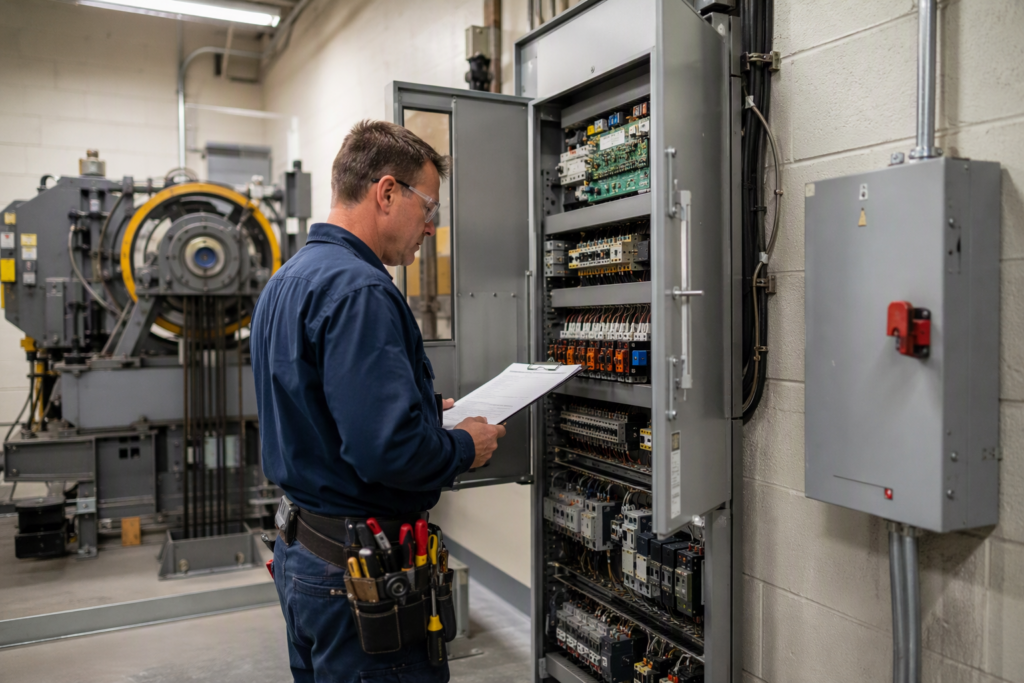
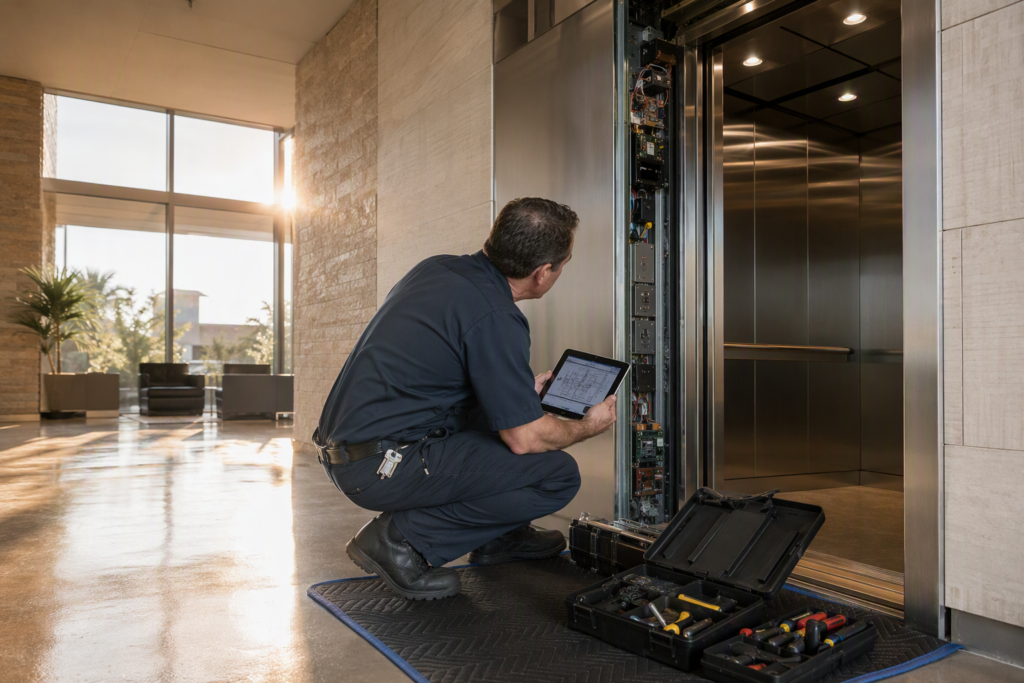
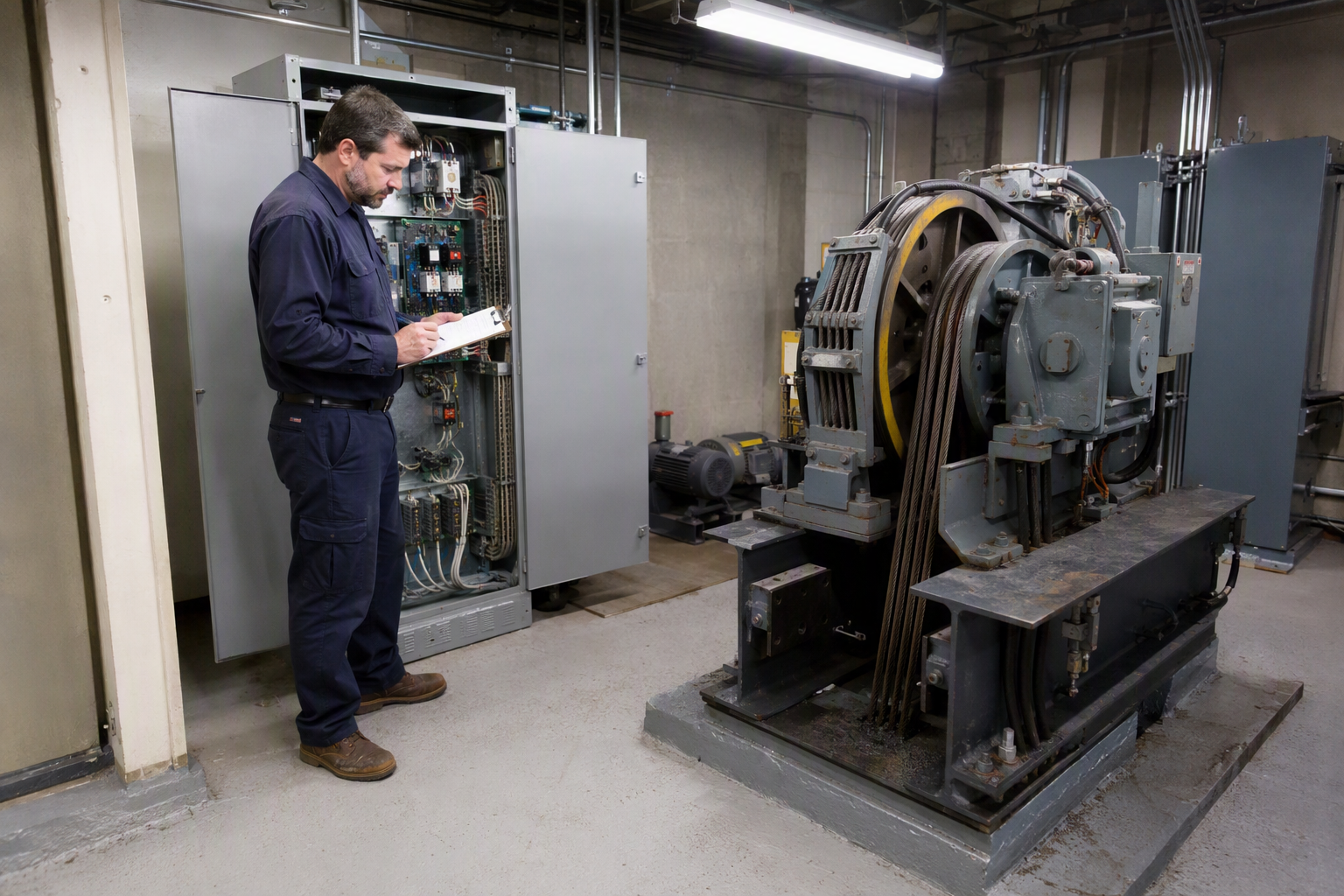
A standard monthly maintenance visit covers lubrication of moving mechanical components, door system checks, safety device testing, cab interior inspection, and a review of the machine room for environmental or equipment concerns.
During a monthly visit, a qualified elevator mechanic works through a structured checklist. Key tasks typically include:
- Lubricating guide rails, rollers, and sheaves
- Inspecting and adjusting door operators, clutches, and sills
- Testing the door reversal mechanism and door close force
- Checking leveling accuracy at each landing
- Inspecting the pit for water intrusion, debris, or oil accumulation
- Testing the emergency stop function and interlock switches
- Verifying lighting in the cab, pit, and machine room
- Reviewing the machine room temperature (critical in Arizona’s extreme summer heat)
- Logging all findings in a written service record
Arizona’s desert climate presents unique challenges. Machine room temperatures can exceed safe operating thresholds for elevator controls and hydraulic oil viscosity during Phoenix and Tucson summers, making the machine room temperature check especially important in this region.
What Does a Quarterly Comprehensive Maintenance Visit Include?
A quarterly visit expands on monthly tasks by adding in-depth testing of brake systems, governor and safety mechanisms, hydraulic systems or traction rope/chain inspection, and a thorough review of all electrical controls and contactors.
Quarterly visits are the standard interval at which deeper mechanical and electrical assessments are completed. Tasks that go beyond a monthly visit include:
- Brake lining inspection and brake adjustment
- Governor rope tension and condition check
- Hydraulic fluid level, pressure relief valve testing, and leak inspection (for hydraulic elevators)
- Hoist rope or chain elongation and wear measurement (for traction elevators)
- Motor and controller electrical testing
- Safety edge and light curtain verification
- Overload and underload sensor calibration
- Emergency lighting and communication system test (including the phone or intercom required under ADA guidelines)
- Updated service log entry with findings and any recommended repairs
What Happens During an Annual Elevator Inspection?
An annual inspection conducted by a licensed inspector per ASME A17.1 involves a full witness test of all safety systems, load testing where required, a review of maintenance records, and issuance of a certificate of inspection if the unit passes.
The annual inspection is the most rigorous formal evaluation a commercial elevator undergoes on a routine basis. In Arizona, this inspection must be performed by or in the presence of an inspector authorized by the state. The process typically includes:
- Review of the maintenance log and previous inspection report
- Physical examination of the machine room, including motor, controller, and disconnect
- Pit inspection for safety switch function, lighting, and stop switches
- Hoistway inspection for guide rail condition, counterweight, and buffers
- Full operational test at each floor landing
- Safety device tests including governor trip and safeties (where accessible)
- Door timing, reopening device, and interlock verification at every landing
- Emergency operation test including fire service Phase I and Phase II
- Load test if the elevator has undergone major alteration or if required by the inspection schedule
- Issuance of certificate or a deficiency list requiring corrective action
How Does Elevator Type Affect Maintenance Frequency and Scope?
Hydraulic, traction, and machine-room-less (MRL) elevators each have distinct maintenance requirements based on their drive systems, safety mechanisms, and component wear patterns.
| Elevator Type | Key Monthly Focus | Key Quarterly Focus | Special Considerations in Arizona |
|---|---|---|---|
| Hydraulic | Fluid level, oil leaks, cylinder seals | Pressure relief testing, fluid viscosity, jack condition | Fluid viscosity changes with extreme heat; underground cylinders may require periodic pressure testing |
| Geared Traction | Gear oil level, brake adjustment, rope condition | Rope elongation measurement, motor insulation test, gear wear | Dust ingress into gearboxes is a concern in desert environments |
| Gearless Traction | Sheave groove wear, brake coil condition | Hoist rope diameter measurement, motor windings, encoder calibration | High ambient temperatures affect motor cooling efficiency |
| MRL (Machine-Room-Less) | Drive unit temperature, rope/belt condition | Drive system firmware check, brake module test, controller inspection | Controller electronics are more vulnerable to heat without a dedicated machine room |
What ASME and ADA Codes Apply to Commercial Elevator Maintenance?
The primary governing standard is the ASME A17.1 Safety Code for Elevators and Escalators, supplemented by ADA requirements for accessibility features and OSHA standards for worker safety during maintenance operations.
ASME A17.1 defines maintenance, inspection, and testing requirements in detail, including intervals for various types of tests. The 2019 edition of ASME A17.1 (with subsequent supplements, referenced in 2026 practice) distinguishes between periodic tests, which are conducted on multi-year cycles, and routine maintenance tasks performed more frequently. States and jurisdictions adopt ASME A17.1 by reference and may add local amendments.
ADA requirements relevant to elevator maintenance include the proper function of cab call buttons, floor indicators, audible signals, door timing, and the emergency communication system. If any of these features are found non-operational during a maintenance visit, correction is required to maintain accessibility compliance.
OSHA standards under 29 CFR Part 1926 Subpart R and related standards govern the safety of elevator mechanics themselves during maintenance and repair activities, including lockout/tagout procedures and fall protection in hoistways and pits.
What Are the Consequences of Skipping or Deferring Elevator Maintenance?
Deferred maintenance on a commercial elevator can result in safety incidents, regulatory shutdown orders, increased repair costs, voided insurance coverage, and legal liability for building owners.
Elevators that are not maintained on schedule accumulate deferred wear and component degradation that may not be immediately visible but can lead to sudden failures. Door system malfunctions are among the most common causes of elevator-related injuries. Brake system degradation, hydraulic seal failures, and rope wear are slower processes that become serious safety hazards when left unaddressed.
From a regulatory standpoint, an elevator operating without a current certificate of inspection in Arizona is subject to removal from service. Insurance carriers may also deny claims arising from incidents on unmaintained equipment. Arizona Elevator Solutions advises building owners in Phoenix, Scottsdale, Mesa, and Tucson to maintain continuous maintenance contracts to avoid these compounding risks.
How Should Building Owners Choose a Commercial Elevator Maintenance Provider?
Building owners should evaluate prospective elevator maintenance providers on the basis of their licensing and certifications, familiarity with local Arizona regulatory requirements, range of equipment experience, and the transparency of their maintenance reporting.
Key questions to ask a prospective elevator service contractor include:
- Are your mechanics licensed under Arizona’s elevator contractor licensing requirements?
- Do you carry the required liability and workers’ compensation insurance?
- What does your maintenance contract explicitly include and exclude?
- How do you document service visits, and will I receive written records?
- Do you have experience with the specific elevator brand and model installed in my building?
- How do you handle emergency service calls?
- Will you coordinate directly with the state inspector for annual inspections?
Transparency in service documentation is particularly important. A reputable contractor provides written service records after every visit that building owners can present during inspections or insurance audits.
How Does Building Usage Volume Affect Recommended Service Frequency?
Elevators in high-traffic buildings such as hospitals, hotels, and large office towers experience accelerated component wear and should be serviced more frequently than units in low-traffic buildings such as small office parks or residential buildings.
A useful way to think about service intervals is in terms of door cycles. Elevator doors are among the highest-wear components, and in a high-traffic building, a single elevator may complete thousands of door cycles per day. Door components, operator clutches, gibs, and sills wear proportionally faster under this load. Maintenance contracts for high-traffic installations should reflect this reality with more frequent door system inspections and adjustments.
Conversely, very low-use elevators — such as those in small professional office suites — may accumulate fewer cycles but are still subject to time-based degradation of lubricants, seals, and electrical contacts. A minimum monthly visit schedule applies regardless of usage, and the annual inspection requirement is fixed regardless of traffic volume.
What Should a Building Owner Do If an Elevator Shows a Warning Sign Between Scheduled Visits?
If an elevator displays abnormal behavior between scheduled maintenance visits, the correct response is to take the unit out of service, notify the elevator service contractor, and not return the elevator to service until it has been inspected and cleared by a qualified mechanic.
Follow these steps in order when a warning sign is observed:
- Do not continue to use the elevator if passengers or operators report unusual sounds, vibration, rough leveling, slow or erratic door operation, or any safety device activation.
- Post the elevator out of service and prevent further access where possible.
- Contact your elevator maintenance contractor to report the observed symptoms in specific detail.
- Document the observations with date, time, and a written description of the symptoms.
- If passengers are trapped, do not attempt self-rescue — contact emergency services and the elevator contractor simultaneously.
- Wait for a qualified mechanic to inspect and clear the unit before returning it to service.
- Request a written report from the mechanic documenting what was found and what corrective action was taken.
How Often Should Hydraulic Elevator Fluid Be Tested or Replaced?
Hydraulic elevator fluid should be tested for contamination, viscosity, and moisture content at least annually, with replacement performed when test results indicate degradation — a timeline that varies by usage level and environmental exposure.
In Arizona, the extreme summer heat accelerates hydraulic fluid breakdown by promoting oxidation and viscosity thinning. Underground hydraulic cylinders add the risk of groundwater contamination if cylinder seals degrade. Fluid condition directly affects the smoothness of elevator operation and the integrity of seal components throughout the system. Contaminated or degraded fluid accelerates wear on the pump, valve assembly, and cylinder seals, turning a relatively low-cost fluid replacement into a potentially expensive component repair.
What Records Should Building Owners Keep for Elevator Maintenance Compliance?
Building owners should retain copies of all service visit reports, inspection certificates, test reports, repair invoices, and variance or correction notices in a dedicated elevator file that is accessible to inspectors upon request.
ASME A17.1 requires that a maintenance control program (MCP) be established for each elevator, with records maintained to demonstrate compliance. In practice, this means a building file should contain:
- Current certificate of inspection (posted in or near the cab)
- Maintenance log or service records from all routine visits
- Records of periodic tests as required by ASME A17.1
- Documentation of any repairs, alterations, or replacements
- Copies of any deficiency notices and proof of correction
- Maintenance contract with the current service provider
What Is a Maintenance Control Program (MCP) and Is It Required?
A Maintenance Control Program (MCP) is a written document required under ASME A17.1 that defines the maintenance tasks, intervals, and procedures specific to each elevator installation.
The MCP requirement was introduced in modern editions of ASME A17.1 to formalize what had previously been informal maintenance practices. An MCP must be specific to the equipment — it cannot be a generic document — and must be available to the inspector during the annual inspection. Elevator service contractors are typically responsible for preparing and maintaining the MCP as part of a full-service maintenance contract. Building owners who use piecemeal or self-managed maintenance arrangements must ensure an MCP exists for each unit.
How Do Fire Service and Emergency Operations Factor Into Elevator Maintenance?
Fire service Phase I (recall) and Phase II (firefighter) operations must be tested as part of the maintenance and inspection schedule because these functions are life-safety systems required to operate reliably during a fire emergency.
During a fire event, a commercial elevator is expected to recall to the designated landing automatically when smoke detectors trigger Phase I, and to respond to firefighter manual control under Phase II. If these systems are not tested and maintained, the elevator may fail to perform these functions when needed. ASME A17.1 specifies testing requirements for fire service features, and Arizona’s fire code requirements align with these standards. Fire service testing is typically included in quarterly and annual maintenance visits rather than monthly visits.
What Is the Difference Between a Full-Service Maintenance Contract and a Examine-and-Report Contract?
A full-service maintenance contract covers the cost of routine maintenance labor and many parts within the contract scope, while an examine-and-report (oil and grease) contract covers only the labor for inspection visits, with all repairs and parts billed separately.
Building owners should carefully evaluate which contract structure suits their situation. A full-service contract provides more predictable maintenance costs and incentivizes the contractor to keep the elevator in good condition through preventive attention. An examine-and-report contract may appear less expensive initially but can result in higher total costs if significant repairs are deferred or if labor is billed separately for every adjustment.
Regardless of contract type, building owners should ensure the contract explicitly describes what maintenance tasks are included, what is excluded, how repairs are authorized and priced, and what the notice and termination terms are.
How Does Arizona’s Climate Specifically Affect Commercial Elevator Maintenance Needs?
Arizona’s extreme heat, low humidity, monsoon season dust, and significant temperature differentials between indoor and outdoor environments create specific maintenance challenges that require locally experienced elevator service providers.
Phoenix, Scottsdale, Mesa, and Tucson all experience summer temperatures that regularly exceed safe operating ranges for elevator machine room electronics and hydraulic fluid performance. Specific climate-related maintenance considerations include:
- Machine room cooling: HVAC or ventilation systems in machine rooms must be functional and serviced; failure can cause controller overheating and elevator shutdown
- Dust and particulate intrusion: Monsoon season brings fine dust that can infiltrate electrical cabinets and mechanical spaces, requiring additional cleaning attention
- Hydraulic fluid viscosity: Heat thins hydraulic fluid, potentially affecting system pressure; fluid formulation should be appropriate for high-temperature environments
- Seal and gasket degradation: Thermal cycling between air-conditioned building interiors and hot mechanical spaces accelerates seal aging
- UV and heat effects on cab interiors: Fixtures, ceiling panels, and call button components in sun-exposed cabs may degrade faster
Arizona Elevator Solutions brings region-specific knowledge of these conditions to every maintenance visit across the Phoenix metro, Tucson, Scottsdale, and Mesa markets.
What Is the Role of Modernization in Reducing Maintenance Frequency or Cost?
Elevator modernization — upgrading controls, drive systems, door operators, or cab components — can reduce maintenance frequency for specific components, extend overall equipment lifespan, and improve code compliance, though it does not eliminate the need for regular maintenance.
Older elevators with relay-logic controllers, worn rope systems, or obsolete door operators require more frequent attention and are more likely to generate deficiencies during inspections. Modernizing these components to current solid-state controls, improved drive systems, and contemporary door operators typically reduces the frequency of reactive service calls and simplifies compliance with current editions of ASME A17.1 and ADA requirements.
Modernization decisions should be evaluated against the age of the equipment, the frequency and cost of current repairs, the availability of replacement parts for existing components, and the cost of bringing older equipment into compliance with current code requirements when alterations trigger full compliance reviews.
How Are Elevator Maintenance Costs Typically Structured?
Commercial elevator maintenance costs vary based on elevator type, age, usage, contract scope, and market — building owners should request itemized proposals and compare full-service versus examine-and-report structures before committing to a contract.
Rather than providing figures that would vary widely by installation and cannot be verified, building owners are best served by obtaining written proposals that itemize the services included, the visit frequency, and any exclusions. Key cost drivers to understand include the number of units, the type of elevator, the building’s location and accessibility, the age of the equipment (which affects parts availability and repair frequency), and whether the contract includes major components such as hoist ropes, door operators, or controller repairs.
It is advisable to obtain at minimum two or three proposals and to evaluate them on a total-cost basis over the contract term rather than on monthly rate alone.
When Should a Building Owner Consider Replacing Rather Than Maintaining an Aging Elevator?
Replacement becomes economically and practically preferable when an elevator requires repairs whose cumulative cost approaches or exceeds the cost of modernization, when parts are no longer available from manufacturers, or when the unit cannot be brought into current code compliance through repair alone.
There is no universal age threshold that mandates elevator replacement — a well-maintained unit can remain in safe service well beyond its original design life if parts are available and code compliance is maintained. However, elevators reaching the end of the parts availability window for their control systems, or those requiring significant structural modifications to meet current ASME A17.1 or ADA requirements triggered by an alteration, may face replacement as the most practical path forward.
Need elevator service you can rely on? Arizona Elevator Solutions is ready to help.