Do Elevator Service Companies Also Maintain the Fire Alarm Panel? A Complete FAQ for Arizona Building Owners
Elevator service companies do not maintain fire alarm panels. Fire alarm systems are a separate trade covered by distinct licensing, codes, and inspection authorities. However, the elevator and fire alarm systems at any building must communicate correctly with each other — and that coordination is a critical compliance responsibility that building owners in Phoenix, Tucson, Scottsdale, and Mesa cannot afford to overlook.
Do elevator service companies maintain the fire alarm panel at the same location they service the elevator?
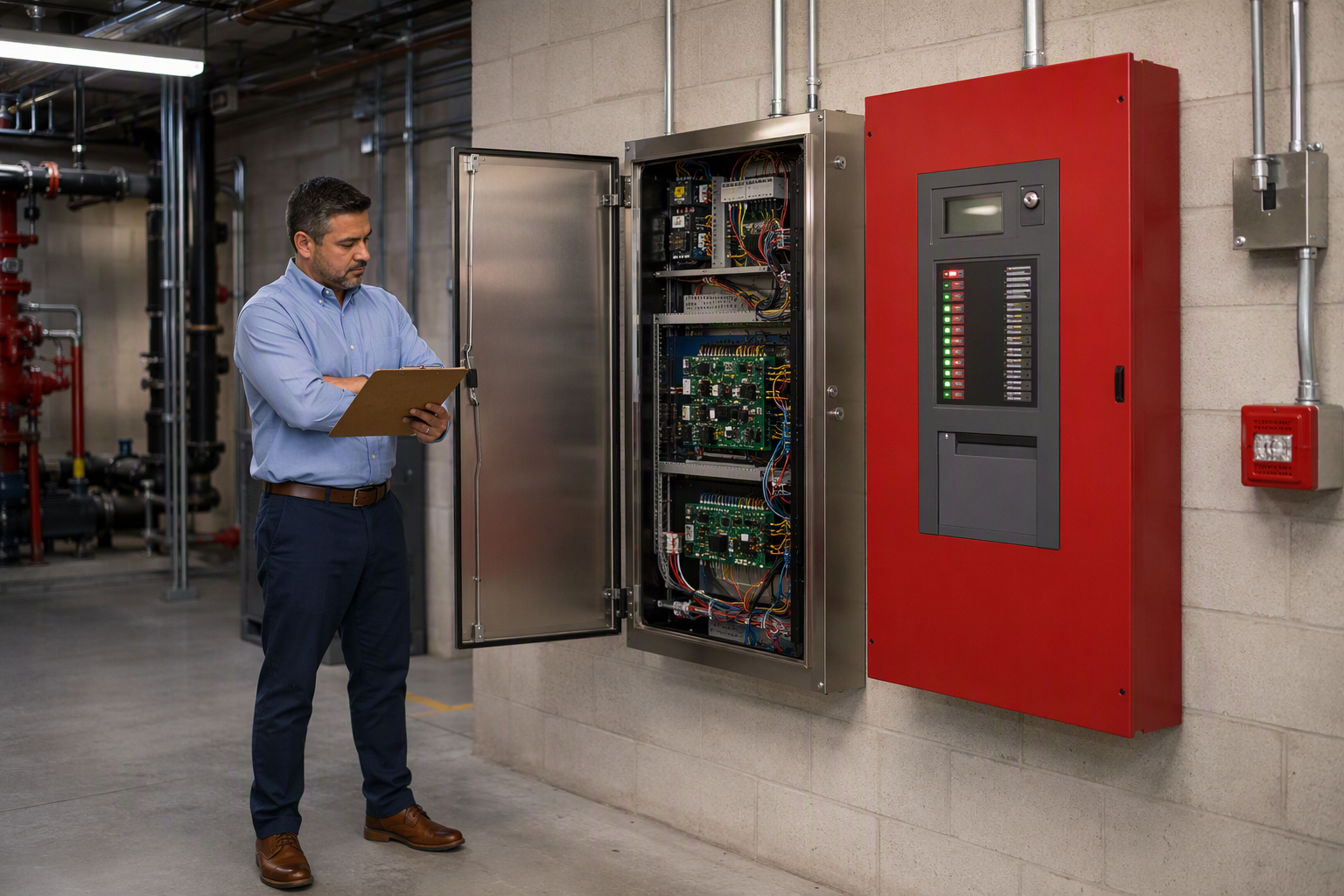
No — elevator service companies are not licensed or equipped to maintain fire alarm panels, which require a separate fire alarm contractor credential entirely distinct from elevator contractor licensing.
This is one of the most common misconceptions building owners hold after signing an elevator maintenance contract. Owners sometimes assume that because the elevator responds to fire alarm signals, the elevator contractor is responsible for the entire chain of equipment. In practice, the two systems are governed by different codes, inspected by different authorities, and serviced by different licensed trades. Conflating the two can leave gaps in both elevator compliance and fire safety compliance.
In Arizona, elevator contractors must hold an R-12 or C-12 license from the Arizona Registrar of Contractors, under A.R.S. §§ 23-491 through 23-491.16. Fire alarm contractors operate under a completely separate licensing framework administered by the State Fire Marshal’s Office and local fire authorities. Neither license authorizes work under the other.
What is the connection between a fire alarm system and an elevator?
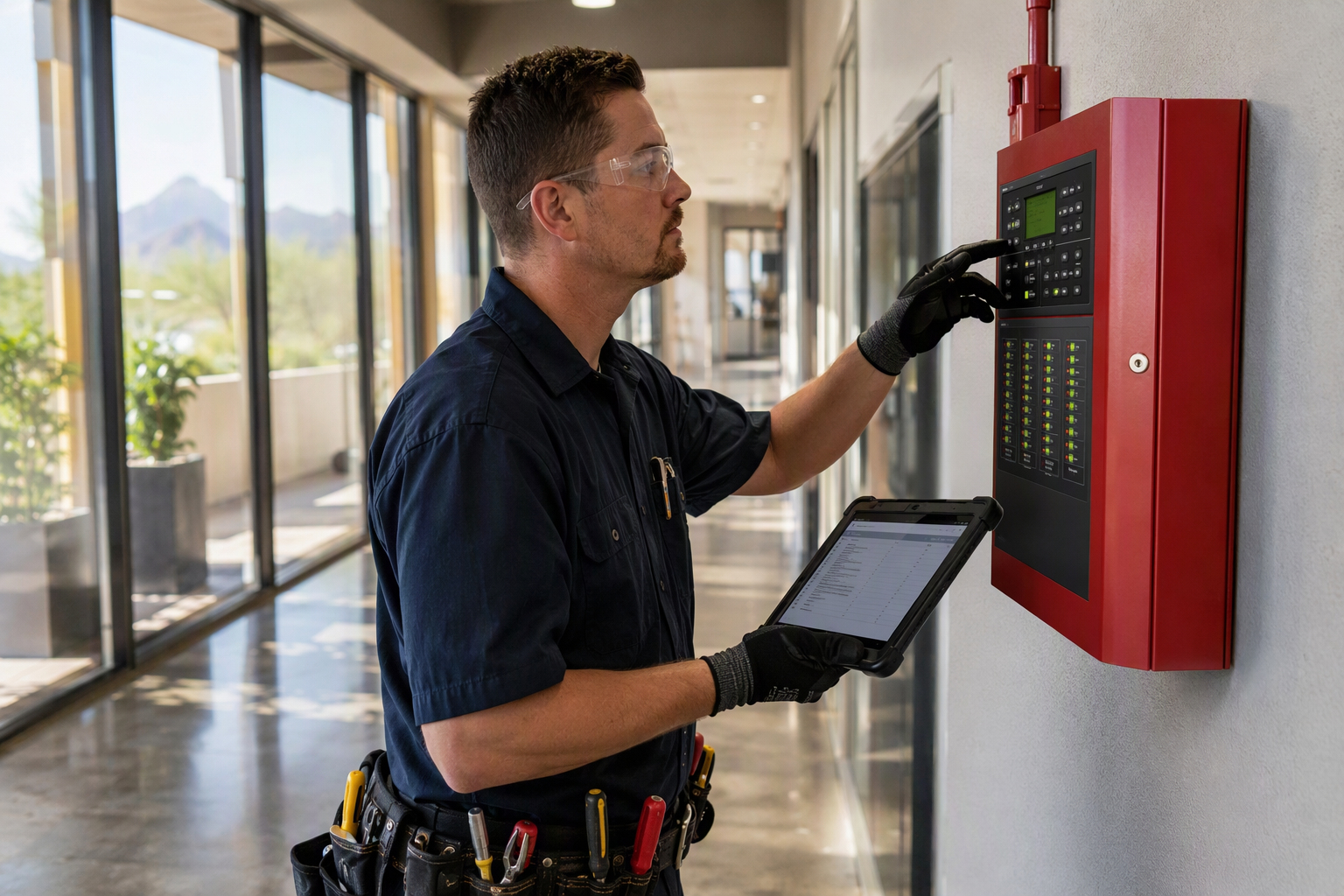
Fire alarm systems send signals to elevator controls to initiate Phase I Emergency Recall and Phase II Firefighter Service operations, making the two systems functionally interdependent even though they are separately owned and maintained.
When a smoke detector triggers in an elevator machine room, hoistway, or lobby, the fire alarm panel sends a signal to the elevator controller to recall the cab to the designated recall floor and open its doors. This is called Phase I Emergency Recall, and it is required under the ASME A17.1 Safety Code for Elevators and Escalators, which Arizona has adopted in the 2019 edition for equipment installed, repaired, or altered on or after January 1, 2023. Phase II allows trained firefighters to take manual control of the cab. Both phases depend on a correctly functioning and properly calibrated fire alarm panel sending the right signals at the right time.
If the fire alarm panel is out of calibration, uses incorrect zone assignments, or sends spurious signals, the elevator may recall unexpectedly, fail to recall when needed, or behave erratically during an actual fire emergency. This is why building owners must maintain both systems — and ensure the two contractors coordinate with each other during testing.
What does the elevator contractor actually do regarding fire safety systems?
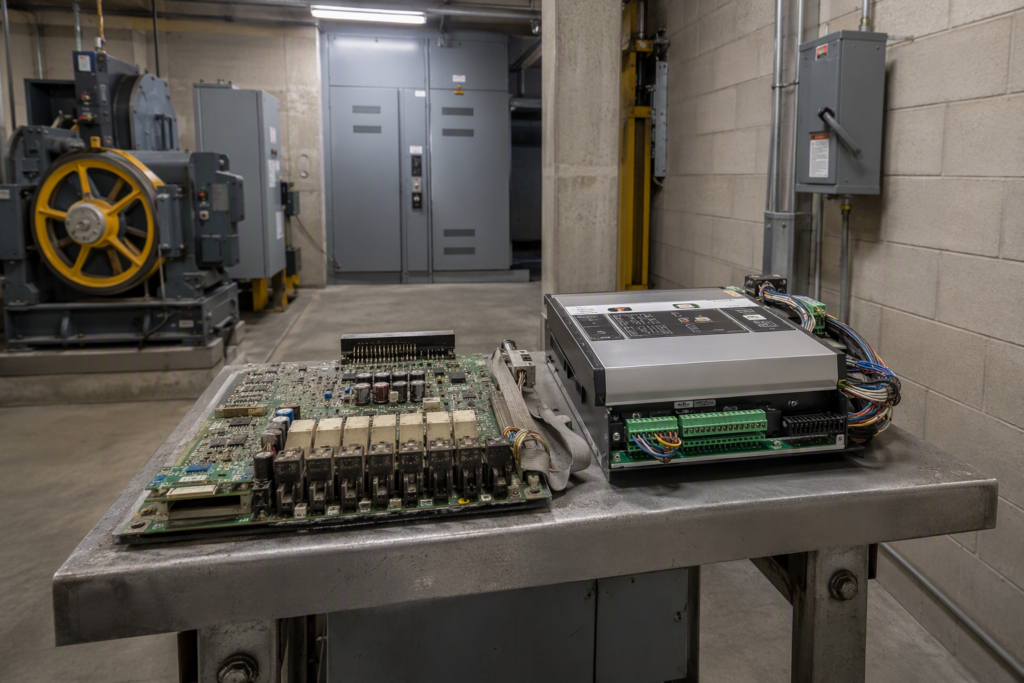
The elevator contractor verifies that the elevator’s on-board components — the smoke detectors dedicated to the hoistway and machine room, the firefighter service key switch, and the controller logic — function correctly when triggered by a fire alarm signal, but the contractor does not service the fire alarm panel itself.
More specifically, Arizona elevator service work covers the following fire-related elevator components:
- Smoke detectors mounted inside the hoistway, machine room, or elevator lobby that are wired directly to the elevator controller (not to the fire alarm panel)
- The Phase I recall key switch and indicator lights at the lobby level
- Phase II firefighter operation controls inside the cab
- The Arizona Firefighters Service (AZFS) key operation — Arizona law requires conveyances with firefighters’ emergency operation to use the designated AZFS key
- Verification that the elevator responds correctly when test signals are sent from the fire alarm panel
What the elevator contractor does not do: inspect, test, repair, replace, or certify the fire alarm panel, its wiring, its control boards, its notification appliances, or its power supply.
Who is responsible for maintaining the fire alarm panel in an Arizona building?
The building owner is ultimately responsible for ensuring the fire alarm system is inspected and maintained by a licensed fire alarm contractor, typically under the authority of the local fire marshal or fire prevention bureau in the applicable Arizona municipality.
In Phoenix, the Fire Prevention Division of the Phoenix Fire Department has authority over fire alarm system compliance. Similar local fire authorities govern Tucson, Scottsdale, and Mesa. State-level fire codes adopted by Arizona set minimum inspection and testing intervals for fire alarm systems. These requirements sit completely outside the jurisdiction of the Industrial Commission of Arizona (ICA) Elevator Division, which oversees only elevator and conveyance safety.
Which agency regulates elevators in Arizona in 2026?
As of September 12, 2026, elevator safety in Arizona is administered by the Industrial Commission of Arizona (ICA), Elevator Division, following the reorganization under Laws 2026, Ch. 73 — previously known as the ADOSH Elevator Safety Section.
The ICA Elevator Division enforces A.R.S. §§ 23-491 through 23-491.16 and the Arizona Administrative Code rules R20-5-502 through R20-5-515. Within the City of Phoenix, the City of Phoenix Elevator Section (Planning and Development Department) conducts inspections for elevators, escalators, moving walks, dumbwaiters, and chairlifts; the state handles equipment located outside Phoenix city limits.
The fire alarm panel at the same building falls under the jurisdiction of the local fire authority having jurisdiction (AHJ) — a separate governmental body with no overlap in authority with the ICA Elevator Division.
What happens during an annual elevator inspection regarding fire-related features?
During an annual elevator inspection, the inspector verifies that Phase I Emergency Recall and Phase II Firefighter Service operate correctly, that the AZFS key functions, and that any hoistway or machine room smoke detectors assigned to the elevator controller respond appropriately — but the inspector does not test or certify the fire alarm panel.
Under A.R.S. §§ 23-491 through 23-491.16, every Arizona conveyance must be inspected annually, and no conveyance may operate without a valid annual certificate of inspection issued by the state. The certificate of inspection covers elevator-side compliance only. The building owner must separately document fire alarm panel compliance through the fire alarm contractor and local fire authority.
Building owners in Phoenix, Tucson, Scottsdale, and Mesa should maintain separate compliance files for elevator inspections and fire alarm inspections, since different AHJs may request either set of records at any time.
What is Phase I Emergency Recall and who is responsible for testing it?
Phase I Emergency Recall is the automatic or manual return of an elevator cab to a designated floor upon activation of a fire alarm signal, and testing responsibility is shared between the elevator contractor and the fire alarm contractor — each testing their own side of the system.
The elevator contractor tests the elevator’s response to the signal: does the cab return to the designated floor, do the doors open and remain open, do the in-car controls become inoperative? The fire alarm contractor tests that the panel correctly sends the recall signal when the appropriate smoke detectors activate. A complete and reliable test requires both contractors to coordinate so the entire signal chain is verified end-to-end.
ASME A17.1-2019, adopted by Arizona for equipment installed, repaired, or altered on or after January 1, 2023, contains the technical requirements for firefighters’ emergency operations. Building owners should confirm that both contractors document their respective portions of the test in writing and that both records are retained on file.
What is the Arizona Firefighters Service (AZFS) key and why does it matter?
The AZFS key is an Arizona-specific standardized key required for elevators with firefighters’ emergency operation, ensuring that first responders across the state can access and operate any compliant elevator cab during an emergency.
Arizona rules specifically require that conveyances equipped with firefighters’ emergency operation use the AZFS key — not a generic or building-specific key. Elevator service contractors, including Arizona Elevator Solutions, are responsible for verifying that the correct AZFS key switch is installed and functional during maintenance visits. The fire alarm panel and its connection to the recall sequence must also be verified separately by the fire alarm contractor. Owners should confirm both verifications are documented.
What should a building owner do if the fire alarm and elevator systems are not communicating correctly?
The building owner should immediately notify both the elevator service contractor and the fire alarm contractor, arrange a coordinated joint test, and if necessary take the elevator out of service until proper communication is restored.
Here is the recommended step-by-step process:
- Document the symptom in writing — note the date, time, what occurred (e.g., elevator failed to recall during a fire alarm test, or recalled without a fire alarm signal), and who observed it.
- Contact the elevator service contractor to inspect the elevator controller, smoke detectors assigned to the controller, and Phase I/Phase II wiring on the elevator side.
- Contact the licensed fire alarm contractor to inspect the fire alarm panel, relevant zones, smoke detectors wired to the panel, and the panel’s output relay or signal to the elevator controller.
- Schedule a coordinated test with both contractors present so the full signal chain can be verified simultaneously.
- If the fault cannot be resolved quickly, consider taking the elevator out of service voluntarily — under A.R.S. §§ 23-491 through 23-491.16, operating a conveyance with a known safety hazard exposes the owner to regulatory liability.
- Notify the ICA Elevator Division and the local fire authority if the condition involves an active safety risk.
- Retain all test documentation, repair records, and written communications from both contractors.
Are there smoke detectors that belong to the elevator and not the fire alarm panel?
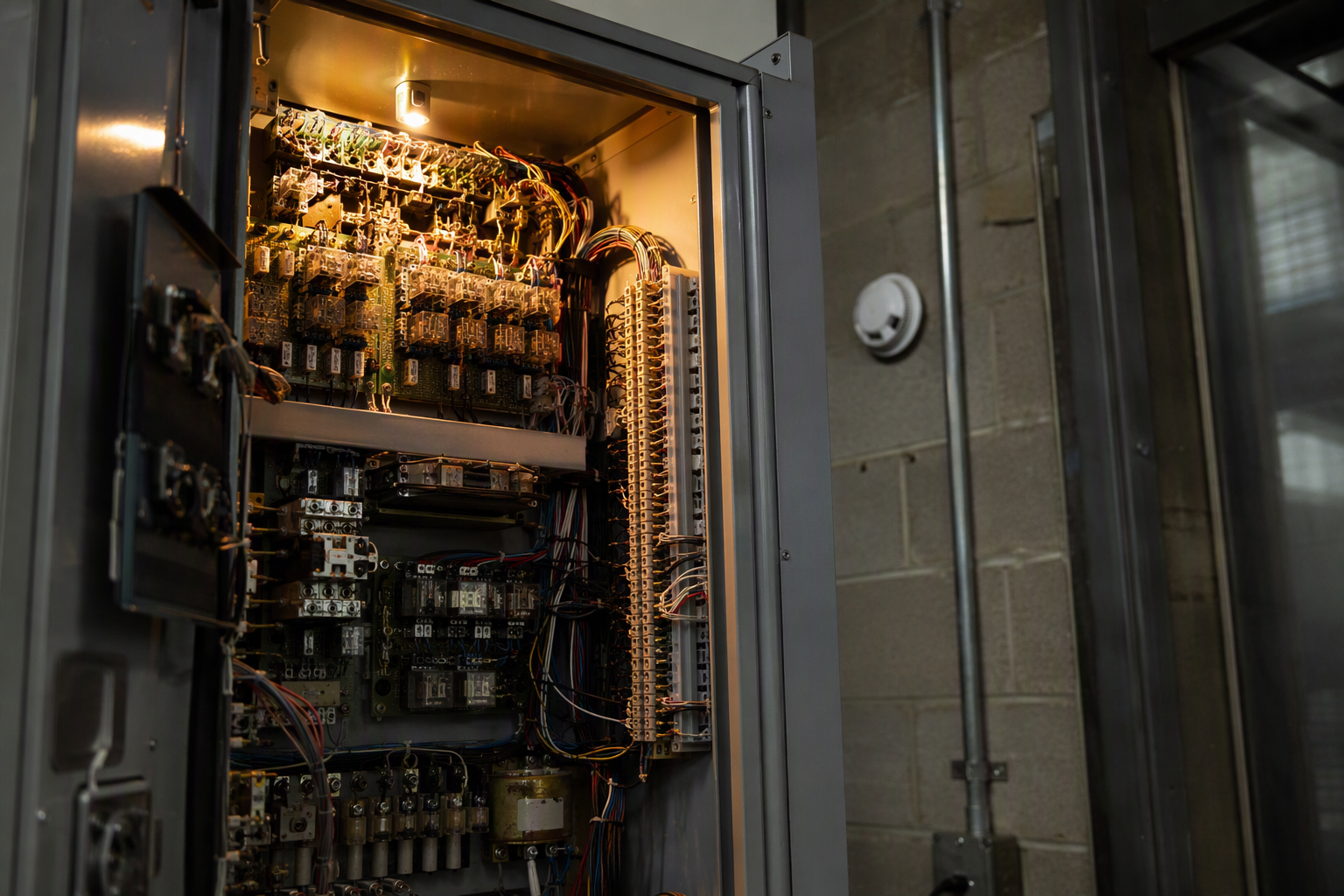
Yes — some smoke detectors in the hoistway and machine room are wired directly to the elevator controller rather than to the building’s fire alarm panel, and these are the elevator contractor’s responsibility to test and service.
The distinction matters because two sets of smoke detectors may be physically co-located in a machine room: one set wired to the fire alarm panel (fire alarm contractor’s responsibility) and another set wired directly to the elevator controller (elevator contractor’s responsibility). Building owners sometimes assume all smoke detectors in a machine room belong to one system. An experienced elevator service company will clearly identify which detectors it is responsible for and confirm which belong to the fire alarm contractor’s scope. If there is any ambiguity, a joint site walk with both contractors is the best way to draw clear boundaries.
Does ADA compliance affect fire alarm and elevator coordination?
Yes — ADA requirements for accessible means of egress and two-way communication systems in elevator cabs intersect with fire alarm system design and must be maintained in coordination with elevator service work.
The ADA requires that elevators serving as accessible means of egress include two-way communication systems, visual and audible signals, and, in some configurations, areas of rescue assistance. The two-way communication system in an elevator cab is often integrated with or monitored by the building’s fire alarm or emergency communication system. While the elevator contractor maintains the cab-side communication hardware, the signal path and monitoring station configuration are often the fire alarm contractor’s or building management system contractor’s responsibility. Building owners should confirm in writing which contractor owns each component.
What records must Arizona building owners keep for elevator and fire alarm compliance?
Arizona building owners must keep the state certificate of inspection at the same location as the conveyance and make it available for inspection on request, and must separately maintain fire alarm inspection records as required by the local fire authority.
The state also requires that the state serial number or the certificate be posted in or close to the conveyance in an easily accessible location. Fire alarm records are governed by the local fire authority’s requirements and are not filed with the ICA Elevator Division. Maintaining two separate, organized compliance files — one for elevator and one for fire alarm — reduces risk during unannounced inspections by either authority.
How often must elevators be inspected in Arizona?
Arizona requires each conveyance to be inspected before it first goes into service, after any modification or alteration, and annually thereafter, with no conveyance permitted to operate without a valid annual certificate of inspection.
These intervals are set under A.R.S. §§ 23-491 through 23-491.16 and the Arizona Administrative Code R20-5-502 through R20-5-515. Arizona owners may use a private elevator inspector authorized by the ICA — but that inspector may not inspect a conveyance owned, operated, or last serviced by the inspector, a company the inspector owns, or the inspector’s employer. Using a private inspector does not relieve the owner of their legal obligations under Arizona law.
Fire alarm systems have separate inspection intervals established by the local fire authority, typically aligned with NFPA 72 (National Fire Alarm and Signaling Code), though building owners should confirm the exact interval with their local fire marshal since the state fire code is the applicable authority — not the ICA.
What are the consequences of operating an elevator with a non-functional fire alarm interface in Arizona?
Operating a conveyance with a known safety hazard — including a malfunctioning fire alarm interface — exposes the building owner to regulatory action by the ICA Elevator Division, potential certificate revocation, and civil liability in the event of injury.
Arizona law under A.R.S. §§ 23-491 through 23-491.16 prohibits operating a conveyance that is not in a safe condition. The ICA Elevator Division has authority to order a conveyance out of service. Additionally, the local fire authority may take independent action if a fire alarm deficiency is discovered. Owners who discover a communication failure between their fire alarm panel and elevator controller should treat it as an urgent matter requiring immediate contractor response, not a deferred maintenance item.
What is the difference between R-12 and C-12 elevator contractor licenses in Arizona?
The Arizona Registrar of Contractors issues both the R-12 (residential) and C-12 (commercial) elevator license classifications, authorizing licensees to install and repair elevators, dumbwaiters, escalators, and moving walks — but neither classification covers fire alarm panel work.
When hiring a contractor for elevator work in Phoenix, Tucson, Scottsdale, or Mesa, building owners should verify that the contractor holds the appropriate R-12 or C-12 license. Arizona Elevator Solutions holds the required Arizona contractor licensing for elevator installation and repair work. For fire alarm panel maintenance, a separately licensed fire alarm contractor must be engaged — the elevator contractor’s license does not extend to that scope regardless of how comprehensive the maintenance agreement appears.
Should elevator maintenance contracts include fire alarm coordination language?
Yes — a well-structured elevator maintenance agreement should explicitly define the boundary between elevator-side fire safety components and fire alarm panel components, and should include a provision for coordinated testing with the fire alarm contractor at agreed intervals.
Without clear contract language, gaps in accountability are common. The elevator contractor may assume the fire alarm contractor is testing the signal relay; the fire alarm contractor may assume the elevator contractor handles the full integration. A coordinated annual test — where both contractors are present and both sides of the signal chain are verified — is the most reliable way to confirm that Phase I and Phase II operations will work correctly in an actual emergency. Arizona Elevator Solutions recommends that building owners review their maintenance agreement language with both contractors to confirm full coverage.
What should building owners in Phoenix, Tucson, Scottsdale, and Mesa look for when hiring an elevator service company?
Building owners should verify that the elevator contractor holds an R-12 or C-12 license from the Arizona Registrar of Contractors, is familiar with ICA Elevator Division requirements, understands the AZFS key requirement, and proactively communicates the scope boundaries around fire alarm panel work.
A reputable elevator service company will be transparent about what is and is not included in its scope, will not make representations about fire alarm panel work, and will encourage coordinated testing with the fire alarm contractor. Arizona Elevator Solutions serves commercial and residential clients across Phoenix, Tucson, Scottsdale, and Mesa, and provides clear documentation of which elevator-side fire safety components are covered under its maintenance scope.
How does elevator code compliance in Arizona compare to baseline federal requirements?
The table below summarizes key compliance benchmarks at the federal and Arizona levels as they apply to elevator and fire alarm interface requirements in 2026.
| Requirement Area | Federal / Code Standard | Arizona-Specific Requirement | Responsible Party |
|---|---|---|---|
| Elevator inspection interval | ASME A17.1-2019 — sets technical standards | Annual inspection required; certificate must be on-site; no operation without valid certificate (A.R.S. §§ 23-491 through 23-491.16) | Building owner / elevator service contractor |
| Phase I Emergency Recall | ASME A17.1-2019 — required for elevators subject to firefighters’ emergency operation | AZFS key required for firefighters’ emergency operation; verified during annual inspection | Elevator contractor (elevator side); fire alarm contractor (panel side) |
| Fire alarm panel maintenance | NFPA 72 (National Fire Alarm and Signaling Code) — sets testing intervals | Local fire authority AHJ enforces fire alarm compliance; separate from ICA Elevator Division jurisdiction | Licensed fire alarm contractor |
| Hoistway / machine room smoke detectors (elevator-wired) | ASME A17.1-2019 — specifies detector placement and function | Verified by elevator inspector during annual inspection | Elevator contractor |
| Hoistway / machine room smoke detectors (panel-wired) | NFPA 72 — governs fire alarm system detectors | Local fire authority AHJ enforces; not within ICA Elevator Division jurisdiction | Fire alarm contractor |
| ADA two-way communication in cab | ADA — requires two-way communication for accessible means of egress | No Arizona-specific deviation; ADA applies directly | Elevator contractor (cab hardware); fire alarm or emergency communication contractor (signal path) |
| Contractor licensing — elevator | No federal elevator contractor license | R-12 (residential) or C-12 (commercial) — Arizona Registrar of Contractors | Arizona elevator contractor |
| Contractor licensing — fire alarm | No federal fire alarm contractor license | State Fire Marshal and local AHJ requirements (separate from ROC elevator license) | Licensed fire alarm contractor |
What questions should a building owner ask when interviewing elevator and fire alarm contractors about system coordination?
Building owners should ask both contractors a defined set of questions to confirm that the full interface between systems is covered without gaps or overlapping claims of responsibility.
Recommended questions to ask the elevator contractor:
- Which specific smoke detectors in the machine room and hoistway are wired to the elevator controller and fall within your maintenance scope?
- What documentation do you provide after testing Phase I and Phase II firefighter operations?
- Will you coordinate directly with our fire alarm contractor for joint annual testing?
- Does your maintenance agreement explicitly exclude fire alarm panel work?
Recommended questions to ask the fire alarm contractor:
- Which smoke detectors in the machine room and hoistway are wired to the fire alarm panel and within your scope?
- How do you test the panel’s output relay or signal to the elevator controller?
- Will you coordinate with the elevator contractor for joint annual testing?
- What documentation do you provide after testing the fire alarm panel’s elevator interface zones?
Arizona Elevator Solutions recommends that building owners request written answers to these questions and retain them as part of their facility compliance documentation.
What is the best practice for managing the elevator and fire alarm interface on an ongoing basis?
The best practice is to schedule an annual coordinated test with both the elevator service contractor and the fire alarm contractor present at the same time, document all results in writing, and retain records for each inspection authority that may request them.
Ad hoc testing — where each contractor tests only their side in isolation — misses the most common failure mode, which is a communication breakdown at the interface between the two systems. Coordinated testing catches interface faults that neither contractor would detect independently. Building owners in Phoenix, Tucson, Scottsdale, and Mesa should build coordinated testing into both the elevator maintenance agreement and the fire alarm service agreement as an explicit, scheduled annual event. Arizona Elevator Solutions works with building owners to plan elevator-side testing in a way that supports seamless coordination with the fire alarm contractor’s schedule.
Contact Arizona Elevator Solutions for a free elevator assessment at 480-557-7600.
Need elevator service you can rely on? Arizona Elevator Solutions is ready to help.