Elevator Contract Negotiation for Healthcare Facilities in Arizona

Elevator service contracts in healthcare settings are among the most consequential agreements a facilities manager will sign. Hospitals, surgical centers, long-term care facilities, and medical office buildings in Phoenix, Tucson, Scottsdale, and Mesa depend on elevators to move patients, staff, medical equipment, and supplies around the clock. A contract that works for a commercial office building may leave a hospital dangerously exposed. Understanding what to negotiate—and what Arizona law requires—protects patients, staff, and the organization.
What Makes Healthcare Elevator Contracts Different From Standard Commercial Agreements?
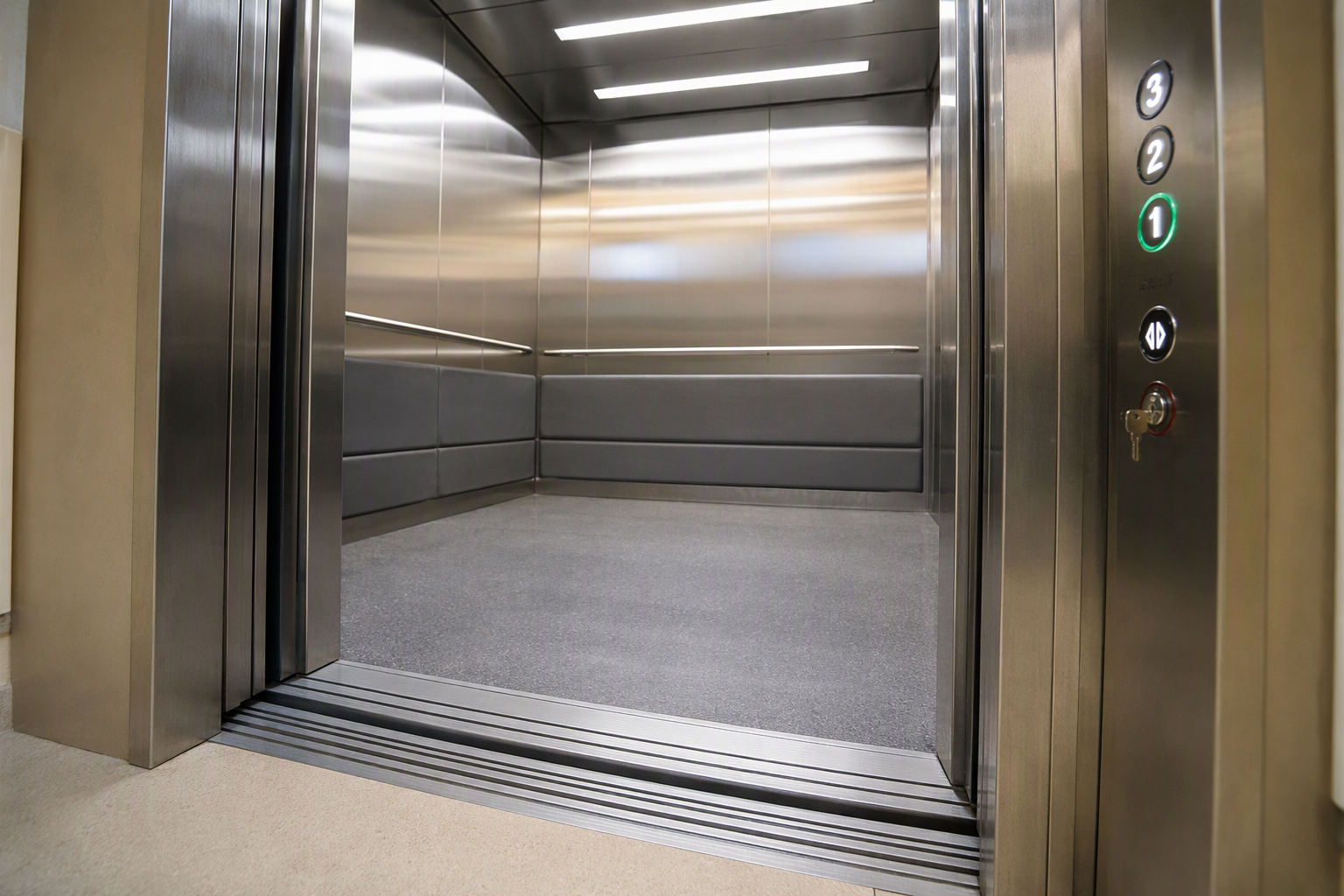
Healthcare elevators operate under conditions that standard commercial contracts rarely address. Patient transport units carry occupied hospital beds and stretchers. Utility elevators move medication carts, surgical supply cases, and biohazard waste. Service interruptions that are inconvenient in an office building can become patient safety events in a hospital. Contract language must reflect this reality.
Key differentiators for healthcare elevator contracts include:
- Continuous-operation expectations with minimal planned downtime windows
- Infection control requirements governing how technicians enter and work in clinical areas
- Compliance documentation requirements tied to Joint Commission surveys and CMS inspections
- Stretcher and bariatric capacity specifications
- Firefighters’ emergency operation provisions unique to Arizona, including the required Arizona Firefighters Service (AZFS) key
- Coordination with hospital incident command protocols during elevator outages
Arizona Elevator Solutions works with healthcare facilities teams across the Phoenix metro and Tucson regions to review contract language against these operational realities before an agreement is signed.
What Arizona Laws Govern Elevator Compliance in Healthcare Buildings?
Healthcare facilities in Arizona are subject to elevator safety requirements under A.R.S. §§ 23-491 through 23-491.16 (Safety Conditions for Elevators and Similar Conveyances), as amended by Laws 2026, Ch. 73. These statutes are administered by the Industrial Commission of Arizona’s Elevator Division (formerly the ADOSH Elevator Safety Section prior to September 12, 2026).
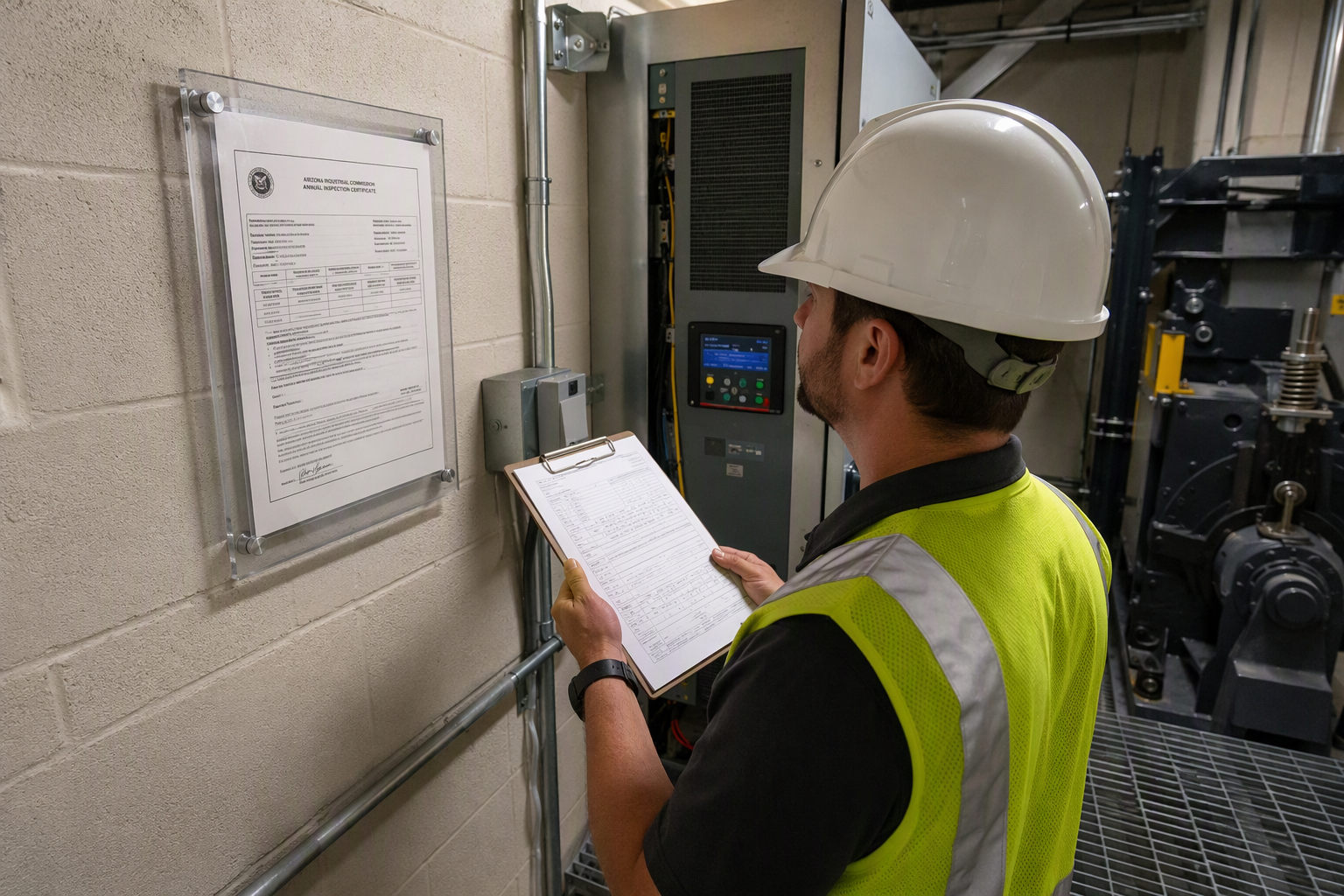
Under Arizona law, every conveyance must be inspected before it first enters service, after any modification or alteration, and annually thereafter. No conveyance may operate in Arizona without a valid annual certificate of inspection issued by the state. The owner must keep that certificate at the location of the conveyance and make it available on request. The state serial number or certificate must also be posted in or near the conveyance in an easily accessible location.
For equipment installed, repaired, or altered on or after January 1, 2023, the adopted code is ASME A17.1-2019 under Arizona Administrative Code R20-5-502 through R20-5-515. Healthcare facilities with platform lifts or stairway chairlifts installed on or after that date must also comply with ASME A18.1-2020.
Within the City of Phoenix, the City of Phoenix Elevator Section (Planning and Development Department) handles inspections for elevators, escalators, moving walks, dumbwaiters, and chair lifts. Equipment outside Phoenix city limits falls under the Industrial Commission of Arizona’s Elevator Division.
Any service contractor working on healthcare elevators in Arizona must hold an R-12 or C-12 elevator license classification issued by the Arizona Registrar of Contractors. Note that the ROC licenses contractors but does not issue annual certificates of inspection—that authority belongs to the Industrial Commission of Arizona’s Elevator Division.
What Federal Codes Apply to Healthcare Elevators in Arizona?
Beyond Arizona-specific statutes, healthcare elevator contracts must address federal requirements:
- ASME A17.1 Safety Code for Elevators and Escalators — sets design, installation, inspection, testing, and maintenance standards
- Americans with Disabilities Act (ADA) — mandates accessible elevator design, door timing, call button placement, and tactile controls in facilities serving the public
- OSHA — governs maintenance technician safety in machine rooms and elevator pits
Healthcare facilities must also align elevator maintenance documentation with The Joint Commission’s Environment of Care standards and CMS Conditions of Participation, both of which reference life safety code compliance. A contract that does not guarantee timely provision of inspection records and maintenance logs can jeopardize accreditation surveys.
What Should Be Included in the Scope of Work for a Healthcare Elevator Contract?
Scope of work is the most negotiated section of any elevator service agreement. For healthcare facilities, a comprehensive scope should cover:
- Preventive maintenance schedules aligned with ASME A17.1-2019 maintenance intervals
- Lubrication, adjustment, and cleaning of all mechanical and electrical components
- Testing of firefighters’ emergency operation and the AZFS key function
- Door timing and force testing to ADA standards
- Emergency lighting and communication system verification
- Seismic provisions applicable to the installation
- Modernization or repair thresholds that trigger notification obligations under Arizona’s 90-day pre-installation notice requirement
- Entrapment rescue procedures and coordination with hospital security and facilities staff
How Should Healthcare Facilities Evaluate Elevator Service Vendors?
Vendor selection criteria for healthcare elevator contracts should go beyond price. Facilities managers in Phoenix, Scottsdale, Mesa, and Tucson should assess:
- Proof of current R-12 or C-12 Arizona Registrar of Contractors license
- Familiarity with Joint Commission and CMS documentation requirements
- Experience with the specific equipment types on site (hydraulic, traction, MRL)
- Infection control compliance protocols for working in patient care areas
- Capacity to provide inspection records, maintenance logs, and test certificates in the format required for accreditation surveys
- Clarity on which work is included versus billed separately (parts, repairs, callback visits)
- Ability to coordinate notification filings with the Industrial Commission of Arizona’s Elevator Division
Arizona Elevator Solutions supports healthcare procurement teams through the vendor evaluation process, helping facilities ask the right questions before committing to a multi-year agreement.
What Are the Most Common Contract Traps Healthcare Facilities Should Avoid?
Several contract terms routinely disadvantage healthcare facility owners:
- Exclusion lists — contracts that exclude major components (controllers, hydraulic cylinders, door operators) shift repair costs back to the owner unexpectedly
- Proprietary parts clauses — some vendors lock facilities into proprietary components that prevent competitive bidding on future repairs
- Auto-renewal terms — long auto-renewal windows with limited cancellation rights can lock a hospital into an underperforming vendor
- Vague documentation obligations — contracts that do not specify when maintenance records will be delivered create gaps during accreditation surveys
- Inspection coordination gaps — contracts that place full responsibility for scheduling state annual inspections on the owner without vendor support can result in lapsed certificates, which is a violation of Arizona law
How Often Must Healthcare Elevators Be Inspected in Arizona?
Arizona law requires annual inspections of every conveyance. A conveyance must also be inspected before it first enters service and after any modification or alteration. Healthcare facilities may engage a private elevator inspector authorized by the Industrial Commission of Arizona to conduct these inspections. Arizona private elevator inspectors must register with the commission annually and demonstrate at least eight hours of approved continuing education. A private inspector may not inspect a unit they, their employer, or a company they own last serviced—a conflict-of-interest provision healthcare procurement teams should verify when negotiating inspection arrangements.
What Happens If a Healthcare Elevator Is Involved in an Accident or Breakdown?
Arizona law requires the owner to notify the Industrial Commission of Arizona’s Elevator Division within 24 hours of any accident that injures a person or disables a conveyance. Healthcare facilities should ensure that service contracts clearly define the vendor’s role in this notification process, in incident documentation, and in coordinating any required follow-up inspection before the unit returns to service. Contract language should specify who bears responsibility for the costs of that post-incident inspection.
What Role Does the Arizona Firefighters Service Key Play in Healthcare Elevator Contracts?
Arizona conveyances equipped with firefighters’ emergency operation must use the Arizona Firefighters Service (AZFS) key. This is a state-specific requirement that differs from other jurisdictions. Healthcare facilities should confirm that any service vendor is familiar with AZFS key requirements and that all firefighters’ emergency operation systems are tested and documented as part of the maintenance scope—not treated as an optional add-on.
What Questions Your Inspector Will Ask
Healthcare facility managers should be prepared for the following questions during state inspections and Joint Commission surveys:
- Is the annual certificate of inspection posted in or near the conveyance?
- Is the state serial number visible on or close to the unit?
- Can you produce the full maintenance log for the past inspection cycle?
- Has the unit undergone any modifications or alterations that required advance notification to the Industrial Commission of Arizona’s Elevator Division?
- Were the required 90-day advance notices submitted for any installation, relocation, or alteration?
- Is firefighters’ emergency operation functional and has it been tested, with the AZFS key on file?
- Is there documentation of any incidents reported to the state within the required 24-hour window?
- Does the service contractor hold a current R-12 or C-12 license from the Arizona Registrar of Contractors?
- Does the private inspector—if used—hold current registration with the Industrial Commission of Arizona?
- Are all ADA accessibility features—door timing, call button placement, tactile controls—functioning and documented?
How Long Should a Healthcare Elevator Service Contract Run?
Contract length in healthcare settings involves a balance between stability and flexibility. Longer terms may offer pricing predictability but can reduce leverage if service quality declines. Healthcare facilities should negotiate meaningful performance review checkpoints regardless of contract length, and ensure that documentation requirements, compliance reporting obligations, and state notification responsibilities are clearly assigned throughout the full term. Arizona Elevator Solutions helps healthcare facilities in Phoenix, Tucson, Scottsdale, and Mesa structure contract terms that support both operational continuity and regulatory compliance.
What Should a Healthcare Facility Do When Transitioning Between Elevator Service Vendors?
Vendor transitions carry compliance risk if not managed carefully. A structured transition process helps avoid gaps in the annual inspection cycle and ensures that state certificates remain current throughout the changeover. Key steps include:
- Request a full copy of all maintenance records, inspection certificates, and state correspondence from the outgoing vendor
- Confirm the current status of the annual certificate of inspection with the Industrial Commission of Arizona’s Elevator Division
- Verify that any outstanding repair items noted in the last inspection report are addressed before the transition is finalized
- Confirm the incoming vendor’s R-12 or C-12 license status with the Arizona Registrar of Contractors
- Brief the incoming vendor on facility-specific protocols, including infection control procedures and hospital incident command coordination
- Notify relevant internal stakeholders—facilities, risk management, compliance, nursing leadership—of the transition timeline
Arizona Elevator Solutions assists healthcare facilities through the full transition process to protect both patients and regulatory standing.
Contact Arizona Elevator Solutions for a free elevator assessment at 480-557-7600.
Need elevator service you can rely on? Arizona Elevator Solutions is ready to help.