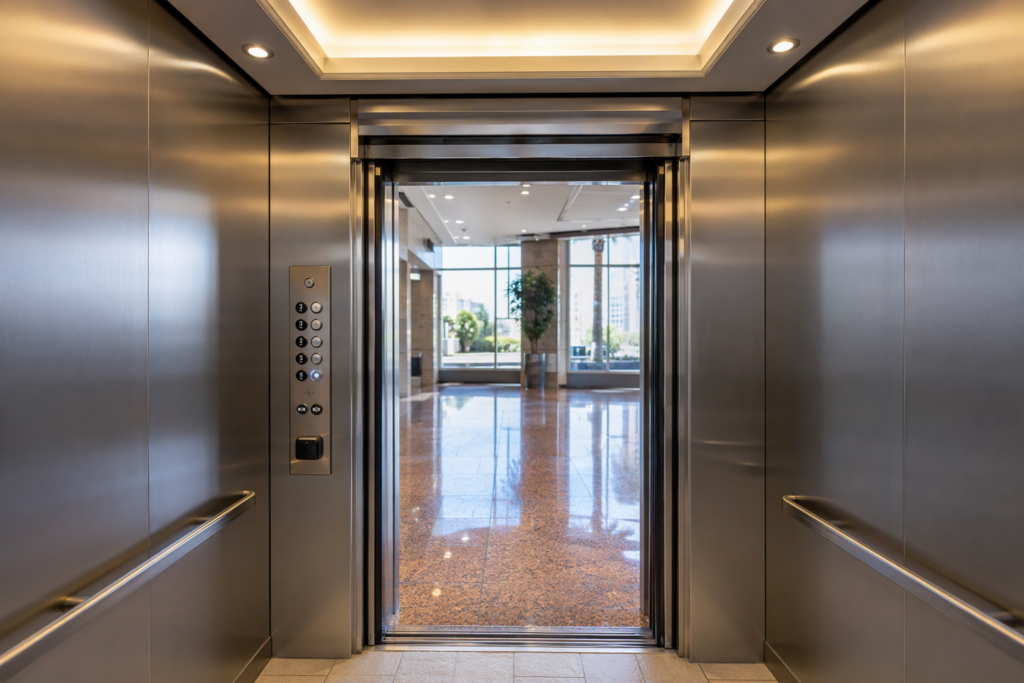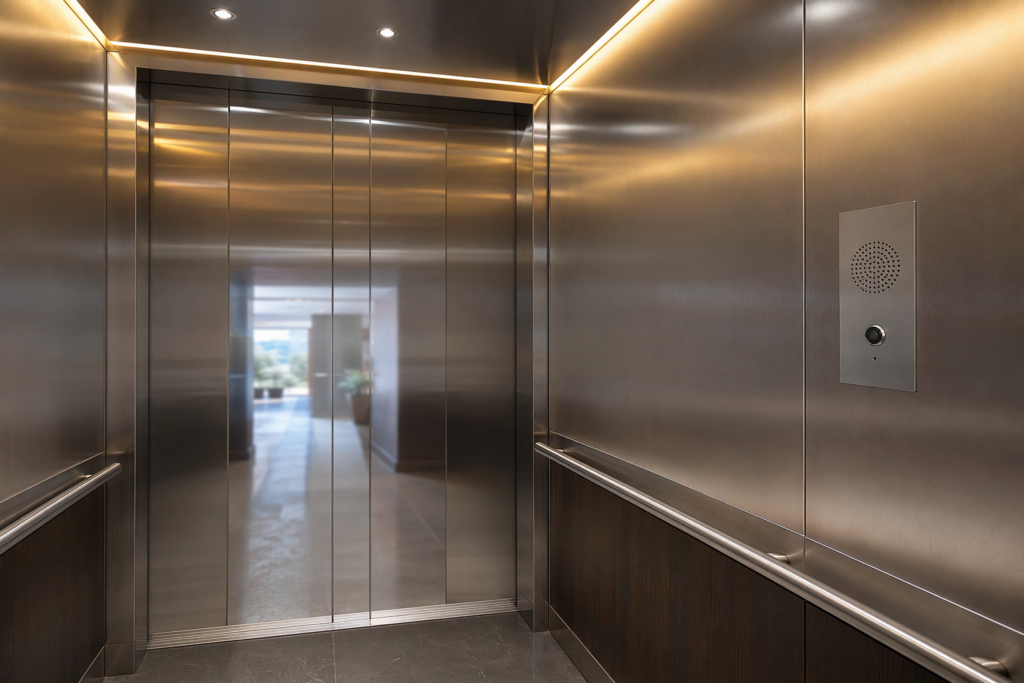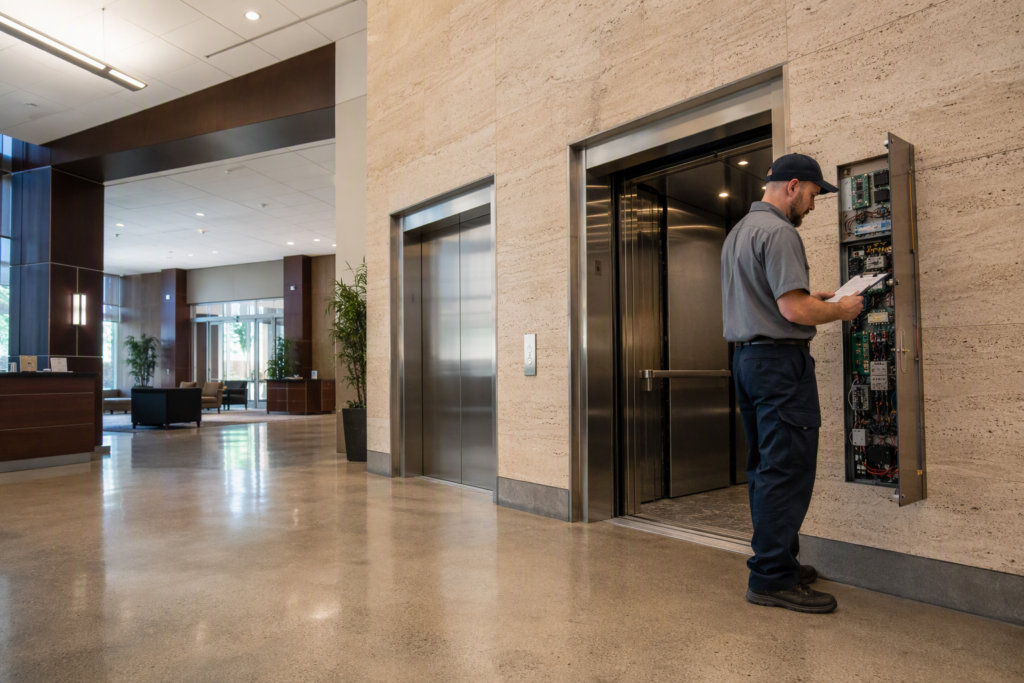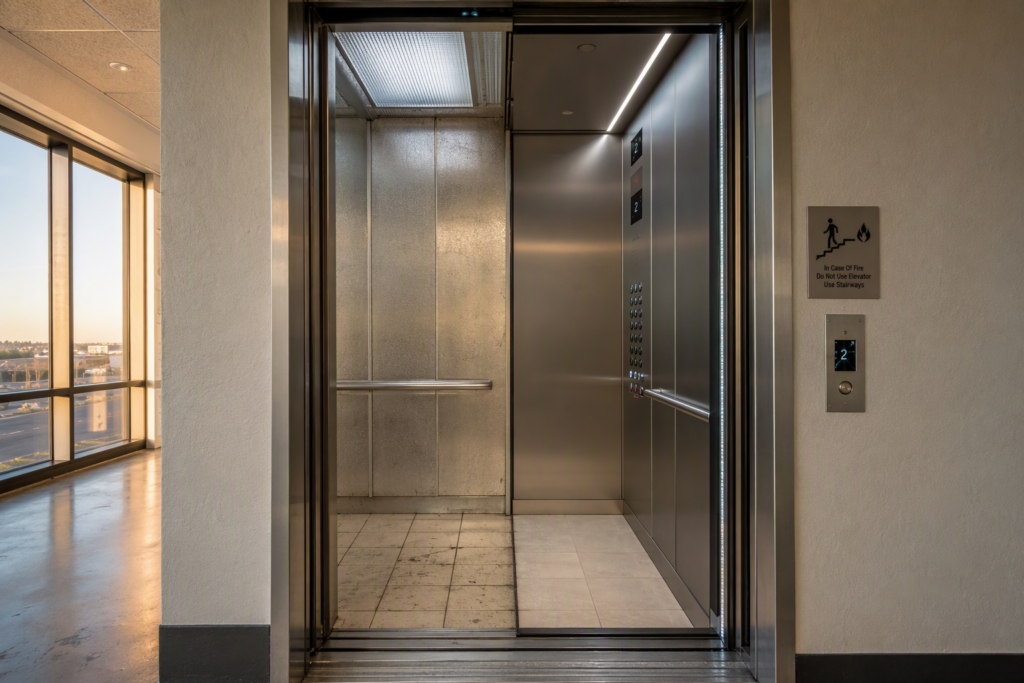
Yes, Arizona Elevator Solutions services Abbey Elevators. Technicians working with Arizona Elevator Solutions inspect, maintain, repair, and modernize Abbey Elevator equipment across Phoenix, Tucson, Scottsdale, and Mesa. Abbey units follow the same ASME A17.1 safety code requirements as any other elevator brand operating in Arizona, and all service work complies with state statute and Industrial Commission of Arizona rules.
Abbey Elevator Service in Arizona: Complete FAQ
What types of Abbey Elevator equipment does Arizona Elevator Solutions service?

Arizona Elevator Solutions services the full range of Abbey Elevator product lines, including hydraulic passenger elevators, traction elevators, limited-use/limited-application (LU/LA) elevators, and residential units.
Abbey Elevators has historically supplied hydraulic and traction systems to commercial, multi-family residential, and institutional markets. Each product category carries its own mechanical profile: hydraulic systems use a piston-and-cylinder drive with a pump unit, while traction units rely on sheave-and-counterweight arrangements. Both types are governed by the ASME A17.1 Safety Code for Elevators and Escalators, which Arizona adopted in its 2019 edition effective January 9, 2023, under Arizona Administrative Code R20-5-502 through R20-5-515. Technicians familiar with Abbey’s component specifications can service oil-seal assemblies, hydraulic power units, controller boards, door operators, and cab interiors across the product range.
Does Arizona require a specific license to work on Abbey Elevators?

Yes. Any contractor installing or repairing an Abbey Elevator in Arizona must hold an R-12 or C-12 elevator contractor license issued by the Arizona Registrar of Contractors.
The Arizona Registrar of Contractors grants R-12 (residential) and C-12 (commercial) elevator license classifications to contractors who meet its qualification standards. These classifications authorize work on elevators, dumbwaiters, escalators, and moving walks — the full equipment scope that Abbey products span. The R-12/C-12 license governs the contractor entity; it does not substitute for the annual certificate of inspection issued by the Industrial Commission of Arizona (ICA) Elevator Division, which is a separate compliance requirement. Building owners should verify that any service company they hire for Abbey equipment holds the appropriate ROC classification before work begins.
Which Arizona regulatory body oversees Abbey Elevator compliance?
The Industrial Commission of Arizona (ICA) Elevator Division oversees all elevator safety compliance in Arizona, including Abbey Elevator units operating outside the City of Phoenix.
As of September 12, 2026, Arizona elevator safety is administered by the ICA Elevator Division under A.R.S. §§ 23-491 through 23-491.16, as amended by Laws 2026, Ch. 73. This division was formerly known as the ADOSH Elevator Safety Section. Equipment located within the City of Phoenix falls under the City of Phoenix Elevator Section (Planning and Development Department) for inspection purposes, while the ICA handles equipment in all other Arizona jurisdictions, including Tucson, Scottsdale, and Mesa. Both authorities apply the same adopted technical code: ASME A17.1-2019.
How often must an Abbey Elevator in Arizona be inspected?
Arizona law requires every elevator, including Abbey units, to be inspected before it first goes into service, after any modification or alteration, and annually after that.
This three-trigger inspection requirement comes directly from A.R.S. §§ 23-491 through 23-491.16 and the Arizona Administrative Code R20-5-502 through R20-5-515. No Abbey Elevator — or any other conveyance — may legally operate in Arizona without a current annual certificate of inspection issued by the state. The owner must keep that certificate at the same location as the conveyance and make it available on request. Additionally, the state serial number or certificate must be posted in or near the conveyance in an easily accessible location. Missing or lapsed certificates expose building owners to regulatory action, including shutdown orders.
Can a private inspector perform the annual inspection on an Abbey Elevator?
Yes. Arizona permits owners to hire a private elevator inspector authorized by the Industrial Commission of Arizona to perform initial or annual inspections on Abbey Elevator equipment.
Private inspectors operating in Arizona must register with the ICA annually and demonstrate at least eight hours of approved continuing education each registration cycle. There is one critical conflict-of-interest restriction: a private inspector may not inspect a conveyance owned, operated, or last serviced by the inspector personally, a company the inspector owns, or the inspector’s employer. This rule ensures objectivity. Importantly, engaging a private inspector does not relieve the building owner of any legal obligation under Arizona statute. The owner remains responsible for maintaining the Abbey unit in a safe, code-compliant condition regardless of who performed the inspection.
What ASME code applies to Abbey Elevators installed or repaired in Arizona after January 1, 2023?
Arizona adopted ASME A17.1/CSA B44, 2019 edition, for all equipment installed, repaired, or altered on or after January 1, 2023, effective January 9, 2023.
The ASME A17.1 Safety Code for Elevators and Escalators is the primary technical standard that defines design, construction, operation, inspection, testing, maintenance, alteration, and repair requirements. Any Abbey Elevator work performed after the January 2023 adoption date — including controller upgrades, door operator replacements, or hydraulic cylinder overhauls — must conform to the 2019 edition’s requirements. Abbey units installed before that date are governed by the edition in effect at the time of original installation; however, Arizona statute allows lawfully installed older conveyances to remain in service unless the ICA elevator chief determines the use poses a hazard to life, health, or property.
What does a routine maintenance visit on an Abbey Elevator include?
A routine maintenance visit on an Abbey Elevator covers a systematic inspection and servicing of all major mechanical, electrical, and safety systems to prevent failures and maintain code compliance.
Industry-standard preventive maintenance for Abbey hydraulic units typically addresses the following areas:
- Hydraulic system: Fluid level check, oil condition assessment, pump pressure testing, and cylinder seal inspection for any seepage that could create environmental or operational hazards.
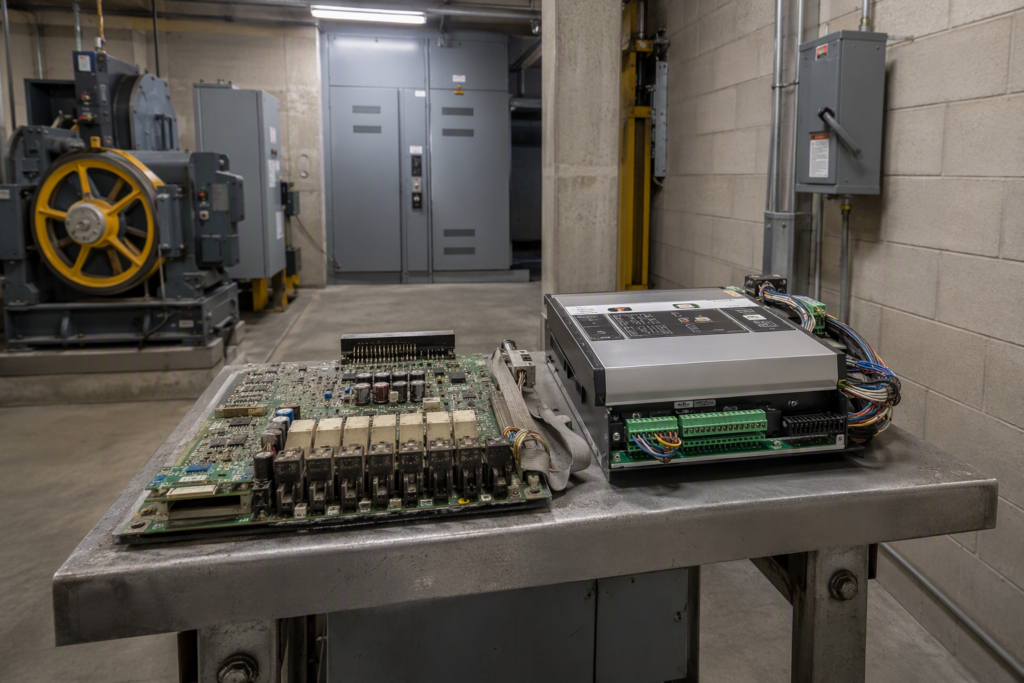
- Controller and electrical: Review of controller boards, fuse conditions, wiring integrity, selector switches, and relay or solid-state logic components specific to Abbey’s control architecture.
- Door systems: Adjustment of door operators, clutch mechanisms, gibs, and safety edges; verification that door-open dwell time meets ADA requirements for accessible use.
- Safety devices: Testing of oil-line rupture valves, low-oil safety switches, pit stop switches, and emergency lighting per ASME A17.1-2019 requirements.
- Cab and hoistway: Lubrication of guide rails, inspection of buffers, sill condition, pit sump pump function, and cleanliness of the machine room or pump unit area.
- Load testing: Where due, full-load and no-load pressure tests as required by Arizona Administrative Code R20-5-502 through R20-5-515.
Arizona Elevator Solutions structures maintenance programs around these categories so that every Abbey unit remains in compliance between annual state inspections.
What should a building owner do immediately after an Abbey Elevator malfunction or accident in Arizona?
Arizona law requires owners to notify the state within 24 hours of any accident that injures a person or disables a conveyance, making a clear response protocol essential.
- Secure the elevator immediately. Place the unit out of service, lock the machine room if accessible, and prevent passengers from entering or attempting to use the cab.
- Assist any trapped or injured occupants. If passengers are entrapped, contact emergency services. Do not attempt a mechanical rescue without qualified personnel.
- Notify the Industrial Commission of Arizona Elevator Division within 24 hours. This is a statutory requirement under A.R.S. §§ 23-491 through 23-491.16 for any accident that injures a person or disables the conveyance.
- If the elevator is within the City of Phoenix, also notify the City of Phoenix Elevator Section. The Planning and Development Department may have parallel notification or investigation requirements.
- Preserve the scene. Do not alter, clean, or operate the equipment until authorized by the appropriate regulatory authority or an investigation is complete.
- Contact a licensed elevator service contractor. Arrange for a qualified technician to evaluate the Abbey unit before returning it to service.
- Document everything. Record times, witness accounts, and any observed mechanical conditions in writing for regulatory and liability purposes.
How does ADA compliance apply to Abbey Elevator installations?
Abbey Elevators installed in buildings covered by the Americans with Disabilities Act must meet ADA accessibility standards, which govern cab dimensions, door clearances, control button height, and audible signals.
The ADA Standards for Accessible Design specify minimum clear width for elevator doors, minimum cab dimensions, control panel button height and tactile marking requirements, and door-open timing for passenger safety. These requirements apply to new construction and alterations triggering a path-of-travel obligation. Abbey Elevator units installed in commercial or multi-family settings in Phoenix, Scottsdale, Mesa, and Tucson must be evaluated against current ADA standards when the building undergoes renovation. A common compliance gap in older Abbey hydraulic installations is door-open dwell time and call button height, both of which can be corrected through controller reprogramming or hardware retrofit without replacing the full unit.
What is the difference between Abbey Elevator repair and modernization?
Repair restores an Abbey Elevator to its original operating condition, while modernization replaces major components or systems with updated technology to improve performance, safety, or energy efficiency.
| Factor | Repair | Modernization |
|---|---|---|
| Scope | Restores failed or worn component to original spec | Upgrades controller, drive, door operator, or cab to current technology |
| Code trigger | Generally maintains existing code compliance | May require full ASME A17.1-2019 compliance review as an alteration |
| Arizona notification | Not typically required for like-for-like repairs | Owner must notify ICA at least 90 days before altering a conveyance |
| Inspection requirement | Annual certificate continues on existing schedule | Inspection required after any modification or alteration before return to service |
| Expected outcome | Restores reliability; does not extend design life significantly | Extends useful life, improves energy use, and updates safety features |
| Typical triggers | Component failure, oil leak, door malfunction | Controller obsolescence, parts unavailability, energy upgrade goals |
Arizona owners considering Abbey Elevator modernization must notify the Industrial Commission of Arizona at least 90 days before the alteration begins, as required by A.R.S. §§ 23-491 through 23-491.16. A post-alteration inspection is then required before the unit returns to service.
Are parts readily available for Abbey Elevator equipment in Arizona?
Parts availability for Abbey Elevator equipment varies by model generation, with newer components generally accessible through elevator parts distributors, while legacy or discontinued Abbey parts may require sourcing, fabrication, or cross-referencing with compatible aftermarket equivalents.
Abbey Elevator, like many regional elevator manufacturers, produced equipment across several decades and design generations. Controllers manufactured in the analog relay-logic era present the greatest parts challenge, as original boards and relays are no longer in production. Experienced service technicians address this through several strategies: sourcing new-old-stock components through specialty distributors, retrofitting modern solid-state controllers that interface with existing mechanical systems, or performing a targeted controls modernization. Hydraulic components — cylinders, pump units, packing, and valves — are generally more readily available due to standardization across the hydraulic elevator industry. Arizona Elevator Solutions maintains familiarity with these sourcing pathways for Abbey equipment across its service markets.
What happens if an Abbey Elevator in Arizona operates without a valid certificate of inspection?
Operating an elevator in Arizona without a valid annual certificate of inspection violates A.R.S. §§ 23-491 through 23-491.16 and can result in mandatory shutdown, regulatory penalties, and liability exposure for the building owner.
The ICA Elevator Division and, within Phoenix, the City of Phoenix Elevator Section have authority to order conveyances out of service when certificates have lapsed or inspections reveal unsafe conditions. Beyond regulatory consequences, operating an uncertified Abbey Elevator creates significant civil liability exposure if a passenger is injured. Insurance carriers may also deny coverage for incidents occurring while a conveyance is out of compliance. Every Arizona conveyance is assigned a state serial number on a tag fixed to the controller or mainline disconnect — inspectors and enforcement personnel use this identifier to verify certificate status quickly. Building owners should maintain a compliance calendar that tracks annual inspection due dates for each Abbey unit on their property.
Do Abbey platform lifts and stairway chairlifts follow the same rules as full elevators in Arizona?
No. Abbey platform lifts and stairway chairlifts installed, repaired, or altered in Arizona on or after January 1, 2023 must comply with ASME A18.1-2020 rather than ASME A17.1-2019.
ASME A18.1 is the dedicated safety standard for platform lifts and stairway chairlifts, addressing the distinct mechanical and safety characteristics of these lower-travel, lower-capacity conveyances. In Arizona, the same annual inspection and certificate-of-operation requirements that apply to full elevators also apply to platform lifts and stairway chairlifts, and the same 90-day advance notification rule applies before installation or alteration. ADA compliance requirements also extend to platform lifts when they serve as a means of accessible entry in lieu of a ramp or elevator. Building owners operating Abbey chairlifts or platform lifts alongside full elevator systems should ensure that each conveyance type is tracked and inspected under its applicable standard.
Does Arizona require firefighters’ emergency operation on Abbey Elevators?
Yes. Arizona conveyances equipped with firefighters’ emergency operation must use the Arizona Firefighters Service (AZFS) key, which is a state-specific requirement.
The ASME A17.1-2019 code establishes the technical requirements for firefighters’ emergency operation, including Phase I recall and Phase II in-car operation. Arizona adds a state-specific key requirement: the AZFS key must be used for this function. Building owners and service contractors working on Abbey Elevators that include firefighters’ service must ensure that the key switch hardware is compatible with the AZFS key standard. This is particularly relevant during Abbey Elevator modernization projects where door operator or controller hardware is being replaced, as the new hardware must incorporate compliant AZFS key switches. Fire departments in Phoenix, Tucson, Scottsdale, and Mesa rely on standardized key access during emergency operations, so non-compliant key switches are a code deficiency that will be flagged during inspection.
How should a building owner prepare an Abbey Elevator for the annual state inspection?
Preparing an Abbey Elevator for the annual Arizona state inspection involves ensuring the machine room, pit, and cab are accessible, all documentation is on-site, and known deficiencies are corrected before the inspector arrives.
A pre-inspection readiness review should address the following:
- Documentation: Confirm the current certificate of inspection is posted or available at the conveyance location, and that the state serial number tag is legible on the controller or mainline disconnect.
- Machine room access: The machine room must be clean, free of stored materials unrelated to elevator operation, properly lit, and accessible with appropriate key access.
- Pit condition: The pit must be dry, clean, and free of standing water or debris. Pit lighting and the pit stop switch must be functional.
- Safety device records: Any records of safety device tests performed since the last inspection should be available for the inspector’s review.
- Outstanding repairs: Any known deficiencies identified during routine maintenance should be corrected before the annual inspection. An uncorrected deficiency found during inspection may result in a conditional certificate or an out-of-service order.
- AZFS key hardware: Verify that firefighters’ service key switches are operational and use the correct AZFS key format where applicable.
What geographic areas does Arizona Elevator Solutions cover for Abbey Elevator service?
Arizona Elevator Solutions provides Abbey Elevator service throughout Phoenix, Tucson, Scottsdale, and Mesa, covering both commercial and residential equipment in each market.
These four Arizona markets represent a broad cross-section of elevator environments. Phoenix installations span high-rise commercial buildings, government facilities, and healthcare campuses. Scottsdale’s commercial and resort property sector includes Abbey hydraulic installations in low- and mid-rise office and hospitality buildings. Mesa’s industrial, medical, and multi-family residential portfolio presents a range of Abbey product types. Tucson’s university, government, and commercial buildings round out the service territory. In each market, the applicable regulatory authority — the City of Phoenix Elevator Section within Phoenix, and the ICA Elevator Division elsewhere — has jurisdiction over Abbey Elevator compliance, and service work is coordinated with those inspection schedules.
How does Arizona Elevator Solutions approach Abbey Elevator modernization planning?
Arizona Elevator Solutions approaches Abbey Elevator modernization through a systematic assessment of the unit’s mechanical condition, controller generation, parts availability, and code compliance status before recommending a scope of work.
A modernization assessment for an Abbey unit typically examines the controller technology (relay logic, solid-state, or microprocessor), hydraulic cylinder condition and submergence depth, door operator generation, cab finishes and lighting, and the status of all required safety devices. The assessment produces a prioritized findings report that distinguishes between items required for code compliance, items recommended to prevent imminent failure, and items that represent optional upgrades for performance or energy efficiency. Because any alteration to an Abbey unit triggers the Arizona 90-day advance notification requirement to the ICA and a post-alteration inspection, the modernization timeline must account for regulatory lead time. Building owners in Phoenix must also coordinate with the City of Phoenix Elevator Section for permit and inspection scheduling.
What environmental considerations apply to Abbey hydraulic elevators in Arizona?
Abbey hydraulic elevators use mineral-based or biodegradable hydraulic fluid, and Arizona’s warm climate creates specific considerations for fluid viscosity management and underground cylinder corrosion monitoring.
Arizona’s high ambient temperatures — particularly in Phoenix, Scottsdale, and Mesa — affect hydraulic fluid viscosity throughout the seasonal cycle. Elevated machine room temperatures can thin hydraulic fluid, reducing operating pressure and increasing pump wear. Service technicians should monitor fluid condition and verify that the fluid grade specified for the Abbey unit’s pump is appropriate for Arizona’s temperature range. Underground single-bottom cylinders in older Abbey hydraulic installations present a corrosion monitoring obligation, as soil chemistry and moisture levels in Arizona’s desert environment can vary significantly by site. ASME A17.1-2019 addresses cylinder testing requirements, and building owners should ensure their Abbey units have documentation of cylinder integrity testing on file.
How do emergency communication requirements apply to Abbey Elevators in Arizona?
Abbey Elevators must be equipped with a means of two-way communication between the elevator cab and a location staffed to respond to calls, as required by the ASME A17.1 Safety Code for Elevators and Escalators and reinforced by ADA requirements for hearing-impaired users.
The ASME A17.1 Safety Code for Elevators and Escalators specifies requirements for emergency communication systems, including the capacity for passengers to summon help if the elevator stops between floors or door systems fail. The ADA adds requirements for emergency communication that is accessible to individuals with hearing impairments, which in practice means visual signal capability in addition to audible two-way communication. Many older Abbey cab installations used analog telephone connections that have become unreliable as copper telephone infrastructure has been retired. Building owners should evaluate whether the emergency communication system in their Abbey units meets current standards and consider cellular or VoIP-based upgrades during maintenance or modernization cycles.
Why should building owners in Arizona choose a service provider familiar with Abbey Elevator equipment specifically?
Abbey Elevator equipment has design characteristics — particularly in older controller generations and hydraulic configurations — that require technician familiarity to diagnose efficiently and service correctly without misapplying generic procedures.
Generic elevator maintenance procedures cover universal principles, but manufacturer-specific knowledge affects diagnostic speed, parts sourcing accuracy, and the appropriateness of any retrofits. An Abbey controller from an earlier production generation may use logic sequencing or safety circuit architecture that differs from more common major-brand systems. Misidentifying a fault condition or applying a non-compatible replacement component can introduce new safety risks or trigger additional code compliance issues. Arizona Elevator Solutions services Abbey Elevator equipment across Phoenix, Tucson, Scottsdale, and Mesa with knowledge of the brand’s product history and the specific Arizona regulatory framework — the combination of manufacturer familiarity and state-specific compliance expertise that building owners need to maintain safe, certificated Abbey units year over year.
Contact Arizona Elevator Solutions for a free elevator assessment at 480-557-7600.
Need elevator service you can rely on? Arizona Elevator Solutions is ready to help.