Best Elevator Companies in Arizona: A Data-Driven Guide for 2026

Arizona building owners, property managers, and facilities directors face a crowded marketplace when searching for elevator contractors. Understanding the regulatory framework, licensing requirements, and compliance obligations that govern elevator companies in Arizona is the most reliable way to separate qualified providers from unqualified ones. This page organizes the verified facts that matter most in 2026.
What Licenses Must the Best Elevator Companies in Arizona Hold?
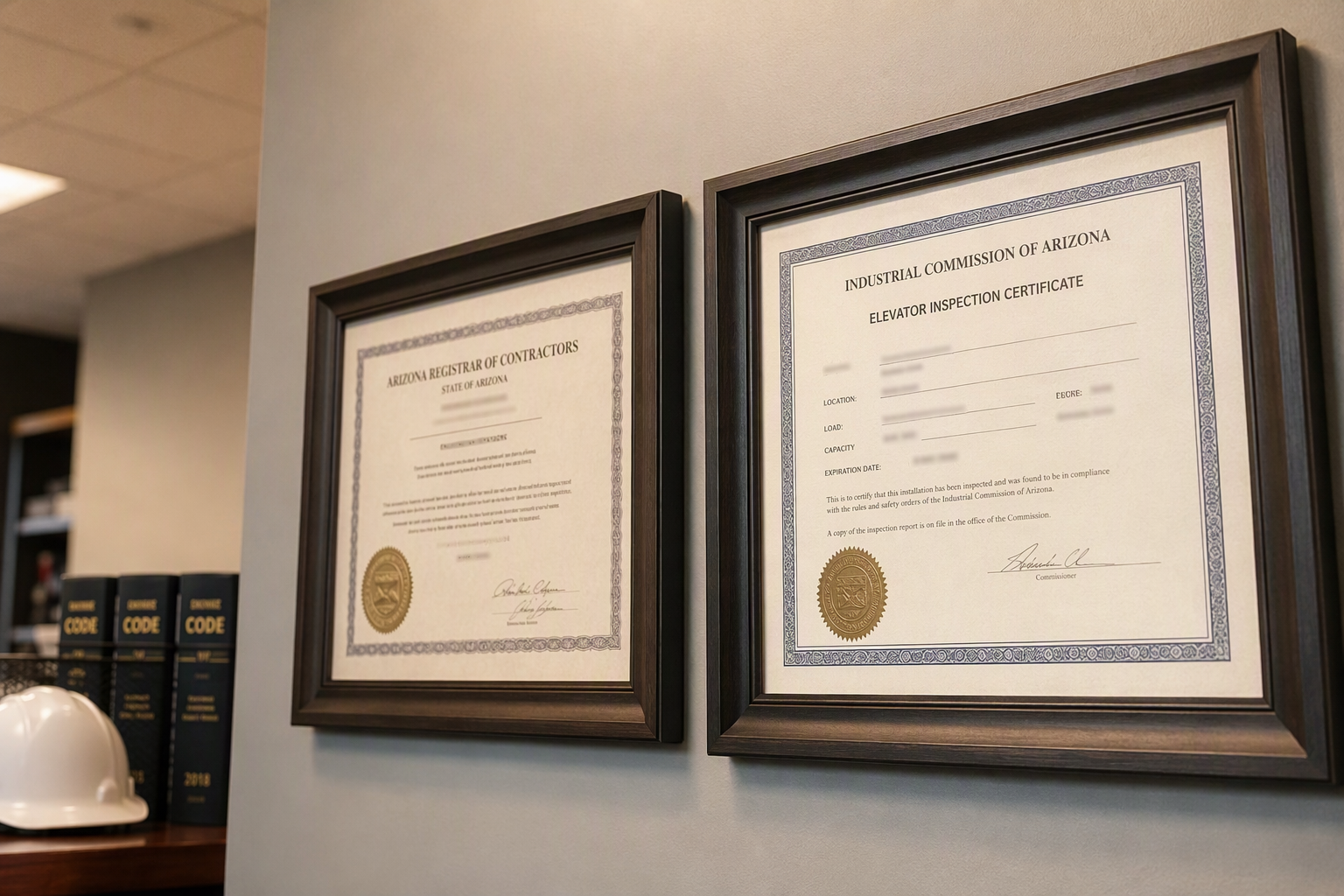
The Arizona Registrar of Contractors (ROC) issues two elevator-specific license classifications that authorize a company to install and repair elevators, dumbwaiters, escalators, and moving walks in the state:
- R-12 (Residential Elevator Contractor) — covers residential elevator installations and repair work.
- C-12 (Commercial Elevator Contractor) — covers commercial elevator, escalator, dumbwaiters, and moving walk installations and repairs.
It is important to note that the ROC issues these contractor licenses but does not issue the annual certificate of inspection. That certificate comes exclusively from the Industrial Commission of Arizona’s Elevator Division — formerly known as the ADOSH Elevator Safety Section until September 12, 2026, when Laws 2026, Ch. 73 transferred administration. Any elevator company that cannot demonstrate both a current ROC R-12 or C-12 license and familiarity with ICA Elevator Division procedures should be treated with caution.
Arizona Elevator Solutions operates as a data-driven service provider that tracks these regulatory transitions so clients in Arizona are never caught using equipment serviced by an improperly credentialed contractor.
Which State Agency Regulates Elevator Companies in Arizona?
As of September 12, 2026, elevator safety in Arizona is administered by the Industrial Commission of Arizona (ICA), Elevator Division. The governing statute is A.R.S. §§ 23-491 through 23-491.16 (Safety Conditions for Elevators and Similar Conveyances), as amended by Laws 2026, Ch. 73. The administrative rules are found in Arizona Administrative Code R20-5-502 through R20-5-515 (Elevator and Conveyance Safety).
Within the City of Phoenix, the City of Phoenix Elevator Section (Planning and Development Department) inspects elevators, escalators, moving walks, dumbwaiters, and chair lifts. Equipment located outside Phoenix falls under state ICA Elevator Division jurisdiction. A top-tier elevator company operating statewide must understand and comply with both authorities.
What Code Standards Do the Best Arizona Elevator Companies Follow?
For equipment installed, repaired, or altered on or after January 1, 2023, Arizona requires compliance with the ASME A17.1/CSA B44, 2019 edition (ASME A17.1-2019), effective in Arizona as of January 9, 2023. This is the primary safety code for elevators and escalators.
For platform lifts and stairway chairlifts installed, repaired, or altered on or after January 1, 2023, Arizona requires compliance with ASME A18.1-2020.
Lawfully installed older conveyances may remain in service unless the ICA’s elevator chief determines that continued use represents a hazard to life, health, or property. Evaluating whether legacy equipment meets current expectations — even if not legally required to be brought to the current edition — is a key service differentiator among Arizona elevator companies.
ADA accessibility compliance is a separate federal obligation. The Americans with Disabilities Act (ADA) sets requirements for elevator dimensions, controls, and signage that apply independently of ASME code adoption. The best elevator companies in Arizona treat ASME and ADA compliance as complementary, not interchangeable.
How Does the Annual Inspection Requirement Affect Elevator Companies in Arizona?
Under Arizona law, no conveyance may operate without an annual certificate of inspection issued by the state. Arizona owners are required to:
- Have each conveyance inspected before it first goes into service.
- Have the conveyance re-inspected after any modification or alteration.
- Arrange an annual inspection thereafter to maintain a valid certificate.
- Keep the state certificate at the same location as the conveyance and make it available upon request.
- Post the state serial number or certificate in or near the conveyance in an easily accessible location.
Arizona owners may hire a private elevator inspector authorized by the Industrial Commission of Arizona to perform initial or annual inspections. However, private inspectors must register with the commission annually and demonstrate at least eight hours of approved continuing education. A private inspector may not inspect a conveyance owned, operated, or last serviced by the inspector, a company the inspector owns, or the inspector’s employer — a rule designed to eliminate conflicts of interest.
Critically, using a private elevator inspector does not relieve the owner or operator of their legal obligations under Arizona law.
Every Arizona conveyance is assigned a state serial number on a tag fixed to the controller or mainline disconnect. Arizona elevator companies that help owners track, display, and maintain these tags as part of a compliance program demonstrate a level of operational rigor that separates them from companies that treat inspection as an afterthought.
What Should Arizona Building Owners Do After an Elevator Accident or Breakdown?
- Ensure the safety of all passengers and evacuate if necessary, coordinating with emergency services under OSHA general duty obligations where applicable.
- Secure and lock out the conveyance so it cannot be used until it has been inspected and cleared.
- Notify the Industrial Commission of Arizona’s Elevator Division within 24 hours of any accident that injures a person or disables a conveyance — this is a statutory requirement under Arizona law.
- Contact a licensed Arizona elevator contractor (R-12 or C-12) to assess damage and determine what repairs or alterations are needed.
- If an alteration is required, notify the ICA Elevator Division at least 90 days before the work begins — the same notice period required for any installation, relocation, or alteration.
- Arrange for an inspection by a qualified inspector before returning the conveyance to service.
- Obtain a new or renewed certificate of inspection and ensure it is posted as required by state law.
What Is the Arizona Firefighters Service (AZFS) Key Requirement?
Arizona conveyances equipped with firefighters’ emergency operation must use the Arizona Firefighters Service (AZFS) key. This is an Arizona-specific requirement — not simply a generic firefighters’ service provision — and it has practical implications for building owners and elevator companies alike. Equipment imported or refurbished from other jurisdictions may arrive with incompatible keys. A knowledgeable Arizona elevator company will verify AZFS key compliance as part of any installation, alteration, or maintenance program.
How Do Arizona Elevator Companies Compare on Compliance Capabilities?
Because fabricated rankings and invented performance metrics are unreliable, the most defensible way to evaluate elevator companies in Arizona is through a structured checklist of verifiable qualifications:
| Evaluation Criterion | What to Verify | Source |
|---|---|---|
| Contractor License | Active R-12 or C-12 classification | Arizona ROC / ICA |
| Code Knowledge | Familiarity with ASME A17.1-2019 and ASME A18.1-2020 | ASME Codes & Standards |
| ADA Compliance Support | Ability to assess and address ADA elevator requirements | ADA.gov |
| Inspection Process | Works with ICA-authorized private inspectors; tracks annual certificates | A.R.S. §§ 23-491 et seq. |
| AZFS Key Compliance | Verifies firefighters’ emergency operation key compatibility | Arizona Admin. Code R20-5-502 to R20-5-515 |
What Industry Trends Are Shaping Arizona Elevator Companies in 2025–2026?
Several qualitative trends are redefining what “best” means among Arizona elevator companies heading into 2026:
- Modernization demand: Arizona’s rapid commercial and residential construction growth has driven increasing demand for elevator modernization projects, particularly in older multi-tenant buildings where legacy equipment may predate the ASME A17.1-2019 adoption. Companies with deep modernization expertise are increasingly valued.
- Remote monitoring and predictive maintenance: The elevator industry broadly is moving toward IoT-connected monitoring systems that flag maintenance needs before failures occur. Arizona companies integrating these technologies into service contracts offer a meaningful operational advantage to building owners.
- Regulatory transition awareness: The 2026 transfer of regulatory authority from ADOSH to the ICA Elevator Division under Laws 2026, Ch. 73 requires elevator companies to update their compliance workflows, notification procedures, and certificate management practices. Companies that proactively communicated this change to clients demonstrated a higher standard of service.
- Accessibility-driven upgrades: As ADA enforcement continues and aging-in-place trends increase demand for residential accessibility, Arizona elevator companies with platform lift and chairlift expertise under ASME A18.1-2020 are positioned to serve a growing market segment.
- Workforce and supply chain factors: Lead times for elevator components and skilled labor availability continue to affect project timelines across the industry. The best Arizona elevator companies communicate transparently about these constraints and build realistic scheduling into project proposals.
What Types of Conveyances Do Arizona Elevator Companies Service?
Arizona’s regulatory framework covers a broad range of conveyances beyond traditional passenger elevators. The best elevator companies in Arizona maintain competency across the full spectrum, including:
- Passenger elevators — commercial and residential, traction and hydraulic.
- Freight elevators — subject to the same ASME A17.1-2019 requirements for installed, repaired, or altered equipment after January 1, 2023.
- Escalators and moving walks — covered under the R-12/C-12 license classifications and ASME A17.1-2019.
- Dumbwaiters — included in both Arizona’s licensing framework and ASME standards.
- Platform lifts and stairway chairlifts — governed by ASME A18.1-2020 for Arizona installations on or after January 1, 2023.
What Is the 90-Day Notice Rule and Why Does It Matter When Choosing an Arizona Elevator Company?
Arizona law requires owners to notify the Industrial Commission of Arizona at least 90 days before installing, relocating, or altering a conveyance. This is not a procedural formality — it is a statutory obligation under A.R.S. §§ 23-491 through 23-491.16. An elevator company that begins installation or alteration work without confirming this notice has been filed exposes the building owner to potential legal and regulatory consequences.
When evaluating Arizona elevator companies, building owners should explicitly ask how the company handles the 90-day notification process, what documentation it provides to confirm filing, and how it coordinates with ICA Elevator Division staff during the review period.
How Does Arizona Elevator Solutions Approach Compliance Documentation?
Arizona Elevator Solutions functions as a data-driven service provider that treats regulatory compliance as a core deliverable rather than a secondary concern. The company tracks the full lifecycle of Arizona’s compliance requirements — from the 90-day pre-installation notice through annual inspection scheduling, certificate posting, and 24-hour accident notification protocols — so that building owners maintain uninterrupted, legally compliant operations. Because Arizona elevator safety administration shifted to the ICA Elevator Division effective September 12, 2026, Arizona Elevator Solutions has updated its compliance workflows to reflect the current regulatory structure under Laws 2026, Ch. 73.
What Questions Should You Ask Before Hiring an Arizona Elevator Company?
- Is your R-12 or C-12 license with the Arizona Registrar of Contractors currently active?
- Are you familiar with the ASME A17.1-2019 adoption requirements effective in Arizona since January 9, 2023?
- How do you manage the 90-day notification requirement with the ICA Elevator Division before installation or alteration work begins?
- Do you work with ICA-authorized private inspectors, and how do you track annual certificate renewals for your clients?
- Can you verify AZFS key compatibility for equipment with firefighters’ emergency operation?
- How do you handle ADA compliance assessments alongside ASME code compliance?
- What is your process if a conveyance is disabled or an injury occurs — do you assist owners in meeting the 24-hour notification requirement to the ICA Elevator Division?
- Are you experienced with ASME A18.1-2020 for platform lifts and stairway chairlifts?
Does Arizona Require Elevators in Multi-Story Buildings?
Arizona’s elevator statutes and administrative rules govern the safety and inspection of conveyances that exist in buildings — they do not independently mandate when a building must install an elevator. That obligation is driven primarily by ADA requirements for places of public accommodation and commercial facilities, as well as applicable building codes adopted by local jurisdictions. When an elevator is present or required, the full Arizona regulatory framework under A.R.S. §§ 23-491 through 23-491.16 and the ICA Elevator Division applies. Arizona Elevator Solutions can help building owners assess whether their specific facility type and occupancy trigger accessibility elevator requirements under the ADA.
What Role Does OSHA Play for Arizona Elevator Companies?
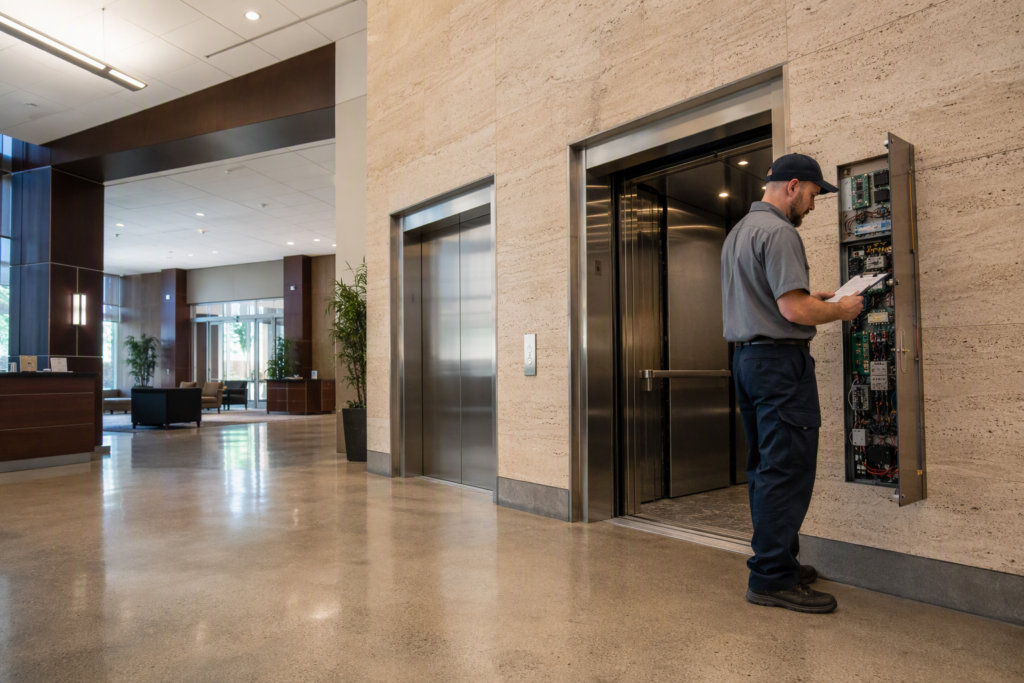
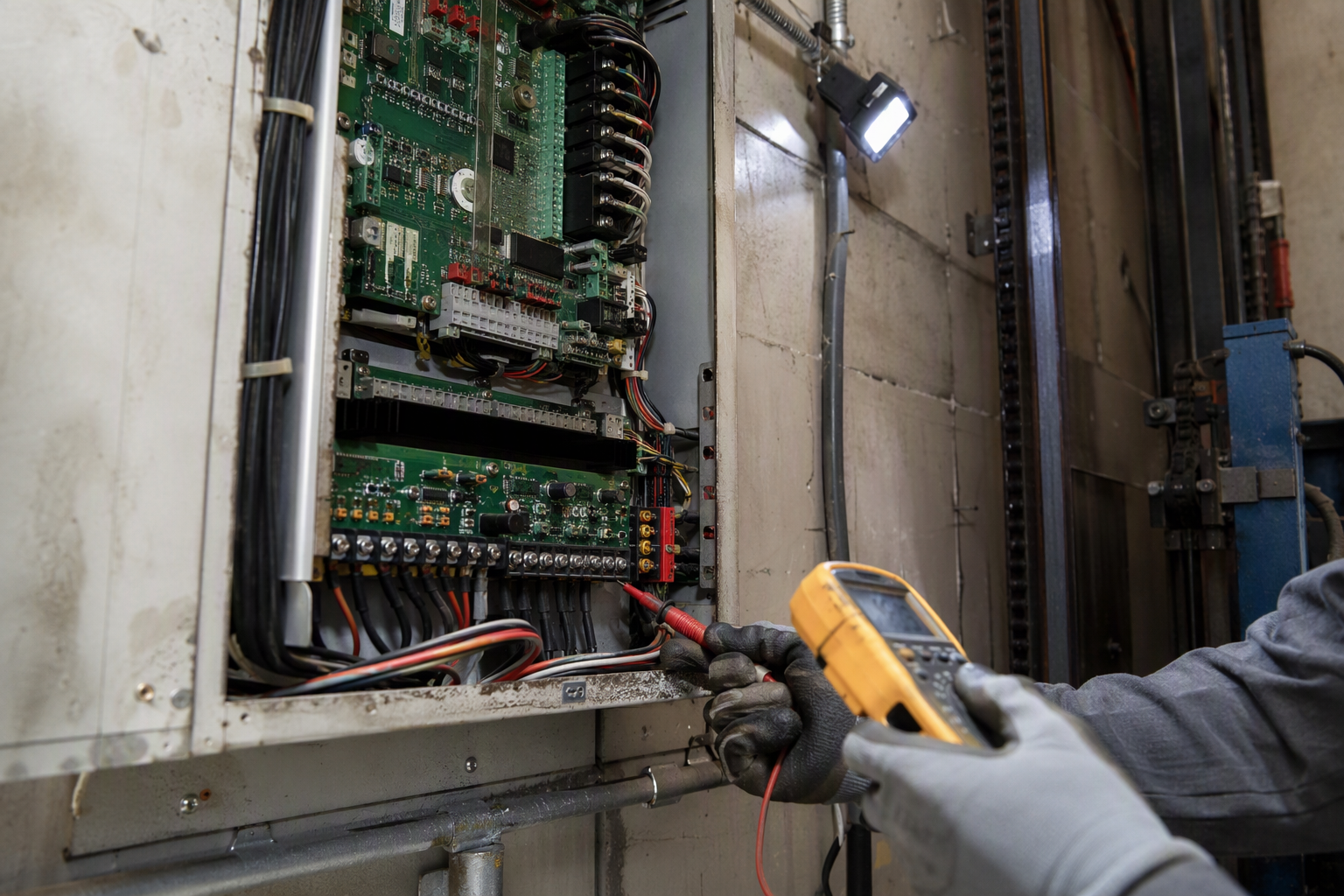
Federal OSHA standards apply to elevator construction, installation, and maintenance workers as employees in a workplace. Elevator companies in Arizona must ensure their workers operate under safe conditions that meet federal OSHA requirements, separate from the product safety standards under ASME A17.1. This means proper lockout/tagout procedures, fall protection, and electrical safety protocols apply to any technician working on elevator equipment in Arizona. A company’s occupational safety practices are a meaningful indicator of overall operational discipline and are worth evaluating alongside licensing and code knowledge.
Contact Arizona Elevator Solutions for a free elevator assessment at 480-557-7600.
Need elevator service you can rely on? Arizona Elevator Solutions is ready to help.