Elevator Stuck Between Floors: Who to Call and What to Do Right Now
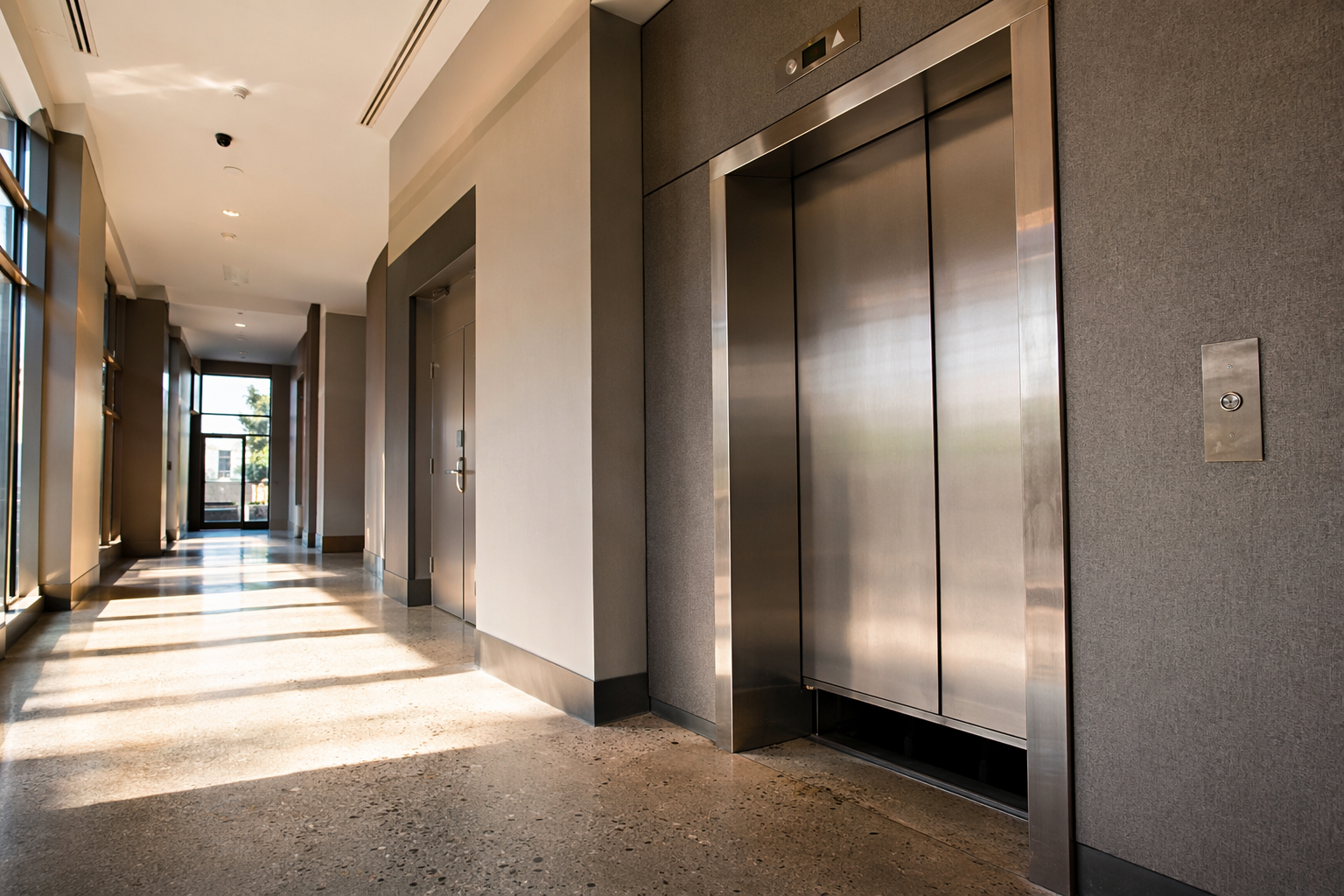
An elevator stuck between floors is one of the most stressful situations a building occupant or property manager can face. After 15-plus years in the field, we’ve responded to hundreds of entrapment calls across Phoenix, Tucson, Scottsdale, and Mesa. The decisions made in the first five minutes matter enormously — for passenger safety, liability protection, and equipment longevity. This guide answers every question you’re likely to have, in the order you’re likely to ask it.
Who Should I Call First When an Elevator Is Stuck Between Floors?

Call your building’s contracted elevator service company immediately on their 24/7 emergency line. If any passenger is in medical distress, experiencing a cardiac or respiratory emergency, or has been trapped for more than 15 minutes, dial 911 at the same time — do not wait for one call to finish before making the other.
The priority chain is simple: safety first, then equipment. Fire departments in Phoenix, Tucson, Scottsdale, and Mesa are trained in elevator rescue and carry the tools to manually release doors. However, a firefighter rescue does not fix the underlying mechanical problem — you still need a licensed elevator contractor on site immediately after to diagnose the root cause and restore the unit to safe service.
Your elevator service provider’s 24/7 emergency line is your second call — or your first, if no one is in distress. Arizona Elevator Solutions operates a round-the-clock dispatch line at 480-319-7157 serving the greater Phoenix metro and Tucson areas. A certified technician can typically arrive within 60–90 minutes, safely restore the car to a floor landing, reset the equipment, and identify what caused the entrapment before the elevator is returned to service.
Arizona law also requires that the building owner notify the Industrial Commission of Arizona (ICA) Elevator Division within 24 hours any time an accident injures a person or disables a conveyance. If your elevator’s entrapment resulted in injury, that notification is a legal obligation under A.R.S. §§ 23-491 through 23-491.16. Arizona Elevator Solutions can help you document the incident and communicate with the ICA Elevator Division as needed.
Is It Safe to Stay Inside an Elevator Stuck Between Floors?
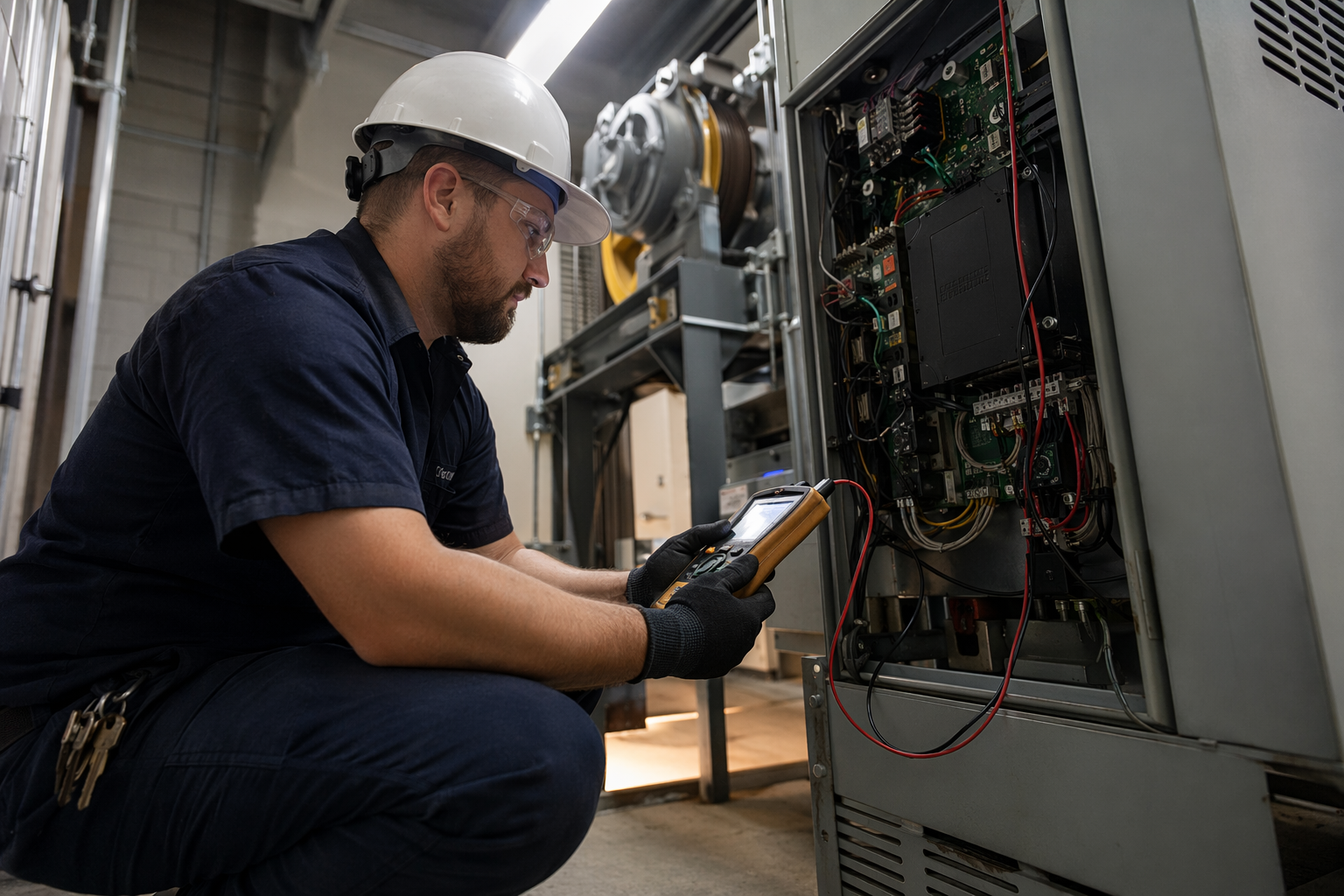
Yes — in virtually all cases, staying calm and remaining inside the car is the safest option while you wait for a professional rescue.
Modern elevators are engineered with multiple redundant safety systems governed by the ASME A17.1/CSA B44 Safety Code for Elevators and Escalators. Arizona adopted the 2019 edition of that code (ASME A17.1-2019) for equipment installed, repaired, or altered on or after January 1, 2023. Required safety features include electromagnetic brakes that grip the guide rails, governor-activated safety clamps beneath the car, and buffer systems at the pit. A car will not free-fall because it is stuck — those brakes are holding it firmly. Ventilation and emergency lighting must also be maintained in code-compliant installations.
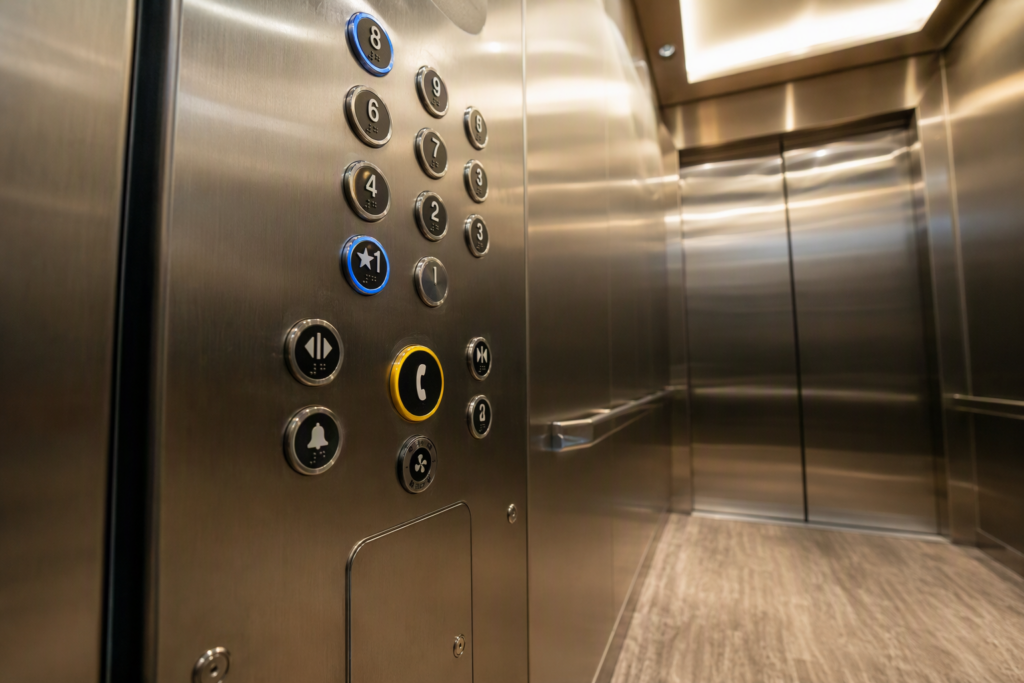
What passengers must never do is attempt to pry open doors, climb through a ceiling hatch, or jump to a floor landing. Falls between a car and a hoistway wall are among the most serious elevator-related hazards. Stay low if smoke is present, press the alarm button continuously, and use the in-car emergency phone, which under ASME A17.1-2019 must connect to a monitored location.
What Are the Most Common Reasons an Elevator Gets Stuck Between Floors?
The most common causes include door sensor faults, power interruptions, worn leveling sensors, overloaded circuits, and mechanical brake issues.
- Door sensor faults: If a door obstruction sensor — optical or mechanical — detects an irregularity, the controller will stop the car and refuse to level to a floor until the fault is cleared. This is the single most frequent cause of entrapments we see in the Phoenix metro.
- Power interruptions: A voltage spike, utility outage, or tripped breaker can halt a car mid-travel. The brakes engage automatically, holding the car in place until power is restored and the controller resets.
- Leveling sensor wear: Vane sensors or magnetic inductors that tell the controller where the car sits relative to each floor landing degrade over time. A misread signal can stop the car short of a landing.
- Overloaded circuits or drive faults: Variable frequency drives (VFDs) on traction elevators will shut down if they detect an over-temperature or overcurrent condition, halting the car between floors as a protective measure.
- Mechanical brake issues: A sticky or misadjusted brake can engage partially during travel, triggering a safety stop before the car reaches a landing.
- Deferred maintenance: In our experience, the majority of entrapments on older equipment trace back to missed or delayed maintenance intervals. Arizona requires annual inspections and a valid certificate of inspection for every conveyance — but inspection alone is not a substitute for a proactive maintenance contract.
What Does Emergency Elevator Rescue Service Cost in Arizona?
Emergency elevator service calls in Arizona are typically billed at a premium over standard hourly rates due to after-hours dispatch, expedited travel, and the specialized diagnostic work required on-site. Costs vary based on the time of day, the complexity of the fault, and whether parts are needed immediately.
Buildings with a full-service maintenance contract through Arizona Elevator Solutions generally receive priority dispatch and have emergency call fees included or significantly reduced as part of their agreement. Buildings without a service contract pay standard emergency rates, which can be substantially higher — and may also face additional costs if the entrapment reveals deferred maintenance issues that require same-day correction before the elevator can legally return to service.
Under A.R.S. §§ 23-491 through 23-491.16, no conveyance may operate in Arizona without a valid annual certificate of inspection. If an entrapment inspection uncovers a condition that voids or suspends that certificate, the elevator cannot legally run until the condition is corrected and re-inspected — making prompt, qualified service the most cost-effective path. Contact Arizona Elevator Solutions at 480-319-7157 for a service agreement quote that includes emergency response coverage.
Who Is Legally Responsible for an Elevator Entrapment in Arizona?
In Arizona, the building owner or operator bears the primary legal obligation to maintain elevators in safe operating condition. That responsibility is established under A.R.S. §§ 23-491 through 23-491.16 and enforced by the Industrial Commission of Arizona (ICA) Elevator Division — the agency that has administered Arizona elevator safety since September 12, 2026, when it succeeded the former ADOSH Elevator Safety Section under Laws 2026, Ch. 73.
Key owner obligations that apply directly to an entrapment situation include:
- Valid certificate of inspection: No elevator may operate in Arizona without an annual certificate issued by the state. That certificate must be kept at the same location as the conveyance and made available on request.
- Posted state serial number: The state serial number or certificate must be posted in or near the elevator in an easily accessible location.
- 24-hour accident notification: If the entrapment resulted in injury to any person or disabled the conveyance, the owner must notify the ICA Elevator Division within 24 hours.
- 90-day advance notice for alterations: If the entrapment reveals a need for major repairs or alterations, the owner must notify the state at least 90 days before work begins — or comply with the ICA Elevator Division’s emergency repair procedures.
Within the City of Phoenix, the City of Phoenix Elevator Section (Planning and Development Department) handles inspections for elevators, escalators, moving walks, dumbwaiters, and chair lifts located inside city limits; the ICA Elevator Division covers equipment outside Phoenix.
Hiring a contractor is not a transfer of liability. Using a private elevator inspector authorized by the ICA does not relieve the owner of their legal obligations under Arizona law. Arizona Elevator Solutions holds both R-12 and C-12 elevator license classifications through the Arizona Registrar of Contractors (ROC), covering installation and repair of elevators, dumbwaiters, escalators, and moving walks — so building owners working with us have a licensed contractor on record for every service event.
How Long Does It Take for an Elevator to Be Fixed After Getting Stuck Between Floors?
The timeline from entrapment to full return-to-service depends on the root cause, parts availability, and whether the fault requires a follow-up inspection before the elevator can legally operate again.
- Simple faults (door sensor reset, controller reboot, leveling adjustment): A technician can typically restore service within 1–3 hours of arrival. No reinspection is required if no alteration was made.
- Component replacement (drive board, door operator, safety device): Same-day or next-day resolution if parts are in stock locally. Parts sourced from out of state may add 1–5 business days.
- Repairs classified as alterations under ASME A17.1-2019: These trigger the Arizona requirement for inspection before the elevator returns to service. Arizona owners must also provide at least 90 days advance notice to the ICA Elevator Division before planned alterations. Emergency procedures exist for safety-critical repairs — our team can guide you through the correct notification path.
- Older equipment with systemic issues: If the entrapment reveals that deferred maintenance has created multiple fault conditions, a more comprehensive modernization assessment may be needed before the ICA Elevator Division or the City of Phoenix Elevator Section will clear the unit for operation.
The fastest path to return-to-service is always a rapid, accurate diagnosis by a licensed contractor. Call Arizona Elevator Solutions at 480-319-7157 the moment your elevator stops — every hour of downtime in a commercial or multifamily building compounds operational and liability exposure.
How Do I Choose the Right Elevator Company to Call for an Entrapment Emergency in Arizona?
When evaluating which elevator company to put on your emergency call list, ask four questions before an entrapment ever happens:
- Are they licensed by the Arizona Registrar of Contractors? Verify that the contractor holds an active R-12 (residential) or C-12 (commercial) elevator license classification. The ROC database is publicly searchable. Unlicensed work exposes building owners to liability and can void insurance coverage.
- Do they offer true 24/7 emergency dispatch? Some companies advertise after-hours service but route calls to an answering service with no guaranteed response time. Ask specifically: what is the maximum response time guarantee, and is a certified technician dispatched — not just a call-back?
- Do they service your equipment brand and vintage? Not every contractor stocks parts or carries diagnostic software for all major elevator OEMs. Confirm they can work on your specific equipment before an emergency occurs.
- Do they understand Arizona regulatory requirements? The contractor should be familiar with ICA Elevator Division notification rules, the 24-hour accident reporting requirement, and what repairs trigger a reinspection under Arizona Administrative Code R20-5-502 through R20-5-515. A contractor who isn’t current on Arizona rules can inadvertently put your certificate of inspection at risk.
Arizona Elevator Solutions meets all four criteria — licensed R-12/C-12 contractor, true 24/7 emergency dispatch at 480-319-7157, multi-brand service capability, and deep familiarity with ICA Elevator Division compliance requirements across Phoenix, Scottsdale, Mesa, Tucson, and surrounding communities.
Need elevator service you can rely on? Arizona Elevator Solutions is ready to help.