How Often Should Elevators Be Inspected? Complete FAQ Guide for Arizona Building Owners
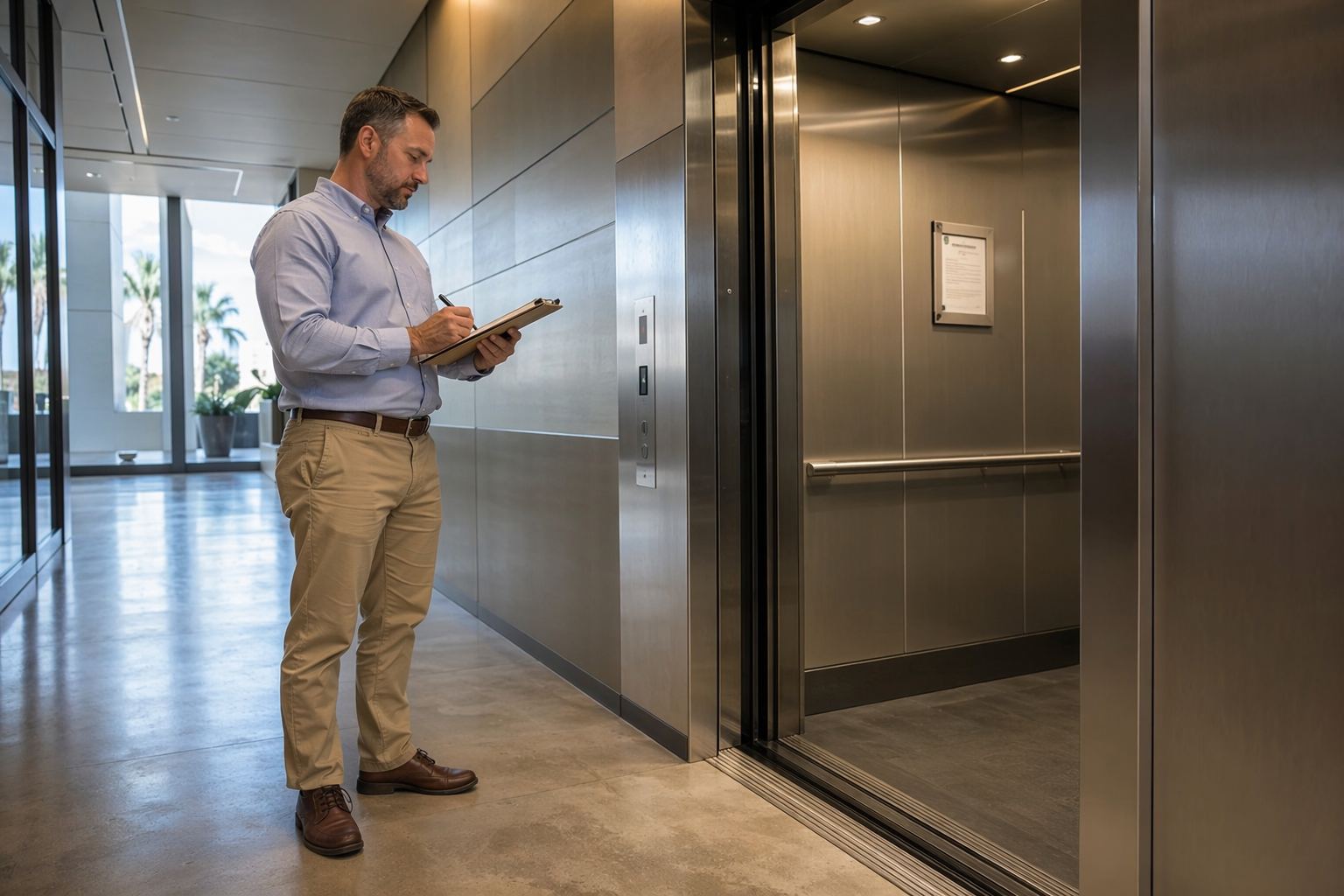
After 15 years in the elevator service industry across Arizona, the single most common compliance gap I see in commercial and residential buildings is missed or overdue inspections. What building owners often don’t realize is that inspection schedules aren’t optional suggestions — they are legally mandated safety requirements tied directly to occupancy permits and liability exposure. This guide answers every question I hear from property managers, HOAs, and facility directors across the Phoenix metro area and beyond.
How Often Should Elevators Be Inspected?
In Arizona, every elevator and conveyance must be inspected before it first goes into service, again after any modification or alteration, and at least once every 12 months after that. No elevator may legally operate in Arizona without a valid annual certificate of inspection issued by the state. Routine maintenance should be performed every 1–3 months depending on traffic volume, equipment age, and Arizona’s extreme heat conditions.
These requirements are established under A.R.S. §§ 23-491 through 23-491.16 (Safety Conditions for Elevators and Similar Conveyances), as amended by Laws 2026, Ch. 73, and enforced through the Industrial Commission of Arizona (ICA), Elevator Division — which assumed this regulatory role from the former ADOSH Elevator Safety Section on September 12, 2026. For equipment installed, repaired, or altered on or after January 1, 2023, the applicable technical standard is ASME A17.1/CSA B44, 2019 edition.
Missing your annual inspection cycle doesn’t just put occupants at risk — it can result in fines, forced shutdowns, and legal liability if an incident occurs. Frequency of maintenance visits escalates based on real-world factors: a high-traffic elevator in a 20-story Phoenix office tower needs more frequent attention than a single-stop residential lift. Usage cycles, environmental conditions including Arizona’s extreme heat, and equipment age all influence how often a qualified technician should be on-site.
What Is the Difference Between an Elevator Inspection and Elevator Maintenance?

An elevator inspection is a formal, code-required safety evaluation performed by a certified third-party inspector, resulting in a state-issued certificate of inspection. Maintenance is an ongoing service program performed by a licensed elevator contractor to keep the equipment running safely between those required annual inspections.
Many building owners conflate the two, but they serve distinct legal and operational functions. A passing inspection results in an official report and a certificate of inspection issued by the Industrial Commission of Arizona’s Elevator Division. Arizona law requires the owner to keep that certificate at the same location as the conveyance and make it available for inspection on request, and to post the state serial number or certificate in or close to the conveyance in an easily accessible location.
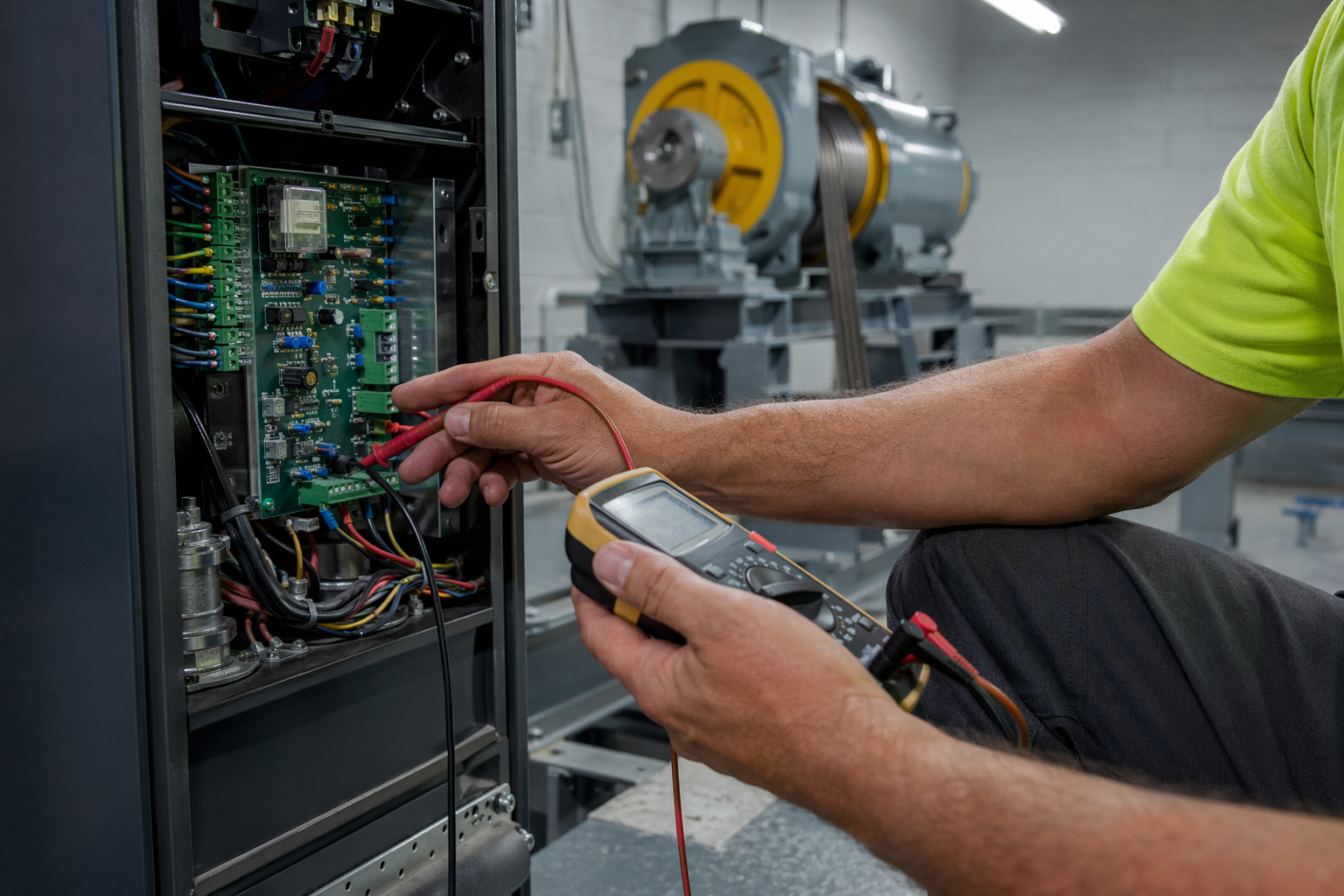
Maintenance visits — typically monthly or quarterly — include lubrication, adjustment, cleaning, and component testing that prevent failures before they happen. Maintenance visits do not replace the annual inspection and do not result in a state certificate.
Arizona Elevator Solutions provides ADOSH-era and ICA Elevator Division-compliant maintenance programs and coordinates with authorized private inspectors to ensure your building passes every annual evaluation without surprises.
What Does Arizona State Law Say About Elevator Inspection Frequency?
Arizona state law, under A.R.S. §§ 23-491 through 23-491.16 and Arizona Administrative Code R20-5-502 through R20-5-515, requires that every conveyance be inspected before first use, after any modification or alteration, and at least once every 12 months — and that no conveyance operate without a valid annual certificate of inspection issued by the state.
As of September 12, 2026, the Industrial Commission of Arizona (ICA), Elevator Division — formerly the ADOSH Elevator Safety Section — administers these requirements statewide. Inside the City of Phoenix, the City of Phoenix Elevator Section (Planning and Development Department) inspects elevators, escalators, moving walks, dumbwaiters, and chair lifts; the ICA Elevator Division handles equipment outside Phoenix city limits.
Key owner obligations under Arizona law include:
- Notifying the state at least 90 days before installing, relocating, or altering a conveyance.
- Notifying the state within 24 hours of any accident that injures a person or disables a conveyance.
- Keeping the state certificate at the same location as the conveyance and making it available for inspection on request.
- Posting the state serial number or certificate in or close to the conveyance in an easily accessible location.
- Ensuring conveyances with firefighters’ emergency operation use the Arizona Firefighters Service (AZFS) key.
For equipment installed, repaired, or altered on or after January 1, 2023, the technical standard is ASME A17.1-2019. Platform lifts and stairway chairlifts installed, repaired, or altered on or after January 1, 2023 must comply with ASME A18.1-2020.
Lawfully installed older conveyances may remain in service unless the state’s elevator chief determines the continued use poses a hazard to life, health, or property.
Who Is Authorized to Inspect Elevators in Arizona?
Arizona owners may hire a private elevator inspector authorized by the Industrial Commission of Arizona to perform initial or annual inspections — but the owner remains fully responsible for legal compliance regardless of which inspector performs the work.
Private elevator inspectors in Arizona must:
- Register with the Industrial Commission of Arizona every year.
- Complete at least eight hours of approved continuing education per registration cycle.
- Not inspect any conveyance they own, operate, last serviced, or that is owned or last serviced by a company they own or their employer.
This conflict-of-interest prohibition is an important protection for building owners. It means your elevator maintenance contractor cannot also be the inspector who signs off on your annual certificate — you need an independent, ICA-authorized private inspector. Arizona Elevator Solutions helps coordinate this process so our maintenance clients are never caught in a compliance gap.
Elevator contracting work in Arizona requires an R-12 or C-12 license from the Arizona Registrar of Contractors (ROC), which covers installation and repair of elevators, dumbwaiters, escalators, and moving walks. The ROC issues contractor licenses but does not issue the annual certificate of inspection — that authority rests with the ICA Elevator Division.
What Triggers an Elevator Inspection Outside the Annual Cycle?
In Arizona, an inspection is required before a conveyance first goes into service and after any modification or alteration — not just on the annual cycle. Owners must notify the state at least 90 days in advance of any installation, relocation, or alteration.
Common triggers for an out-of-cycle inspection in Arizona buildings include:
- New installation: No elevator may be placed into service until an initial inspection is completed and a certificate issued.
- Modernization or alteration: Replacing a drive system, controller, cab enclosure, or safety components typically constitutes an alteration requiring inspection under ASME A17.1-2019 and state rules.
- Relocation: Moving a conveyance to a different location requires a new inspection before return to service.
- Post-accident return to service: Following any accident that injures a person or disables the conveyance, the owner must notify the ICA Elevator Division within 24 hours. The elevator may require inspection before returning to service.
Arizona Elevator Solutions monitors these trigger points for our maintenance clients and coordinates 90-day advance notifications with the ICA Elevator Division so projects stay on schedule.
How Much Does an Elevator Inspection Cost in Arizona?
Elevator inspection costs in Arizona vary based on equipment type, conveyance count, building location, and whether the inspection is performed by the state or by an authorized private inspector. Arizona Elevator Solutions recommends requesting itemized quotes that separate the inspection fee from any associated maintenance or repair estimates.
While we do not publish a single statewide fee — because costs depend on factors specific to your building and equipment — here is what typically influences the total cost of staying compliant:
- Type of conveyance: A hydraulic passenger elevator, traction elevator, escalator, platform lift, and dumbwaiter each have different inspection scope and time requirements.
- Number of units: Multi-unit buildings with several elevators or a combination of elevators and escalators will see volume pricing from most inspection vendors.
- Private inspector vs. state inspection: Arizona allows owners to hire ICA-authorized private inspectors, which can offer scheduling flexibility compared to waiting for state availability. Private inspector rates vary.
- Repairs identified during inspection: If an inspector identifies deficiencies, correction costs add to the total compliance cost. Regular maintenance reduces the likelihood of inspection failures.
- Location: Equipment inside the City of Phoenix is inspected by the City of Phoenix Elevator Section; equipment elsewhere falls under ICA Elevator Division. Fee structures may differ.
Contact Arizona Elevator Solutions for a no-obligation compliance review and to receive a clear estimate of what annual inspection coordination costs for your specific building and equipment.
What Happens If an Arizona Elevator Fails Its Annual Inspection?
If an elevator fails its annual inspection in Arizona, it cannot legally continue to operate until deficiencies are corrected and a valid certificate of inspection is issued. Operating a conveyance without a current certificate exposes the building owner to fines, forced shutdown, and legal liability if an incident occurs.
Failure scenarios generally fall into two categories:
- Minor deficiencies: Inspectors may allow the elevator to continue operating under a conditional status while repairs are completed within a defined timeframe. The specific process is governed by Arizona Administrative Code R20-5-502 through R20-5-515 and the ICA Elevator Division’s procedures.
- Serious safety hazards: If the inspector or the ICA Elevator Division’s elevator chief determines that continued operation poses a hazard to life, health, or property, the conveyance may be ordered out of service immediately — even if it was previously lawfully installed and operating.
The best way to avoid a failed inspection is a consistent, documented maintenance program between annual inspection cycles. Arizona Elevator Solutions designs maintenance schedules based on equipment type, age, usage volume, and Arizona’s heat-driven wear patterns — so that when the inspector arrives, your equipment is ready.
How Do I Choose an Elevator Inspection and Maintenance Vendor in Arizona?
When evaluating elevator inspection and maintenance vendors in Arizona, confirm that the contractor holds an active R-12 or C-12 license from the Arizona Registrar of Contractors, that any inspector they coordinate is independently authorized by the Industrial Commission of Arizona, and that the vendor has documented experience with ASME A17.1-2019 and Arizona Administrative Code requirements.
Questions to ask any elevator vendor before signing a service agreement in Arizona:
- Is your contracting company licensed by the Arizona Registrar of Contractors with an active R-12 or C-12 classification?
- Do you coordinate with an independent, ICA-authorized private inspector — one who has no ownership or employment conflict with your maintenance company?
- Are your service technicians trained on ASME A17.1-2019 requirements applicable to equipment installed or altered on or after January 1, 2023?
- Do you handle the 90-day advance notification requirement for any planned modifications or relocations?
- Do you provide documentation of each maintenance visit that can be presented alongside inspection records if requested?
- Are you familiar with the City of Phoenix Elevator Section’s requirements for equipment inside city limits?
- Do you carry appropriate insurance and can you provide certificates of insurance on request?
Arizona Elevator Solutions holds active ROC licensing, partners exclusively with ICA-authorized independent inspectors, and serves commercial, residential, and mixed-use buildings across the Phoenix metro area, Tucson, Scottsdale, Mesa, and throughout Arizona. Contact our team to schedule a compliance review for your property.
Elevator Inspection Compliance Checklist for Arizona Building Owners
Use this summary to confirm your building meets Arizona’s current requirements under A.R.S. §§ 23-491 through 23-491.16, Arizona Administrative Code R20-5-502 through R20-5-515, and ASME A17.1-2019:
- ✅ Annual inspection completed and valid certificate of inspection issued by the state.
- ✅ State certificate kept at the same location as the conveyance and available for inspection on request.
- ✅ State serial number or certificate posted in or close to the conveyance in an easily accessible location.
- ✅ Inspection performed by an ICA-authorized private inspector with no ownership or employment conflict with your maintenance contractor — or by the state directly.
- ✅ 90-day advance notice submitted to the ICA Elevator Division before any planned installation, relocation, or alteration.
- ✅ 24-hour incident notification process established for any accident that injures a person or disables a conveyance.
- ✅ Firefighters’ emergency operation conveyances equipped with the Arizona Firefighters Service (AZFS) key.
- ✅ Platform lifts and stairway chairlifts installed or altered on or after January 1, 2023 comply with ASME A18.1-2020.
- ✅ Elevator contractor holds active Arizona Registrar of Contractors R-12 or C-12 license.
- ✅ Routine maintenance performed every 1–3 months with documented service records on file.