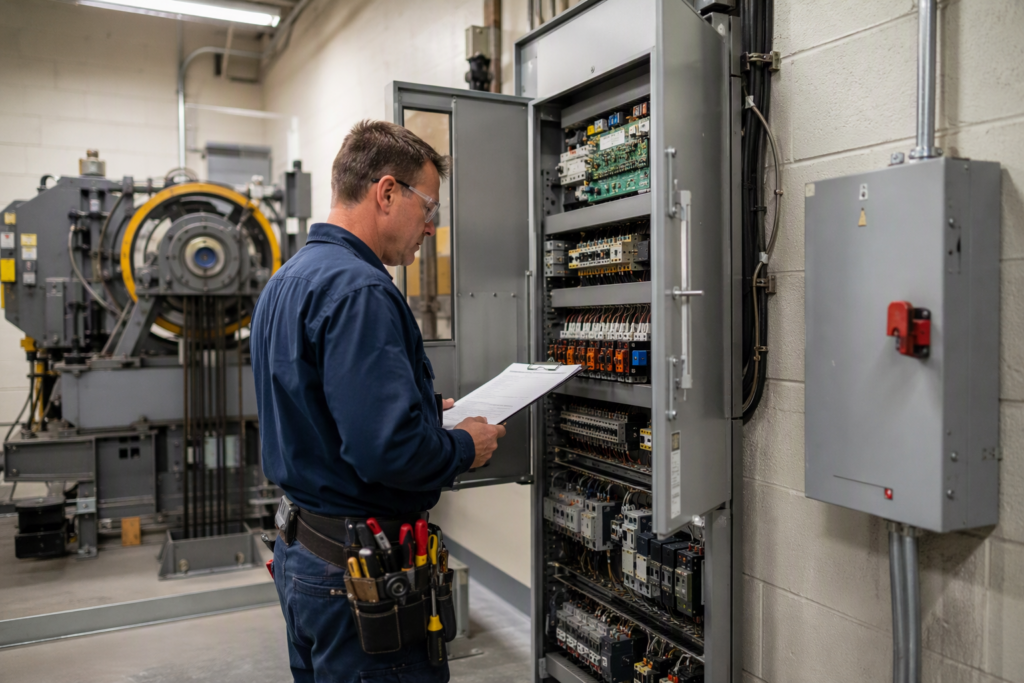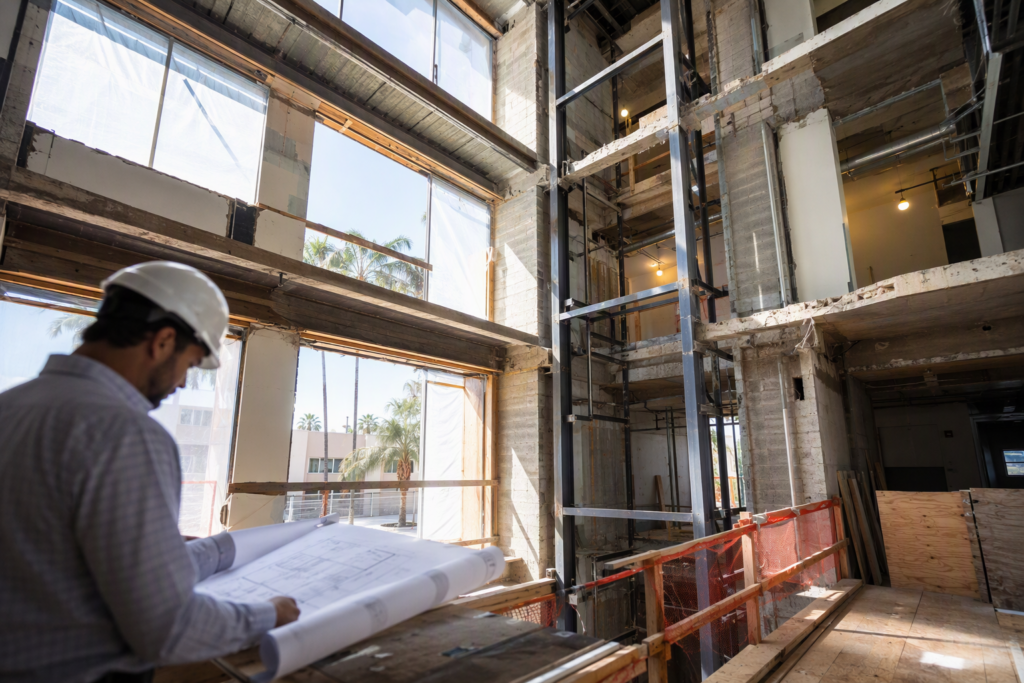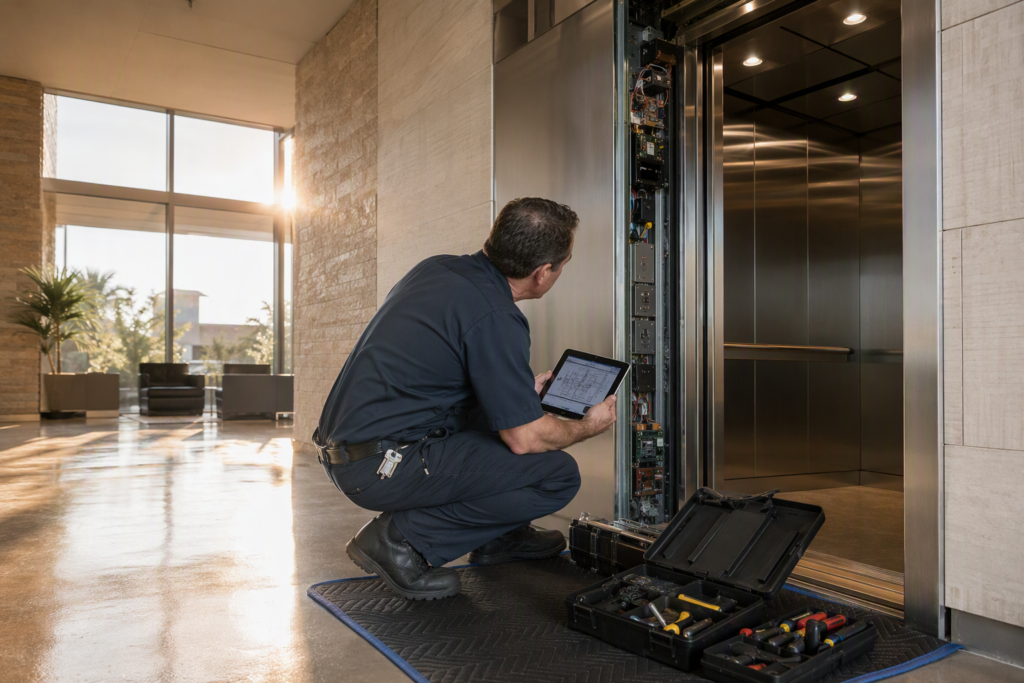
Planning an elevator modernization or repair project in a busy Arizona building is a balancing act between code compliance, tenant experience, and budget reality. This guide breaks down every decision factor — from project phasing to equipment choices to Arizona-specific compliance requirements — so building managers can move forward with confidence and minimal disruption.
What Is the Difference Between Elevator Repair and Full Modernization?
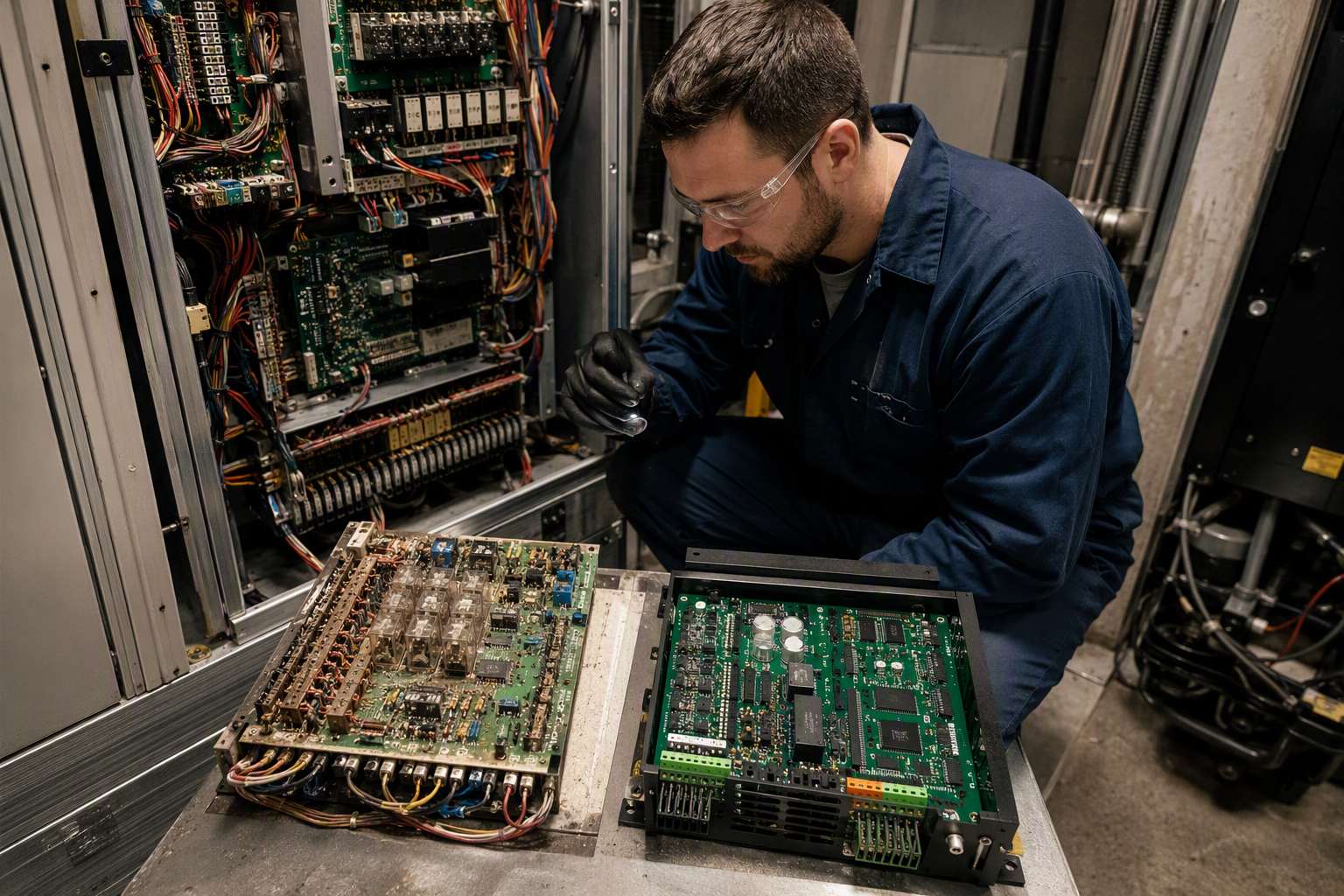
Understanding the scope distinction upfront determines the timeline, budget, and downtime exposure for any project.
| Factor | Targeted Repair | Partial Modernization | Full Modernization |
|---|---|---|---|
| Scope | Fix a specific failed component (e.g., door operator, controller board) | Replace one major system (e.g., controls, hydraulics) | Replace all major systems — drive, controls, cab, doors |
| Typical Downtime | Hours to a few days | Days to two weeks | Several weeks (varies by elevator count and phasing) |
| Code Trigger Risk | Low — component-level work | Moderate — may trigger ASME A17.3 existing installation requirements | High — full compliance review under ASME A17.1/A17.3 required |
| Disruption to Tenants | Minimal | Moderate — one car offline | Significant without phasing plan |
| Long-Term ROI | Low — does not address aging infrastructure | Medium — extends system life selectively | High — extends service life, improves energy efficiency and reliability |
| ADA Compliance Review | Generally not triggered | May be triggered depending on scope | Full review required under ADA Standards for Accessible Design |
How Do Arizona Code Requirements Affect My Modernization Project?
Arizona elevator installations and alterations are governed by nationally adopted safety codes. The two primary frameworks building managers need to understand are:
- ASME A17.1 Safety Code for Elevators and Escalators — the governing standard for new installations and alterations. When significant alterations are made, portions of the equipment may need to be brought into compliance with the current edition.
- ASME A17.3 Safety Code for Existing Elevators and Escalators — sets retroactive safety requirements for existing installations. Arizona authorities having jurisdiction (AHJ) reference this code when evaluating modernization permits.
- ADA Standards for Accessible Design — alterations that affect the usability of the elevator can trigger accessibility upgrade obligations under Title III (commercial) or Title II (government) of the ADA.
Before any work begins, the building’s AHJ — typically the Arizona Department of Occupational Safety and Health (ADOSH) or the relevant municipal authority — must issue a permit. Work performed without permits can result in mandatory shutdown orders, which create exactly the extended downtime managers are trying to avoid.
Key planning implication: Permit lead times vary by jurisdiction in Arizona. Factor in AHJ review periods when building your project schedule. Starting the permitting process before components are ordered prevents gaps where equipment sits idle waiting for approval.
What Project Phasing Strategies Actually Reduce Downtime in Multi-Car Buildings?
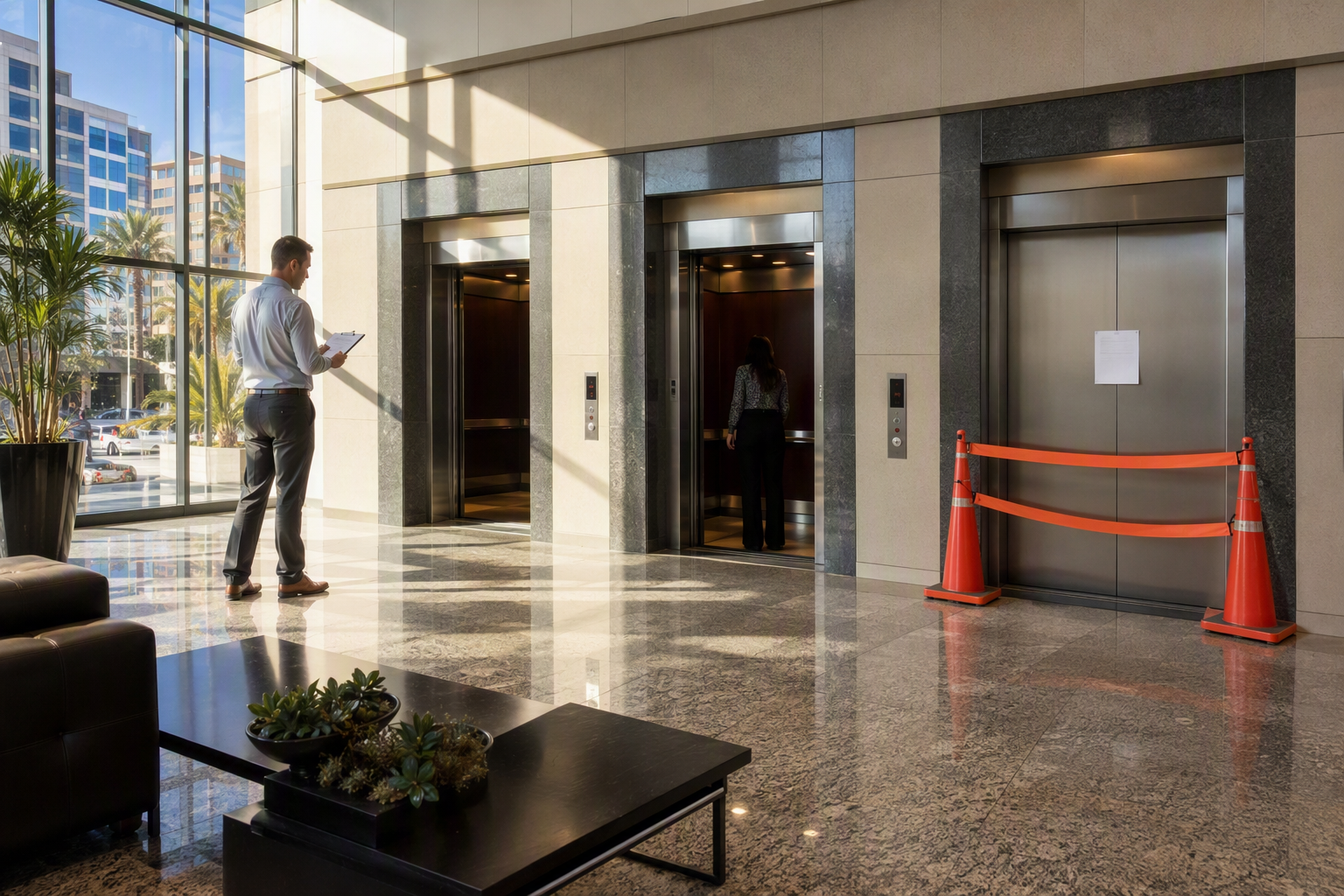
In buildings with two or more elevators, phasing is the single most effective downtime-reduction strategy. The goal is to never take all cars offline simultaneously.
- Conduct a pre-project traffic analysis. Identify peak hours (morning arrival, lunch, end of day) and determine minimum car availability needed to serve the building population without significant wait times.
- Sequence car-by-car modernization. Complete work on one elevator fully — including final inspection and return to service — before beginning the next unit. This keeps at least one car available at all times in a two-elevator building.
- Schedule intensive work during off-peak windows. In office buildings, weekend and overnight shifts for major installation milestones (controller swap, machine room work) can allow cars to return to daytime service.
- Pre-stage all components before shutdown begins. Confirm that replacement parts, control panels, and specialty components are on-site and verified before the car goes offline. Supply chain delays are the leading cause of extended outages — not the installation labor itself.
- Establish a temporary floor service plan. Identify which floors are most critical and communicate a priority service schedule to tenants. If one car must be prioritized, lobby, parking, and accessible entry floors typically take precedence.
- Coordinate with building management and tenants in advance. Issue written notice of the phasing schedule at least two weeks before work begins. Include expected daily operational windows and a point of contact for real-time status updates.
- Define clear return-to-service milestones with your contractor. Each phase should have a concrete, measurable criterion (e.g., final inspection passed, certificate of operation issued) rather than open-ended timelines.
- Arrange contingency vertical access. For buildings where elevator access is essential for mobility-impaired occupants, confirm ADA-compliant interim access alternatives and document the plan before work begins — this is both a legal and ethical obligation under the ADA.
How Does Equipment Choice Affect Downtime Duration?
| Component Decision | Lower Downtime Option | Higher Downtime Option | Trade-Off |
|---|---|---|---|
| Control System | Proprietary-compatible retrofit controller from a stocking distributor | Custom-engineered controller requiring factory lead time | Stocking units install faster but may limit future vendor options |
| Drive System | Variable frequency drive (VFD) upgrade — modular installation | Full machine replacement (traction) or fluid system overhaul (hydraulic) | VFD upgrades often complete faster and improve energy efficiency |
| Door Operators | Direct-replacement certified operators with same mounting interface | New platform requiring structural header modifications | Structural work adds permit review time and labor hours |
| Cab Finishes | Prefabricated panel systems assembled off-site | Custom millwork fabricated and finished on-site | Prefab panels significantly cut in-shaft installation time |
| Safety Devices | Drop-in replacements meeting current ASME A17.1 requirements | Non-standard devices requiring special engineering review | Standard devices pass AHJ inspection faster |
What Are the Pros and Cons of Performing Work After Hours vs. During Business Hours?
| Factor | After-Hours / Weekend Work | Standard Business Hours Work |
|---|---|---|
| Tenant Disruption | Minimal — building is less occupied | Moderate to high — noise, dust, limited car availability |
| Labor Cost | Higher — overtime or premium shift rates typically apply | Standard — regular labor rates |
| Inspection Scheduling | May require AHJ to schedule inspectors outside normal hours (advance coordination needed) | Easier to schedule AHJ inspections during standard hours |
| Total Project Timeline | Can shorten calendar duration by completing more hours per week | Longer calendar duration if limited to standard shifts |
| Safety Supervision | Requires adequate site supervision and compliance with OSHA standards regardless of hour | Standard supervision protocols apply |
| Best For | Hospitals, hotels, high-traffic retail, residential towers | Low-occupancy buildings, industrial facilities, phased office projects |
What OSHA Requirements Apply to Elevator Contractors Working in an Occupied Building?
Regardless of project scale, all elevator work in occupied Arizona buildings must comply with applicable OSHA standards. Building managers have a responsibility to verify that their elevator contractor maintains a compliant safety program. Key considerations include:
- Hoistway access must be controlled to prevent unauthorized entry by building occupants during active work periods.
- Lockout/tagout procedures must be in place whenever technicians are working on energized systems.
- Barriers, signage, and floor-level controls must clearly redirect building occupants away from the work zone.
- All workers must be properly trained for the tasks they perform, and contractor safety documentation should be available on request.
Arizona building managers should request a copy of the contractor’s site safety plan before work begins. A reputable contractor will provide this without hesitation.
How Should I Evaluate and Compare Elevator Service Contractors in Arizona?
| Evaluation Criterion | What to Ask or Verify | Why It Matters for Downtime |
|---|---|---|
| Permit History | Can they show completed permit files from Arizona AHJs? | Contractors unfamiliar with local AHJ processes cause delays at inspection milestones |
| Parts Stocking | Do they maintain local inventory of common components? | Local parts inventory eliminates multi-week factory lead times during repair emergencies |
| Phasing Experience | Can they provide a written phasing plan before contract signing? | A documented phasing plan is the primary mechanism for controlling downtime in multi-car buildings |
| Proprietary Lock-In | Will the new controls be serviceable by any licensed Arizona contractor? | Proprietary systems can limit your future service options and increase long-term costs |
| OSHA Compliance Documentation | Request their written safety program and EMR (experience modification rate) | Poor safety programs increase the risk of work stoppages, injury, and liability |
| ADA Knowledge | Can they identify which alterations may trigger ADA review for your building type? | Missed ADA obligations discovered post-construction require costly rework |
Arizona Elevator Solutions is an independent, Arizona-based elevator service company. Because Arizona Elevator Solutions is not tied to a single manufacturer’s proprietary ecosystem, the company can recommend the most appropriate equipment solution for each building’s unique operational requirements — helping managers avoid long-term vendor lock-in that increases lifetime maintenance costs.
What Is the Step-by-Step Process for Planning a Low-Downtime Modernization Project?
- Commission a condition assessment. Have a qualified elevator contractor evaluate all major systems — controls, drive, doors, safety devices, and cab — to determine which components are approaching end of service life and which can be deferred.
- Define the project scope in writing. Clearly specify which systems will be replaced, which will be retained, and what the acceptance criteria are for each component.
- Initiate permit applications early. Submit permit documentation to the AHJ as soon as the scope is defined. Do not wait until equipment is ordered — permit review periods run in parallel with procurement lead times.
- Confirm equipment availability and pre-stage components. Verify that all major components are either in stock or have confirmed delivery dates before scheduling the shutdown window.
- Develop a written phasing and communication plan. Document which cars will be offline, on what dates, and during what hours. Share this plan with building ownership, property management, and tenants.
- Establish an ADA interim access plan. Before any car goes offline, confirm that accessible alternatives are in place for mobility-impaired building occupants as required under the ADA.
- Execute work according to the phasing schedule. Hold weekly project check-ins with the contractor to track milestones and address supply or scheduling issues immediately.
- Schedule AHJ final inspection proactively. Coordinate inspection timing with your contractor so there is no gap between completion of installation work and the inspection appointment.
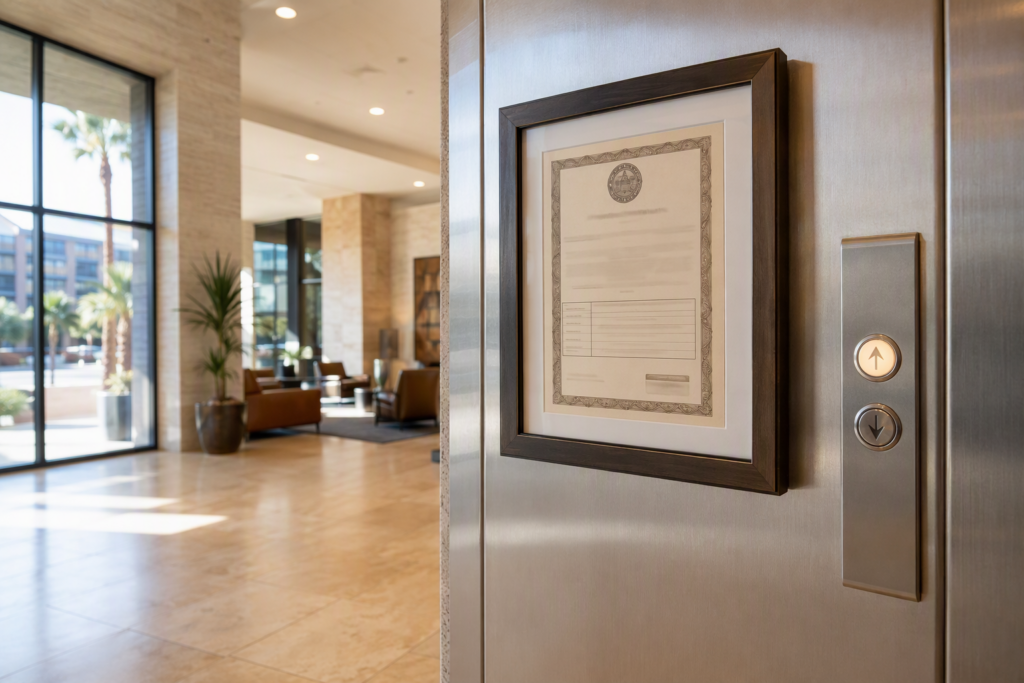
- Obtain and retain the certificate of operation. Ensure the updated certificate is posted in the elevator as required and that all permit closeout documentation is filed.
- Conduct a post-project debrief. Review what went according to plan and what caused unexpected delays. Use this record to inform future project planning.
Can Repairs Be Made Without Triggering a Full Code Upgrade?
This is one of the most common questions building managers face when weighing repair versus modernization. The answer depends on the nature and extent of the work performed.
Under ASME A17.3, certain types of alterations trigger requirements to bring affected systems up to current code — while routine maintenance and like-for-like component replacement generally do not. The threshold is typically whether the work constitutes an “alteration” as defined by the code.
Practical guidance for Arizona building managers:
- Replacing a failed component with an identical or functionally equivalent part is generally treated as maintenance, not alteration.
- Replacing a control system, drive system, or safety device with a different type or design is more likely to constitute an alteration requiring AHJ review.
- Any work that changes the rated speed, capacity, or travel of the elevator will trigger a full alteration review.
Building managers should always consult with their AHJ and a qualified elevator contractor before proceeding with any work that could be interpreted as an alteration. Proceeding without a permit when one is required can result in mandatory shutdown of the equipment until the violation is resolved — the very outcome this planning guide is designed to prevent.
What Questions Should I Ask Before Signing an Elevator Modernization Contract?
- Will the new controls be open-protocol or proprietary? Open-protocol systems allow any qualified Arizona contractor to service the equipment in the future.
- Who pulls the permits, and what is the expected lead time from this AHJ? The contractor should handle permitting and have a realistic timeline based on the specific jurisdiction.
- What is the parts sourcing plan, and what happens if a component is backordered? Get contingency sourcing commitments in writing.
- What is the daily operational window during installation? Confirm specifically when the car will be unavailable each day.
- How will ADA accessibility be maintained during the project? The contractor should have a clear answer; this is a legal requirement under the ADA.
- What warranty covers labor and parts after project completion? Understand both the scope and duration of post-completion coverage.
- Who is the designated point of contact for daily status updates? A named contact and communication protocol prevents information gaps that frustrate building managers and tenants.
Why Does Choosing an Independent Arizona Elevator Contractor Matter?
Large national elevator manufacturers often bundle modernization contracts with long-term, exclusive maintenance agreements. While this can simplify vendor management, it also ties building owners to a single provider for the life of the equipment — regardless of service quality or pricing competitiveness.
Independent contractors like Arizona Elevator Solutions are not obligated to specify any particular manufacturer’s equipment. This allows for objective recommendations based on the building’s actual needs, local parts availability, and total cost of ownership over the equipment’s service life. Independent service also means building managers retain the flexibility to evaluate service providers at contract renewal rather than being locked into proprietary service arrangements.
For Arizona building managers, working with a locally based, independent provider also means familiarity with the specific AHJs across the state — from Maricopa County to Pima County and beyond — reducing permitting friction and inspection scheduling delays.
What Should Be Included in a Downtime Mitigation Plan?
A formal downtime mitigation plan is a written document — not a verbal agreement — that should accompany any modernization or major repair contract. At minimum, it should include:
- A phased shutdown schedule with specific dates and daily operational windows for each elevator
- Parts availability confirmation for all long-lead components before project start
- An interim accessibility plan meeting ADA requirements for mobility-impaired building occupants
- A tenant and occupant notification schedule with template communications
- Milestone-based project checkpoints with criteria for advancing to the next phase
- An escalation protocol for unexpected delays, including contractor contact hierarchy and building manager notification timelines
- AHJ inspection scheduling commitments to prevent gaps at project closeout
Get a Free Elevator Assessment from Arizona Elevator Solutions
Planning an elevator modernization or repair project in an occupied Arizona building requires careful coordination, local code knowledge, and a contractor committed to minimizing disruption to your tenants and operations. Arizona Elevator Solutions provides independent, manufacturer-neutral assessments to help Arizona building managers define project scope, evaluate equipment options, and build a realistic phasing plan before a single permit is filed.
Contact Arizona Elevator Solutions for a free elevator assessment: 480-557-7600
Need elevator service you can rely on? Arizona Elevator Solutions is ready to help.