Who Should I Contact & How Often Should Elevators Be Inspected? Complete FAQ Guide
After 15-plus years working on elevators across Phoenix, Tucson, Scottsdale, and Mesa, the two questions I hear most from building owners and property managers are deceptively simple: Who do I call? and How often? The answers involve state law, federal code, equipment type, and usage load — and getting them wrong carries real legal and safety consequences. This guide covers every angle, updated to reflect Arizona’s regulatory structure as of 2026.
How often should elevators be inspected in Arizona?
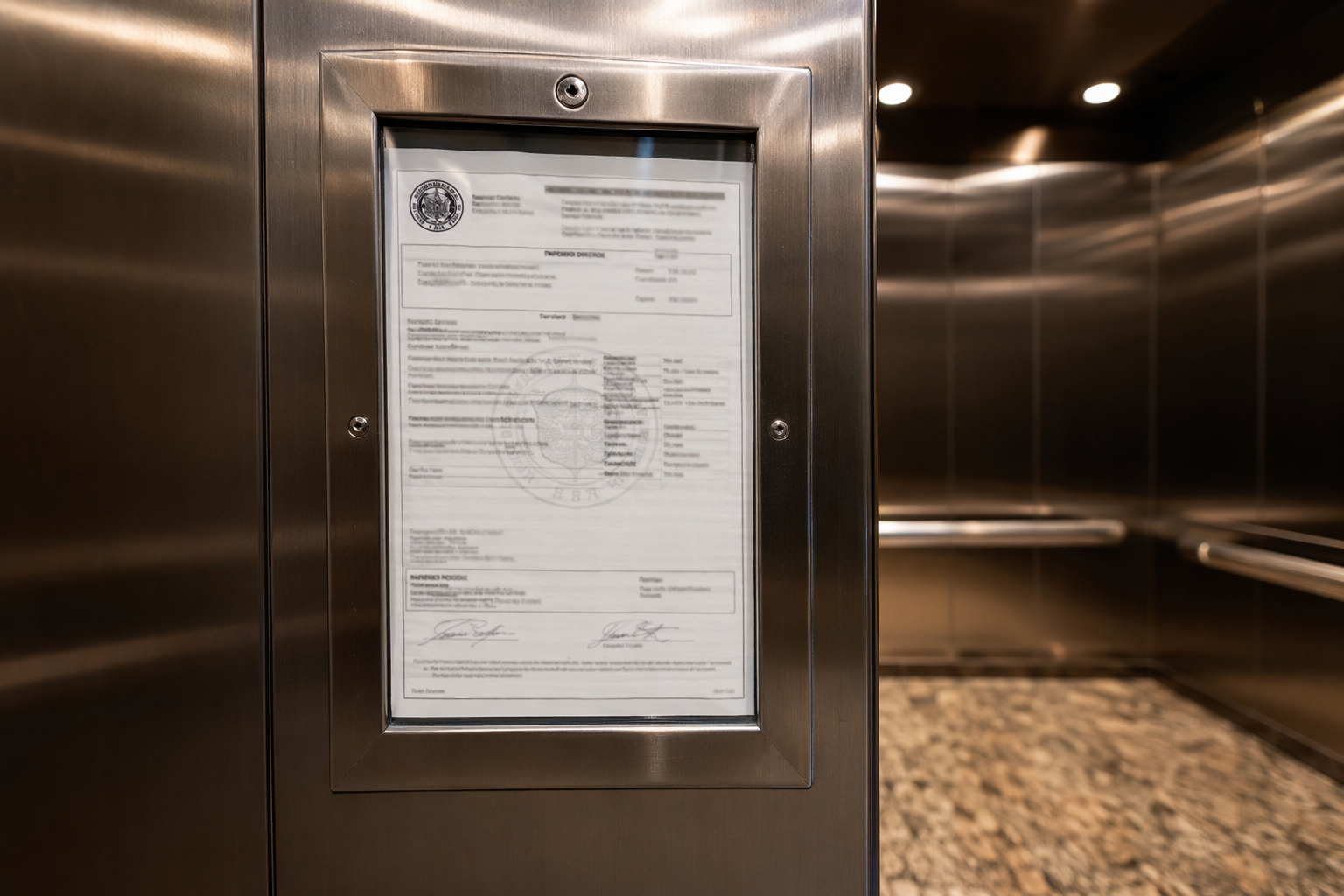
In Arizona, every conveyance must be inspected before it first goes into service, after any modification or alteration, and annually after that. No conveyance may legally operate in Arizona without a current annual certificate of inspection issued by the state.
Arizona elevator inspection requirements are governed by A.R.S. §§ 23-491 through 23-491.16 (Safety Conditions for Elevators and Similar Conveyances), as amended by Laws 2026, Ch. 73, and implemented through Arizona Administrative Code R20-5-502 through R20-5-515. The adopted technical standard for equipment installed, repaired, or altered on or after January 1, 2023 is ASME A17.1/CSA B44, 2019 edition, effective in Arizona as of January 9, 2023.
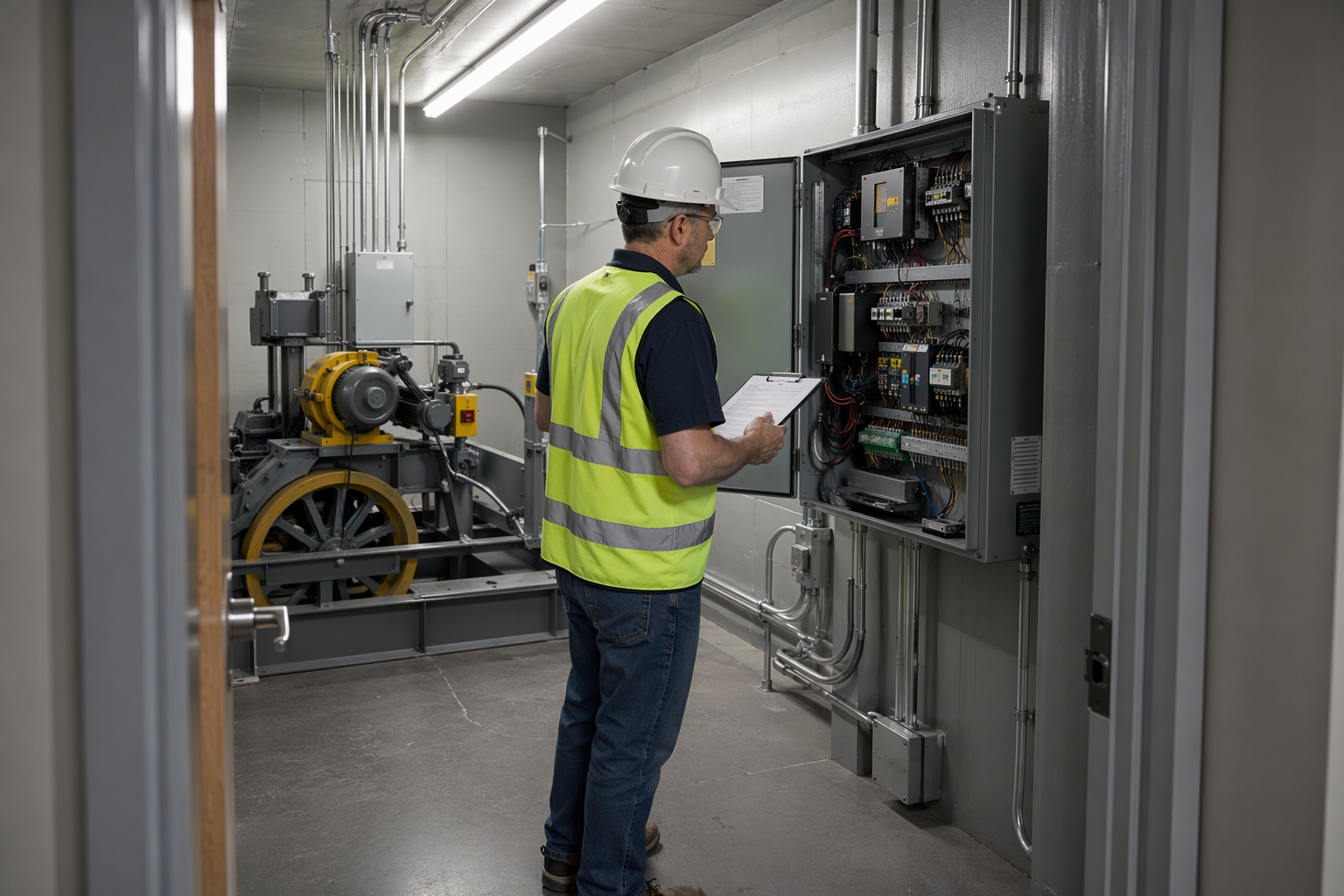
Annual inspections verify structural integrity, safety devices, door operations, emergency systems, and code compliance. But an annual inspection alone is not a maintenance plan. High-traffic commercial elevators in a Phoenix office tower or a Scottsdale resort need monthly or quarterly maintenance visits to catch worn components before they become safety hazards or costly breakdowns. Arizona Elevator Solutions recommends maintenance visits every one to three months depending on equipment classification and daily usage volume.
Who is authorized to inspect elevators in Arizona?

In Arizona, official elevator safety inspections must be performed either by inspectors employed by the state or by private elevator inspectors specifically authorized by the Industrial Commission of Arizona (ICA), Elevator Division — the agency that has administered elevator safety statewide since September 12, 2026, when it assumed those responsibilities from the former ADOSH Elevator Safety Section.
Arizona private elevator inspectors must register with the Industrial Commission of Arizona every year and demonstrate at least eight hours of approved continuing education to maintain their authorization. There is one important restriction: a private inspector may not inspect a conveyance owned, operated, or last serviced by the inspector, a company the inspector owns, or the inspector’s employer. This conflict-of-interest rule is a hard requirement under state law.
There is also a local layer to understand: within the City of Phoenix, the City of Phoenix Elevator Section (Planning and Development Department) inspects elevators, escalators, moving walks, dumbwaiters, and chair lifts. The Industrial Commission of Arizona’s Elevator Division handles all equipment located outside Phoenix city limits. If your building is in Scottsdale, Mesa, Tempe, Tucson, or any other Arizona jurisdiction, the ICA Elevator Division is your primary contact.
Critically, using a private elevator inspector does not relieve the building owner or operator of their legal obligations under Arizona law. Your elevator maintenance contractor and your official inspector are typically separate parties — the licensed contractor performs ongoing upkeep, while the independent inspector certifies compliance. Arizona Elevator Solutions provides maintenance and can coordinate with authorized private inspectors to help ensure your certificate of inspection remains current.
What is the difference between an elevator inspection and elevator maintenance?
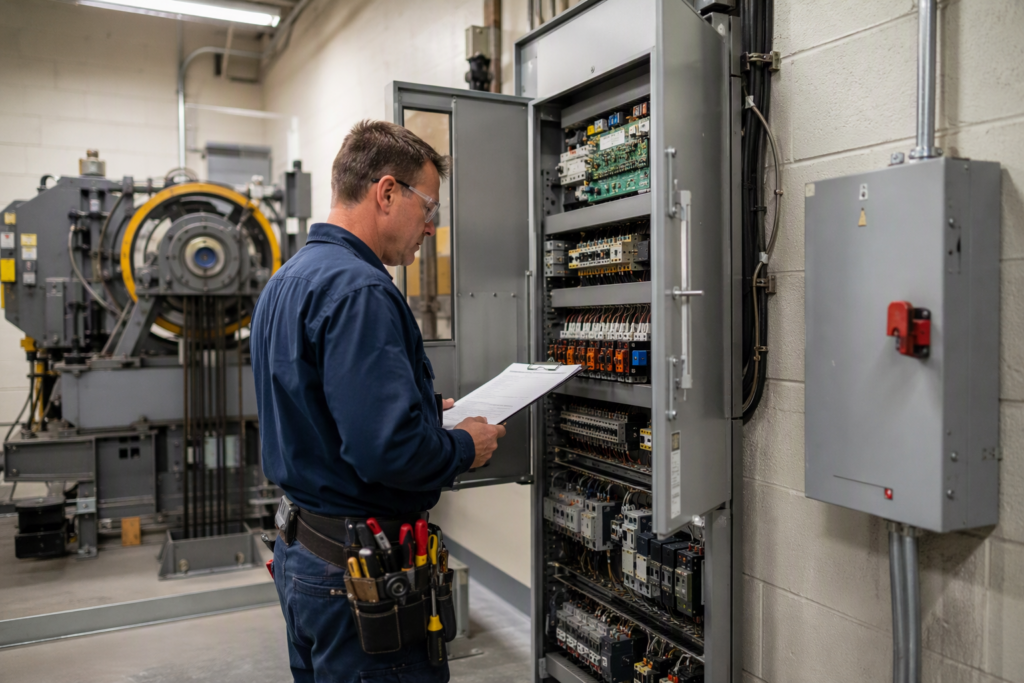
An elevator inspection is a formal, code-required safety audit performed by an independent state-authorized inspector, while elevator maintenance is ongoing, scheduled service performed by a licensed elevator contractor to keep equipment operating safely between inspections.
The annual inspection is a compliance checkpoint — the inspector verifies that the conveyance meets the requirements of ASME A17.1-2019 and Arizona Administrative Code R20-5-502 through R20-5-515 and issues or withholds the state certificate. The maintenance program is everything that happens between those checkpoints: lubrication, adjustment, parts replacement, safety testing, and documentation. A building that passes its annual inspection but skips routine maintenance is still running a significant risk of breakdowns, shortened equipment life, and liability exposure.
Arizona Elevator Solutions recommends treating inspection and maintenance as complementary, not interchangeable. Our maintenance agreements are structured so that every scheduled visit produces a written service record — documentation that supports a smooth annual inspection and demonstrates the building owner’s due diligence under state law.
Who do I contact to register or report an elevator issue in Arizona?
The contacts you need depend on your situation:
- Statewide regulation and certificates of inspection: Industrial Commission of Arizona (ICA), Elevator Division. This is the primary state authority for all conveyances outside Phoenix city limits, and the agency responsible for issuing state serial numbers, overseeing private inspector authorization, and enforcing A.R.S. §§ 23-491 through 23-491.16.
- Equipment inside the City of Phoenix: City of Phoenix Elevator Section, Planning and Development Department.
- Contractor licensing: Arizona Registrar of Contractors (ROC) — R-12 (residential) and C-12 (commercial) classifications cover elevator installation and repair. Note that the ROC licenses contractors but does not issue the annual certificate of inspection.
- New installation, relocation, or alteration: Arizona owners must notify the Industrial Commission of Arizona at least 90 days before installing, relocating, or altering a conveyance.
- Accidents and incidents: Arizona owners must notify the state within 24 hours of any accident that injures a person or disables a conveyance.
- Routine maintenance and coordination: A licensed elevator contractor holding an Arizona ROC R-12 or C-12 license, such as Arizona Elevator Solutions.
What must be posted or kept on-site for an Arizona elevator?
Arizona law imposes two distinct display obligations that building owners often confuse:
- State serial number or certificate posted near the conveyance: Every Arizona conveyance is assigned a state serial number on a tag fixed to the controller or mainline disconnect. The state serial number or the certificate of inspection must be posted in or close to the conveyance in an easily accessible location.
- Full certificate of inspection kept on-site: The owner must keep the actual state certificate at the same location as the conveyance and make it available for inspection on request.
Failure to maintain current, properly posted documentation is a compliance violation independent of whether the elevator itself is mechanically sound. Arizona Elevator Solutions includes a documentation review in every maintenance visit to help building owners stay current on both requirements.
Do platform lifts and stairway chairlifts face the same inspection rules in Arizona?
Yes, with one important code distinction. Platform lifts and stairway chairlifts installed, repaired, or altered in Arizona on or after January 1, 2023 must comply with ASME A18.1-2020 rather than ASME A17.1. The inspection frequency rules under A.R.S. §§ 23-491 through 23-491.16 still apply: these conveyances must be inspected before first use, after any alteration, and annually. The same certificate of inspection and posting requirements apply.
Older, lawfully installed lifts may remain in service unless the ICA Elevator Division’s elevator chief determines that continued operation poses a hazard to life, health, or property. Building owners with legacy equipment should document its original installation date and maintenance history — that record supports an argument that the equipment was lawfully installed under the code in effect at the time.
How much does elevator inspection and maintenance cost in Arizona?
Costs vary based on equipment type, building location, conveyance age, and the scope of service included in a maintenance agreement. Rather than publish figures that become outdated quickly, here is the framework Arizona Elevator Solutions uses to help building owners budget accurately:
- Annual inspection fee: Charged by the authorized private inspector or state inspector. Private inspector fees are market-based and vary; some maintenance contractors coordinate this as part of a service package.
- Routine maintenance contract: Typically priced per conveyance per month, with contract tiers covering different levels of parts coverage and response time. High-traffic commercial elevators generally require more frequent visits and carry higher contract costs than low-use residential or accessibility lifts.
- Repair and parts: Billed separately from maintenance contracts unless a full-coverage agreement is in place. Older equipment and proprietary systems can carry significantly higher parts costs.
- Modernization: Code upgrades triggered by a major alteration are a separate capital expense. Arizona Elevator Solutions provides written modernization proposals with itemized scope so building owners can plan accurately.
Contact Arizona Elevator Solutions for a site-specific maintenance proposal. We serve Phoenix, Scottsdale, Mesa, Tempe, Chandler, Gilbert, Tucson, and surrounding Arizona communities.
What happens if an Arizona elevator operates without a current certificate of inspection?
Operating a conveyance in Arizona without a current annual certificate of inspection is a violation of A.R.S. §§ 23-491 through 23-491.16. The Industrial Commission of Arizona’s Elevator Division has authority to require the conveyance to be taken out of service until the violation is corrected. Building owners can also face liability exposure if an unrelated incident occurs while the elevator is operating out of compliance.
The most common reason certificates lapse is a scheduling gap — the annual inspection date passes, the owner is not notified in time, and the certificate expires before a new one is issued. Arizona Elevator Solutions tracks inspection due dates for every client conveyance and initiates coordination with an authorized private inspector well in advance to prevent lapses.
How do I choose the right elevator maintenance contractor in Arizona?
When evaluating elevator contractors in Arizona, verify the following before signing a maintenance agreement:
- ROC license: Confirm the contractor holds an active Arizona Registrar of Contractors R-12 or C-12 elevator license. The ROC license database is publicly searchable.
- Service scope: Clarify whether the contract covers parts, labor, emergency callbacks, and modernization recommendations — or only routine visits.
- Inspection coordination: Ask whether the contractor will coordinate annual inspection scheduling with an authorized private inspector, or whether that is the building owner’s responsibility.
- Documentation practices: A professional contractor provides written service records after every visit. Those records are your evidence of compliance and your first line of defense in any liability dispute.
- Response time: For high-traffic buildings, understand guaranteed callback times for entrapments and safety-related shutdowns.
- Conflict-of-interest rules: Remember that the same company may not both maintain and officially inspect the same conveyance under Arizona’s private inspector authorization rules. A contractor who claims to provide both the maintenance and the official annual certification for the same unit should be asked to clarify the specific inspector’s credentials and independence.
Arizona Elevator Solutions has served building owners across Arizona for more than 15 years. Our technicians hold Arizona ROC licensing, and we maintain transparent service documentation so building owners always know exactly where their equipment stands. Contact us to discuss a maintenance program for your building.
Need elevator service you can rely on? Arizona Elevator Solutions is ready to help.