Choosing the wrong elevator service contract can mean unexpected repair bills, compliance gaps, and elevator downtime that disrupts tenants, residents, or customers. This guide breaks down both contract types side by side, explains how each affects your budget and compliance posture in Arizona, and helps building owners and property managers make a confident, informed decision.
What Is a Full Maintenance Elevator Contract?
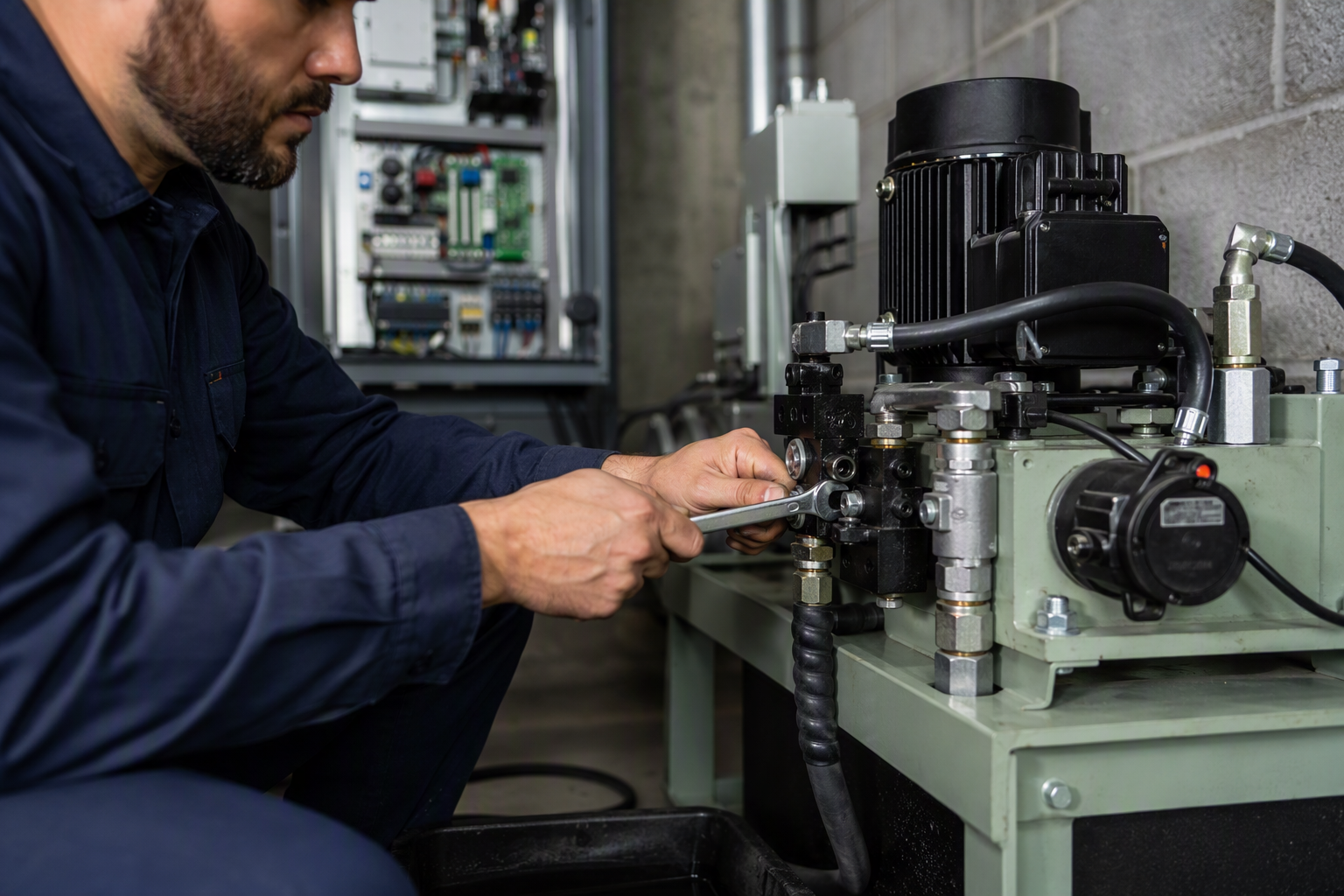
A full maintenance contract — sometimes called a comprehensive maintenance agreement — bundles routine preventive maintenance, emergency service calls, labor, and most replacement parts into a single recurring fee. The elevator service contractor assumes financial responsibility for keeping the elevator operational and compliant with applicable safety codes, including the ASME A17.1 Safety Code for Elevators and Escalators.
Under this structure, the building owner pays a predictable monthly or annual amount regardless of how many service calls or part replacements occur during the contract period. Major modernization projects and cosmetic repairs are typically excluded, but mechanical and safety-related component replacements are generally covered.
What Is a Parts and Labor Elevator Contract?

A parts and labor contract — also called a time and materials or oil and grease contract in the industry — covers the technician’s time and basic consumables (lubricants, minor adjustments) during scheduled maintenance visits. When a component fails or requires replacement, the building owner pays separately for both the part and the labor to install it.
This structure keeps the baseline monthly cost lower but transfers all repair cost risk to the building owner. A single major component failure can result in a bill that far exceeds any savings accumulated over months of lower premiums.
Full Maintenance vs. Parts and Labor: Side-by-Side Comparison Table
| Factor | Full Maintenance Contract | Parts & Labor Contract |
|---|---|---|
| Monthly Cost | Higher flat fee | Lower flat fee |
| Repair Cost Risk | Contractor absorbs most risk | Building owner absorbs all risk |
| Budget Predictability | High — fixed recurring expense | Low — variable, repair-driven costs |
| Best Elevator Age | Older or high-use equipment | Newer equipment under warranty |
| Parts Coverage | Most mechanical/safety parts included | Billed separately at market rate |
| Labor Coverage | Included for covered repairs | Billed hourly beyond scheduled visits |
| Emergency Calls | Usually included | Typically billed at premium rates |
| Compliance Support | Contractor typically handles code-driven repairs | Owner responsible for funding corrections |
| Contractor Incentive | Motivated to maintain proactively | Revenue increases when repairs are needed |
| Ideal Property Type | Multi-family residential, commercial, healthcare | Low-traffic buildings, newer installations |
Pros and Cons at a Glance
| Contract Type | Pros | Cons |
|---|---|---|
| Full Maintenance |
|
|
| Parts & Labor |
|
|
What Does Arizona Require for Elevator Maintenance and Inspections?
Arizona elevators are subject to the ASME A17.1 Safety Code for Elevators and Escalators for new installations and the ASME A17.3 Safety Code for Existing Elevators and Escalators for existing equipment. Both codes establish minimum maintenance, inspection, and testing standards that apply regardless of which contract type a building owner selects.
Compliance with these codes is not optional — the Arizona Department of Occupational Safety and Health (ADOSH), which operates under federal OSHA plan authority for Arizona, oversees elevator safety in the state. If an inspection reveals code deficiencies, the cost of correction falls to the building owner. A full maintenance contract typically includes the contractor’s responsibility to address code-driven mechanical corrections as part of their scope; a parts and labor contract does not.
Buildings that serve the public must also remain accessible in compliance with the Americans with Disabilities Act (ADA), and elevator outages that eliminate the only accessible route can trigger ADA compliance concerns.
Which Contract Type Is Right for Your Building?
The right contract depends on several variables specific to your property. Use the decision framework below as a starting point, and consult with a qualified elevator service provider like Arizona Elevator Solutions for a property-specific assessment.
Choose a Full Maintenance Contract if:
- The elevator is more than ten years old and out of manufacturer warranty
- The building relies heavily on the elevator (residential high-rise, healthcare, hospitality)
- The building’s operating budget requires predictable monthly expenses
- Management capacity for handling surprise repair invoices is limited
- A previous elevator service history shows recurring or costly repairs
- The property is subject to tenant or lease agreements requiring elevator availability
Consider a Parts and Labor Contract if:
- The elevator is newly installed and covered by an active manufacturer’s warranty
- Usage is genuinely low and documented (small office building, limited stops)
- The owner has capital reserves set aside specifically for equipment repairs
- A qualified facility manager can monitor equipment performance closely
How Do You Compare Elevator Service Contracts From Different Vendors?
Contract language varies significantly across elevator service companies. Before signing, building owners should compare the following elements across any quotes received:
| Contract Element | What to Look For | Red Flags |
|---|---|---|
| Parts Exclusions List | Specific list of what is covered | Vague “major components excluded” language |
| Labor Scope | Clearly defined covered labor categories | Cap on annual labor hours |
| Emergency Service Terms | Written commitment on emergency coverage | Emergency calls excluded or billed separately |
| Escalation Clauses | Defined annual price increase limits | Unlimited escalation tied to “cost indexes” |
| Proprietary Parts Lock-In | Non-proprietary parts options available | Sole-source parts requirement from vendor only |
| Contract Termination | Reasonable notice period (30–90 days) | Multi-year lock-in with large cancellation fees |
| Code Compliance Responsibility | Clear language assigning ASME compliance corrections | Compliance corrections billed as extras |
| Record-Keeping & Reporting | Written service records provided to owner | Verbal-only updates, no paper trail |
Arizona Elevator Solutions, as an independent certified elevator service provider serving Arizona, provides transparent contract documentation and does not lock clients into proprietary parts arrangements — a common concern with original equipment manufacturer service programs.
What Is Typically Excluded From Both Contract Types?
Even a full maintenance contract has limits. Understanding exclusions prevents billing surprises. Common exclusions across contract types include:
- Full cab modernization or cosmetic refurbishment
- Structural or hoistway repairs (civil/construction work)
- Damage caused by vandalism, misuse, or third parties
- Code-mandated upgrades resulting from changes in applicable standards (sometimes called “code compliance upgrades” or “retroactive requirements”)
- Hydraulic fluid replacement beyond routine top-off (varies by contract)
- Pit flooding or water intrusion remediation
Always request a written exclusions list and review it carefully before signing.
How Do You Evaluate an Independent Elevator Contractor vs. an OEM Service Program?
Original Equipment Manufacturers (OEMs) offer service programs for their own equipment, which can be convenient for new installations. However, independent certified contractors like Arizona Elevator Solutions offer several advantages:
- Multi-brand capability: Independent contractors service equipment from multiple manufacturers, useful for buildings with mixed or legacy equipment
- Competitive pricing: Without brand-tied overhead, independent providers can offer more competitive contract terms
- Non-proprietary parts: Independent contractors are not limited to single-source parts, which can reduce component costs significantly
- Objective assessment: An independent provider has no incentive to recommend unnecessary upgrades tied to proprietary systems
- Local accountability: Arizona-based contractors are directly accountable to Arizona property owners and subject to Arizona regulatory oversight
What Steps Should You Take Before Signing an Elevator Service Contract?
- Request a current elevator inspection report — Review the most recent inspection findings to understand the equipment’s existing condition before any contract obligation begins.
- Obtain at least three written contract proposals — Compare full maintenance and parts and labor options side by side, not just price but scope and exclusions.
- Have the contract reviewed by legal counsel — Elevator service agreements can be multi-year commitments; legal review of escalation clauses and termination terms protects the building owner.
- Confirm the contractor’s Arizona licensing status — Verify that the elevator service company holds all applicable Arizona state certifications before work begins.
- Request references from similar Arizona properties — Ask for references from buildings of comparable size, elevator type, and age.
- Clarify emergency response terms in writing — Ensure the contract specifies how emergency entrapments and after-hours calls are handled and at what cost.
- Understand the transition process — If switching from another contractor, confirm what records, codes, and equipment documentation will be transferred.
- Review annual price escalation caps — Confirm any automatic price increases are capped and tied to a defined index or percentage.
Does the Age of the Elevator Change Which Contract Is the Better Value?
Elevator age is one of the most important factors in contract selection. Newer installations typically have fewer component failures and may benefit from ongoing manufacturer warranty coverage, making a parts and labor contract more cost-effective during those early years. As equipment ages, wear-related component failures become more frequent and less predictable. For equipment that has reached mid-life or beyond, the financial protection offered by a full maintenance contract generally outweighs the higher monthly premium — particularly in Arizona’s climate, where heat affects hydraulic systems and electrical components in ways that accelerate normal wear cycles.
Can You Switch Contract Types Mid-Term?
Contract switching mid-term depends entirely on the terms of the existing agreement. Many elevator service contracts include auto-renewal clauses and early termination penalties. Building owners should review termination provisions before assuming they can switch. If a building’s elevator recently experienced a costly repair event under a parts and labor contract, that is often the catalyst that prompts a switch to full maintenance — but the timing should be negotiated carefully to avoid penalty costs that offset the savings.
What Role Does Preventive Maintenance Play in Both Contract Types?
Regardless of contract type, preventive maintenance is the foundation of elevator reliability and safety. The ASME A17.1 Safety Code for Elevators and Escalators establishes maintenance requirements that apply whether an elevator is under full maintenance or parts and labor coverage. The practical difference is incentive structure: under a full maintenance contract, the contractor has a financial incentive to maintain equipment proactively because reactive repairs come out of their margin. Under a parts and labor contract, the contractor’s revenue increases when repairs are needed, which does not necessarily create the same proactive maintenance culture.
Building owners under a parts and labor contract should be especially diligent about confirming that all scheduled maintenance visits are completed on time and fully documented.
Are There Hybrid Elevator Contracts Available?
Yes. Some elevator service companies, including independent providers like Arizona Elevator Solutions, offer hybrid or customized contracts that fall between a standard parts and labor agreement and a comprehensive full maintenance package. These arrangements might include a cap on annual repair costs billed to the owner, a defined list of covered components with others excluded, or tiered pricing based on elevator age and usage intensity. A hybrid contract can be appropriate for buildings that want more protection than basic parts and labor provides but are not yet ready to commit to the full maintenance premium — particularly useful when transitioning aging equipment toward eventual modernization.
How Does Contract Type Affect ADA and Code Compliance?
Elevator downtime and deferred repairs can create ADA compliance exposure when an elevator serves as the sole accessible route in a building. Extended outages — more likely when repair costs cause owners to delay fixes under a parts and labor contract — can place buildings in violation of accessibility requirements. A full maintenance contract, by removing financial barriers to timely repair, reduces the risk of extended outages and the compliance problems they create. Under OSHA-aligned Arizona requirements, equipment must also remain safe for workers and the public — another reason deferred repairs carry regulatory risk beyond simple inconvenience.
Why Choose Arizona Elevator Solutions?
Arizona Elevator Solutions is an independent, Arizona-based certified elevator service company serving commercial, residential, and institutional properties across the state. Because Arizona Elevator Solutions operates independently of any single manufacturer, the team provides objective recommendations on contract type, coverage scope, and equipment needs — without the pressure of proprietary system sales or single-brand lock-in.
The company serves Arizona building owners across the full range of elevator types and ages, and provides transparent written contracts that clearly define covered scope, exclusions, and emergency service terms — giving property managers and building owners the documentation they need for informed budget planning and regulatory compliance.
Ready to Choose the Right Elevator Contract for Your Arizona Property?
Contact Arizona Elevator Solutions for a free elevator assessment. A qualified technician will evaluate your equipment’s condition, review your current service agreement, and provide a clear recommendation on whether a full maintenance or parts and labor contract best fits your building.
Call us today: 480-319-7157
Need elevator service you can rely on? Arizona Elevator Solutions is ready to help.