Quick Answer: Elevator repair costs vary widely by failure type — door malfunctions are typically the most frequent and least expensive repairs, while motor replacements and full control system overhauls represent the highest investment, with costs driven by equipment age, parts availability, code compliance requirements, and whether the work is performed under a full-service contract or on a time-and-materials basis.
For building owners and property managers in Arizona, an elevator outage is never just a maintenance line item — it is a tenant relations issue, a liability exposure, and a potential ADA compliance concern, all at once. Understanding where repair dollars actually go — and what drives cost differences between failure types — is the first step toward smarter budgeting and vendor decisions.
This guide breaks down the real cost landscape for the four most common elevator failure categories, compares repair versus replacement scenarios, and explains how Arizona building owners can make informed decisions before signing any service agreement.
What Drives Elevator Repair Costs in Arizona?
Before examining individual failure types, building owners should understand the core variables that shape any repair estimate:
- Equipment age and obsolescence: Older units — particularly hydraulic systems installed before the 1990s — may require parts that are no longer manufactured, significantly increasing labor time and sourcing costs.
- Proprietary vs. non-proprietary components: Some elevator manufacturers use proprietary controllers and software that legally or technically restrict servicing to their own technicians, limiting competitive bidding.
- Code compliance requirements: Any repair that triggers a permit may also require the unit to be brought into compliance with current editions of the ASME A17.1 Safety Code for Elevators and Escalators or ASME A17.3 Safety Code for Existing Elevators and Escalators.
- Labor market conditions: Arizona’s construction and maintenance labor markets fluctuate; Phoenix metro rates differ from rural Arizona.
- Contract structure: Full-service maintenance contracts typically bundle routine repairs at lower marginal cost; time-and-materials arrangements expose building owners to full market pricing per incident.
- Emergency vs. scheduled service: After-hours and emergency calls carry premium labor rates regardless of failure type.
Door Malfunction Repair Costs: What to Expect
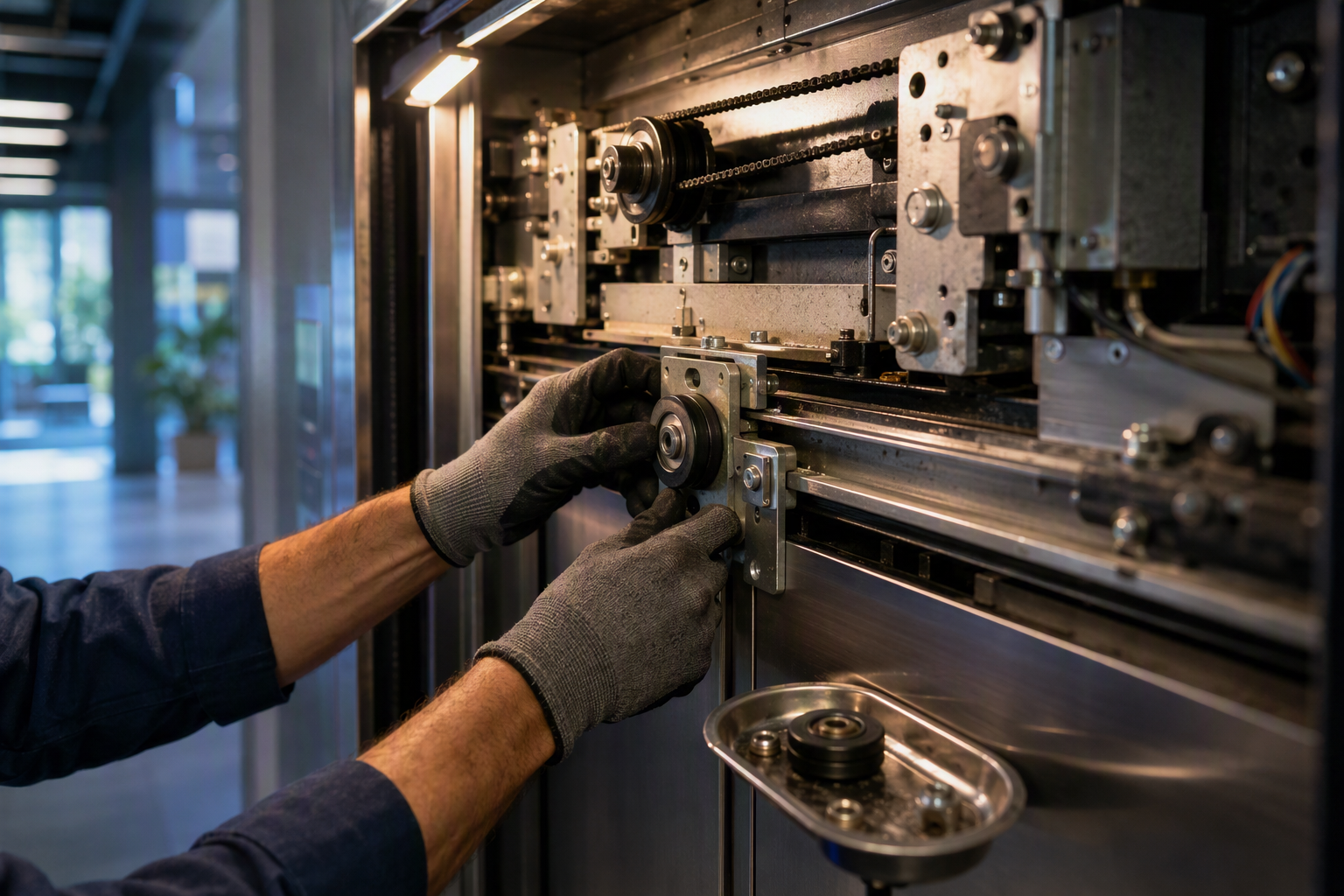
Door system failures — including doors that fail to open, close, reverse, or align properly — are the single most common elevator service call category across commercial and residential buildings. The frequency is attributable to the mechanical intensity of door systems: door operators, hangers, gibs, clutches, rollers, and safety edges all experience continuous wear.
Common Door System Failure Scenarios
- Worn or broken door rollers and hangers
- Failed door operator motor or gearbox
- Misaligned or damaged sill and gibs
- Faulty door safety edge or light curtain
- Broken or stretched door cables
- Defective door close/open limit switches
| Repair Type | Estimated Cost Range | Typical Downtime | Complexity | Code Trigger Risk |
|---|---|---|---|---|
| Roller/hanger replacement | Low–Moderate | 2–4 hours | Low | Low |
| Door operator motor replacement | Moderate–High | 4–8 hours | Moderate | Moderate |
| Light curtain / safety edge replacement | Low–Moderate | 2–4 hours | Low | Low |
| Full door operator replacement (new unit) | High | 1–2 days | High | High |
| Sill and track realignment | Low | 1–3 hours | Low | Low |
Note: Cost ranges are presented qualitatively because actual pricing in the Arizona market varies by equipment brand, parts availability, labor rates, and service contract terms. Arizona Elevator Solutions recommends requesting itemized quotes for every repair scenario.
Motor and Drive System Repair Costs: The High-Stakes Category
Motor and drive failures represent the highest average repair cost in the elevator service industry. Whether a building operates a traction elevator (AC or DC motor with a gearbox or gearless drive) or a hydraulic unit (submersible or above-ground pump/motor), motor system failures demand significant investment in parts, labor, and frequently, code compliance upgrades.
Traction vs. Hydraulic Motor Failures
| Scenario | System Type | Cost Level | Downtime | Recommended Action | Key Consideration |
|---|---|---|---|---|---|
| Motor winding repair (rewind) | Traction | Moderate | Days–Weeks | Repair if motor is modern and parts are available | Turnaround time from rewind shop varies significantly |
| Motor replacement (new) | Traction | High–Very High | 1–2 Weeks | Replace if motor is obsolete or rewound repeatedly | May require drive system upgrade for compatibility |
| Variable Frequency Drive (VFD) failure | Traction | Moderate–High | 1–5 Days | Replace drive board or full VFD unit | Proprietary drives may limit vendor options |
| Hydraulic pump/motor replacement | Hydraulic | Moderate–High | 1–3 Days | Replace; repair rarely cost-effective | Oil type and cylinder condition must be assessed |
| Hydraulic cylinder replacement | Hydraulic | Very High | 1–3 Weeks | Evaluate full modernization at this decision point | Triggers PVC liner requirement per ASME A17.3 in many AHJs |
Repair vs. Modernization: The 50% Rule of Thumb
A widely used industry benchmark suggests that when repair costs approach or exceed roughly half the cost of full modernization, building owners should evaluate modernization as the more financially sound path. This threshold is not codified but reflects the compounding cost risk of maintaining aging drive systems. Arizona Elevator Solutions can provide a side-by-side assessment to help building owners evaluate this decision point objectively.
Control System Repair Costs: When the Brain Fails
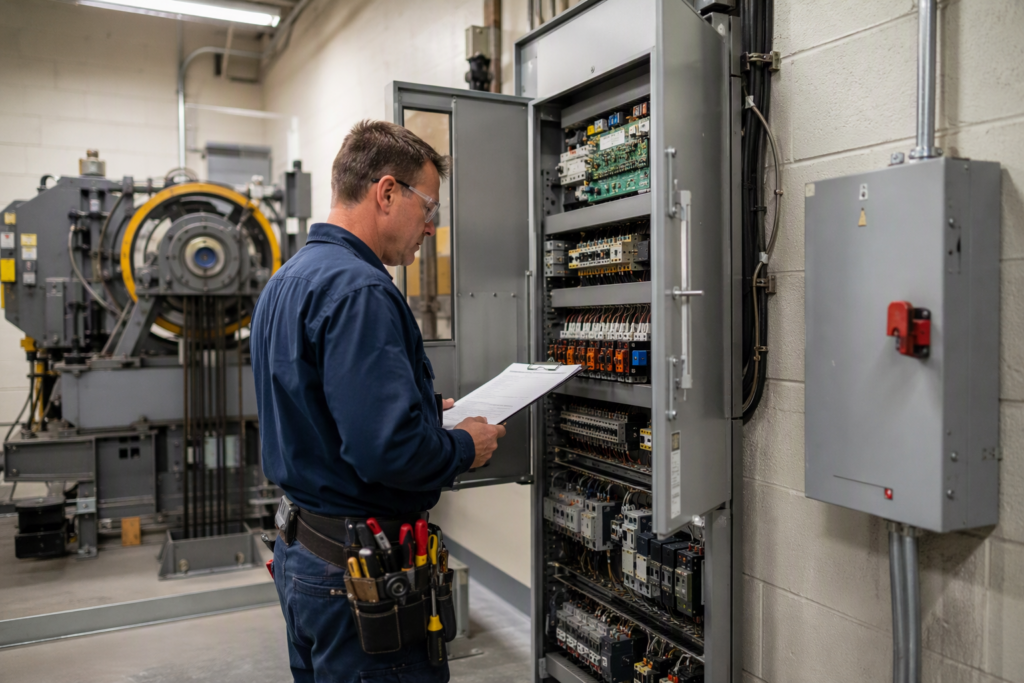
Elevator control systems — including relay-based, solid-state, and modern microprocessor controllers — govern every function from floor leveling to door timing to emergency recall. Control system failures range from individual circuit board replacements to full controller overhauls.
| Failure Type | Cost Level | Downtime | Compliance Risk | Repair vs. Replace Guidance |
|---|---|---|---|---|
| Single circuit board failure | Low–Moderate | Hours–Days | Low | Repair/replace board if controller is current generation |
| Relay logic controller (older system) | Moderate | Days | Moderate–High | Consider full controller modernization |
| Microprocessor controller replacement | High–Very High | 1–2 Weeks | High | Full replacement; verify non-proprietary options |
| Selector/encoder system failure | Moderate | 1–3 Days | Low–Moderate | Repair or replace component |
| Emergency lighting/communication failure | Low | Hours | High (ADA/ASME) | Immediate repair required — regulatory exposure is significant |
Emergency communication systems in elevator cabs are subject to requirements under both the Americans with Disabilities Act and the ASME A17.1 Safety Code for Elevators and Escalators. A failed two-way communication device is not a deferred maintenance item — it is an immediate compliance and liability issue.
Safety System Repair Costs: Non-Negotiable Compliance Expenditures
Safety system failures — including governor and safety gear issues, buffer problems, pit flooding or sump failures, and overspeed device malfunctions — are in a category of their own. These repairs cannot be deferred, and many trigger mandatory shutdown by the Arizona Department of Occupational Safety and Health (ADOSH), the state agency that administers elevator safety under OSHA-aligned frameworks in Arizona.
| Safety Component | Cost Level | Shutdown Risk if Deferred | Inspection Trigger |
|---|---|---|---|
| Governor rope replacement | Moderate | High | Yes — typically requires re-inspection |
| Safety gear inspection and reset | Moderate | Very High | Yes |
| Oil buffer replacement | Moderate–High | High | Yes |
| Pit sump pump failure | Low–Moderate | Moderate | Situational |
| Overspeed governor replacement | High | Very High | Yes — mandatory load test may be required |
| Brake assembly repair or replacement | Moderate–High | Very High | Yes |
How Do I Know Whether to Repair or Replace My Elevator?
The repair-vs.-replace decision depends on several intersecting factors that no single cost figure can answer alone. Building owners should evaluate:
- Age of equipment: Systems beyond their design service life face accelerating failure frequency regardless of individual repairs made.
- Parts availability: Obsolete or discontinued equipment creates sourcing delays and premium parts costs that compound over time.
- Cumulative repair history: A pattern of repeated failures in a short window is a stronger signal than any individual repair cost.
- Code compliance gap: Older equipment may require costly upgrades to meet current ASME A17.3 retroactive safety requirements whenever a permit-required repair is performed.
- Energy efficiency: Older hydraulic units and DC traction systems consume significantly more energy than modern equivalents, affecting total cost of ownership.
- Tenant and ADA experience: Frequent outages create ADA accessibility liability for multi-story buildings where elevator service is legally required.
What Happens If I Delay an Elevator Repair?
Deferred maintenance on elevator systems creates compounding risk across three dimensions:
- Regulatory exposure: Arizona building owners are subject to periodic inspections. An out-of-compliance unit can result in a mandatory shutdown order from ADOSH, leaving the building owner with no revenue-generating elevator and an emergency repair timeline.
- Liability escalation: A documented failure that precedes an injury dramatically increases legal exposure. Insurance carriers may deny claims when maintenance records show deferred known issues.
- Cost amplification: A worn door roller that costs little to replace today can destroy a door operator if left unaddressed, multiplying repair cost severalfold.
- Parts obsolescence acceleration: Delayed repairs on aging systems increase the probability that the next failure will occur after a manufacturer discontinues a critical component.
- Tenant and building value impact: Elevator outages in commercial and multi-family buildings affect tenant satisfaction, lease renewals, and property appraisal values.
What Should I Do Immediately After an Elevator Failure?
- Secure the unit: Take the elevator out of service immediately. Do not allow passengers to use a unit showing any malfunction, especially door, leveling, or safety system issues.
- Post clear signage: Notify building occupants that the elevator is out of service and provide accessible alternative routes where available.
- Document the failure: Record the time, nature of the malfunction, and any error codes displayed on the controller or machine room panel.
- Contact your elevator service provider: Reach out to your maintenance contractor or an independent certified elevator company such as Arizona Elevator Solutions for a prompt service call.
- Assess ADA impact: If the building has floors that are only accessible by elevator, evaluate whether the outage creates an ADA accessibility compliance issue requiring notification to affected parties.
- Review your service contract: Determine whether the failure is covered under an existing maintenance agreement or will be billed separately.
- Request a written repair assessment: Before authorizing work, obtain a written scope of work and cost estimate that separates parts, labor, and any permit or inspection fees.
- Retain all repair records: Document every service call, part replaced, and inspection result. This record protects building owners in the event of a future liability claim or regulatory audit.
Does Elevator Repair Require a Permit in Arizona?
In Arizona, elevator work is regulated at the state level through the OSHA-aligned ADOSH Elevator Safety Program. Many categories of repair — including controller replacements, motor replacements, and safety system work — require permits and post-repair inspections before the unit can return to service. Routine maintenance items such as lubrication, adjustment, and minor parts replacement typically do not require permits, but the line between maintenance and alteration is defined by the applicable edition of ASME A17.1 and the Arizona AHJ interpretation.
Building owners should confirm permit requirements with their service provider before any work begins. Unpermitted alterations can result in fines, forced removal of unpermitted work, and increased liability.
Are Independent Elevator Companies Less Expensive Than OEM Service?
Independent certified elevator service companies — those not affiliated with original equipment manufacturers — frequently offer more competitive pricing on time-and-materials repairs and modernization projects because they are not constrained to manufacturer-specified labor rates or proprietary parts markups. The key qualification distinction is whether the independent company employs certified elevator mechanics and holds the necessary state contractor licensing to perform permitted work in Arizona.
The primary limitation of independent service providers arises with proprietary equipment: if a manufacturer has legally restricted access to software diagnostic tools or spare parts, independent technicians may face barriers on those specific systems. A reputable independent company will identify proprietary constraints upfront rather than after accepting a service call.
Arizona Elevator Solutions operates as an independent certified elevator service company, providing building owners with competitive alternatives to OEM service agreements across a wide range of equipment brands and system types.
What Is Included in a Full-Service Elevator Maintenance Contract?
Full-service maintenance contracts vary significantly between providers. Building owners should request itemized documentation of what is and is not included. Key questions to ask any elevator service contractor include:
- Which parts are covered under the contract and which are billed separately?
- Are emergency callbacks included at no additional charge, or billed at premium rates?
- Does the contract cover oil and hydraulic fluid for hydraulic units?
- Are controller boards and electronic components included or excluded?
- Does the contract include permit fees and inspection scheduling?
- What is the contract’s exclusion list for “major components”?
- Is there a cap on annual repair costs under the contract?
- What are the cancellation terms?
Not all full-service contracts are equivalent in scope. A lower monthly premium that excludes major components may cost more in total than a higher-premium contract with broader coverage, depending on equipment condition and age.
How Does Equipment Age Affect Repair Costs?
Equipment age is one of the most reliable predictors of repair cost trajectory. As elevator systems age beyond their designed service life, several cost dynamics converge:
- Parts scarcity: Discontinued components require either salvage sourcing, custom fabrication, or substitution with compatible alternatives — each adding cost and lead time.
- Permit-triggered upgrades: Under ASME A17.3, certain repairs on existing elevators may trigger retroactive safety requirements, meaning a targeted repair generates additional required work.
- Failure rate acceleration: Mechanical systems experience increasing failure rates as cumulative wear exceeds design tolerances, meaning repair frequency rises even when individual repair costs remain stable.
- Insurance and warranty coverage: Older units may no longer qualify for certain insurance products or extended warranty programs, removing financial protection from the building owner.
Why Choose Arizona Elevator Solutions for Elevator Repair and Assessment?
Arizona Elevator Solutions is an independent certified elevator service company serving building owners throughout Arizona. As an independent provider, Arizona Elevator Solutions is not tied to a single manufacturer’s equipment or pricing structure, which allows for objective repair-versus-modernization assessments and competitive pricing across multiple equipment brands.
Arizona Elevator Solutions provides repair services, maintenance contracts, and modernization planning for commercial, multi-family, and institutional buildings across the Arizona market. Their team works within the regulatory framework established by ADOSH and adheres to the standards set forth in the ASME A17.1 Safety Code for Elevators and Escalators and ASME A17.3 Safety Code for Existing Elevators and Escalators.
For Arizona building owners navigating door malfunction repairs, motor and drive system failures, control system breakdowns, or safety system compliance concerns, Arizona Elevator Solutions offers a free elevator assessment to help establish a clear picture of equipment condition, repair priorities, and cost expectations before any commitment is made.
Get a Free Elevator Assessment from Arizona Elevator Solutions
Don’t wait for the next failure to understand what your elevator system actually needs. Arizona Elevator Solutions provides no-obligation assessments for building owners across Arizona — covering equipment condition, code compliance gaps, repair prioritization, and honest repair-versus-modernization guidance.
Contact Arizona Elevator Solutions for a free elevator assessment: 480-557-7600
Need elevator service you can rely on? Arizona Elevator Solutions is ready to help.